
Ham Radio Handheld: Complete Guide to HT Selection, Programming, and Technician License Use
Complete ham radio handheld guide for Technician license holders. 💯 Compare HTs, programming tips, antennas, frequencies, and exam prep advice.
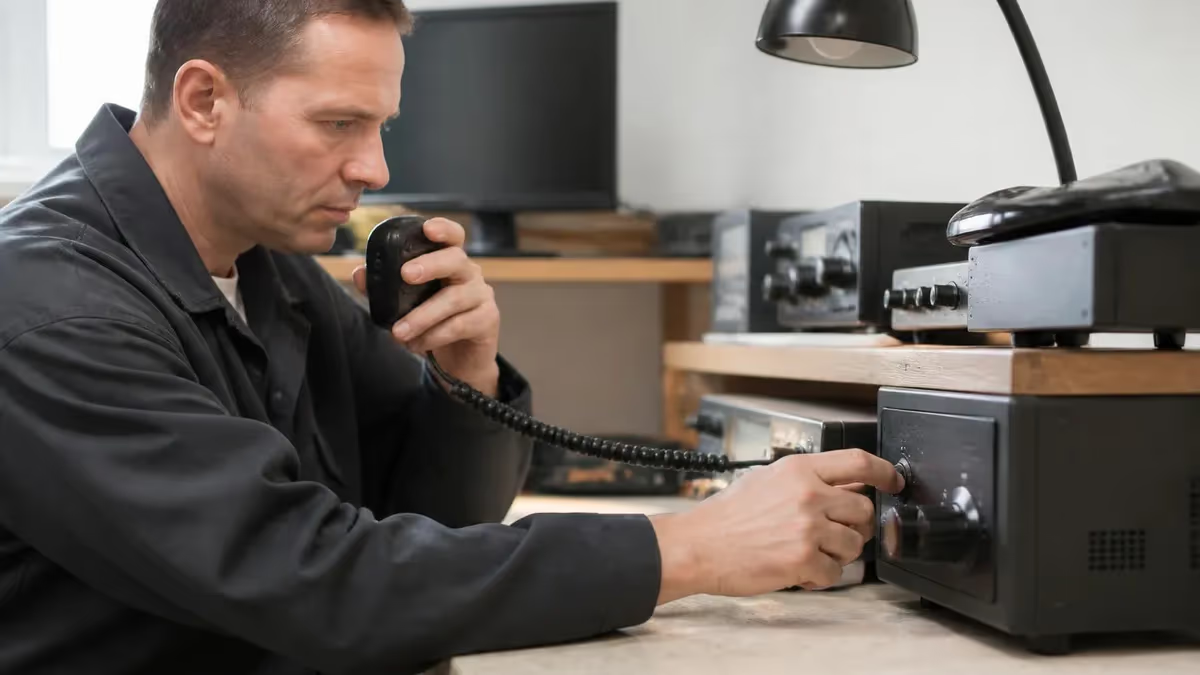
The ham radio handheld is the gateway device for nearly every new amateur radio operator in the United States, and choosing the right unit can make the difference between an engaging hobby and an expensive paperweight. A handheld transceiver, commonly called an HT, fits in your palm, runs on a rechargeable battery, and connects you to repeaters, simplex contacts, weather alerts, and emergency nets within seconds of unboxing. Before you transmit, however, you need a valid ham radio license from the FCC, and that journey begins with the Technician class exam.
Handhelds dominate the entry-level market because they are affordable, portable, and capable enough to make hundreds of contacts. Popular models from Baofeng, Yaesu, Icom, and Kenwood range from $25 budget radios to $500 commercial-grade units. The vast majority of new hams start with a dual-band VHF/UHF HT covering the 2-meter and 70-centimeter amateur bands, which is exactly where Technician privileges are most active.
This guide walks through everything you need to know about ham radio handhelds, including which features actually matter, how to program memory channels without going insane, what antennas dramatically improve performance, and how the handheld fits into your broader study plan for the Technician exam. We will also cover legal requirements, battery management, and the cultural etiquette that separates respected operators from rule-breakers.
Whether you are buying your first $30 Baofeng UV-5R or upgrading to a waterproof Yaesu FT-70DR, the same principles apply: understand the rules, learn the bands, program the local repeaters, and practice listening before you key the microphone. The handheld is a tool, and like any tool, it rewards those who learn to use it properly.
The handheld market has exploded since the FCC eliminated the Morse code requirement in 2007, opening the hobby to a new generation of operators interested in digital modes, emergency communications, and outdoor recreation. Today there are more than 750,000 licensed amateur radio operators in the United States, and the Technician class accounts for roughly half of them. Most of those Technicians own at least one handheld, and many own three or four for different purposes.
Understanding what makes a good handheld is not just about specifications on a box. It involves practical considerations like glove-friendly buttons, audio clarity in noisy environments, programming software compatibility, and aftermarket accessory availability. We will explore each of these dimensions so you can buy once and buy right, avoiding the common trap of cycling through three cheap radios before settling on the one you should have purchased initially.
By the end of this guide you will know exactly which handheld matches your goals, how to get it on the air legally, and how to use it as a study aid while preparing for the Technician license test. The combination of hands-on radio time and structured exam preparation is the fastest path from curious beginner to confident, contributing amateur operator.
Ham Radio Handheld by the Numbers
Handheld Categories & Key Features
Radios like the Baofeng UV-5R, BF-F8HP, and Quansheng UV-K5 cost $25-$70 and cover 2m/70cm. Great for learning, but build quality, audio, and receiver performance lag behind premium brands. Ideal first radio for testing the hobby.
Yaesu FT-65R, Icom IC-T10, and Kenwood TH-K20A cost $130-$200 and deliver superior receivers, cleaner audio, and rugged housings. Excellent for ARES, RACES, public service events, and daily commuter use on local repeaters.
Yaesu FT-70DR (System Fusion), Icom ID-52A (D-STAR), and Anytone AT-D878UV (DMR) range from $200-$700 and add digital voice, GPS, internet linking via hotspots, and text messaging while retaining analog FM operation.
Kenwood TH-D75A and Yaesu VX-6R offer waterproofing, APRS, wideband receive, and submersibility ratings. Built for SAR teams, marine use, and operators who demand reliability in harsh weather. Expect $400-$700 pricing.
Technician class operators have full privileges on all amateur VHF and UHF bands, which is precisely where handhelds operate. The 2-meter band (144-148 MHz) and the 70-centimeter band (420-450 MHz) are the workhorses of handheld operation, hosting thousands of FM voice repeaters across the country. You can also explore 6 meters, 1.25 meters, and 23 centimeters with the right equipment, although dedicated handhelds for those bands are less common.
Understanding band plans is essential before you transmit. Each amateur band is divided into sub-bands for different modes including FM voice, SSB, CW, digital, and satellite. On 2 meters, repeater outputs typically fall between 145.20-145.50 MHz and 146.61-147.39 MHz, while simplex calling happens on 146.52 MHz. Memorizing these ham radio frequencies takes time, but your handheld can store them in labeled memory channels for instant recall.
Repeater operation requires understanding offsets and tones. A 2-meter repeater uses a standard 600 kHz offset between input and output frequencies, while 70 cm uses 5 MHz. Many repeaters also require a CTCSS tone, sometimes called PL tone, to access them. Your handheld must be programmed with the correct output frequency, offset direction, and access tone before you can use a repeater. This is where chirp or RT Systems programming software saves hours of manual button-mashing.
Simplex operation means transmitting and receiving on the same frequency without a repeater. Simplex is ideal for short-range communication between operators within a few miles, and it leaves repeaters available for users who actually need the extended range. New operators sometimes monopolize repeaters for casual chats that would work fine on simplex, which is considered poor etiquette.
Beyond voice, your handheld can monitor weather alerts on NOAA Weather Radio frequencies between 162.400 and 162.550 MHz, scan public safety channels in receive-only mode where legal, and listen to commercial aviation, marine, and FRS/GMRS traffic depending on the model. Wideband receive is one of the most underrated features for new operators learning the radio spectrum.
Technician privileges also include limited HF access on the 10-meter band between 28.300 and 28.500 MHz for SSB voice, plus CW privileges on portions of 80, 40, 15, and 10 meters. While you cannot use a typical VHF/UHF handheld on HF, knowing your full privilege set helps you plan future equipment purchases and exam study priorities.
Power output for handhelds typically maxes out at 4 to 5 watts, although some high-power models like the Baofeng BF-F8HP reach 8 watts. More power does not always mean better communication. Antenna quality, terrain, and elevation matter far more than wattage, and a 5-watt signal into a quality antenna will outperform 8 watts into the stock rubber duck nearly every time.

Ham Radio Technician Practice Test Questions
Prepare for the Ham Radio Technician Test exam with our free practice test modules. Each quiz covers key topics to help you pass on your first try.
Ham Radio Technician Antennas & Feedlines
Ham Radio Technician Exam Questions covering Antennas & Feedlines. Master Ham Radio Technician Test concepts for certification prep.
Ham Radio Technician Basic Electronics & C...
Free Ham Radio Technician Practice Test featuring Basic Electronics & Circuitry. Improve your Ham Radio Technician Exam score with mock test prep.
Ham Radio Technician Equipment & Tools Usage
Ham Radio Technician Mock Exam on Equipment & Tools Usage. Ham Radio Technician Study Guide questions to pass on your first try.
Ham Radio Technician Amateur
Ham Radio Technician Test Prep for Amateur. Practice Ham Radio Technician Quiz questions and boost your score.
Ham Radio Technician General
Ham Radio Technician Questions and Answers on General. Free Ham Radio Technician practice for exam readiness.
Ham Radio Technician III
Ham Radio Technician Mock Test covering III. Online Ham Radio Technician Test practice with instant feedback.
Ham Radio Technician II
Free Ham Radio Technician Quiz on II. Ham Radio Technician Exam prep questions with detailed explanations.
Ham Radio Technician I
Ham Radio Technician Practice Questions for I. Build confidence for your Ham Radio Technician certification exam.
Ham Radio Technician License
Ham Radio Technician Test Online for License. Free practice with instant results and feedback.
Ham Radio Technician Licensing Regulations...
Ham Radio Technician Study Material on Licensing Regulations & Standards. Prepare effectively with real exam-style questions.
Ham Radio Technician Operating Procedures ...
Free Ham Radio Technician Test covering Operating Procedures & Etiquette. Practice and track your Ham Radio Technician exam readiness.
Ham Radio Technician Radio Wave Propagatio...
Ham Radio Technician Exam Questions covering Radio Wave Propagation & Modulation. Master Ham Radio Technician Test concepts for certification prep.
Ham Radio Technician Safety Procedures & R...
Free Ham Radio Technician Practice Test featuring Safety Procedures & Risk Management. Improve your Ham Radio Technician Exam score with mock test prep.
Programming Your Ham Radio Equipment
Manual programming uses the handheld keypad to enter each memory channel one at a time. You navigate the menu system, set the receive frequency, then the transmit offset, the CTCSS or DCS tone, the channel name, and finally save the entry. On a Baofeng UV-5R this takes roughly two to three minutes per channel once you know the sequence, longer if you are referencing a paper repeater directory.
Manual programming is tedious but builds menu fluency, and you will appreciate that fluency in the field when you need to add a frequency quickly. Practice by programming your two closest repeaters, the 146.52 simplex calling frequency, and the NOAA weather station nearest your home. Five well-programmed channels beat a hundred random scans every time.
Should Your First Radio Be a Handheld?
- +Affordable entry point starting under $30 for a fully functional dual-band HT
- +Portable and pocket-sized for field day, hiking, commuting, and emergency go-bags
- +Battery powered with no external power supply or installation required
- +Immediate access to local repeaters with hundreds of operators on the air daily
- +Excellent training tool for learning band plans, repeater offsets, and CTCSS tones
- +Works with hotspots for digital modes like DMR, D-STAR, and System Fusion
- +Doubles as a NOAA weather radio and public safety scanner where legal
- −Limited range compared to mobile or base stations with proper antennas
- −Stock rubber duck antennas perform poorly and should be replaced immediately
- −Battery life can disappoint during heavy transmit use, requiring spare batteries
- −Small buttons and dim displays frustrate operators with vision or dexterity issues
- −Cannot operate on HF bands where most long-distance contacts occur
- −Cheap models have poor receiver selectivity and can be overloaded by nearby signals
Pros and Cons at a Glance
| Pros | Cons |
|---|---|
| Portable and pocket-sized for field day, hiking, commuting, and emergency go-bags | Limited range compared to mobile or base stations with proper antennas |
| Battery powered with no external power supply or installation required | Stock rubber duck antennas perform poorly and should be replaced immediately |
| Immediate access to local repeaters with hundreds of operators on the air daily | Battery life can disappoint during heavy transmit use, requiring spare batteries |
| Excellent training tool for learning band plans, repeater offsets, and CTCSS tones | Small buttons and dim displays frustrate operators with vision or dexterity issues |
| Works with hotspots for digital modes like DMR, D-STAR, and System Fusion | Cannot operate on HF bands where most long-distance contacts occur |
| Doubles as a NOAA weather radio and public safety scanner where legal | Cheap models have poor receiver selectivity and can be overloaded by nearby signals |

Pre-Transmit Checklist for Your Ham Radio Handheld
- ✓Confirm your FCC Technician license has been granted and your call sign appears in the ULS database
- ✓Charge the battery fully and consider carrying a spare or USB-C power bank
- ✓Verify the antenna is correctly attached and seated tight to the SMA or BNC connector
- ✓Program at least three local repeaters with correct offset and CTCSS tone settings
- ✓Test receive audio by monitoring a known active repeater for at least five minutes
- ✓Set power output to low or medium for short-range simplex to conserve battery
- ✓Identify your station with your call sign at the start and end of each contact
- ✓Listen on the calling frequency before transmitting to avoid interrupting active contacts
- ✓Verify squelch settings so you do not miss weak signals from distant stations
- ✓Carry a printed copy of local repeater frequencies in case the radio loses memory
Your antenna matters more than your radio
Spend $30 on a quality aftermarket antenna like the Nagoya NA-771 or Signal Stick before you spend $300 on a fancier handheld. A good antenna on a cheap radio will outperform a stock antenna on an expensive radio every single time. Range improvements of two to three times are common.
Batteries are the silent killer of handheld enjoyment. A radio with a dead battery is a paperweight, and lithium-ion packs degrade over time even when not in use. Most modern HTs ship with 1500-2200 mAh battery packs that deliver 8 to 14 hours of typical use, but heavy transmit cycles can cut that to under 4 hours. Buy a spare battery on day one, and consider a drop-in desktop charger or USB-C alternative for redundancy in emergencies.
Antennas separate respectable handheld operators from frustrated ones. The stock rubber duck antenna that ships with your HT is engineered to be inexpensive, not effective. Replacing it with a Nagoya NA-771, Signal Stick, or Diamond SRH77CA can double your usable range immediately, especially for transmit. For mobile use, a magnetic mount antenna on a vehicle roof connected via an SMA-to-PL259 adapter transforms a handheld into a respectable mobile rig.
Speaker microphones extend the handheld experience by letting you clip the radio to your belt while the microphone attaches near your collar. This is invaluable during public service events, hiking, or any activity where you need both hands free. Quality speaker mics from Yaesu, Icom, and Pryme cost $30-$80 and offer better audio than the radio body itself.
Programming cables are essential if you plan to use CHIRP or RT Systems software. Always buy the cable that matches your radio model, and prefer cables with FTDI or genuine Prolific chipsets over generic clones that often fail on modern Windows and macOS systems. A $15 cable that works reliably beats a $4 cable that drops the connection mid-write and bricks your radio.
The ham radio outlet chain and online retailers like DX Engineering, Gigaparts, and Main Trading Company stock everything you need including batteries, antennas, mics, and cables. For budget builds, Amazon and AliExpress carry the same accessories at lower prices but with mixed quality control. Read recent reviews carefully and stick with named brands when possible.
Carrying cases and belt clips protect your investment. A handheld dropped on concrete from belt height has a real chance of cracking the LCD or breaking the antenna connector. Nylon cases with belt loops, Molle-compatible pouches, and chest uses for hiking all extend the useful life of your radio significantly. Some operators add screen protectors as cheap insurance.
Finally, consider waterproofing if you operate outdoors. The Yaesu VX-6R and Kenwood TH-D75A carry IP67 and IP54 ratings respectively, meaning they survive rain and brief immersion. For non-waterproof radios, dry bags from outdoor retailers add splash protection at minimal cost. Water damage is the most common cause of handheld death after impact damage from drops.
Receiving on amateur frequencies requires no license, but transmitting without a valid FCC license is a federal violation that can result in fines exceeding $10,000. Pass the Technician exam first, wait for your call sign to appear in the ULS database, then key the microphone.
The most powerful study tool for the Technician exam is not a textbook or a practice quiz app, although both help. It is your own handheld radio, sitting next to you while you study, letting you hear the band plans, repeater conversations, and operating practices the test will ask about. Buy your radio before you take the exam, even though you cannot transmit yet, and you will absorb the material twice as fast.
Start by programming the closest repeaters and listening during morning and evening commute hours when traffic is heaviest. You will hear operators identify with their call signs, request repeater testing, run nets, and exchange signal reports. Every term you encounter in those conversations such as 73, QSL, simplex, full quieting, picket fencing, and breakers will appear somewhere in the question pool.
Use practice exam software like HamStudy, eHam, or QRZ to drill questions, but do not memorize answers without understanding them. The Technician pool contains 423 questions, and you will be tested on 35 randomly selected ones. You need 26 correct to pass, which is roughly 74 percent. Studying answers by rote leaves you helpless if a slightly reworded question appears on test day.
Group your study by topic: rules and regulations, operating procedures, radio wave propagation, amateur radio practices, electrical principles, circuit components, station equipment, modulation modes, antennas and feedlines, and safety. Each section maps to a specific subelement of the exam, and you should spend more time on weak areas rather than re-drilling sections you already master.
Hands-on time with the handheld reinforces theory. When you program a 2-meter repeater with a 600 kHz negative offset and a 100 Hz CTCSS tone, the concept of repeater offsets stops being abstract. When you watch your battery drop from full to half during a 20-minute high-power transmission, the relationship between power, time, and battery capacity becomes intuitive rather than memorized.
Many experienced hams recommend taking the full practice test daily for two weeks before the exam date. Aim for consistent scores above 85 percent on multiple consecutive practice tests before scheduling your real exam. The Volunteer Examiner Coordinator sessions cost $15 and are held weekly in most metropolitan areas, with online remote testing also available through groups like GLAARG and HamStudy.
After you pass and receive your call sign, your ham radios become teaching tools for the next wave of new operators. Mentoring beginners, called Elmering in amateur radio tradition, is one of the most rewarding aspects of the hobby and helps cement your own knowledge as you explain concepts to others.
Operating etiquette separates respected hams from operators no one wants to talk to. Always listen before transmitting, identify with your call sign every ten minutes and at the end of each contact, leave gaps between transmissions for emergency traffic, and never transmit on a frequency you have not first verified is clear. These four habits cover 90 percent of good operating practice on any band.
Repeater etiquette has additional layers. Avoid kerchunking, which is briefly keying the microphone without identifying just to hear the repeater tail. Do not hog the repeater for long monologues when others may be waiting. Yield to emergency traffic or net activity immediately when announced. If you are testing audio or signal strength, ask for a signal report rather than asking if anyone is listening.
Joining a local club accelerates your skills dramatically. Most ARRL-affiliated clubs hold weekly nets, monthly meetings, license exam sessions, and field days. Members will gladly help you program your radio, recommend antennas, demonstrate digital modes, and introduce you to the broader amateur community. Club membership typically costs $15-$30 per year and pays back many times over in mentorship and equipment loans.
Field Day, held the fourth full weekend of June, is the largest amateur radio event in North America. Clubs set up portable stations in parks, on hilltops, and at emergency operations centers to practice off-grid communication. Bringing your handheld to a Field Day site exposes you to HF operation, antenna construction, digital modes, and the social culture of amateur radio in a single weekend.
Emergency preparedness is one of the most compelling reasons to own a handheld. When cellular networks fail during hurricanes, wildfires, earthquakes, or extended power outages, amateur radio operators provide the communication backbone for Red Cross shelters, hospitals, and emergency operations centers. ARES, RACES, and Skywarn programs train licensed operators for these scenarios and welcome new Technicians.
Consider building a go-bag containing your handheld, spare battery, USB charger, paper repeater list, notepad, pen, headlamp, and emergency contact information. Store it near the door so it is ready in seconds when an emergency strikes. Your handheld is most valuable when conditions are worst, and preparation in calm times pays off when seconds matter.
Finally, keep learning. The Technician license is a starting point, not a destination. Many operators upgrade to General within a year, opening worldwide HF voice and digital privileges, and to Amateur Extra within three years for full band privileges and contest exclusivity. Each upgrade unlocks new modes, bands, and conversations, and your handheld remains useful at every step of the journey.
Sample Ham Radio Technician Test Practice Questions
Try these questions from our free Ham Radio Technician Test practice tests. The correct answer and an explanation follow each question.
Which document serves as proof of a Technician license while waiting for the physical license to arrive?
- A. The ARRL membership card
- B. A letter from the Volunteer Examiner
- C. The FCC ULS license query printout showing grant status
- D. The CSCE (Certificate of Successful Completion of Examination)
Answer: C. The FCC ULS license query printout showing grant status
Once the FCC grants the license in ULS, an official printout from the ULS database serves as valid proof of licensure.
What is the minimum age to obtain a Technician Class amateur radio license?
- A. 16
- B. 18
- C. 21
- D. No age limit
Answer: D. No age limit
There is no minimum age limit to obtain a Technician Class amateur radio license in the United States. Anyone, regardless of age, who can pass the required written examination is eligible to become a licensed amateur radio operator.
What is the grace period after a Technician license expires during which you may renew it without retesting?
- A. 6 months
- B. 1 year
- C. 2 years
- D. 5 years
Answer: C. 2 years
The FCC allows a 2-year grace period after expiration to renew without retaking the exam.
Which of the following is NOT a valid reason for the FCC to suspend or revoke an amateur radio license?
- A. Willful interference with another station
- B. Failure to maintain a current mailing address
- C. Operating outside authorized frequency privileges
- D. Using a radio purchased from another country
Answer: D. Using a radio purchased from another country
The origin of radio equipment is not grounds for license revocation as long as the equipment meets FCC technical standards.
Ham Radio Technician Questions and Answers
About the Author

Educational Psychologist & Academic Test Preparation Expert
Columbia University Teachers CollegeDr. Lisa Patel holds a Doctorate in Education from Columbia University Teachers College and has spent 17 years researching standardized test design and academic assessment. She has developed preparation programs for SAT, ACT, GRE, LSAT, UCAT, and numerous professional licensing exams, helping students of all backgrounds achieve their target scores.
Join the Discussion
Connect with other students preparing for this exam. Share tips, ask questions, and get advice from people who have been there.
View discussion (3 replies)