
Ham Radio License: What It Is and How to Get One 2026 October
⏳ Get your ham radio license step by step. Learn what each license class covers, costs, exam requirements, and how to get on the air fast.
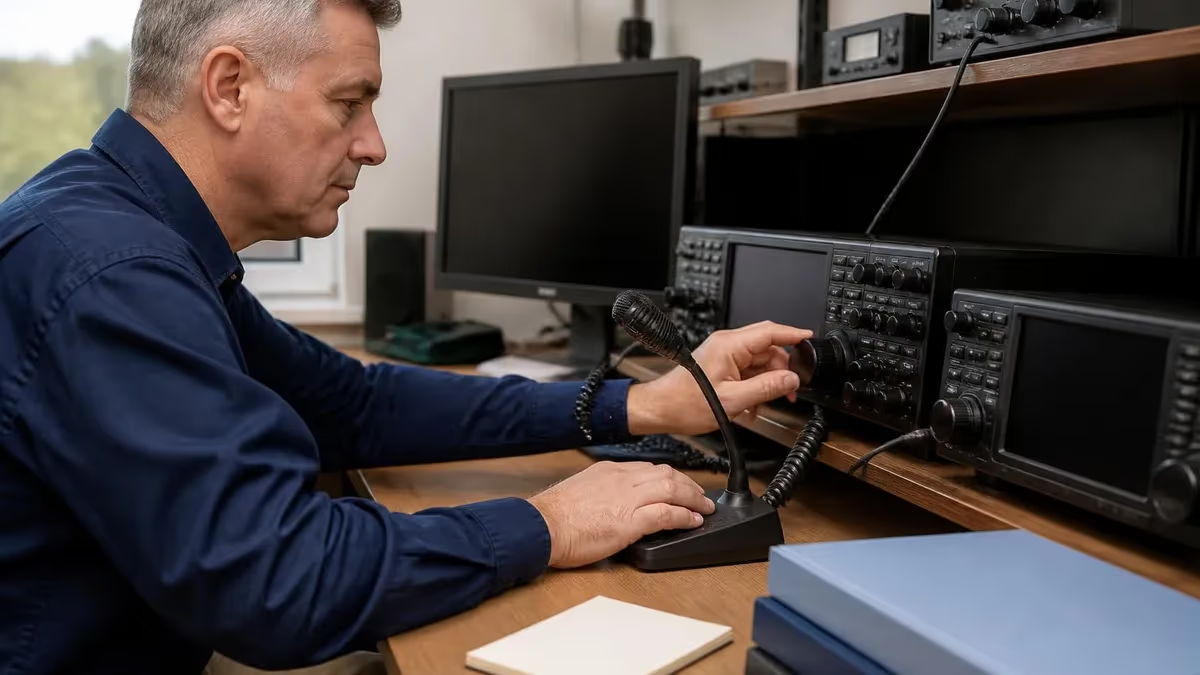
What Is a Ham Radio License?
A ham radio license is an FCC authorization that lets you transmit on amateur radio frequencies. Without one, you can listen all you want—but the moment you key up a mic or tap out Morse code, you're legally required to have it. That's the short answer.
The longer answer is that it's also a kind of passport. It gets you into a worldwide community of operators, emergency responders, experimenters, and satellite enthusiasts. Your callsign—issued automatically when you pass—becomes your identity on the air.
The FCC issues three license classes in the US: Technician, General, and Amateur Extra. Each one unlocks more frequencies and modes. Most people start with the Technician class, and honestly, it opens up more than enough to keep you busy for years.
Do You Need a License for Ham Radio?
Yes—if you want to transmit. That's not negotiable. The FCC requires every US amateur radio operator to hold a valid license before transmitting on any amateur band. No license means potential fines and equipment confiscation. It's not just a bureaucratic hurdle; the licensing system keeps the bands organized and interference manageable.
That said, you don't need a license to listen. Shortwave listening and monitoring are completely fine without any credential. Some people spend years as SWLs (shortwave listeners) before they ever get licensed. But if you want to answer back, help with an emergency net, talk to the International Space Station, or bounce signals off the moon—you need that license.
The Three License Classes Explained
Think of the three classes as stepping stones, each one adding privileges on top of the last.
Technician Class
This is where everyone starts. The Technician exam has 35 questions drawn from a published question pool—you need to answer at least 26 correctly (74%) to pass. No Morse code required (that went away in 2007).
Technicians get full privileges on all amateur bands above 30 MHz. That means VHF and UHF—the bands most commonly used for local communication, repeaters, satellite work, and the International Space Station crossband repeater. You also get limited HF privileges on 10 meters, which can reach across the country and overseas during good band conditions.
General Class
Once you've passed the Technician exam, you can take the General exam in the same sitting—or come back later. The General opens up most of the HF bands, where you can reach virtually anywhere on the planet. Long-distance DX contacts, voice communication across oceans, digital modes on 40 and 20 meters—it all becomes available.
The General exam is also 35 questions, same passing threshold of 74%. Most people find it a step up in difficulty but still very manageable with a few weeks of study.
Amateur Extra Class
Extra is the top tier. It unlocks exclusive segments of the HF bands that no other license class can access, plus some additional operating privileges. The exam is 50 questions from a much larger pool—you need 74% again, so 37 correct. It's the hardest of the three, covering things like antenna theory, operating procedures, and electronics principles at a deeper level.
You don't need Extra to have a great ham radio experience, but if you enjoy learning and want every frequency available, it's worth pursuing.
How to Get Your Ham Radio License
Getting licensed is more straightforward than most people expect. Here's the actual process:
Study the Question Pool
The FCC requires that exam questions come from a publicly available pool. Right now the Technician pool has 411 questions across 10 subelement groups. Your actual test pulls 35 of them. This means you can study the exact questions you might see—there are no surprises hidden behind a paywall.
Free resources are everywhere. The ARRL (American Radio Relay League) publishes study guides. HamStudy.org and Ham Radio Prep let you drill questions online at no cost. Many people pass after two to four weeks of daily practice for 20-30 minutes.
Find an Exam Session
Volunteer Examiner Coordinators (VECs) organize exam sessions across the country. The ARRL VEC and W5YI-VEC are the two biggest. You can search for in-person sessions on the ARRL website or on HamStudy.org's exam finder. Many clubs also offer sessions at hamfests and club meetings.
Remote online exams are now widely available too—useful if you're in a rural area or just prefer the convenience. Several VECs run online sessions via video call. Check ARRL and HamStudy for current options.
If you're in Seattle or another major metro, you'll almost certainly find a session within a short drive, often weekly.
Show Up and Take the Test
Bring a valid government-issued photo ID, your FRN (FCC Registration Number—get one free at the FCC's CORES system before your exam), and the exam fee. As of 2024, most VECs charge $15. Some charge slightly more; a few exam sessions are free.
You'll usually get your result on the spot. If you pass, you'll receive a Certificate of Successful Completion of Examination (CSCE). Your callsign typically appears in the FCC ULS database within a few days—sometimes faster. Once it's there, you can legally operate.
Can You Use a Ham Radio Without a License?
Short answer: no, not to transmit. Long answer: there are a few edge cases worth knowing.
FRS (Family Radio Service) walkie-talkies don't require a license—but those aren't ham radios. CB radio doesn't require a license either. GMRS requires a license but it's a simple administrative one, not an exam. These are all separate services from amateur radio.
On amateur frequencies specifically, you can't transmit without a license. Some people ask about using a ham radio in an emergency—the FCC does allow unlicensed persons to use any means of communication in a genuine emergency to save life or property, but that's a narrow exception, not a workaround for casual use.
Why Do You Need a License for Ham Radio?
A few reasons, and they're all legitimate.
First, the radio spectrum is a shared public resource. Licenses help coordinate who uses what frequencies and ensure operators know the rules. An unlicensed operator who causes interference has no accountability. A licensed operator has a callsign tied to their name and address—there's skin in the game.
Second, the exam actually teaches you things you'll need. Basic electronics, propagation, antenna theory, emergency procedures, operating practices. You're not just proving you read a pamphlet—you're demonstrating you know enough to operate without causing problems.
Third, the license system supports emergency communications. ARES (Amateur Radio Emergency Service) and RACES (Radio Amateur Civil Emergency Service) are built on licensed hams who can deploy during disasters. That structure requires a credentialed community.
How Much Does a Ham Radio License Cost?
The exam fee runs $15 at most sessions. Some club-run sessions are free. Starting in 2022, the FCC began charging a $35 administrative fee for new licenses and upgrades—this goes directly to the FCC, separate from the exam fee.
So total cost to get licensed: roughly $50 for most people. The license itself is good for 10 years and renewal is free (no exam required, just an online renewal through the FCC).
Compared to other hobbies, that's nothing. The radio equipment is a separate cost, but you can get on the air with a $25 handheld or borrow a club's radio at first.
Studying for Your Technician Exam: Practical Tips
A few things that actually work:
Use HamStudy.org's spaced repetition mode. It focuses your time on questions you keep getting wrong instead of drilling ones you already know cold. Most people reach passing confidence in 10-15 hours of study time this way.
Don't try to memorize formulas by brute force—understand what they're for. Ohm's Law (V = IR) makes intuitive sense once you picture water flowing through a pipe. The math questions on the Technician exam are straightforward if you understand the concepts behind them.
Join a local club before your exam. Most clubs are thrilled to have new blood and will point you toward study groups, upcoming exam sessions, and sometimes lend you equipment for your first transmission. The Ham Radio Technician Test practice questions on this site are a solid resource too—they mirror the real question pool format.
Take full practice tests under timed conditions at least twice before your real exam. You have 35 minutes for 35 questions. That's plenty of time, but simulating the format reduces test-day anxiety.
What Happens After You Get Licensed?
Your callsign goes live in the FCC database, usually within 1-10 days after passing. Download the Universal Licensing System app or check the FCC ULS website to track it.
Once your callsign is active, you can legally transmit. Get a basic handheld (HT) radio for VHF/UHF—the Baofeng UV-5R runs about $25 and is fine for starting out, though most serious operators eventually upgrade. Program in a few local repeater frequencies (repeaterbook.com has them all mapped) and make your first contact.
From there, most people find the hobby grows naturally. You might get into HF and start working DX contacts. You might get into digital modes like FT8 or JS8Call. Some operators focus on satellite communications or moonbounce (EME). Others do community emergency preparedness through ARES. There's no single track—you follow what interests you.
If you want to upgrade to General, you can do it at the same exam session where you pass your Technician. Many people knock out both in one visit. The Ham Radio General Class Test practice materials here will help you prep for that upgrade when you're ready.
Getting a Ham Radio License in Seattle (and Other Major Cities)
If you're in Seattle specifically—or any large metro—your options are good. The Western Washington DX Club, Puget Sound Repeater Group, and several other local clubs run regular exam sessions. Check the ARRL exam search tool filtered to Washington state, or look at HamStudy.org's session finder.
Many Seattle-area sessions happen at community centers, libraries, or hamfests like the Bellevue Hamfair. Online sessions through ARRL and W5YI-VEC are also an option if scheduling in-person is tough.
The FCC FRN you'll need can be registered at wireless.fcc.gov/coresWeb—it's free and takes about five minutes. Get that done before your exam day so there's no last-minute scramble.

Ready to Start?
The ham radio license process is genuinely accessible—it's not a gatekeeping system designed to keep people out. The question pool is public, the exam is inexpensive, study resources are free, and the license lasts a decade. Most people who decide to get licensed are on the air within a month.
If you're still deciding whether it's worth it: even the entry-level Technician license opens up local emergency nets, satellite contacts, APRS tracking, and more. You don't need to wait for General or Extra to have a rich experience.
Start with practice tests, find a nearby exam session, and get that callsign. The Ham Radio Technician Test practice exams here follow the exact FCC question pool format—use them to benchmark where you are and fill in any gaps before test day. There are also HAM practice tests for when you're ready to level up to Extra Class.
About the Author

Educational Psychologist & Academic Test Preparation Expert
Columbia University Teachers CollegeDr. Lisa Patel holds a Doctorate in Education from Columbia University Teachers College and has spent 17 years researching standardized test design and academic assessment. She has developed preparation programs for SAT, ACT, GRE, LSAT, UCAT, and numerous professional licensing exams, helping students of all backgrounds achieve their target scores.
Join the Discussion
Connect with other students preparing for this exam. Share tips, ask questions, and get advice from people who have been there.
View discussion (3 replies)