
Ham Radio Transceiver Guide: Choosing Your First Radio for the Technician License
Pick the right ham radio transceiver for your Technician license. 🗨️ Compare HT, mobile, and base radios, bands, antennas, and budget tips.
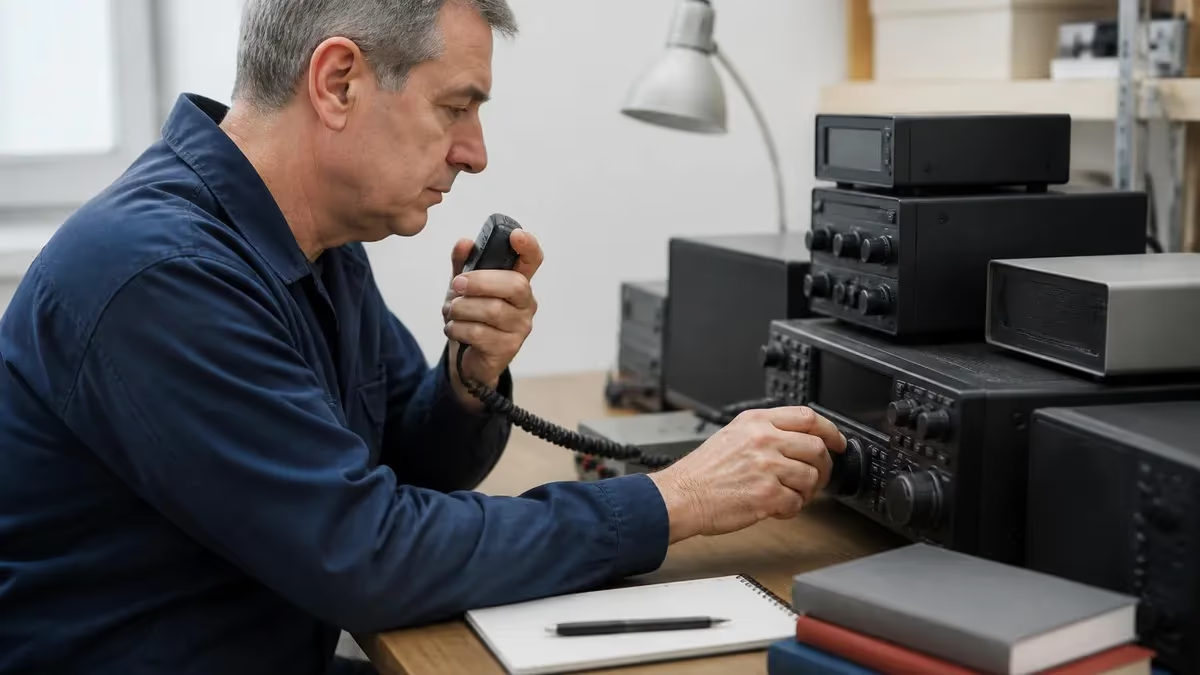
A ham radio transceiver is the single most important purchase you will make on the path to earning your ham radio license, and choosing the right one shapes every conversation, contest, and emergency net you will ever join. The word transceiver simply combines transmitter and receiver into one box, so when you key the microphone you send a signal out on a frequency, and when you release the button you hear replies coming back through the same radio. Picking wisely now saves frustration later.
Most new Technician class operators start with a handheld transceiver, commonly called an HT, because handhelds are inexpensive, portable, and ready to use right out of the box on the 2 meter and 70 centimeter bands. These VHF and UHF bands are exactly where Technicians have the broadest privileges, and they are also where most local repeaters, emergency communications nets, and club activities live. A good HT can be carried in a coat pocket or clipped to a belt during outdoor activities.
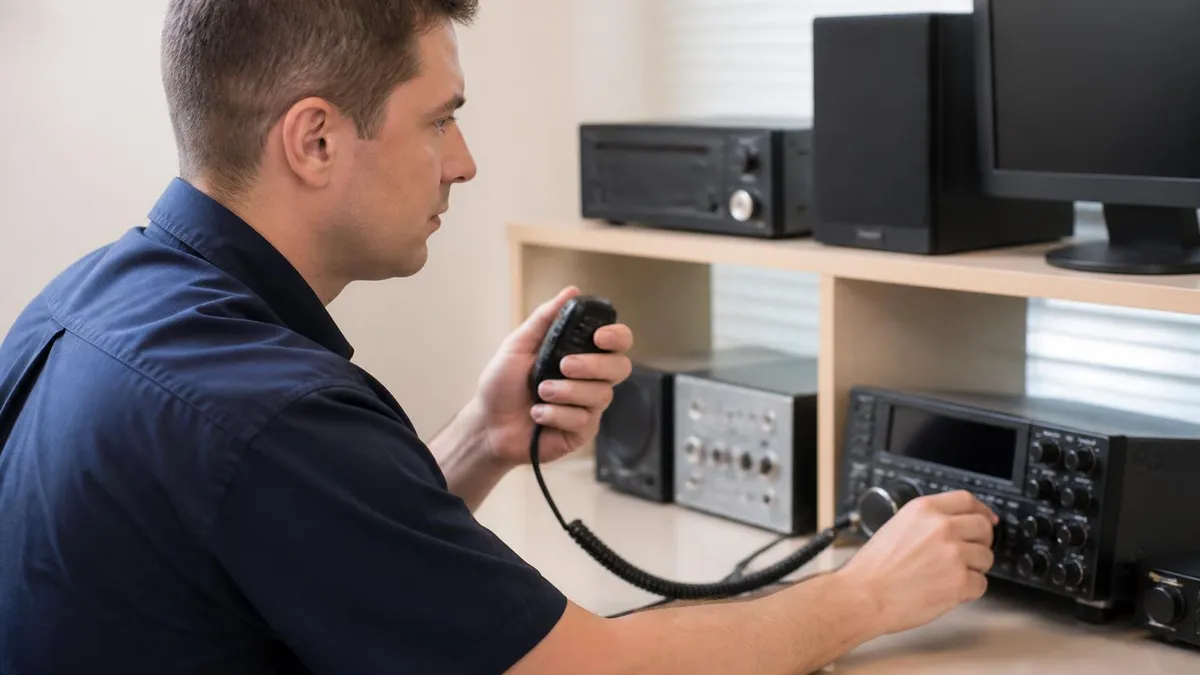
Beyond the handheld, mobile transceivers mount in vehicles and push out twenty five to seventy five watts, while base station radios sit on a desk and connect to outdoor antennas for serious range. Each form factor has trade offs in power, antenna requirements, audio quality, and price. A clear understanding of how transceivers differ will keep you from buying a radio that disappoints you within a few weeks of unboxing it.
This guide walks through every major decision a new Technician faces when shopping for a first transceiver: analog versus digital modes, single band versus dual band coverage, programming software, antenna pairing, battery life, and accessory ecosystems. We will compare popular models in the under one hundred dollar bracket alongside premium radios that cost five times more. By the end you will know exactly which transceiver fits your goals, location, and budget.
You will also learn how the transceiver interacts with the rest of your station. A radio is only as good as the antenna feeding it and the power supply behind it, so we cover SWR meters, coaxial cable choices, magnetic mount antennas, and ground plane requirements. Treating the transceiver as part of a system rather than a standalone gadget is what separates operators who enjoy the hobby from those who give up after a few static filled attempts.
Finally, we tackle the practical realities of operating legally and effectively in 2026. FCC rules, repeater etiquette, simplex frequencies, and the role of CTCSS tones all matter the moment you press your push to talk button. Whether you plan to use your transceiver for weekend hiking, neighborhood preparedness, satellite contacts, or contesting, the foundation you build with your first radio will serve you for decades of amateur radio enjoyment.
Before you spend a single dollar on equipment, finish reading this article and take a few practice quizzes. Knowing the question pool inside out helps you understand why certain transceiver features exist, such as PL tones, narrow band filters, and offset shifts. That knowledge translates directly into smarter buying decisions and faster on air confidence once your call sign arrives in the FCC database.
Ham Radio Transceivers by the Numbers

Transceiver Types Every Technician Should Know
Portable battery powered radios output 1 to 8 watts on VHF and UHF. Perfect for hiking, local repeater work, emergency go bags, and learning the hobby without committing to a large investment.
Vehicle mounted radios push 25 to 75 watts through external antennas and run from 13.8 volt DC power. They offer dramatically better range and audio quality than any handheld can deliver.
Desktop radios pair with outdoor antennas and AC power supplies to deliver maximum performance. Many include HF coverage so upgraded license holders can reach worldwide contacts from one rig.
Premium transceivers cover HF, VHF, UHF, and digital modes in a single chassis. Models like the Icom IC-705 or Yaesu FT-991A grow with you as you upgrade past the Technician class license.
Digital transceivers connect to internet linked repeaters and reflectors, enabling crystal clear voice across the globe. Ideal for new hams in areas with strong digital repeater coverage and active local networks.
Understanding bands and frequencies is essential before you spend money on a transceiver, because the radio you choose physically limits where you can transmit. The most important ham radio frequencies for new Technicians live in the 2 meter band running from 144 to 148 MHz and the 70 centimeter band running from 420 to 450 MHz. These two VHF and UHF allocations carry nearly all local repeater traffic, simplex chat, and emergency communication activity in North America.
Technician class licensees also enjoy limited HF privileges on 10 meters, 15 meters, 40 meters, and 80 meters, mostly using CW or digital modes. If you anticipate upgrading to General or Extra within a year, consider a transceiver that already covers HF. Spending a bit more now on a radio like the Yaesu FT-891 or Icom IC-7300 prevents a complete equipment replacement when your privileges expand. The shortwave bands open propagation paths to other continents.
Modes matter just as much as bands. FM dominates the 2 meter and 70 centimeter portions of the spectrum and is what every entry level transceiver supports. Single sideband, or SSB, is more efficient and reaches farther with the same power but is found mostly above 144.200 MHz in the so called weak signal portion of 2 meters. AM is rare today, while CW remains popular among contesters and DXers chasing distant contacts.
Digital voice is the fastest growing segment of the hobby. DMR uses time division multiple access and is incredibly popular due to inexpensive hardware from manufacturers like AnyTone and TYT. D-STAR is the Icom backed system with strong international reach. Yaesu System Fusion uses the C4FM modulation scheme and bridges seamlessly between analog and digital users. Each ecosystem has dedicated repeaters, talkgroups, and reflectors that you join after entering your call sign.
Memory channels are another specification worth checking. Better transceivers store 200 to 1000 channels, letting you pre program every local repeater, weather station, and simplex frequency. Cheap radios with only 128 memories fill up quickly once you start traveling. Look for a radio with PC programming software support, because hand keying frequencies through small buttons on an HT is tedious and prone to mistakes that cause illegal out of band transmissions.
Power output and squelch features round out the band related decisions. Most HTs offer high, medium, and low power settings to conserve battery and reduce interference. Tone squelch, often called CTCSS or PL, opens your receiver only when a matching sub audible tone is present. Digital code squelch, or DCS, performs the same function with a digital code. Both keep your radio quiet when other users share the frequency on different repeater systems.
One final consideration is repeater offsets. On 2 meters the standard offset is 600 kHz, and on 70 centimeters it jumps to 5 MHz. Your transceiver must automatically apply the correct offset when you select a repeater pair, otherwise your signal lands on the wrong frequency and never reaches the receiving station. Modern radios handle this automatically once you load a memory channel, which is why programming software is so valuable for newcomers.
Ham Radio Technician Practice Test Questions
Prepare for the Ham Radio Technician Test exam with our free practice test modules. Each quiz covers key topics to help you pass on your first try.
Ham Radio Technician Antennas & Feedlines
Ham Radio Technician Exam Questions covering Antennas & Feedlines. Master Ham Radio Technician Test concepts for certification prep.
Ham Radio Technician Basic Electronics & C...
Free Ham Radio Technician Practice Test featuring Basic Electronics & Circuitry. Improve your Ham Radio Technician Exam score with mock test prep.
Ham Radio Technician Equipment & Tools Usage
Ham Radio Technician Mock Exam on Equipment & Tools Usage. Ham Radio Technician Study Guide questions to pass on your first try.
Ham Radio Technician Amateur
Ham Radio Technician Test Prep for Amateur. Practice Ham Radio Technician Quiz questions and boost your score.
Ham Radio Technician General
Ham Radio Technician Questions and Answers on General. Free Ham Radio Technician practice for exam readiness.
Ham Radio Technician III
Ham Radio Technician Mock Test covering III. Online Ham Radio Technician Test practice with instant feedback.
Ham Radio Technician II
Free Ham Radio Technician Quiz on II. Ham Radio Technician Exam prep questions with detailed explanations.
Ham Radio Technician I
Ham Radio Technician Practice Questions for I. Build confidence for your Ham Radio Technician certification exam.
Ham Radio Technician License
Ham Radio Technician Test Online for License. Free practice with instant results and feedback.
Ham Radio Technician Licensing Regulations...
Ham Radio Technician Study Material on Licensing Regulations & Standards. Prepare effectively with real exam-style questions.
Ham Radio Technician Operating Procedures ...
Free Ham Radio Technician Test covering Operating Procedures & Etiquette. Practice and track your Ham Radio Technician exam readiness.
Ham Radio Technician Radio Wave Propagatio...
Ham Radio Technician Exam Questions covering Radio Wave Propagation & Modulation. Master Ham Radio Technician Test concepts for certification prep.
Ham Radio Technician Safety Procedures & R...
Free Ham Radio Technician Practice Test featuring Safety Procedures & Risk Management. Improve your Ham Radio Technician Exam score with mock test prep.
Where to Buy Quality Ham Radio Equipment
The largest dedicated dealer in the United States is ham radio outlet, operating storefronts in California, Arizona, Georgia, New Hampshire, Virginia, Oregon, and Texas. Their staff are licensed operators who can demonstrate radios on the counter, answer programming questions, and help you compare features in person. Online orders ship quickly with no sales tax in states without a physical location.
HRO carries every major brand including Yaesu, Icom, Kenwood, Alinco, and Elecraft. They also stock accessories such as power supplies, antennas, coaxial cable, microphones, and SWR meters. Bundle deals frequently appear during ARRL field day weekends and major hamfests. Sign up for their email newsletter to catch closeout prices on discontinued models that often outperform newer budget radios.
Handheld Versus Mobile Transceiver: Which Should You Buy First?
- +Handhelds are inexpensive, often under fifty dollars for a working radio that gets you on the air immediately
- +Battery powered operation means you can use the radio anywhere without needing to install power wiring
- +Portable form factor fits in a backpack for camping, hiking, and emergency go kits
- +Small size makes programming and learning the menu system less intimidating for new operators
- +Most HTs include FM broadcast receive plus NOAA weather alert channels as bonus features
- +Easy to take to club meetings, hamfests, and license testing sessions for hands on practice
- +Replacement is cheap if the radio is dropped, lost, or damaged during outdoor activities
- −Output power of 5 watts limits range, especially indoors or in valleys where line of sight is blocked
- −Stock rubber duck antennas are notoriously inefficient and need upgrading for reliable performance
- −Small speakers produce thin audio that struggles in noisy environments like vehicles or outdoor events
- −Tiny buttons and small displays make manual frequency entry slow and frustrating without a computer
- −Battery life drops significantly when transmitting frequently or running high power modes
- −Cheap HTs often have wide receive filters that pick up interference from nearby pagers and commercial stations
- −Upgrading to a mobile later means paying twice when buying the right radio first would have been cheaper
Pros and Cons at a Glance
| Pros | Cons |
|---|---|
| Handhelds are inexpensive, often under fifty dollars for a working radio that gets you on the air immediately | Stock rubber duck antennas are notoriously inefficient and need upgrading for reliable performance |
| Battery powered operation means you can use the radio anywhere without needing to install power wiring | Small speakers produce thin audio that struggles in noisy environments like vehicles or outdoor events |
| Portable form factor fits in a backpack for camping, hiking, and emergency go kits | Tiny buttons and small displays make manual frequency entry slow and frustrating without a computer |
| Small size makes programming and learning the menu system less intimidating for new operators | Battery life drops significantly when transmitting frequently or running high power modes |
| Most HTs include FM broadcast receive plus NOAA weather alert channels as bonus features | Cheap HTs often have wide receive filters that pick up interference from nearby pagers and commercial stations |
| Easy to take to club meetings, hamfests, and license testing sessions for hands on practice | Upgrading to a mobile later means paying twice when buying the right radio first would have been cheaper |

Ham Radio Transceiver Setup Checklist
- ✓Confirm your FCC issued call sign appears in the ULS database before transmitting
- ✓Charge the battery fully or connect to a regulated 13.8 volt DC power supply rated for the radio
- ✓Install a quality antenna and check SWR with a meter before transmitting at full power
- ✓Download programming software like CHIRP or the manufacturer specific tool to your computer
- ✓Load local 2 meter and 70 centimeter repeater frequencies with correct offsets and CTCSS tones
- ✓Program the standard simplex calling frequencies of 146.520 MHz and 446.000 MHz
- ✓Add NOAA weather radio channels for emergency situational awareness during severe weather
- ✓Set the squelch level to just block background noise without missing weak incoming signals
- ✓Verify your microphone gain and audio levels by asking for a signal report on a repeater
- ✓Save a backup copy of your programmed channel file in case you need to factory reset the radio
Buy the antenna before you buy the radio
Experienced hams will tell you that a five dollar antenna upgrade on a twenty five dollar Baofeng outperforms a five hundred dollar radio with the stock rubber duck. Spend your first accessory budget on a quality aftermarket antenna such as the Diamond SRH77CA or Signal Stick. The difference in transmit range and receive sensitivity is dramatic and immediately noticeable on every contact you make.
An antenna is the most important accessory you will buy after the transceiver itself, and choosing the right one transforms a mediocre radio into a reliable communicator. The stock rubber duck antenna shipped with most handhelds is a compromise designed for portability, not performance. Replacing it with a longer aftermarket whip such as the Nagoya NA-771 or Diamond SRH77CA boosts radiated power by several decibels, which directly translates into reaching more distant repeaters and copying weaker stations.
For mobile installations the magnetic mount antenna is the simplest path to good performance without drilling holes in the vehicle roof. A quarter wave magnet mount on a vehicle gives you a counterpoise ground plane equal to the entire car body, which dramatically improves the radiation pattern compared to any handheld. Run RG58 or LMR240 coaxial cable through a door gasket to keep the installation reversible if you sell the car or change vehicles.
Base station ham radios reach their full potential only when paired with outdoor antennas mounted as high as practical above local obstructions. A simple ground plane antenna for 2 meters and 70 centimeters costs under fifty dollars and outperforms any indoor solution. Coax runs should use LMR400 or equivalent low loss cable, especially on the higher 70 centimeter band where attenuation becomes significant over runs longer than fifty feet.
Power supplies are the third critical part of the station. Mobile and base transceivers draw twenty to thirty amps at full transmit power on VHF and UHF, so a switching power supply rated for at least twenty five amps continuous duty is the minimum. Astron, MFJ, Powerwerx, and Samlex make reliable units. Use Anderson Powerpole connectors throughout your station for easy reconfiguration and ARES or RACES interoperability during emergency deployments.
SWR meters and dummy loads round out the essential test gear. An inexpensive cross needle SWR power meter installed inline between your transceiver and antenna feedline tells you instantly when something is wrong with the antenna system. A high SWR can damage the radio finals after only a few seconds of transmit, so checking SWR on every frequency you plan to use is essential before keying up at full power for the first time.
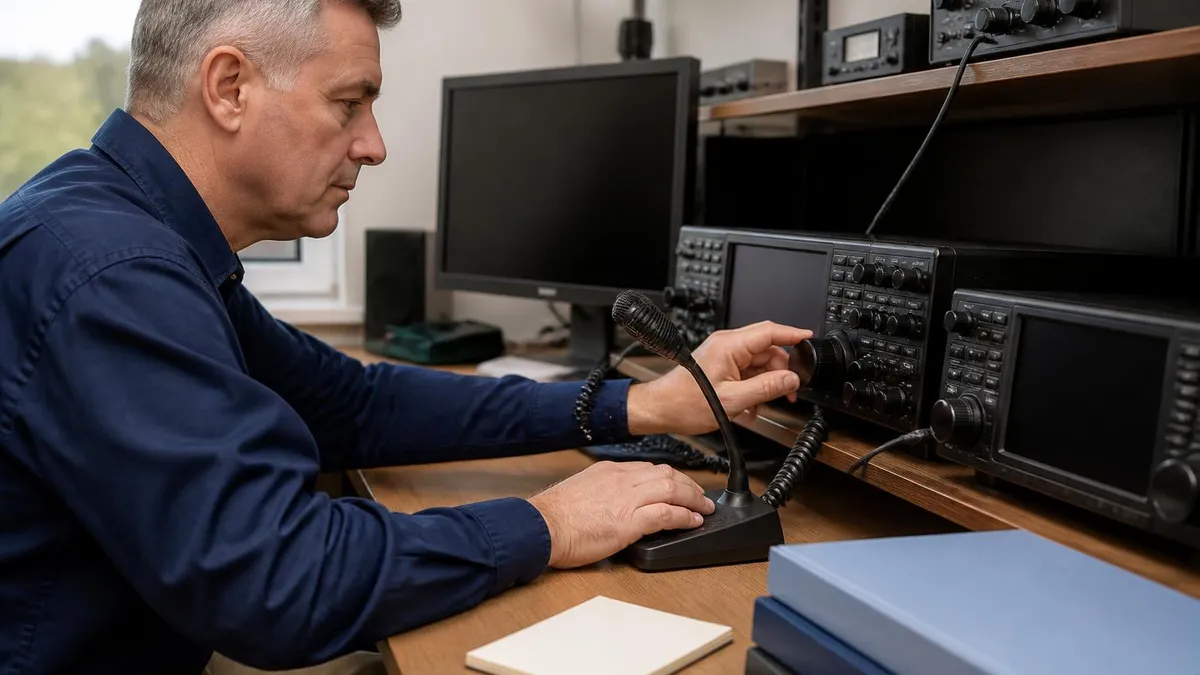
Microphones and speakers improve operating comfort and audio quality. A speaker microphone clipped to your shirt lapel keeps your hands free during emergency communications, and a desktop microphone with adjustable gain transforms a mobile radio into a comfortable base station setup. Headsets with VOX activation let you operate hands free during driving when local laws permit, which is especially handy for traffic nets and casual ragchew sessions on commute drives.
Finally, do not overlook station grounding and lightning protection. A single inexpensive coax lightning arrestor at the entry point to your house, connected to a proper ground rod with heavy gauge wire, can save thousands of dollars in equipment during a thunderstorm. Even handheld users benefit from a charging discipline that disconnects radios from chargers during severe weather, since voltage surges through household wiring can destroy modern electronics in microseconds.
FCC rules prohibit transmitting on amateur radio frequencies without a valid license, even for testing purposes. Receive only is fine while you study, but pressing the push to talk button before your call sign appears in the ULS database can result in fines up to ten thousand dollars per violation. Some Baofeng radios also transmit outside the amateur bands by default, so disable any unlocked frequency ranges before going on the air.
Earning your ham radio frequencies privileges is only the start of becoming a confident operator. The first time you key up your transceiver on a busy repeater can be intimidating, but the amateur radio community is famously welcoming to newcomers who follow basic etiquette. Begin by listening for at least a full minute to understand who is using the frequency, what topics they are discussing, and whether the repeater requires a specific access tone or color code.
When you join a conversation, simply state your call sign clearly and wait for acknowledgment. Phrases like contact, monitoring, or listening signal to the net that you are available for QSO. Avoid the citizens band habit of using phonetic alphabet variations like sugar or sam, and stick with the standard ITU phonetics: alpha, bravo, charlie, and so forth. Clear pronunciation makes the difference between being understood and repeating your call sign multiple times during a weak signal opening.
Repeater operating involves a few unique conventions. Pause for one to two seconds after pressing push to talk before speaking, because repeater systems often need a moment to capture your signal and rebroadcast it. Leave a similar gap between transmissions to give other stations a chance to join the conversation or break in with an emergency. Long monologues that last more than thirty seconds annoy other users and waste duty cycle on heavily used machines.
Simplex operation skips the repeater entirely and is excellent for short range communication between nearby stations. The national simplex calling frequency on 2 meters is 146.520 MHz, and on 70 centimeters it is 446.000 MHz. Avoid calling CQ on the calling frequency for extended periods; instead establish contact and move to another simplex frequency to clear the calling channel for others. Local club nets often publish simplex frequency plans that members memorize.
Emergency communication is one of the most rewarding applications of your Technician license. Joining your local Amateur Radio Emergency Service group or Radio Amateur Civil Emergency Service team puts your skills and equipment to public service during severe weather, search operations, and disasters. Most ARES groups conduct weekly nets and quarterly drills that build the muscle memory needed to operate effectively when public safety depends on amateur radio communication links.
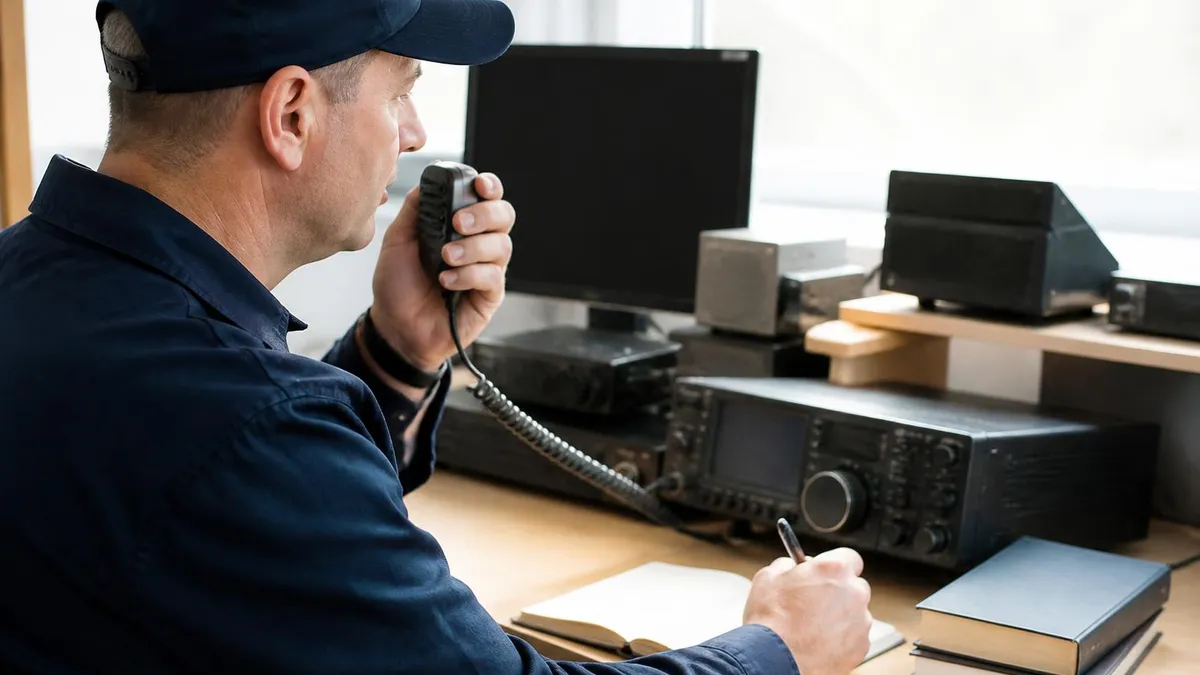
Logging your contacts, even on simple repeater conversations, accelerates learning enormously. A paper notebook or a free program like Log4OM records every contact with the date, time, frequency, mode, and a brief comment about the conversation. Reviewing your log after a few weeks reveals propagation patterns, repeater performance, and operator preferences that make subsequent contacts smoother and more productive. Many seasoned hams maintain logs going back forty or fifty years across thousands of QSOs.
Continuing education sets apart casual hobbyists from skilled operators. Subscribe to QST magazine through the ARRL, watch YouTube channels like Ham Radio Crash Course or KB9VBR Antennas, and attend at least one hamfest per year. Topics like antenna modeling, digital modes, satellite operation, and emergency communications open new dimensions of the hobby that your first transceiver can absolutely participate in once you understand how to drive it expertly.
Final preparation for the Technician exam should focus on the question pool maintained by the National Conference of Volunteer Examiner Coordinators. There are 411 questions in the current pool, and your 35 question exam draws directly from them with no rewording. Memorizing every correct answer is possible but understanding the underlying concepts produces an operator who passes the General and Extra exams later with similar ease. Strong ham radio prep mixes drill style flashcards with practical hands on activity.
Use multiple study tools rather than relying on a single approach. The ARRL Ham Radio License Manual is the traditional textbook and covers every topic in the question pool with technical depth. Online practice exam sites randomly draw thirty five questions from the pool and grade your answers instantly, building familiarity with the exam format. Pairing one or two passes through the printed manual with daily practice exams in the final two weeks before testing produces consistently high scores.
Some concepts trip up nearly every newcomer regardless of background. Antenna polarization, the difference between mode and bandwidth, repeater offset calculations, RF safety exposure limits, and the rules around third party traffic require focused study. Spend extra time on these topic areas, drawing diagrams and quizzing yourself out loud. Active recall beats passive reading by a significant margin in cognitive science research on long term retention of technical material.
Test day logistics matter more than most candidates realize. Bring two forms of identification including one with a photograph, plus the fifteen dollar exam fee in the format your local VE team accepts. Arrive at least fifteen minutes early to complete paperwork without rushing. Calculators are permitted as long as they are not programmable, and scratch paper is provided. Take advantage of the full forty minutes typically allowed even though you can finish in under fifteen if confident.
After passing the Technician exam, your call sign typically appears in the FCC ULS database within ten business days. Until that listing exists you cannot legally transmit, even with the radio sitting on the desk in front of you. Use the waiting period productively by programming repeaters, installing antennas, and listening to local activity so that your first transmission is smooth, confident, and properly identified with your shiny new call sign.
Plan your upgrade path from day one. Most active operators reach for the General class license within twelve to eighteen months of earning their Technician, because the General opens HF privileges that turn weekend operating into worldwide contacts. The General question pool builds directly on Technician concepts with additional depth on propagation, antenna theory, and operating rules. Many study programs allow you to pass both exams during a single VE testing session if you arrive prepared.
Most importantly, get on the air as soon as your call sign arrives. The hobby is learned by doing, and every conversation teaches something new about your transceiver, your antenna, or your operating technique. Local clubs welcome new members eagerly and frequently sponsor mentoring programs called Elmers that pair newcomers with experienced operators. The connections you build during those first months of operating become lifelong friendships across the amateur radio community.
Sample Ham Radio Technician Test Practice Questions
Try these questions from our free Ham Radio Technician Test practice tests. The correct answer and an explanation follow each question.
How long is a valid FCC amateur radio license?
- A. 5 years
- B. 10 years
- C. 15 years
- D. Life of the licensee
Answer: B. 10 years
FCC amateur radio licenses are valid for 10 years from the date of issue or renewal.
What is the minimum age requirement to obtain an amateur radio license in the United States?
- A. 13 years old
- B. 16 years old
- C. 18 years old
- D. There is no minimum age requirement
Answer: D. There is no minimum age requirement
The FCC imposes no minimum age requirement for an amateur radio license; anyone who passes the exam may be licensed.
What is the Technician class license privilege regarding 60-meter (5 MHz) channels?
- A. Full phone and CW privileges on all five channels
- B. No operating privileges
- C. CW only on the 5.332 MHz channel
- D. USB phone on 15 watts PEP
Answer: B. No operating privileges
Technician class licensees have no operating privileges on the 60-meter band; those channels require at minimum a General class license.
A technician notices the receive audio on a mobile radio is distorted only at high volume. What is the most likely cause?
- A. Antenna SWR is too high
- B. The audio amplifier is being driven into clipping or the speaker is damaged
- C. The squelch threshold is set too low
- D. The operating frequency is off by 600 Hz
Answer: B. The audio amplifier is being driven into clipping or the speaker is damaged
Distortion at high volume almost always indicates the audio amplifier is overdriven past its linear range or the speaker cone is physically damaged.
Ham Radio Technician Questions and Answers
About the Author

Educational Psychologist & Academic Test Preparation Expert
Columbia University Teachers CollegeDr. Lisa Patel holds a Doctorate in Education from Columbia University Teachers College and has spent 17 years researching standardized test design and academic assessment. She has developed preparation programs for SAT, ACT, GRE, LSAT, UCAT, and numerous professional licensing exams, helping students of all backgrounds achieve their target scores.
Join the Discussion
Connect with other students preparing for this exam. Share tips, ask questions, and get advice from people who have been there.
View discussion (3 replies)