
Ham Radio 440 Band: Complete Guide to UHF Frequencies, Equipment, and Technician License Privileges
Master the ham radio 440 band with this complete guide to UHF frequencies, equipment, antennas, and Technician license privileges on 70 centimeters. 💡
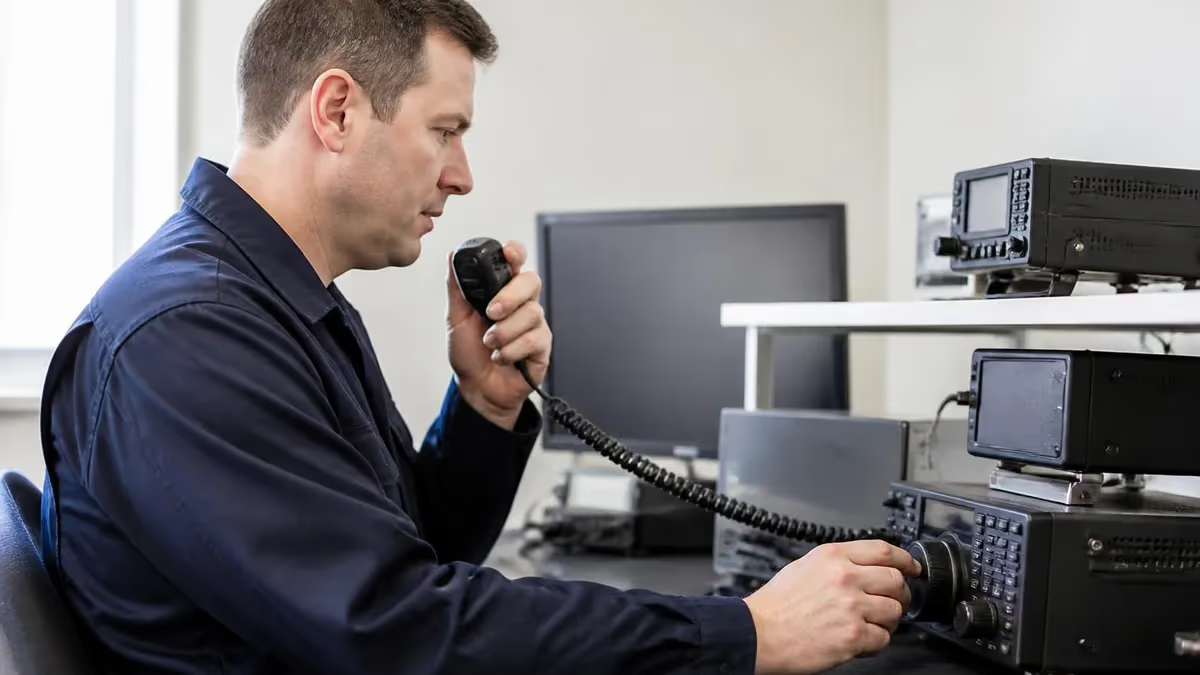
The ham radio 440 band represents one of the most popular UHF frequency allocations available to licensed amateur radio operators across the United States. Whether you are currently studying for your ham radio license or already hold Technician-class privileges, understanding the 70-centimeter band between 420 and 450 MHz is essential for effective communication. This frequency range offers unique propagation characteristics, supports extensive repeater networks nationwide, and provides a remarkably versatile platform for voice, data, and experimental operations that keep operators engaged for decades.
Officially designated as the 70-centimeter band by the American Radio Relay League, the 440 band spans from 420 to 450 MHz and falls squarely within the ultra-high frequency spectrum. Among all the ham radio bands available to Technician licensees, this allocation stands out for its compact antenna requirements and reliable line-of-sight communication capabilities. Many newcomers to amateur radio choose this band as their primary operating frequency because affordable handheld transceivers readily cover the entire 30-MHz-wide allocation without requiring large or complex antenna installations at home.
Obtaining a ham radio license is the first step toward accessing the 440 band and all its powerful capabilities. The Federal Communications Commission requires every operator to pass the Technician-class examination, which covers fundamental radio theory, federal regulations, and standard operating procedures. This entry-level license grants full privileges on the 70-centimeter band, including all emission modes and the maximum permitted power output of 1,500 watts peak envelope power. The ham radio license test consists of 35 multiple-choice questions drawn from a publicly available question pool updated on a regular cycle.
Modern ham radio equipment designed for the 440 band ranges from compact handheld transceivers costing under fifty dollars to sophisticated base station setups with advanced digital capabilities and high-fidelity audio. Dual-band radios covering both the 2-meter and 70-centimeter bands remain the most popular choice among Technician licensees because they provide simultaneous access to the two most active VHF and UHF allocations in a single device. Many operators also invest in dedicated mobile rigs for permanent vehicle installations and directional antennas for extended-range point-to-point communication.
Before purchasing your first transceiver, consider browsing a trusted ham radio outlet to compare specifications and pricing across different manufacturers and model years. Popular brands including Yaesu, Icom, Kenwood, and Baofeng offer models at various price points, each with distinct features suited to different operating styles and budget constraints. Understanding your intended use cases—whether local repeater access, emergency communications, digital messaging, or satellite operation—will help narrow your equipment choices and ensure you invest wisely in gear you will actually use regularly.
This comprehensive guide covers everything you need to know about the ham radio 440 band, from detailed frequency allocations and repeater operations to antenna selection and proven operating techniques. We explore the technical characteristics that make the 70-centimeter band unique among amateur allocations, compare it thoroughly with other popular ham radio bands, and provide practical advice for getting the most out of your UHF privileges. Whether you are preparing for the Technician exam or looking to expand your current on-air activities into new territory, this resource serves as your definitive reference.
Understanding ham radio bands and their distinct characteristics is fundamental knowledge for every serious amateur radio operator. The 440 band offers capabilities that complement lower-frequency allocations beautifully, including superior performance for indoor and portable operations, shorter antenna requirements for high-gain directional arrays, and wider bandwidth for modern digital modes like DMR, System Fusion, and D-STAR. As you progress through this guide, you will discover precisely why experienced operators consider the 70-centimeter band an indispensable part of their amateur radio toolkit.
Ham Radio 440 Band by the Numbers

Understanding the 440 Band Frequency Allocations
This segment is shared with federal government radiolocation services. Amateur operators may use these frequencies but must accept interference from military radar systems. Usage is geographically restricted near certain Department of Defense installations, so check local coordination before transmitting here.
Primarily used for repeater auxiliary links and control operations. These frequencies support the backbone infrastructure that connects distant repeater sites. Amateur television experimenters also use portions of this segment for narrowband ATV transmissions in certain metropolitan coordination areas.
This sub-band hosts weak-signal SSB and CW activity centered around 432.100 MHz. Earth-Moon-Earth communication and tropospheric scatter contacts happen here. This segment is critical for amateur operators pursuing long-distance UHF records and satellite uplink operations via amateur orbital platforms.
The most heavily used portion of the 440 band contains repeater output frequencies. Thousands of FM voice repeaters across the United States transmit on these frequencies using standard 5-MHz offset pairs. Digital repeaters using DMR, Fusion, and D-STAR also populate this segment extensively.
This segment carries corresponding repeater input frequencies paired with outputs in the 438–444 MHz range. The national simplex calling frequency at 446.000 MHz lives here, providing a universal meeting point for operators seeking direct radio-to-radio contacts without repeater infrastructure.
Repeater operations dominate activity on the ham radio 440 band, making it the busiest UHF allocation in amateur radio. A repeater receives signals on one frequency and simultaneously retransmits them on another, dramatically extending the communication range of low-power handheld and mobile radios. On the 70-centimeter band, the standard frequency offset between input and output is 5 MHz, meaning a repeater transmitting on 442.500 MHz listens for incoming signals on 447.500 MHz. This consistent offset structure makes programming radios straightforward once you understand the basic pairing scheme.
Understanding ham radio frequencies and their allocation within the 440 band helps operators navigate the crowded repeater landscape effectively. Most metropolitan areas host dozens or even hundreds of 70-centimeter repeaters, each serving different communities, clubs, and emergency communication networks. Many repeaters require a CTCSS tone or DCS code for access, which prevents interference from distant stations and unauthorized users. Your radio must be programmed with the correct tone frequency to activate the repeater squelch and gain access to the system for regular use.
Simplex communication on the 440 band provides a valuable alternative when repeater infrastructure is unavailable or unnecessary for the contact distance involved. The national simplex calling frequency of 446.000 MHz serves as the universal meeting point where operators can establish initial contact before moving to a clear working frequency. Simplex range on 70 centimeters typically spans three to ten miles depending on terrain, antenna height, and transmitter power output, making it ideal for neighborhood-level emergency communications and local event coordination activities.
Digital voice modes have transformed the 440 band landscape over the past decade, with three major protocols competing for operator adoption and repeater installations nationwide. DMR, which stands for Digital Mobile Radio, uses time-division multiple access technology to carry two simultaneous conversations on a single 12.5-kHz channel. Yaesu System Fusion provides both digital and analog compatibility in a single protocol, while Icom D-STAR offers integrated data transmission capabilities including GPS position reporting and low-speed internet gateway access for connected operators.
Amateur television represents another fascinating application of the 440 band, though its bandwidth requirements limit operations to specific segments coordinated by regional frequency coordination bodies. Narrowband ATV using digital compression techniques allows operators to transmit live video signals within standard channel bandwidths, opening possibilities for remote station monitoring, emergency scene documentation, and experimental video communication projects. While ATV activity has declined somewhat with the rise of internet streaming, dedicated enthusiasts continue advancing the technology.
Satellite communication through the 440 band connects operators with amateur radio satellites orbiting Earth, providing thrilling opportunities for long-distance contacts using relatively simple ground station equipment. Several active amateur satellites use 70-centimeter frequencies for uplink or downlink operations, including the International Space Station which occasionally operates on UHF frequencies during special event contacts. Tracking satellites requires understanding orbital mechanics and Doppler shift compensation, adding an educational dimension that many operators find deeply rewarding and scientifically engaging.
Power regulations on the 440 band permit all license classes to transmit up to 1,500 watts peak envelope power, though practical considerations usually keep most operators well below that maximum threshold. Handheld radios typically transmit between one and eight watts, mobile installations output between 25 and 50 watts, and base stations may run 50 to 100 watts into directional antennas for extended range coverage. The FCC requires operators to use the minimum power necessary to maintain reliable communication, a principle that promotes efficient spectrum sharing among the thousands of active licensees.

Ham Radio Technician Practice Test Questions
Prepare for the Ham Radio Technician Test exam with our free practice test modules. Each quiz covers key topics to help you pass on your first try.
Ham Radio Technician Antennas & Feedlines
Ham Radio Technician Exam Questions covering Antennas & Feedlines. Master Ham Radio Technician Test concepts for certification prep.
Ham Radio Technician Basic Electronics & C...
Free Ham Radio Technician Practice Test featuring Basic Electronics & Circuitry. Improve your Ham Radio Technician Exam score with mock test prep.
Ham Radio Technician Equipment & Tools Usage
Ham Radio Technician Mock Exam on Equipment & Tools Usage. Ham Radio Technician Study Guide questions to pass on your first try.
Ham Radio Technician Amateur
Ham Radio Technician Test Prep for Amateur. Practice Ham Radio Technician Quiz questions and boost your score.
Ham Radio Technician General
Ham Radio Technician Questions and Answers on General. Free Ham Radio Technician practice for exam readiness.
Ham Radio Technician III
Ham Radio Technician Mock Test covering III. Online Ham Radio Technician Test practice with instant feedback.
Ham Radio Technician II
Free Ham Radio Technician Quiz on II. Ham Radio Technician Exam prep questions with detailed explanations.
Ham Radio Technician I
Ham Radio Technician Practice Questions for I. Build confidence for your Ham Radio Technician certification exam.
Ham Radio Technician License
Ham Radio Technician Test Online for License. Free practice with instant results and feedback.
Ham Radio Technician Licensing Regulations...
Ham Radio Technician Study Material on Licensing Regulations & Standards. Prepare effectively with real exam-style questions.
Ham Radio Technician Operating Procedures ...
Free Ham Radio Technician Test covering Operating Procedures & Etiquette. Practice and track your Ham Radio Technician exam readiness.
Ham Radio Technician Radio Wave Propagatio...
Ham Radio Technician Exam Questions covering Radio Wave Propagation & Modulation. Master Ham Radio Technician Test concepts for certification prep.
Ham Radio Technician Safety Procedures & R...
Free Ham Radio Technician Practice Test featuring Safety Procedures & Risk Management. Improve your Ham Radio Technician Exam score with mock test prep.
Ham Radio Equipment for the 440 Band
Handheld transceivers, commonly called HTs, are the most popular entry point for new operators exploring the ham radio 440 band. Models from Baofeng start under thirty dollars, while premium offerings from Yaesu, Icom, and Kenwood range from one hundred to five hundred dollars with advanced features including GPS, Bluetooth connectivity, and digital mode compatibility. Most HTs output between one and eight watts on UHF, providing adequate range for accessing local repeaters within a ten-mile radius using the factory-supplied rubber duck antenna.
When selecting a handheld for 440 band operations, prioritize dual-band capability covering both 2-meter and 70-centimeter allocations for maximum flexibility in the field. Key features to evaluate include receiver sensitivity specifications, battery capacity measured in milliamp-hours, the availability of programming software for efficient memory channel management, and whether the radio supports the digital voice protocol used by your local repeater network. Waterproof ratings matter significantly if you plan to use your HT during outdoor activities, emergency deployments, or public service events in variable weather conditions.
Ham Radio 440 Band vs. 2-Meter Band: Pros and Cons
- +Smaller antennas make portable and mobile installations significantly easier and more practical
- +Wider 30-MHz bandwidth supports more simultaneous users and diverse operating modes
- +Less crowded than the 2-meter band in many metropolitan areas providing clearer channels
- +Better building penetration for indoor portable communications during events and emergencies
- +Superior performance for directional antenna arrays with compact physical dimensions
- +Extensive digital repeater infrastructure including DMR, Fusion, and D-STAR networks
- −Shorter line-of-sight range compared to VHF 2-meter signals in identical conditions
- −Higher coaxial cable losses require premium low-loss feedline for longer cable runs
- −Government radar sharing restricts use in the 420-426 MHz segment near military sites
- −Fewer simplex contacts due to reduced range without repeater infrastructure assistance
- −Higher equipment costs for comparable power levels compared to 2-meter-only radios
- −Greater susceptibility to multipath interference in urban environments with tall buildings
Pros and Cons at a Glance
| Pros | Cons |
|---|---|
| Smaller antennas make portable and mobile installations significantly easier and more practical | Higher coaxial cable losses require premium low-loss feedline for longer cable runs |
| Better building penetration for indoor portable communications during events and emergencies | Fewer simplex contacts due to reduced range without repeater infrastructure assistance |
| Superior performance for directional antenna arrays with compact physical dimensions | Greater susceptibility to multipath interference in urban environments with tall buildings |

Essential Ham Radio Bands Checklist for New Technician Operators
- ✓Pass the 35-question Technician exam with a score of 74 percent or higher to earn your license.
- ✓Apply for your FCC call sign through the Universal Licensing System after passing the exam.
- ✓Purchase a dual-band handheld or mobile radio covering both 2-meter and 70-centimeter bands.
- ✓Program your local 440 band repeater frequencies including correct offset and CTCSS tone codes.
- ✓Store the national simplex calling frequency of 446.000 MHz in a dedicated memory channel.
- ✓Join a local amateur radio club to connect with experienced operators and access club repeaters.
- ✓Practice proper repeater etiquette including waiting for the courtesy tone before transmitting.
- ✓Test your radio on simplex to verify transmit power and audio quality before making repeater contacts.
- ✓Register with your regional frequency coordinator to stay informed about repeater changes and additions.
- ✓Invest in a quality external antenna to dramatically improve your signal strength and reception range.
The 70-Centimeter Band Offers the Widest Amateur Allocation Below Microwave Frequencies
At 30 MHz wide, the 440 band provides more bandwidth than any other amateur radio allocation below 902 MHz. This extraordinary width supports thousands of repeater pairs, multiple digital voice networks, amateur television, satellite uplinks, and weak-signal experimentation—all within a single band. Technician licensees receive full privileges across the entire allocation, making it the most feature-rich band available at the entry level of amateur radio licensing.
Selecting the right ham radio antenna for 440 band operations is arguably the single most impactful decision you can make to improve your station performance. Unlike lower-frequency bands where antennas can stretch dozens of feet in length, 70-centimeter antennas remain physically compact because the wavelength measures only about 27 inches. This compact size enables practical high-gain directional designs that would be impossibly large at HF frequencies, giving UHF operators a significant advantage when pursuing weak-signal contacts, satellite passes, or extended-range repeater access from challenging locations.
The simplest antenna for 440 band operations is the quarter-wave vertical whip, measuring approximately six and three-quarter inches in length. Every handheld radio ships with a factory rubber duck antenna of roughly this dimension, though aftermarket replacements with improved gain characteristics can boost effective radiated power by three to six decibels without any increase in actual transmitter output. For mobile installations, a quarter-wave or five-eighths-wave magnetic-mount antenna placed on the vehicle roof provides excellent omnidirectional coverage for repeater access while driving through varied terrain across your coverage area.
Collinear vertical antennas represent the most popular choice for fixed base station installations on the 70-centimeter band due to their omnidirectional radiation pattern and moderate gain figures. A typical dual-band collinear antenna stands four to six feet tall and provides approximately six decibels of gain on UHF frequencies, effectively quadrupling your radiated power compared to a simple quarter-wave vertical. Diamond, Comet, and Tram manufacture widely used fiberglass collinear models that mount easily on standard mast hardware and withstand years of outdoor weather exposure without significant performance degradation over time.
Directional Yagi antennas unlock the full potential of the 440 band for weak-signal work, satellite tracking, and long-distance point-to-point communication. A modest five-element Yagi for 70 centimeters measures only about two feet long yet delivers approximately ten decibels of gain focused in a single direction, making it roughly ten times more effective than an omnidirectional antenna. Longer Yagi designs with fifteen or more elements can exceed seventeen decibels of gain, enabling Earth-Moon-Earth contacts and tropospheric scatter communications that span hundreds of miles under favorable atmospheric conditions.
Propagation on the 440 band follows primarily line-of-sight characteristics, meaning that the effective communication range depends heavily on antenna height, terrain obstructions, and atmospheric conditions between the transmitting and receiving stations. Under normal conditions, two stations with antennas mounted at typical residential heights of thirty to forty feet can reliably communicate over distances of fifteen to thirty miles on simplex. Improved locations such as hilltops, tall buildings, or mountain ridges dramatically extend this range, sometimes enabling contacts exceeding one hundred miles with modest power levels during favorable conditions.
Tropospheric ducting represents the most dramatic propagation enhancement available on the 70-centimeter band, occasionally enabling contacts spanning five hundred miles or more across temperature inversion layers in the lower atmosphere. These ducting events occur most frequently during stable high-pressure weather systems in late summer and early fall, particularly along coastal regions and across large bodies of water. Experienced 440 band operators monitor propagation forecasts and example signals to identify ducting conditions early, positioning themselves to make rare long-distance contacts that would normally be impossible on UHF frequencies during standard conditions.
Feedline selection critically affects 440 band antenna system performance because coaxial cable losses increase significantly at UHF frequencies compared to VHF and HF installations. Standard RG-58 coaxial cable loses approximately seven decibels per hundred feet at 440 MHz, effectively wasting eighty percent of your transmitter power as heat before the signal reaches the antenna. Upgrading to LMR-400 reduces that loss to under two decibels per hundred feet, preserving the vast majority of your transmitted power and receiver sensitivity for dramatically improved overall station performance.
The 420–426 MHz segment of the 440 band is shared with federal government radiolocation services, primarily military radar installations. Amateur operators in certain geographic areas near Department of Defense facilities may face power restrictions or complete exclusion from this segment. Check with your regional frequency coordinator and the ARRL band plan before transmitting below 426 MHz to ensure compliance with all applicable sharing agreements and avoid harmful interference.
Mastering proper operating techniques on the 440 band ensures productive contacts and builds your reputation as a courteous, skilled amateur radio operator within the community. Repeater etiquette forms the foundation of good operating practice, starting with the simple habit of listening before transmitting to avoid interrupting ongoing conversations. When you key your microphone on a repeater, wait a full second after the squelch opens before speaking to ensure the repeater has fully activated and your first words are not clipped by the system activation delay that occurs on every transmission cycle.
Identifying your station correctly is a fundamental legal requirement that every operator must follow without exception when using ham radios on any frequency including the 440 band. FCC regulations require you to transmit your assigned call sign at the beginning and end of each communication session, and at least once every ten minutes during extended conversations. Use standard phonetics when conditions are marginal to ensure your call sign is correctly copied by other operators and any monitoring stations. Proper identification not only satisfies the legal requirement but also builds trust and accountability within the amateur radio community.
Making your first contact on a 440 band repeater can feel intimidating, but the process is straightforward once you understand the standard protocol that experienced operators follow every day. Simply key your microphone and say your call sign followed by the word monitoring or listening. This brief transmission signals to other operators that you are available for a conversation without demanding immediate attention from anyone specifically. Many repeaters also host scheduled nets at specific times where a net control station manages an organized round-table discussion, providing an excellent structured environment for new operators to practice their skills.
Emergency communication represents one of the most important applications of the 440 band, with thousands of amateur operators trained and equipped to provide critical backup communications when commercial infrastructure fails during disasters. Organizations like the Amateur Radio Emergency Service and Radio Amateur Civil Emergency Service maintain active volunteer networks that deploy during hurricanes, earthquakes, wildfires, and other catastrophic events. The compact size of 440 band equipment makes it particularly well suited for deployment in emergency shelters, command posts, and field hospitals where space and portability are primary operational considerations.
Programming your radio efficiently saves valuable time and reduces frustration during normal operations and emergency activations on the 70-centimeter band. Most modern transceivers support computer-based programming through free software applications like CHIRP, which allows you to build comprehensive channel lists on your computer and upload them to the radio in seconds. Organize your memory channels by geographic area or functional purpose, grouping local repeaters separately from travel channels, emergency frequencies, and simplex calling frequencies for intuitive quick access during any operating scenario you might encounter.
Interference management on the 440 band requires awareness of the various services sharing this frequency allocation and the practical steps operators can take to minimize disruption. Government radar systems operating in the 420–426 MHz segment can produce strong pulsed signals that desensitize nearby receivers, while intermodulation products from commercial transmitter sites occasionally create phantom signals on amateur frequencies. Using CTCSS tone squelch, adjusting receiver bandwidth settings, and strategically positioning directional antennas all help mitigate interference issues and maintain clear communications on an increasingly congested band.
Joining a local amateur radio club provides invaluable support for operators developing their 440 band skills and expanding their understanding of UHF communication techniques. Club members share decades of collective experience in antenna building, radio programming, emergency preparedness, and contest operating that accelerates your learning curve dramatically compared to studying alone. Many clubs maintain their own repeater systems, offer equipment loan programs for new members, and organize regular on-air activities and in-person meetings where you can receive hands-on mentoring from experienced operators who remember exactly what it felt like to be a beginner.
Practical preparation for operating on the 440 band extends well beyond passing the Technician exam and purchasing your first radio, though both milestones represent essential starting points on your amateur radio journey. Investing time in hands-on practice with your specific equipment builds the muscle memory and operational confidence needed to communicate effectively under all conditions, including the high-stress environments common during emergency deployments. Start by programming all your local repeater frequencies, testing each one individually to verify correct offset and tone settings before you need them for an actual contact or emergency communication.
Developing strong ham radio prep habits ensures you are always ready to operate when opportunities or emergencies arise on the 440 band. Keep your handheld radio batteries charged and carry a spare battery pack or AA battery case in your go-bag at all times. Maintain a printed reference card listing your most-used repeater frequencies, tone codes, and emergency channel assignments because electronic devices can fail at the worst possible moments. Experienced operators recommend conducting a weekly radio check on your primary repeater to verify equipment functionality and maintain your presence in the local amateur radio community network.
Antenna experimentation provides one of the most rewarding learning experiences available to 440 band operators, and the compact dimensions of 70-centimeter antennas make construction projects accessible even for beginners with minimal tools and workspace. Building a simple ground-plane antenna from copper wire and an SO-239 connector takes under thirty minutes and costs less than five dollars in materials, yet delivers performance comparable to many commercial offerings. More ambitious builders can construct Yagi arrays, collinear verticals, and even helical antennas for satellite work using readily available materials from local hardware stores and online electronics suppliers.
Digital mode exploration represents the fastest-growing segment of 440 band activity, with DMR, System Fusion, and D-STAR networks expanding rapidly across the country. Joining a digital network connects your radio to worldwide communication infrastructure through internet-linked repeater systems, enabling conversations with operators thousands of miles away using nothing more than a handheld radio and a local repeater. Many clubs host digital mode training sessions where experienced operators help newcomers configure their radios, register with network databases, and make their first digital contacts on these increasingly popular platforms.
Contest operating on the 440 band sharpens your skills in rapid station identification, signal reporting, and efficient communication under competitive time pressure. The ARRL sponsors several contests throughout the year that include UHF categories, including the popular January VHF Contest and the June VHF Contest where operators compete to contact as many stations as possible across amateur VHF and UHF bands. Participating in contests, even casually, dramatically improves your operating speed, phonetic alphabet proficiency, and ability to copy weak signals under challenging band conditions that test your equipment and technique simultaneously.
Continuing education beyond the Technician license opens additional operating privileges and deeper understanding of the radio science underlying 440 band communications. The General-class license examination covers intermediate radio theory and grants access to extensive HF frequency allocations, while the Amateur Extra examination unlocks the complete amateur radio spectrum including exclusive sub-bands reserved for the most advanced operators. Each progression in license class expands your technical knowledge and on-air capabilities while connecting you with increasingly skilled operators who share your passion for amateur radio experimentation and public service.
The amateur radio community thrives on the willingness of experienced operators to mentor newcomers, and your participation on the 440 band contributes to this vital cycle of knowledge transfer that has sustained the hobby for over a century. As you gain confidence and skill, consider volunteering as a net control station, assisting with public service events, or helping newly licensed operators program their first radios and make their initial contacts.
The relationships you build through amateur radio often develop into lasting friendships bonded by shared technical interests, mutual respect, and the unique satisfaction of communicating through equipment and antennas you understand at a fundamental level.
Sample Ham Radio Technician Test Practice Questions
Try these questions from our free Ham Radio Technician Test practice tests. The correct answer and an explanation follow each question.
Which HF/MF bands are all amateur frequency privileges available to General class license holders?
- A. 60 meters, 20 meters, 17 meters, and 12 meters
- B. 160 meters, 80 meters, 40 meters, and 10 meters
- C. 160 meters, 60 meters, 30 meters, 17 meters, 12 meters, and 10 meters
- D. 160 meters, 30 meters, 17 meters, 15 meters, 12 meters, and 10 meters
Answer: C. 160 meters, 60 meters, 30 meters, 17 meters, 12 meters, and 10 meters
General class licensees have full amateur privileges across the entire amateur allocation on 160, 60, 30, 17, 12, and 10 meters, while bands like 80, 40, 20, and 15 meters are only partially available to them. The other lists either omit qualifying bands or include 15 meters, where General access is restricted to portions of the band rather than the whole segment.
Which class of amateur license grants full HF privileges?
- A. Technician
- B. General
- C. Amateur Extra
- D. Both General and Amateur Extra
Answer: D. Both General and Amateur Extra
Both General and Amateur Extra class licensees have full HF privileges, though Extra has slightly more band segments available.
What, beyond the FCC-established privileges, is a band plan?
- A. A list of operating schedules
- B. A voluntary guideline for using different modes or activities within an amateur band
- C. A plan devised by a club to indicate frequency band usage
- D. A list of available net frequencies
Answer: B. A voluntary guideline for using different modes or activities within an amateur band
Explanation: A band plan is an optional set of rules for using specific modes or activities within an amateur band, in addition to the rights granted by the FCC.
What is the Technician class license privilege regarding 60-meter (5 MHz) channels?
- A. Full phone and CW privileges on all five channels
- B. No operating privileges
- C. CW only on the 5.332 MHz channel
- D. USB phone on 15 watts PEP
Answer: B. No operating privileges
Technician class licensees have no operating privileges on the 60-meter band; those channels require at minimum a General class license.
Ham Radio Technician Questions and Answers
Ham Radio License Practice Test: Free Technician Exam Prep & Question Pool
Ham Radio Antenna Guide: Types, Towers, Portable, and Satellite Antennas
Control Operator Ham Radio: Complete Guide to Ham Radio Operations, Licensing, and On-Air Procedures
Ham Radio Handheld: Complete Guide to HT Selection, Programming, and Technician License Use
Ham Radio Clubs in My Area: How to Find, Join, and Thrive in Local Amateur Radio Communities
About the Author

Educational Psychologist & Academic Test Preparation Expert
Columbia University Teachers CollegeDr. Lisa Patel holds a Doctorate in Education from Columbia University Teachers College and has spent 17 years researching standardized test design and academic assessment. She has developed preparation programs for SAT, ACT, GRE, LSAT, UCAT, and numerous professional licensing exams, helping students of all backgrounds achieve their target scores.
Join the Discussion
Connect with other students preparing for this exam. Share tips, ask questions, and get advice from people who have been there.
View discussion (3 replies)