
Onsite Forklift Training and Certification in Anaheim: Complete Guide to OSHA-Compliant Workplace Training Programs for 2026
Onsite forklift training and certification in Anaheim — OSHA-compliant programs, costs, schedules, and exam prep for operators and employers. 🎯

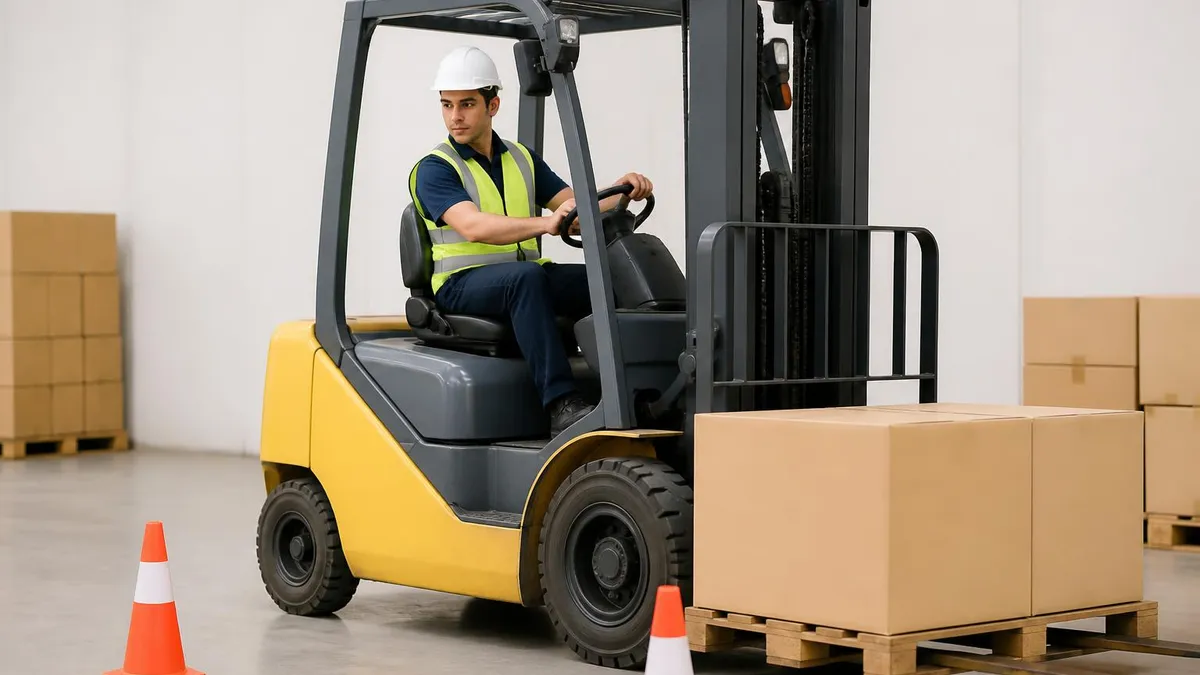
Onsite forklift training and certification anaheim programs have become the fastest, most cost-effective way for warehouses, distribution centers, and manufacturing facilities across Orange County to meet OSHA 29 CFR 1910.178(l) requirements without disrupting daily operations. Instead of sending operators offsite for two or three days at a vocational school, employers bring a certified trainer directly to their facility, where operators train on the exact lull forklift, reach truck, or counterbalance unit they use every shift. The result is faster certification, lower per-operator costs, and dramatically better real-world skill transfer. Practice with the free Forklift certification practice test on PracticeTestGeeks (7 questions with answer explanations).
Anaheim sits at the heart of Southern California's logistics corridor, and the demand for trained, certified forklift operators continues to climb as the Ports of Long Beach and Los Angeles push more freight inland through the Inland Empire. Local employers now compete aggressively for skilled workers, and an OSHA-compliant certification card is the baseline qualification for almost every warehouse job posted within a 30-mile radius. Onsite training removes the bottleneck of scheduling, travel time, and trainer availability that historically slowed hiring.
The legal framework is straightforward but unforgiving. OSHA requires every powered industrial truck operator to receive formal instruction, practical hands-on training, and a workplace-specific evaluation before operating equipment unsupervised. Certifications must be renewed every three years or sooner if the operator is involved in an accident, observed operating unsafely, assigned a new truck type, or moved to a new work environment. Onsite programs satisfy all three OSHA pillars in a single visit, typically four to eight hours per operator group.
Cost is another major driver. Offsite training in the Anaheim area runs $185 to $375 per operator when you factor in tuition, travel, and lost productivity. Onsite group rates routinely drop to $75 to $125 per operator when you certify six or more employees in one session. For a 30-person warehouse, that difference can exceed $7,500 per certification cycle, money that goes directly back into wages, equipment, or safety upgrades like overhead guards and blue spotter lights.
Beyond compliance, the strongest business case for onsite training is accident reduction. The Bureau of Labor Statistics attributes roughly 35,000 serious injuries and 85 fatalities each year to forklift incidents, and OSHA estimates that 70 percent of these are preventable through proper training. Insurance carriers in California increasingly require documented onsite evaluations before renewing workers' compensation policies, and several major Anaheim distribution centers now mandate annual refresher training even though OSHA only requires it every three years.
This guide walks through every element of a compliant onsite program: how to choose a trainer, what curriculum to demand, how the evaluation is conducted, what records you must keep, and how to prepare your operators so they pass the first time. Whether you are a small body shop in Anaheim Hills running a single propane truck or a 500,000-square-foot fulfillment center near the 91 freeway operating dozens of electric reach trucks, the principles are identical, and the path to a fully certified workforce is more accessible than most managers realize.
Use the table of contents below to jump to the section most relevant to your role. Operators looking to pass the written and practical exam should focus on positions four through nine. Employers building a compliance program should read every section, paying particular attention to recordkeeping requirements and the checklist near the end of the article, which doubles as an audit-ready document for OSHA inspections.
Free Forklift certification Study Tools
Interactive Forklift certification resources on PracticeTestGeeks, free to start:
- Forklift Instructions 1 — 7 questions with answer explanations
- Forklift certification flashcards — review key terms and concepts card by card
- Forklift certification study guide — topic-by-topic overview of what the exam covers
- Forklift certification cheat sheet — one-page printable summary for last-minute review
- OSHA requires forklift operators to undergo a performance evaluation at least once every three years. (Occupational Safety and Health Administration (OSHA), U.S. Department of Labor; employers certify operators)
- Forklift operator certification under OSHA requires formal and practical training and an employer evaluation of the operator's workplace performance. (Occupational Safety and Health Administration (OSHA), U.S. Department of Labor; employers certify operators)
- For forklift operator certification, the employer must evaluate the operator's performance and determine that the operator can operate safely before workplace operation. (Occupational Safety and Health Administration (OSHA), U.S. Department of Labor; employers certify operators)
Facts verified Oct 15, 2026 against Occupational Safety and Health Administration (OSHA), U.S. Department of Labor; employers certify operators. Dates that have passed are removed automatically.
Forklift certification Certification Exam at a Glance
| Item | Detail | Official source |
|---|---|---|
| Renewal | Performance evaluation at least every three years | Occupational Safety and Health Administration (OSHA), U.S. Department of Labor; employers certify operators |
| Delivery | Formal instruction, practical training and workplace evaluation | Occupational Safety and Health Administration (OSHA), U.S. Department of Labor; employers certify operators |
| Eligibility | Training and demonstrated competence before workplace operation | Occupational Safety and Health Administration (OSHA), U.S. Department of Labor; employers certify operators |
Facts verified Oct 15, 2026 against Occupational Safety and Health Administration (OSHA), U.S. Department of Labor; employers certify operators. Dates that have passed are removed automatically.
Onsite Forklift Training in Anaheim by the Numbers

How an Onsite Forklift Training Program Is Structured
The trainer reviews your equipment list, facility layout, operator count, and prior certifications. This 30-minute call determines curriculum scope, truck types covered, and whether bilingual instruction is needed for Spanish-speaking operators.
Two to three hours of formal OSHA content covering stability principles, load handling, pedestrian safety, refueling, battery care, and California-specific Cal/OSHA amendments. Delivered in your breakroom or conference area with printed handouts.
A 25 to 40 question multiple-choice exam covering classroom material. Passing score is typically 80 percent. Operators who fail receive immediate remediation and a second attempt the same day at no extra charge.
Each operator performs a pre-shift inspection, completes a controlled driving course, picks and stacks loads at varying heights, and demonstrates emergency procedures on the exact truck they will operate during work shifts.
The trainer signs an OSHA-compliant evaluation form documenting competency on each truck class. You receive wallet cards, certificates, and a master roster within 48 hours, ready for any compliance audit.
OSHA's powered industrial truck standard, 29 CFR 1910.178, is the federal backbone of all forklift training in the United States, and California layers additional Cal/OSHA requirements on top through Title 8, Section 3668. Together, these regulations specify exactly what content must be covered, how operator competency is verified, and how long training records must be retained. Onsite training programs in Anaheim are designed to satisfy both standards simultaneously, which is critical because California enforces stricter penalties than most states.
The training itself breaks into three mandatory components. First, formal instruction covers truck-related topics like operating instructions, differences between truck classes, controls, stability, and refueling, plus workplace-related topics including surface conditions, pedestrian traffic, narrow aisles, ramps, and hazardous atmospheres. Second, practical training requires demonstrations by the trainer and hands-on exercises performed by the operator. Third, an evaluation must verify the operator can perform the job safely in the actual work environment.
Refresher training is triggered by specific events, not just the three-year clock. If a forklift driver is observed operating unsafely, involved in an accident or near-miss, receives an unsatisfactory evaluation, is assigned to a different type of truck, or experiences a workplace change that introduces new hazards, the employer must provide additional training before that operator returns to duty. Onsite programs are uniquely positioned to handle these incident-driven retrains because the trainer can arrive within 24 to 72 hours.
Recordkeeping is where many Anaheim employers stumble during Cal/OSHA inspections. You must document the name of each operator, the date of training, the date of evaluation, and the identity of the person performing the training or evaluation. These records must be available for inspection and retained for as long as the operator remains employed, plus a reasonable period afterward. Most compliance attorneys recommend keeping records for at least five years after separation.
Class-specific certification is another commonly misunderstood requirement. OSHA recognizes seven distinct truck classes, ranging from Class I electric motor rider trucks through Class VII rough terrain forklifts. An operator certified on a sit-down counterbalance is not automatically qualified to operate a stand-up reach truck or a propane-powered Class IV cushion-tire unit. Onsite trainers will list every class covered on the operator's wallet card, which protects both the employee and the employer during audits.
Trainer qualifications matter enormously. OSHA requires the person delivering training to have the knowledge, training, and experience to instruct operators and evaluate competency. There is no federal trainer license, but reputable onsite providers carry credentials from organizations like the National Safety Council, NCCCO, or CITA, and they maintain liability insurance of at least $1 million per occurrence. Always request proof of insurance and trainer credentials before signing a service agreement.
Finally, understand that certification is portable but not transferable. An operator who leaves your facility with a valid card can apply for jobs at other warehouses, but the new employer is still legally required to conduct a site-specific evaluation before allowing that operator on equipment. This is why onsite training in your own facility is so valuable: the evaluation portion happens on the actual equipment, in the actual aisles, under the actual conditions where work will be performed.

Forklift certification Practice Test Questions
Prepare for the Forklift certification Certification exam with our free practice test modules. Each quiz covers key topics to help you pass on your first try.
Forklift certification Certification Forkl...
Forklift certification Exam Questions covering Certification Forklift certification Maintenance and Repairs. Master Forklift certification Test concepts for certification prep.
Forklift certification Certification Forkl...
Free Forklift certification Practice Test featuring Certification Forklift certification Maintenance and Repairs Questions and Answers. Improve your Forklift certification Exam score with mock test prep.
Forklift certification Certification Forkl...
Forklift certification Mock Exam on Certification Forklift certification Operator Training and Certification Requirements. Forklift certification Study Guide questions to pass on your first try.
Forklift certification Certification Forkl...
Forklift certification Test Prep for Certification Forklift certification Operator Training and Certification Requirements Questions and Answers. Practice Forklift certification Quiz questions and boost your score.
Forklift certification Load Handling and S...
Forklift certification Questions and Answers on Load Handling and Stability. Free Forklift certification practice for exam readiness.
Forklift certification OSHA Regulations an...
Forklift certification Mock Test covering OSHA Regulations and Compliance. Online Forklift certification Test practice with instant feedback.
Forklift certification Pre-Operation Inspe...
Free Forklift certification Quiz on Pre-Operation Inspections. Forklift certification Exam prep questions with detailed explanations.
Forklift certification Refueling and Recha...
Forklift certification Practice Questions for Refueling and Recharging Procedures. Build confidence for your Forklift certification certification exam.
Forklift certification Safe Driving and Ma...
Forklift certification Test Online for Safe Driving and Maneuvering. Free practice with instant results and feedback.
Forklift certification Workplace Hazard Id...
Forklift certification Study Material on Workplace Hazard Identification. Prepare effectively with real exam-style questions.
Forklift certification Forklift Instructions
Free Forklift certification Test covering Forklift Instructions. Practice and track your Forklift certification exam readiness.
Forklift certification Forklift MCQ
Forklift certification Exam Questions covering Forklift MCQ. Master Forklift certification Test concepts for certification prep.
Forklift certification Forklift Employer R...
Free Forklift certification Practice Test featuring Forklift Employer Responsibilities. Improve your Forklift certification Exam score with mock test prep.
Forklift certification Forklift Penalties ...
Forklift certification Mock Exam on Forklift Penalties for Non-Compliance. Forklift certification Study Guide questions to pass on your first try.
Forklift Operator Curriculum Breakdown
The classroom portion covers truck stability principles using the stability triangle concept, load center calculations, capacity plate interpretation, and the effects of tilt and elevation on lateral stability. Operators learn to read data plates, calculate derated capacity when attachments are installed, and identify the conditions that cause tip-overs, which account for roughly 24 percent of all forklift fatalities according to NIOSH data.
Additional classroom modules cover pedestrian awareness, blind corner protocols, the three-point contact rule when mounting and dismounting, proper horn usage at intersections, and the specific hazards of operating in refrigerated warehouses, outdoor yards, and loading dock environments. Onsite trainers customize the depth of each module based on your facility's actual hazards rather than teaching generic content.
Onsite vs Offsite Forklift Training: Which Is Better?
- +Training happens on the exact equipment operators will use during their shifts
- +Significantly lower per-operator cost when groups of 6 or more are certified together
- +No travel time, no lost productivity, no transportation logistics for employees
- +Workplace-specific hazards like narrow aisles, dock plates, and outdoor yards are addressed directly
- +Bilingual English and Spanish instruction available for diverse Anaheim workforces
- +Same-day remediation and retesting for operators who initially fail any component
- +Customizable scheduling including swing shift, graveyard, and weekend sessions
- −Requires temporarily clearing a section of the warehouse for the driving course
- −Minimum group size of 4 to 6 operators typically required for the best pricing tier
- −Quality varies dramatically between providers, making credential verification essential
- −Some smaller employers lack a suitable indoor space for inclement weather sessions
- −Equipment must be in safe working condition before practical exercises can begin
- −Trainer availability in peak season can stretch lead times to 2 or 3 weeks
Pros and Cons at a Glance
| Pros | Cons |
|---|---|
| Training happens on the exact equipment operators will use during their shifts | Requires temporarily clearing a section of the warehouse for the driving course |
| No travel time, no lost productivity, no transportation logistics for employees | Quality varies dramatically between providers, making credential verification essential |
| Workplace-specific hazards like narrow aisles, dock plates, and outdoor yards are addressed directly | Some smaller employers lack a suitable indoor space for inclement weather sessions |
| Bilingual English and Spanish instruction available for diverse Anaheim workforces | Equipment must be in safe working condition before practical exercises can begin |

Pre-Training Checklist for Anaheim Employers
- ✓Confirm the trainer carries at least $1 million in general liability insurance with your facility named as additional insured
- ✓Verify the trainer's credentials from NSC, NCCCO, CITA, or an equivalent recognized organization
- ✓Compile a roster of every operator including full legal name, employee ID, and prior certification dates
- ✓Inventory all forklift truck classes operators will need certification on (Class I through VII)
- ✓Schedule equipment maintenance so every truck used in training has current inspection records
- ✓Designate a clear 40-by-60-foot practice area with cones, pallets, and a stacking rack
- ✓Print and distribute pre-reading materials at least 48 hours before classroom instruction
- ✓Coordinate with production supervisors to avoid scheduling conflicts during the training window
- ✓Arrange Spanish or Vietnamese interpretation if any operators need primary-language instruction
- ✓Prepare a digital recordkeeping system to file completion certificates and evaluation forms
Online-only training is NOT OSHA compliant on its own
OSHA explicitly requires hands-on practical evaluation conducted by a qualified trainer who physically observes the operator on the equipment. Online video courses can satisfy the classroom portion, but the practical evaluation must happen in person, on the truck, in the workplace. Employers who rely solely on online certification cards face citations of $16,131 per violation, and operators face significant injury risk.
Pricing for onsite forklift training in Anaheim follows a tiered structure that rewards larger groups. A single operator certification typically runs $185 to $250 because the trainer must still cover travel, classroom prep, and a minimum two-hour onsite commitment. Groups of two to five operators drop to roughly $135 to $175 per person, groups of six to fifteen fall to $85 to $125, and groups of sixteen or more can negotiate flat-rate pricing as low as $65 per operator when bundled with annual refresher contracts.
Travel surcharges apply outside the immediate Anaheim service area. Most providers include free travel within Orange County, with modest fees of $50 to $150 for trips to Long Beach, Riverside, San Bernardino, or northern Los Angeles County. Some providers waive travel entirely for contracts over $2,500 or for repeat customers with quarterly training cycles. Always request the all-in price in writing before signing, because cancellation fees, retest fees, and certificate replacement fees can add up quickly.
Scheduling lead times vary by season. From January through April, most Anaheim providers can dispatch a trainer within 5 to 10 business days. From May through September, when warehouses staff up for back-to-school and pre-holiday inventory, lead times stretch to 2 to 4 weeks. October through December is the busiest period, and major distribution centers often book recurring monthly slots a year in advance to guarantee availability during peak season.
Return on investment calculations consistently favor onsite training for any operation with more than four operators. A single recordable forklift injury costs an employer an average of $135,000 when you factor in direct medical costs, workers' compensation premium increases, lost productivity, OSHA fines, and legal exposure. Preventing just one such incident over a three-year certification cycle through better training delivers a return of more than 100 times the program cost for a 20-operator warehouse.
Insurance benefits compound the savings. Several major California workers' compensation carriers now offer experience modifier credits of 3 to 7 percent for facilities that document annual onsite refresher training, even though OSHA only requires it every three years. For a warehouse with an annual payroll of $3 million, that credit can equal $5,000 to $12,000 per year, often paying for the entire training program multiple times over.
Bundled service contracts are increasingly popular among Anaheim's larger employers. Under a typical annual agreement, the provider commits to certifying all new hires within 14 days, conducting two refresher visits per year, and handling all incident-driven retrains at no additional charge. Pricing is usually structured as a monthly retainer of $400 to $1,200 depending on headcount, which simplifies budgeting and eliminates the administrative burden of scheduling one-off sessions.
Government training credits sometimes apply for California employers. The Employment Training Panel administers grants that can reimburse 50 to 100 percent of forklift training costs for incumbent worker upskilling, particularly for small manufacturers and warehouses with fewer than 100 employees. The application process takes 60 to 90 days, but for larger training initiatives the reimbursement can fully fund a year of onsite programming.
Cal/OSHA conducted more than 4,200 warehouse-focused inspections statewide in the past 12 months, with Orange County and the Inland Empire identified as priority enforcement regions. Missing or expired forklift certifications carry per-violation penalties up to $16,131 for serious violations and $161,323 for willful or repeated violations. Maintain digital copies of every certificate and evaluation form, organized by employee, ready for instant retrieval.
Passing the written and practical exam on the first attempt comes down to preparation, repetition, and understanding what evaluators actually look for. Operators who study the OSHA-recommended pre-reading materials, take at least two practice tests, and walk through the equipment's data plate and controls before the session almost always pass cleanly. Those who arrive cold typically struggle with capacity calculations, stability principles, and the specific terminology used in multiple-choice questions.
For the written portion, focus your study on five high-yield topics: the stability triangle and how load center affects capacity, the seven OSHA truck classes and what powers each one, pre-shift inspection requirements, pedestrian right-of-way rules at intersections and blind corners, and refueling or recharging safety. These five areas typically account for 60 to 70 percent of the questions on any reputable certification exam, and missing the basics on any of them is the most common reason operators fail.
The practical exam favors slow, deliberate, narrated operation over speed. Evaluators want to see you sound the horn at every intersection, look in the direction of travel, maintain a four-foot following distance from pedestrians, and travel with the load tilted back and four to six inches off the ground. Rushing through cone courses to look skilled is a frequent cause of dropped points, especially when operators clip cones or fail to come to a complete stop at marked positions.
Pre-shift inspections deserve special attention because evaluators almost always include them in the practical scoring rubric. Memorize the inspection sequence for your specific truck type and verbalize each check as you perform it. Walk around the truck, check forks for cracks and wear, examine chains for stretch and proper tension, look under the truck for hydraulic leaks, test the horn and lights, verify the seat belt operates correctly, and confirm the parking brake holds on a slight incline.
The single most overlooked skill on practical exams is proper dismount technique. Operators routinely jump down from the seat, skip the three-point contact rule, or step off without setting the parking brake and lowering the forks. This costs easy points and signals to the evaluator that an operator has been cutting corners. Practice the full dismount: lower forks fully, set parking brake, place controls in neutral, turn off the key, then face the truck and use three points of contact while stepping down.
Stand-up reach trucks deserve separate practice if your facility uses them. The operating position, controls, and visibility characteristics differ significantly from sit-down counterbalance trucks, and operators certified only on counterbalance equipment frequently fail when first evaluated on stand-up models. Spend at least 30 minutes operating any new truck class before the practical exam to build muscle memory for the deadman switch, multi-function joystick, and braking dynamics.
Finally, take advantage of free online practice tests in the weeks before your session. Sites like this one offer hundreds of OSHA-aligned questions covering every topic that appears on real certification exams. Aim to score 90 percent or higher on three consecutive practice tests before training day. If you are an employer, distribute practice test links to operators when you confirm their training schedule, and make completion of at least one practice round a prerequisite for attending the session.
Day-of-training preparation is what separates smooth, successful sessions from frustrating, expensive ones. Operators should arrive 15 minutes early, wear closed-toe steel-toe boots, bring a government-issued photo ID, and have a pen ready for the written exam. Loose clothing, jewelry, and any item that could catch on controls or pallets must be removed before practical exercises begin. Long hair must be tied back, and any operator wearing prescription glasses should bring a backup pair in case of damage.
Employers should designate a single point of contact who can answer the trainer's questions about facility layout, equipment specifications, and operator schedules without interrupting production. This contact should also handle distribution of wallet cards, filing of evaluation forms, and updating the human resources system with new certification dates. Trying to coordinate these tasks reactively after the trainer leaves typically delays card issuance by a week or more and creates compliance gaps.
If you operate specialty equipment like order pickers, telehandlers, or rough-terrain forklifts, request that the trainer include those classes during the same visit. Adding additional truck classes typically costs $25 to $50 per operator per class, far less than scheduling a separate visit later. Some community forklift dealers in Anaheim also bundle attachment training, covering side-shifters, fork positioners, and clamps, which can save additional money for operations that use multiple attachments throughout the workday.
Refresher training between full recertification cycles is one of the highest-ROI safety investments available to warehouse operators. A two-hour annual refresher costs $35 to $60 per operator when bundled with full certification contracts, and it dramatically reduces near-miss incidents in the months that follow. Topics that benefit most from annual reinforcement include pedestrian awareness, blind corner protocols, proper fork positioning, capacity derating with attachments, and emergency response procedures for tip-overs.
Recordkeeping discipline pays dividends during Cal/OSHA inspections, workers' compensation audits, and unemployment claims. Maintain a single digital folder per employee containing the original training certificate, the wallet card image, the workplace evaluation form, all refresher training dates, and any incident-driven retraining documentation. Cloud-based learning management systems like SafetyCulture, KPA, and Vector Solutions can automate expiration alerts, which prevents the most common compliance failure of letting cards lapse unnoticed.
Finally, build a culture where operators feel empowered to report defective equipment without fear of retaliation. The single best predictor of long-term forklift safety performance is the rate at which operators voluntarily tag out unsafe trucks. Facilities that average more than one tag-out per truck per quarter consistently have lower recordable injury rates than facilities that average less than one tag-out per truck per year, even after controlling for fleet size and operating hours. Onsite trainers can help build that culture by modeling the behavior and explicitly granting operators permission to stop work.
The path from untrained employee to fully certified, productive forklift operator in Anaheim is shorter and more affordable than many employers assume. With proper preparation, the right trainer, and a commitment to ongoing reinforcement, your workforce can be OSHA-compliant within a week of scheduling. Use this guide as your reference, take the practice tests linked throughout, and treat certification not as a regulatory checkbox but as the foundation of a safer, more profitable operation.
Sample Forklift certification Practice Questions
Try these questions from our free Forklift certification practice tests. The correct answer and an explanation follow each question.
What is the minimum age OSHA sets for operating a forklift in a non-agricultural workplace?
- A. 16 years
- B. 18 years
- C. 21 years
- D. No minimum
Answer: B. 18 years
OSHA prohibits anyone under 18 from operating a forklift in non-agricultural employment.
An employee has been operating the same counterbalanced forklift safely for five years. Workplace conditions and the type of forklift have not changed. According to OSHA 29 CFR 1910.178(l)(4), what is the MAXIMUM interval at which this operator must receive refresher training and an evaluation?
- A. Every year.
- B. Only after an accident or near-miss.
- C. Every five years.
- D. At least once every three years.
Answer: D. At least once every three years.
OSHA standard 1910.178(l)(4)(iii) mandates that all forklift operators must be evaluated at least once every three years to ensure their skills are current. Refresher training is also required sooner if the operator is involved in an accident, is observed operating unsafely, is assigned to a different truck, or if workplace conditions change.
If a forklift begins to tip over sideways, what is the OSHA-recommended action for the operator?
- A. Jump away from the forklift immediately
- B. Stay in the seat, grip the steering wheel, and brace for impact
- C. Stand up in the seat and leap toward higher ground
- D. Try to shift the load to rebalance the forklift
Answer: B. Stay in the seat, grip the steering wheel, and brace for impact
OSHA recommends operators stay in the seat, grip the wheel firmly, brace feet, and lean away from the fall direction — jumping out is more likely to result in being crushed.
According to OSHA regulations (29 CFR 1910.178), when must a forklift pre-operation inspection be performed?
- A. Only when a new operator uses the forklift
- B. At the beginning of each shift or daily, whichever is more frequent
- C. Once per week, if the forklift is used regularly
- D. After the forklift has been refueled or recharged
Answer: B. At the beginning of each shift or daily, whichever is more frequent
OSHA standard 29 CFR 1910.178(q)(7) mandates that powered industrial trucks must be inspected at least daily before being used. If a forklift is used around the clock, it must be inspected after each shift.
Forklift Questions and Answers
Forklift Tires: Complete Guide to Types, Sizing, Wear Patterns, and Replacement Costs
Forklift Accessories: Complete Guide to LED Lights, Attachments, Safety Gear, and Productivity Upgrades for 2026
Forklift License Renewal: Complete Guide to Forklift License Expiry, OSHA Recertification, and Operator Requirements for 2026
Forklift Safety Training: Complete OSHA Compliance Guide for Operators and Employers
Forklift Repair Service: Complete Guide to Costs, Common Repairs, and Choosing the Right Technician
How this page was made: written with AI tools and published by Nathan Beja, founder of Practice Test Geeks, who is responsible for its content. Exam facts are checked against the official sources listed below. Not reviewed by a subject-matter expert. Editorial policy
Sources & references
Exam facts on this page (fees, format, dates, passing scores) are checked against these official sources; the date is our last check. Editorial policy
- osha.gov — Test delivery, eligibility, renewal · verified Oct 2026