
Forklift Mechanic Jobs — Complete Guide (2026)
Forklift mechanic jobs pay $42K–$72K with strong demand. 🏆 Duties, ASE certs, OEM training, salary, top employers, and how to land a service tech role.
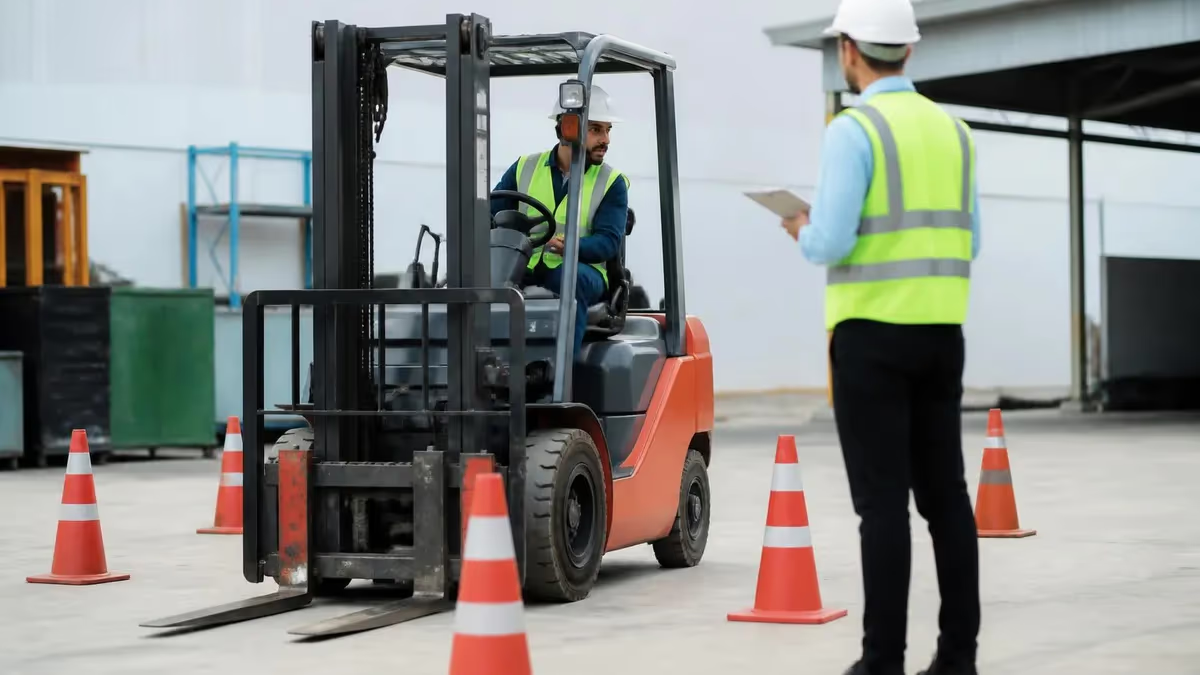
Forklift Mechanic Jobs: Career Guide (2026)
The median forklift mechanic earned $54,310 in 2024 — and senior service techs crack $80K with overtime. That's BLS data for the broader industrial machinery mechanic category, and forklift specialists sit near the top of the band because the work mixes hydraulics, electrical, propane, and diagnostics on one machine. Demand is steady. Warehouses don't slow down, and every forklift on the floor needs a tech to keep it moving. Practice with the free Forklift certification practice test on PracticeTestGeeks (7 questions with answer explanations).
This guide walks through what forklift mechanic jobs actually involve day to day, which certifications get you hired faster, salary ranges by experience and region, and the employers that hire the most. You'll also see the difference between field service and shop tech roles — they pay similar money but the lifestyle is wildly different.
Short answer up front: if you've got mechanical aptitude, a clean driving record, and you're willing to do OEM training (Toyota, Crown, Hyster-Yale, Linde, KION), you can land an entry-level forklift technician role inside 90 days. Hourly starts around $20–$24, jumps to $28–$34 after one year. Diesel and electric specialists earn more than gas-only techs. Field service techs add a company truck and per-diem on top.
Before we dig into duties and certs, brush up on forklift fundamentals — knowing how operators use the equipment makes you a better mechanic. A short refresher on forklift training covers controls, mast operation, and the lift cylinder mechanics you'll be fixing every week. You don't need to be a licensed operator, but you do need a forklift certification card to test-drive units after a repair.
Worth knowing: the role goes by several names. Material Handling Equipment (MHE) Technician. Industrial Equipment Mechanic. Forklift Service Tech. Lift Truck Mechanic. Forklift Maintenance Technician. Forklift Repair Technician. Forklift Truck Mechanic. All the same job. Different employers, different titles.
- OSHA requires forklift operators to undergo a performance evaluation at least once every three years. (Occupational Safety and Health Administration (OSHA), U.S. Department of Labor; employers certify operators)
- Forklift operator certification under OSHA requires formal and practical training and an employer evaluation of the operator's workplace performance. (Occupational Safety and Health Administration (OSHA), U.S. Department of Labor; employers certify operators)
- For forklift operator certification, the employer must evaluate the operator's performance and determine that the operator can operate safely before workplace operation. (Occupational Safety and Health Administration (OSHA), U.S. Department of Labor; employers certify operators)
Facts verified Oct 15, 2026 against Occupational Safety and Health Administration (OSHA), U.S. Department of Labor; employers certify operators. Dates that have passed are removed automatically.
Forklift certification Certification Exam at a Glance
| Item | Detail | Official source |
|---|---|---|
| Renewal | Performance evaluation at least every three years | Occupational Safety and Health Administration (OSHA), U.S. Department of Labor; employers certify operators |
| Delivery | Formal instruction, practical training and workplace evaluation | Occupational Safety and Health Administration (OSHA), U.S. Department of Labor; employers certify operators |
| Eligibility | Training and demonstrated competence before workplace operation | Occupational Safety and Health Administration (OSHA), U.S. Department of Labor; employers certify operators |
Facts verified Oct 15, 2026 against Occupational Safety and Health Administration (OSHA), U.S. Department of Labor; employers certify operators. Dates that have passed are removed automatically.
Free Forklift certification Study Tools
Interactive Forklift certification resources on PracticeTestGeeks, free to start:
- Forklift Instructions 1 — 7 questions with answer explanations
- Forklift certification flashcards — review key terms and concepts card by card
- Forklift certification study guide — topic-by-topic overview of what the exam covers
- Forklift certification cheat sheet — one-page printable summary for last-minute review

- Median pay: $54,310/yr ($26.11/hr) — BLS 2024 data
- Top 10% earn: $80,000+ (senior field service techs, dealership leads)
- Entry-level start: $42,000–$48,000 ($20–$23/hr)
- Job growth: 5% through 2032 (faster than average)
- Training time: 6 months (OEM) to 2 years (UTI/Lincoln Tech)
- Top certs: ASE T-series, OSHA forklift cert, OEM (Toyota, Crown, Hyster-Yale)
- License needed: CDL Class B for most field service roles
Forklift Mechanic Career at a Glance
What a Forklift Mechanic Actually Does
A forklift mechanic — or service technician, depending on who's writing the paycheck — diagnoses, repairs, and maintains powered industrial trucks. That's the official OSHA term for forklifts, reach trucks, order pickers, pallet jacks, and the whole material-handling family. The job mixes mechanical, hydraulic, and electrical work on machines that lift 3,000 to 35,000 pounds.
Daily Duties
Most days start with a work order from dispatch. You drive to a warehouse, pull the unit aside, and start with a visual inspection. Forks, chains, hoses, tires, mast, overhead guard. From there it's diagnostic work — hooking a laptop to the truck's controller (Toyota's PMS, Crown's Access1, Linde's LDM software) to pull fault codes. Most modern forklifts log thousands of operating parameters.
Hydraulic repairs are constant. Lift cylinders leak. Tilt cylinders bind. Hoses crack. You'll rebuild more cylinders than you can count in year one. Forks themselves wear and have to be measured against OSHA's 10% wear rule — once the heel thickness drops 10% below new, the fork is condemned and replaced.
Electrical work depends on the truck type. Class I sit-down electrics run 36V or 48V battery packs with AC traction motors. You'll test cells, check water levels, repair contactors, troubleshoot regen braking, and replace control modules. Internal combustion units — Class IV (cushion-tire) and Class V (pneumatic) — run gas, diesel, or LPG. LPG is the most common in warehouses because it burns clean enough for indoor use. Propane regulators fail constantly. So do vaporizers.
Preventative Maintenance
PM service is bread and butter. Every 250 operating hours a forklift needs oil, filters, hydraulic fluid checked, brake adjustment, mast lubrication, and inspection of the load-bearing parts. A busy fleet of 40 trucks generates roughly one PM per workday. Steady work, predictable hours.
If you're considering the operator side first — many techs start there — review forklift operator training requirements. Operating experience makes you a sharper diagnostician because you understand how operators actually use (and abuse) the equipment. And you'll need OSHA forklift certification anyway to road-test units after a repair.
Forklift Classes You'll Service
What it is: Battery-powered counterbalance forklifts, the classic warehouse workhorse. 36V or 48V lead-acid or lithium-ion packs.
Main repairs: Battery cell replacement, contactor swaps, controller diagnostics, AC traction motor rebuilds, hydraulic pump service. Charger troubleshooting too — chargers fail more than the trucks.
Major brands: Toyota 8FBE, Crown SC, Hyster J-series, Yale ERP, Raymond.
Training Paths and Certifications
You don't need a four-year degree. You don't even need an associate degree — though it helps. What you need: mechanical aptitude, basic electrical theory, hydraulic fundamentals, and the willingness to learn OEM-specific software.
OEM Training Programs (The Fast Track)
The major manufacturers run their own tech schools. Toyota Material Handling's tech program is 24 months, mostly on-the-job with classroom blocks at Toyota's Columbus, Indiana training center. Crown Equipment's program runs about 6 months and is paid. Hyster-Yale runs a similar accelerated track. Linde's North America program is shorter but heavier on European-style electrical systems. These are dealer-based — you apply to a dealership, they put you through the OEM curriculum.
Why OEM matters: the laptop diagnostics are proprietary. A Toyota tech can plug into any Toyota, but Crown's software won't talk to a Toyota truck and vice versa. The big dealerships will pay for cross-training in your second or third year if you stick around.
Trade School Path (UTI, Lincoln Tech)
Universal Technical Institute (UTI) and Lincoln Tech both run diesel/industrial mechanic programs that include forklift modules. Programs run 12 to 24 months, cost $20,000 to $40,000, and finish with industry certifications. The advantage: you graduate with broad skills covering diesel engines, hydraulics, and electrical — useful if you want to switch to heavy equipment later.
ASE Certifications
The Automotive Service Excellence (ASE) Medium/Heavy Truck series (T1 through T8) covers most of what a forklift tech needs to know. T2 (Diesel Engines), T3 (Drive Train), T5 (Brakes), and T6 (Electrical) are the most relevant. Each test costs $51. Pass all required tests plus document two years of work experience and you're ASE-certified — a $2–$4/hour raise at most dealerships.
Other Required Credentials
CDL Class B is required for most field service roles because you'll drive a service truck with a crane or compressor over 26,001 lbs GVWR. Some dealerships hire without it but require you to get it within 6 months. Cost: $3,000–$7,000 if you go through a CDL school. Cheaper if your employer sponsors it.
OSHA forklift operator certification is mandatory because you'll test-drive every unit you service. The card is good for 3 years and most dealers issue it in-house during onboarding.
Manufacturer-specific certifications go deeper than ASE. Toyota Tech, Crown Tech, Hyster-Yale University, Komatsu Connect, and Linde Service Academy each run multi-module curriculums that pair classroom instruction with structured shop time. Completing one full OEM track usually takes 18–24 months. Cross-training on a second OEM brand earns you another $3–$5 per hour at most dealerships. The honest answer: pick the brand your local dealer carries, then add a second brand when you're ready to job-hop in year four or five.

Training Costs Comparison
Salary, Top Employers, and Where the Jobs Are
Forklift mechanic pay scales hard with experience and specialty. Here's the honest spread.
Pay by Experience Level
Entry-level apprentice techs (year 1) earn $20–$24/hour, roughly $42,000–$50,000/year. The role is mostly PM service — oil changes, filters, basic brake work — under direct supervision. After 12 months passing core OEM modules, you'll see $26–$30/hour or $54,000–$62,000.
Journeyman techs (years 3–7) with full OEM certification and at least two ASE tests earn $30–$36/hour, $62,000–$75,000. Field service techs at this level often add $300–$600/week in overtime and per diem. Master techs and shop foremen (8+ years) clear $80,000 and frequently $90,000+ at major dealerships in high-cost areas.
Where the Jobs Are
The hiring hotspots track warehouse density. Ports drive massive demand because container freight requires forklifts, reach stackers, and yard tractors at every step. The Los Angeles/Long Beach corridor, Savannah, Houston, and northern New Jersey are saturated with dealerships and in-house fleets. Inland warehousing hubs — Memphis, Indianapolis, Columbus OH, Dallas, Atlanta — also run hot. If you live near an Amazon fulfillment center, Walmart distribution hub, or FedEx ground facility, there's a forklift mechanic shortage within 20 miles of you.
Top Employers
Dealerships hire the bulk of forklift mechanics. Toyota Material Handling dealers (Toyota Lift, ProLift), Crown Equipment branches, Hyster-Yale dealers (Briggs Equipment, MH Equipment), Linde Material Handling, KION (Linde + Baoli + Dematic), and Mitsubishi/Caterpillar Forklift dealers collectively employ tens of thousands of techs in North America. They pay well, train well, and offer a clear promotion ladder.
In-house fleets are the other path. Large warehouses keep their own techs on payroll — Amazon's Reliability Maintenance Engineering (RME) team is one of the biggest in-house programs in the country, with techs at every fulfillment center. Walmart distribution centers, FedEx ground hubs, UPS, Home Depot DCs, and Target import warehouses all run in-house teams. Hourly rates are similar to dealerships, but the benefits packages (especially Amazon's RTE tier-1 stock grants) often beat dealership total comp.
Field Service vs Shop Tech
Field service techs drive a service van with parts, tools, and a small crane to customer warehouses. You work alone or with one helper, see five customers a day, and your job is to keep the customer's downtime to zero. Field service pays $2–$4/hour more than shop work and adds company-vehicle commuting. The downside: you eat lunch in your van, and weather happens. Snow, heat, dusty warehouses — all part of the gig.
Shop techs work at the dealership, doing heavier rebuilds and overhauls that the field can't handle. Engine swaps, mast rebuilds, full repaints, transmission overhauls. Cleaner work environment, predictable hours, less driving. Pay is slightly lower but the work is more interesting if you like deep wrenching.
If you want the full picture, the forklift mechanic jobs guide walks through it step by step.
Related reading: forklift mechanic jobs covers the next step in more detail.
Forklift Mechanic Career — Honest Trade-offs
- +Strong demand — every warehouse needs techs, recession-resistant
- +Entry without a degree — apprentice in 90 days with OEM training
- +Pay grows fast — $20/hr entry to $36/hr journeyman in 3–5 years
- +Clear ladder — apprentice to journeyman to master to shop foreman
- +Variety of work — mechanical, hydraulic, electrical, diagnostic
- +Employer-sponsored CDL and OEM training (no out-of-pocket cost)
- +Field service techs get company vehicle plus per diem
- +Lithium-ion conversion boom is creating a wave of new openings
- −Physically demanding — lifting cylinders, climbing into mast assemblies
- −Battery work involves acid and serious electrical hazards
- −On-call rotations for emergency breakdowns (nights, weekends)
- −Warehouses are hot in summer, freezing in winter — no climate control
- −Tools are expensive ($5K–$15K personal investment in year 1)
- −Software learning curve is steep with each new OEM brand
Pros and Cons at a Glance
| Pros | Cons |
|---|---|
| Strong demand — every warehouse needs techs, recession-resistant | Physically demanding — lifting cylinders, climbing into mast assemblies |
| Clear ladder — apprentice to journeyman to master to shop foreman | Battery work involves acid and serious electrical hazards |
| Variety of work — mechanical, hydraulic, electrical, diagnostic | On-call rotations for emergency breakdowns (nights, weekends) |
| Employer-sponsored CDL and OEM training (no out-of-pocket cost) | Warehouses are hot in summer, freezing in winter — no climate control |
| Field service techs get company vehicle plus per diem | Software learning curve is steep with each new OEM brand |
How to Land Your First Forklift Mechanic Job
Three real paths, ranked by speed to paycheck.
Path 1: Apply Directly to Dealerships
This is the fastest. Toyota Material Handling, Crown Equipment, Hyster-Yale dealerships, Linde branches — all have career pages and most run paid apprentice programs. You don't need experience, but you need to demonstrate mechanical aptitude in the interview. They'll usually give you a hands-on test: identify a tool, describe a hydraulic system, troubleshoot a basic circuit. Pass that and they'll start you Monday at $20–$22/hour with OEM training built into the job.
Best dealerships to target: Briggs Equipment (Hyster-Yale, big network in Texas/Southeast), ProLift Toyota (Midwest), MH Equipment (Caterpillar/Mitsubishi, Midwest), Raymond West (Raymond Class II/III, West Coast), Russell Equipment (Toyota, Northeast).
Path 2: In-House Warehouse Fleets
Apply at Amazon RME, Walmart distribution centers, FedEx Ground hubs, UPS, Home Depot DCs, and Target import warehouses. Amazon RME is huge and well-paid — tier 1 techs start around $24–$28/hour with full benefits and RSUs. The hiring is rolling. Look for "Reliability Maintenance Engineering Technician" or "MHE Technician" on amazon.jobs.
Path 3: Trade School First
If you don't have any mechanical background, UTI's Industrial Maintenance program or Lincoln Tech's diesel/industrial track gives you 12–18 months of structured learning. Cost is high, but you graduate hireable across multiple equipment categories — forklifts, telehandlers, skid steers, scissor lifts.
Job Boards That Actually Work
Indeed and ZipRecruiter cover the bulk of postings. Material Handling Equipment Distributors Association (MHEDA) has a dealer-direct board with the cleanest job pool — fewer ghost listings, real positions only. The Associated General Contractors (AGC) job board lists some of the larger construction-tied forklift roles. LinkedIn is decent for field service supervisor and shop foreman roles, less useful for apprentice tech.
What to Put on the Resume
Three things employers scan for. One: any mechanical experience — auto shop, motorcycle work, even home renovation counts. Two: any electrical or hydraulic exposure — high school shop class, military MOS, family business. Three: forklift operator experience. If you've operated a lift truck for a year in a warehouse, you already understand the equipment. That's a huge leg up. Even a basic OSHA card from a previous warehouse job moves you to the top of the apprentice stack.

Your Path to Master Forklift Tech
Months 0–3: Apply & Onboard
Months 4–12: Apprentice Year
Year 2: First OEM Cert
Years 3–5: Journeyman
Years 6–10: Master Tech
Specializations That Pay More
Once you're past year three, specialization is where the money jumps. A few directions worth knowing about.
Lithium-Ion Conversion Specialist
Warehouses are swapping lead-acid for lithium-ion battery packs at a frantic pace. The labor is specialized — high-voltage isolation, battery management system (BMS) diagnostics, charger reconfiguration. Techs certified on BSL Battery, Flux Power, Green Cubes, or OneCharge systems earn $4–$8/hour above their journeyman base. Some dealers now run lithium-only service teams.
Telehandler and Rough-Terrain
JLG, Genie, and Manitou rough-terrain forklifts and telehandlers run on different drivetrains than warehouse units — 4WD, tier-4 diesels, longer hydraulic booms. Mechanics certified across both lift truck and telehandler categories command premium rates at construction-equipment dealerships.
Hydrogen Fuel Cell Service
Plug Power and Ballard hydrogen fuel cell forklifts are growing in large fulfillment centers (Amazon, Walmart, BMW plants). Service requires hydrogen safety certification plus electrical training. Niche skill, premium pay, limited locations.
Field Service Supervisor / Shop Foreman
Move into management around years 8–12. You stop wrenching and start dispatching. Salary jumps to $85K–$110K plus bonus. Less hands-on, more spreadsheets. Some techs love it, others hate it. Worth trying for a year before committing.
Independent Repair
A handful of senior techs go independent — open a one-truck mobile shop or a small dealer-independent repair business. Income potential is high ($150K+) but you eat the overhead, insurance, and parts inventory. The path is harder than it looks. Recommended only after 10+ years on the dealer side, with strong customer relationships already built.
If you're still weighing whether the trade is right for you, look at the day-to-day work of an operator first — the forklift certification path is short, cheap, and gives you real warehouse experience before committing to the mechanic ladder.
Where the Trade Is Going
Three forces are reshaping the work over the next decade. First, lithium-ion batteries are replacing lead-acid across most Class I and Class III fleets — that means BMS diagnostics and high-voltage isolation are becoming core skills, not specialty add-ons. Second, telematics and remote monitoring let dealers schedule predictive maintenance instead of waiting for breakdowns. Third, hydrogen fuel cell rollout at large fulfillment centers is creating a small but high-paying niche. Techs who learn the new powertrains early earn premium rates by year five.
Forklift Mechanic Salary by Career Stage
- Salary: $54,310/yr
- Hourly: $26.11
- Source: BLS 2024
- Salary: $42K–$48K
- Hourly: $20–$23
- Role: Apprentice / shadow tech
- Salary: $62K–$75K
- Hourly: $30–$36
- Cert: OEM + 1–2 ASE
- Salary: $80K–$95K
- OT Boost: +$5K–$15K
- Role: Foreman / lead
- Add: +$3K–$8K/yr
- Vehicle: Company truck
- Per Diem: $50–$80/day
- Premium: +15–20%
- Hotspots: LA, NJ, Savannah, Houston
- Demand: Constant
First-Year Forklift Mechanic Checklist
- ✓Get OSHA forklift operator certification card (week 1)
- ✓Buy starter tool set — Snap-On / Matco / Mac, $3K–$5K (financing via dealer)
- ✓Complete OEM Module 1 (basics, safety, intro to controls)
- ✓Pass ASE T6 (Electrical) — best first ASE test for forklift work
- ✓Shadow a journeyman on at least 50 PM services before solo work
- ✓Get CDL Class B permit (if not already licensed)
- ✓Learn at least one OEM diagnostic software fluently (Toyota PMS, Crown Access1, etc)
- ✓Join MHEDA or local industry chapter — networking matters by year 2
- ✓Document every repair in a personal logbook — speeds promotion review
Sample Forklift certification Practice Questions
Try these questions from our free Forklift certification practice tests. The correct answer and an explanation follow each question.
To keep the forklift stable, the combined center of gravity must remain:
- A. Outside the stability triangle
- B. Within the stability triangle
- C. Directly over the rear axle
- D. As high as possible
Answer: B. Within the stability triangle
The truck stays upright only while the combined center of gravity stays inside the stability triangle.
When should a forklift be tagged out of service?
- A. At the end of each shift
- B. Only when the engine fails completely
- C. Whenever a defect that affects safe operation is found
- D. Once a week for routine maintenance
Answer: C. Whenever a defect that affects safe operation is found
A forklift must be taken out of service and tagged immediately when any unsafe defect is identified during inspection or operation.
The overhead guard on a forklift should be inspected to confirm it is:
- A. Painted a bright color
- B. Free of cracks, bends, and secure
- C. Removable for tight spaces
- D. Equipped with a light
Answer: B. Free of cracks, bends, and secure
The overhead guard protects the operator from falling objects and must be structurally sound.
What should you do before driving a forklift down a ramp with a load?
- A. Drive forward with the load pointed downhill
- B. Drive in reverse with the load pointed uphill
- C. Turn sideways to reduce speed
- D. Raise the load to full height
Answer: B. Drive in reverse with the load pointed uphill
On a ramp with a load, keep the load pointed uphill and travel in reverse when going down to prevent the load from sliding off or the truck tipping.
Forklift Questions and Answers
Related Forklift Career Guides
Forklift Driver: Complete Career Guide
Forklift Operator: Job Duties, Pay & Certification Requirements
Forklift Jobs: Requirements, Salary, and How to Get Hired
Forklift Repair: Common Issues, Costs, and Decision-Making
OSHA Forklift Certification: 29 CFR 1910.178 Training, Evaluation & Recertification Guide
How this page was made: written with AI tools and published by Nathan Beja, founder of Practice Test Geeks, who is responsible for its content. Exam facts are checked against the official sources listed below. Not reviewed by a subject-matter expert. Editorial policy
Sources & references
Exam facts on this page (fees, format, dates, passing scores) are checked against these official sources; the date is our last check. Editorial policy
- osha.gov — Test delivery, eligibility, renewal · verified Oct 2026