
Infant CPR Course: Complete 2026 October Training Guide for Babies Under 12 Months
📚 Complete infant CPR course guide: certification options, ACLS algorithm basics, step-by-step techniques, costs, and how to choose the right training
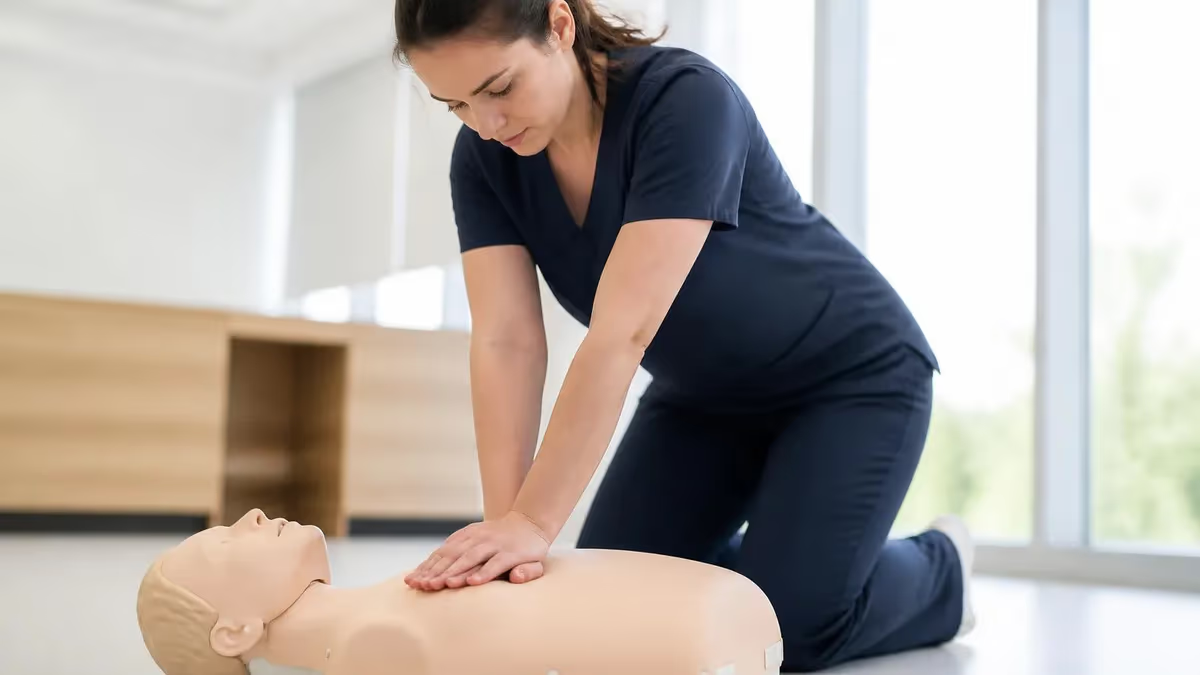
An infant CPR course teaches you exactly how to respond when a baby under 12 months stops breathing or loses a pulse, and it is one of the most consequential two hours a parent, grandparent, nanny, or daycare worker can spend. The techniques differ dramatically from adult resuscitation because infant anatomy, respiratory rate, and circulation respond uniquely to compressions and rescue breaths. A quality infant cpr course covers infant CPR mechanics, choking relief, AED use on small bodies, and the recognition signals that distinguish a sleeping baby from one in cardiac arrest.
The American Heart Association reports that more than 7,000 children under age 18 experience out-of-hospital cardiac arrest each year in the United States, and survival rates climb sharply when a bystander begins CPR within the first minute. For infants specifically, respiratory causes drive most arrests — choking, suffocation, drowning, or sudden infant death syndrome — which means rescue breaths play a far larger role than in adult cases where chest compressions alone often suffice.
Modern courses are built around the same chain-of-survival framework that underpins the acls algorithm used by hospital teams, but scaled down to the gentler force, faster rate, and smaller airway of a baby. You will learn to compress with two fingers or two thumb-encircling hands, deliver puffs of air rather than full breaths, and recognize the subtle signs of deterioration that infants show before collapse. The curriculum balances science with muscle memory.
Course providers range from the American Heart Association and American Red Cross to the national cpr foundation and dozens of OSHA-aligned online platforms. Prices typically range from free community classes to $90 blended courses with in-person skills verification. Certification cards are usually valid for two years, after which a brief renewal course refreshes the techniques and incorporates updated guidelines from the International Liaison Committee on Resuscitation.
Who actually needs this training? New parents top the list, but childcare licensing in nearly every state now requires infant CPR for daycare staff, nannies, build parents, pediatric nurses, lifeguards at family pools, and many youth sports coaches working with infants in parent-and-me classes. Even babysitters as young as 13 can take age-appropriate versions through programs like the Red Cross Babysitter's Training, which weaves infant CPR into a broader child safety curriculum.
The good news is that infant CPR is learnable, repeatable, and durable. Studies tracking skill retention show that hands-on practice with a manikin produces correct compression depth and rate up to six months after training, while purely video-based learning fades within weeks. That is why hybrid courses — online theory plus a live skills session — have become the gold standard for busy adults who want both schedule flexibility and confidence that their hands will know what to do under pressure.
This guide walks you through every dimension of choosing and completing an infant CPR course: what topics get covered, how providers differ, what each step of infant CPR actually involves, common mistakes, cost ranges, recertification timelines, and the practical decisions that separate a course you finish from one you actually remember. By the end you will know exactly which class to sign up for, what to expect on training day, and how to keep your skills sharp between renewals.
Infant CPR Course by the Numbers

What a Typical Infant CPR Course Covers
Scene Safety & Assessment
Calling for Help & AED Retrieval
Chest Compressions Technique
Rescue Breaths & Airway
Choking Relief Sequence
Skills Test & Certification
Infant CPR diverges from adult CPR in nearly every measurable way, and understanding those differences is the entire reason a dedicated infant cpr course exists. The infant heart sits higher in the chest, the airway is narrower and more easily obstructed, the bones are softer, and the normal respiratory rate is roughly 30 to 60 breaths per minute compared to 12 to 20 in an adult. Applying adult force or adult breath volume to a baby can fracture ribs, rupture lung tissue, or push air into the stomach instead of the lungs.
The first major contrast is compression depth. For an adult you compress at least two inches; for a child about two inches; for an infant about 1.5 inches, or roughly one-third the depth of the chest. Force comes from fingers or thumbs rather than a stacked-palm heel-of-hand technique, and the rescuer's body weight stays off the baby entirely. Getting this calibration wrong is the most common error new trainees make on the manikin.
The second contrast is the breath-to-compression ratio. For a single-rescuer infant scenario the ratio is 30 compressions to 2 breaths, identical to adult CPR. But when two rescuers are present, infant ratio shifts to 15:2 — more frequent breath delivery because oxygen demand is higher in pediatric arrests where the cause is usually respiratory rather than cardiac. This shift never happens with adults and catches many trainees off guard during skills testing.
The third contrast is AED use. Pediatric attenuator pads or a pediatric AED setting are preferred for any patient under 8 years old or under 55 pounds. If only adult pads are available, you place one on the front of the chest and one on the back to avoid pad overlap on a small torso. The course teaches you that delay-to-shock matters more than perfect pad placement, so you should never withhold defibrillation waiting for pediatric equipment.
The fourth contrast involves pulse checks. In adults you check the carotid artery in the neck; in infants you check the brachial artery on the inside of the upper arm because the short, fatty neck of a baby makes carotid palpation unreliable. You spend no more than ten seconds checking before deciding to start compressions, since the cost of delay is higher than the cost of compressing a baby who has a faint pulse.
The fifth contrast is the recognition window. Infants deteriorate quickly from respiratory distress to respiratory failure to cardiac arrest, often without dramatic warning signs. A baby who is unusually quiet, pale, mottled, or limp may be minutes from arrest. Courses teach you to look up the CPR card lookup system for your provider before training day so you can verify your future certification quickly when daycare or employer audits arrive.
The sixth contrast involves family dynamics during real emergencies. Parents and caregivers freeze more often when the patient is their own infant than when responding to a stranger. Quality courses include role-playing scenarios that build the muscle memory needed to override that freeze response and begin compressions within seconds of recognizing arrest, because every minute without CPR drops survival by roughly ten percent.

CPR Practice Test Questions
Prepare for the CPR Cardiopulmonary Resuscitation Practice exam with our free practice test modules. Each quiz covers key topics to help you pass on your first try.
CPR Basic CPR
CPR Exam Questions covering Basic CPR. Master CPR Test concepts for certification prep.
CPR and First Aid
Free CPR Practice Test featuring and First Aid. Improve your CPR Exam score with mock test prep.
CPR (Cardiopulmonary Resuscitation) Adult ...
CPR Mock Exam on (Cardiopulmonary Resuscitation) Adult CPR and AED Usage. CPR Study Guide questions to pass on your first try.
CPR (Cardiopulmonary Resuscitation) Airway...
CPR Test Prep for (Cardiopulmonary Resuscitation) Airway Obstruction and Choking. Practice CPR Quiz questions and boost your score.
CPR (Cardiopulmonary Resuscitation) Cardio...
CPR Questions and Answers on (Cardiopulmonary Resuscitation) Cardiopulmonary Emergency Recognition. Free CPR practice for exam readiness.
CPR (Cardiopulmonary Resuscitation) Child ...
CPR Mock Test covering (Cardiopulmonary Resuscitation) Child and Infant CPR. Online CPR Test practice with instant feedback.
CPR (Cardiopulmonary Resuscitation) High-P...
Free CPR Quiz on (Cardiopulmonary Resuscitation) High-Performance Team Dynamics. CPR Exam prep questions with detailed explanations.
CPR (Cardiopulmonary Resuscitation) Legal ...
CPR Practice Questions for (Cardiopulmonary Resuscitation) Legal and Ethical Considerations. Build confidence for your CPR certification exam.
CPR for Specific Populations
CPR Test Online for for Specific Populations. Free practice with instant results and feedback.
CPR Airway & Breathing Management
CPR Exam Questions covering Airway & Breathing Management. Master CPR Test concepts for certification prep.
CPR Assessment & Recognition of Cardiac Ar...
Free CPR Practice Test featuring Assessment & Recognition of Cardiac Arrest. Improve your CPR Exam score with mock test prep.
CPR Chest Compressions & Defibrillation
CPR Mock Exam on Chest Compressions & Defibrillation. CPR Study Guide questions to pass on your first try.
CPR Post-Resuscitation Care & Recovery
CPR Test Prep for Post-Resuscitation Care & Recovery. Practice CPR Quiz questions and boost your score.
Top Course Providers and Pals Certification Pathways
The AHA Heartsaver Pediatric First Aid CPR AED course is the industry benchmark for non-healthcare providers needing infant CPR. It runs about 4 to 5 hours, costs $60 to $90, and produces a two-year certification accepted by virtually every daycare licensing board in the United States. The course blends video lectures, manikin practice, and a hands-on skills test with an AHA-aligned instructor.
For healthcare professionals who care for infants, the AHA offers BLS and PALS pathways. A full pals certification is a 14-hour course covering the pediatric advanced life support algorithm including arrhythmia recognition, IO access, and medication dosing for infants and children. Pediatric nurses, ER staff, and pediatric clinic providers typically pursue this credential rather than the basic Heartsaver track.
Online vs In-Person Infant CPR Course: Which Wins?
- +Hands-on practice builds durable muscle memory that survives stress
- +Instructor feedback corrects depth and rate errors immediately
- +Live skills testing meets daycare licensing requirements in all states
- +Group scenarios simulate real emergencies with multiple rescuers
- +Manikin practice produces six-month skill retention in studies
- +AHA and Red Cross cards from in-person courses are universally accepted
- +Networking with other parents and caregivers builds local emergency awareness
- −In-person courses cost 2-3x more than online equivalents
- −Scheduling conflicts force you to wait weeks for the next session
- −Travel time adds 1-2 hours to the total commitment
- −Online courses lack hands-on validation and can produce false confidence
- −Pure video learning skills fade within 4-6 weeks without practice
- −Some online providers are not accepted by licensing boards or employers
- −Self-paced courses tempt learners to skip critical skills modules
Pros and Cons at a Glance
| Pros | Cons |
|---|---|
| Hands-on practice builds durable muscle memory that survives stress | Scheduling conflicts force you to wait weeks for the next session |
| Instructor feedback corrects depth and rate errors immediately | Online courses lack hands-on validation and can produce false confidence |
| Live skills testing meets daycare licensing requirements in all states | Some online providers are not accepted by licensing boards or employers |
| Group scenarios simulate real emergencies with multiple rescuers | Self-paced courses tempt learners to skip critical skills modules |

Pre-Course Preparation Checklist for Your Infant CPR Course
- ✓Confirm your course provider is accepted by your employer or state licensing board
- ✓Read the course outline to identify any prerequisite reading materials
- ✓Wear comfortable clothing that allows kneeling and bending without restriction
- ✓Bring a water bottle since manikin practice is more physical than expected
- ✓Eat a light meal beforehand to maintain focus during the 4-hour session
- ✓Review basic anatomy of the infant chest and airway the night before
- ✓Charge your phone fully so you can capture digital certification on the spot
- ✓Bring photo ID for skills test verification with AHA or Red Cross instructors
- ✓Arrive 15 minutes early to complete registration and equipment setup
- ✓Prepare two or three questions about your specific caregiving situation
Every minute without CPR drops infant survival by roughly 10 percent
Research consistently shows that imperfect CPR started within 60 seconds of arrest produces better outcomes than perfect CPR started after four minutes. If you witness an infant collapse and you are not sure your technique is textbook-correct, start compressions anyway. Pushing on the chest at any reasonable rate moves blood; doing nothing guarantees catastrophic outcome.
Certification, cost, and renewal timelines vary across providers, but the practical economics matter most when you are deciding whether to take a class personally, send your nanny, or enroll your entire daycare staff. The American Heart Association and American Red Cross both issue digital certification cards immediately upon successful completion, and both cards remain valid for exactly two years from the issue date. After that window closes, you need either a recertification course or a brand-new full course depending on your provider and how lapsed your certification is.
Course pricing breaks into three rough tiers. Free community courses offered by hospitals, fire departments, and nonprofit groups like the national cpr foundation give parents and grandparents zero-cost access to basic infant CPR knowledge, though they often skip formal certification. Paid online courses run $25 to $40 and produce a digital card within minutes; their acceptance varies. Blended and in-person courses run $60 to $120 and produce universally accepted certifications backed by hands-on skills verification.
Employer reimbursement is more common than caregivers realize. Daycare centers, hospitals, fitness studios offering parent-baby classes, and many youth sports leagues will reimburse certification costs when training is required for the role. Independent contractors like nannies and babysitters cannot typically expense the cost, but it is fully deductible as a professional expense at tax time if you operate as a sole proprietor or LLC.
Recertification timelines deserve careful attention because gaps in certification create problems with daycare audits, hospital credentialing, and licensing renewals. Most providers send email reminders 60 and 30 days before expiration; some also send a final 7-day reminder. If your card expires by even one day, some employers treat you as uncertified until you complete a full course rather than a shorter renewal class, doubling your cost and time commitment.
The renewal class itself is shorter and cheaper than the original course. AHA Heartsaver renewals run about 2 hours and cost $40 to $60; Red Cross renewals follow a similar structure. Online-only renewals are widely available for those whose original certification came from an in-person course and who have maintained hands-on practice. Skills decay studies suggest that even certified caregivers benefit from a 30-minute manikin refresher every 6 months between formal renewals.
Group rates apply when daycares, churches, gyms, or youth organizations want to certify multiple staff at once. AHA instructors typically charge $40 to $60 per person for groups of 8 or more, and on-site training eliminates travel time for everyone. Some providers also offer family packages where two adults from the same household train together at a discounted rate, which is popular for new parents and grandparent caregivers preparing together.
One overlooked cost is the manikin investment for serious caregivers. A basic infant CPR manikin runs $40 to $90 and lasts indefinitely with light cleaning between uses. Families who buy one and practice quarterly retain skills dramatically better than those who rely solely on the two-year formal renewal cycle. For nannies and au pairs, owning a personal manikin and demonstrating regular practice to employers signals professional commitment and often justifies a higher hourly rate.
Approximately 18 states require hands-on skills verification for daycare staff CPR certification, and many hospitals reject purely online cards for clinical roles. Before paying for an online-only course, confirm acceptance with your employer, licensing board, or state childcare regulatory agency. A $25 online card you cannot use is worse than a $75 blended course that works everywhere.
Practical skills are where infant CPR training translates from PowerPoint into hands that know what to do under stress, and the gap between knowing and doing is wider than most trainees expect. The first practical reality is that real infants do not look like manikins. They are warmer, smaller in some dimensions, larger in others, slippery from sweat or vomit, and surrounded by panicked family members. Quality courses spend at least an hour drilling scenarios that approximate this chaos rather than only practicing on the calm tabletop manikin.
The most common technical mistake is compressing too shallowly. New trainees often hesitate to push hard on a baby because the instinct against hurting an infant overrides training. But shallow compressions produce shallow blood flow, and ineffective CPR is functionally identical to no CPR. Instructors counter this with depth-feedback manikins that beep or light up when compressions hit the correct 1.5-inch mark, building a calibrated sense of force that transfers to real emergencies.
The second common mistake is breath over-inflation. Adult lungs accept 500 to 600 mL per breath; infant lungs accept perhaps 30 to 40 mL. Trainees who blow full adult breaths force air into the stomach, distending the abdomen, raising the diaphragm, and reducing the space available for chest expansion. Quality courses teach the visual check — watch only for a gentle chest rise, then stop — rather than counting volumes or seconds beyond the one-second guideline.
The third mistake is interrupting compressions too long for breaths, pulse checks, or AED setup. Modern guidelines emphasize minimizing pauses to under ten seconds because every interruption drops perfusion pressure that takes 30 to 60 seconds of compressions to rebuild. This is where the two-rescuer infant ratio of 15:2 shines: one rescuer compresses continuously while the other manages airway, AED, and communication, eliminating the solo back-and-forth pause cycle.
The fourth practical skill is the choking algorithm, which differs sharply from adult Heimlich maneuvers. For a conscious choking infant under 12 months you deliver five firm back blows between the shoulder blades with the heel of your hand while the baby is positioned head-down across your forearm, then flip the baby and deliver five chest thrusts using the same two-finger technique as compressions. Abdominal thrusts are never used on infants because they can rupture the liver.
The fifth practical skill is psychological preparation. Studies of bystander CPR show that caregivers who mentally rehearse emergency scenarios — visualizing the kitchen floor, the bath time, the car seat — initiate CPR significantly faster than those who only practice on a manikin in a classroom. Quality instructors close the course by having participants visualize their own home environments and identify where they would place the infant, where the phone is, and how they would direct a partner or older child to help. For deeper review, the CPR cardiopulmonary resuscitation complete study guide is a useful post-course companion.
The sixth practical skill is teamwork choreography for households with multiple adults. Decide in advance who calls 911, who retrieves the AED if one is in the home, who unlocks the door for paramedics, and who manages older children during the emergency. Families that pre-assign these roles respond measurably faster than those who improvise. This pre-planning is sometimes called a household emergency action plan and takes about fifteen minutes to draft.
Final preparation for your infant CPR course should focus less on memorizing facts and more on building the practical readiness that pays off when the class ends and real life begins. Spend the week before training watching the AHA or Red Cross preview videos online so the terminology feels familiar before you arrive. Trainees who pre-watch the videos complete the hands-on portion with significantly higher confidence scores, according to provider internal surveys, because they spend instructor time refining technique rather than learning vocabulary.
On training day itself, choose a spot near the front of the room where you can see the instructor's hand placement clearly. Manikin practice is unforgiving of subtle technique errors, and the closer you are to the instructor's demonstration, the better your imitation will be. Ask questions liberally — instructors prefer thirty questions during practice to one mistake during real cardiac arrest, and your tuition pays for that interaction time.
Take notes during the lecture portion specifically on the parts that surprised you. Most trainees discover three or four counterintuitive facts during their first infant CPR course: the brachial pulse check location, the two-thumb encircling technique for two rescuers, the 15:2 ratio shift, and the prohibition on abdominal thrusts for infants. Writing these surprises down with a brief reason for each builds durable understanding that survives the two-year gap until renewal.
After certification, keep your digital card accessible. Save the PDF to your phone, email it to yourself, and screenshot the verification QR code if your provider offers one. Daycare audits, summer camp registrations, and emergency room intake forms increasingly ask for proof of certification on the spot, and fumbling for credentials in the moment looks unprofessional. Some caregivers also print a wallet-sized card for redundancy when phones die or networks fail.
Build a household practice rhythm. The single best predictor of skill retention is not the quality of your course but the frequency of brief practice afterward. Five minutes per quarter on a manikin or even a folded pillow keeps the motor patterns alive between renewals. Some families pair this practice with quarterly smoke alarm checks, daylight saving time changes, or seasonal home maintenance so it becomes a habit rather than an event.
Pair your certification with a few practical environmental adjustments. Install or check carbon monoxide detectors, secure window cords and small toys that pose choking hazards, post the Poison Control number (1-800-222-1222) on the refrigerator, and add the address of your home to a sticky note near the phone so any caregiver can read it to 911 without scrambling.
These adjustments take an afternoon and amplify the value of your training enormously. For lighter reading on what music tempos work and what to avoid, see inappropriate CPR songs — selecting the right beat-per-minute reference truly does help compressions stay in the 100-120 BPM zone.
Finally, share what you learned. Talking through the course content with a partner, parent, sibling, or grandparent reinforces your own memory while building a wider safety net around the infant you care about. Many providers offer a discount or free seat for a second household member if you book together. Cross-training household adults is among the highest-value uses of an evening you will ever make, because cardiac arrest does not wait for the most trained person to be in the room.
CPR Questions and Answers
CPR Card Lookup: How to Verify, Replace, and Access Your CPR Certification in 2026
Adult CPR: Complete Step-by-Step Guide to Hands-Only and Standard CPR in 2026
CPR - Cardiopulmonary Resuscitation: Complete Study Guide 2026
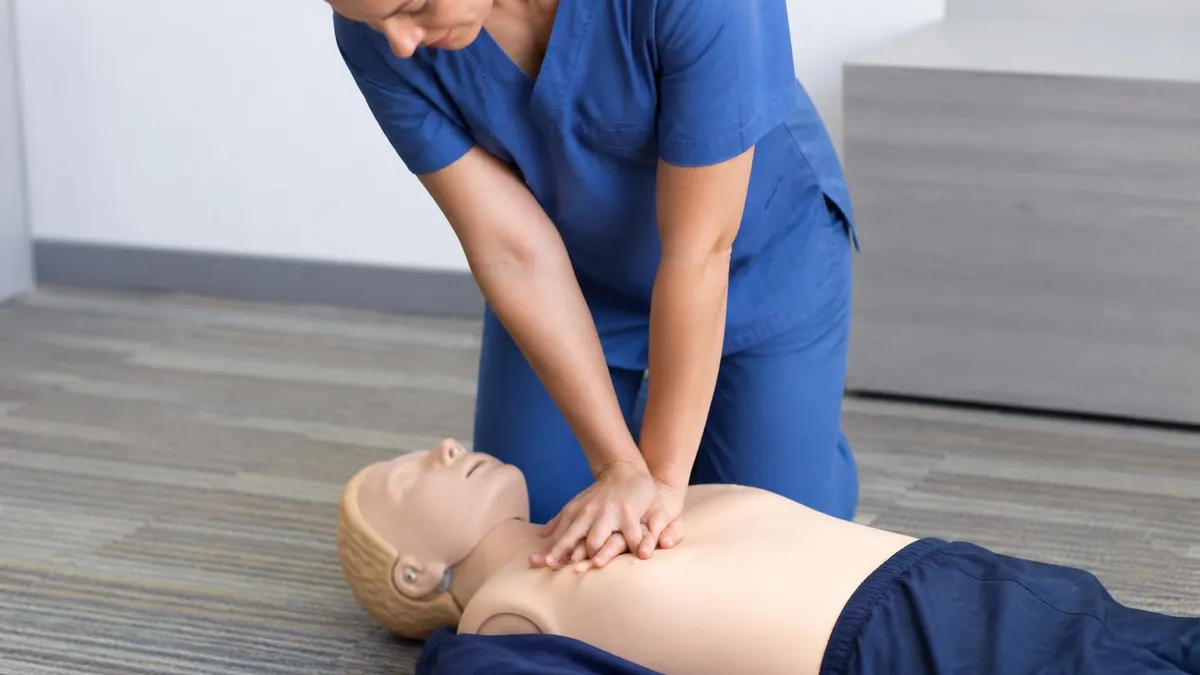
Inappropriate CPR Songs: What Not to Play, Why It Matters, and Better Beat-Per-Minute Alternatives
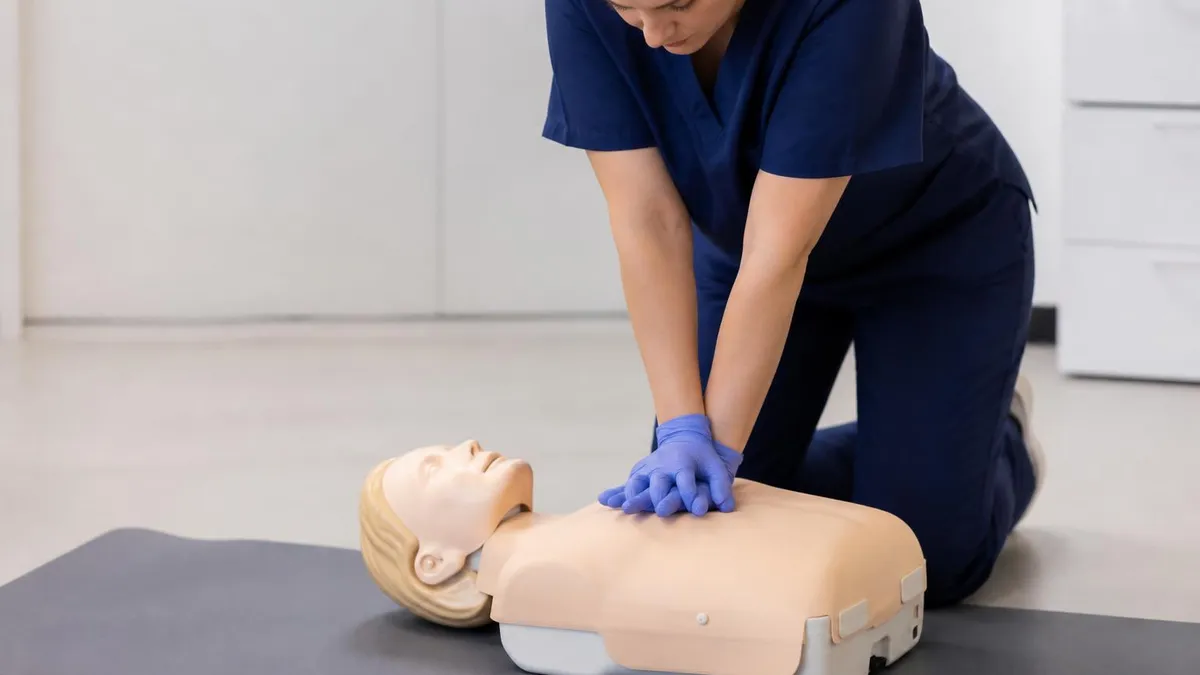
AHA CPR Recertification: How to Recertify CPR Online with the American Heart Association in 2026
About the Author

Registered Nurse & Healthcare Educator
Johns Hopkins University School of NursingDr. Sarah Mitchell is a board-certified registered nurse with over 15 years of clinical and academic experience. She completed her PhD in Nursing Science at Johns Hopkins University and has taught NCLEX preparation and clinical skills courses for nursing students across the United States. Her research focuses on evidence-based exam preparation strategies for healthcare certification candidates.
Join the Discussion
Connect with other students preparing for this exam. Share tips, ask questions, and get advice from people who have been there.
View discussion (5 replies)