
Will CPR Break Ribs? CPR Technique Questions Answered for 2026 August
Will CPR break ribs? Get answers to top CPR technique questions covering compressions, ✅ AED use, infant CPR, and the ACLS algorithm in 2026 August.
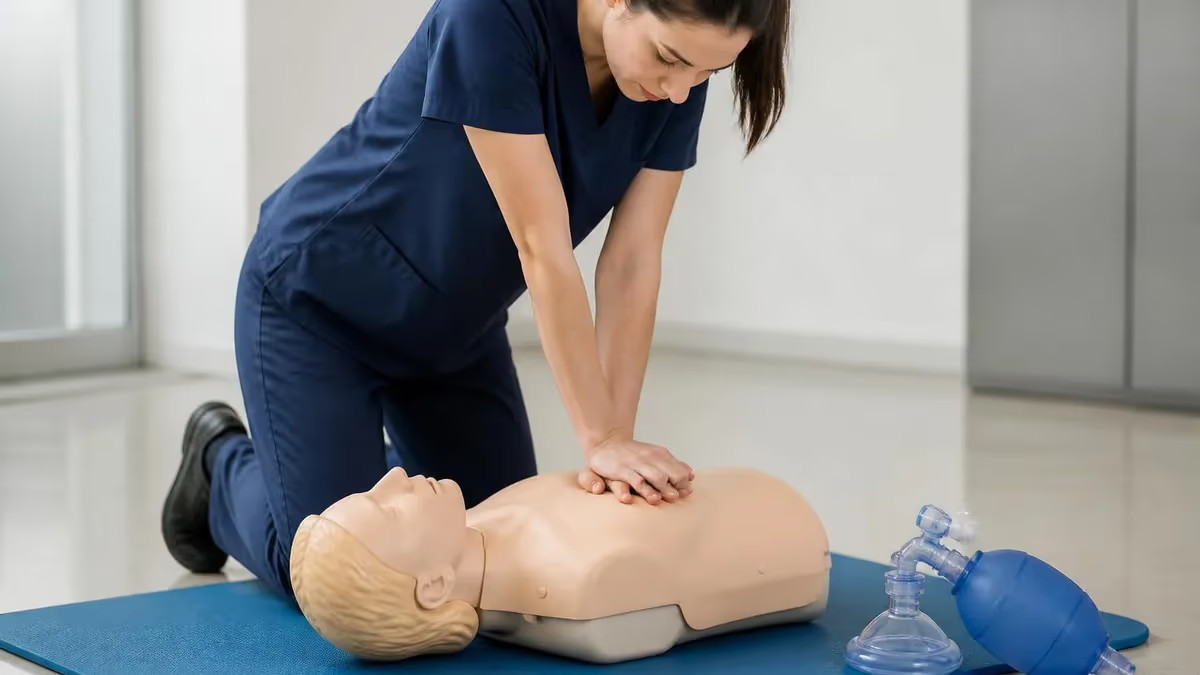
Will CPR break ribs? It is the single most common question asked in every certification classroom, and the honest answer surprises most students: yes, properly performed CPR frequently causes rib fractures or cartilage separation, and that outcome is considered acceptable when weighed against the alternative of brain death. Studies from emergency medicine journals consistently show that between 30 and 86 percent of adult cardiac arrest victims who receive bystander chest compressions sustain some form of skeletal injury, most commonly fractures of the third through sixth ribs along the sternal border.
This article tackles the most searched CPR technique questions head-on, from compression depth and rate to the role of the acls algorithm in resuscitation protocols. We will demystify why ribs break, when it should worry you, and how rescuers can deliver high-quality compressions without hesitation. You will also learn how technique differs between an adult, a child, and an infant, and what national cpr foundation guidelines say about pushing through the cracking sensation many rescuers report during their first real save.
Whether you are preparing for a Basic Life Support skills test, refreshing your knowledge before a recertification, or simply curious after watching a CPR scene in a television drama, this guide assumes you want the unvarnished truth. We will cite current American Heart Association numbers, walk through the biomechanics of chest compression, and explain why fear of injury remains the single biggest reason bystanders freeze during cardiac arrest emergencies in the United States.
To understand the technique fully, you also need to distinguish between common emergencies that look similar but require different responses. A clear grasp of heart attack vs cardiac arrest changes everything about when and how you start compressions. A heart attack is a plumbing problem where the patient is usually awake; cardiac arrest is an electrical problem where the patient is unresponsive and pulseless. CPR only works on the second scenario, and recognizing the difference within ten seconds is the foundation of every technique question that follows.
The good news is that modern CPR training has been simplified dramatically in the last decade. The 2025 international guidelines emphasize hands-only chest compressions for untrained bystanders, removing the rescue-breath barrier that kept many people from acting. Compression-only CPR delivered immediately doubles or even triples a victim's survival odds compared to waiting for paramedics. That is why even imperfect technique that cracks a few ribs is vastly superior to perfect inaction.
Throughout the following sections we will move from the why to the how. Expect concrete numbers: compression depth in inches, rate in beats per minute, hand placement landmarks, and rescue breath ratios. We will also cover infant cpr, which uses two fingers rather than the heel of the hand, and discuss the recovery position for breathing patients who do not need full resuscitation. By the end, the technique questions that intimidate most learners will feel routine, and you will know exactly what to do when those ribs do crack.
CPR Technique by the Numbers

Core CPR Technique Components Every Rescuer Must Master
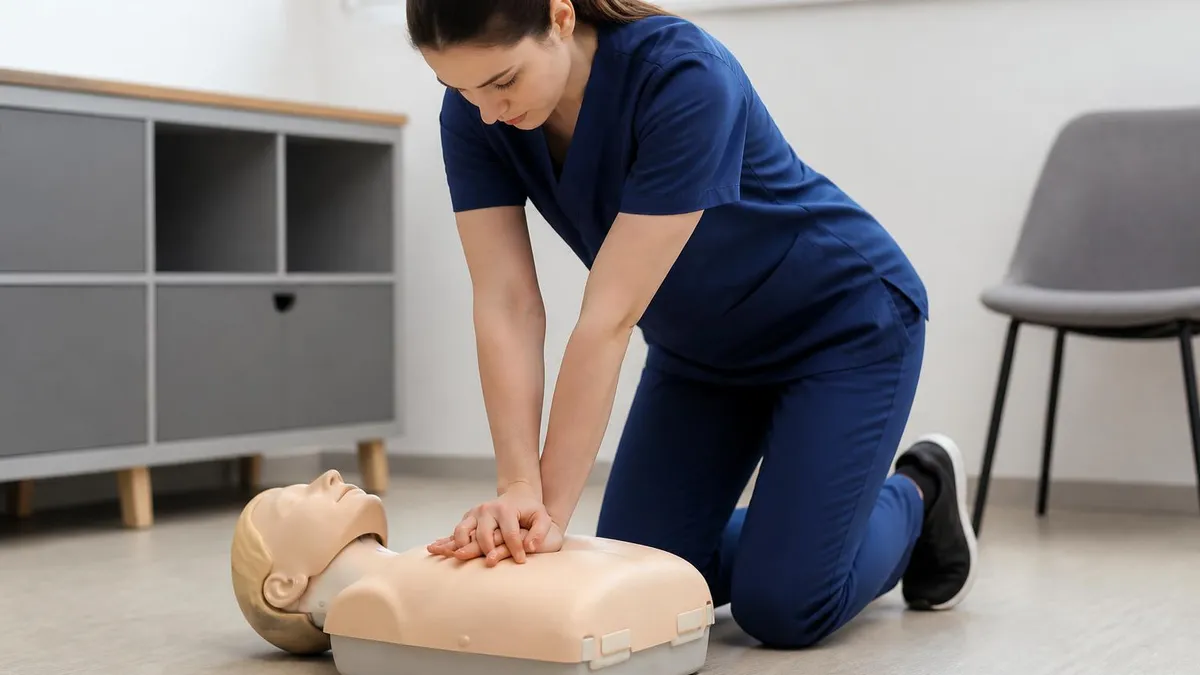
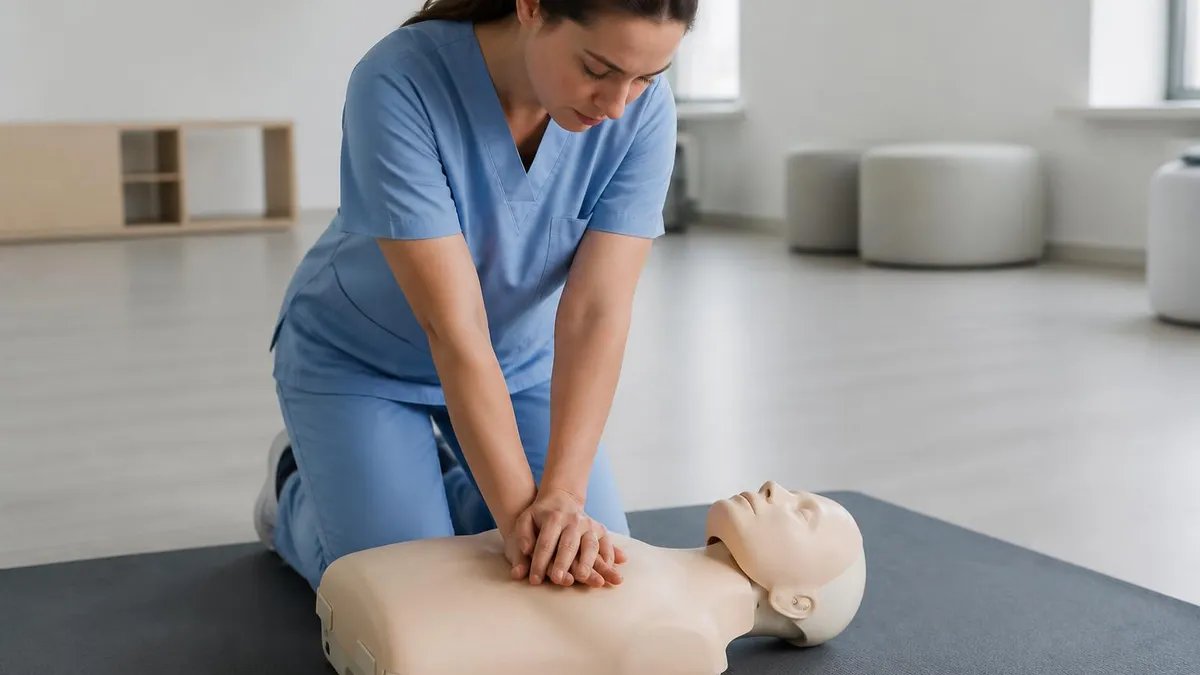
Heel of the dominant hand on the lower half of the sternum, between the nipples on adults. Other hand interlocks on top. Fingers off the ribs to concentrate force on the breastbone and reduce flail-rib injury.
Push at least 2 inches but no more than 2.4 inches in adults, about one-third of chest depth in children and infants. Too shallow fails to circulate blood; too deep increases organ injury without survival benefit.
Aim for 100 to 120 compressions per minute, the tempo of disco classic Stayin' Alive. Faster than 120 reduces ventricular filling between beats and lowers cardiac output despite the rescuer's effort.
Let the chest rise completely between every compression so the heart can refill with blood. Leaning on the sternum is the single most overlooked mistake and silently destroys coronary perfusion pressure.
Pause compressions for no more than 10 seconds for breaths, pulse checks, or AED rhythm analysis. Every pause causes blood pressure to collapse and must be rebuilt with 15 seconds of fresh compressions.
The biomechanics of why CPR breaks ribs are simple once you visualize them. The adult sternum is a flat, slightly flexible bone that articulates with the ribs through cartilage joints. To compress the heart muscle that sits behind it by the required two inches, a rescuer must displace not just the sternum but the entire anterior chest wall. In older adults whose costal cartilage has calcified and whose bones have demineralized, the cartilage gives way with an audible pop, sometimes followed by rib fractures along the parasternal line.
Research published in Resuscitation and the New England Journal of Medicine over the past decade consistently puts the rate of CPR-related skeletal injury between 30 and 86 percent in adults, with the variance driven mostly by patient age, gender, and bone density. Women over 70 are at the highest end of the range. Importantly, autopsy studies show that fatal injuries directly caused by chest compressions, such as cardiac rupture or liver laceration, occur in well under one percent of resuscitations. The benefit-to-harm ratio overwhelmingly favors continuing compressions.
When a rescuer first feels the give, it is usually costochondral separation rather than a complete rib fracture. The sensation is unmistakable: a soft crunching like packed snow under a boot. American Heart Association instructors universally teach trainees to push through this feeling because relaxing pressure at that moment is what causes survival rates to collapse. The respiratory rate of the victim is zero at that point, and the heart is not pumping. Stopping to assess injury simply guarantees death.
Modern manikins now include realistic feedback devices that click when correct depth is achieved and beep when the rescuer leans on the chest. This technology has reduced the gap between classroom performance and real-world execution. Even so, surveys of survivors who received bystander CPR find that the overwhelming majority would gladly accept fractured ribs in exchange for a second chance at life. Several support groups exist specifically to help survivors process the experience of waking up bruised but alive.
One technique question that comes up frequently involves baby cpr. The reassuring news is that infants almost never sustain rib fractures during properly performed compressions because their bones are still highly cartilaginous and pliable. Two-finger or two-thumb encircling technique on infants delivers adequate depth without the brute force required for adults. If you do feel cracking on an infant, you are almost certainly compressing too deeply or in the wrong location.
For pediatric rescuers, this difference often relieves significant anxiety. Many parents who complete pals certification report that their biggest fear before training was hurting a child they were trying to save. Understanding that anatomy itself protects infants and small children from compression injury makes the technique easier to execute decisively. The hesitation that comes from imagining a broken child rib disappears once you understand the underlying physics of a flexible thoracic cage.
The bottom line for rescuers is this: ribs heal, brains do not. Within four to six weeks, the typical CPR-related rib fracture is fully consolidated and the patient is back to normal activity. Anoxic brain injury, by contrast, begins within four minutes of arrest and becomes irreversible by ten. Every second you spend worrying about injury is a second of brain death you are causing. The technique is forgiving; biology is not.
CPR Practice Test Questions
Prepare for the CPR Cardiopulmonary Resuscitation Practice exam with our free practice test modules. Each quiz covers key topics to help you pass on your first try.
CPR Basic CPR
CPR Exam Questions covering Basic CPR. Master CPR Test concepts for certification prep.
CPR and First Aid
Free CPR Practice Test featuring and First Aid. Improve your CPR Exam score with mock test prep.
CPR (Cardiopulmonary Resuscitation) Adult ...
CPR Mock Exam on (Cardiopulmonary Resuscitation) Adult CPR and AED Usage. CPR Study Guide questions to pass on your first try.
CPR (Cardiopulmonary Resuscitation) Airway...
CPR Test Prep for (Cardiopulmonary Resuscitation) Airway Obstruction and Choking. Practice CPR Quiz questions and boost your score.
CPR (Cardiopulmonary Resuscitation) Cardio...
CPR Questions and Answers on (Cardiopulmonary Resuscitation) Cardiopulmonary Emergency Recognition. Free CPR practice for exam readiness.
CPR (Cardiopulmonary Resuscitation) Child ...
CPR Mock Test covering (Cardiopulmonary Resuscitation) Child and Infant CPR. Online CPR Test practice with instant feedback.
CPR (Cardiopulmonary Resuscitation) High-P...
Free CPR Quiz on (Cardiopulmonary Resuscitation) High-Performance Team Dynamics. CPR Exam prep questions with detailed explanations.
CPR (Cardiopulmonary Resuscitation) Legal ...
CPR Practice Questions for (Cardiopulmonary Resuscitation) Legal and Ethical Considerations. Build confidence for your CPR certification exam.
CPR for Specific Populations
CPR Test Online for for Specific Populations. Free practice with instant results and feedback.
CPR Airway & Breathing Management
CPR Exam Questions covering Airway & Breathing Management. Master CPR Test concepts for certification prep.
CPR Assessment & Recognition of Cardiac Ar...
Free CPR Practice Test featuring Assessment & Recognition of Cardiac Arrest. Improve your CPR Exam score with mock test prep.
CPR Chest Compressions & Defibrillation
CPR Mock Exam on Chest Compressions & Defibrillation. CPR Study Guide questions to pass on your first try.
CPR Post-Resuscitation Care & Recovery
CPR Test Prep for Post-Resuscitation Care & Recovery. Practice CPR Quiz questions and boost your score.
Adult, Child, and Infant CPR Technique Differences
Adult CPR begins the moment a person is unresponsive, not breathing normally, and pulseless. Use two hands stacked on the lower half of the sternum, compress 2 to 2.4 inches at 100 to 120 per minute, and deliver 30 compressions followed by 2 rescue breaths if trained. If untrained, perform hands-only compressions continuously until an AED arrives or paramedics take over. Pulse checks must not exceed ten seconds because every interruption causes coronary perfusion pressure to crash.
The hardest part of adult technique is sustaining depth and rate for more than two minutes without fatigue. Rotate rescuers every two-minute cycle if at all possible because compression quality degrades rapidly after the first 90 seconds. Studies show even experienced paramedics push too shallow by the third minute when no relief is available. Modern AEDs prompt compression depth and rate audibly, and following the device guidance dramatically improves outcomes versus rescuer instinct alone in cardiac arrest scenarios.

Hands-Only CPR vs Conventional 30:2 CPR — Which Is Better?
- +Easier to remember under stress with no ratio counting required
- +Eliminates mouth-to-mouth hesitation that delays bystander action
- +Maintains uninterrupted compressions for steady coronary perfusion
- +Recommended for untrained bystanders in adult sudden collapse
- +Studies show equivalent survival for witnessed adult cardiac arrest
- +Less rescuer fatigue because no pause-breathe-resume cycles
- −Inadequate for hypoxic arrests like drowning, overdose, or choking
- −Not recommended for children or infants who need ventilation
- −Provides no oxygen replacement after roughly 4 to 6 minutes
- −Less effective for prolonged arrests beyond 10 minutes
- −Can delay rescue breaths when EMS arrival is significantly delayed
- −Not suitable when the cause of arrest is respiratory failure
Perfect Compression Checklist for Every CPR Attempt
- ✓Confirm scene is safe before approaching the unresponsive victim
- ✓Check responsiveness by tapping shoulders and shouting loudly
- ✓Call 911 and request an AED before starting compressions
- ✓Place victim on a firm, flat surface, never a bed or couch
- ✓Expose the chest and identify the lower half of the sternum
- ✓Stack hands with fingers interlocked, heels centered on sternum
- ✓Lock elbows and position shoulders directly over your hands
- ✓Compress at least 2 inches deep at 100 to 120 per minute
- ✓Allow full chest recoil between every single compression cycle
- ✓Switch rescuers every 2 minutes to prevent fatigue degradation
Sing in your head while you compress
The 1977 Bee Gees disco hit Stayin' Alive has a tempo of exactly 103 beats per minute, which falls squarely inside the 100-to-120 compressions-per-minute target zone for high-quality CPR. Mentally playing the song while pushing has been shown in randomized trials to improve rescuer rate accuracy by over 30 percent. Other 103-to-110 BPM songs that work include Another One Bites the Dust, Crazy in Love, and Walk the Line.
The acls algorithm is the structured decision tree that guides healthcare providers through advanced cardiac life support, and it overlays directly on top of the basic CPR technique we have already covered. Where BLS ends with high-quality compressions and AED defibrillation, ACLS adds vascular access, advanced airway management, rhythm interpretation, and timed administration of epinephrine and amiodarone. The algorithm is essentially a flowchart that branches based on whether the cardiac rhythm is shockable, namely ventricular fibrillation or pulseless ventricular tachycardia, or non-shockable, namely asystole or pulseless electrical activity.
For shockable rhythms, the algorithm prescribes immediate defibrillation followed by two minutes of CPR before the next pulse and rhythm check. Epinephrine 1 milligram is given every three to five minutes, and amiodarone 300 milligrams is administered after the second or third shock. The cycle repeats with continuous compressions, periodic rhythm analysis, and ongoing search for reversible causes summarized as the Hs and Ts: hypoxia, hypovolemia, hydrogen ion acidosis, hypothermia, hyperkalemia, tension pneumothorax, tamponade, toxins, thrombosis pulmonary, and thrombosis coronary.
Many people first hear of ACLS during pals certification or nursing school clinical rotations, but the principles apply equally to lay rescuers using an AED. The device itself is essentially a simplified, audible version of the acls algorithm: it analyzes the rhythm, decides whether a shock is indicated, and prompts the rescuer to deliver energy or resume compressions. Knowing this lets you trust the machine instead of second-guessing it. What does aed stand for? Automated External Defibrillator, and the word automated is doing real work in that name.
Pad placement matters enormously for AED effectiveness. The standard anterolateral placement puts one pad on the upper right chest below the clavicle and the other on the left lateral chest below the armpit. The current flows through the heart between them. Avoid placing pads over medication patches, jewelry, or pacemaker bulges. If the chest is wet, towel-dry it first; if extremely hairy, shave the pad locations with the disposable razor included in most AED kits to ensure good electrical contact through the skin.
One under-discussed element of the acls algorithm is the role of the airway. Once an advanced airway such as an endotracheal tube or supraglottic device is placed, ventilation rate changes from 30:2 to a continuous 10 breaths per minute with uninterrupted compressions. This is sometimes called asynchronous ventilation. The respiratory rate target of 10 per minute, or one breath every six seconds, prevents hyperventilation, which paradoxically reduces venous return and lowers cardiac output during arrest.
End-tidal CO2 monitoring through capnography has become a key feedback tool inside the algorithm. A sudden rise above 35 to 40 mmHg often signals return of spontaneous circulation, while values persistently below 10 mmHg after 20 minutes of resuscitation suggest extremely poor prognosis. Providers use this number to decide whether to continue or terminate resuscitation efforts. It is one of several objective indicators that have replaced the older subjective end-points still depicted in television dramas.
Finally, the algorithm emphasizes post-arrest care once return of circulation is achieved. Targeted temperature management, hemodynamic optimization, and rapid cardiac catheterization for suspected coronary occlusion all improve neurological outcomes. The technique questions that began with will cpr break ribs end with a much larger question: how do we keep the brain alive once the heart is back? That is where modern life support science is moving fastest in 2026.

The single most damaging mistake new rescuers make is interrupting compressions to feel for a pulse repeatedly. Each pause causes coronary perfusion pressure to collapse, and it takes another 15 to 20 seconds of compressions to rebuild. Limit any pulse check to a maximum of 10 seconds, and when in doubt about whether a pulse is present, resume compressions immediately. Pushing on a beating heart causes far less harm than failing to push on a stopped one.
The most common technique mistakes during real-world CPR are not exotic errors; they are predictable lapses that show up in every observational study of bystander resuscitation. The first is insufficient depth, with most lay rescuers pushing only 1 to 1.5 inches when 2 inches is required. The second is leaning on the chest between compressions, preventing full recoil and venous return. The third is fixation on rescue breaths at the expense of compressions, particularly among older rescuers trained before the 2010 guideline updates.
Rate errors swing in both directions. Anxious rescuers often exceed 140 per minute, which sounds productive but actually reduces stroke volume because the ventricles never refill between compressions. Slower rescuers drift toward 80 per minute as fatigue sets in. The 100-to-120 window exists for good physiologic reasons, and audible metronomes or AED-driven prompts dramatically improve rescuer adherence to it. Many newer manikins now include real-time visual feedback that has reduced rate errors in training by over 60 percent.
Hand position drift is another consistent issue. Rescuers tend to slide too low toward the xiphoid process or too high onto the manubrium as they tire. Both errors reduce cardiac output and increase injury risk. Periodically check that the heel of the hand is still centered on the lower half of the sternum, roughly between the nipples. A second rescuer watching from the side should call out position corrections without slowing compressions.
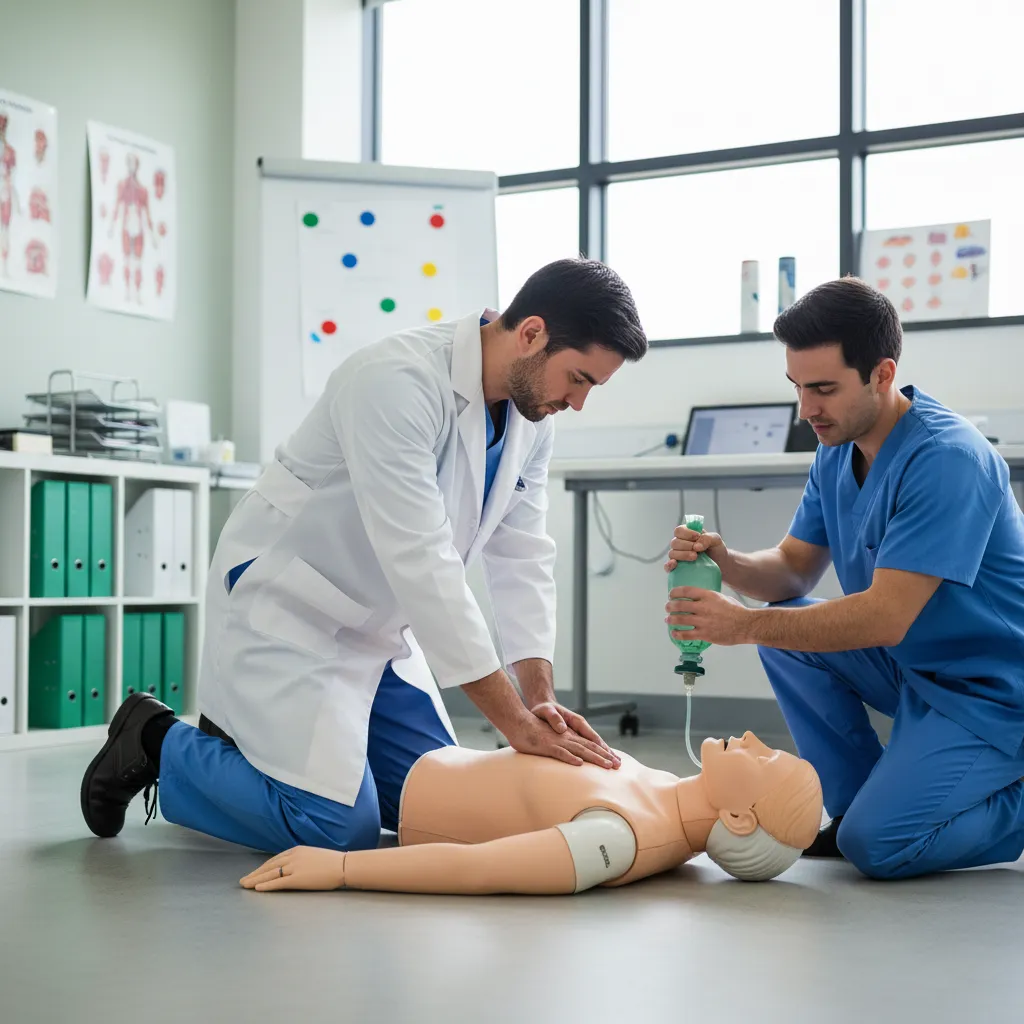
Ventilation errors deserve their own paragraph. Over-inflation is the most common: rescuers blow too forcefully or too long, causing air to enter the stomach rather than the lungs. This gastric distention pushes up against the diaphragm, reduces lung capacity, and often triggers regurgitation that complicates airway management. Each breath should last about one second with just enough volume to make the chest visibly rise — no more. This is true whether you are working on an adult, child, or infant.
An often-overlooked element of technique is the recovery position itself. The leather cpr training videos and modern animations both show how to roll a breathing but unconscious patient onto their side after return of circulation. The recovery position prevents aspiration of vomit and keeps the tongue from obstructing the airway. Place the lower arm out at 90 degrees, the upper arm under the head, bend the upper knee, and roll the patient toward you. Reassess breathing every two minutes while waiting for EMS to arrive on scene.
Rescuer fatigue is the silent assassin of compression quality. Studies using high-fidelity manikins show that depth begins falling off measurably after just 90 seconds of single-rescuer CPR, even among trained professionals. Compressions become shallower, slower, and less consistent without the rescuer noticing. This is why every modern guideline emphasizes rotating compressors every two minutes when two or more rescuers are present, switching positions during the brief AED rhythm analysis pause to minimize interruption.
Lastly, one mental mistake undermines everything else: hesitation born from fear of doing harm. Reviewing case data from every cardiac arrest registry in the United States shows that bystanders who do something almost always improve outcomes versus bystanders who do nothing. Even imperfect compressions delivered immediately outperform perfect compressions delivered five minutes later by paramedics. The technique exists to optimize outcomes, but the technique only works if you actually start. That decision must come within the first ten seconds of recognizing arrest.
Practical preparation for real-world CPR begins well before any emergency. Take an in-person Basic Life Support course every two years, not just a one-time online module. Hands-on practice with feedback manikins builds the muscle memory you will need when adrenaline shrinks your fine-motor control. The position recovery technique, infant chest compressions, and AED pad placement all become second nature only through repetition. Mental rehearsal between courses also helps; visualize yourself walking through a scenario from scene safety to handover to paramedics.
Choose your training provider carefully. The national cpr foundation, American Heart Association, and American Red Cross are the three most widely recognized credentialing bodies in the United States, and all three meet OSHA and most state employment requirements. Verify that any course you take issues a card accepted by your employer or licensing board before paying. Hybrid courses that combine online didactic learning with an in-person skills check produce equivalent skill retention to fully in-person courses at lower total cost and time commitment.
Build the technique into your home and workplace. Know the location of every AED in your building, gym, school, or place of worship. Modern AEDs cost between 1,200 and 2,500 dollars and the price has fallen steadily over the last decade. Some homeowner associations and workplaces qualify for discounted bulk pricing through state public-access defibrillation programs. Every minute that defibrillation is delayed reduces survival by roughly 10 percent, so having a device within 90 seconds of any potential victim is the goal.
Practice mental cues that combat freeze response. The most effective is the simple verbal script: I see an unresponsive person, the scene is safe, I am calling 911, I am starting compressions now. Saying these phrases out loud, even when alone, activates the speech-motor system and breaks the cognitive lock that paralyzes most untrained witnesses. Trainers call this verbal commitment, and it has measurably reduced freeze-time in randomized bystander simulations conducted across multiple universities and EMS systems.
Memorize the AED voice prompts in advance. Most modern devices say something like attach pads to victim's bare chest, analyzing rhythm do not touch patient, shock advised stand clear, deliver shock now. Knowing the script means you stop fighting the device and start cooperating with it. Many rescuers freeze the first time an AED tells them to stand clear because they confuse the prompt with permission to stop. The prompt means continue compressions until the moment of analysis, not abandon the patient.
Find tempo cues you can rely on. The cpr songs approach uses tracks with 100-to-120 BPM to anchor your rate. Stayin' Alive at 103 BPM is the classic, but Crazy in Love, Walk the Line, Hips Don't Lie, and Cecilia all sit in the ideal window. Pick one you know by heart so the chorus surfaces automatically under stress. Some rescuers prefer counting in two-second blocks of four: one-two-three-four, one-two-three-four, four compressions per two seconds equals 120 per minute.
Finally, remember that the life support system you join in any cardiac arrest is much larger than just you. The chain of survival includes immediate recognition, early CPR, rapid defibrillation, advanced care by paramedics, and post-resuscitation hospital care. Each link multiplies the chance that the victim walks out of the hospital neurologically intact. Your job in those first three or four minutes is simply not to drop the link you are holding. Push hard, push fast, do not stop, and let the rest of the chain do its work.
CPR Questions and Answers

About the Author

Registered Nurse & Healthcare Educator
Johns Hopkins University School of NursingDr. Sarah Mitchell is a board-certified registered nurse with over 15 years of clinical and academic experience. She completed her PhD in Nursing Science at Johns Hopkins University and has taught NCLEX preparation and clinical skills courses for nursing students across the United States. Her research focuses on evidence-based exam preparation strategies for healthcare certification candidates.
Join the Discussion
Connect with other students preparing for this exam. Share tips, ask questions, and get advice from people who have been there.
View discussion (5 replies)