
CPR Courses Near Me 2026 October: Find Accredited Training in Your Area
⏳ Find CPR courses near me with accredited instructors, ACLS algorithm training, PALS certification, and infant CPR classes. Compare costs, formats, and...
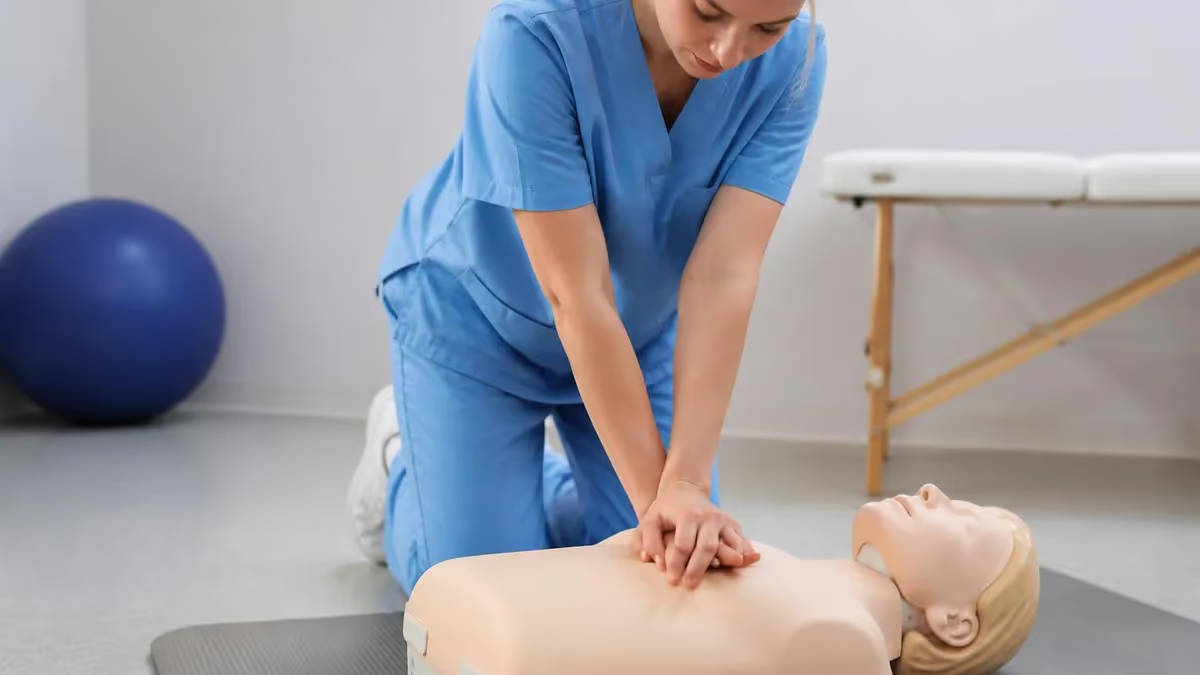
Searching for cpr courses near me in 2026 means navigating a crowded marketplace of providers, formats, and certification standards that have evolved dramatically over the past three years. Whether you need certification for a new healthcare job, a daycare licensing requirement, or simply to protect your family, the right course depends on your role, your schedule, and the recognition standards of your employer or licensing board. Understanding the landscape before you register saves time, money, and frustration when your employer rejects an unaccredited card.
The cpr course ecosystem includes the American Heart Association, American Red Cross, American Safety and Health Institute, and the cpr index of smaller providers that issue certifications recognized at varying levels. Healthcare employers almost universally require AHA Basic Life Support, while general workplace, childcare, and community courses can be satisfied by any nationally accredited program. Knowing which tier you need prevents you from paying for an advanced course you do not actually require.
Local availability has expanded considerably since 2023, when hybrid blended learning became the dominant format. Most metropolitan areas now offer in-person skills sessions seven days a week, with online cognitive modules you complete at home before attending a 90-minute hands-on validation. This shift cut total seat time roughly in half while maintaining the same testing rigor, and it explains why a typical cpr course can now be booked, completed, and certified within 48 hours in most cities.
Pricing in 2026 ranges from free community classes funded by municipal fire departments to $185 for premium small-group instruction at hospital training centers. The average BLS Provider course costs $75 to $110, Heartsaver CPR/AED runs $55 to $90, and pediatric add-ons typically add $20 to $35. Cards are valid for two years from issue date, and most providers will email a digital card within 24 hours of skills check completion, with a physical card mailed if requested.
Beyond price, the most important variable is whether your instructor is currently licensed and whether the training site uses calibrated manikins with real-time feedback devices. Since 2020, the American Heart Association has required feedback-enabled manikins for all BLS and ACLS courses, measuring compression depth, rate, recoil, and ventilation volume. Courses that still use uninstrumented manikins technically violate program standards and may produce cards that fail employer verification, so always ask before booking.
This guide walks through everything you need to evaluate local cpr courses: how to verify provider accreditation, which course level matches your role, what to expect in skills testing, how renewal differs from initial certification, and how online and blended options compare to traditional classroom training. By the end, you will know exactly which course to book in your area and what questions to ask before paying.
CPR Training by the Numbers

Main CPR Course Types Available Locally
Designed for the general public, teachers, fitness staff, and workplace responders. Covers adult, child, and infant cpr plus AED operation in roughly four hours.
What is a bls certification? It is the healthcare-provider entry credential covering high-performance team CPR, advanced airway considerations, and AED use for nurses, EMTs, dentists, and students.
Advanced Cardiac Life Support teaches the full acls algorithm, rhythm recognition, pharmacology, and post-arrest care for emergency department, ICU, and code-team clinicians.
Pals certification covers pediatric assessment, respiratory rate evaluation, shock recognition, and pediatric resuscitation algorithms for clinicians treating infants and children.
Combines Heartsaver CPR with bleeding control, burns, fractures, and medical emergencies. Common for daycare staff, coaches, camp counselors, and OSHA compliance.
Finding legitimate cpr courses near me starts with confirming which certifying body your employer or licensing board recognizes. In most US states, healthcare positions require an American Heart Association BLS Provider card specifically, while non-clinical workplaces typically accept AHA, Red Cross, or ASHI certifications interchangeably. Some childcare licensing agencies maintain their own approved-provider lists, so check your state regulations before registering for any course, including the popular national cpr foundation programs that some employers do and do not accept.
The fastest way to locate authorized in-person training is to use each certifying organization's official course locator. The AHA Class Connector at cpr.heart.org and the Red Cross course finder at redcross.org both let you filter by ZIP code, course type, and date. These tools only show training sites that have signed current provider agreements, which is your single best protection against ending up with a card that gets rejected at human-resources verification.
Hospital training centers are usually the gold standard for healthcare-provider courses because their instructors teach the same content daily and stay current on the latest 2025 guideline updates. Community colleges, fire departments, and ambulance services also run high-quality programs, often at lower cost. Independent training centers vary widely, so look for visible AHA Training Center affiliation, recent Google reviews mentioning successful card verification, and explicit mention of feedback-enabled manikins.
If you live in a rural area, your nearest in-person skills check may be 30 to 60 minutes away, but blended learning makes this manageable. You complete the cognitive portion online over two to three hours at home, then drive once to a skills site for a 90-minute hands-on session and validation. Many rural EMS agencies host monthly community skills days specifically to serve outlying residents and keep classes near me realistically accessible.
Workplace-hosted courses are another underused option. If your employer has more than ten people needing certification, most training centers will send an instructor to your site for the same per-person price or less. This eliminates travel time, lets your team train together, and creates a stronger response culture because coworkers practice scenarios with each other rather than with strangers. Ask your HR or safety coordinator whether group on-site training is an option before booking individually.
Beware of any provider advertising fully online certification with no skills check, especially for healthcare-level courses. The American Heart Association does not issue BLS, ACLS, or PALS cards through purely online programs, and any vendor claiming otherwise is selling a card that will fail verification. Skills must be demonstrated to a licensed instructor in person or via real-time remote video assessment with an approved skills kit. If a course seems suspiciously fast or cheap, verify the provider on the certifying body's website before paying.

CPR Practice Test Questions
Prepare for the CPR Cardiopulmonary Resuscitation Practice exam with our free practice test modules. Each quiz covers key topics to help you pass on your first try.
CPR Basic CPR
CPR Exam Questions covering Basic CPR. Master CPR Test concepts for certification prep.
CPR and First Aid
Free CPR Practice Test featuring and First Aid. Improve your CPR Exam score with mock test prep.
CPR (Cardiopulmonary Resuscitation) Adult ...
CPR Mock Exam on (Cardiopulmonary Resuscitation) Adult CPR and AED Usage. CPR Study Guide questions to pass on your first try.
CPR (Cardiopulmonary Resuscitation) Airway...
CPR Test Prep for (Cardiopulmonary Resuscitation) Airway Obstruction and Choking. Practice CPR Quiz questions and boost your score.
CPR (Cardiopulmonary Resuscitation) Cardio...
CPR Questions and Answers on (Cardiopulmonary Resuscitation) Cardiopulmonary Emergency Recognition. Free CPR practice for exam readiness.
CPR (Cardiopulmonary Resuscitation) Child ...
CPR Mock Test covering (Cardiopulmonary Resuscitation) Child and Infant CPR. Online CPR Test practice with instant feedback.
CPR (Cardiopulmonary Resuscitation) High-P...
Free CPR Quiz on (Cardiopulmonary Resuscitation) High-Performance Team Dynamics. CPR Exam prep questions with detailed explanations.
CPR (Cardiopulmonary Resuscitation) Legal ...
CPR Practice Questions for (Cardiopulmonary Resuscitation) Legal and Ethical Considerations. Build confidence for your CPR certification exam.
CPR for Specific Populations
CPR Test Online for for Specific Populations. Free practice with instant results and feedback.
CPR Airway & Breathing Management
CPR Exam Questions covering Airway & Breathing Management. Master CPR Test concepts for certification prep.
CPR Assessment & Recognition of Cardiac Ar...
Free CPR Practice Test featuring Assessment & Recognition of Cardiac Arrest. Improve your CPR Exam score with mock test prep.
CPR Chest Compressions & Defibrillation
CPR Mock Exam on Chest Compressions & Defibrillation. CPR Study Guide questions to pass on your first try.
CPR Post-Resuscitation Care & Recovery
CPR Test Prep for Post-Resuscitation Care & Recovery. Practice CPR Quiz questions and boost your score.
ACLS Algorithm, PALS Certification & BLS Compared
The BLS Provider course teaches high-quality CPR for adult, child, and infant victims, AED operation, bag-mask ventilation, and team-based resuscitation dynamics. It is the foundational healthcare credential and what is a bls certification used for in nursing, dentistry, EMS, and student clinical rotations. The course runs roughly four hours in person or two hours of online study plus a 90-minute skills session for blended learners.
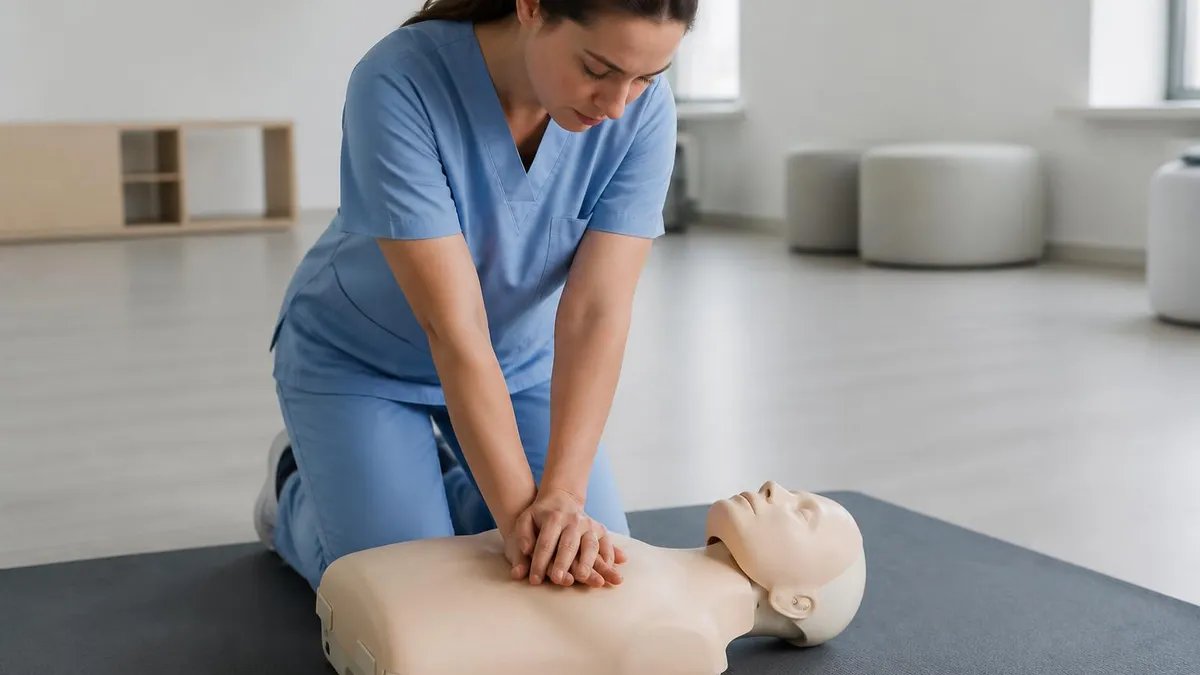
Skills testing requires demonstrating compressions at 100 to 120 per minute, two inches deep on an adult manikin, with full chest recoil and minimal interruption. Candidates also perform two-rescuer CPR with bag-mask ventilation, switch positions every five cycles, and use an AED on a simulated patient. Most testing centers report first-time pass rates above 90 percent, with retests offered the same day or within one week at no additional cost.
In-Person vs. Blended CPR Courses Near Me
- +Faster total completion when scheduling allows immediate skills check
- +Online cognitive portion can be completed at your own pace at home
- +Skills sessions are shorter and more focused than full classroom days
- +Same certification card and equal recognition as full in-person courses
- +Reduces time off work to roughly 90 minutes instead of half a day
- +Available seven days a week at most metropolitan training centers
- +Lower per-student cost at many sites due to reduced instructor time
- −Requires self-discipline to complete online cognitive modules thoroughly
- −Less peer interaction and team-based scenario practice during cognitive phase
- −Some learners struggle without instructor presence during initial concept learning
- −Online portion must be completed before scheduled skills check or session is forfeited
- −Technology issues with online platform occasionally delay course completion
- −Skills check failures still require returning for a retest appointment

Pre-Registration Checklist for CPR Courses
- ✓Confirm the exact certification level your employer or licensing board requires
- ✓Verify the provider is currently listed on AHA, Red Cross, or ASHI training site locators
- ✓Check that the instructor card number is active and not expired
- ✓Ask whether feedback-enabled manikins are used during practice and testing
- ✓Confirm the course covers your specific population needs including infant cpr
- ✓Verify total cost includes the certification card with no surprise add-on fees
- ✓Read recent Google reviews mentioning successful employer card verification
- ✓Schedule at least one week before your job start date to allow for retest if needed
- ✓Complete any required online cognitive module before the skills session deadline
- ✓Bring photo ID, comfortable clothing, and any prerequisite confirmation emails to class
Always check the official Training Center locator
Every legitimate AHA-aligned course shows up on cpr.heart.org's Class Connector with the training center name, instructor information, and current accreditation status. If a course you found through a Google ad or social media does not appear there, your card may not verify when your employer checks it. Spend two minutes confirming before spending two hours in class.
Pricing varies considerably by region, provider type, and course level. In 2026, expect Heartsaver CPR/AED to run $55 to $90 in most US markets, BLS Provider to cost $75 to $110, and ACLS or PALS to fall between $185 and $275 for initial certification. Renewal courses are typically 15 to 30 percent less because the cognitive content is condensed for already-credentialed providers. Group rates of five to ten percent are common when three or more colleagues register together for the same session.
Free courses exist but require homework to find. Many fire departments offer no-cost Heartsaver CPR to community residents quarterly or monthly, partly funded by federal grants and partly by departmental community outreach budgets. Public health departments, hospital community education programs, and some employers offering free training to family members of staff are other legitimate free paths. Always confirm the card issued meets your requirement, since some free community courses provide a participation certificate rather than a full provider card.
Cards are valid for two calendar years from the issue date, not from when you took the course, and renewal must occur before expiration to avoid retaking the full initial course. Most providers send a reminder email 60 days before expiration, but do not rely on this. Set your own calendar reminder 90 days out so you have time to schedule a convenient renewal date rather than scrambling at the last minute and losing job eligibility.
Common reasons employers reject cards include unrecognized issuing agency, expired instructor credentials at the time of training, and digital cards from purely online programs lacking required skills demonstration. Some hospital systems explicitly require AHA cards and reject Red Cross or ASHI even though the content and rigor are equivalent. Confirm your employer's specific policy in writing before paying, since this varies hospital by hospital and even unit by unit within larger systems.
Refund and reschedule policies differ widely. Reputable training centers allow free rescheduling with at least 48 hours notice and offer full refunds minus a small processing fee for cancellations more than seven days out. Beware of providers requiring full payment with no refund option, especially for blended courses where the online portion has been completed. Read terms before paying, and pay by credit card rather than cash or Zelle so you retain dispute rights.
If you see local results for screen repair shops, simply add the word certification or class to your search to filter for the right industry. The actual CPR certification industry uses cpr.heart.org, redcross.org, and ashi.us as its primary authoritative domains.
If your instructor's AHA, Red Cross, or ASHI credentials lapsed between the time you registered and the day of class, your card may be invalidated retroactively. Always ask to see current instructor identification at the start of skills testing, and photograph it for your records. This protects you if the training center later loses its accreditation and your card needs reverification by a new employer months later.
Choosing among local providers comes down to four factors: official accreditation, instructor quality, equipment standards, and schedule fit. Accreditation is non-negotiable, instructor quality determines how much you actually learn, equipment determines whether your skills get accurate feedback, and schedule fit determines whether you actually show up. A perfect course you cannot attend is worth less than a good course that fits your life. Be realistic about your availability when comparing options.
Hospital-based training centers tend to score highest on all four factors because they teach the same content daily, maintain calibrated manikin inventories under biomedical engineering oversight, and run sessions on virtually every weekday and many weekends. Their prices skew toward the upper end of the range, but you are essentially paying for guaranteed quality. If your employer is a healthcare system, your home hospital's training center is almost always the safest choice for both quality and downstream card recognition.
Community-based providers including the Red Cross, YMCA, and local fire departments offer excellent value, especially for Heartsaver-level courses. Their instructors are often passionate volunteers or career firefighters who teach because they want better community outcomes, not just for the income. Equipment varies more than at hospital centers, so ask specifically about feedback manikins before booking. For learning the difference between heart attack vs cardiac arrest, these courses are typically more than sufficient.
Independent for-profit training centers occupy the middle ground. The best ones offer convenient scheduling, modern equipment, and instructors with strong clinical backgrounds. The worst rush students through to maximize per-hour revenue and use the same manikins for years without recalibration. Reviews are your best filter here. Look for specific mentions of feedback devices, instructor names, and successful card verification rather than vague praise, since fake reviews tend toward generic enthusiasm.
Online-only providers should be approached carefully. Pure online certification without any skills component is not recognized for healthcare positions and is increasingly rejected even for general workplace requirements after a 2024 OSHA guidance update emphasizing hands-on competency. Blended programs that combine online cognitive learning with in-person skills validation are legitimate and convenient, but the in-person component is essential. If a provider claims you can certify from your couch in 30 minutes, they are selling a worthless card.
Finally, consider the value of practicing with the population you actually serve. Pediatric clinicians benefit from PALS-emphasized courses with experienced pediatric instructors. School staff and parents benefit from courses heavy on child and infant scenarios. Office workers benefit from courses emphasizing adult sudden cardiac arrest and AED use. Ask the provider what proportion of class time goes to each population before booking, and pick the course that maps to your real-world risk profile.
Preparing the night before class makes the difference between a smooth four-hour experience and a stressful retest. Print or screenshot your registration confirmation, complete any required pre-course assessment or e-learning modules, and review the basic compression rate of 100 to 120 per minute and depth of two inches for adults. For BLS or higher, also review the 30:2 single-rescuer ratio and the 15:2 two-rescuer ratio for children and infants so you walk in with the numbers already in long-term memory rather than learning them under stress.
Dress for kneeling on the floor for extended periods. Comfortable pants, closed-toe shoes, and a shirt that allows free arm movement are essential. Hospital scrubs work well if you have them. Avoid jewelry on your hands and wrists that might scratch manikins or interfere with compressions. Bring water, a small snack, and a notepad. Cell phones should be silenced and put away during skills testing to avoid distractions and preserve other students' focus during their attempts.
During the cognitive portion, ask questions even when you think you know the answer. The instructor's framing of a concept often reveals testing emphasis that the written materials downplay. Specifically pay attention to changes in 2025 guidelines, which adjusted compression-to-ventilation timing for pediatric resuscitation and refined post-arrest temperature management. Older study materials may not reflect these updates, and current testing uses the latest version. If you have a study guide more than a year old, supplement it with current online resources.
Skills practice is where most candidates make or break the certification. Use the practice time aggressively. Many students stand back, watch others practice, and step in only when their turn comes formally. This is the worst possible strategy. The instructor is there to coach you, and the manikins are there to be used. Practice three or four times more than minimum, especially for any skill you do not perform daily at work. Compressions feel different on a manikin than on a real chest, and your body needs reps to find the right depth and rate.
The position recovery technique, infant cpr, choking response, and AED placement are the four areas where adult learners most commonly need extra practice. Position recovery for unconscious breathing patients is taught in Heartsaver and Red Cross courses and is often skipped in pure BLS Provider classes, so know your course scope. The two-thumb encircling technique for infants is awkward at first and worth practicing repeatedly. AED placement on small chests requires the alternate front-back pad position, which surprises candidates who only practiced on adult manikins.
After certification, schedule a 30-minute refresher with yourself every six months. Watch a recent skills video, mentally rehearse a code, and review the algorithms. This dramatically reduces renewal-course anxiety two years later and, more importantly, keeps the skills accessible during a real emergency. Studies show that CPR skill retention drops measurably within three months of training without practice, so brief self-refreshers preserve the competence you paid for. Reviewing baby cpr resources alongside adult content keeps your full skill set sharp.
CPR Questions and Answers
About the Author

Registered Nurse & Healthcare Educator
Johns Hopkins University School of NursingDr. Sarah Mitchell is a board-certified registered nurse with over 15 years of clinical and academic experience. She completed her PhD in Nursing Science at Johns Hopkins University and has taught NCLEX preparation and clinical skills courses for nursing students across the United States. Her research focuses on evidence-based exam preparation strategies for healthcare certification candidates.
Join the Discussion
Connect with other students preparing for this exam. Share tips, ask questions, and get advice from people who have been there.
View discussion (5 replies)