
AHA CPR Online Training: Complete Guide to American Heart Association Certification in 2026 October
AHA CPR online training guide: ✏️ blended learning, costs, course options, BLS/Heartsaver, skills check, and how to get certified online in 2026 October.
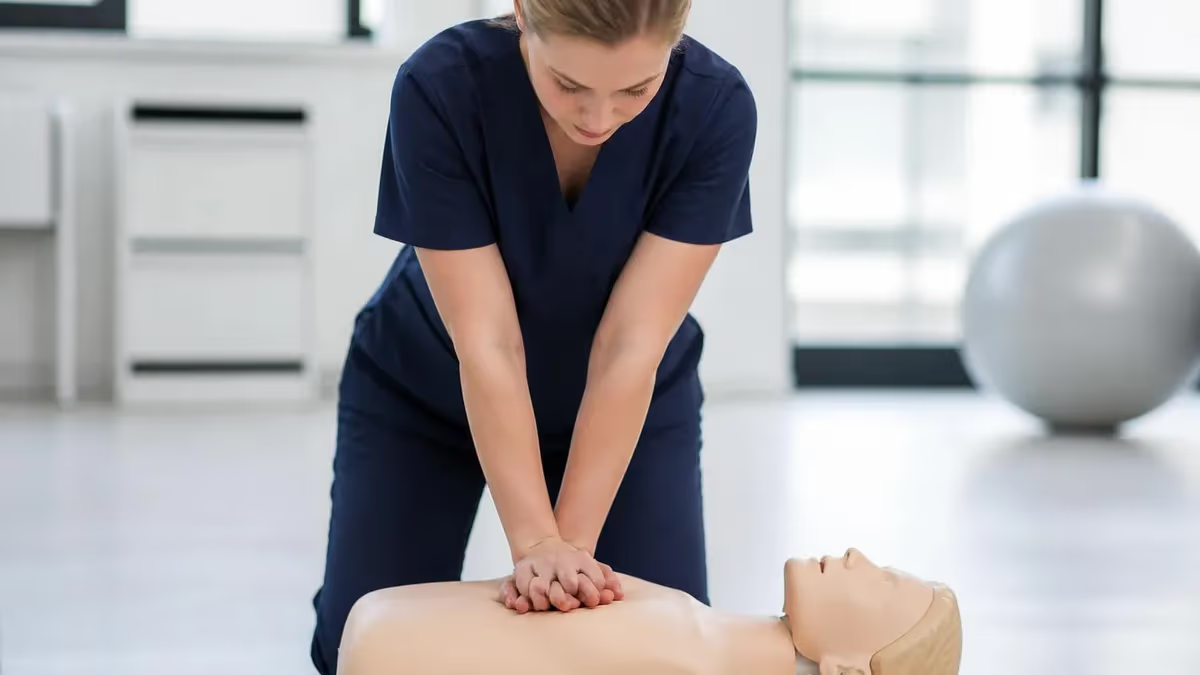
AHA CPR online training has become the most flexible way to earn a nationally recognized cardiopulmonary resuscitation credential in 2026, combining self-paced eLearning with a hands-on skills check. The American Heart Association (AHA) issues more than 22 million course completion cards each year, and a growing share now begin online. Whether you need certification for nursing school, daycare licensing, lifeguarding, or workplace compliance, the AHA blended-learning pathway lets you study at home, then prove competence in person.
The format suits busy adults who want quality without sacrificing time. Online modules cover the same cognitive content as classroom courses — chain of survival, compression depth and rate, ventilation ratios, and how to use an automated external defibrillator (AED). After completing the online portion, students attend a short hands-on session with an AHA Instructor or use a Voice-Assisted Manikin (VAM) station to demonstrate skills before a certification card is issued.
This guide explains exactly how AHA CPR online training works in 2026: the course catalog, what each level covers, costs, time investment, employer acceptance, and how blended learning compares with options from the national cpr foundation and other providers. It also walks through eligibility, technology requirements, and what happens on skills-test day so you arrive prepared.
Three courses dominate online enrollment: Heartsaver CPR AED for the general public, BLS Provider for healthcare workers, and HeartCode ACLS or PALS for advanced clinicians. Each follows the 2025 AHA Guidelines Update, which reinforced high-quality compressions (100–120 per minute, 2–2.4 inches deep) and tightened standards around team dynamics and post-arrest care. Online learners see the same evidence-based content used in instructor-led classes.
The credential matters because survival from out-of-hospital cardiac arrest still hovers near 10 percent in the United States. Bystander CPR roughly doubles survival, yet only about 40 percent of victims receive it. Training more people — especially through accessible online formats — directly raises that number. AHA cards remain the most widely accepted credential among hospitals, EMS agencies, schools, and OSHA-regulated workplaces.
Before enrolling, confirm your employer or licensing board accepts blended learning. Most do, but a small number of state nursing boards still require fully in-person BLS the first time you certify. We'll cover that nuance, along with pricing tiers, refund policies, and what to do if you fail the skills check. By the end of this article you'll know whether AHA online training is the right route — and exactly how to finish with a valid two-year card.
AHA CPR Online Training by the Numbers
Key Facts at a Glance
| Item | Value | Details |
|---|---|---|
| Online Module Time | 1–3 hrs | Heartsaver to BLS Provider |
| Typical Course Cost | $30–$175 | Plus skills session fee |
| Card Validity | 2 years | All AHA CPR courses |

AHA CPR Online Course Catalog
For the general public, teachers, coaches, childcare staff, and workplace responders. Covers adult, child, and infant cpr plus AED use. 1–2 hour online module followed by a 30-minute skills check. No prerequisites required.
For healthcare workers — nurses, paramedics, dentists, medical students, and respiratory therapists. Adds two-rescuer CPR, bag-mask ventilation, and team dynamics. 2–3 hour module plus skills session. Most widely required clinical credential.
For advanced providers managing cardiac arrest, stroke, and ACS. Includes the full acls algorithm set, rhythm recognition, pharmacology, and megacode simulation. Requires current BLS and 4–6 hours of online study before the skills check.
Pediatric Advanced Life Support online for clinicians treating critically ill infants and children. Includes pals certification skills: pediatric assessment triangle, shock management, and resuscitation algorithms. 6–8 hours online plus hands-on testing.
Combines first aid with CPR and AED training for workplace OSHA compliance. Covers bleeding control, burns, seizures, and allergic reactions alongside resuscitation. About 3 hours online plus a longer skills check session.
Blended learning is the AHA's official term for combining online cognitive instruction with an in-person psychomotor skills evaluation. The model launched broadly in 2010 and now powers most adult CPR education in the United States. Students log in to the AHA eLearning portal, complete interactive modules with video demonstrations, answer embedded knowledge checks, and finish a multiple-choice written exam. Only after passing the online portion can they schedule a hands-on skills check with an authorized AHA Instructor.
The online portion is genuinely self-paced. You can pause modules, rewatch sections, and return over multiple days within a 60-day enrollment window. Most learners finish Heartsaver in one or two sittings; BLS Provider usually takes two to three hours of focused study. The platform tracks progress, so you cannot fast-forward through required videos — the system enforces a minimum view time on each clip to ensure the cognitive content actually lands.
The written exam is delivered immediately after the modules. Heartsaver requires 70 percent to pass, while BLS Provider, ACLS, and PALS each require 84 percent. You get one free retake. If you fail twice, you must restart the module from the beginning. Questions test recognition of cardiac arrest, choking response, compression-to-ventilation ratios, AED operation, recovery position, and what does aed stand for in clinical practice — the answer being automated external defibrillator.
Once the written exam is passed, the AHA issues a completion certificate showing you finished Part 1. You print it or save the PDF, then bring it to the skills session. Skills checks are offered at AHA Training Centers, hospitals, fire stations, community colleges, and a growing number of standalone testing sites. Some larger employers run in-house skills sessions for their own staff at no charge beyond the eLearning fee.
An alternative to instructor-led skills checks is the Voice-Assisted Manikin (VAM) station. These self-directed manikins talk you through compressions, ventilations, and AED placement, scoring your depth and rate in real time. VAM stations sit in many hospitals, gyms, and AHA Training Center lobbies. They make recertification especially fast — some clinicians complete the entire BLS renewal in under an hour total, online plus VAM.
The two-part design has measurable advantages. AHA research shows blended learners score equally well on skills tests compared with traditional classroom students, while reporting higher satisfaction with scheduling flexibility. The format also frees instructors to focus class time on coaching technique rather than lecturing — a better use of expert time and a faster path to competence for the student.
One caveat: blended learning is not the same as fully online certification. Any program that promises a complete AHA card without a hands-on skills check is misrepresenting the credential. The AHA has never offered a 100 percent online card, and the Resuscitation Council along with most state regulators specifically require demonstrated psychomotor performance before a card is issued. Always verify the issuing Training Center against the AHA's official directory.

CPR Practice Test Questions
Prepare for the CPR Cardiopulmonary Resuscitation Practice exam with our free practice test modules. Each quiz covers key topics to help you pass on your first try.
CPR Basic CPR
CPR Exam Questions covering Basic CPR. Master CPR Test concepts for certification prep.
CPR and First Aid
Free CPR Practice Test featuring and First Aid. Improve your CPR Exam score with mock test prep.
CPR (Cardiopulmonary Resuscitation) Adult ...
CPR Mock Exam on (Cardiopulmonary Resuscitation) Adult CPR and AED Usage. CPR Study Guide questions to pass on your first try.
CPR (Cardiopulmonary Resuscitation) Airway...
CPR Test Prep for (Cardiopulmonary Resuscitation) Airway Obstruction and Choking. Practice CPR Quiz questions and boost your score.
CPR (Cardiopulmonary Resuscitation) Cardio...
CPR Questions and Answers on (Cardiopulmonary Resuscitation) Cardiopulmonary Emergency Recognition. Free CPR practice for exam readiness.
CPR (Cardiopulmonary Resuscitation) Child ...
CPR Mock Test covering (Cardiopulmonary Resuscitation) Child and Infant CPR. Online CPR Test practice with instant feedback.
CPR (Cardiopulmonary Resuscitation) High-P...
Free CPR Quiz on (Cardiopulmonary Resuscitation) High-Performance Team Dynamics. CPR Exam prep questions with detailed explanations.
CPR (Cardiopulmonary Resuscitation) Legal ...
CPR Practice Questions for (Cardiopulmonary Resuscitation) Legal and Ethical Considerations. Build confidence for your CPR certification exam.
CPR for Specific Populations
CPR Test Online for for Specific Populations. Free practice with instant results and feedback.
CPR Airway & Breathing Management
CPR Exam Questions covering Airway & Breathing Management. Master CPR Test concepts for certification prep.
CPR Assessment & Recognition of Cardiac Ar...
Free CPR Practice Test featuring Assessment & Recognition of Cardiac Arrest. Improve your CPR Exam score with mock test prep.
CPR Chest Compressions & Defibrillation
CPR Mock Exam on Chest Compressions & Defibrillation. CPR Study Guide questions to pass on your first try.
CPR Post-Resuscitation Care & Recovery
CPR Test Prep for Post-Resuscitation Care & Recovery. Practice CPR Quiz questions and boost your score.
BLS, ACLS, and PALS Certification Online
BLS Provider is the foundational clinical credential for any worker who delivers care in a healthcare setting. The 2025 update reinforces high-quality compressions, minimal interruptions, and clear team communication. Online modules walk through adult, pediatric, and infant cpr plus two-rescuer ventilation using bag-mask devices.
The skills check evaluates one-rescuer and two-rescuer CPR, AED operation, choking relief, and infant techniques. Expect a 30 to 45 minute hands-on session. Cards are valid two years. BLS is required by virtually every US hospital, EMS agency, and life support training program. Average online completion time is 2 to 3 hours.
AHA Online vs Classroom CPR Training
- +Self-paced modules let you study evenings and weekends
- +Lower opportunity cost than full-day classroom courses
- +Identical curriculum and cognitive content as in-person classes
- +Voice-Assisted Manikin stations allow rapid skills testing
- +Course content stays accessible for 60-day review window
- +Better for shift workers, parents, and rural students
- +Reduces instructor lecture time so coaching is more focused
- −Still requires in-person skills check — not fully online
- −Requires reliable internet and a modern browser
- −Some state nursing boards mandate first-time in-person BLS
- −Self-discipline needed to finish within the 60-day window
- −Skills sites can be limited in rural areas
- −Technology glitches can delay certificate issuance
- −Slightly higher total cost than group classroom rates in some markets
AHA Online Training Pre-Enrollment Checklist
- ✓Verify your employer or licensing board accepts blended learning
- ✓Confirm which course level you need: Heartsaver, BLS, ACLS, or PALS
- ✓Check that the provider is a real AHA Training Center via the official AHA directory
- ✓Test your browser, audio, and internet speed before purchasing the course
- ✓Block two to three hours of focused study time on your calendar
- ✓Identify a nearby skills check location and confirm available dates
- ✓Have your photo ID ready for the in-person skills session
- ✓Budget for the combined eLearning plus skills session fee
- ✓Download the current AHA Guidelines highlights PDF for reference
- ✓Schedule the skills check within 60 days of finishing online modules
There is no fully online AHA CPR card
Any website promising an instant 100 percent online American Heart Association CPR certification is misleading. The AHA requires a hands-on skills evaluation by an authorized Instructor or Voice-Assisted Manikin station for every card issued. If you only need an OSHA-compliant general awareness certificate and not a clinical card, that is a different product entirely — and it is not AHA-issued.
The skills check is the moment your online effort becomes a real credential. You arrive at the Training Center with the Part 1 completion certificate, photo ID, and ideally comfortable clothes you can kneel in. Sessions run 20 to 75 minutes depending on the course level. Heartsaver is the shortest; PALS the longest. Plan to be on your knees beside a manikin demonstrating compressions, ventilations, and AED use under direct observation.
For BLS Provider, the evaluator scores you on six core competencies: scene safety and assessment, high-quality compressions, effective ventilations with a barrier device, AED operation, two-rescuer team dynamics, and infant CPR. You must achieve all critical performance criteria — not just most of them. Compression depth, rate, full recoil, and minimizing pauses are the most common failure points. The instructor uses a manikin with feedback technology that scores depth and rate in real time.
If you fail any portion, the instructor remediates on the spot and lets you re-attempt. Most students who fail the first try pass on the second. If you fail twice in one session, you must rebook. Some Training Centers charge for re-attempts; others include one free retest. Always ask about the policy before paying. Voice-Assisted Manikin stations score automatically and print a pass/fail receipt at the end of each cycle.
Once you pass, the Training Center issues your eCard within 24 to 72 hours. AHA eCards arrived in 2017 and are now the default — the old plastic cards are nearly gone. Your eCard lives in a personal AHA eCard portal accessible by QR code and verification number. Employers can confirm authenticity directly through the AHA verification site, which deters the small but persistent problem of forged paper cards.
The card is valid for exactly two years from the last day of the month it was issued. Set a calendar reminder for 90 days before expiration. Letting your card lapse means restarting the full course, not just doing a renewal — a costly mistake for healthcare workers facing employer audits. The AHA does not currently offer a grace period beyond the expiration date.
Re-certification for BLS, ACLS, and PALS is faster than initial certification. Renewal eLearning modules are shorter — about half the original time — because they focus on updates and high-yield review rather than introductory content. The skills check is the same length, but most experienced clinicians complete it on a VAM station in under 15 minutes. Plan to spend $60 to $100 on renewal for BLS, more for ACLS and PALS.
Hundreds of websites sell CPR cards that look like AHA cards but are not affiliated with the American Heart Association. Hospital HR departments verify cards through the AHA portal — fakes get flagged immediately, and the consequences can include rescinded job offers. Confirm any provider through the official AHA Training Center locator before paying.
Employer acceptance of AHA blended learning is broad but not universal. Most US hospitals, EMS agencies, surgical centers, dental offices, and dialysis clinics accept blended-learning BLS cards without restriction. The Joint Commission, OSHA, and most state Departments of Health explicitly recognize the format as equivalent to traditional classroom training. The card itself does not indicate whether it was earned via blended or classroom delivery — verifiers see only the credential.
A small number of regulators carve out exceptions. A handful of state nursing boards require first-time BLS to be delivered fully in person for new graduates, with blended learning permitted only for renewals. A few hospital systems write internal policies preferring in-person, especially for ICU and ED staff. Always confirm with HR or the licensing board before purchasing. The national cpr foundation publishes guidance that can be useful for general public learners, but for clinical roles the AHA card remains the gold standard.
Lifeguards, daycare workers, and school staff almost always accept Heartsaver. American Camp Association programs typically accept either Heartsaver or American Red Cross equivalents. OSHA-regulated workplaces — manufacturing, construction, oil and gas — accept Heartsaver First Aid CPR AED for designated responders. For these roles, the online format is a clear win because it minimizes lost work hours.
Outside the US, AHA cards are accepted by international hospitals, cruise lines, oil rigs, and humanitarian organizations because the AHA Guidelines align closely with the International Liaison Committee on Resuscitation (ILCOR) consensus. Some European countries prefer their national resuscitation council card, but virtually all accept AHA as equivalent. For travel medicine and expat clinical work, AHA is the most portable life support credential available.
Cost varies by provider. Direct AHA eLearning prices range from $30 for Heartsaver CPR AED to about $175 for HeartCode ACLS. Skills check fees add $30 to $90 depending on location and provider. Bundled packages from Training Centers often combine both for $80 to $250 total. Group rates are available for organizations enrolling 10 or more learners — useful for hospital onboarding or large school districts.
Refund policies vary too. Most Training Centers offer full refunds before you start the online modules. Once you begin Part 1, refunds become partial or unavailable. Skills check fees are usually nonrefundable once a slot is reserved. Read the cancellation terms before paying, especially for ACLS and PALS, where the total spend can exceed $300. Some providers also offer rescheduling at no charge if given 48 hours' notice.
For most learners, the bottom line is simple: AHA online training delivers the same curriculum, the same card, and the same employer recognition as classroom training, at a lower time cost. If your employer accepts blended learning — and the vast majority do — it is the most efficient path to certification in 2026.
Smart preparation makes the difference between a 30-minute skills check and a frustrating retake. Start by watching the AHA's free skills demonstration videos on YouTube before you even buy the course. The videos show exactly what evaluators look for: hand placement, locked elbows, hips over hands, full recoil between compressions, and a smooth handoff during two-rescuer CPR. Watching first means the paid modules become reinforcement rather than first exposure.
Practice compressions on a firm surface at home using a couch cushion or a rolled towel. Aim for the 100 to 120 beats per minute rate using a metronome app or a song with the right tempo — though choose carefully, because there are well-known inappropriate cpr songs that share the right BPM but the wrong mood for a real emergency. Two minutes of continuous compressions is harder than it sounds. Build endurance before the skills check so you don't fatigue mid-evaluation.
For BLS and above, learn the team dynamics language the AHA uses. Closed-loop communication, clear role assignment, and constructive intervention are scored during megacodes. Practice saying out loud: I will take compressions, you take the airway, can you confirm IV access. The vocabulary feels stiff at first but evaluators reward it explicitly, and using it well shortens your skills check substantially.
Review the most-tested numbers until they are automatic. Compression depth: 2 to 2.4 inches adult, about 2 inches child, 1.5 inches infant. Rate: 100 to 120 per minute for all ages. Ratio without an advanced airway: 30:2 single rescuer, 15:2 two-rescuer pediatric. With an advanced airway: continuous compressions plus one breath every 6 seconds. AED pad placement and minimum age. Choking sequence differences between adult, child, and infant.
For ACLS and PALS, drill the algorithms until you can recite them without the card. Memorize epinephrine dose timing — every 3 to 5 minutes during arrest. Know when amiodarone or lidocaine enters the picture in shockable rhythms. Practice rhythm strips with online simulators; recognizing VF, pulseless VT, asystole, PEA, and the bradycardia and tachycardia patterns is mandatory. The exam will not let you reference notes during the megacode.
On the day of the skills check, eat a real meal, hydrate, and arrive 15 minutes early. Wear flat shoes and clothing you can move in. Bring two forms of ID and the Part 1 certificate. Tell the instructor up front if you have any physical limitation — they can often accommodate it. Slow down, breathe, and speak your actions aloud as you perform them. Talking through the sequence shows the evaluator your decision-making and protects you when small motor errors happen.
After you pass, save the eCard PDF to cloud storage and add the expiration date to your calendar with a 90-day reminder. Print one paper copy for your wallet if your employer still asks. Then put the knowledge to use — teach a family member the compression rhythm, show kids the recovery position, install a CPR app on your phone. Trained bystanders save lives, and the value of your card multiplies the more people around you understand the basics.
CPR Questions and Answers
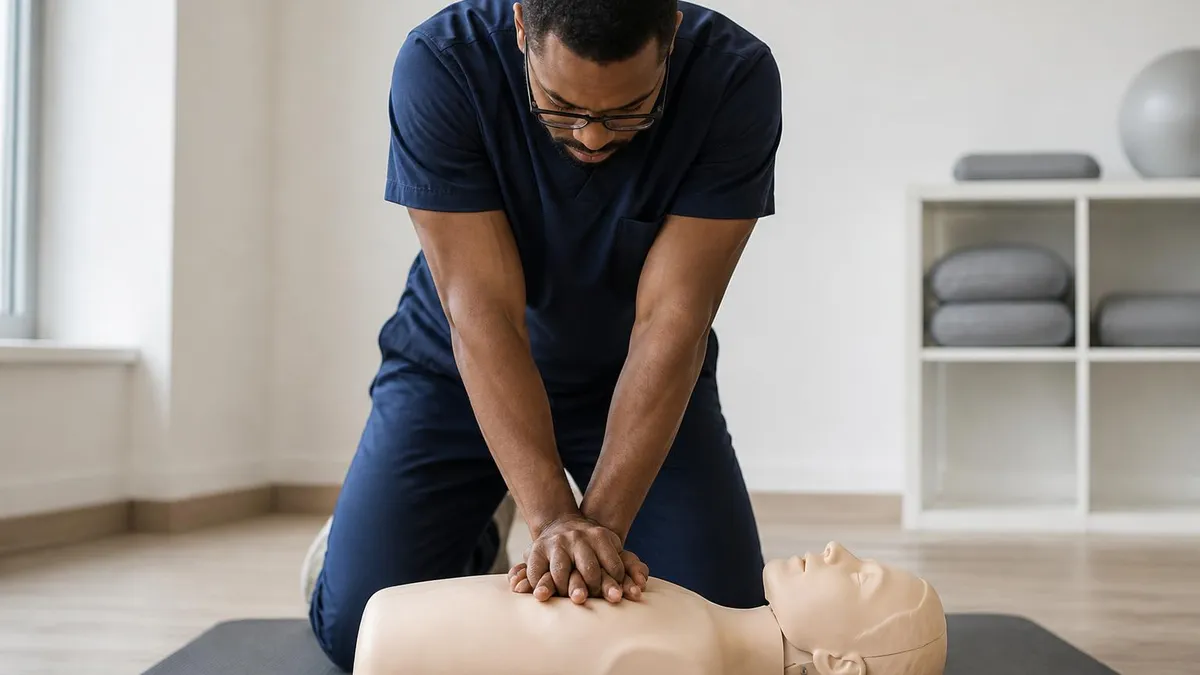
CPR Card Lookup: How to Verify, Replace, and Access Your CPR Certification in 2026
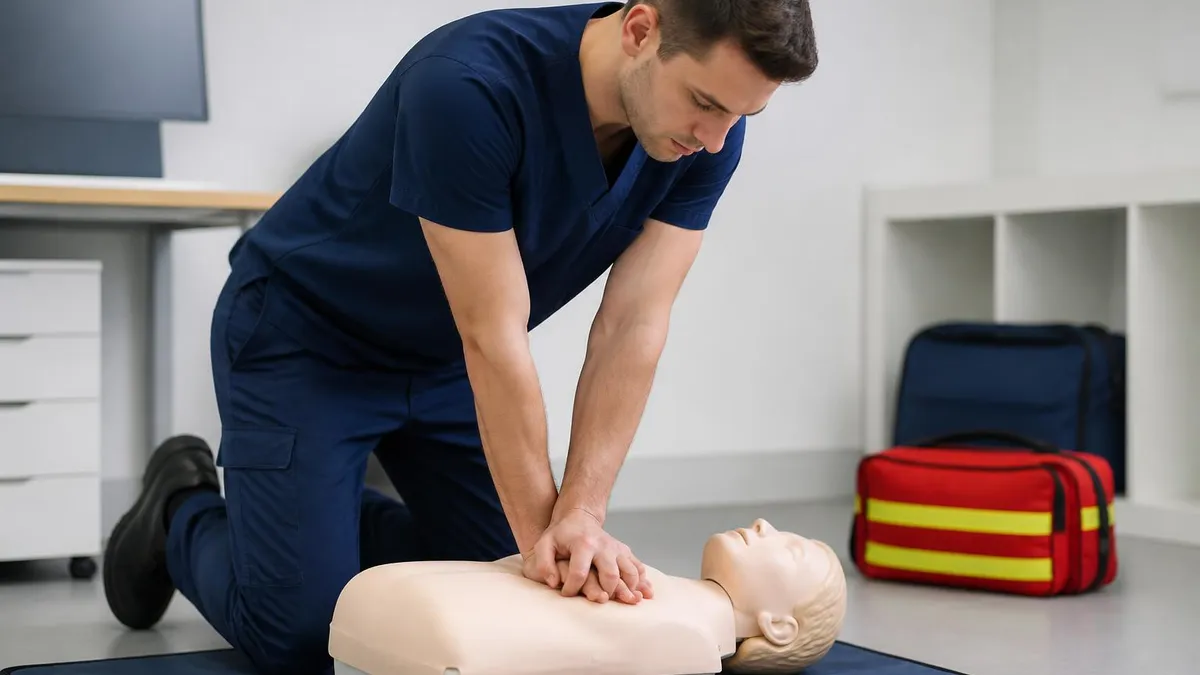
Adult CPR: Complete Step-by-Step Guide to Hands-Only and Standard CPR in 2026
CPR - Cardiopulmonary Resuscitation: Complete Study Guide 2026
Inappropriate CPR Songs: What Not to Play, Why It Matters, and Better Beat-Per-Minute Alternatives
AHA CPR Recertification: How to Recertify CPR Online with the American Heart Association in 2026
About the Author

Registered Nurse & Healthcare Educator
Johns Hopkins University School of NursingDr. Sarah Mitchell is a board-certified registered nurse with over 15 years of clinical and academic experience. She completed her PhD in Nursing Science at Johns Hopkins University and has taught NCLEX preparation and clinical skills courses for nursing students across the United States. Her research focuses on evidence-based exam preparation strategies for healthcare certification candidates.
Join the Discussion
Connect with other students preparing for this exam. Share tips, ask questions, and get advice from people who have been there.
View discussion (5 replies)