
BLS Certification NYC: Complete 2026 October Guide to Classes, Costs & Renewal in New York City
✍🏼 BLS certification NYC guide: AHA & Red Cross classes, costs, renewal options, exam tips, and where healthcare providers train across all 5 boroughs.
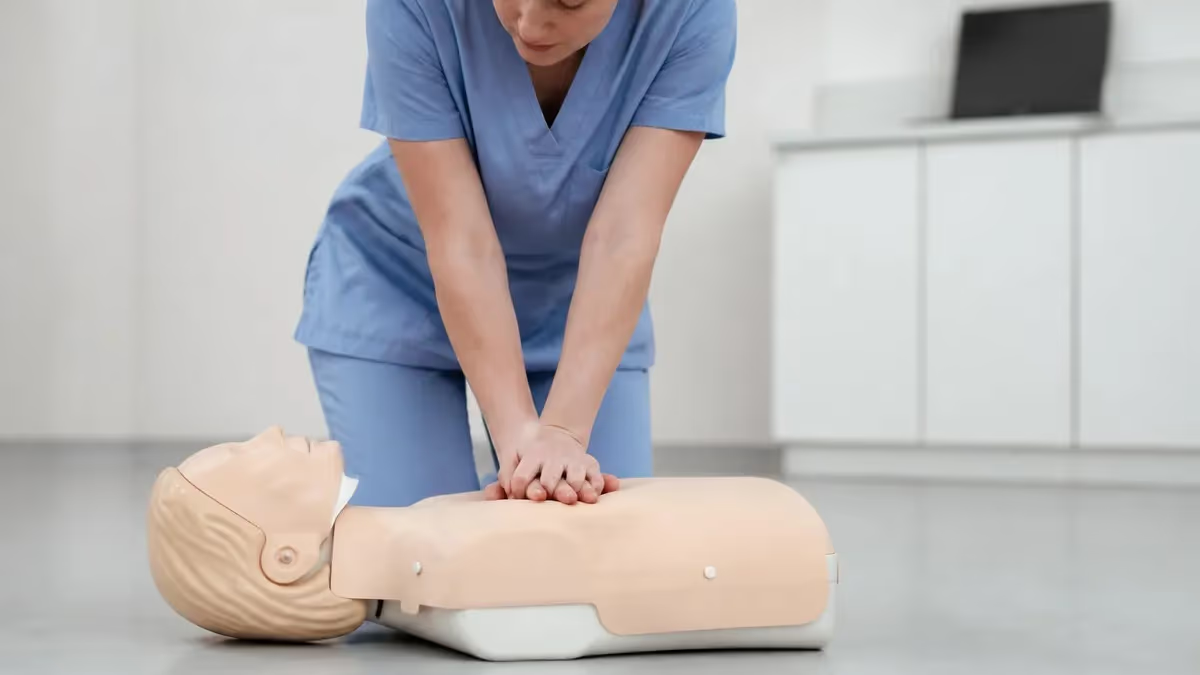
If you work in healthcare anywhere in the five boroughs, earning your BLS certification NYC credential is one of the most important professional milestones you will reach. New York City employs more nurses, paramedics, medical assistants, dental hygienists, and respiratory therapists than almost any other metropolitan area in the country, and nearly all of them must hold a current Basic Life Support card before they can begin clinical work. This guide walks you through every step of getting certified in Manhattan, Brooklyn, Queens, the Bronx, and Staten Island.
So what is a BLS certification, and why do NYC hospitals from Mount Sinai to NYU Langone require it before your first shift? BLS is a structured training program that teaches healthcare professionals how to recognize cardiac arrest, deliver high-quality CPR, use an automated external defibrillator, and manage choking emergencies in adults, children, and infants. It is the foundation skill set for every resuscitation team in the city, from emergency departments to outpatient surgery centers in Midtown.
The two governing bodies that issue cards accepted by NYC employers are the American Heart Association and the American Red Cross. Most major hospital systems specifically request the AHA BLS Provider card, though Red Cross BLS is increasingly accepted at urgent care chains, dental practices, and long-term care facilities across the boroughs. Whichever path you choose, your certification is valid for two years and must be renewed before the expiration date printed on the card.
The cost of BLS certification in NYC ranges from about $65 for a community-based group class in Brooklyn up to $185 for a private same-day session in a Midtown training center. Online blended learning options have become extremely popular since 2020 because they let you complete the cognitive portion at home and finish the hands-on skills check in under two hours at a local site. This is especially helpful for busy NYC clinicians juggling rotating shifts.
Class availability is excellent across the city. You can walk into a training center in the Financial District on a Saturday morning, complete a Friday evening course in Astoria, or schedule an after-work session near Atlantic Terminal. Major training centers operate seven days a week, and many offer same-day cards so you can start a new job on Monday. The american red cross basic life support program also runs frequent community classes in partnership with NYC libraries and YMCAs.
This guide answers the questions NYC learners ask most often. You will learn how BLS differs from a basic CPR class, what to expect on the AHA written exam, how the skills test is scored, what to wear and bring, how renewal works when your card expires, and what to do if you fail on the first attempt. We also cover free practice questions you can use the night before your exam.
Whether you are a CUNY nursing student preparing for clinicals at Bellevue, a dental assistant starting a new role on the Upper East Side, or a paramedic recertifying through FDNY EMS, this resource is built to save you time and money. Read through the sections that apply to you, take the practice quizzes embedded throughout, and use the checklist before your test day.
BLS Certification NYC by the Numbers
Key Facts at a Glance
| Item | Value | Details |
|---|---|---|
| Class Cost Range | $65-$185 | Group vs private same-day |
| Card Validity | 2 Years | Both AHA and Red Cross |
| Full Class Length | 4-5 Hours | In-person initial certification |

Where to Take BLS Certification in NYC
Mount Sinai, NYU Langone, NewYork-Presbyterian, and Montefiore all operate internal AHA training centers. Classes are usually open to outside healthcare workers for a modest fee and follow strict AHA curriculum standards.
Dozens of independent sites in Midtown, Downtown Brooklyn, Long Island City, and Flushing offer flexible scheduling, weekend classes, and same-day card issuance. Most accept walk-ins on busy weekends.
The Greater NY Red Cross chapter runs BLS Provider classes from its Manhattan headquarters and partner locations. Their digital certificate is delivered within 24 hours and is widely accepted.
BMCC, LaGuardia, Hostos, and Queensborough Community College all host BLS classes for students enrolled in allied health programs. Tuition-bundled options can be significantly cheaper than retail.
Complete the cognitive module at home through AHA HeartCode, then book a 60 to 90 minute hands-on skills check at any NYC partner site. Ideal for renewal candidates and shift workers.
Understanding what does BLS stand for helps clarify what you will actually learn in your NYC class. BLS stands for Basic Life Support, and the curriculum covers single-rescuer and team-based resuscitation, high-quality chest compressions, ventilation with a bag-mask device, AED operation, and relief of foreign-body airway obstruction. NYC employers want to see this specific provider-level card, not a generic community CPR certificate, because the BLS curriculum includes two-rescuer scenarios and infant techniques that are essential in clinical settings.
Many learners ask if BLS and CPR are the same. The short answer is no. CPR is a single skill, while BLS is a complete healthcare-provider course that includes CPR as one component along with team dynamics, AED use, opioid-associated emergencies, and pediatric resuscitation. If a Brooklyn dental office asks for CPR, a BLS card always satisfies that requirement, but a community CPR card may not satisfy a hospital BLS requirement. Always confirm with your NYC employer before registering.
The American Heart Association BLS Provider course is the gold standard for NYC hospital employment. NewYork-Presbyterian, Mount Sinai, NYU Langone, Memorial Sloan Kettering, and Hospital for Special Surgery explicitly list AHA BLS on their nursing and allied health job postings. The curriculum is updated to the 2025 AHA Guidelines for CPR and ECC, which include refined compression depth recommendations and updated opioid emergency protocols that NYC providers should know cold.
The red cross basic life support course follows nearly identical clinical science but uses a slightly different testing structure. Red Cross uses a 25-question multiple-choice exam with a 80% passing score, while AHA uses a 25-question exam with the same 84% passing threshold for the initial cert and provides the answer rationales after each missed question. Both organizations follow the International Liaison Committee on Resuscitation consensus, so the actual clinical content is functionally equivalent.
For most NYC healthcare workers, the deciding factor between AHA and Red Cross is which card your specific employer requires. A nurse joining Bellevue must show an AHA BLS card on day one, while a dental hygienist working in a private Tribeca office may have a choice. If you are unsure, AHA is the safer default because it is universally accepted across all NYC hospital systems, urgent cares, surgery centers, and FDNY-affiliated EMS agencies.
Basic life support for healthcare providers in NYC also includes pediatric and infant resuscitation, which is essential if you work at a children's hospital like Cohen Children's Medical Center or the pediatric units at Mount Sinai Kravis. The course teaches compression-to-ventilation ratios that differ between single-rescuer and two-rescuer infant scenarios, and it covers the specific anatomical landmarks for infant chest compressions using the two-thumb encircling hand technique.
NYC has unique training advantages that learners in smaller cities do not enjoy. You can typically find a class within a half-hour subway ride no matter which borough you live in. Same-day card issuance is standard at most training centers, and many sites offer evening and weekend classes specifically designed for shift workers. The high density of training options also keeps prices competitive, with frequent group discounts for hospital cohorts and nursing school cohorts.
BLS Practice Test Questions
Prepare for the BLS - Basic Life Support exam with our free practice test modules. Each quiz covers key topics to help you pass on your first try.
BLS High-Quality CPR & Provider Skills
BLS Exam Questions covering BLS High-Quality CPR & Provider Skills. Master BLS Test concepts for certification prep.
BLS Special Situations & Scenarios
Free BLS Practice Test featuring BLS Special Situations & Scenarios. Improve your BLS Exam score with mock test prep.
BLS Adult, Child & Infant Resuscitation
BLS Mock Exam on Adult, Child & Infant Resuscitation. BLS Study Guide questions to pass on your first try.
BLS Airway Management & Ventilation
BLS Test Prep for Airway Management & Ventilation. Practice BLS Quiz questions and boost your score.
BLS Automated External Defibrillator (AED)...
BLS Questions and Answers on Automated External Defibrillator (AED) Use. Free BLS practice for exam readiness.
BLS Certification: Cardiac Arrest
BLS Mock Test covering Certification: Cardiac Arrest. Online BLS Test practice with instant feedback.
BLS Certification: Choking
Free BLS Quiz on Certification: Choking. BLS Exam prep questions with detailed explanations.
BLS Certification: Respiratory Arrest
BLS Practice Questions for Certification: Respiratory Arrest. Build confidence for your BLS certification exam.
BLS Chain of Survival
BLS Test Online for Chain of Survival. Free practice with instant results and feedback.
BLS CPR Techniques & Procedures
BLS Study Material on CPR Techniques & Procedures. Prepare effectively with real exam-style questions.
BLS Legal & Ethical Considerations
Free BLS Test covering Legal & Ethical Considerations. Practice and track your BLS exam readiness.
BLS Post-Resuscitation Care
BLS Exam Questions covering Post-Resuscitation Care. Master BLS Test concepts for certification prep.
BLS Class Formats Available Across NYC
The traditional in-person initial BLS class runs 4 to 5 hours and combines lecture, video instruction, hands-on skills practice, a written exam, and a skills test. This format works best for first-time learners, nursing students, and anyone who learns better with direct instructor feedback. Most NYC training centers run these classes on Saturdays and Sundays as well as several weekday evenings.
Expect to be on the floor practicing compressions, bag-mask ventilation, and AED placement for most of the session. NYC training rooms typically pair students two-by-two with manikins and rotate roles. The basic life support exam American Heart Association portion comes near the end, and most students finish with their card in hand the same day.
Pros and Cons of BLS Certification NYC Options
- +Hundreds of training centers across all five boroughs make scheduling easy
- +Same-day card issuance is standard at most NYC sites
- +Competitive pricing thanks to high training center density
- +Evening and weekend classes accommodate shift workers and students
- +Both AHA and Red Cross cards are accepted by most NYC employers
- +Blended online options save in-person time for busy clinicians
- +Group discounts available for nursing school and hospital cohorts
- −Manhattan training centers charge premium rates compared to outer boroughs
- −Some hospitals only accept AHA, narrowing your choices
- −Walk-in availability is limited during peak nursing graduation months
- −Skills testing requires showing up regardless of online completion
- −Lost card replacement fees can run $25 to $35 per request
- −Same-day private sessions can cost up to $185 in Midtown
- −Subway delays can cause learners to miss the strict class start time

Pre-Class Checklist for BLS Certification NYC
- ✓Confirm whether your NYC employer requires AHA or Red Cross BLS
- ✓Register and pay at least one week before your preferred class date
- ✓Download the AHA BLS Provider Manual or Red Cross digital handbook
- ✓Review the 2025 AHA Guidelines highlights, especially compression depth
- ✓Take at least two free practice quizzes to identify weak topics
- ✓Eat a real meal before class to avoid fatigue during skills practice
- ✓Wear comfortable closed-toe shoes and loose clothing for kneeling
- ✓Bring a government-issued photo ID for check-in and exam verification
- ✓Arrive 15 minutes early to handle subway delays and elevator lines
- ✓Bring a pen, water bottle, and a small notebook for instructor tips
Book Tuesday or Wednesday morning classes for the smallest groups
NYC weekend classes can hold 12 to 20 students per instructor, which limits hands-on manikin time. Midweek morning classes typically have 4 to 8 learners, giving you significantly more practice reps with the AED and bag-mask device. Most training centers charge identical prices regardless of day, so booking midweek is a free upgrade to a better learning experience.
On exam day, your NYC BLS class begins with check-in, ID verification, and a quick review of class logistics. The instructor will distribute manikins, AED trainers, pocket masks, and bag-mask devices. Most classes start with a video-led practice-while-watching segment that introduces high-quality CPR, then transitions to hands-on rotations. Expect to spend at least 90 minutes of your class actively on the floor practicing compressions, ventilations, and team-based scenarios with a partner. The instructor circulates constantly to provide real-time feedback.
The basic life support exam American Heart Association uses contains 25 multiple-choice questions covering adult, child, and infant resuscitation, AED use, choking, opioid emergencies, and team dynamics. You need to score 84% or higher to pass on the first attempt, which means you can miss no more than four questions. Questions are scenario-based rather than memorization-heavy, so understanding why each step happens matters more than rote recall. The AHA BLS exam is open book in most training environments, but you should still study because you have limited time.
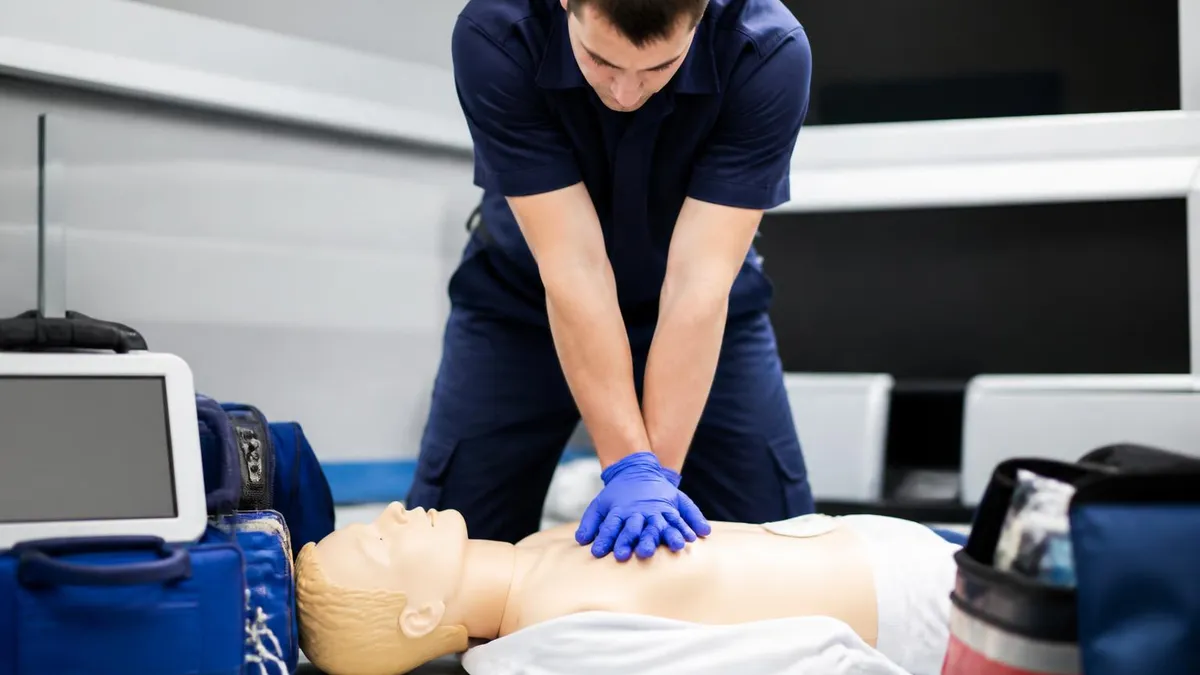
The skills test is where many candidates feel the most pressure. You will be asked to demonstrate adult CPR with an AED, infant CPR with two-rescuer ventilation, and bag-mask technique. The instructor uses a strict checklist that includes compression depth between 2 and 2.4 inches, compression rate between 100 and 120 per minute, full chest recoil, minimal interruptions, and proper ventilation volume. NYC instructors are generally supportive but they cannot pass you if you miss critical criteria.
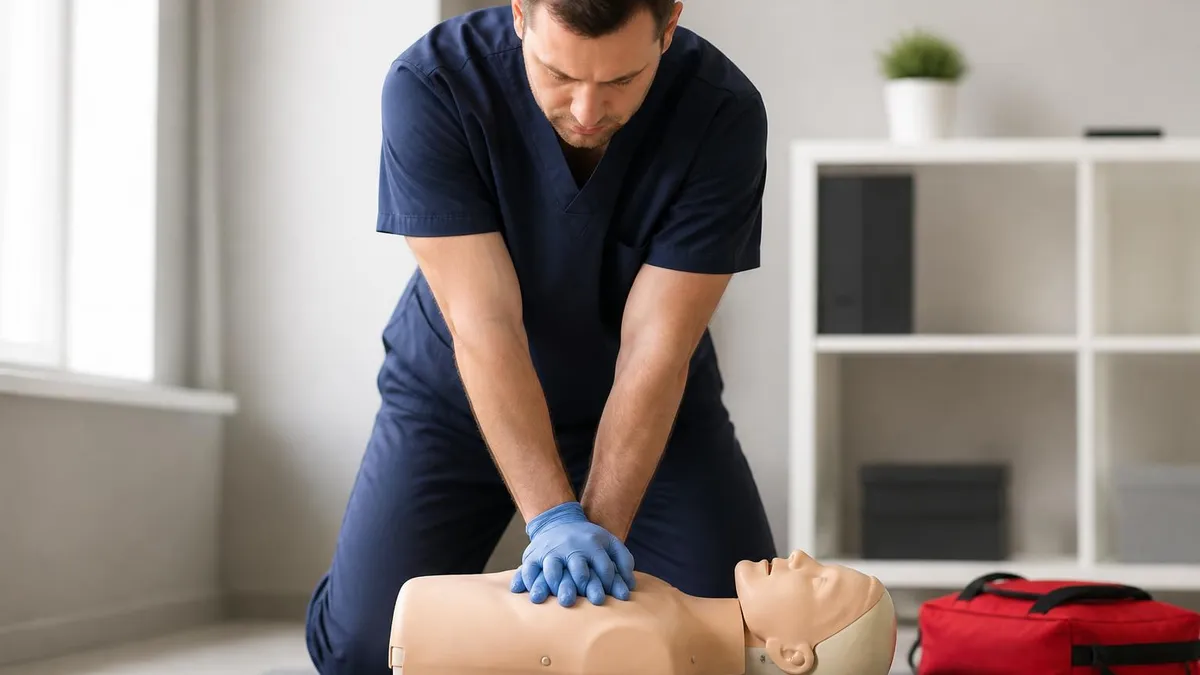
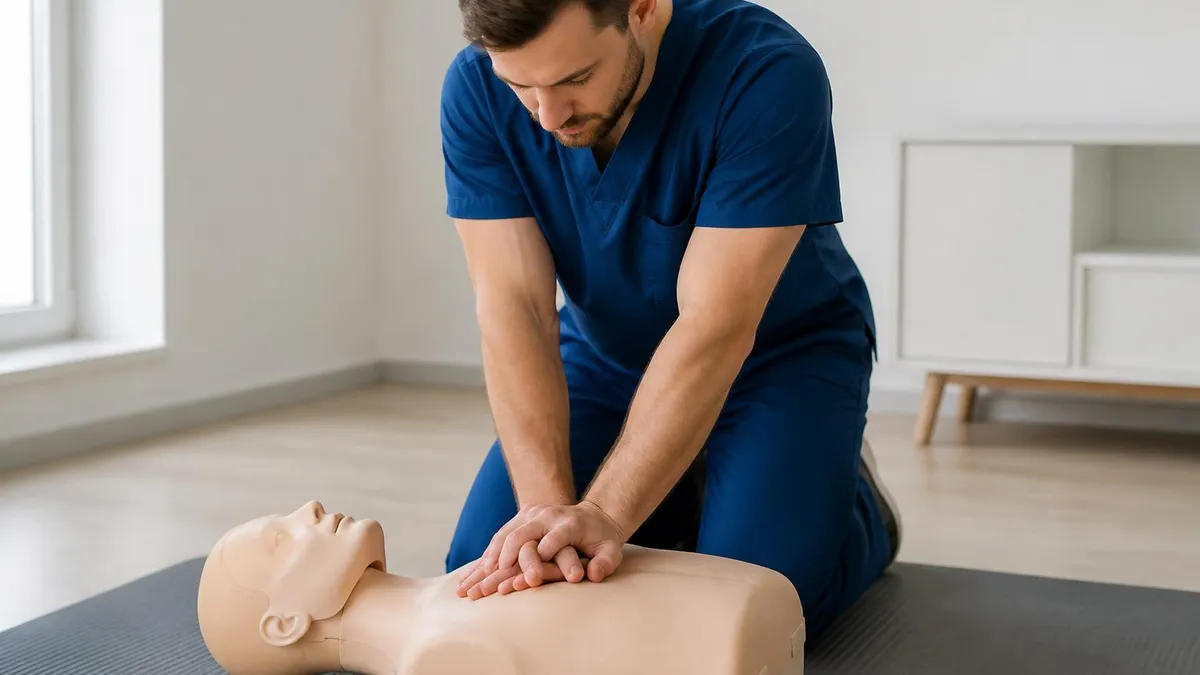
If you struggle with compression depth, ask the instructor before your test to coach you on body positioning. Lock your elbows, keep your shoulders directly over the manikin, and push from your hips rather than your arms. NYC training centers use manikins with audio and visual feedback that click when compressions are deep enough, which makes practice more effective. Take advantage of every practice rep before your formal evaluation.
For the AED portion, narrate your steps out loud. Say turn on the AED, expose the chest, attach pads in the upper right and lower left positions, clear the patient, allow the AED to analyze, deliver the shock if advised, and immediately resume compressions. Verbalizing your actions shows the instructor you understand the protocol even if you fumble a manual step. This is a small habit that has helped many NYC candidates pass when they were nervous.
If you fail the skills check on the first attempt, do not panic. NYC training centers allow remediation on the same day or scheduled within the next few days at no additional cost. The instructor will identify exactly which criteria you missed and give you focused practice time on those skills before retesting. Most candidates who remediate pass on the second attempt because the gap is usually a single specific skill rather than overall preparedness.
After you pass, your card is issued either as a physical AHA eCard delivered by email within 24 hours or as a Red Cross digital certificate available immediately through their portal. Print a copy for your records, save the PDF to your phone, and forward it to your employer's HR or compliance team. NYC hospitals typically require you to upload the card to their credentialing system within five business days of completing the course to remain compliant.
NYC hospitals and outpatient facilities automatically pull clinicians from the schedule if their BLS card expires, even by one day. Track your expiration date and renew at least 30 days early. Late renewals may require you to retake the full initial course rather than the shorter renewal class, costing extra time and money.
Renewing your BLS in NYC is significantly faster than initial certification. A basic life support renewal class takes about 2 to 3 hours and skips much of the introductory material covered in the initial course. You can also choose a blended renewal pathway, completing the cognitive review online and finishing the skills check in under an hour. The renewal exam follows the same format as initial certification, but you typically already know the content and can finish quickly with confidence.
Many NYC clinicians wonder how long does bls certification last and how to time their renewal. The answer is two years from the date of issue, and the card expires on the last day of the issue month. So if your card was issued on March 12, 2024, it expires on March 31, 2026. Most NYC employers send automated reminder emails 90 days, 60 days, and 30 days before expiration so you have ample time to schedule renewal without scrambling.
The blended online renewal option has become the dominant pathway for NYC healthcare workers because it lets you complete the cognitive review on your subway commute, during lunch breaks, or in the evening after work. Once you finish the online module, you book a 60-minute skills check at any partner site across the five boroughs. The total time investment is often under three hours of active engagement spread across a few days.
The renewal-versus-initial distinction matters because renewal classes are typically $10 to $30 cheaper than initial classes and significantly shorter. However, renewal eligibility requires that your current card has not yet expired. If your card lapses, you must register for the full initial class regardless of how many times you have previously certified, which is why tracking your expiration date is so important for NYC clinicians juggling busy schedules.
Some NYC employers cover the full cost of renewal as part of their continuing education benefits. NewYork-Presbyterian, Mount Sinai, NYU Langone, and Northwell Health all provide either free in-house renewal classes or reimburse external renewal costs up to a set limit. Check with your HR team or your clinical educator before paying out of pocket because reimbursement is often available even for external classes.
The difference between BLS renewal and ALS or PALS recertification matters for nurses and paramedics pursuing higher credentials. If you are also certified in ACLS or PALS, you can often complete all three renewals in a single weekend at NYC training centers that offer combined courses. Many learners coordinate these together to minimize time off work and reduce travel time across boroughs. Check the how long does basic life support certification last guide for the full timeline comparison.
Finally, remember that even when your card is current, your skills decay without practice. NYC hospitals run regular mock code drills and CPR refresher sessions throughout the year. Participate in these whenever possible because they reinforce muscle memory between formal renewals. Many clinicians find that the mock codes are the highest-yield practice because they happen in realistic environments with actual team dynamics, equipment placement, and time pressure.
To maximize your chances of passing the BLS exam on the first attempt, build a focused study plan that combines the official AHA or Red Cross materials with realistic practice questions. Most NYC learners benefit from spending 3 to 5 hours reviewing the provider manual highlights, watching the official skills videos, and completing at least 50 practice questions across multiple topic areas. The goal is to reach a point where you can explain why each step in the algorithm happens, not just memorize the sequence.
Focus your studying on the most commonly tested concepts. These include adult compression depth and rate, compression-to-ventilation ratios for single-rescuer versus two-rescuer scenarios, AED pad placement for adults and infants, the maximum acceptable pause for pulse checks, and the appropriate response to opioid-associated emergencies. NYC instructors confirm that these topics appear on nearly every exam version and are the most common reasons candidates miss the 84% passing threshold.
Avoid cramming the night before. The science of resuscitation requires you to integrate multiple pieces of information under simulated stress, which works much better when learned over several days. Set aside 45 minutes per evening for three to four nights leading up to your class. Use a quiet space, eliminate phone distractions, and take notes by hand because handwriting forces deeper processing than passive reading.
Practice with a partner if possible. Even if your partner has no medical background, walking them through the BLS algorithm out loud will reveal gaps in your understanding. NYC nursing students often form small study groups in coffee shops near Bellevue, Lenox Hill, and Maimonides, and these informal sessions are some of the most effective preparation tools. Teaching the material is one of the highest-use study techniques in adult learning research.
On the morning of your class, eat a real breakfast with protein and complex carbohydrates. Skills practice is physically demanding, and you will be kneeling on the floor performing chest compressions for extended periods. Bring a refillable water bottle because most NYC training centers do not provide drinks. Wear breathable clothing because training rooms can get warm with full classes and overhead lighting running for hours.
If you are anxious about the skills check, ask your instructor early in the class for extra coaching on specific skills. NYC instructors expect this question and welcome it because it shows engagement. Most are happy to give you an additional rotation on the manikin during break time. Use this time to focus on your weakest skill rather than reviewing what you already do well, because targeted practice yields the largest improvement.
Finally, take advantage of every free practice resource available online before your class. Free practice quizzes simulate the format and difficulty of the actual exam, give you immediate feedback on incorrect answers, and identify topics where you need more review. Many NYC candidates report that completing 100 or more practice questions across multiple quizzes made the actual exam feel familiar and significantly reduced their test-day anxiety.
Sample BLS - Basic Life Support Practice Questions
Try these questions from our free BLS - Basic Life Support practice tests. The correct answer and an explanation follow each question.
How many rescue breaths per minute should be given to a child who has a pulse but is not breathing?
- A. 6–8 breaths per minute
- B. 10–12 breaths per minute
- C. 12–20 breaths per minute
- D. 20–25 breaths per minute
Answer: C. 12–20 breaths per minute
Rescue breathing for children without cardiac arrest is delivered at 12–20 breaths per minute (one breath every 3–5 seconds).
A lone rescuer finds an unresponsive, non-breathing child who was just pulled from a pool. When should EMS be activated?
- A. Call EMS before starting any CPR
- B. Provide approximately 2 minutes (5 cycles) of CPR first, then activate EMS
- C. Activate EMS simultaneously by using a phone on speaker while compressing
- D. Wait until the child regains consciousness before calling EMS
Answer: B. Provide approximately 2 minutes (5 cycles) of CPR first, then activate EMS
For pediatric drowning victims, hypoxia is the primary cause, so 2 minutes of CPR is prioritized before a lone rescuer leaves to activate EMS.
How often should rescuers switch roles during two-rescuer CPR?
- A. Every 5 minutes
- B. Every 1 minute
- C. Every 2 minutes
- D. Only when exhausted
Answer: C. Every 2 minutes
During two-rescuer CPR, rescuers should switch roles (compressor and ventilating rescuer) approximately every 2 minutes, or after 5 cycles of 30:2 compressions and breaths. This regular rotation helps prevent rescuer fatigue, ensuring that high-quality chest compressions are maintained without significant interruptions, which is vital for patient survival.
An AED is available but the victim has an implanted pacemaker or ICD visible under the skin on the chest. Where should the AED pad be placed?
- A. Directly over the implanted device
- B. At least 1 inch (2.5 cm) away from the implanted device
- C. On the victim's back only
- D. Do not use the AED if an ICD is present
Answer: B. At least 1 inch (2.5 cm) away from the implanted device
AED pads should be placed at least 1 inch away from implanted pacemakers or ICDs to prevent interference with pad contact and effective defibrillation.
BLS Questions and Answers
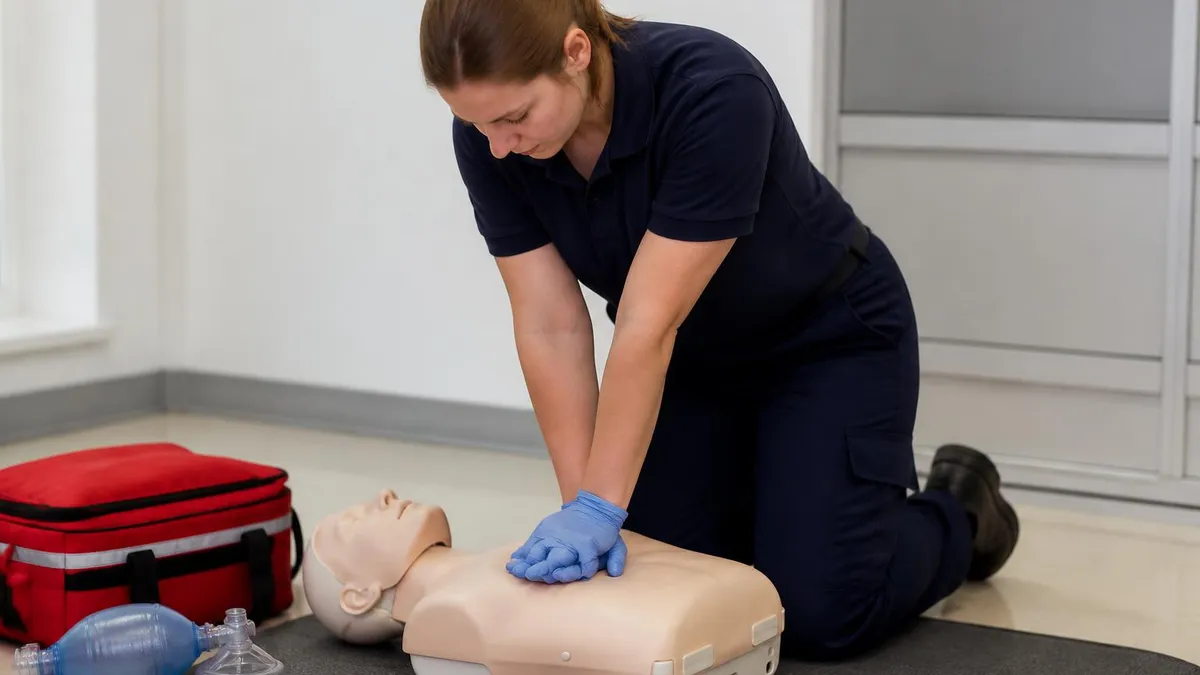
Pediatric BLS Algorithm: Complete 2026 Guide for Healthcare Providers
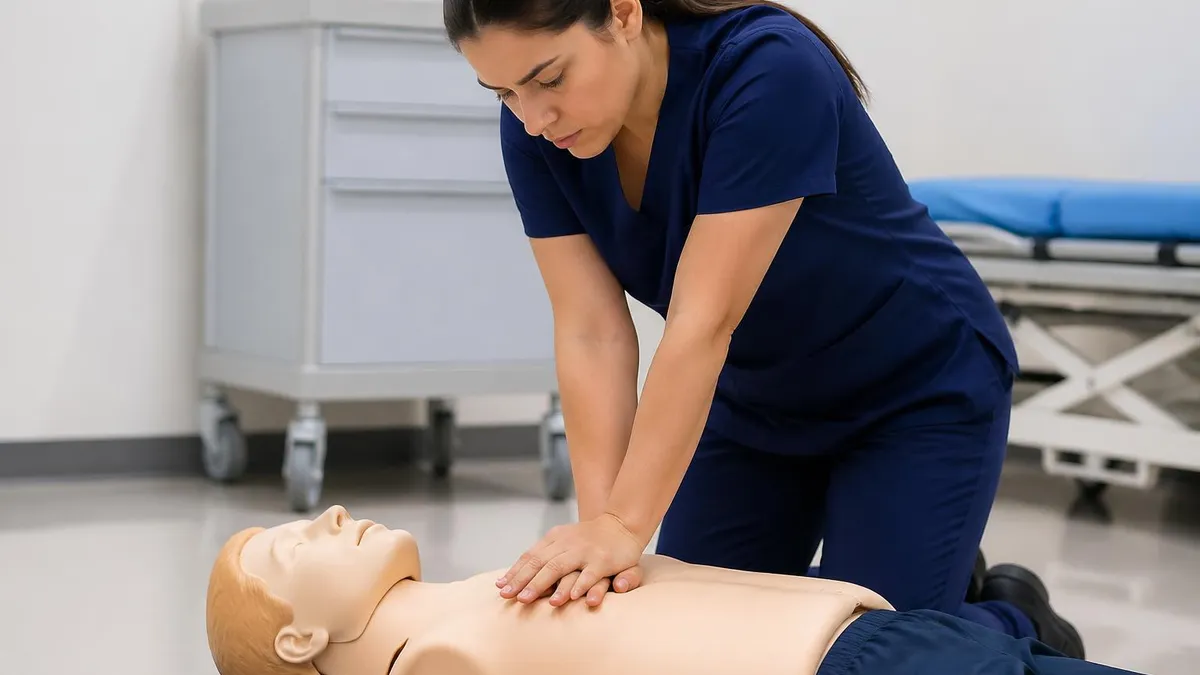
American Heart Association BLS: Certification, Renewal, Cost & What to Expect
Online BLS Renewal: Complete 2026 Guide to Recertifying Your Basic Life Support Card
BLS vs ALS: Complete Comparison of Basic and Advanced Life Support
Are CPR and BLS the Same? Complete 2026 Guide to Differences, Certification & Training
About the Author

Registered Nurse & Healthcare Educator
Johns Hopkins University School of NursingDr. Sarah Mitchell is a board-certified registered nurse with over 15 years of clinical and academic experience. She completed her PhD in Nursing Science at Johns Hopkins University and has taught NCLEX preparation and clinical skills courses for nursing students across the United States. Her research focuses on evidence-based exam preparation strategies for healthcare certification candidates.
Join the Discussion
Connect with other students preparing for this exam. Share tips, ask questions, and get advice from people who have been there.
View discussion (8 replies)