
2026 October ASVAB Practice Test: Complete Study Guide to Scores, Format & Prep
Ace your 2026 October ASVAB practice test 🎯 Full guide: scores, format, study tips, and free practice questions to boost your AFQT and land your dream MOS.

The 2025 ASVAB practice test is the single most important preparation tool available to anyone planning to enlist in the U.S. military. Whether you are aiming for the Army, Navy, Air Force, Marine Corps, or Coast Guard, your Armed Services Vocational Aptitude Battery score determines not only whether you qualify to serve, but which career fields and job specialties will be open to you.
Thousands of recruits underestimate the exam every year, showing up underprepared and scoring below the minimum AFQT threshold required for their branch. Starting your prep with a realistic practice test gives you an honest baseline and reveals exactly where to focus your study hours.
Understanding what the ASVAB actually measures is the first step toward a strong score. The exam is not a general knowledge quiz — it is a multi-domain aptitude assessment covering nine distinct subject areas, from arithmetic reasoning and mathematics knowledge to mechanical comprehension and electronics information. Each subtest feeds into composite scores called line scores, which recruiters use to match you with specific military occupational specialties (MOS). A high AFQT opens the door to enlistment, but strong line scores in areas like skilled technical or electronics determine whether you qualify for the most sought-after and highest-paying roles.
Many test-takers are surprised to learn that the ASVAB is offered in two distinct formats: the computer-adaptive CAT-ASVAB administered at Military Entrance Processing Stations (MEPS) and the paper-and-pencil P&P-ASVAB given at Military Entrance Test (MET) sites.
The CAT version adapts question difficulty based on your previous answers, meaning a correct response leads to a harder follow-up question while an incorrect answer triggers an easier one. This adaptive design makes guessing strategies less effective and places a premium on genuine subject mastery. The P&P version is linear and allows you to skip and return to questions within a subtest, which requires a different pacing strategy.
For 2025, the content of the ASVAB remains consistent with recent years, though testing centers have expanded access to the CAT-ASVAB and updated some digital interface features. The nine core subtests — General Science, Arithmetic Reasoning, Word Knowledge, Paragraph Comprehension, Mathematics Knowledge, Electronics Information, Auto and Shop Information, Mechanical Comprehension, and Assembling Objects — remain unchanged. The AFQT score is derived exclusively from the four subtests of Arithmetic Reasoning, Mathematics Knowledge, Word Knowledge, and Paragraph Comprehension. Knowing this allows smart test-takers to prioritize their study time where it directly impacts their enlistment eligibility.
One commonly misunderstood aspect of ASVAB preparation involves the relationship between asvab scores and fitness requirements. Many recruits preparing for military service are simultaneously working toward their physical fitness benchmarks, including the army combat fitness test, which replaced the legacy Army Physical Fitness Test as the official fitness assessment. While your ASVAB score and your physical fitness score are evaluated independently, strong performance in both categories positions you as the most competitive candidate possible and expands your options for advanced training programs and bonus eligibility at enlistment.
The stakes of ASVAB performance extend far beyond simple pass-or-fail. Every branch sets minimum AFQT scores for enlistment, and these minimums vary considerably. The Army currently requires a minimum AFQT of 31 for non-prior-service recruits, while the Air Force typically requires 36 and the Coast Guard holds candidates to a minimum of 40.
However, hitting the floor score only qualifies you for a limited range of jobs, often the least desirable ones. Recruits aiming for intelligence, cyber operations, medical, or aviation support fields routinely need AFQT scores in the 65-to-99 range plus competitive line scores in specific composites. A 2025 ASVAB practice test taken seriously is the fastest way to understand where you currently stand relative to your personal targets.
This comprehensive guide walks you through everything you need to know to maximize your 2025 ASVAB score: the full exam format, the scoring system explained in plain language, a week-by-week study schedule, the best resources including an asvab study guide approach and free practice tests, insider tips on pacing and strategy, and answers to the most common questions recruits ask. Whether you have three months to prepare or are testing in three weeks, the framework here will help you build an efficient, targeted plan that gets results.
2025 ASVAB by the Numbers
ASVAB Exam Format & Structure
| Section | Questions | Time | Weight | Notes |
|---|---|---|---|---|
| General Science (GS) | 16 | 8 min | Line Score | Biology, chemistry, physics, earth science |
| Arithmetic Reasoning (AR) | 16 | 39 min | AFQT | Word problems, rates, percentages |
| Word Knowledge (WK) | 16 | 8 min | AFQT | Vocabulary and synonym identification |
| Paragraph Comprehension (PC) | 11 | 22 min | AFQT | Reading passages, main idea, inference |
| Mathematics Knowledge (MK) | 16 | 20 min | AFQT | Algebra, geometry, number theory |
| Electronics Information (EI) | 16 | 8 min | Line Score | Circuits, voltage, current, resistance |
| Auto & Shop Info (AS) | 11 | 7 min | Line Score | Engines, tools, vehicle systems |
| Mechanical Comprehension (MC) | 16 | 20 min | Line Score | Pulleys, gears, fluid dynamics, force |
| Assembling Objects (AO) | 16 | 16 min | Line Score | Spatial reasoning, puzzle assembly |
| Total | 145 | ~3 hours (CAT) / ~3.5 hours (P&P) | 100% |
Decoding your ASVAB scores is essential for setting realistic goals and choosing which subtests to prioritize. The score that most recruits hear about first is the AFQT — the Armed Forces Qualification Test score — which is a percentile ranking derived from four specific subtests: Arithmetic Reasoning, Mathematics Knowledge, Word Knowledge, and Paragraph Comprehension.
An AFQT of 65 means you scored equal to or better than 65 percent of a nationally representative sample of 18-to-23-year-old Americans who took the test in 1997, which serves as the norm group. This percentile framing means ASVAB scores are relative, not absolute — the exam does not have a fixed passing score independent of the norm group comparison.
Beyond the AFQT, every branch of the military uses a system of composite scores called line scores or aptitude area scores. These composites are calculated by combining raw scores from specific subtests in different configurations depending on the branch. The Army, for example, uses composites labeled Skilled Technical (ST), Electronics (EL), General Maintenance (GM), General Technical (GT), and several others.
A strong GT score opens doors to officer candidate programs and advanced technical training. The Navy's composites, called Rating Entry scores, are structured differently and prioritize different combinations of subtests. Understanding which composites govern your target MOS is a critical planning step that most recruits overlook until after they have already taken the exam.
Many recruits ask how the aft score chart factors into their overall military qualification picture. The Army Combat Fitness Test, which the military now uses instead of the legacy Army Physical Fitness Test, has its own scoring rubric based on age group and gender, assigning points across six events: the deadlift, standing power throw, hand-release push-up, sprint-drag-carry, leg tuck or plank, and two-mile run.
ACFT scores and ASVAB scores are tracked separately, but both play a role in your overall qualification profile, particularly for specialized roles. Taking the army fitness test alongside your ASVAB prep lets you build a complete picture of your enlistment readiness.
One of the most common misconceptions about ASVAB scoring involves the difference between standard scores and percentile scores. Each subtest generates a standard score with a mean of 50 and a standard deviation of 10. These standard scores are then combined according to branch-specific formulas to produce line scores, and the four AFQT-relevant subtests are combined to produce the percentile-based AFQT.
When your recruiter references your score, they are almost always talking about the AFQT percentile. When they discuss job eligibility, they shift to line score minimums. A candidate can have a 72 AFQT — qualifying for virtually any branch — and still be ineligible for a specific MOS if their relevant line score is below the threshold for that specialty.
The retest policy is an important piece of the ASVAB scoring landscape that every candidate should understand before their first sitting. If you are not satisfied with your initial score, you must wait one calendar month before retesting. After your second test, a six-month waiting period applies before any subsequent retests.
This policy makes your first serious attempt critically important — walking in underprepared and banking on a quick retest is a strategy that costs months of time. Recruiters also note that a significantly lower second score can raise questions during the enlistment process, so your goal should always be to perform at your peak on the first attempt.
Score reporting is immediate for CAT-ASVAB candidates at MEPS, with your AFQT available to your recruiter within hours. P&P test results take one to two weeks to process. Both formats are equally valid for enlistment purposes, though MEPS testing is generally preferred because of the faster turnaround and the fact that you complete your full medical screening at the same location.
Once your scores are on file with the Department of Defense, they remain valid for two years, meaning candidates who tested while in high school through the Student Testing Program have a window to enlist before their scores expire and a retest becomes mandatory.
For recruits who want to benchmark themselves against real score targets, a useful rule of thumb is the following: AFQT 50-64 opens the majority of enlisted roles across all branches; AFQT 65-92 unlocks virtually all enlisted roles and puts you in a strong position for enlistment bonuses; AFQT 93-99 places you in the top tier and signals strong officer candidacy potential. Alongside your AFQT work, targeted practice on the mechanical and electronics subtests pays dividends for technical MOS options that often carry higher starting pay and civilian marketability after service.
ASVAB Study Guide: Strategies by Subtest
The four AFQT subtests — Arithmetic Reasoning, Mathematics Knowledge, Word Knowledge, and Paragraph Comprehension — deserve the majority of your study time because they determine whether you can enlist at all. For math, build your skills from fundamentals first: integer operations, fractions, decimals, and percentages before moving into algebra and geometry. Arithmetic Reasoning problems are word problems, so practicing reading comprehension alongside math will serve double duty. Aim for 20 to 30 math practice problems per day in the six weeks before your test date.
Word Knowledge is the subtest that most improves with consistent daily practice over weeks rather than intensive cramming. Build a vocabulary habit using flashcards — the Barron's ASVAB wordlist is one of the most widely validated resources. Paragraph Comprehension rewards test-takers who practice active reading: reading passages once, identifying the main idea, and resisting the urge to answer from memory rather than from the text. Time yourself on passage sets to build the pace required in the actual exam environment.
CAT-ASVAB vs. Paper-and-Pencil ASVAB: Key Differences
- +CAT-ASVAB results available immediately at MEPS on test day
- +Computer-adaptive format gives more precise score estimates in fewer questions
- +MEPS testing combines ASVAB and medical screening in one visit for efficiency
- +CAT interface displays one question at a time, reducing overwhelm for many test-takers
- +Adaptive difficulty means strong test-takers face appropriately challenging questions
- +Most military branches slightly prefer MEPS CAT records for administrative simplicity
- −CAT-ASVAB does not allow skipping or reviewing previous answers within a subtest
- −Technical difficulties at test centers can disrupt your session unexpectedly
- −P&P version at MET sites may be the only option in rural or remote locations
- −Paper version takes 1-2 weeks for score reporting, delaying your recruiter timeline
- −P&P test format requires stricter personal time management across fixed subtest blocks
- −Some test-takers find staring at a monitor for three hours more fatiguing than paper
Pros and Cons at a Glance
| Pros | Cons |
|---|---|
| CAT-ASVAB results available immediately at MEPS on test day | CAT-ASVAB does not allow skipping or reviewing previous answers within a subtest |
| Computer-adaptive format gives more precise score estimates in fewer questions | Technical difficulties at test centers can disrupt your session unexpectedly |
| MEPS testing combines ASVAB and medical screening in one visit for efficiency | P&P version at MET sites may be the only option in rural or remote locations |
| CAT interface displays one question at a time, reducing overwhelm for many test-takers | P&P test format requires stricter personal time management across fixed subtest blocks |
| Adaptive difficulty means strong test-takers face appropriately challenging questions | Some test-takers find staring at a monitor for three hours more fatiguing than paper |
2025 ASVAB Practice Test Prep Checklist
- ✓Take a full-length diagnostic practice ASVAB to establish your baseline AFQT and line scores.
- ✓Identify which line score composites are required for your target MOS and set subtest-level score goals.
- ✓Build a daily study schedule allocating the most time to your weakest AFQT subtests.
- ✓Use official ASVAB study materials including the ASVAB Official Study Guide from the Department of Defense.
- ✓Complete at least three full-length timed practice tests before your actual test date.
- ✓Review every wrong answer — understand why the correct choice is right, not just what the right answer is.
- ✓Study vocabulary with spaced-repetition flashcards for 15 minutes every day for six weeks.
- ✓Watch video explanations for Mechanical Comprehension and Electronics concepts you find difficult.
- ✓Simulate real test conditions for at least one full practice run: no phone, no breaks, strict timing.
- ✓Confirm your test center location and arrival time with your recruiter at least 72 hours before test day.

Scoring 50 Means You Beat Half the Country — Aim Higher for the Best Jobs
Many recruits confuse AFQT scores with percentage-correct scores. An AFQT of 65 does not mean you answered 65% of questions correctly — it means you outperformed 65% of the 1997 civilian norm group. Top military jobs in cyber, intelligence, and aviation typically require AFQT scores above 70 combined with strong line scores in Electronics or Skilled Technical composites. Set your target 10-15 points above the floor for your desired MOS to leave room for test-day nerves and still land where you need to be.
Understanding how asvab scores translate into specific military career paths is one of the most motivating and strategically important parts of ASVAB preparation. The military operates with hundreds of distinct job specialties — the Army alone lists over 150 MOS codes — and each has its own minimum line score thresholds. These thresholds are not arbitrary; they reflect the cognitive and aptitude demands of each role.
An infantry soldier needs a strong Combat (CO) score, while an intelligence analyst requires a high Skilled Technical (ST) composite. A signals intelligence collector must hit minimum thresholds in both Electronics (EL) and Skilled Technical (ST), making cross-subtest performance essential for competitive applicants.
Some of the most competitive and well-compensated specialties require not just a high AFQT but specific combinations of line scores that most candidates do not naturally optimize for without deliberate study. Cyber operations specialists in the Army (MOS 17C) require an ST score of 112 and a SKILLED score of 112 simultaneously — requirements that place these roles well out of reach for candidates who only study to pass the AFQT minimum.
Similarly, becoming an Army linguist (MOS 35P) requires qualifying on the Defense Language Aptitude Battery (DLAB) in addition to your ASVAB line scores. Understanding this layered qualification system early helps you build a comprehensive prep plan rather than stopping at AFQT eligibility.
For candidates interested in exploring how their individual ASVAB performance maps to career options, the Department of Defense provides the ASVAB Career Exploration Program, which is separate from the formal MEPS testing process and is commonly administered in high schools. Recruits who want a detailed breakdown of how their line scores align with military job families should consult the army pt test resource, which explains how each composite score gates access to different branches and specialties. This kind of career-oriented research, done before your first practice test, transforms your study plan from generic to laser-focused.
The relationship between ASVAB scores and enlistment bonuses is another dimension that experienced recruiters emphasize. Many branches offer enlistment bonuses of $5,000 to $50,000 or more for candidates who qualify for high-demand specialties — and nearly all of those specialties require above-average ASVAB line scores.
A candidate who invests eight additional weeks in ASVAB prep to lift their ST or EL composite from 95 to 115 might unlock a $20,000 enlistment bonus in addition to a more desirable career specialty. Viewed through this lens, every hour of preparation has a calculable return on investment that far exceeds what most recruits realize.
Officer pathways involve a different assessment process, but the ASVAB still plays a role. Enlisted soldiers applying for Officer Candidate School (OCS) or Warrant Officer programs are evaluated on their ASVAB GT score alongside college credits, physical fitness, and leadership evaluations.
The GT score is one of the most widely cited composite scores in the Army, derived from Verbal Expression (VE — itself a combination of WK and PC) and Arithmetic Reasoning. A GT score of 110 is a common minimum for many officer and warrant officer programs, making the AFQT foundation inseparable from long-term career advancement even for those who enlist first and pursue officer pathways later.
One frequently overlooked benefit of strong ASVAB performance is its effect on duty station preferences. While no branch guarantees assignments, candidates with high ASVAB scores and competitive qualifications for multiple MOS options have more use during the Advanced Individual Training (AIT) assignment process. Recruiters working with high-scoring candidates can sometimes negotiate enlistment incentives including preferred duty station options as part of the enlistment contract. Every point gained on your practice test translates into real-world options that affect where you live, what you do, and how much you earn for the duration of your service.
The civilian career value of ASVAB-adjacent skills should not be underestimated either. Candidates who master the Electronics and Mechanical subtests to qualify for technical military roles often emerge from service with certifications and clearances that command premium salaries in defense contracting, cybersecurity, and telecommunications.
Veterans with security clearances obtained through technical MOS service regularly earn 20 to 40 percent salary premiums over civilian peers with equivalent education. Treating your 2025 ASVAB preparation as an investment in your 10-year career trajectory, not just a one-day exam, is the mindset shift that separates recruits who maximize their military opportunity from those who merely meet the minimum bar.
Your ASVAB scores are valid for two years from the date of testing. If you tested through your high school's Student Testing Program or took the ASVAB more than 24 months ago, your scores on file are no longer valid for enlistment and you will need to retest at a MEPS or MET site. Additionally, falsifying information on pre-test questionnaires or during the enlistment process can result in permanent disqualification. Always work with your recruiter to confirm your score validity window before making any enlistment timeline decisions.
Choosing the right preparation resources is where many recruits lose significant ground before they even sit down at the test terminal. The market for ASVAB prep materials ranges from genuinely excellent to actively misleading, and navigating it requires knowing what to look for. The most trusted entry-level resource remains the official ASVAB practice materials provided by the military's own ASVAB Career Exploration Program website, which offers free sample questions aligned to the actual exam.
Beyond the official materials, a well-structured third-party asvab study guide that includes full-length practice tests with explained answer keys is the next most valuable investment you can make, and resources like asvab for dummies provide that in an accessible, systematically organized format.
Online practice test platforms offer a significant advantage over static book-based preparation for one important reason: immediate feedback. When you answer a practice question incorrectly and the platform immediately shows you the correct answer with a worked explanation, your brain processes that correction in context — a cognitive reinforcement that is far more efficient than reviewing a completed paper test after the fact.
For arithmetic reasoning and mathematics knowledge in particular, seeing the step-by-step solution process for a problem you got wrong cements the method in a way that simply reading the answer never does. A combination of book-based concept review and online question drilling is the approach that most consistently produces score gains.
Video-based learning has become an increasingly important part of the ASVAB prep ecosystem, particularly for mechanical comprehension and electronics information. These subtests rely heavily on spatial reasoning and visual concepts — understanding how a block-and-tackle pulley system multiplies force, or how current flows through a parallel circuit — that are genuinely difficult to absorb from text-only descriptions.
YouTube channels dedicated to ASVAB prep, as well as physics and engineering primers, provide animated visualizations that make these concepts click in a matter of minutes. Spending 20 to 30 minutes with video explanations before drilling practice questions in these subtests dramatically accelerates comprehension.
Group study and tutoring are underutilized resources that can pay significant dividends for recruits who struggle with math anxiety or who have been out of school for several years. Many military family support centers and veteran service organizations offer free ASVAB tutoring programs. Local libraries frequently maintain ASVAB study guide collections and may have computer access for online practice tests.
If you are in a delayed enlistment program, ask your recruiter whether their office provides any structured study support — many recruiting stations maintain small study libraries or can connect you with current soldiers who tutored themselves to high scores and are willing to mentor new candidates through the process.
The question of how long to study is one that depends heavily on your current baseline score relative to your target. A candidate who scores 55 on their diagnostic practice test and needs a 65 for their desired MOS needs a different plan than someone starting at 35 who needs 50 to qualify at all.
As a general framework, recruits with a 15-to-20-point gap between their current practice score and their goal should plan for a minimum of eight weeks of structured daily study. Those with larger gaps — 25 points or more — should allow 12 to 16 weeks and consider whether working with a tutor for the most challenging subtests would accelerate their timeline cost-effectively.
Practice test fatigue is a real phenomenon that undermines the effectiveness of over-drilling in the final days before your exam. In the last 72 hours before your test date, shift from active practice drilling to light review of concept summaries, vocabulary flashcards, and formula sheets.
Prioritize sleep above all other preparation activities in this window — research consistently shows that sleep deprivation impairs performance on cognitive assessments more severely than any knowledge gap that could be filled by last-minute cramming. Arriving at the testing center well-rested, having eaten a balanced meal, and having given yourself extra time to account for traffic or parking is worth more than another four hours of practice questions the night before.
Finally, take advantage of the full ecosystem of free resources available specifically for 2025 ASVAB test-takers. PracticeTestGeeks.com provides a complete library of arithmetic reasoning practice sets, from foundational to advanced difficulty, all modeled on current exam question formats. Working through multiple sets in sequence — starting with the practice tests linked throughout this guide — gives you both a measure of your current readiness and the targeted repetition needed to turn weak areas into strengths before your official test date arrives.
Building effective daily study habits is the difference between candidates who show up on test day feeling confident and those who feel underprepared despite weeks of good intentions. The most productive ASVAB study sessions are short, focused, and consistent — 45 to 60 minutes of deliberate practice six days per week outperforms three-hour weekend marathons every time.
This is not just motivational advice; it reflects how memory consolidation actually works. Shorter, spaced sessions allow your brain to encode new information during sleep and reinforce it through review, while long cramming sessions produce rapid forgetting curves that leave you back where you started by the following week.
Begin every study session with a brief warm-up on material you have already mastered before moving into new or challenging content. This priming effect puts your brain in active retrieval mode and makes the subsequent learning more efficient. For math subtests, a five-minute review of the previous day's problems before starting new material reinforces the methods you practiced and surfaces any lingering confusion before it compounds.
For vocabulary, start each session by reviewing yesterday's flashcard deck before adding new words. This overlap structure — review before new — is the core mechanism of spaced repetition and is why it produces results that massed study cannot match.
One of the highest-use moves any ASVAB candidate can make is to obtain a copy of their ASVAB score report from a previous sitting (if applicable) and analyze the subtest breakdown before building their study plan. Your standard scores for each of the nine subtests tell you precisely which areas are dragging down your composites.
A candidate who scores 62 in Arithmetic Reasoning but 43 in Mathematics Knowledge knows exactly where to invest additional time — improving MK by 10 points produces a direct AFQT gain. Without this diagnostic information, many candidates spend their limited study time on content they already know well rather than the areas that would move their score most.
Managing test anxiety is a preparation task that deserves the same deliberate attention as content review. High-performing students with genuinely strong content knowledge regularly underperform on standardized tests because unmanaged anxiety disrupts working memory and decision-making under time pressure.
Tactical breathing exercises — a four-count inhale, hold for four, exhale for six — activate the parasympathetic nervous system and measurably reduce acute stress responses within 60 to 90 seconds. Practicing these techniques during your timed mock tests conditions your nervous system to use them automatically on the real test day, when the stakes feel highest and the impulse to rush is strongest.
Candidates retesting after an unsatisfactory first attempt should approach their second preparation cycle differently than their first. Analyze your official score report from your initial sitting to identify specific subtest weaknesses, and focus your retesting prep almost entirely on those targeted areas rather than repeating a broad review that covers your stronger subtests again.
A candidate who passed the AFQT minimum but underperformed on line scores needed for their target MOS benefits most from deep drilling on the relevant technical subtests rather than additional AFQT math and verbal practice. Targeted remediation in a six-to-eight-week retest window consistently produces line score gains of 10 to 20 points in the areas under study.
Physical preparation is an often-dismissed component of cognitive performance that has real, measurable effects on standardized test outcomes. Regular aerobic exercise in the weeks before your ASVAB test date improves working memory, attention span, and processing speed — the exact cognitive functions the ASVAB measures. Even 30 minutes of moderate-intensity aerobic exercise three to four times per week produces measurable cognitive benefits within two weeks. This is doubly relevant for military recruits who are also preparing for their army combat fitness test requirements — a consistent physical training routine supports both your ASVAB performance and your fitness assessment readiness simultaneously.
The night before your ASVAB, prepare everything you need so the morning is completely stress-free. Lay out your identification documents (you will need a valid government-issued photo ID), note your reporting time (typically 30-60 minutes before the test window opens), plan your route to the test site, and pack a light snack if the testing session will run through a meal time.
Arrive calm, focused, and with the understanding that every hour of preparation you have put in is already working in your favor. The 2025 ASVAB rewards candidates who prepare systematically and arrive ready to perform — and with the right study approach, that is exactly the position you will be in.
Sample ASVAB - Armed Services Vocational Aptitude Battery Practice Questions
Try these questions from our free ASVAB - Armed Services Vocational Aptitude Battery practice tests. The correct answer and an explanation follow each question.
A bolt has 16 threads per inch. If you turn it 4 complete revolutions, how far does it advance?
- A. 4 inches
- B. 16 inches
- C. 0.25 inches
- D. 64 inches
Answer: C. 0.25 inches
The pitch of the bolt is 1/16 inch per revolution. Over 4 revolutions: 4 × (1/16) = 4/16 = 0.25 inches advance.
If one complete revolution of the steering wheel causes the wheels to turn 20 degrees, what is the steering ratio?
- A. 12:1
- B. 15:1
- C. 18:1
- D. 20:1
Answer: C. 18:1
The steering ratio is calculated by dividing the total degrees of steering wheel rotation by the degrees the wheels turn. One complete revolution of the steering wheel is 360 degrees, and the wheels turn 20 degrees, resulting in a ratio of 360/20, which simplifies to 18:1.
A trapezoid and a triangle are the only two pieces of a puzzle. The triangle's base equals the trapezoid's shorter parallel side. Where does the triangle attach to complete a larger triangle overall?
- A. On top of the trapezoid's shorter side, apex pointing up
- B. Below the trapezoid's longer side, apex pointing down
- C. To the left side of the trapezoid
- D. Overlapping the center of the trapezoid
Answer: A. On top of the trapezoid's shorter side, apex pointing up
Placing the triangle's base on the trapezoid's shorter top side, with the apex pointing upward, completes a larger triangle.
A platoon of 40 soldiers must complete a 10-mile march. If 25% fall out before finishing, how many soldiers complete the march?
- A. 25
- B. 28
- C. 30
- D. 32
Answer: C. 30
25% of 40 = 10 soldiers fall out; 40 − 10 = 30 soldiers finish.
Take the full ASVAB - Armed Services Vocational Aptitude Battery practice test
ASVAB Questions and Answers




About the Author
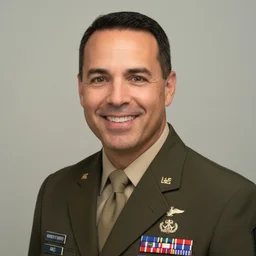
Retired Military Officer & Armed Forces Test Preparation Specialist
United States Army War CollegeColonel Steven Harris (Ret.) served 28 years in the US Army, earning a Master of Arts in Military Science from the Army War College and a Bachelor of Science in Criminal Justice. He has coached thousands of military enlistment and officer candidate program applicants through the ASVAB, AFQT, AFCT, OAR, and officer selection assessment processes across all military branches.
Join the Discussion
Connect with other students preparing for this exam. Share tips, ask questions, and get advice from people who have been there.
View discussion (5 replies)