
Marine Corps ASVAB Practice Test: Complete Study Guide for 2026 September
Ace your marine corps asvab practice test with real strategies, score breakdowns, and free drills. 🎯 Know what score you need and how to hit it.
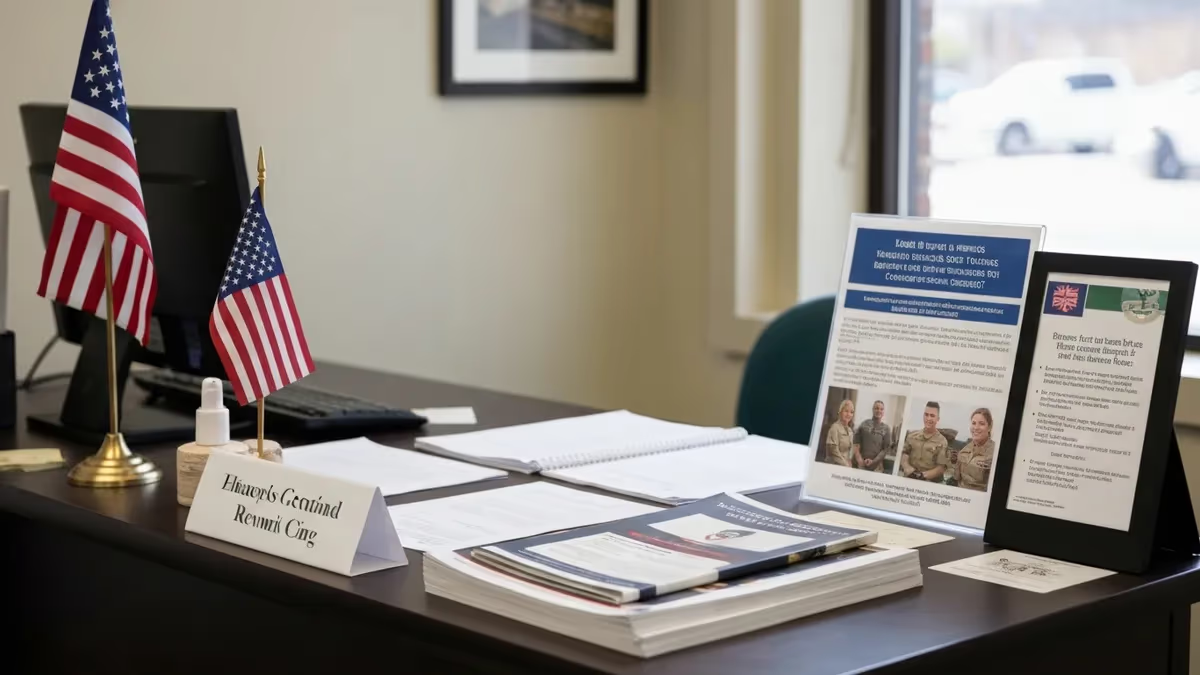
If you're aiming to join the United States Marine Corps, your first major hurdle is the ASVAB — the Armed Services Vocational Aptitude Battery. Taking a marine corps asvab practice test is the single most effective step you can take to understand where you stand, identify your weakest subjects, and build a targeted study plan before test day. The Marine Corps requires a minimum AFQT score of 32 for high school graduates and 50 for GED holders, but competitive applicants consistently score well above those floors to qualify for the most desirable MOS assignments.
The ASVAB is not a general knowledge quiz — it is a multi-domain aptitude battery that evaluates nine separate subject areas ranging from arithmetic reasoning and mathematics knowledge to mechanical comprehension and electronics information. Each of those subtests contributes to composite scores that recruiters use to match Marines to specific occupational specialties. Understanding this structure from the outset will help you allocate your study time far more efficiently than simply reviewing random content without a plan.
Many candidates underestimate the ASVAB because they assume a minimum passing score is all they need. In practice, Marine Corps MOS options are gated behind specific line scores, not just the AFQT. For example, infantry roles require an GT (General Technical) score, while intelligence and communications billets demand higher CO (Clerical-Operator) or EL (Electronics) line scores. This makes deliberate, structured practice essential for anyone who wants options rather than a single assignment.
Effective preparation typically spans six to twelve weeks depending on your starting baseline. Candidates who score in the 50th percentile on their first diagnostic practice test generally need eight weeks of consistent daily study to push into the 65th to 75th percentile range, which opens up the majority of Marine Corps occupational specialties. Those starting below the 40th percentile should budget at least ten to twelve weeks and focus heavily on arithmetic reasoning and word knowledge first, since those two subtests carry the most weight in the AFQT calculation.
This guide covers everything from the structure of the exam and the specific ASVAB scores the Marine Corps uses, to weekly study schedules, proven test-taking strategies, and the most common mistakes candidates make on practice tests. You will find free quiz tiles throughout the page that let you drill arithmetic reasoning questions — the highest-weight AFQT subtest — immediately. Whether you are just starting your research or you are two weeks out from your scheduled MEPS exam date, this resource gives you actionable steps and an asvab study guide framework to maximize your score.
One detail many recruits miss is the difference between the CAT-ASVAB administered at MEPS and the paper-and-pencil version sometimes given at mobile examining team sites. The computer-adaptive version adjusts question difficulty in real time based on your responses, which means early questions carry more statistical weight than later ones. Practicing under timed, adaptive conditions — rather than just reviewing static question banks — is critical preparation for how the real exam actually works.
Finally, remember that ASVAB scores are valid for two years. If you score below your goal on the first attempt, you must wait one calendar month before retesting, and a second retest requires an additional month. There is no penalty for retesting, and many Marines credit their second-attempt score — built on a structured review of their first diagnostic — with opening the MOS they actually wanted. Consistent, deliberate practice with real test-format questions is the fastest path to that outcome.
Marine Corps ASVAB by the Numbers

ASVAB Exam Format & Structure
| Section | Questions | Time | Weight | Notes |
|---|---|---|---|---|
| Arithmetic Reasoning (AR) | 15 | 39 min | AFQT | Word problems; highest AFQT weight |
| Word Knowledge (WK) | 16 | 8 min | AFQT | Vocabulary in context |
| Paragraph Comprehension (PC) | 11 | 22 min | AFQT | Reading passages |
| Mathematics Knowledge (MK) | 16 | 20 min | AFQT | Algebra, geometry |
| General Science (GS) | 16 | 8 min | Line Scores | Biology, chemistry, physics |
| Electronics Information (EI) | 16 | 8 min | Line Scores | Circuits, current, voltage |
| Mechanical Comprehension (MC) | 16 | 20 min | Line Scores | Gears, pulleys, levers |
| Auto & Shop Information (AS) | 11 | 7 min | Line Scores | Tools, engine systems |
| Assembling Objects (AO) | 16 | 16 min | Line Scores | Spatial visualization |
| Total | 145 | 3 hours (CAT-ASVAB) | 100% |
The Marine Corps uses ASVAB scores in two distinct ways: first, to determine basic eligibility through the Armed Forces Qualification Test (AFQT) percentile, and second, to slot Marines into MOS categories through composite line scores. The AFQT is calculated from four subtests — Arithmetic Reasoning, Word Knowledge, Paragraph Comprehension, and Mathematics Knowledge — and expressed as a percentile from 1 to 99. A score of 50 means you outperformed exactly half of a national reference group of 18 to 23 year-olds who took the exam.
For Marine Corps enlistment with a high school diploma, the minimum AFQT percentile is 32. GED holders must score 50 or higher and are often required to provide proof of college credits or other qualifying credentials. However, meeting the minimum does not guarantee your choice of MOS. The Marine Corps publishes specific line score minimums for every Military Occupational Specialty, and these composite scores draw from different combinations of the nine subtests. Understanding which subtests feed your target MOS line score is the key to efficient preparation.
The most important line scores for Marine Corps applicants are GT (General Technical), CL (Clerical), MM (Mechanical Maintenance), EL (Electronics), GM (General Maintenance), CO (Clerical-Operator), ST (Skilled Technical), and OC (Operator-Clerical). GT, which is derived from VE (Verbal Expression: WK + PC) plus AR, governs infantry, military police, and many leadership-intensive roles. A GT score of 110 or higher is required for the Marine Corps Officer Candidate School application and for many competitive enlisted billets.
Candidates targeting combat arms roles — 03XX infantry, 08XX artillery, 18XX tank — typically need a GT score of 80 to 90 minimum, with GT 100+ making you a highly competitive applicant. Those aiming for intelligence (02XX), signals (06XX), or aviation electronics (60XX) face EL score requirements of 105 to 115 or higher, which means your Electronics Information and General Science subtests become just as important as your AFQT performance. Mapping your desired MOS to its specific line score requirements before you begin studying will save you significant preparation time.
The army fitness test page offers supplementary context on how physical and aptitude benchmarks interact in military selection processes, which can help candidates understand the broader qualification picture. On the cognitive side, recruits who score 90 or above on the AFQT are often considered for special programs including nuclear field training through Naval partnerships, intelligence analyst tracks, and cryptologic language immersion programs — all of which are available to highly qualified Marine Corps candidates through inter-service agreements.
It is also worth noting that the ASVAB subtests vary in their difficulty curves. Arithmetic Reasoning tends to have the steepest learning curve for candidates who have been out of school for several years, because it requires applying mathematical concepts to multi-step word problems under tight time pressure. In contrast, Word Knowledge rewards consistent vocabulary study over several weeks — a few hundred flash cards practiced daily can produce measurable score gains in just four to six weeks. Understanding which subtests respond quickly to study versus which require longer preparation cycles helps you build a realistic timeline.
Finally, if you achieve a strong AFQT score on your first attempt but miss a specific line score threshold for your target MOS, you are permitted to request a retest with the understanding that the Marine Corps will use your most recent score — not your highest. This policy makes it critical to be fully prepared before retesting, not just for the AFQT floor but for the specific composite line scores your desired MOS demands. A strategic, subtest-specific practice plan is the best insurance against a score regression on a retest.
ASVAB Study Strategies by Subtest
Arithmetic Reasoning and Mathematics Knowledge together account for roughly half of your AFQT score, making them the highest-leverage subtests to improve. For AR, focus on translating word problems into algebraic equations quickly — practice identifying keywords like "total," "per," "remaining," and "ratio" that signal which operation to apply. Work through at least 20 timed word problems per day, starting with a 90-second limit per question and gradually reducing to 60 seconds as your fluency improves over two to three weeks.
Mathematics Knowledge covers algebra fundamentals (solving for x, systems of equations), geometry (area, perimeter, the Pythagorean theorem), and number properties (factors, multiples, exponents). Many candidates lose easy points on MK by misremembering formulas under pressure. Create a one-page formula sheet and review it every morning during your study period. Then take a timed 16-question MK practice set — strictly 20 minutes — at least three times per week to build the speed and accuracy the CAT-ASVAB demands from the first question onward.
CAT-ASVAB vs. Paper ASVAB: Which Should You Prepare For?
- +CAT-ASVAB results are available immediately after the test session ends at MEPS
- +Computer-adaptive format means fewer total questions while maintaining statistical precision
- +Adaptive difficulty can reward well-prepared candidates with a score ceiling boost
- +MEPS is the most common testing site, so CAT-ASVAB prep is directly applicable for most recruits
- +No waiting for scoring — recruiters can begin MOS conversations the same day
- +CAT-ASVAB allows you to move at your own pace within each subtest's time limit
- −You cannot skip and return to questions on the CAT-ASVAB — each answer is locked in immediately
- −Early questions carry disproportionate statistical weight in the adaptive algorithm
- −Technical glitches at a testing station, though rare, can disrupt performance
- −Adaptive difficulty can feel psychologically harder if early questions seem very challenging
- −Less familiarity for candidates who have only practiced on paper-based question sets
- −Screen-based reading may be slower for candidates more comfortable with printed text passages
Marine Corps ASVAB Prep Checklist
- ✓Take a full diagnostic practice test in the first week to establish your baseline AFQT and line scores.
- ✓Look up the specific line score requirements for your top three target MOS choices on the official USMC MOS manual.
- ✓Build a weekly study calendar that allocates the most daily time to your lowest-scoring subtests.
- ✓Complete at least three timed Arithmetic Reasoning practice sets every week throughout your prep period.
- ✓Study 30 new vocabulary words per week using spaced repetition flash cards for Word Knowledge.
- ✓Review and memorize key math formulas (quadratic formula, area formulas, exponent rules) on a single reference sheet.
- ✓Watch demonstration videos for Mechanical Comprehension topics like gears, pulleys, and levers.
- ✓Take a full-length timed practice ASVAB every two weeks to track score progress across all nine subtests.
- ✓Simulate CAT-ASVAB conditions by answering questions on a screen without skipping or going back.
- ✓Confirm your MEPS appointment date and stop introducing new material in the 48 hours before your test.

GT Score 110+ Unlocks the Most Marine Corps Opportunities
A General Technical (GT) composite score of 110 or higher is the threshold for Officer Candidate School eligibility, most intelligence billets, and many competitive enlisted MOS tracks. GT is calculated from your Verbal Expression score (Word Knowledge + Paragraph Comprehension) plus Arithmetic Reasoning. Improving just these three subtests can move your GT score by 20 or more points — often the difference between one MOS and an entire category of advanced options.
Understanding how ASVAB scores are calculated and reported is essential for setting realistic goals and communicating accurately with your recruiter. The AFQT percentile is the number most people focus on, but it is derived from a formula applied to raw subtest scores that are first converted to standard scores, then combined. Specifically, AFQT = 2VE + AR + MK, where VE (Verbal Expression) = WK + PC after conversion. This formula means that a one-point improvement in your Arithmetic Reasoning raw score has double the impact on AFQT that a one-point gain in most line-score-only subtests would have.
Raw scores on each subtest are first converted to scaled standard scores ranging from 20 to 62 for the nine individual subtests. These standard scores are then used in various weighted combinations to produce the ten Marine Corps composite line scores. Because each line score draws from a different subtest combination, it is entirely possible — and quite common — for a candidate to have a strong AFQT percentile (say, 72nd percentile) while falling short of a specific line score minimum due to weakness in one or two technical subtests that happen to dominate that composite.
The aft score chart concept, familiar to candidates who also track the Army Combat Fitness Test, parallels how Marine Corps physical fitness standards function alongside cognitive scores. Both systems use composite measurements to place service members in appropriate roles, and both reward targeted preparation. For the ASVAB specifically, the score chart most useful to Marine Corps candidates is the MOS qualification matrix, which lists every MOS alongside its minimum line score requirements — this document is publicly available through Marine Corps recruiting resources.
Many candidates are surprised to learn that ASVAB scores are normed against a 1997 reference population sample of approximately 12,000 Americans ages 18 to 23. This means the percentile you receive reflects performance relative to that fixed historical benchmark rather than the current test-taking population. In practical terms, this norming approach tends to be slightly favorable for well-prepared contemporary test-takers, since average educational attainment and test preparation access have improved somewhat since 1997. Your percentile accurately reflects your academic aptitude relative to a broad national baseline.
For recruits who have taken the ASVAB once and want to understand their score report in detail, the key documents are the ASVAB Score Report and the Enlistment Eligibility Form provided at MEPS. The score report lists all nine subtest standard scores, the AFQT percentile, and the composite line scores. Cross-referencing each line score against the MOS qualification matrix tells you exactly which specialties you currently qualify for — and which subtests you would need to improve to access additional options on a retest.
The army combat fitness test page provides parallel insight into how physical fitness standards intersect with aptitude scoring in the broader military qualification framework. On the aptitude side, it is worth noting that the ASVAB also produces an Armed Services Vocational Aptitude Battery Career Exploration Score, used in high school counseling contexts, which is separate from and not equivalent to the MEPS enlistment AFQT percentile.
Some candidates who took the ASVAB in high school under a Career Exploration Program (CEP) assume that score counts for enlistment — it does not. You must take the ASVAB at an official MEPS or MET site for the score to be valid for enlistment purposes.
Score validity is another practical consideration. ASVAB scores used for enlistment are valid for two years from the test date. Candidates who scored well in high school and are enlisting more than two years after their CEP administration will need to retest regardless of their prior result. Building on a strong prior foundation with a focused refresher study period of four to six weeks is typically sufficient for candidates retesting after two years, assuming they maintained their academic skills in the interim through college coursework or professional work involving quantitative reasoning.
The Marine Corps uses your most recent ASVAB score — not your highest — for MOS qualification. If you retest and score lower than your previous attempt, your original score is no longer usable. Wait until you have completed a full structured study period and are consistently scoring above your goal on practice tests before scheduling a retest appointment at MEPS.
The weeks immediately before your MEPS appointment are the most high-stakes preparation period, and how you use them can determine whether you walk out with your first-choice MOS or settle for available openings. Six to eight weeks out, your primary goal should be diagnostic: take a full-length timed practice test under realistic conditions — no phone, no breaks beyond the standard subtest transitions, on a computer screen if possible — to get a clear picture of exactly where you stand across all nine subtests, not just the AFQT components.
Four to six weeks out, shift into targeted drilling mode. Identify the two or three subtests where your scores fall furthest below your MOS line score targets, and allocate at least 60% of your daily study time to those areas. For most Marine Corps candidates, this means heavy Arithmetic Reasoning drilling for AFQT improvement combined with Electronics Information or Mechanical Comprehension work for line score improvement. Use timed practice sets religiously during this phase — untimed practice breeds a false confidence that dissolves the moment the MEPS clock starts running.
Two to three weeks out, begin full-length timed simulations twice per week. Each simulation should cover all nine subtests in order, with only the standard breaks between sections. After each simulation, spend at least 30 minutes reviewing every question you missed — not just noting the correct answer, but understanding why each wrong answer was wrong and why the correct answer is correct. This review process is where genuine score improvement happens; passive re-reading of material has far less impact than active error analysis on practice questions you have already answered.
The final two weeks before your MEPS appointment should involve reducing the volume of new practice and increasing the quality of review. Stop introducing new topic areas — your brain needs time to consolidate what it has already learned. Instead, run two or three shorter, subtest-specific drills per day focusing on your weakest areas, and do one final full-length simulation exactly one week before your scheduled appointment. This simulation will give you a confidence-calibrated sense of your current ceiling and flag any remaining weak spots with enough time to do one final targeted review.
Sleep, nutrition, and physical state on test day have a measurable effect on cognitive performance. Research consistently shows that even one night of poor sleep (under six hours) reduces working memory capacity and processing speed — both of which are directly tested in Arithmetic Reasoning and Mathematics Knowledge. In the three days before your MEPS appointment, prioritize seven to eight hours of sleep, limit alcohol entirely, stay well hydrated, and eat a protein-rich breakfast on test morning. These are not abstract wellness suggestions; they are performance variables that can swing your score by several percentile points.
If you want a structured daily approach to the final preparation phase, the asvab for dummies page provides a beginner-friendly breakdown of test-taking strategies that work regardless of your starting level. Pay particular attention to the strategies for managing time on Arithmetic Reasoning and the technique for eliminating wrong answers on Word Knowledge — these two approaches alone can recover three to five points for candidates who previously lost them to time pressure or vocabulary guessing rather than genuine lack of knowledge.
One final practical note: bring everything MEPS requires on your testing day. Missing documents — birth certificate, Social Security card, relevant medical records — can result in a rescheduled appointment, which means additional weeks of waiting and the psychological cost of sustained pre-test anxiety. Confirm your appointment details with your recruiter at least 48 hours in advance, confirm your transportation, and arrive at least 15 minutes early. MEPS runs on a strict schedule, and a late arrival can forfeit your testing slot entirely, requiring you to rebook and restart the waiting period from scratch.
The practical tips that separate high-scoring ASVAB candidates from average performers are rarely about raw intelligence — they are almost always about preparation discipline, test strategy, and self-awareness. The most common mistake candidates make on ASVAB practice tests is treating them casually: taking breaks mid-section, looking up answers when stuck, or skipping questions they find difficult. This kind of low-stakes practice builds false confidence and creates none of the mental conditioning you need for a timed, locked-in computer-adaptive exam at MEPS.
One of the most powerful preparation habits is daily exposure to timed question sets rather than marathon weekly study sessions. Cognitive science research on skill acquisition consistently shows that short, daily deliberate practice sessions produce faster improvement than equivalent time spent in large infrequent blocks. For ASVAB preparation, this means 45 to 60 minutes of focused daily drilling is more effective than a single four-hour Saturday session covering the same total hours. Your brain consolidates learning during sleep, so spreading practice across more days with rest between sessions accelerates retention.
For Arithmetic Reasoning specifically, learn to identify the three most common question archetypes: rate problems (speed, work rate, unit pricing), proportion and ratio problems, and multi-step algebraic word problems. Roughly 80% of AR questions fall into one of these three categories. Once you recognize which archetype a question belongs to within the first reading, you can immediately apply the correct solution template rather than working from scratch — this is the single biggest time-saver on the most time-pressured subtest in the AFQT battery.
On test day itself, use the first few seconds of each subtest to take a single slow breath and read the instructions, even if you have read them dozens of times in practice. This 10-second ritual interrupts anxiety spirals and anchors your attention to the task. For the CAT-ASVAB, remember that you cannot go back — so never leave an answer blank. If you are genuinely unsure, eliminate any obviously wrong choices and make your best informed guess. The adaptive algorithm penalizes unanswered questions more severely than incorrect ones in terms of score ceiling impact.
Word Knowledge is the subtest most amenable to last-minute improvement. In the final week before your exam, focus exclusively on your flash card review rather than learning new words, and spend 10 minutes each morning doing a rapid-fire vocabulary drill — read the word, say the definition aloud, then check. This verbal production step, rather than passive recognition, dramatically improves recall under exam pressure. Aim for 90% accuracy on your existing card stack before your appointment rather than trying to add 50 more unfamiliar words days before the test.
Mechanical Comprehension deserves special mention as the subtest that most often surprises candidates. Many test-takers who grew up without mechanical experience assume MC is largely about memorization. In fact, it tests applied physical intuition — understanding how force, motion, and mechanical advantage work in real systems. The best preparation beyond practice questions is watching 10 to 15 short videos demonstrating pulley systems, gear trains, and lever classes in actual motion. Seeing these systems operate physically in a video, even once, creates a mental model that persists far more reliably than text descriptions during the high-pressure exam environment.
Lastly, remember that the ASVAB is a tool designed to find the best match between your aptitudes and available military roles — not to screen candidates out arbitrarily. The Marine Corps wants qualified candidates in the right MOS slots, and a strong ASVAB score demonstrably predicts job performance across virtually all military occupational specialties.
Every hour of deliberate, honest practice you invest before your MEPS appointment directly translates into a wider range of career options, a stronger negotiating position on your enlistment contract, and a more confident start to your Marine Corps career. The effort you invest now pays dividends for the entire length of your service.
ASVAB Questions and Answers




About the Author
Retired Military Officer & Armed Forces Test Preparation Specialist
United States Army War CollegeColonel Steven Harris (Ret.) served 28 years in the US Army, earning a Master of Arts in Military Science from the Army War College and a Bachelor of Science in Criminal Justice. He has coached thousands of military enlistment and officer candidate program applicants through the ASVAB, AFQT, AFCT, OAR, and officer selection assessment processes across all military branches.
Join the Discussion
Connect with other students preparing for this exam. Share tips, ask questions, and get advice from people who have been there.
View discussion (5 replies)