
ACLS H and T: Complete 2026 October Guide to Reversible Causes of Cardiac Arrest
✍🏼 Master the ACLS H and T reversible causes of cardiac arrest. Complete 2026 October guide with diagnosis, treatment, mnemonics & practice questions.

The ACLS H and T framework represents one of the most critical diagnostic tools in advanced cardiovascular life support, providing a structured approach to identifying and treating the underlying causes of cardiac arrest. When a patient codes and standard interventions like high-quality CPR, defibrillation, and epinephrine fail to achieve return of spontaneous circulation, the acls h and t mnemonic guides clinicians through twelve reversible conditions that may be driving the arrest. Memorizing these causes is not optional for ACLS providers—it is fundamental to saving lives in pulseless electrical activity and asystole scenarios.
The American Heart Association built the H and T framework into every ACLS algorithm because survival rates plummet when reversible causes go unidentified. Studies show that approximately 50% of in-hospital cardiac arrests have an identifiable and treatable underlying cause, yet teams often default to mechanical compressions and rhythm checks without systematically working through the differential. The H and T approach forces providers to think beyond the immediate rhythm and consider what physiological insult initially triggered the arrest, transforming a potentially futile resuscitation into a targeted intervention.
The six H causes include hypovolemia, hypoxia, hydrogen ion acidosis, hypo/hyperkalemia, hypothermia, and hypoglycemia (in some versions), while the five T causes encompass tension pneumothorax, tamponade, toxins, thrombosis pulmonary, and thrombosis coronary. Each cause has distinct clinical presentations, electrocardiographic clues, and specific treatments that must be delivered rapidly during ongoing resuscitation. The framework is deliberately memorable because cognitive load during a code is enormous, and a simple alphabetical mnemonic helps ensure nothing gets missed in the chaos.
Understanding the H and T causes is tested heavily on the ACLS certification exam, with multiple megacode scenarios requiring candidates to verbalize and address reversible causes as part of their team leader responsibilities. Instructors evaluate whether students can move beyond rote algorithm execution and demonstrate true critical thinking about why a patient is not responding to standard care. This skill separates competent ACLS providers from exceptional ones who actually improve patient outcomes in real-world resuscitations.
This comprehensive guide walks through each of the H and T causes in detail, covering pathophysiology, recognition strategies, evidence-based treatments, and the order in which to consider them based on clinical context. Whether you are preparing for initial ACLS certification, renewing your provider card, or simply wanting to sharpen your code response skills, mastering the reversible causes framework is essential. We will also cover common exam questions, memory aids that actually work, and how to integrate H and T thinking into your team-based resuscitation approach.
The AHA's 2020 Guidelines for Cardiopulmonary Resuscitation and Emergency Cardiovascular Care, with updates extending through 2026, continue to emphasize that identifying and treating reversible causes is a Class I recommendation during cardiac arrest. This means there is strong evidence supporting the practice, and failing to consider these causes constitutes substandard care. Point-of-care ultrasound, arterial blood gas analysis, and rapid bedside testing have made H and T evaluation faster and more accurate than ever before.
By the end of this guide, you will have a working knowledge of all twelve reversible causes, the assessment tools needed to identify each one, the specific treatments to administer, and the mental framework to apply this knowledge under pressure. We have included practice scenarios, common exam questions, and links to additional resources to reinforce your learning and prepare you for both the certification exam and real patient care situations.
ACLS H and T by the Numbers

The Six H Causes of Cardiac Arrest
Severe volume depletion from hemorrhage, dehydration, third-spacing, or sepsis. Treat with rapid crystalloid boluses (1-2L IV/IO) and blood products if hemorrhagic. Often shows narrow QRS PEA with rapid rate on monitor.
Inadequate oxygen delivery to tissues from airway obstruction, respiratory failure, or pulmonary disease. Confirm airway patency, deliver 100% oxygen, verify ETT placement with waveform capnography, and ensure bilateral chest rise.
Severe metabolic or respiratory acidosis impairing cardiac contractility and pressor response. Treat with adequate ventilation, sodium bicarbonate (1 mEq/kg) for known severe acidosis, and address underlying cause via ABG analysis.
Potassium derangements cause life-threatening arrhythmias. Hyperkalemia: calcium chloride, insulin/dextrose, bicarbonate, albuterol. Hypokalemia: IV potassium replacement with magnesium. Peaked T waves or U waves on ECG provide clues.
Core temperature below 30°C causes Osborn waves, bradycardia, and refractory VF. Active rewarming with warmed IV fluids, warm humidified oxygen, and ECMO when available. Continue CPR until core temp reaches 32-35°C.
While not in all current AHA lists, severe hypoglycemia can mimic arrest presentations. Check fingerstick glucose immediately during code. Treat with 25g D50 IV push for confirmed hypoglycemia in adult patients.
The six T causes of cardiac arrest represent mechanical, toxicological, and obstructive conditions that prevent normal cardiac output despite electrical activity. Each requires specific diagnostic confirmation and targeted treatment that goes beyond standard ACLS algorithms. Understanding these conditions in depth allows providers to make rapid, life-saving interventions during the critical window when reversibility remains possible. Unlike some H causes that can be partially managed with empiric treatment, most T causes require definitive procedural or pharmacological intervention to achieve ROSC.
Tension pneumothorax occurs when air accumulates under pressure in the pleural space, collapsing the lung and shifting the mediastinum, which compresses the great vessels and prevents venous return to the heart. Classic findings include absent breath sounds, tracheal deviation away from the affected side, hyperresonance to percussion, and jugular venous distention. In a coding patient, immediate needle decompression at the second intercostal space midclavicular line or fifth intercostal space anterior axillary line is life-saving, followed by definitive chest tube placement.
Cardiac tamponade results from fluid accumulation in the pericardial sac that prevents adequate ventricular filling. Common causes include trauma, malignancy, uremia, and post-cardiac surgery complications. Beck's triad of hypotension, muffled heart sounds, and JVD is rarely complete in arrest scenarios, making point-of-care ultrasound essential for diagnosis. Treatment requires emergency pericardiocentesis, typically performed via subxiphoid approach with ultrasound guidance, to drain enough fluid to restore cardiac output.
Toxins encompass a vast category including drug overdoses, environmental exposures, and venoms that can cause cardiac arrest through various mechanisms. Common culprits include tricyclic antidepressants (treat with sodium bicarbonate), beta-blockers and calcium channel blockers (high-dose insulin euglycemia, glucagon, calcium), opioids (naloxone), and digoxin (digoxin immune fab). The patient's medication list, accessible pill bottles, and bystander history become crucial diagnostic information that team members should actively seek during the code.
Thrombosis pulmonary, or massive pulmonary embolism, causes obstructive shock by blocking pulmonary arterial blood flow. Risk factors include recent surgery, immobilization, malignancy, pregnancy, and hypercoagulable states. ECG may show S1Q3T3 pattern, right heart strain, or new right bundle branch block. Bedside echocardiography showing right ventricular dilation and hypokinesis with a small underfilled left ventricle is diagnostic. Treatment includes systemic thrombolytics (alteplase 50-100mg) administered during ongoing CPR.
Thrombosis coronary, or acute myocardial infarction, remains the most common cause of out-of-hospital cardiac arrest in adults. ST-elevation on a pre-arrest ECG, known coronary artery disease, or witnessed chest pain before collapse all point toward this etiology. Definitive treatment requires emergent cardiac catheterization with percutaneous coronary intervention, ideally with door-to-balloon time under 90 minutes. Mechanical CPR devices and ECMO have expanded the window for intervention in these patients dramatically over recent years.
Some ACLS curricula include additional T causes such as trauma, which can encompass multiple mechanisms including hypovolemia from hemorrhage, tension pneumothorax, tamponade, and direct cardiac injury. The mnemonic flexibility reflects the reality that cardiac arrest in trauma patients often involves multiple simultaneous reversible causes requiring parallel interventions. Effective resuscitation in these complex cases demands a coordinated team approach with clearly assigned roles and rapid sequential decision-making.
ACLS Practice Test Questions
Prepare for the ACLS Advanced Cardiovascular Life Support Practice exam with our free practice test modules. Each quiz covers key topics to help you pass on your first try.
ACLS Cardiac Rhythms & ECG Interpretation
ACLS Exam Questions covering ACLS Cardiac Rhythms & ECG Interpretation. Master ACLS Test concepts for certification prep.
ACLS Pharmacology & Medications
Free ACLS Practice Test featuring ACLS Pharmacology & Medications. Improve your ACLS Exam score with mock test prep.
ACLS Best Practices & Methodologies
ACLS Mock Exam on Best Practices & Methodologies. ACLS Study Guide questions to pass on your first try.
ACLS Communication & Stakeholder Relations
ACLS Test Prep for Communication & Stakeholder Relations. Practice ACLS Quiz questions and boost your score.
ACLS Core Concepts & Fundamentals
ACLS Questions and Answers on Core Concepts & Fundamentals. Free ACLS practice for exam readiness.
ACLS Data Analysis & Reporting
ACLS Mock Test covering Data Analysis & Reporting. Online ACLS Test practice with instant feedback.
ACLS Documentation & Record Keeping
Free ACLS Quiz on Documentation & Record Keeping. ACLS Exam prep questions with detailed explanations.
ACLS Industry Regulations & Compliance
ACLS Practice Questions for Industry Regulations & Compliance. Build confidence for your ACLS certification exam.
ACLS Leadership & Team Management
ACLS Test Online for Leadership & Team Management. Free practice with instant results and feedback.
ACLS Professional Standards & Ethics
ACLS Study Material on Professional Standards & Ethics. Prepare effectively with real exam-style questions.
ACLS Quality Assurance & Improvement
Free ACLS Test covering Quality Assurance & Improvement. Practice and track your ACLS exam readiness.
ACLS Risk Management & Assessment
ACLS Exam Questions covering Risk Management & Assessment. Master ACLS Test concepts for certification prep.
Diagnosing H and T Causes in Real Time
Rapid physical assessment during a code includes checking bilateral breath sounds and chest rise to detect tension pneumothorax or improper ETT placement. Assess for jugular venous distention which suggests tamponade, tension pneumothorax, or massive PE. Skin examination may reveal track marks suggesting opioid overdose, hives indicating anaphylaxis, or bleeding sources causing hypovolemia.
Pupillary examination provides toxicology clues with pinpoint pupils suggesting opioids and dilated pupils suggesting anticholinergics or stimulants. Abdominal distention may indicate intra-abdominal hemorrhage or aortic catastrophe. Temperature assessment, ideally with a core thermometer, identifies hypothermia. These quick bedside checks should be assigned to a specific team member while CPR continues uninterrupted by the rhythm check timer.

Using the H and T Framework: Strengths and Limitations
- +Provides structured cognitive framework during high-stress resuscitation
- +Covers majority of reversible causes of cardiac arrest in clinical practice
- +Easy-to-remember mnemonic reduces missed diagnoses during codes
- +Endorsed by AHA as Class I recommendation in all ACLS algorithms
- +Encourages team-based critical thinking beyond rote algorithm execution
- +Integrates seamlessly with point-of-care ultrasound and rapid bedside testing
- +Applicable to PEA, asystole, refractory VF/VT, and post-ROSC management
- −Some causes (hypoglycemia, trauma) are not universally included across all curricula
- −Memorizing twelve items adds cognitive load during high-acuity events
- −Framework does not prioritize causes by likelihood in specific clinical contexts
- −Requires resources (ultrasound, labs, blood products) not available everywhere
- −Can lead to over-treatment if applied without clinical correlation
- −Treatment of some causes (PE thrombolysis) carries significant risk
- −Does not address some emerging considerations like ECMO candidacy
Pros and Cons at a Glance
| Pros | Cons |
|---|---|
| Provides structured cognitive framework during high-stress resuscitation | Some causes (hypoglycemia, trauma) are not universally included across all curricula |
| Covers majority of reversible causes of cardiac arrest in clinical practice | Memorizing twelve items adds cognitive load during high-acuity events |
| Easy-to-remember mnemonic reduces missed diagnoses during codes | Framework does not prioritize causes by likelihood in specific clinical contexts |
| Endorsed by AHA as Class I recommendation in all ACLS algorithms | Requires resources (ultrasound, labs, blood products) not available everywhere |
| Encourages team-based critical thinking beyond rote algorithm execution | Can lead to over-treatment if applied without clinical correlation |
| Integrates seamlessly with point-of-care ultrasound and rapid bedside testing | Treatment of some causes (PE thrombolysis) carries significant risk |
H and T Assessment Checklist for Every Code
- ✓Confirm airway patency and verify ETT placement with waveform capnography for hypoxia
- ✓Obtain rapid fingerstick glucose to rule out hypoglycemia within first 2 minutes
- ✓Send arterial blood gas with electrolytes including potassium, calcium, and lactate
- ✓Check core temperature with esophageal or bladder probe to assess hypothermia
- ✓Auscultate bilateral breath sounds and assess for tracheal deviation indicating tension pneumothorax
- ✓Perform bedside echocardiography to evaluate for tamponade and RV strain from PE
- ✓Review medication list with pharmacist for potential toxic ingestions or interactions
- ✓Examine skin for bleeding sources, hives, track marks, and signs of trauma
- ✓Calculate fluid status from history and consider 1-2L crystalloid bolus for suspected hypovolemia
- ✓Document each H and T cause considered and the assessment finding in the code record
Verbalize the H's and T's Out Loud Every Two Minutes
The single most important practice for ACLS team leaders is to verbalize the H and T differential during every rhythm check. Saying "We are considering hypovolemia—has the bolus been completed? Hypoxia—is capnography showing good waveform?" forces systematic thinking and signals to the team what assessments are needed. Silent consideration leads to missed diagnoses.
Memorizing twelve reversible causes under pressure requires effective mnemonic strategies that work when adrenaline is high and cognitive bandwidth is limited. The simplest approach is the alphabetical H and T grouping itself, but many providers benefit from additional memory aids that link causes to specific patient presentations or treatments. Building these associations during training pays dividends when you cannot afford to pause and reference a card during an actual resuscitation.
One popular mnemonic for the six H's uses the phrase "Hypovolemia, Hypoxia, Hydrogen ion, Hypo/Hyperkalemia, Hypothermia, Hypoglycemia." Some instructors teach "4 H's" focusing on the original AHA causes (hypovolemia, hypoxia, hydrogen ion, hypo/hyperkalemia) and treating hypothermia and hypoglycemia separately. Either approach works as long as you systematically consider each cause. The key is repetition during practice scenarios so that recall becomes automatic during real events.
For the T's, the standard mnemonic includes "Tension pneumothorax, Tamponade cardiac, Toxins, Thrombosis pulmonary, Thrombosis coronary." Some versions add "Trauma" as a sixth T, recognizing that traumatic arrest involves multiple reversible mechanisms simultaneously. Visual mnemonics that link each T to a specific intervention (T-pneumo = needle, Tamponade = pericardiocentesis needle, Toxins = antidote vial, PE = clot buster, MI = cath lab) help solidify the action-oriented thinking required during codes.
Pattern recognition based on clinical context dramatically improves diagnostic speed. A dialysis patient who codes with peaked T waves on monitor strongly suggests hyperkalemia requiring immediate calcium chloride. A young woman post-op with sudden arrest and JVD likely has pulmonary embolism. An elderly patient on warfarin with abdominal distention may have bled into the peritoneum causing hypovolemic arrest. Building these clinical scripts through case-based learning makes H and T application intuitive rather than methodical.
The order in which you consider causes should be guided by likelihood given the clinical scenario, not simply by alphabetical order. For an unwitnessed arrest with no history, start with the most common causes: hypoxia, hypovolemia, acidosis, and coronary thrombosis. For a hospitalized patient on multiple medications, prioritize toxins and electrolyte abnormalities. For a trauma patient, simultaneously consider hypovolemia, tension pneumothorax, and tamponade. This contextual prioritization comes with experience and deliberate practice.
Effective team communication around H and T thinking requires shared mental models. The team leader should announce "We are at the two-minute mark, continuing CPR. Considering the H's and T's—we have ruled out hypoxia with good capnography. Suspecting hypovolemia given the GI bleed history, so let's get two more units of blood. Has anyone checked the potassium?" This narration keeps everyone aligned and ensures parallel processing of multiple potential causes. Find more strategies in our acls guidelines.
Practice scenarios that specifically test H and T recognition are widely available through ACLS courses, online simulators, and instructor-led megacodes. The American Heart Association's instructor materials include scripted scenarios designed to test reversible cause identification under time pressure. Repeated exposure to varied clinical presentations builds the pattern recognition that distinguishes expert ACLS providers from novices. Aim for at least 10-15 full megacode simulations before your certification exam to build true competency.
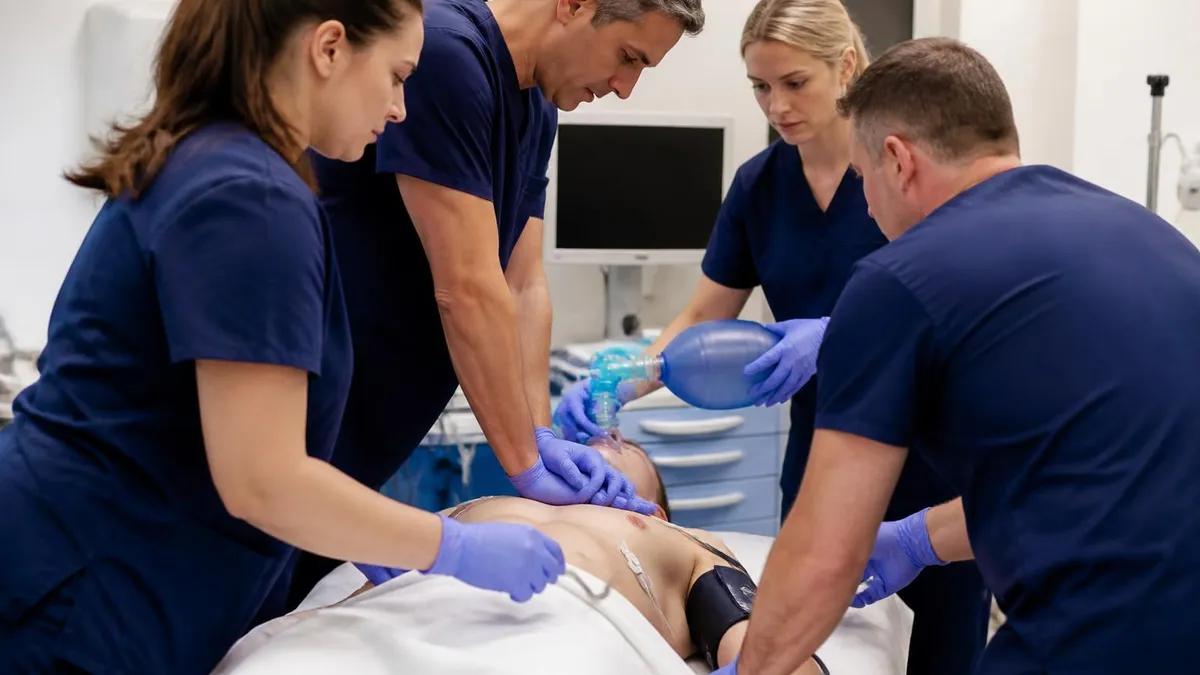
While hypoxia, hypovolemia, and coronary thrombosis dominate most cardiac arrest cases, less common causes like tension pneumothorax in mechanically ventilated patients, hyperkalemia in dialysis patients, and tricyclic toxicity in overdose cases require immediate recognition. Missing these diagnoses turns a potentially survivable arrest into a fatal event. Always systematically work through all twelve causes, even when one seems obvious.
The ACLS certification exam tests H and T knowledge through both written questions and megacode simulation scenarios. Written exam questions typically present a clinical vignette and ask candidates to identify the most likely reversible cause based on history and presentation. Common formats include identifying which intervention treats which cause (calcium chloride for hyperkalemia), recognizing ECG patterns associated with specific causes (peaked T waves, S1Q3T3), and selecting the appropriate diagnostic test for a given scenario (echocardiogram for suspected tamponade).
During megacode evaluations, instructors specifically watch for whether candidates verbalize H and T considerations during the resuscitation. Simply running through the algorithm correctly without addressing reversible causes typically results in failure or remediation, even if other technical skills are strong. Practice articulating your thinking out loud: "As team leader, I want to consider the H's and T's. Given this patient's history of CKD, I'm concerned about hyperkalemia. Let's get a stat potassium and consider empiric calcium chloride."
Common exam pitfalls include confusing the treatments for hypo- versus hyperkalemia, forgetting that sodium bicarbonate is not routinely recommended during cardiac arrest except for specific indications, and missing the connection between PEA with narrow QRS and likely mechanical or hypovolemic causes versus PEA with wide QRS suggesting metabolic or toxic causes. Reviewing these specific patterns before your exam significantly improves performance. Check out our acls study guide for more exam preparation strategies.
The H and T framework also appears in scenario-based questions about specific clinical situations. Trauma arrests require simultaneous consideration of hypovolemia, tension pneumothorax, and tamponade. Drowning victims need rapid airway management for hypoxia and warming for hypothermia. Drug overdose patients need toxin-specific antidotes alongside standard ACLS. Understanding these contextual applications demonstrates the clinical judgment that ACLS instructors evaluate during certification.
Time management during codes requires the team leader to balance algorithm execution with H and T evaluation. The standard two-minute CPR cycle provides the natural rhythm for systematic reassessment. During the brief rhythm check pause, the leader should verbalize: "Compressions paused, checking rhythm. Continuing CPR. We are now at minute six. H's and T's review: hypoxia ruled out with good ETCO2 of 35, hypovolemia treated with 2L fluid, considering acidosis pending ABG, calcium given empirically for possible hyperkalemia." This rhythm of structured reassessment is what examiners want to see.
Documentation of H and T consideration is increasingly required in code records and quality improvement reviews. Hospitals review every cardiac arrest case for whether reversible causes were systematically considered and treated. Failure to document this consideration, even when interventions were appropriate, can result in quality metric failures and educational remediation. Building documentation habits during training ensures these standards become second nature in practice.
Finally, remember that the H and T framework is a starting point, not a complete diagnostic schema. Some patients have complex multifactorial arrests that require advanced interventions like ECMO, mechanical circulatory support, or surgical interventions. Knowing when to escalate beyond standard ACLS and engage subspecialty support is part of being a sophisticated provider. The framework gives you the foundation, but clinical judgment and experience complete the picture.
Practical application of the H and T framework requires more than memorization—it demands the ability to integrate information from multiple sources rapidly while leading a complex resuscitation. The most successful ACLS providers develop personal systems for organizing this information, whether through mental checklists, written code sheets with H and T prompts, or team-based roles that ensure parallel processing of multiple potential causes. Building these habits during training translates directly into improved patient outcomes in real codes.
One effective approach is the "three buckets" mental model where you categorize potential causes into mechanical (tension pneumothorax, tamponade, PE), metabolic (acidosis, electrolytes, hypoglycemia), and circulatory/respiratory (hypovolemia, hypoxia, MI). This grouping helps the team leader assign different team members to investigate different categories simultaneously rather than considering causes sequentially. The respiratory therapist focuses on airway and oxygenation, the pharmacist reviews medications, and the ultrasonographer evaluates mechanical causes.
Real-world experience has shown that the most missed reversible causes are hyperkalemia in dialysis patients, tension pneumothorax in mechanically ventilated patients, and pulmonary embolism in post-operative or immobilized patients. These three account for a disproportionate share of "failed" resuscitations where the underlying cause was identifiable but not addressed during the code. Specifically training for these scenarios with high-fidelity simulation improves recognition rates and patient outcomes substantially.
The integration of point-of-care ultrasound into ACLS practice has revolutionized H and T identification. RUSH (Rapid Ultrasound for Shock and Hypotension) and CASA (Cardiac Arrest Sonographic Assessment) protocols allow trained providers to rapidly evaluate cardiac function, pericardial space, lung sliding for pneumothorax, IVC volume status, and abdominal aorta during the brief rhythm check pauses. Investing in ultrasound training pays enormous dividends in code outcomes. Read more in our acls drugs for medication-specific applications.
Team training for H and T application benefits enormously from structured debriefing after every code. The team should review which causes were considered, which were ruled in or out, what evidence was used, and what could have been done better. This learning loop builds institutional expertise over time and identifies systemic gaps in equipment, training, or processes. High-performing teams consistently outperform peers in cardiac arrest survival rates partly because of these continuous improvement practices.
For individual providers preparing for certification or working in high-acuity environments, regular self-testing on H and T scenarios maintains sharpness. Spaced repetition apps, monthly case reviews, and participation in mock codes all contribute to maintaining competency. The skills required for effective code response degrade rapidly without practice, even among experienced providers. Building deliberate practice into your professional development ensures readiness when the code is called.
Finally, recognize that not every cardiac arrest is survivable, even with perfect H and T application. Some patients have irreversible underlying conditions, prolonged downtimes before resuscitation, or comorbidities that preclude meaningful recovery. The H and T framework guides aggressive treatment when reversibility exists, but skilled providers also recognize when continued resuscitation is no longer appropriate and transition to compassionate end-of-life care. This judgment, informed by patient wishes, family input, and clinical realities, completes the spectrum of expert ACLS practice.
ACLS Questions and Answers
ACLS Study Guide: Complete 2026 Certification Prep with Algorithms, Drugs & Practice Tests

ACLS Guidelines 2026: Complete AHA Update on Algorithms, Drugs, CPR Quality & Post-Arrest Care

ACLS Drugs: Complete 2026 Guide to Medications, Doses, Indications & Algorithm Use

ACLS Renewal Near Me: Find Local Recertification Classes, Costs & Online Options in 2026

ACLS Certification Cost: Complete 2026 Price Guide for Initial Courses, Renewals, Online Options & Hidden Fees
About the Author

Registered Nurse & Healthcare Educator
Johns Hopkins University School of NursingDr. Sarah Mitchell is a board-certified registered nurse with over 15 years of clinical and academic experience. She completed her PhD in Nursing Science at Johns Hopkins University and has taught NCLEX preparation and clinical skills courses for nursing students across the United States. Her research focuses on evidence-based exam preparation strategies for healthcare certification candidates.