
ACLS Certification Cost: Complete 2026 October Price Guide for Initial Courses, Renewals, Online Options & Hidden Fees
ACLS certification cost breakdown for 2026 October: initial courses, renewals, online vs in-person pricing, employer reimbursement, and hidden fees explained. 📝
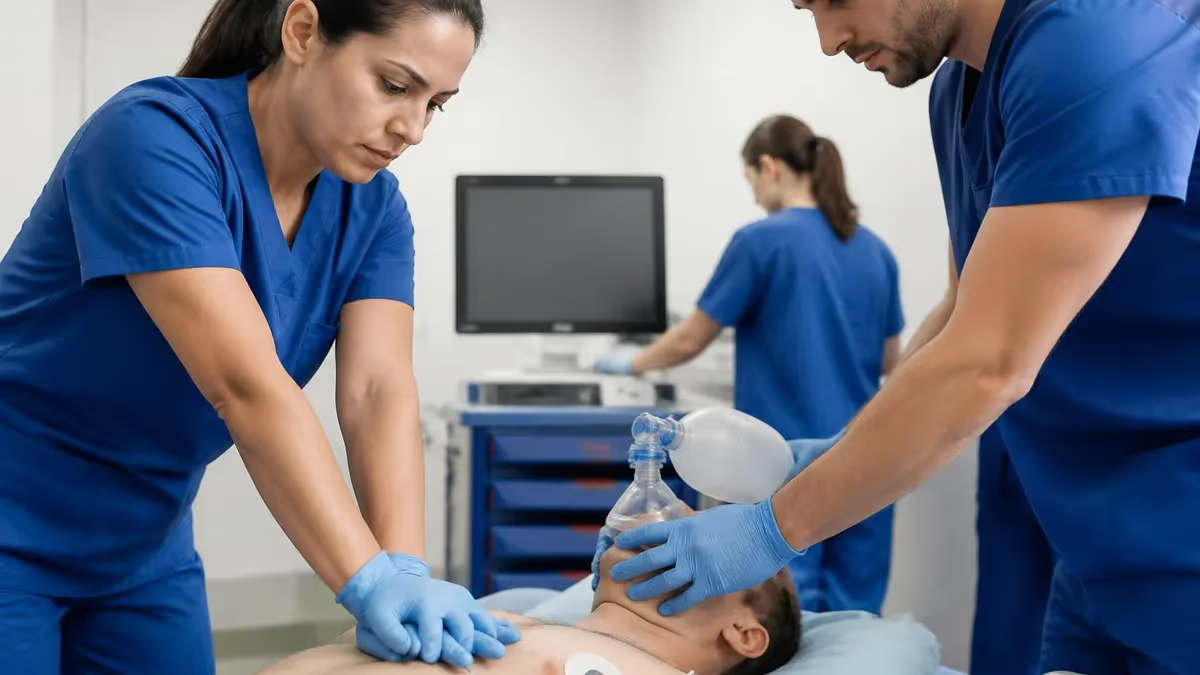
The total acls certification cost in 2026 ranges from roughly $150 to $400 for initial certification and $110 to $325 for renewal, depending on the provider, delivery format, and geographic region. Most healthcare professionals discover that the sticker price advertised on a course landing page rarely reflects the final amount they actually pay once skills evaluations, textbooks, expedited card delivery, and retest fees are added. Understanding the full cost structure before enrolling helps you avoid surprises and choose the certification path that meets your employer's standards.
Three organizations dominate the U.S. market: the American Heart Association (AHA), the American Red Cross, and a growing number of online-only providers that issue cards accepted at varying degrees by hospitals. AHA courses typically command the highest prices because they remain the gold standard for accreditation, while online providers often advertise prices under $175 to attract budget-conscious learners. The catch is that not every employer accepts every card, so verify acceptance before paying.
For working clinicians, the time cost matters as much as the dollar cost. A traditional two-day in-person course consumes 12 to 16 hours of classroom time plus travel, while a blended HeartCode ACLS pathway lets you complete the cognitive portion online and reserve a 2-3 hour skills session at a training center. Blended courses often save money on facility overhead but require you to pay separately for the skills check, which surprises many first-time enrollees who assumed the online fee covered everything.
Renewal pricing also differs from initial certification. Most providers discount renewal courses by 20 to 40 dollars because the cognitive content is shorter and skills evaluations move faster for experienced providers. If your card has already expired, however, you will likely pay the full initial rate because instructors must teach the complete curriculum rather than the abbreviated update. This is why scheduling your renewal 60 to 90 days before expiration is one of the highest-return decisions in the entire ACLS lifecycle.
Hospital employees often receive partial or full reimbursement, but the reimbursement rules vary widely. Some health systems pay directly through a contracted vendor, others require employees to front the cost and submit receipts, and still others reimburse only after the employee passes and submits a copy of the card. Travel nurses, agency clinicians, and per-diem staff usually pay out of pocket and treat the certification as a tax-deductible professional expense.
Beyond the course itself, expect to budget for the official AHA Provider Manual ($55-$65 print, $48 eBook), a precourse self-assessment if your provider requires one, and a CPR pocket mask if your employer does not supply one. These ancillary items can add $80 to $120 to your total. The good news is that all of these resources are reusable for renewal cycles, so the second time around your true acls certification cost drops noticeably.
This complete 2026 guide walks through every line item, compares AHA versus alternative providers, explains how to identify legitimate online courses, and lists the negotiation tactics that experienced clinicians use to lower their out-of-pocket spend. By the end, you will know exactly what to budget, which add-ons are worth it, and where corners can be cut without compromising the card's acceptance at your workplace.
ACLS Certification Cost by the Numbers (2026)
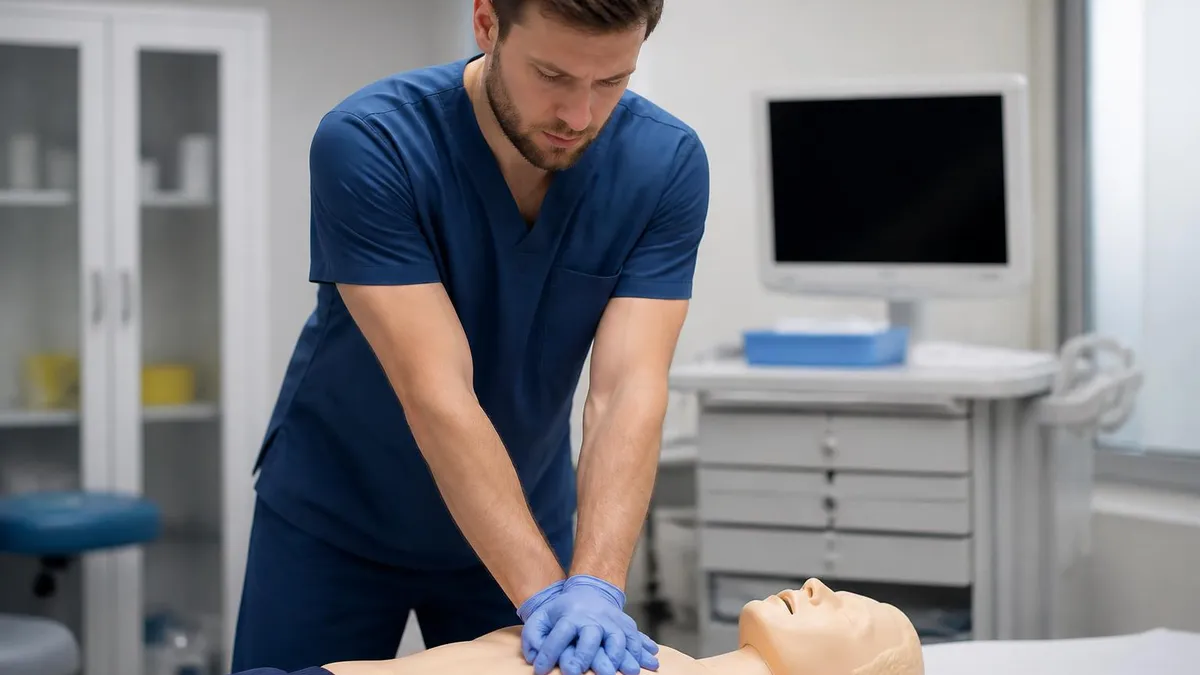
ACLS Certification Cost Breakdown by Component
When comparing the acls certification cost across providers, the American Heart Association sits at the top of the price ladder for one specific reason: its cards are universally accepted at hospitals, emergency departments, and credentialing offices nationwide. AHA does not actually teach courses itself; it licenses Training Centers that pay royalty fees, which flow into your final tuition. Expect to pay between $200 and $300 for an in-person AHA initial course in most metropolitan markets, with rural areas occasionally dipping to $175 and high-cost cities like San Francisco or Boston pushing past $350.
The American Red Cross launched a competing Advanced Life Support program that is now accepted by a growing list of hospital systems. Red Cross prices typically run $50 to $80 below AHA equivalents because the organization operates its own classrooms rather than franchising training centers. The trade-off is acceptance: while most major systems now honor Red Cross cards, smaller community hospitals and some travel nurse agencies still require AHA. Always verify with your specific employer's credentialing department before enrolling.
Online-only providers form the third tier. Names like ACLS.com, NHCPS, and United Medical Education advertise courses between $150 and $200 with no in-person component. Their cards are accepted by some urgent care chains, dental offices, and outpatient surgery centers, but most acute-care hospitals reject them because they bypass the hands-on megacode evaluation. If you work in an inpatient setting, paying a higher price for an AHA or Red Cross card is almost always the safer financial decision long term.
Hospital-employed clinicians frequently get the best deal of all: in-house ACLS classes taught by colleagues who hold instructor certification. These courses are often free or charged at cost ($50-$100) because the facility absorbs the instructor's time. The downside is limited scheduling flexibility, and you must usually wait for the next quarterly cohort. For more details on locating affordable local options, see our guide to ACLS Training Near Me which maps out community college, fire department, and hospital-hosted classes.
Group discounts can reduce per-person tuition by 15 to 30 percent. If you work in a clinic, surgery center, or nursing home where multiple staff members need certification, ask the practice manager to coordinate a private class. Many training centers will travel to the facility for groups of six or more, eliminating commute time and often dropping the price to around $180 per participant. This arrangement also lets the employer claim a single business expense rather than reimbursing employees individually.
Region matters more than most people expect. The Bureau of Labor Statistics tracks healthcare training costs as part of its broader allied health data, and ACLS prices correlate strongly with local wages and commercial real estate costs. A course in Manhattan averages 40 to 60 percent more than the same course in Tulsa or Birmingham. If you live near a state border and a neighboring metro offers significantly lower pricing, consider whether the travel time pencils out against the savings.
Finally, watch for promotional pricing tied to instructor recertification cycles, end-of-quarter targets, and seasonal demand. Many training centers run discounts in January (after holiday slowdowns) and August (before the fall hiring surge). Signing up for two or three training center newsletters and waiting two to four weeks for a promotional code can save you $25 to $50 with no compromise on course quality. Patience pays in this market.
ACLS Practice Test Questions
Prepare for the ACLS Advanced Cardiovascular Life Support Practice exam with our free practice test modules. Each quiz covers key topics to help you pass on your first try.
ACLS Cardiac Rhythms & ECG Interpretation
ACLS Exam Questions covering ACLS Cardiac Rhythms & ECG Interpretation. Master ACLS Test concepts for certification prep.
ACLS Pharmacology & Medications
Free ACLS Practice Test featuring ACLS Pharmacology & Medications. Improve your ACLS Exam score with mock test prep.
ACLS Best Practices & Methodologies
ACLS Mock Exam on Best Practices & Methodologies. ACLS Study Guide questions to pass on your first try.
ACLS Communication & Stakeholder Relations
ACLS Test Prep for Communication & Stakeholder Relations. Practice ACLS Quiz questions and boost your score.
ACLS Core Concepts & Fundamentals
ACLS Questions and Answers on Core Concepts & Fundamentals. Free ACLS practice for exam readiness.
ACLS Data Analysis & Reporting
ACLS Mock Test covering Data Analysis & Reporting. Online ACLS Test practice with instant feedback.
ACLS Documentation & Record Keeping
Free ACLS Quiz on Documentation & Record Keeping. ACLS Exam prep questions with detailed explanations.
ACLS Industry Regulations & Compliance
ACLS Practice Questions for Industry Regulations & Compliance. Build confidence for your ACLS certification exam.
ACLS Leadership & Team Management
ACLS Test Online for Leadership & Team Management. Free practice with instant results and feedback.
ACLS Professional Standards & Ethics
ACLS Study Material on Professional Standards & Ethics. Prepare effectively with real exam-style questions.
ACLS Quality Assurance & Improvement
Free ACLS Test covering Quality Assurance & Improvement. Practice and track your ACLS exam readiness.
ACLS Risk Management & Assessment
ACLS Exam Questions covering Risk Management & Assessment. Master ACLS Test concepts for certification prep.
ACLS Course Formats and What Each Cost Includes
The traditional ACLS course runs 12 to 16 hours over one or two days at an authorized training center. Tuition typically covers the AHA Provider Manual access (sometimes physical, sometimes digital), all classroom materials, the written exam, the megacode skills evaluation, and your eCard upon successful completion. Expect to pay $200 to $300 for initial certification in most U.S. markets, with the higher end common in coastal metros where facility rental and instructor wages drive up overhead.
Hidden costs in this format include parking, lunch (rarely provided), and any retest fees if you fail the megacode on the first attempt. Some centers also charge a separate $25 to $40 fee for expedited eCard delivery, though standard delivery within 24 to 72 hours is usually included. If your work schedule cannot accommodate two consecutive days, look for compressed one-day intensives that cost 10 to 15 percent more but eliminate a second day of childcare or PTO.
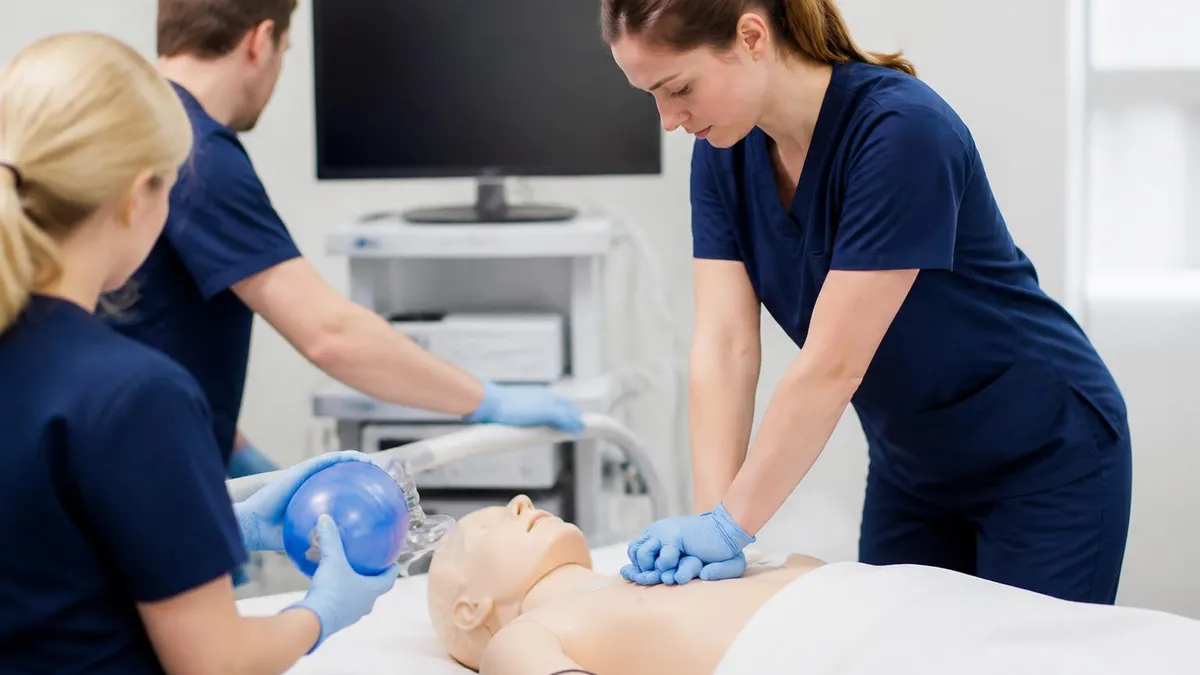
Should You Pay More for AHA Certification?
- +Universal acceptance at hospitals, EDs, and major health systems nationwide
- +Recognized by every state nursing board and physician licensing authority
- +Required by travel nurse agencies, locum tenens firms, and most credentialing services
- +Higher-quality skills practice with mandatory hands-on megacode evaluation
- +Resale value if you become an instructor (only AHA cards qualify for AHA Instructor track)
- +Comprehensive Provider Manual that doubles as a workplace reference for years
- +Aligns with the most current 2020 (and forthcoming 2025) AHA guidelines
- −Costs $50 to $150 more than online-only competitors
- −Less flexible scheduling — requires in-person attendance for at least the skills portion
- −Training centers can be inconsistent in instructor quality and classroom experience
- −Provider Manual sold separately at most centers, adding $55 to $65
- −Late or no-show fees can run $50 to $100 if you reschedule within 48 hours
- −Limited weekend availability in smaller markets means weekday PTO is often required
- −eCard delivery sometimes delayed 3 to 7 days, problematic for last-minute job starts
Pros and Cons at a Glance
| Pros | Cons |
|---|---|
| Universal acceptance at hospitals, EDs, and major health systems nationwide | Less flexible scheduling — requires in-person attendance for at least the skills portion |
| Recognized by every state nursing board and physician licensing authority | Training centers can be inconsistent in instructor quality and classroom experience |
| Required by travel nurse agencies, locum tenens firms, and most credentialing services | Limited weekend availability in smaller markets means weekday PTO is often required |
ACLS Certification Cost-Saving Checklist
- ✓Ask your employer about reimbursement or in-house classes before paying out of pocket
- ✓Schedule renewal 60-90 days before expiration to lock in discounted renewal pricing
- ✓Compare at least three training centers within a 30-mile radius for price variation
- ✓Sign up for two or three center newsletters and wait for promo codes (saves $25-$50)
- ✓Coordinate a group class with coworkers — six or more participants unlocks 15-30% discounts
- ✓Buy the Provider Manual used on eBay or borrow from a colleague to save $55-$65
- ✓Choose blended HeartCode if you self-study well and value scheduling flexibility
- ✓Verify card acceptance with your specific employer's credentialing office before enrolling
- ✓Avoid expedited eCard fees by allowing standard 24-72 hour delivery whenever possible
- ✓Keep all receipts — ACLS is tax-deductible as an unreimbursed professional expense
Book in January or August for the Lowest Prices
Training centers see demand spikes in spring (graduating nurses) and fall (new hospital cohorts), but slow dramatically in early January and mid-August. Booking during these windows often unlocks 10 to 20 percent promotional discounts and gives you first pick of weekend slots. One additional benefit: smaller class sizes mean more one-on-one feedback during megacode practice.
Renewal pricing creates one of the largest swings in total acls certification cost over a clinician's career. The standard renewal course is shorter — typically 5 to 8 hours instead of 12 to 16 — because the curriculum assumes you already understand baseline algorithms and pharmacology. Most AHA training centers price renewal between $150 and $225, a savings of $50 to $75 compared to initial certification at the same facility. Red Cross and online providers offer similar discounts, usually 20 to 40 percent off their initial-course rate.
The single most important rule is to renew before your card expires. Once expired, you must restart with a full initial course, paying the higher price and committing to the longer classroom day. Many clinicians lose track of their two-year expiration date and end up paying an unnecessary $75 to $100 premium plus an extra half-day of PTO. Set a calendar reminder 90 days before expiration and book the renewal class within that window to maximize savings and avoid scheduling stress.
HeartCode ACLS renewal pricing mirrors initial pricing for the online portion ($175) but the skills session is sometimes discounted by $20 to $30 for renewing providers because the evaluator can move faster through familiar territory. If you've completed HeartCode once before, the second cycle feels noticeably smoother, and many providers report finishing the online modules in 4 to 5 hours instead of the 6 to 8 hours required the first time around.
Some hospital systems negotiate bulk renewal contracts that cover all clinical staff at a flat per-employee rate, often around $125 to $150 per renewal. If your employer offers this benefit, the only cost to you is the time investment. Even when reimbursement is partial, taking advantage of an institutional contract usually saves money compared to enrolling independently, and the scheduling is built into your work shift in many cases.
Late renewal — anywhere from one day to several months past expiration — triggers full initial-course pricing at almost every provider. Some centers have informal grace periods where they'll still admit you to the renewal class if you arrive with a card expired by less than 30 days, but this is at the instructor's discretion and not a published policy. Travel nurses are particularly vulnerable because their agencies require active certification to start contracts, so an expired card can cost not just renewal money but also a delayed assignment worth thousands.
Renewing online providers typically charge $99 to $149 for renewal courses. If your employer accepts online cards, these renewals are the cheapest option on the market and can be completed in a single evening from home. The card is usually issued within minutes of passing the final exam. Just be cautious about switching providers between cycles — some hospitals track which organization issued your original card and prefer continuity, while others don't care as long as the credential is valid.
One often-overlooked cost savings: the AHA Provider Manual you bought for initial certification is fully reusable for renewal, as long as the AHA guidelines edition hasn't changed. Guidelines update on a five-year cycle (next major update expected in late 2025 or 2026), so most providers can reuse their manual for two renewal cycles before needing a refresh. This effectively cuts $60 from your renewal cost every two years, which adds up over a decade-long career.
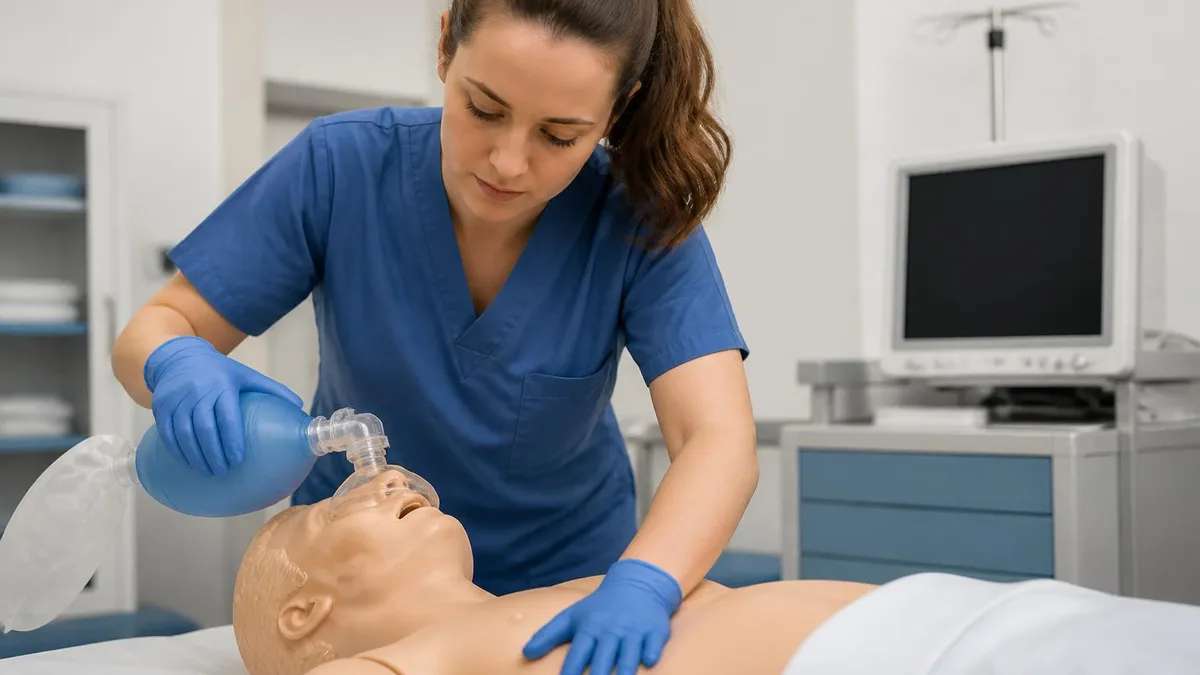
If your ACLS card has lapsed — even by one day — most training centers will require you to take the full initial course at initial pricing, costing $50 to $100 more than a timely renewal. Mark your two-year expiration on your calendar and book renewal at least 60 days early. Travel nurses face additional risk: an expired card can delay contract start dates and cost thousands in lost wages.
Choosing the right ACLS provider is not just about finding the lowest acls certification cost — it's about matching the course format and accreditation to your specific career situation. A travel nurse moving between states needs AHA certification because every credentialing agency accepts it without question. A dentist who needs ACLS for sedation privileges may be perfectly served by a Red Cross course at a lower price. An office-based clinician at an urgent care chain might find that an online-only course saves both time and money with zero downside.
Start by asking your employer's credentialing office for a written list of accepted providers. Many hospitals post this internally on their HR portal, but the list is rarely visible from the outside. A five-minute email exchange before you enroll can save you from a $300 mistake. If you're considering a job change, verify acceptance at the prospective employer as well — some health systems have stricter rules than others, and a card that works at one hospital may need to be re-earned at another.
Instructor reputation matters more than price for the in-person portion. A well-rated training center with strong megacode coaching will help you pass on the first attempt and retain knowledge longer, while a poorly run class can leave you frustrated and underprepared. Read Google reviews, ask coworkers for recommendations, and search nursing or physician forums for specific instructor names in your area.
The $25 to $40 difference between centers is often dwarfed by the value of a better learning experience. For a deeper comparison of online and blended pathways, our breakdown of ACLS Training Online walks through which platforms hospitals accept and which to avoid.
Consider your learning style honestly. If you struggle with self-paced material or procrastinate on online modules, the traditional in-person format may actually cost less in the long run because you won't pay for retake attempts. Conversely, if you absorb material faster through reading and video than through lecture, HeartCode lets you move at your own pace and re-watch challenging sections without slowing the class down. Choose the format that maximizes your odds of first-time pass.
Group purchasing is the single most underused cost-reduction tactic in healthcare credentialing. If you work in a clinic, surgery center, urgent care, or nursing home with five or more staff who need ACLS, organize a private on-site class. Most training centers will travel to your facility, eliminate classroom rental costs, and pass the savings on at $150 to $200 per person. The added benefit is that your team trains together using your actual workplace equipment, which improves real-world performance.
Don't underestimate the value of timing your certification to align with employment changes. If you're between jobs or starting a new position, time your ACLS so the receipt falls into the same tax year as other unreimbursed professional expenses. The IRS allows healthcare workers to deduct continuing education and certification costs when itemizing, and clustering these expenses can push you over the standard deduction threshold. A CPA familiar with healthcare workers can model this for under $200 and often saves you many times that amount.
Finally, treat ACLS certification as one component of a broader career investment plan, not a one-off expense. Bundle it with BLS, PALS, or NRP renewals if your role requires them, and ask training centers about multi-certification packages. Many facilities offer 10 to 20 percent discounts when you complete two or more certifications in the same visit, which can knock $50 to $150 off the total cost and save you a full day of separate training visits over the year.
With a clear understanding of acls certification cost behind you, the final step is converting that knowledge into a smart, low-stress purchase. The clinicians who consistently get the best value combine three practices: they shop early, they verify acceptance with their employer in writing, and they study before class begins. Skipping any of these three steps is what turns a $200 course into a $350 ordeal complete with retest fees, scheduling stress, and a card that may not even be accepted where you work.
Begin your preparation at least four weeks before the course date. Order the Provider Manual or access the digital version through your training center's portal, and complete the AHA precourse self-assessment online. This 30-question quiz identifies your weak areas in rhythm recognition, pharmacology, and algorithm sequencing. Most clinicians who fail the megacode do so because of one or two specific knowledge gaps — rhythm interpretation, drug doses, or team dynamics — and the self-assessment surfaces exactly which areas need attention before classroom day.
Practice with free online question banks during the two weeks leading up to your course. Focus on cardiac rhythm strips, pharmacology dose calculations, and case-based algorithms. Twenty to thirty minutes of daily practice consistently outperforms last-minute cramming the night before. Many clinicians report that this preparation alone is what separates first-time-pass students from those who need expensive retakes, and the time investment is essentially free compared to the $50 to $100 cost of a retest.
On class day, arrive 15 to 20 minutes early with a printed copy of your enrollment confirmation, photo ID, and the Provider Manual. Bring a pen, a highlighter, and a water bottle. Lunch is rarely provided in full-day classes, so pack food or scope out the nearest fast-casual option in advance. Skills practice is physical — you'll be on the floor doing chest compressions and standing through simulated codes for hours — so wear scrubs or comfortable athletic wear and supportive shoes.
During the megacode evaluation, the most common errors are not knowledge gaps but communication failures. Speak loudly when calling out rhythms and drug doses, designate clear team roles even in a simulated environment, and verbalize your differential diagnoses. Evaluators are trained to assess team leadership and closed-loop communication, not just technical knowledge. A confident, clear leader passes; a competent but quiet candidate sometimes fails despite knowing the material cold.
After passing, your eCard is typically issued within 24 to 72 hours through the AHA eCards portal or your provider's equivalent system. Save the digital card to your phone, print a paper copy for your wallet, and immediately email a copy to your employer's credentialing office. Many credentialing systems take two to four weeks to update internal records, and an expired listing in HR can prevent you from being scheduled even though your actual card is valid. Proactive submission prevents this administrative headache.
Track every dollar you spend on certification in a simple spreadsheet — tuition, manual, parking, mileage, PTO used. At tax time, these add up to a meaningful deduction for self-employed clinicians and a useful reference if your employer offers reimbursement. For deeper algorithm review and drug-specific preparation that complements this cost guide, our companion articles on the ACLS Study Guide walk through every algorithm and the most-tested medications. Smart preparation transforms the certification from a financial hurdle into a career investment that pays back through better patient outcomes and stronger professional credentials.
ACLS Questions and Answers
ACLS Training Online: Complete 2026 Guide to Courses, Costs, Certification & Hospital Acceptance
ACLS Training Near Me: How to Find Local Classes, Costs & Fast-Track Options in 2026
ACLS Study Guide: Complete 2026 Certification Prep with Algorithms, Drugs & Practice Tests

ACLS Guidelines 2026: Complete AHA Update on Algorithms, Drugs, CPR Quality & Post-Arrest Care
ACLS Drugs: Complete 2026 Guide to Medications, Doses, Indications & Algorithm Use
About the Author

Registered Nurse & Healthcare Educator
Johns Hopkins University School of NursingDr. Sarah Mitchell is a board-certified registered nurse with over 15 years of clinical and academic experience. She completed her PhD in Nursing Science at Johns Hopkins University and has taught NCLEX preparation and clinical skills courses for nursing students across the United States. Her research focuses on evidence-based exam preparation strategies for healthcare certification candidates.