
ACLS Training Online: Complete 2026 October Guide to Courses, Costs, Certification & Hospital Acceptance
📗 ACLS training online: compare AHA, ARC, and blended courses, see real costs, hospital acceptance rules, and pass-rate tips for 2026 October certification.
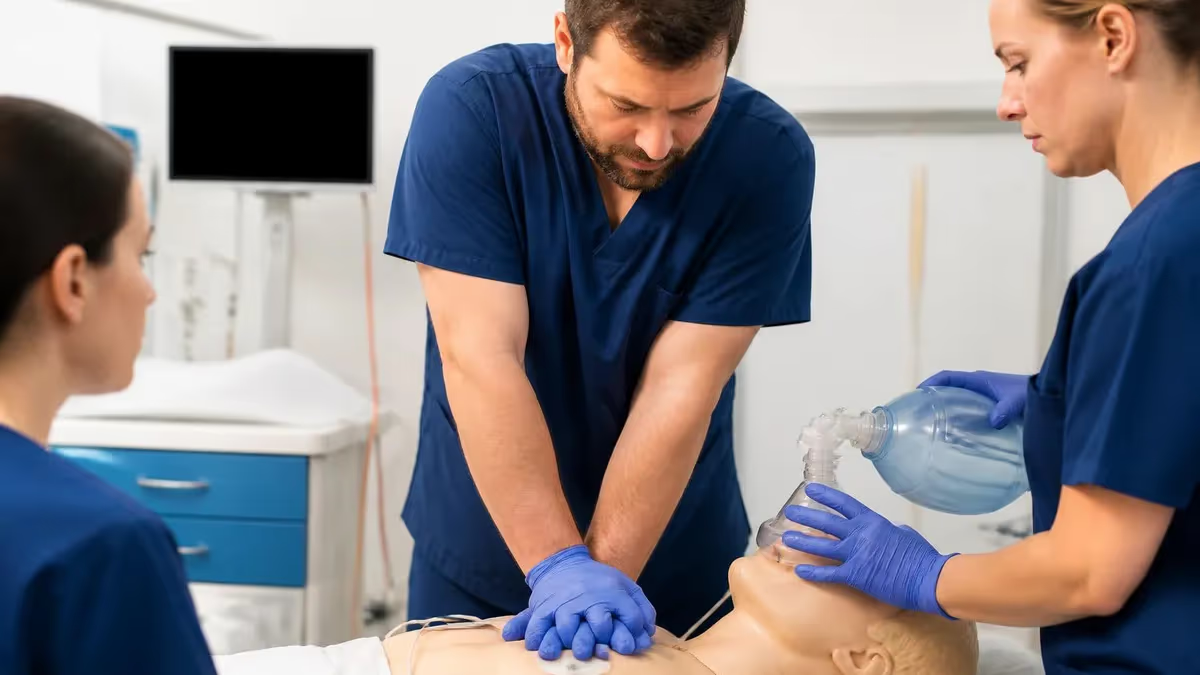
ACLS training online has become the default path for nurses, paramedics, physicians, respiratory therapists, and pharmacists who need Advanced Cardiovascular Life Support certification without burning two full days inside a hospital classroom. In 2026, more than 70% of US clinicians complete the cognitive portion of ACLS through a web-based platform, then either skip the skills check (for non-clinical roles) or attend a one-hour in-person megacode to earn a hospital-accepted card. The shift is driven by staffing shortages, telehealth growth, and AHA-approved blended formats like HeartCode ACLS.
This guide explains exactly how online ACLS works in 2026, which providers issue cards that hospitals will actually accept, how much you should expect to pay, and how to avoid the cheap diploma-mill sites that get rejected at credentialing. We will also cover the realistic time commitment, the equipment you need, the megacode skills component, and how the new 2025 AHA Focused Updates on epinephrine timing and ECPR have changed the course content compared to 2020 curricula.
If you are renewing, the calculus is different from a first-time certification. Renewers can usually complete a 4-6 hour fast-track online course plus a 45-minute skills session, while initial certification candidates need 10-12 hours of self-paced learning before the hands-on portion. We break down both paths step by step, including which sections of the course are graded, what the minimum pass score is, and how many attempts you get before paying again.
You will also find a side-by-side comparison of the three most common online ACLS providers: the American Heart Association (AHA), the American Red Cross (ARC), and ACLS Medical Training (non-AHA). Each has trade-offs in price, hospital acceptance, refresher quality, and skills-check logistics. By the end of this article you will know exactly which option fits your employer requirements, your schedule, and your budget.
We will close with the practical prep work: how to study the algorithms, which drugs and doses are tested most often, what megacode scenarios to expect, and how to use practice ECG strips to walk into the skills check confident. Whether you are an ICU nurse three days from a card expiration or a brand-new PA student preparing for a first attempt, the workflow below is the one experienced instructors recommend.
Before we dive in, one quick reality check: not every "online ACLS certification" listed on Google is recognized by hospitals. Joint Commission accredited facilities almost universally require an AHA or ARC card, and a non-AHA card from a $99 instant-print site will often be rejected at HR onboarding. We will show you how to verify acceptance before you pay so you do not have to repeat the course.
ACLS Training Online by the Numbers
Online ACLS Course Options in 2026
The American Heart Association's official online + skills check format. About 10 hours of self-paced eSimulation, then a 1-hour in-person megacode at an authorized training center. Universally accepted by hospitals.
ARC's blended online course launched in 2022 and is now accepted at most Joint Commission hospitals. Slightly cheaper than AHA, with a modern interface and unlimited practice attempts before the final exam.
Providers like ACLS Medical Training and ACLSOnline.us offer fully online cards with no skills check. Cheap and fast, but only accepted by some non-acute employers — verify before purchase.
Many large health systems contract directly with AHA training centers to deliver employee ACLS through internal LMS portals. Free for staff and counted as paid CE time during shifts.
If you already finished cognitive training elsewhere or hold an expired card, several AHA centers sell skills-only sessions for $75-$120. Useful if your hospital requires the in-person component but you studied independently.
Online ACLS works in two distinct phases under the AHA's current blended-learning model. Phase one is the cognitive component, completed at your own pace through an interactive eSimulation platform called HeartCode ACLS. You log in, watch short video lectures, complete branching patient scenarios in a virtual emergency department, and answer formative questions throughout. The platform tracks your progress, lets you save and resume, and culminates in a 50-question multiple-choice exam where you need 84% to pass.
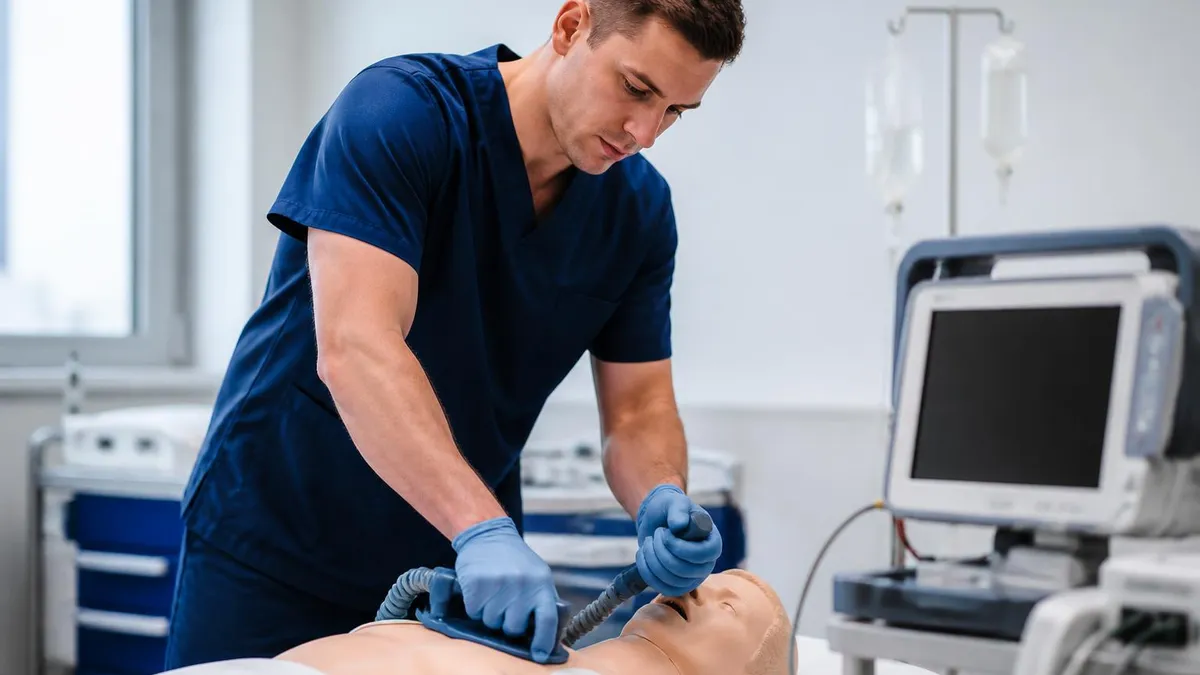
Phase two is the hands-on skills session, which you book separately at an AHA Training Center, simulation lab, or your employer's education department. The skills check covers BLS skills (compressions, bag-mask ventilation, AED use), airway management with an advanced airway, and two megacode scenarios where you lead a simulated resuscitation. Expect to manage VF/pulseless VT, asystole/PEA, bradycardia, and unstable tachycardia with the appropriate algorithm, drugs, and team communication.
The fully online, non-AHA route works differently. Sites like ACLS Medical Training let you read a digital textbook, attempt a 50-question final exam an unlimited number of times, and instantly download a PDF certificate. There is no megacode, no instructor, and no in-person verification. These cards typically cost $150-$175 and are popular with telehealth providers, urgent care RNs at non-Joint-Commission clinics, dental staff, and Canadian or international students whose employers do not require AHA branding.
One critical point in 2026: hospital acceptance is the deciding factor, not price or convenience. The Joint Commission, Magnet, and most state nursing boards reference "AHA-equivalent" courses, and credentialing offices have become stricter since the 2023 wave of fake-card investigations. Always email or call your hospital's medical-staff office with the provider's name before paying. Ten minutes of verification prevents three days of rework when HR rejects your card.
Technical requirements are modest but real. You need a stable broadband connection, a modern browser (Chrome or Edge), speakers or headphones for narrated scenarios, and ideally a second monitor so you can keep the algorithm reference card visible while working through cases. Mobile is supported but not recommended — the dragging interface in eSimulation works much better with a mouse than a touchscreen. Plan on 2-3 sittings of 3-4 hours each rather than one marathon session.
For renewal candidates, the AHA shortened the HeartCode ACLS Update course in 2024 to about 4.5 hours of online work plus a 45-minute skills check focused on whichever algorithms you struggled with on the practice cases. This is a major time saver compared to the older 2-day in-person renewal. Most renewers complete the entire process — online portion, skills appointment, new card in hand — within one calendar week.
If you want a deeper review of the underlying material before you start, our ACLS study guide walks through every algorithm, drug dose, and rhythm strip that appears on the cognitive exam, with worked examples for each megacode scenario.
ACLS Practice Test Questions
Prepare for the ACLS Advanced Cardiovascular Life Support Practice exam with our free practice test modules. Each quiz covers key topics to help you pass on your first try.
ACLS Cardiac Rhythms & ECG Interpretation
ACLS Exam Questions covering ACLS Cardiac Rhythms & ECG Interpretation. Master ACLS Test concepts for certification prep.
ACLS Pharmacology & Medications
Free ACLS Practice Test featuring ACLS Pharmacology & Medications. Improve your ACLS Exam score with mock test prep.
ACLS Best Practices & Methodologies
ACLS Mock Exam on Best Practices & Methodologies. ACLS Study Guide questions to pass on your first try.
ACLS Communication & Stakeholder Relations
ACLS Test Prep for Communication & Stakeholder Relations. Practice ACLS Quiz questions and boost your score.
ACLS Core Concepts & Fundamentals
ACLS Questions and Answers on Core Concepts & Fundamentals. Free ACLS practice for exam readiness.
ACLS Data Analysis & Reporting
ACLS Mock Test covering Data Analysis & Reporting. Online ACLS Test practice with instant feedback.
ACLS Documentation & Record Keeping
Free ACLS Quiz on Documentation & Record Keeping. ACLS Exam prep questions with detailed explanations.
ACLS Industry Regulations & Compliance
ACLS Practice Questions for Industry Regulations & Compliance. Build confidence for your ACLS certification exam.
ACLS Leadership & Team Management
ACLS Test Online for Leadership & Team Management. Free practice with instant results and feedback.
ACLS Professional Standards & Ethics
ACLS Study Material on Professional Standards & Ethics. Prepare effectively with real exam-style questions.
ACLS Quality Assurance & Improvement
Free ACLS Test covering Quality Assurance & Improvement. Practice and track your ACLS exam readiness.
ACLS Risk Management & Assessment
ACLS Exam Questions covering Risk Management & Assessment. Master ACLS Test concepts for certification prep.
Provider Comparison: AHA vs Red Cross vs Non-AHA Online ACLS
The American Heart Association's HeartCode ACLS remains the gold standard for online ACLS training in 2026. The cognitive portion runs about 10 hours through interactive eSimulation, costs $135 for the online key, and is followed by a $75-$150 in-person skills check at an authorized training center. Total spend lands between $210 and $285 depending on region and instructor pricing for the hands-on session.
Hospital acceptance is essentially universal — every Joint Commission accredited facility recognizes the AHA card, and most state nursing boards explicitly list AHA as the reference standard. The eSimulation engine is widely considered the most clinically realistic of the three options, with branching outcomes that respond to your actual treatment decisions rather than just multiple-choice scoring. Cards arrive digitally within 24 hours of the skills check and are validated through the AHA's eCard portal that employers can verify in real time.

Pros and Cons of Completing ACLS Training Online
- +Self-paced learning lets you study during night shifts, between patients, or on days off
- +Significantly cheaper than traditional 2-day instructor-led courses in most markets
- +HeartCode eSimulation provides realistic branching scenarios you cannot replicate in classroom lecture
- +Unlimited review of weak topics before the final exam — no embarrassment in front of peers
- +Faster path to renewal for experienced providers who already know the algorithms cold
- +Digital cards arrive within 24 hours and can be emailed directly to HR or credentialing
- +Same 2-year certification validity as in-person courses with identical hospital acceptance for AHA/ARC
- −Hands-on megacode skills still require an in-person session for AHA and ARC cards
- −Fully online non-AHA cards are rejected by Joint Commission accredited hospitals
- −Self-paced format requires real discipline — many learners abandon mid-course without a deadline
- −Limited real-time instructor feedback on team-leader communication and closed-loop calls
- −Technology issues with eSimulation can cost you locked sections requiring support tickets
- −Skills-check appointments at training centers often book 2-3 weeks out in busy metros
- −Easy to underestimate the cognitive workload and arrive at megacode underprepared on drugs
Pros and Cons at a Glance
| Pros | Cons |
|---|---|
| Self-paced learning lets you study during night shifts, between patients, or on days off | Hands-on megacode skills still require an in-person session for AHA and ARC cards |
| HeartCode eSimulation provides realistic branching scenarios you cannot replicate in classroom lecture | Fully online non-AHA cards are rejected by Joint Commission accredited hospitals |
| Unlimited review of weak topics before the final exam — no embarrassment in front of peers | Self-paced format requires real discipline — many learners abandon mid-course without a deadline |
| Faster path to renewal for experienced providers who already know the algorithms cold | Limited real-time instructor feedback on team-leader communication and closed-loop calls |
Pre-Course Checklist for Online ACLS Training
- ✓Confirm your employer accepts your chosen provider (AHA, ARC, or specific non-AHA brand)
- ✓Confirm your employer accepts your chosen provider (AHA, ARC, or specific non-AHA brand)
- ✓Download the current AHA ACLS Provider Manual (2020 edition with 2025 Focused Update) before starting
- ✓Verify your computer meets minimum specs: Chrome/Edge browser, broadband, working speakers
- ✓Block out 3 study sessions of 3-4 hours each on your calendar before the access code expires
- ✓Review the BLS algorithm first — it is the foundation of every megacode scenario
- ✓Memorize the four cardiac arrest algorithm steps (VF/VT, Asystole, PEA, Bradycardia, Tachycardia)
- ✓Print or save the ACLS pocket reference cards for drugs, doses, and reversible causes (H's and T's)
- ✓Book your in-person skills check appointment BEFORE you start the online portion to avoid delays
- ✓Practice rhythm recognition with at least 50 sample ECG strips before the cognitive exam
- ✓Take a free ACLS practice test to identify weak areas you need to focus on
- ✓Bring a photo ID and your eCard receipt printout to the skills check appointment
The 2025 AHA Focused Update changed epinephrine timing — make sure your course covers it
The 2025 AHA Focused Update reaffirmed that epinephrine 1 mg IV/IO should be given as soon as feasible in non-shockable rhythms, and after the second shock in shockable rhythms. Some non-AHA online courses still reference older 2015 timing — verify your provider's curriculum is current before paying. ECPR for refractory VF/VT is also now a Class 2b recommendation when resources allow.
Total cost for online ACLS in 2026 depends heavily on which provider you choose, whether you need an in-person skills check, and whether your employer subsidizes any portion. AHA HeartCode ACLS typically runs $135 for the online access key plus $75-$150 for the skills session, totaling $210-$285. American Red Cross is slightly cheaper at $169 for online plus $99-$130 for skills, averaging $268. Fully online non-AHA cards land between $150 and $180 with no additional skills fee.
Hidden fees catch many first-time buyers off guard. The AHA's printed Provider Manual is sold separately for $35-$45 if you want a physical copy beyond the digital version included in HeartCode. Some training centers charge an additional $25 "materials fee" for the skills check, and a few add a $15 eCard processing fee. Rescheduling a skills appointment within 48 hours of the booked time can trigger a $50 late-change penalty at busy urban centers. Always read the cancellation policy.
Renewal pricing is notably better. AHA's HeartCode ACLS Update costs $115 for the online portion plus $50-$95 for the abbreviated skills session, totaling $165-$210. ARC's renewal track sits at $139 plus $75-$110 in skills fees. Renewals must be completed before the original card's expiration date — once expired, you pay the full initial certification price even if you only need a refresher, which is a costly mistake to make.
Employer reimbursement is the biggest cost-saver many clinicians overlook. Roughly 70% of US hospitals reimburse ACLS training costs in full as part of CE benefits, but you must submit the receipt and a copy of the new card within the reimbursement window (typically 60-90 days). Travel nursing contracts almost always include certification reimbursement, and per-diem agencies often advance the cost as a sign-on incentive. Ask before paying out of pocket.
Group rates can dramatically reduce per-person cost. AHA Training Centers commonly offer 15-25% discounts for cohorts of 5+ staff scheduled together, and many hospitals coordinate quarterly ACLS days where the entire ICU or ED unit certifies in one bulk session. If you are a manager, work with your training center to schedule a group skills check — it is faster, cheaper, and easier to coordinate scheduling around shift coverage.
Beware of "too cheap to be true" listings. The lowest-priced online ACLS sites — sometimes advertising $69 or $89 — are typically not AHA or ARC affiliated, do not include any skills component, and produce cards that fail credentialing verification. Spending an extra $100-$150 for an AHA-branded card prevents the very real risk of having to retake the entire course at full price when HR rejects the cheap card during onboarding. If you need local options, our ACLS training near me guide compares prices by region.

If your AHA ACLS card expires before you complete the renewal, you cannot use the abbreviated update course — you must pay for the full initial provider course, which adds $50-$100 in cost. Start your online renewal at least 30 days before expiration to avoid this trap, especially if your skills-check appointment is booked weeks out.
Passing the megacode skills check on the first attempt is mostly about preparation, not raw clinical talent. Instructors at AHA Training Centers consistently report that the candidates who fail are those who memorized algorithms but never rehearsed leading a team out loud. The skills check is as much about communication — clear orders, closed-loop confirmation, role assignments — as it is about knowing that amiodarone 300 mg goes after the second shock.
Start your preparation by drilling the four big algorithms until they are reflexive: BLS, Cardiac Arrest (VF/VT and Asystole/PEA branches), Bradycardia with a pulse, and Tachycardia with a pulse (stable and unstable). Write each one out on a blank sheet from memory three times. If you cannot produce the algorithm without the reference card, you are not ready for the megacode regardless of what the eSimulation score says.
Practice saying drug orders out loud in a clear, structured format: drug name, dose, route, and indication. "Epinephrine 1 milligram IV push every 3 to 5 minutes for cardiac arrest" is exactly what instructors want to hear, not a mumbled "give epi." Closed-loop communication means you wait for your team member to repeat the order back before you move on. This single habit accounts for the difference between a smooth pass and a remediation in 80% of skills checks.
Know the reversible causes — the H's and T's — cold. Most megacode scenarios will involve a reversible cause hidden in the patient history or the rhythm strip. Hypoxia, hypovolemia, hydrogen ion (acidosis), hypo/hyperkalemia, hypothermia, tension pneumothorax, tamponade, toxins, thrombosis (coronary), and thrombosis (pulmonary). Verbalizing your differential during the scenario shows the instructor you are thinking diagnostically, not just running an algorithm. For dose memorization, review our ACLS drugs guide.
Rehearse the team-leader role specifically. In your skills check you will not perform compressions or push drugs yourself — you will direct others. Practice standing back, scanning the monitor every 2 minutes during pulse checks, calling rhythm changes, and assigning the next medication. Many candidates feel awkward delegating; the instructor wants to see you confidently in charge, not jumping in to do tasks yourself. A calm, decisive team leader passes; a frantic, hands-on one struggles.
Finally, eat, sleep, and arrive early. The skills check is only 60-90 minutes total but mental fatigue from the cognitive portion is real. Do not schedule your megacode for the same day you finish HeartCode. Take 24-48 hours to review weak spots, do one final algorithm walkthrough, and arrive 15 minutes early to settle in. Confidence on test day comes from sleep, not last-minute cramming.
If you fail any portion of the megacode, AHA centers offer same-day or next-day remediation at no additional cost in most cases. Use the feedback constructively — instructors typically identify one or two specific issues (drug dosing, rhythm misread, poor team communication) rather than failing you globally. Fix the specific issue and retest. The vast majority of remediated candidates pass on the second attempt.
Practical study tips for the cognitive online portion start with treating HeartCode like an actual clinical rotation, not a video game. When the eSimulation patient deteriorates, pause and verbalize your differential out loud before clicking. This habit translates directly to the megacode. Use a notebook beside your laptop to jot down each algorithm step as it appears so you build muscle memory of the flow rather than relying on the on-screen prompts.
Tackle the ECG rhythm strips section with deliberate repetition. The cognitive exam tests rhythm recognition heavily, and many learners breeze through the lecture videos but freeze when an unfamiliar strip appears. Spend at least 90 minutes on rhythm recognition drills before the final exam — there are excellent free practice sets, including our ACLS guidelines companion drill set. Identify rate, regularity, P waves, PR interval, and QRS width on every strip in that exact order.
Drug doses are the single most-tested category on the cognitive exam. Memorize epinephrine 1 mg IV/IO q3-5 min, amiodarone 300 mg first dose then 150 mg, atropine 1 mg q3-5 min up to 3 mg, adenosine 6 mg then 12 mg, and lidocaine 1-1.5 mg/kg first dose. Make a single-page cheat sheet, look at it every morning for a week, and you will have the doses cold by exam day.
Use the practice exam in HeartCode strategically. Do not waste it the night before your real attempt — instead, take it after you have completed roughly 60% of the modules, identify your weak areas, and target those specific topics for the remaining study time. Then take the practice exam again two days before your real attempt as a confidence check. Score below 90% on the practice? Spend more time before booking the live exam.
For renewal candidates, do not skip the modules just because they feel familiar. The 2025 Focused Update introduced changes to ECPR recommendations, epinephrine timing in non-shockable rhythms, and post-arrest temperature management (targeted temperature management at 32-36°C rather than 33°C specifically). The exam will test these updates, and assuming your 2024 knowledge is current can cost you points. Spend two hours on the update modules even if everything else feels routine.
If you are part of a study group, schedule one 90-minute Zoom session before your skills check to run through megacode scenarios verbally. One person plays team leader, others play recorder, compressor, and airway. Switch roles every 10 minutes. This rehearsal is the single most effective preparation for the skills check and is free if you coordinate with classmates. Many hospitals organize these informally in the break room before group certifications.
Finally, on exam day for the cognitive portion: read each question completely before looking at the answers. The AHA writes questions with deliberate distractors — a partially correct answer that misses one element. Slow down, identify the exact phase of the algorithm being tested, and choose the answer that matches the precise step. Rushing is the most common reason capable clinicians score 70% instead of 90%.
ACLS Questions and Answers
ACLS Training Near Me: How to Find Local Classes, Costs & Fast-Track Options in 2026
ACLS Study Guide: Complete 2026 Certification Prep with Algorithms, Drugs & Practice Tests

ACLS Guidelines 2026: Complete AHA Update on Algorithms, Drugs, CPR Quality & Post-Arrest Care
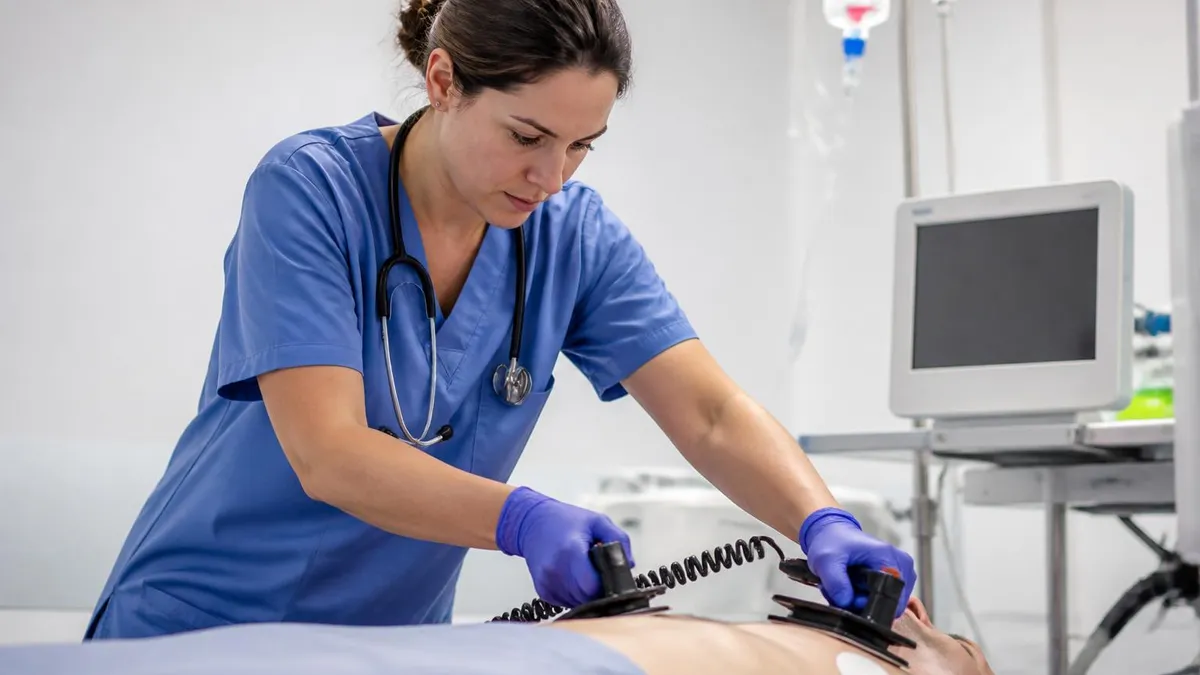
ACLS Drugs: Complete 2026 Guide to Medications, Doses, Indications & Algorithm Use
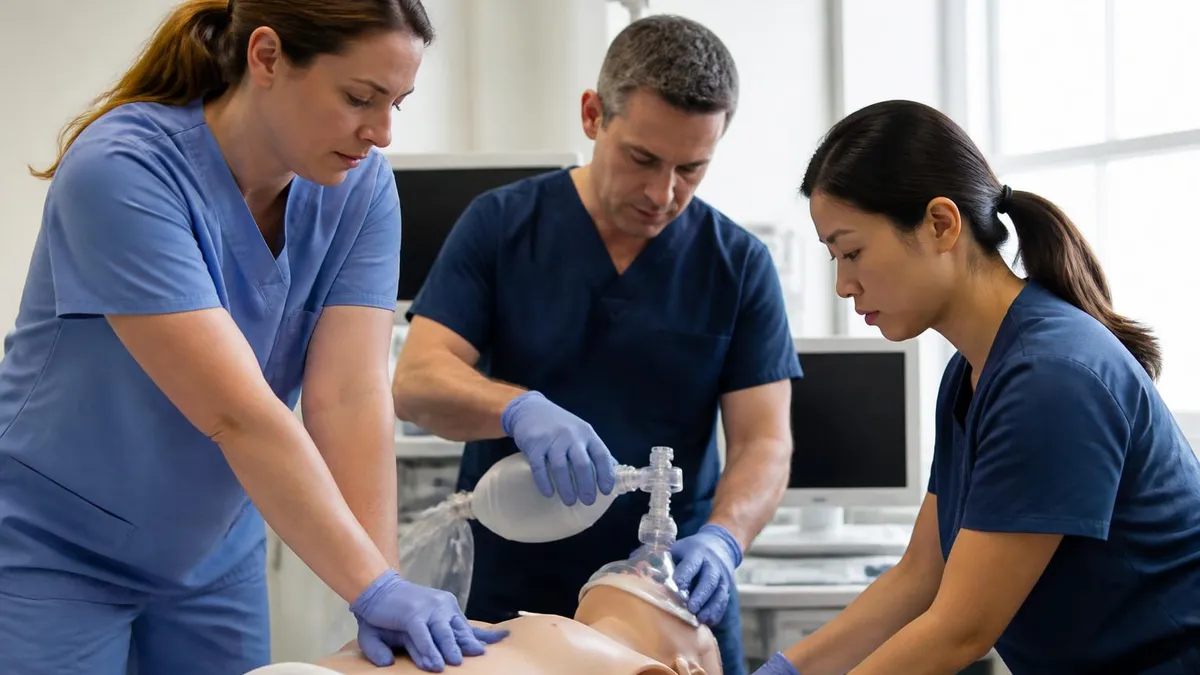
ACLS Renewal Near Me: Find Local Recertification Classes, Costs & Online Options in 2026
About the Author

Registered Nurse & Healthcare Educator
Johns Hopkins University School of NursingDr. Sarah Mitchell is a board-certified registered nurse with over 15 years of clinical and academic experience. She completed her PhD in Nursing Science at Johns Hopkins University and has taught NCLEX preparation and clinical skills courses for nursing students across the United States. Her research focuses on evidence-based exam preparation strategies for healthcare certification candidates.