
Free ACLS Megacode Practice: Master Every Scenario Before Your Certification
Master every ACLS megacode scenario with free practice tests, step-by-step walkthroughs & expert tips. Boost your certification confidence. ✅
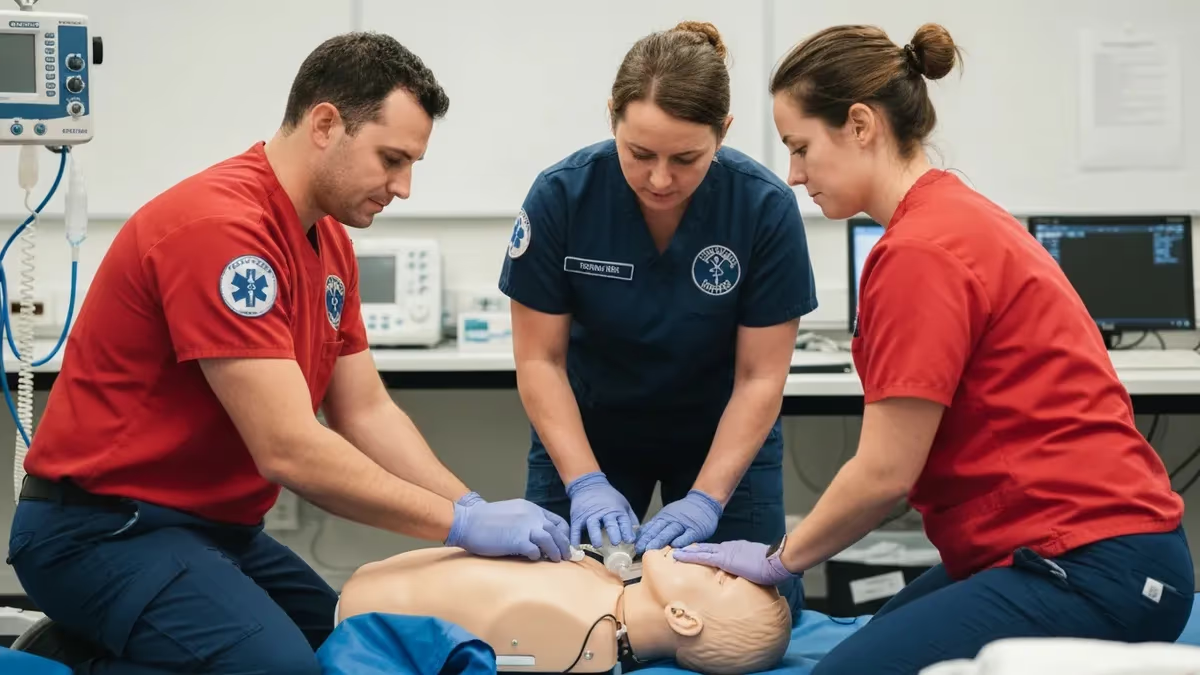
Free ACLS megacode practice is the single most effective way to build the procedural confidence you need before walking into your certification station. The megacode is not a written test — it is a live, high-stakes simulation in which an AHA evaluator watches you lead a resuscitation team through a cardiac arrest or peri-arrest scenario in real time. Knowing the algorithms on paper is necessary but not sufficient; you must demonstrate fluid team leadership, correct drug sequencing, and flawless rhythm interpretation under pressure, all simultaneously.
Most candidates underestimate how different the megacode feels compared to a multiple-choice question bank. When an evaluator says "the patient is unresponsive and pulseless" and hands you a printed rhythm strip showing coarse ventricular fibrillation, you have roughly two seconds to verbalize your assessment, call for defibrillation, and delegate chest compressions — all before the clock even starts counting CPR cycles. That split-second cognitive load is exactly why deliberate megacode rehearsal, using timed repetitions across multiple scenario types, separates passing candidates from those who need a retake.
The six core megacode scenarios tested by the American Heart Association cover VF/pulseless VT, asystole, PEA, unstable bradycardia, unstable tachycardia, and acute stroke recognition. Each has a distinct algorithm branch, specific drug dosages, and a set of critical decision points where hesitation or a wrong choice triggers an automatic evaluator flag. Practicing each scenario in isolation first, then rotating through all six in a random order, mirrors exactly what you will face on test day and conditions your brain to retrieve the correct response automatically.
Online platforms and printed scenario cards are useful starting points, but the gold standard for megacode preparation combines free digital practice tools with hands-on skills station rehearsal in a classroom or simulation lab. The rhythm interpretation and pharmacology questions embedded in practice quizzes on this page target the same knowledge domains the megacode evaluates, making them a powerful complement to mannequin-based drills. For those preparing for their initial certification or a renewal cycle, staying current with updated protocols is equally important — review the latest acls megacode practice guidelines to ensure your technique reflects current AHA standards.
Timing is a critical variable that most self-study resources overlook. The AHA evaluator is watching for adherence to the two-minute CPR cycle, drug administration within the correct window after a rhythm check, and appropriate shock delivery timing. Practicing with a stopwatch until the two-minute rhythm check cadence feels completely automatic is one of the highest-return preparation strategies available, and it costs nothing beyond a practice partner and a reliable timer.
This article walks you through every element of ACLS megacode preparation: the format of the evaluation station, the six scenario types and their critical branch points, how to interpret the rhythms you will encounter, which medications examiners check most closely, and how to organize your final study week for maximum retention. Whether you are sitting for your first certification or your fifth renewal, the structured practice approach outlined here will help you walk into the megacode station with the calm, systematic confidence that evaluators recognize immediately as a sign of a prepared candidate.
Use the free practice quizzes distributed throughout this page as checkpoints. Each quiz targets a specific knowledge domain — cardiac rhythms, pharmacology, or algorithm sequencing — and the questions are written at the same cognitive level as real AHA evaluator prompts. Work through each set honestly, review every incorrect answer against the algorithm, and return to the quizzes after a 48-hour gap to test true retention rather than short-term recall. That retrieval practice cycle is the engine behind the preparation system this page is built around.
ACLS Megacode by the Numbers
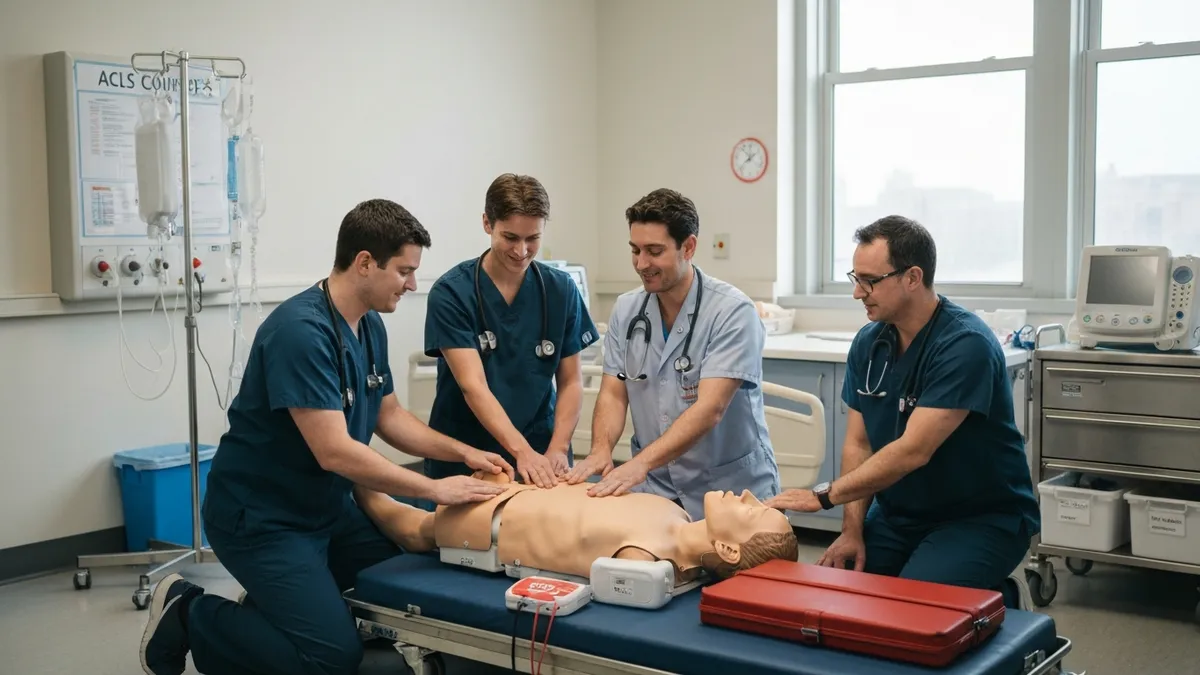
ACLS Megacode Station Format: What to Expect
Before the scenario begins, the evaluator provides a brief patient handoff — age, chief complaint, and initial vital signs. You have roughly 30 seconds to mentally activate the correct algorithm branch before the simulation clock starts.
As team leader, you must verbally assign roles to confederates or classmates within the first 60 seconds: compressor, airway manager, IV/IO access, monitor operator, and recorder. Failure to delegate is one of the top evaluator flags.
Every two minutes the evaluator pauses compressions for a rhythm check. You must verbalize your rhythm interpretation, decide shockable versus non-shockable, and issue the correct order — shock or resume CPR — within five seconds.
After each shock or rhythm check, the evaluator expects you to verbalize the correct drug, dose, and route. For epinephrine in a pulseless arrest that means 1 mg IV/IO every 3 to 5 minutes — verbalize the timing, not just the drug name.
Most megacode scenarios end with either return of spontaneous circulation or a transition to a post-cardiac arrest care discussion. Recognizing ROSC signs — a palpable pulse, a narrow organized rhythm, a rising end-tidal CO₂ — is itself an evaluable skill.
The six core ACLS megacode scenarios each follow a distinct algorithm pathway, and understanding the branch logic of each one is more valuable than memorizing drug lists in isolation. Start with ventricular fibrillation and pulseless ventricular tachycardia because they are the most commonly tested and contain the most evaluable decision points.
The shockable rhythm pathway requires you to deliver an immediate unsynchronized shock, resume high-quality CPR for two minutes without interruption, reassess the rhythm, administer epinephrine 1 mg IV/IO after the second shock, and introduce amiodarone 300 mg IV/IO after the third shock if VF or pVT persists. Each of those steps must happen in the correct sequence and within the correct time window.
Asystole and pulseless electrical activity share the same non-shockable limb of the cardiac arrest algorithm, but they demand different clinical thinking. Asystole presents as a flat line with no discernible electrical activity, and the evaluator will expect you to confirm it in two leads before proceeding.
PEA, by contrast, shows an organized rhythm on the monitor alongside the absence of a palpable pulse, and the critical skill being tested is your ability to verbalize the reversible causes — the Hs and Ts — and direct targeted interventions while compressions continue uninterrupted. Hypovolemia, hypoxia, hydrogen ion excess, hypo/hyperkalemia, hypothermia, tension pneumothorax, tamponade, toxins, thrombosis pulmonary, and thrombosis coronary must all flow from memory in under 30 seconds.
Unstable bradycardia is a scenario many candidates underperform because the threshold for intervention is less intuitive than a pulseless arrest. The AHA defines hemodynamic instability as hypotension below 90 mmHg systolic, acute altered mental status, signs of shock, ischemic chest pain, or acute heart failure — and all five must be on the tip of your tongue when the evaluator asks why you are reaching for atropine.
The correct first-line dose is 0.5 mg IV, repeatable every 3 to 5 minutes to a maximum of 3 mg. If atropine fails, the algorithm directs you to transcutaneous pacing, dopamine infusion at 2 to 20 mcg/kg/min, or epinephrine infusion at 2 to 10 mcg/min — and the evaluator will probe which you choose and why.
Unstable tachycardia requires you to distinguish narrow-complex from wide-complex rhythms before selecting synchronized cardioversion. Narrow-complex regular tachycardias such as SVT respond to vagal maneuvers and adenosine if the patient is stable, but an unstable patient goes directly to synchronized cardioversion starting at 50 to 100 J for narrow regular rhythms, 100 J for narrow irregular, 100 J for wide regular, and 120 to 200 J for atrial fibrillation.
The single most common evaluator flag in this scenario is candidates attempting to cardiovert without first pressing the SYNC button on the defibrillator, which would deliver an unsynchronized shock and risk precipitating VF.
Acute stroke recognition rounds out the six-scenario set and is unique because it tests a separate algorithm that does not involve defibrillation or cardiac medications. The evaluator presents a patient with sudden facial droop, arm drift, and slurred speech, and you must verbalize the Cincinnati Prehospital Stroke Scale findings, establish the last-known-well time, activate the stroke team, and order a non-contrast CT head — all within the first four to five minutes of the simulation.
The key evaluable element is time: the AHA target for door-to-CT is 25 minutes, and for door-to-needle for tPA it is 60 minutes. Knowing those benchmarks and vocalizing them during the scenario signals to the evaluator that you understand the clinical stakes.
Rotating through all six scenarios in randomized order during your final preparation week is the most efficient way to build the mental flexibility the megacode demands. Print or download six scenario cards, shuffle them, set a timer for 20 minutes per scenario, and run through each one aloud — verbalize every order as if a team were listening.
Recording yourself on video is surprisingly effective: most candidates discover they are omitting verbal confirmations, mumbling drug doses, or failing to close the loop on delegated tasks, all of which are evaluator flags that are invisible to the candidate in the moment but obvious on playback.
A common source of errors across all six scenarios is the failure to maintain situational awareness while managing individual algorithm steps. Effective ACLS team leaders use a technique called closed-loop communication, in which every order is repeated back by the recipient before execution, and the team leader verbally confirms when the task is complete. Practicing this communication structure during your megacode rehearsals is not optional — it is a core competency the evaluator is specifically watching for, and neglecting it during practice means you will fall back on old habits under the stress of the actual evaluation.
Many readers pair this guide with the aha acls algorithms to check their readiness before exam day.
Many readers pair this guide with the acls practice test to check their readiness before exam day.
ACLS Megacode Rhythm, Drug & Algorithm Mastery
Accurate rhythm interpretation in under five seconds is the foundation of every megacode scenario. For shockable rhythms, train yourself to recognize coarse VF — chaotic, high-amplitude deflections with no organized P waves or QRS complexes — and pulseless VT — wide, monomorphic or polymorphic QRS complexes at a rate above 150 bpm. The key differentiator between pulseless VT and unstable perfusing VT is the pulse check, which must be verbalized clearly during the scenario so the evaluator knows you understand the distinction.
Non-shockable rhythms require equally rapid recognition. Asystole should be confirmed in at least two leads to rule out fine VF, because the management pathways diverge: fine VF may respond to a shock whereas true asystole never will. PEA can present with virtually any organized rhythm — sinus tachycardia, junctional rhythm, or even a normal sinus rhythm — and the only diagnostic criterion is the absence of a palpable pulse. Drilling all of these rhythm patterns using printed ECG strips or digital flashcards until recognition is reflexive is essential preparation for the live scenario.

Online Megacode Practice vs. In-Person Skills Lab
- +Available 24/7 — practice rhythm interpretation and pharmacology at any hour without scheduling a lab session
- +Unlimited repetitions across all six scenario types without time or resource constraints
- +Immediate feedback on incorrect answers with algorithm-referenced explanations
- +Low-pressure environment lets you identify knowledge gaps before high-stakes simulation
- +Quiz-based practice reinforces retrieval memory, which transfers to faster recall under evaluator pressure
- +Free resources eliminate financial barriers for candidates on tight budgets
- −Cannot replicate the physical stress of hands-on compressions, airway management, or defibrillator operation
- −Team dynamics and closed-loop communication cannot be practiced solo in front of a screen
- −No evaluator feedback on voice projection, body language, or leadership presence
- −Digital scenarios cannot replicate the sensory chaos of a real resuscitation environment
- −Candidates may develop false confidence from high quiz scores without testing procedural fluency
- −Time pressure of the live two-minute CPR cycle is difficult to internalize without a physical mannequin and timer
Pros and Cons at a Glance
| Pros | Cons |
|---|---|
| Unlimited repetitions across all six scenario types without time or resource constraints | Cannot replicate the physical stress of hands-on compressions, airway management, or defibrillator operation |
| Immediate feedback on incorrect answers with algorithm-referenced explanations | Team dynamics and closed-loop communication cannot be practiced solo in front of a screen |
| Low-pressure environment lets you identify knowledge gaps before high-stakes simulation | No evaluator feedback on voice projection, body language, or leadership presence |
| Quiz-based practice reinforces retrieval memory, which transfers to faster recall under evaluator pressure | Digital scenarios cannot replicate the sensory chaos of a real resuscitation environment |
| Free resources eliminate financial barriers for candidates on tight budgets | Candidates may develop false confidence from high quiz scores without testing procedural fluency |
ACLS Megacode Readiness Checklist
- ✓Verbalize the complete cardiac arrest algorithm from memory without referencing a pocket card
- ✓Identify VF, pVT, asystole, PEA, SVT, and atrial fibrillation on ECG strips in under five seconds each
- ✓State the correct epinephrine dose, route, and repeat interval without hesitation
- ✓Correctly sequence amiodarone administration after the third shock in a VF scenario
- ✓List all ten reversible causes of cardiac arrest (Hs and Ts) in under 30 seconds
- ✓Demonstrate the SYNC button workflow before cardioverting any tachycardia scenario
- ✓Assign all five team roles verbally within the first 60 seconds of a simulated arrest
- ✓Use closed-loop communication for every delegated task during at least three full practice scenarios
- ✓Practice each of the six scenario types in randomized order at least twice in the final week
- ✓Review the 2025 AHA guideline updates to confirm your technique matches the current algorithm version
The Two-Minute Rule Is Non-Negotiable
AHA evaluators are specifically watching the clock during CPR cycles. Interrupting compressions before the full two minutes is complete — even by a few seconds to check a pulse or reposition — is one of the most common automatic failure triggers in the megacode station. Practice counting two full minutes with a stopwatch until that interval is physically instinctive, and always verbalize "continuing CPR, reassess in two minutes" to signal situational awareness to the evaluator.
Team leader performance in the ACLS megacode is evaluated on five distinct dimensions that go well beyond algorithm knowledge: situational awareness, closed-loop communication, workload distribution, intervention timing, and self-correction when a team member voices a concern. Most candidates focus almost exclusively on algorithm content during preparation and spend very little deliberate practice time on leadership mechanics, which is precisely why leadership errors are the leading cause of megacode failures among candidates who clearly know the clinical content.
Situational awareness in a resuscitation context means maintaining a mental model of what has happened, what is happening right now, and what needs to happen next — simultaneously. Experienced team leaders do this by narrating the scenario to themselves and the team: "We are two minutes into the arrest, rhythm is VF, we have delivered one shock, no epinephrine yet — when this CPR cycle ends we shock again and give epi immediately after." That running verbal commentary serves as both a self-check and a broadcast to the team, ensuring everyone knows where the scenario stands at every moment.
Closed-loop communication is a specific protocol in which the team leader issues a directive, the recipient repeats it back before executing, and the team leader confirms completion when the task is done. In a megacode scenario it sounds like this: team leader says "Give epinephrine 1 mg IV push now," the nurse repeats "Epinephrine 1 mg IV push," executes, and confirms "Epinephrine 1 mg given." The team leader then acknowledges "Thank you" and moves to the next action.
This three-part cycle — order, confirmation, acknowledgment — prevents the silent errors that cause adverse events in real resuscitations and is a core competency AHA evaluators score explicitly.
Workload distribution errors cluster around two failure modes: the team leader who tries to do everything personally, losing the bird's-eye view the role demands, and the team leader who delegates so vaguely that no one knows who owns which task. Best practice is to assign tasks by name or role: "Sarah, you are on compressions — switch every two minutes. Marcus, establish IV access. Everyone else, let me know when your task is complete." Specific assignment with verbal confirmation is faster and more reliable than general instructions to a group.
Intervention timing errors are the most objectively measurable failure mode in the megacode because the algorithm has explicit windows for every action. Epinephrine given before the second rhythm check, amiodarone given before the third shock, or atropine given before confirming hemodynamic instability in a bradycardia scenario are all timing errors that evaluators note immediately. The most effective way to eliminate timing errors is to practice with a printed algorithm and a stopwatch, calling out each action as you reach the correct moment in the two-minute cycle, until the sequence feels like muscle memory rather than active recall.
Self-correction and receptiveness to team input are evaluated because real resuscitations involve moment-to-moment uncertainty, and evaluators sometimes deliberately script a confederate to voice a concern — "Doctor, I think the patient is in PEA, not VF" — to see whether the team leader can process that input without ego, reassess, and adjust. Candidates who dismiss team input or become defensive fail this evaluable moment even if their original assessment was correct. Practice acknowledging concerns with a brief pause: "Good catch — let me reassess the rhythm," then make a definitive call and move forward.
The most common overall error pattern in ACLS megacode stations is what evaluators informally describe as tunnel vision: the team leader becomes so focused on executing one task correctly that they lose track of the two-minute CPR cycle, forget to give epinephrine, or fail to reassign a fatiguing compressor. The antidote is deliberate multitasking practice.
During your final preparation sessions, practice giving verbal orders, monitoring a timer, and tracking drug administration simultaneously — even if this means narrating aloud to an empty room. The cognitive load you build during practice is the buffer that keeps you organized when the real scenario adds the additional stress of an evaluator's clipboard and a room full of peers watching.
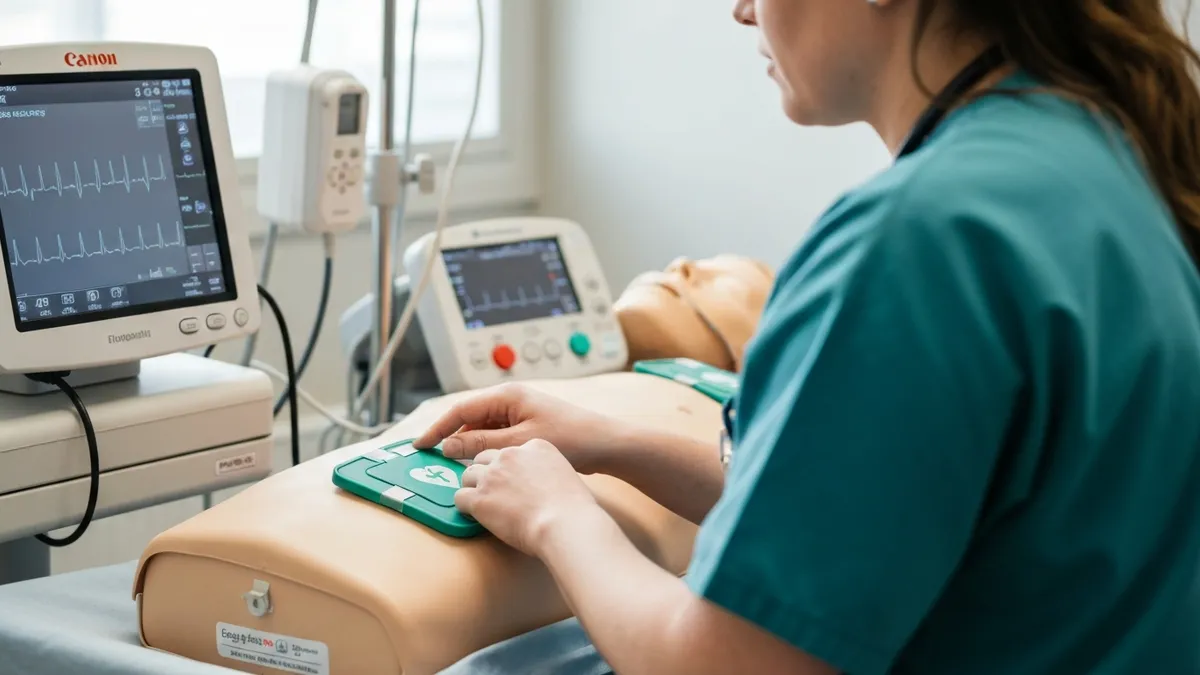
Certain errors result in immediate megacode failure regardless of overall performance: delivering an unsynchronized shock when cardioversion is indicated, administering a drug at the wrong dose by a factor greater than twofold, interrupting CPR for more than ten seconds outside of a rhythm check or shock delivery, or failing to recognize return of spontaneous circulation when clearly prompted. Know these triggers by name and practice specifically to avoid them — one critical error overrides an otherwise strong performance.
Building a structured final-week study plan is the difference between candidates who feel prepared walking into the megacode station and those who feel they studied hard but are still uncertain. The week before your course, divide your preparation into four focused phases: knowledge consolidation on days one and two, scenario walkthrough on days three and four, timed full simulations on days five and six, and a light review with deliberate rest on day seven. Each phase has a distinct cognitive purpose, and treating them as a sequence rather than a random mix of activities produces measurably better outcomes.
Days one and two are for closing knowledge gaps identified by your practice quiz performance. Run through the rhythm interpretation and pharmacology quizzes on this page, log every question you answered incorrectly, and trace each error back to a specific algorithm node or drug parameter. Do not re-read the entire ACLS provider manual — target only the sections that correspond to your error pattern. Candidates who spend day one rereading content they already know are misallocating their preparation time. Focused gap-closing is always more efficient than broad review.
Days three and four are for algorithm walkthrough — narrating each of the six scenario types aloud, in order, as if you were briefing a team. Use the AHA algorithm cards as a script check, but cover them after each step and see whether you can generate the next step from memory before uncovering the answer. This technique, called successive approximation, strengthens the neural pathway for each algorithm branch more effectively than reading because it forces active retrieval rather than passive recognition.
Days five and six are for timed full simulations. Recruit a study partner, shuffle the scenario cards, set a 20-minute timer, and run each scenario from patient presentation through ROSC or scenario termination without stopping. Your partner plays the evaluator, noting every verbal order you give and every timing element you miss. After each simulation, spend five minutes debriefing the errors before moving to the next scenario. Two full simulation sessions across these two days — covering all six scenarios at least once each — is the minimum effective dose for consolidating procedural fluency.
Day seven is intentionally light. Review your notes from the simulation debriefs, skim the algorithm one-pagers, and run through the pharmacology flashcards once. Beyond that, let your brain consolidate what it has absorbed during the prior six days. Sleep is the primary mechanism of procedural memory consolidation in adults, and the research on test performance consistently shows that candidates who sacrifice sleep for last-minute cramming underperform relative to those who sleep a full seven to eight hours before a high-stakes evaluation.
On the morning of your course, arrive with your pocket reference card but commit to not needing it during the megacode itself. Having the card is a backup that reduces anxiety; relying on it during the scenario signals to the evaluator that your knowledge is card-dependent rather than internalized.
Before the scenario begins, take three slow breaths, mentally rehearse the opening sequence — check responsiveness, call for help, start CPR, attach monitor — and remind yourself that you have practiced this dozens of times. The evaluator is looking for competence, not perfection, and a calm, systematic team leader who catches and corrects their own errors passes more reliably than a nervous candidate who executes every step correctly but communicates poorly.
After your ACLS certification, consider building a quarterly megacode review practice into your professional schedule even though the two-year renewal cycle does not require it. Resuscitation skills decay measurably within six months of training according to multiple AHA-commissioned studies, and the candidates who perform best at renewal are almost always those who maintained some level of deliberate practice between certification cycles. Free online quiz tools and printable scenario cards make low-cost quarterly refreshers entirely practical for any healthcare professional, regardless of clinical setting or schedule constraints.
Practical preparation tips for the ACLS megacode begin with a principle that experienced ACLS instructors emphasize consistently: practice out loud, not in your head. Silent review of algorithms activates recognition memory, which feels like knowledge but performs poorly under the cognitive load of a live simulation. Verbalizing every step — even when practicing alone — activates the same speech-production and sequencing circuits you will use during the actual evaluation, producing stronger transfer to the high-pressure scenario environment.
Build a physical practice kit that mirrors what you will encounter in the megacode station. Print all six scenario cards from the AHA provider manual or equivalent resource, print the cardiac arrest and peri-arrest algorithm one-pagers, and write each critical drug order on a separate index card. Use these physical props during your simulation sessions to build the visual associations that help you locate information quickly when stress narrows your attentional field. The tactile habit of reaching for the scenario card and scanning the patient handoff builds a physical routine that reduces cognitive load during the real evaluation.
Drug dose recall is most reliable when organized around a small number of anchor doses rather than a long list of individual medications. The two primary anchor doses in ACLS are epinephrine 1 mg and amiodarone 300 mg, both given IV/IO in pulseless arrest. Every other dose in the algorithm can be organized relative to these anchors: atropine is one-half of epinephrine (0.5 mg), adenosine is six times atropine (6 mg), and the second amiodarone dose is half the first (150 mg). Building this relational map reduces the memory load from ten separate facts to two anchors plus four ratios.
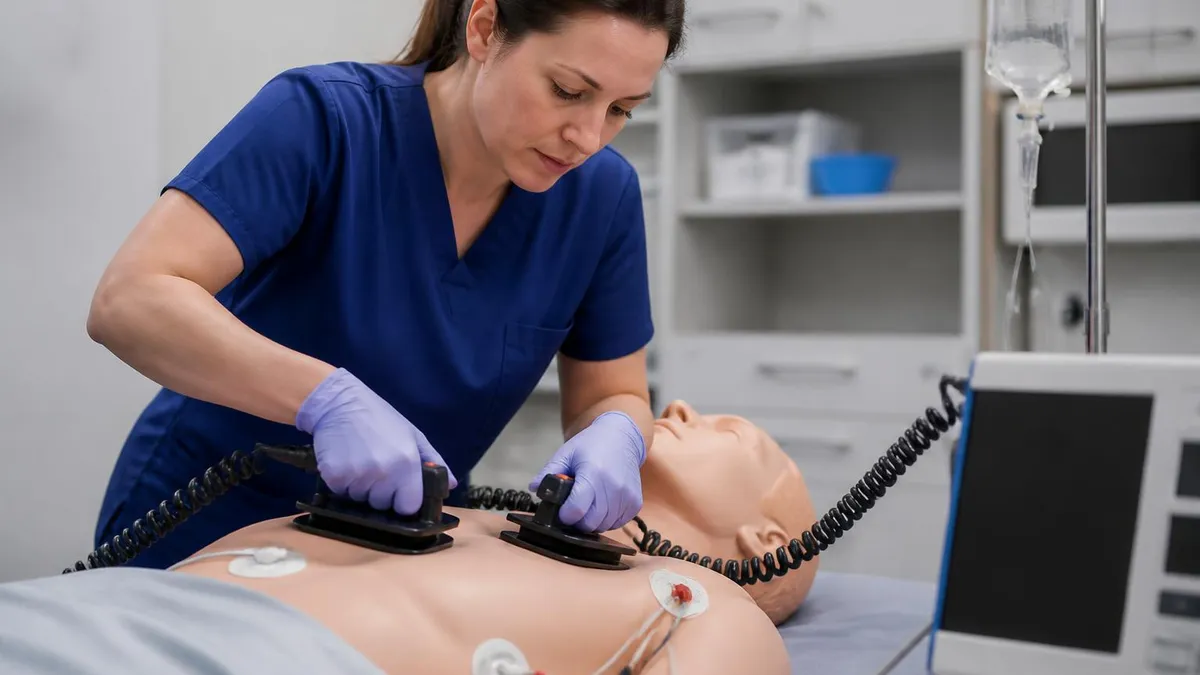
Practice the defibrillator workflow as a physical sequence even if you cannot access a real device. Verbalize each step: power on, attach pads, select energy level, charge, confirm "everyone clear," deliver shock, immediately resume CPR.
The word "immediately" matters — AHA data shows that post-shock pauses of even five to ten seconds significantly reduce the probability of achieving ROSC, and the reflex to resume compressions the instant the shock is delivered must be conditioned through repetition, not just understood intellectually. If your training facility has a practice defibrillator or AED trainer, request access for at least two sessions before your course.
The post-ROSC management sequence is an often-neglected segment of megacode preparation because candidates assume the scenario ends at ROSC. In many evaluations it does not — the evaluator transitions immediately to post-cardiac arrest care questions: target temperature management, permissive hypercapnia versus normocapnia, blood pressure targets, and immediate cath lab activation for suspected STEMI.
Know the key post-ROSC targets: SpO₂ 94 to 98%, PaCO₂ 35 to 45 mmHg, systolic blood pressure above 90 mmHg, and targeted temperature management between 32 and 36 degrees Celsius for patients who remain comatose after ROSC. Verbalizing these targets during your simulation practice adds a final-phase competency that distinguishes outstanding megacode performances from merely passing ones.
Peer practice groups dramatically accelerate megacode preparation relative to solo study. If your workplace or training facility can organize even two or three colleagues into a weekly practice session in the four weeks before your course, the return on that investment is substantial. Peer evaluators notice errors you cannot see in yourself, the social pressure of performing in front of colleagues mimics evaluator stress at a lower intensity, and the act of playing the evaluator role yourself deepens your own algorithm knowledge by forcing you to track multiple concurrent elements of another person's performance.
Finally, remember that the ACLS megacode is designed to be passed by prepared candidates — it is not designed to trick or fail you. The AHA publishes the algorithms, the scenario types, and the critical performance criteria in advance precisely because the goal is to verify competence, not to expose gaps. Candidates who approach the megacode with thorough preparation, realistic simulation practice, and a calm systematic mindset pass at high rates.
The preparation system outlined in this article — quiz-based knowledge building, scenario walkthrough, timed simulation, and structured final-week scheduling — is aligned with how the brain actually consolidates procedural skill, and following it consistently over four to six weeks is sufficient preparation for the vast majority of candidates regardless of their baseline clinical experience.
ACLS Questions and Answers

2025 ACLS Changes: Complete Guide to Updated Guidelines, Algorithms & Certification Requirements

ACLS Acute Coronary Syndrome Algorithm: Complete Study Guide for Certification Prep
ACLS Renewal Class: Complete 2026 Guide to Recertification Requirements, Costs, Formats & Pass Strategies
ACLS Bradycardia Algorithm: Complete 2026 Guide to Recognition, Treatment Steps & Drug Doses

ACLS CPR Certification: Complete Training Guide for Healthcare Professionals
About the Author

Registered Nurse & Healthcare Educator
Johns Hopkins University School of NursingDr. Sarah Mitchell is a board-certified registered nurse with over 15 years of clinical and academic experience. She completed her PhD in Nursing Science at Johns Hopkins University and has taught NCLEX preparation and clinical skills courses for nursing students across the United States. Her research focuses on evidence-based exam preparation strategies for healthcare certification candidates.