
How Much Does a ServSafe Test Cost? Complete Pricing Guide 2026 October
How much does a ServSafe test cost? 🎓 Full breakdown of exam fees, manager vs handler prices, renewal costs & how to save money in 2026 October.
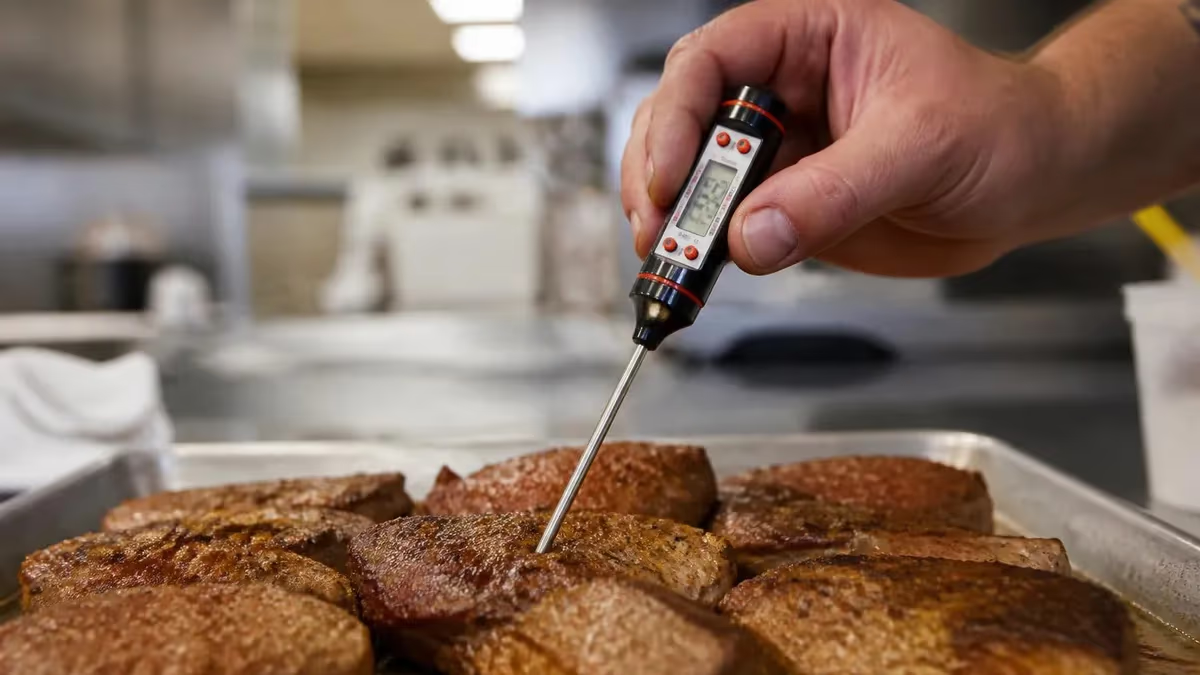
If you are asking how much does a ServSafe test cost, the short answer is that the ServSafe Manager exam fee runs between $36 and $179 depending on whether you purchase the exam alone, bundle it with a textbook, or take a proctored in-person session. Understanding the full pricing structure before you register can save you a significant amount of money and help you choose the right study path. Taking a quality servsafe practice test 2026 before exam day is one of the smartest investments you can make alongside the registration fee.
ServSafe is the food safety certification program administered by the National Restaurant Association Educational Foundation (NRAEF). It is widely recognized across all 50 states and is required by law in many jurisdictions for anyone working as a food service manager, food handler, or alcohol server. Because the certification is tied to public health regulations, employers take it seriously, and state health departments often mandate it as a condition for operating a licensed food establishment.
The ServSafe Manager certification is the flagship credential and carries the highest cost, but it is also the most valuable. The exam consists of 90 multiple-choice questions covering food safety principles, temperature control, personal hygiene, cross-contamination prevention, cleaning and sanitation, and pest management. Passing requires a score of at least 75 percent, which means you need to answer at least 56 of the 80 scored questions correctly. The higher price point reflects the rigor and industry recognition of the credential.
For food handlers who need a more basic certification, ServSafe offers a Food Handler certificate program that is considerably less expensive. Food handler programs typically cost between $15 and $22 per person when purchased through an employer or training provider, and the exam is shorter and less comprehensive than the manager-level assessment. Many employers cover this cost as part of onboarding, making it essentially free for hourly workers in many restaurant chains and food service operations.
Beyond the base exam fee, there are additional costs you should budget for. If you want the official ServSafe textbook and study materials, that adds roughly $50 to $100 to your total investment. Proctored exam sessions, which are required in certain states, may involve a proctor fee ranging from $10 to $35 per candidate. Some testing centers also charge a facility fee. When you add everything up, total out-of-pocket costs for the ServSafe Manager path can range from as little as $36 for a standalone online exam to over $200 for a full instructor-led course with materials.
Fortunately, there are legitimate ways to reduce what you pay. Many community colleges, culinary schools, and restaurant associations offer subsidized ServSafe training at a fraction of the retail price. Some states have workforce development grants that cover certification costs entirely for qualifying workers. Additionally, free online practice resources and servsafe test answers study tools let you build your knowledge before spending money on official prep materials, ensuring you pass on the first attempt and avoid costly retakes.
This comprehensive pricing guide breaks down every fee you might encounter, compares purchasing options, explains the difference between handler and manager exam costs, and gives you a clear roadmap for minimizing your expenses while maximizing your chances of passing the ServSafe test on your first try.
ServSafe Test Cost by the Numbers
Key Facts at a Glance
| Item | Value | Details |
|---|---|---|
| Manager Exam Fee Range | $36–$179 | Exam only vs. full bundle |
| Questions on Manager Exam | 90 | 75% passing score required |
| Certification Valid Period | 5 Years | Renewal required after expiry |
| Food Handler Program Cost | $15–$22 | Often employer-covered |

ServSafe Exam Fee Breakdown by Product Type
The single most important cost decision you will make is choosing between the ServSafe Manager exam and the ServSafe Food Handler certificate. These two credentials serve different purposes, target different job roles, and carry very different price tags. Understanding which one applies to your situation can prevent you from overpaying for a certification you do not legally need or, conversely, underpaying and ending up with a credential that does not satisfy your employer or state health department requirements.
The ServSafe Manager certification is designed for supervisors, shift leads, kitchen managers, executive chefs, and anyone responsible for overseeing food safety practices in a commercial kitchen or food service establishment. At the manager level, you are accountable not just for your own food handling practices but for the practices of everyone on your team. The exam tests a correspondingly deeper level of knowledge, which is why the NRAEF prices it higher and why preparation through a reliable servsafe manager practice test is strongly recommended before test day.
The ServSafe Food Handler program, by contrast, is aimed at line cooks, servers, prep cooks, dishwashers, and other front-line food service workers who handle food as part of their duties but are not responsible for managing others. The food handler assessment covers basic hygiene, cross-contamination prevention, and safe temperature practices at a high level, rather than the detailed food safety management systems covered in the manager exam. Because the content is less complex, the cost is substantially lower.
Many states have specific laws that dictate which certification level is required for which job type. California, for example, requires all food handlers to hold a food handler card, which can be obtained through the ServSafe Food Handler program or through several state-approved alternative programs. Other states, such as Illinois and Texas, require at least one certified food protection manager on duty at all times in a food service establishment, which means the manager-level exam is not optional for those operations. Always check your specific state and local requirements before choosing which exam to purchase.
For those who need the SerSafe Manager certification, the cost difference between purchasing just the exam versus purchasing a full bundle with study materials is a critical financial decision. The standalone online exam at approximately $36 is attractive from a cost perspective, but it assumes you already have the knowledge to pass without additional preparation. Studies and anecdotal reports from food service professionals consistently show that candidates who attempt the manager exam without structured study materials have a significantly lower pass rate than those who invest in a course or textbook.
Bundled packages that combine the textbook, online study course, and proctored exam session represent the best value for most first-time candidates. While the upfront cost is higher at $130 to $179, you get access to the official study materials that mirror what will actually appear on the exam. The ServSafe Manager 7th Edition textbook, for example, includes practice exams, chapter quizzes, and detailed explanations of every topic area.
When you factor in the cost of a retake if you fail (typically $36 for another exam attempt), paying more upfront for better preparation often saves money in the long run. You can also find servsafe test 90 questions and answers pdf free resources to supplement your official study materials at no additional cost.
Employer sponsorship is another dimension of the cost equation that many candidates overlook. Large restaurant chains, hotel groups, and institutional food service operations frequently pay for ServSafe Manager certification for their key employees because a certified manager on staff is both a legal requirement and a liability protection measure. If you are currently employed in food service, it is absolutely worth asking your HR department or direct manager whether the company has a policy for reimbursing or covering certification costs before you pay out of pocket.
ServSafe Test Prep Options: Online, In-Person & Self-Study
The online self-paced ServSafe Manager course is the most flexible and often the most affordable route. You access all course materials through the NRAEF website and work through modules at your own pace over a period of up to 180 days. The online course covers all eight exam domains including safe food handling, purchasing and receiving, storage, preparation, service, facilities and equipment, cleaning, and pest management.
The proctored online exam can be taken from home using a webcam and a secure browser, which eliminates the need to travel to a testing center. This format typically costs between $36 and $99 depending on whether you add the online study course. For candidates with prior food service experience, the self-paced online option is often sufficient preparation for passing the servsafe manager exam on the first attempt.
ServSafe Manager Certification: Is the Cost Worth It?
- +Nationally recognized credential accepted by health departments in all 50 states
- +Required by law for food service managers in many high-population states including Illinois, Texas, and California
- +Demonstrates professional commitment and can support salary negotiations and promotions
- +Certification is valid for five years, making the per-year cost very low relative to the career benefit
- +Employer sponsorship is common, meaning you may pay nothing out of pocket
- +Passing score improves food safety practices that protect customers and reduce liability exposure
- −Upfront exam cost of $36 to $179 is a significant expense for hourly food service workers
- −The 90-question exam has a reported first-time pass rate of around 54 percent, meaning retake costs are common
- −Official study materials from NRAEF add $50 to $100 to the total investment if purchased separately
- −Proctored exam sessions require scheduling in advance and may involve travel to an approved testing center
- −Certification must be renewed every five years at additional cost, creating a recurring expense
- −Not all states accept ServSafe as the sole approved certification, so some candidates may need a second credential
ServSafe Manager Exam Preparation Checklist
- ✓Confirm whether your state or local health department requires the ServSafe Manager certification specifically or accepts alternative programs
- ✓Ask your employer whether they will reimburse or cover the exam fee before paying out of pocket
- ✓Choose your exam format: standalone online, online course bundle, or instructor-led class with proctored exam
- ✓Purchase or download the official ServSafe Manager 7th Edition textbook or access the online study course
- ✓Take at least two full-length 90-question servsafe manager practice tests to establish your baseline score
- ✓Identify your three weakest topic areas based on practice test performance and dedicate extra study time to them
- ✓Review the ServSafe temperature charts, including the temperature danger zone (41°F to 135°F), thoroughly
- ✓Schedule your exam at least two weeks out to allow adequate preparation time and secure your preferred time slot
- ✓Verify all identification documents and exam requirements at least 48 hours before your scheduled test date
- ✓Complete at least one full timed practice test under real conditions the night before your exam to build confidence
Retakes Cost Money — Prepare Before You Pay
The ServSafe Manager exam retake costs the same as the original attempt — typically $36 to $50 for the exam fee alone. Candidates who fail and retake twice end up paying more than the full bundle price. Investing in quality study materials upfront almost always costs less than paying for two or three exam attempts.
Saving money on your ServSafe certification does not mean cutting corners on preparation. There are several legitimate strategies that reduce your out-of-pocket costs without compromising your readiness for the exam. The most impactful of these strategies involve timing your purchase correctly, using free practice resources strategically, and exploring employer and institutional support programs that most candidates are simply unaware of.
The first and most reliable cost-saving move is to use free online practice tests extensively before you spend any money on official materials. High-quality free servsafe manager practice tests allow you to assess your current knowledge level honestly and determine how much study you actually need. If your baseline practice score is already above 75 percent, you may be able to pass the exam with minimal investment in study materials. If your score is below 60 percent, you know that investing in the full textbook and course bundle is worth every penny.
Promotional codes and seasonal discounts are another underutilized avenue for savings. The NRAEF and authorized training providers periodically offer discounts of 10 to 20 percent on ServSafe products, particularly at the beginning and end of the calendar year when food service businesses are doing staff training and certification cycles. Signing up for the NRAEF newsletter and following ServSafe on social media can alert you to these discount windows before they expire. Restaurant industry associations at the state and local level also negotiate group pricing for members that can reduce per-person costs significantly.
Community colleges and workforce development programs represent another excellent cost-reduction pathway. Many community colleges offer ServSafe Manager courses through their continuing education departments at subsidized rates, sometimes as low as $50 to $75 for the complete course including materials and exam. Some states have workforce development grants available through their labor departments that can cover the entire cost of food safety certification for qualifying workers, particularly those who are unemployed, underemployed, or transitioning into the food service industry.
Group training is worth exploring if you work in a supervisory role or own a food service business. When five or more employees need ServSafe Manager certification at the same time, many authorized instructors and training centers offer group pricing that reduces the per-person cost by 20 to 35 percent compared to individual registration. The total savings can be substantial for a restaurant that needs to certify multiple managers simultaneously to comply with local health code requirements.
Digital and used textbook options can also meaningfully reduce your preparation costs. The ServSafe Manager textbook is available in both print and digital PDF formats. The digital version is typically $20 to $30 cheaper than the print edition and is available immediately upon purchase. Previous editions of the textbook (6th edition vs. 7th edition) are available used for very low prices, though you should be aware that some content may have been updated.
The core principles of food safety have not changed dramatically between editions, so a used 9th edition textbook combined with free online practice tests covering current exam content can be a cost-effective approach for budget-conscious candidates. You can find additional servsafe exam practice questions that cover the exact temperature and food handling topics tested on the manager exam without any additional cost.
Finally, do not overlook the potential tax deductibility of your ServSafe certification costs. If you are self-employed as a caterer, personal chef, or independent food service contractor, the cost of maintaining required professional certifications — including ServSafe — may be deductible as a business expense. Consult with a tax professional about your specific situation, but for eligible candidates this can effectively reduce the real cost of certification by 15 to 25 percent depending on your tax bracket.
Only purchase ServSafe exams and study materials through the official NRAEF website or an authorized training provider. Unauthorized third-party sellers on marketplaces like eBay or Amazon may offer exam vouchers or answer keys that are fraudulent, expired, or invalid. Using a fraudulent exam voucher can result in a denied test attempt with no refund, and purchasing unofficial answer keys violates exam integrity policies and can lead to certification denial.
Once you have budgeted for and purchased your ServSafe Manager exam, the focus shifts entirely to passing on your first attempt and making the most of your investment. The ServSafe Manager exam is a genuinely challenging assessment, and the 54 percent first-time pass rate means nearly half of all candidates need to retake it. Understanding what the exam actually tests — and what study strategies are most effective — is essential for maximizing your return on the money you have already spent.
The ServSafe Manager exam covers eight major content domains, and they are not weighted equally. The highest-weighted domain is Purchasing and Receiving Safe Food, which accounts for approximately 15 percent of exam questions. Safe Facilities, Equipment, and Pest Management and Food Safety Regulations each account for around 10 to 12 percent. Understanding which domains carry the most weight allows you to allocate your study time proportionally rather than spending equal time on all topics regardless of their importance to your final score.
Temperature control is one of the most frequently tested concepts on the servsafe manager exam and also one of the most memorization-intensive.
You will need to know the temperature danger zone (41°F to 135°F), safe minimum cooking temperatures for all major protein types (165°F for poultry, 155°F for ground meats, 145°F for whole cuts of pork and fish), proper refrigerator storage temperatures (41°F or below), and the two-stage cooling method (from 135°F to 70°F within two hours, then from 70°F to 41°F within an additional four hours). These numbers appear on the exam repeatedly in different scenarios, and knowing them precisely is non-negotiable for a passing score.
The servsafe manager sample test format includes scenario-based questions that present a situation in a restaurant or food service setting and ask you to identify the food safety violation, the correct corrective action, or the applicable regulatory standard. These questions require you to apply knowledge rather than simply recall facts, which is why passive reading of the textbook is insufficient preparation.
Active practice with realistic multiple-choice questions that mirror the exam format is the most effective study method, and it is also the most time-efficient approach for busy food service professionals who need to fit certification study into limited personal time.
Time management during the actual exam matters more than most candidates expect. The ServSafe Manager exam is not strictly timed per question, but the overall session typically runs about three hours. With 90 questions to answer in that window, you have an average of two minutes per question. Scenario-based questions with longer stems can take three to four minutes to read and analyze carefully, which means you need to move through the simpler factual recall questions more quickly to compensate. Practicing with timed mock exams builds the pacing instincts that help you manage the clock effectively on test day.
After the exam, results are typically available immediately for the online proctored format and within a few days for instructor-led classroom exams that use paper answer sheets. If you pass, your ServSafe Manager certification is valid for five years from the date of the exam, after which you must complete a renewal exam. If you do not pass, you can retake the exam after a mandatory waiting period, which varies by testing format.
Most formats allow retakes after 24 hours for the first retake, but require a longer waiting period for subsequent attempts. Use the waiting period productively by reviewing your weak areas using free servsafe manager practice tests to identify exactly where your knowledge gaps are before spending money on another exam attempt. You can also access comprehensive servsafe test answers resources to understand the reasoning behind correct answers, not just memorize the answers themselves.
The ServSafe certification process, despite its cost and rigor, represents one of the best returns on investment available in the food service industry. A certified food protection manager commands higher pay, enjoys greater job security, and has a broader range of employment opportunities across restaurants, hospitals, schools, hotels, and catering operations. For many food service professionals, the certification pays for itself within the first month of employment at a higher wage or in a management role that requires the credential.
Building a practical, week-by-week study schedule is the single most effective thing you can do after registering for the ServSafe Manager exam. Candidates who study consistently over four to six weeks consistently outperform those who attempt to cram all the material into a single marathon session over a weekend. The brain retains food safety concepts — temperatures, time parameters, regulatory thresholds — much more reliably through spaced repetition than through cramming, and the scenario-based question format rewards genuine comprehension rather than superficial familiarity with facts.
In weeks one and two of your study plan, focus on the foundational chapters of the ServSafe curriculum: the basics of foodborne illness, the major biological, chemical, and physical hazards, and the principles of a HACCP (Hazard Analysis Critical Control Point) system. These chapters provide the conceptual framework that makes everything else in the curriculum make sense. Understanding why temperature control matters — because bacterial pathogens like Salmonella and E. coli thrive between 41°F and 135°F — makes it far easier to remember the specific temperature rules than trying to memorize them in isolation.
In weeks three and four, shift your focus to the operational chapters that cover receiving and storage, food preparation, service, and facility management. These chapters are the most scenario-heavy and require you to visualize realistic food service situations. Work through the practice questions at the end of each chapter in the ServSafe textbook, and for every question you miss, read the explanation carefully and note the principle behind the correct answer. Building a personal error log of questions you have missed and reviewing it regularly accelerates learning in a way that passive re-reading simply cannot match.
In the final week before your exam, shift entirely to full-length timed practice tests. Take at least two complete 90-question mock exams under real testing conditions — no notes, no phone, timed for 90 minutes to simulate mild time pressure. Review every incorrect answer immediately after each practice test while your reasoning is still fresh. Pay particular attention to questions that you answered correctly by guessing, because those reveal knowledge gaps that could become incorrect answers on the real exam when a question tests the same concept in a slightly different way.
On the day of your exam, arrive early or log in early for online sessions. For in-person exams, bring valid government-issued photo identification and any materials your testing center has specified in the registration confirmation. For online proctored exams, ensure your webcam, microphone, and internet connection are functioning before the session starts and that your testing environment is free of notes and unauthorized materials. The online proctoring software is sophisticated and can flag unusual behavior, so taking the exam in a quiet, distraction-free environment is both a test performance strategy and a compliance requirement.
Post-exam, regardless of whether you pass or need to retake, update your employer and personnel records promptly. A certified food protection manager certificate from ServSafe needs to be posted or available for inspection in many jurisdictions, and your employer's HR file should reflect your current certification status.
If your certification is approaching its five-year expiration, start preparing for renewal at least 60 days out to avoid a lapse that could put your employer out of compliance with local health regulations. The renewal exam covers the same content as the initial exam and costs roughly $30 to $50, making it a much smaller investment than the original certification.
The food safety knowledge you gain through ServSafe preparation extends well beyond the exam itself. Understanding HACCP principles, temperature danger zones, allergen management, and cross-contamination prevention makes you a genuinely safer, more competent food service professional. The certificate on your wall is valuable — but the knowledge behind it is what actually protects customers, reduces foodborne illness outbreaks, and builds the professional reputation that advances a career in food service over the long term.
Sample ServSafe Practice Questions
Try these questions from our free ServSafe practice tests. The correct answer and an explanation follow each question.
When a server suspects a guest has had too much to drink and may be driving, what is the BEST course of action?
- A. Ignore the situation — it is not the server's responsibility once the guest leaves
- B. Offer to call a taxi, rideshare, or contact a sober companion for the guest
- C. Serve the guest coffee to sober them up before they drive
- D. Notify other guests at the table to handle the situation
Answer: B. Offer to call a taxi, rideshare, or contact a sober companion for the guest
Offering alternative transportation such as a taxi or rideshare is the responsible action. Coffee does not reduce BAC; only time does. The server has a duty of care that extends to preventing the guest from driving intoxicated.
A standard drink is defined as containing how much pure alcohol?
- A. 0.5 ounces
- B. 0.6 ounces
- C. 1.0 ounce
- D. 1.5 ounces
Answer: B. 0.6 ounces
A standard drink contains 0.6 ounces of pure (ethyl) alcohol. This is the baseline used when comparing drinks of different sizes and proofs. A 12 oz beer at 5%, a 5 oz glass of wine at 12%, and 1.5 oz of 80-proof spirits all equate to approximately one standard drink containing 0.6 oz of pure alcohol.
It is the middle of a service and your walk-in refrigerator has broken down. You call the repairman to fix the problem. How much time can the foods in the refrigerator hold (above 41 °F) before you need to throw them away?
- A. 1 hour
- B. 2 hours
- C. 4 hours
- D. 8 hours
Answer: B. 2 hours
If a refrigerator breaks down and food temperatures rise above 41°F (5°C), the food can be held safely for a maximum of two hours. After two hours, if the temperature has not returned to 41°F or below, the food must be discarded to prevent the proliferation of harmful bacteria. This two-hour rule applies to the initial period of temperature abuse before the four-hour total danger zone limit.
What is the purpose of a master cleaning schedule?
- A. To list what, when, and how items are cleaned
- B. To track employee vacation days
- C. To record daily sales totals
- D. To plan the menu rotation
Answer: A. To list what, when, and how items are cleaned
A master cleaning schedule details cleaning tasks, timing, and methods.
ServSafe Questions and Answers


About the Author

Registered Sanitarian & Food Safety Certification Expert
Cornell University College of Agriculture and Life SciencesThomas Wright is a Registered Sanitarian and HACCP-certified food safety professional with a Bachelor of Science in Food Science from Cornell University. He has 17 years of experience in food safety auditing, regulatory compliance, and foodservice management training. Thomas prepares food industry professionals for ServSafe Manager, HACCP certification, and state food handler examinations.
Join the Discussion
Connect with other students preparing for this exam. Share tips, ask questions, and get advice from people who have been there.
View discussion (7 replies)