
How Long Does the ServSafe Manager Course Take? Complete Training Guide
How long does the ServSafe manager course take? Full training guide with exam tips, study schedules & free ServSafe practice test resources. ✅
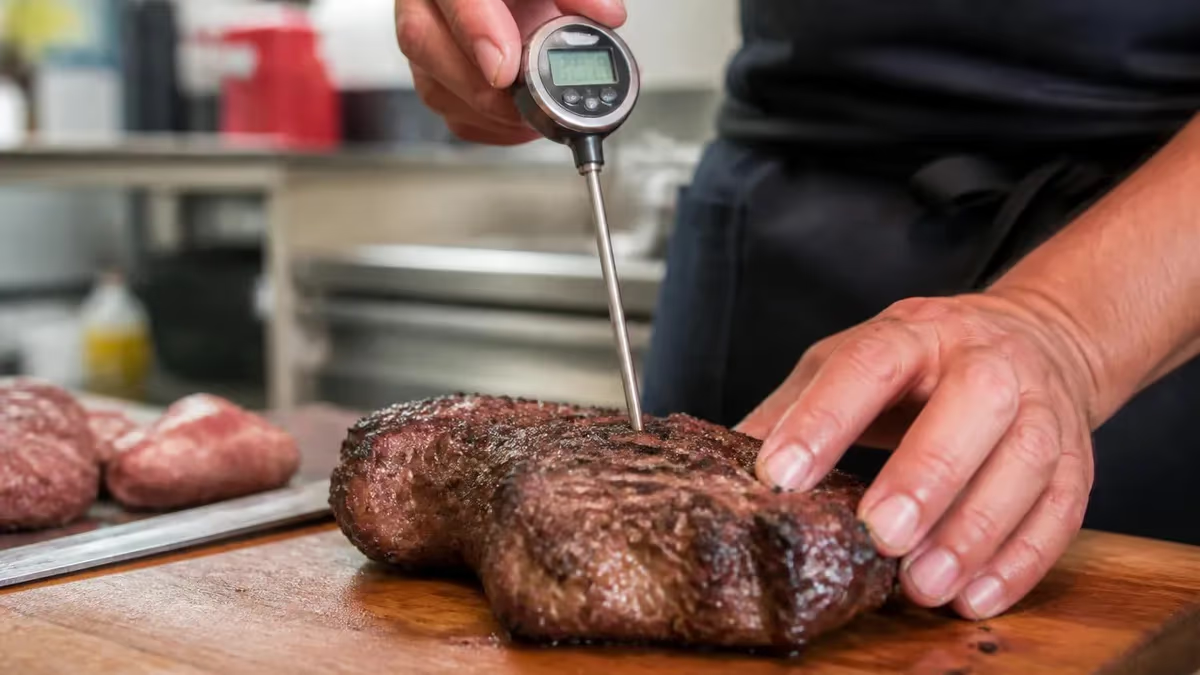
If you're wondering how long does the ServSafe manager course take, the short answer is that the training itself typically runs 8 to 15 hours depending on the format you choose, while the full journey from enrollment to certification — including study time and the proctored exam — usually takes one to three weeks.
The ServSafe Manager program, developed by the National Restaurant Association Educational Foundation (NRAEF), is the gold standard for food safety certification across the United States, and understanding the time commitment up front helps you plan your schedule without surprises. Taking a quality servsafe exam answers resource early in your studies pays dividends on exam day.
The ServSafe Manager course is designed specifically for food service supervisors, executive chefs, kitchen managers, and anyone responsible for overseeing food safety practices in a commercial setting. Unlike the entry-level Food Handler certificate — which can be completed in as little as 90 minutes — the Manager certification demands deeper knowledge of microbiology, HACCP principles, regulatory compliance, and employee supervision. This elevated complexity is reflected in both the study hours required and the difficulty of the final 90-question proctored exam, which demands a score of 75 percent or higher to pass.
Most candidates who enroll in an instructor-led classroom course spend between two and four days in training, with sessions running roughly four to six hours each. Online self-paced options let you absorb the same content over a flexible window of one to two weeks, making them popular with working professionals who cannot commit to consecutive classroom days. Hybrid formats combine pre-work online modules with a single half-day in-person review session before the exam, compressing the total calendar time while maintaining comprehensive coverage of all tested domains.
Preparation quality matters far more than raw hours. Research consistently shows that candidates who supplement official course materials with a dedicated servsafe manager practice test perform significantly better than those who rely on the textbook alone. Practice tests expose you to the phrasing style of real exam questions, reveal knowledge gaps while there is still time to address them, and build the test-taking stamina needed for a 90-question timed assessment. Many successful candidates run through at least three to five full practice exams during the week before their test date.
The exam itself is administered either in a classroom setting immediately after an instructor-led course or at a separately scheduled proctored testing event. When taken in the classroom, the exam adds roughly two additional hours to your final course day. If you schedule a separate proctored session, you will need to factor in that appointment when mapping out your overall timeline. Either way, plan for results to be available within a few days, after which ServSafe will mail your certificate and your employer receives notification of your passing status.
Throughout this article we will walk you through the full structure of the ServSafe Manager course, break down what each training format looks like in practice, explain exactly what the 90-question exam covers and how it is scored, share a realistic study schedule you can follow regardless of your starting knowledge level, and point you toward the best free and paid servsafe test prep resources available today. Whether you have two weeks or two months before your exam date, this guide gives you a clear action plan for earning your certification on the first attempt.
ServSafe Manager Course by the Numbers

ServSafe Manager Course: Recommended Study Schedule
- ▸Read ServSafe Manager textbook chapters 1–4 (The Importance of Food Safety, Microbiology, Contamination, Allergens)
- ▸Watch official ServSafe online module videos for each chapter
- ▸Complete chapter review questions at the end of each section
- ▸Take one 90-question servsafe manager practice test to establish a baseline score
- ▸Flag every question you answered incorrectly and note the chapter reference
- ▸Read chapters 5–9 (Purchasing, Receiving, Storage, Preparation, Service)
- ▸Study the temperature danger zone chart until it is fully memorized (41°F–135°F)
- ▸Review HACCP principles and practice identifying critical control points
- ▸Take a second full-length servsafe manager sample test and target 80%+ score
- ▸Review all wrong answers and re-read the relevant textbook sections
- ▸Complete chapters 10–15 (Cleaning and Sanitizing, Building and Equipment, Pest Management, Food Safety Management Systems, Food Safety Regulations)
- ▸Take two timed, full-length practice exams under exam conditions
- ▸Review the ServSafe Manager Study Guide summary at the end of each chapter
- ▸Schedule and sit your proctored ServSafe Manager exam
- ▸Submit paperwork to your employer and state health department as required
The ServSafe Manager exam is structured around nine core content domains drawn directly from the ServSafe Manager textbook, and understanding what each domain covers helps you allocate your study time intelligently. The most heavily weighted areas are the Flow of Food (Purchasing, Receiving, Storage, Preparation, and Service), which together account for roughly 40 percent of exam questions, and Food Safety Management Systems (primarily HACCP), which typically drives another 10 to 15 percent of the test. Candidates who focus first on these two clusters tend to see the fastest improvement in their servsafe manager test scores.
The microbiology domain — covering bacteria, viruses, parasites, and fungi responsible for foodborne illness — is deceptively challenging because it requires memorization of specific pathogens, their sources, symptoms they cause, and the temperatures or conditions that prevent their growth.
Questions in this domain often present real-world scenarios in which a kitchen employee makes a decision (such as thawing chicken on the counter overnight) and ask you to identify the specific danger. The ability to connect abstract microbiological concepts to everyday kitchen situations is exactly the skill that separates candidates who pass on the first attempt from those who need a retake.
The allergen management section has grown significantly in recent ServSafe updates and now includes questions on the eight major food allergens recognized by the FDA, cross-contact prevention protocols, how to communicate with guests who have dietary restrictions, and the responsibilities of managers when staff members handle allergenic ingredients. If you are preparing for a servsafe test 90 questions and answers pdf free download, pay careful attention to the allergen chapters — this is a domain where many candidates lose preventable points by underestimating its weight.
Cleaning and sanitizing is another domain that trips up test-takers who spend too little time on it. The exam distinguishes sharply between cleaning (removing visible soil) and sanitizing (reducing pathogens to safe levels), and questions will test your knowledge of correct sanitizer concentrations for chlorine, iodine, and quaternary ammonium compounds, appropriate contact times, water temperature requirements, and the proper sequence of steps in a three-compartment sink setup. Memorizing these specific numbers — for example, chlorine sanitizer effective between 50 and 100 parts per million — is essential because the exam tests exact figures rather than general concepts.
Pest management, facility design, and food safety regulations round out the remaining content. While these domains carry less individual weight than Flow of Food questions, they contain highly specific details — like the correct gap clearance under exterior doors to prevent rodent entry, or which federal agencies share jurisdiction over food safety — that appear regularly as exam questions.
The best approach is to read these chapters carefully once, create brief flashcards for the specific numbers and agency names, and review them during the final few days before your exam rather than trying to memorize everything weeks in advance when it may fade.
One often-overlooked dimension of servsafe test prep is understanding how exam questions are constructed. ServSafe questions are almost always scenario-based, presenting a realistic kitchen situation and asking which action a manager should take, which hazard is most serious, or what regulatory requirement applies. This means that rote memorization alone is insufficient — you must be able to apply knowledge to novel situations.
The best way to build this skill is through repeated exposure to practice questions, especially those that explain why wrong answers are wrong, not just why correct answers are correct. Understanding the reasoning behind each answer choice transforms passive memorization into active, applicable knowledge.
To supplement your textbook study, consider reviewing the most current edition of the FDA Food Code, which ServSafe aligns its content with, particularly for temperature regulations and employee health policies. Topics like when an ill employee must be excluded from work versus when they can be restricted to non-food-contact duties appear regularly on the exam and reflect real regulatory distinctions that managers must understand. Candidates who read even a few chapters of the FDA Food Code in addition to their ServSafe textbook often find that exam questions suddenly feel much more intuitive rather than arbitrary.
ServSafe Manager Test Prep: Training Format Comparison
Instructor-led classroom courses are the most structured way to complete your ServSafe Manager training and typically run two to three consecutive days of four to six hours each. You receive real-time answers to questions, benefit from group discussions that reinforce difficult concepts, and often take the proctored exam on the final day of class, condensing your entire certification timeline into a single week. Many local health departments, community colleges, and restaurant associations offer these sessions at low or no cost.
The main downside of classroom training is scheduling inflexibility — sessions run on fixed dates that may not align with your work schedule, and missing even one day can set you back significantly. That said, studies of ServSafe pass rates consistently show that candidates who complete instructor-led courses outperform self-study candidates by a measurable margin, largely because direct instruction helps clarify the scenario-based question style before exam day arrives. If your schedule permits, this format gives you the strongest foundation for a first-attempt pass.

Online vs. Classroom ServSafe Manager Course: Which Is Right for You?
- +Online courses let you study at your own pace and revisit difficult modules without time pressure
- +Classroom courses provide real-time instructor feedback and peer discussion that clarifies confusing exam scenarios
- +Online format eliminates commute time and allows study from any location with internet access
- +Classroom format keeps you accountable with fixed session dates and built-in exam scheduling
- +Online courses can be paused and resumed across multiple weeks for shift workers with irregular schedules
- +Instructor-led courses have statistically higher first-attempt pass rates due to structured exam skill-building
- −Online self-paced learners frequently delay scheduling their exam, extending the total certification timeline
- −Classroom sessions require consecutive days off work that kitchen managers may find difficult to arrange
- −Online learners miss out on the group Q&A dynamic that helps clarify scenario-based question interpretation
- −Classroom course seats fill up quickly in high-demand urban markets, sometimes requiring weeks of wait time
- −Online format requires strong self-discipline — candidates without study routines often underperform on the exam
- −In-person classroom proctoring environments can feel high-pressure for candidates not accustomed to formal testing settings
ServSafe Manager Exam Readiness Checklist
- ✓Complete all chapters of the current ServSafe Manager textbook (7th Edition) before your exam date.
- ✓Score 80% or higher on at least three full-length servsafe manager practice tests before sitting the real exam.
- ✓Memorize the temperature danger zone (41°F–135°F) and all critical cooking temperature thresholds.
- ✓Review the eight major food allergens and the correct response protocol for an allergic guest reaction.
- ✓Study the three-compartment sink procedure including correct sanitizer concentration ranges for all approved sanitizer types.
- ✓Learn the five CDC risk factors for foodborne illness and which ServSafe policies address each one.
- ✓Confirm your exam appointment date, location, and acceptable photo ID requirements at least one week in advance.
- ✓Practice reading ServSafe questions slowly — identify the scenario type (hazard, procedure, or regulation) before choosing an answer.
- ✓Review the employee health policy chapter, including exclusion versus restriction criteria for specific illnesses.
- ✓Get adequate sleep the night before the exam — fatigue significantly reduces performance on scenario-based comprehension questions.
The 80% Practice Test Rule
Industry data from ServSafe training providers shows that candidates who consistently score 80% or higher on servsafe manager practice tests before their exam date pass the real certification exam at a rate exceeding 85%. If you are scoring below 75% on practice exams with less than one week remaining before your test, seriously consider rescheduling your exam date to allow additional preparation time — the $36 reschedule fee is far less costly than a failed attempt and full retake.
On the day of your ServSafe Manager exam, knowing exactly what to expect logistically can be just as important as knowing the material. The exam consists of 90 multiple-choice questions and you have two hours to complete it. All questions are drawn from the current ServSafe Manager textbook, and there are no trick questions — every correct answer can be traced back to a specific passage in the study material.
The exam is scored externally by the National Restaurant Association, and you will typically receive your official score within three to four business days, though your proctor may give you an unofficial indication of pass or fail before you leave the testing location.
Understanding the passing threshold is critical. You need to answer at least 68 of the 90 questions correctly — a score of 75 percent — to earn your ServSafe Manager certification. This means you can miss up to 22 questions and still pass, which is reassuring for candidates who feel anxious about the exam.
However, the distribution of questions across content domains means that poor performance in high-weight areas like Flow of Food can make passing much harder even if you excel in lighter domains. Balanced preparation across all nine content areas is genuinely the optimal strategy, not cramming only the chapters you find most interesting.
If you do not pass on your first attempt, you are permitted to retake the exam up to three times within a 60-day period from your original test date, after which you must complete additional training before attempting again. Each retake requires a separate exam fee, currently $36 for the exam-only option when purchased through a training provider. Many candidates who fail once report that their second attempt is dramatically different because they now know exactly which question types felt unfamiliar, and they can focus their additional preparation with surgical precision rather than studying broadly across all nine domains.
Reviewing servsafe manager test answers from official practice materials is the most reliable way to prepare for the specific phrasing and format of real exam questions. The National Restaurant Association designs ServSafe questions to test applied judgment, not vocabulary recall, which means the best answer to a scenario question is always the one that a knowledgeable, safety-conscious manager would choose in real kitchen operations. Candidates who have actual kitchen management experience often find that their practical knowledge aligns well with correct exam answers — the ServSafe exam was designed to validate real-world competence, not just textbook knowledge.
Time management during the exam deserves more attention than most candidates give it. Two hours for 90 questions averages out to approximately 80 seconds per question — enough time to read carefully if you stay focused and avoid overthinking. The most common time-management mistake is spending four or five minutes on a single confusing question early in the exam, which creates stress and compresses time available for later questions.
The recommended strategy is to mark any question you find genuinely uncertain and return to it after completing all questions you feel confident about. You will almost always see flagged questions in a different light after answering the questions that follow them.
After completing all 90 questions, resist the urge to change answers unless you have a specific reason — a recalled fact, a reread of the scenario that reveals you misunderstood it — because first instincts on scenario-based exams are correct more often than anxious second-guessing.
Multiple studies of standardized test performance show that answer changes from a correct response to an incorrect one outnumber changes in the other direction by a ratio of roughly two to one. Trust your preparation, mark your uncertainties, and review them methodically in the final minutes of the allotted time rather than scanning all 90 answers indiscriminately.
One practical tip that experienced ServSafe instructors consistently recommend is arriving at your testing location 15 to 20 minutes early. Late arrivals cause stress spikes that measurably impair performance on the first 10 to 15 questions — exactly the wrong time to be performing below your peak. Bring your photo ID, confirm any materials your proctor permits (scratch paper, a non-programmable calculator), and spend the waiting time doing light breathing exercises or reviewing your temperature chart flashcards rather than anxiously scanning your textbook, which can introduce last-minute doubt about answers you already know confidently.
Your ServSafe Manager certification is valid for exactly five years from the date of your exam. Many states and local health jurisdictions require that at least one certified food protection manager be on duty during all hours of food service operation — an expired certification can trigger inspection violations, fines, or temporary closure orders. Mark your renewal date on your calendar the same day you receive your certificate and begin renewal preparations at least 90 days before expiration to ensure uninterrupted compliance.
Once you hold your ServSafe Manager certification, a new set of professional responsibilities and opportunities opens up. In most states, a certified food protection manager must be identified on the food service establishment's health permit application, and some jurisdictions require that this person be physically present on-site during all hours of operation rather than simply being contactable by phone.
Understanding your state's specific regulatory requirement is important because it determines how your certification is used operationally, not just whether you possess it. Check with your local health department or review your state's food code to confirm the exact requirements that apply to your establishment.
The five-year renewal cycle for ServSafe Manager certification requires that you either retake and pass the current version of the exam or complete an approved continuing education pathway, depending on which options are available in your state at the time of your renewal. Because the ServSafe textbook is updated periodically to reflect changes in the FDA Food Code, the renewal exam may cover content that was not included in your original certification exam — another reason to begin preparing for renewal with fresh study materials rather than relying solely on knowledge from your previous certification cycle.
Many food service professionals use their ServSafe Manager certification as a platform for career advancement into roles such as food safety director, corporate trainer, or health inspector liaison. Some candidates pursue the additional Certified Professional in Food Safety (CP-FS) credential offered by the National Environmental Health Association once they have accumulated sufficient field experience, a credential that commands significantly higher salaries in institutional food service and healthcare dining settings. Your ServSafe certification is most accurately viewed not as a one-time bureaucratic requirement but as the foundation of a professional food safety competency portfolio that grows throughout your career.
From an employer perspective, having multiple ServSafe-certified managers on staff provides operational resilience — if your sole certified manager leaves or goes on leave, another team member can maintain regulatory compliance without requiring an emergency training course. Many restaurant groups make ServSafe Manager certification a requirement for promotion into any supervisory role, and some extend it to lead line cooks and front-of-house supervisors who interact directly with food allergies and special dietary requests.
Cultivating a culture of food safety certification within your team is one of the most cost-effective risk management strategies available to a food service operation, given that a single foodborne illness outbreak can cost a restaurant hundreds of thousands of dollars in remediation, legal fees, and reputational damage.
For candidates preparing for the servsafe managers practice test content on HACCP principles, it is worth noting that the ServSafe exam tests HACCP at a conceptual and applied level that goes well beyond simply memorizing the seven principles.
You should be able to identify critical control points in a specific production process, determine what constitutes a critical limit for a given CCP, describe corrective actions when a critical limit is exceeded, and explain the difference between verification and validation activities. These HACCP questions often appear in scenario format and require you to evaluate a manager's decision rather than simply recall a definition.
The food safety management system content in the ServSafe Manager exam also touches on active managerial control (AMC), a regulatory philosophy promoted by the FDA that emphasizes proactive, systems-based approaches to controlling the five risk factors for foodborne illness rather than reactive responses to violations discovered during health inspections. Understanding AMC as a framework helps you answer a category of ServSafe questions that ask what a well-run food safety program looks like at the organizational level — questions about training programs, documentation practices, self-inspection protocols, and corrective action systems that many candidates find confusing without this conceptual anchor.
Finally, consider the relationship between your ServSafe Manager certification and your establishment's food safety culture more broadly. Research published in the Journal of Food Protection has found that kitchens with certified managers demonstrate measurably lower rates of health code violations than comparable kitchens without certification — not simply because the certified manager knows the rules, but because certification creates a shared vocabulary and expectation of food safety practice throughout the team.
When you earn your ServSafe Manager certification, you are not just documenting your personal knowledge; you are positioning yourself to elevate the food safety standards of everyone who works under your supervision.
Building an effective study routine for the ServSafe Manager exam does not require extreme hours — it requires consistency, the right resources, and honest self-assessment at every stage. The candidates who struggle most are those who read the textbook passively without testing themselves, and then encounter exam questions that feel completely unfamiliar despite having technically covered the material.
Active recall — the practice of testing yourself before you feel ready — is the single most evidence-supported study technique for certification exams, and incorporating it from day one of your preparation rather than saving practice tests for the final week transforms your retention dramatically.
Create a simple study log that tracks which ServSafe chapters you have covered, your most recent practice test score, and the three to five topic areas where you are still losing points consistently. Review this log at the beginning of every study session so you allocate time strategically rather than defaulting to the chapters you already understand well.
Many candidates unconsciously gravitate toward studying familiar material because it feels productive and comfortable — but spending your third hour reviewing the microbiology chapter you already know cold is time that could be spent mastering sanitizer concentrations, which will appear on the real exam just as often.
Flashcards remain one of the most efficient tools for the memorization-heavy components of the ServSafe Manager exam. Create a deck specifically for numbers: cooking temperatures for specific proteins, holding temperature thresholds, sanitizer concentration ranges, refrigeration temperature requirements, maximum food storage timeframes, and pest exclusion measurements. Run through this deck for five to ten minutes at the beginning of each study session, then set it aside while you focus on scenario-based practice. The combination of daily spaced repetition for factual recall and active scenario practice for applied judgment covers both dimensions of what the exam tests.
Study groups, when available, can accelerate preparation significantly — particularly for scenario-based questions where different interpretations of the same question reveal important conceptual misunderstandings. Explaining your reasoning for a practice answer to another person forces you to articulate your logic in a way that silently selecting answers does not, and hearing a classmate's reasoning process often reveals a more reliable approach to a question type you had been solving inconsistently. If no formal study group is available, online ServSafe forums and Reddit communities host active discussions of practice questions and exam experiences that can serve a similar function.
In the final 48 hours before your exam, shift your preparation from active learning to light review and physical preparation. Avoid reading new chapters or introducing new concepts — this is not the time to discover a topic you have not covered, because the resulting anxiety will do more harm than the knowledge would do good.
Instead, do a single timed practice run through your weakest content domain, review your numerical flashcard deck one final time, confirm all logistical details for your exam appointment, and prioritize getting full nights of sleep on both the night before and the night before that. Sleep deprivation impairs the retrieval processes that scenario-based exam questions depend on far more than it impairs simple factual recall.
On the morning of your exam, eat a balanced meal approximately 90 minutes before your scheduled start time — blood sugar stability has a documented positive effect on sustained cognitive performance during multi-hour assessments. Avoid excessive caffeine if you are not accustomed to it, since the anxiety amplification effect can overwhelm any alertness benefit for candidates who do not regularly consume caffeine.
Wear comfortable, layered clothing since testing room temperatures vary widely, and bring a non-programmable pen or pencil if your proctor permits scratch paper, which can be invaluable for working through temperature conversion questions or drawing flow-of-food diagrams to reason through complex scenarios.
After the exam — whether you pass or need to retake — document what the experience taught you. Which question domains felt comfortable? Which ones required the most deliberate thought? Were there specific question types you had not encountered in your practice tests?
This debrief, written while the experience is fresh, becomes an invaluable planning document either for your retake preparation or for helping a colleague who is preparing for the exam after you. The ServSafe Manager certification is not the end of your food safety education journey — it is the credential that establishes your readiness to lead it within your establishment and your community.
ServSafe Questions and Answers





About the Author

Registered Sanitarian & Food Safety Certification Expert
Cornell University College of Agriculture and Life SciencesThomas Wright is a Registered Sanitarian and HACCP-certified food safety professional with a Bachelor of Science in Food Science from Cornell University. He has 17 years of experience in food safety auditing, regulatory compliance, and foodservice management training. Thomas prepares food industry professionals for ServSafe Manager, HACCP certification, and state food handler examinations.
Join the Discussion
Connect with other students preparing for this exam. Share tips, ask questions, and get advice from people who have been there.
View discussion (7 replies)