
Phlebotomy Training Academy — Complete Guide (2026 September)
Phlebotomy training academy guide for 2026 September: 🎯 top US programs, costs ($600-$2,500), length (4-12 weeks), NHA/ASCP certification paths, and state rules.

Phlebotomy Training Academy — Complete Guide (2026)
A phlebotomy training academy is short, focused, and surprisingly cheap. You can start untrained in February and be drawing blood for pay in May. That's the appeal — and that's also why the field gets confusing fast.
Programs differ wildly. One academy charges $599 for a 4-week certificate with 40 clinical hours. Another charges $2,400 for a 12-week NAACLS-approved program with 120 clinical hours plus a paid externship. Both are legal. Both will train you. Only one will impress a hospital recruiter.
This guide breaks down what you actually get for your money — the real classroom-to-clinical ratio, the certification exams employers care about, and the state rules that decide whether your certificate even matters where you live. We'll name specific academies, list their hours and costs, and flag the ones with NAACLS approval. No fluff, no upsell.
Here's the short version. Pick a NAACLS-approved program if you can. Make sure clinical hours hit at least 100. Plan to take the NHA CPT or ASCP PBT exam right after graduation. If you live in California, Louisiana, Nevada, or Washington, you'll also need a state license — that adds a step but not much cost. Want to compare local options first? Check phlebotomy classes near me to see what's in your zip code.
One more thing before you enroll anywhere. Ask the academy two questions: what's your CPT exam pass rate, and where do graduates work? Real academies answer in seconds. Sketchy ones dodge.
The phlebotomy field grew 8% last year alone — faster than most healthcare roles — and demand is highest in suburban hospitals and plasma centers that opened during the pandemic and never slowed down. That growth keeps tuition reasonable because schools compete to fill seats. It also means you can negotiate.
Several academies in this guide drop $100-$200 off advertised tuition if you ask, especially for cash payments or for groups of two or more enrolling together. Worth asking. Worst they say is no. And many will quietly throw in a free NHA exam retake voucher if you press a little.

- Typical length: 4–12 weeks (full-time) or 3–6 months part-time
- Classroom hours: 80–200 hours of lecture + lab
- Clinical externship: 40–100 hours required, 120+ at top programs
- Cost range: $600 (community college) to $2,500 (private academy)
- Successful sticks required: 30 venipunctures + 10 capillary draws (CLSI standard)
- Certification exam: NHA CPT, ASCP PBT, NCCT NCPT, AMCA, or ASPT — pick one
- NAACLS-approved programs: Strongest credential for hospital jobs
Phlebotomy Training by the Numbers
Top Phlebotomy Training Academies in the US
No federal ranking exists for phlebotomy schools. The closest thing is NAACLS approval — the National Accrediting Agency for Clinical Laboratory Sciences. NAACLS-approved programs are vetted on curriculum, faculty, and clinical hours. Hospitals look for it. So should you.
Below are academies that combine NAACLS approval (where applicable), strong clinical placement, and reasonable cost. Each one trains hundreds of phlebotomists per year and places graduates into hospital, clinic, or blood-bank jobs within weeks of graduation.
National Phlebotomy Solutions (Multi-State)
NPS runs 40+ classrooms across 15 states. The 5-week course costs $899 and includes 80 classroom hours plus a 40-hour externship. NHA CPT exam fee included. Pass rate published quarterly — usually 88-92%. Not NAACLS-approved but widely accepted by retail-lab employers like Quest and LabCorp.
Phlebotomy USA (California-based)
10-day intensive ($895) or 4-week weekend program ($1,195). California-state-approved, which matters because CA requires CPT-1 licensure. Includes 40+ clinical hours at partner hospitals. Strong if you want to start work in 30 days.
Med Cert Career Institute (Online + Hybrid)
Self-paced online lecture portion + in-person clinical. About $1,600 total, 12 weeks typical. NHA exam voucher included. Best for people working full-time who need lecture flexibility.
Allied Health Career Institute (FL, GA, NC)
$1,200 for a 6-week hybrid program. 100-hour classroom + 100-hour clinical externship at affiliated hospitals. Posts a 94% NHA pass rate. Good fit if you're aiming for a hospital staff role, not just a draw-station tech job.
Community College Options (Best Value)
If you live near a strong community college, this is almost always the cheapest path with the strongest credential. Phlebotomy school at a CC usually means NAACLS approval, real lab equipment, and a clinical placement at a teaching hospital.
- Anne Arundel Community College (MD) — $1,650, 16 weeks, NAACLS-approved, 120 clinical hours
- City Colleges of Chicago (IL) — $890, 12 weeks, NAACLS-approved, hospital externship
- Pima Community College (AZ) — $1,100, 16 weeks, 100+ clinical hours at Banner Health
- Cuyahoga Community College (OH) — $1,400, 11 weeks, NAACLS-approved
- Houston Community College (TX) — $850, 11 weeks, partnership with Memorial Hermann
Want a deeper rundown of program types? See our full breakdown of phlebotomy programs. For nearby options, phlebotomy courses near me has the zip-search version.
Phlebotomy Academy Cost Breakdown
Program Format: Hours, Length & What You Actually Do
Every legitimate program splits into three buckets — didactic lecture, hands-on lab, and clinical externship. Skip any one of those and you can't sit for certification. The CLSI (Clinical and Laboratory Standards Institute) requires a minimum of 30 successful venipuncture draws and 10 capillary sticks before you graduate. Most academies set their own higher bar.
Didactic Lecture (40-100 hours)
This is the textbook part. Anatomy of the venous system. Order of draw. Tube additives. OSHA and HIPAA. Patient ID protocols. Pre-analytical errors. Why hemolysis ruins potassium results. Why EDTA tubes invert eight times, not three. The order of draw alone takes a full lecture day — and it's the single most-tested topic on every certification exam. Drill yourself on it with our order of draw phlebotomy guide before exam day.
Hands-On Lab (40-80 hours)
Practice on rubber arms first. Then on classmates. Yes, you will get stuck. Everyone does. By week three you should be hitting on the first try about 70% of the time on a normal forearm vein. The instructor watches your angle, your bevel position, your tourniquet placement, your release timing. Bad habits get corrected fast — they have to, because you can't unlearn them once they're muscle memory.
Clinical Externship (40-120 hours)
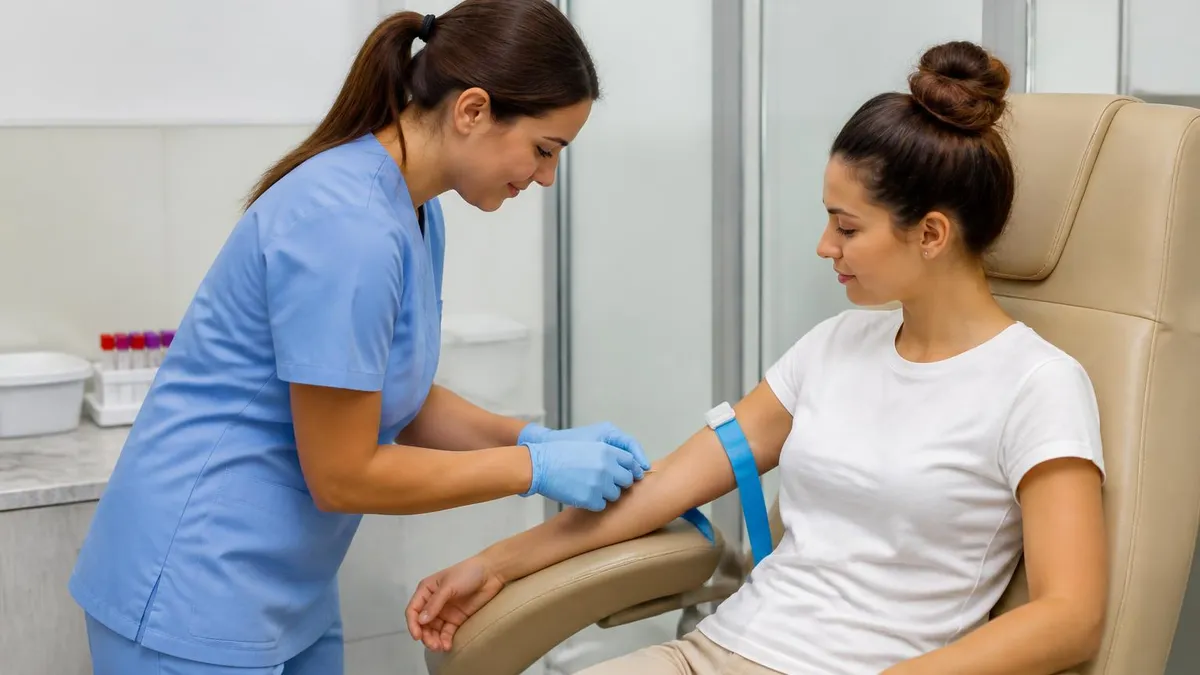
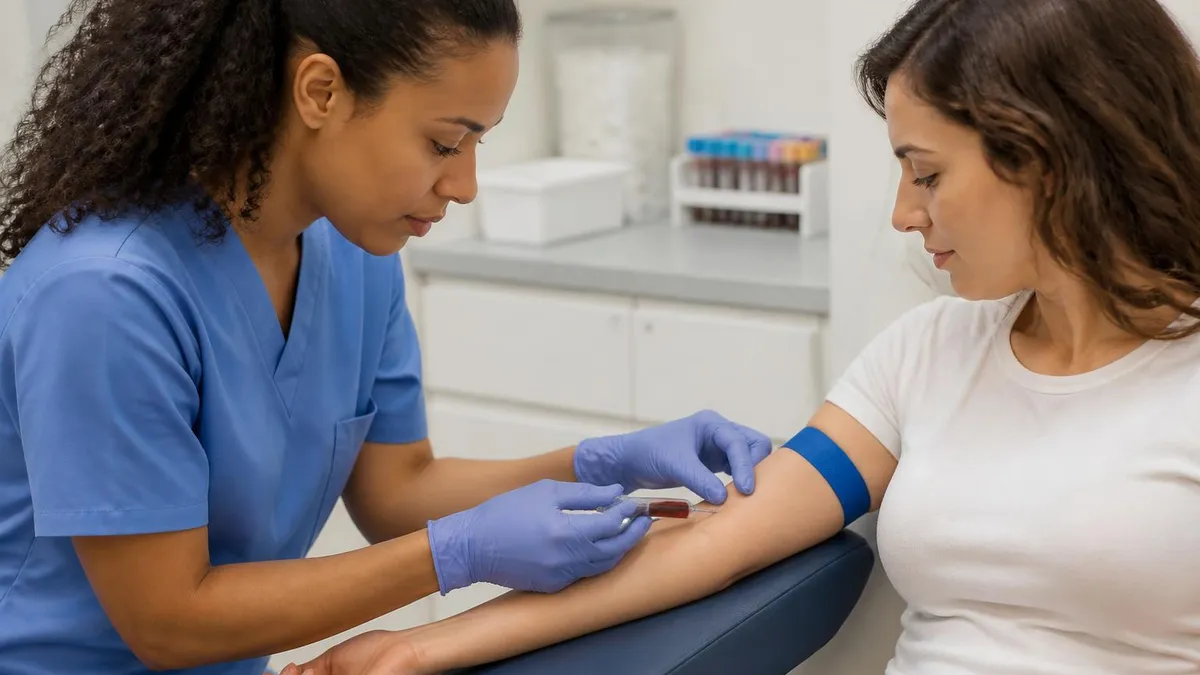
This is where you draw on real patients. Usually at a hospital outpatient lab, a Quest or LabCorp draw station, or a blood-donor center. You start by observing. By day three you're doing easy sticks — clear veins, calm patients, antecubital fossa. By the end of the externship you're doing pediatric heel sticks, elderly patients with fragile veins, and morning rounds on inpatient floors. Some academies offer paid externships. Most don't.
Equipment You'll Master
Vacutainer system. Butterfly needles. Straight needles. Syringe transfer. Capillary heel-stick devices. Centrifuge basics. Specimen labeling and chain of custody. Point-of-care glucose meters. Blood culture bottles. You'll handle all of it.
A few academies also teach IV insertion and ECG basics as add-ons — useful if you're considering becoming a phlebotomy technician with broader hospital responsibilities. Mobile draw work? See mobile phlebotomy for what that path looks like.

Typical 8-Week Phlebotomy Academy Schedule
Week 1
Week 2
Week 3
Week 4
Week 5
Week 6
Week 7
Week 8
Certification Paths After Graduation
Graduating from an academy means you finished the training. It does not make you a certified phlebotomist. For that, you sit a national exam. Five organizations offer recognized credentials. Which one you pick matters more than most students realize.
Most academies bundle one exam voucher into the tuition — usually NHA CPT. If yours doesn't, budget another $90-$135. Whatever certification you pick, study the phlebotomy certification requirements specific to your target exam. Need a refresher on what is phlebotomy in clinical practice? Start there. Many students also tackle therapeutic phlebotomy as a specialty add-on later.
Compare Phlebotomy Certification Bodies
National Healthcareer Association — Certified Phlebotomy Technician. The most popular phlebotomy credential in the US. Exam fee $117. About 100 multiple-choice questions over 2 hours. First-attempt pass rate around 75%. Recognized in all 50 states and accepted by virtually every hospital, lab, and clinic. If you only get one credential, get this one. Most academies bundle the NHA voucher into tuition.
Compare the Five Major Phlebotomy Certifications
- Cost: $117
- Length: 2 hrs / 100 questions
- Pass rate: ~75%
- Best for: General hospital and lab work
- Cost: $135
- Length: 2 hrs / 80 questions
- Pass rate: ~70%
- Best for: Academic medical centers, top hospitals
- Cost: $90
- Length: 3 hrs / 130 questions
- Pass rate: ~78%
- Best for: Budget option, broad acceptance
- Cost: $110
- Length: 2 hrs / 100 questions
- Pass rate: ~80%
- Best for: Outpatient labs, draw stations
- Cost: $80
- Length: 2 hrs / 100 questions
- Pass rate: ~85%
- Best for: Cheapest valid credential
State Licensure: Where You Need More Than a Certificate
For most of the US, your national certification is enough. Show up at a clinic in Texas or Florida with an NHA CPT card and you can start work the next morning. But four states demand a separate state license on top of national certification. If you live in one — or plan to move to one — factor this in before you enroll.
California (CPT-1, CPT-2, LPT)
The strictest state. Three license tiers. Most academy grads pursue CPT-1 (Certified Phlebotomy Technician I), which lets you do skin punctures and venipunctures. Requires 40 hours of didactic + 40 hours of practical + 20 venipunctures + 10 skin punctures verified by your school. Then national certification. Then a state application with a $100 fee. Total time: about 8 weeks from start to licensed.
Louisiana
Requires registration with the Louisiana State Board of Medical Examiners. National certification (NHA, ASCP, NCCT) qualifies you. Renewal every 2 years. $50 application fee.
Nevada
Office of Laboratory Services requires phlebotomists to hold a state OLS certificate in addition to national. Approved programs only. About $75 application fee.
Washington
Medical Assistant-Phlebotomist credential through the Department of Health. National certification required first, then state app and fee. Allows you to work in any clinical setting.
Every Other State
National certification is enough. Some employers may also want a current BLS (basic life support) card and a background check. Standard stuff.
One more wrinkle — even in unregulated states, hospitals sometimes have their own internal credentialing rules. A large hospital system may require ASCP specifically and won't accept NHA. Always ask the employer before assuming. To narrow down employers in your area, browse current openings via phlebotomy listings.
In-Person vs Online Phlebotomy Training
- +In-person: Real hands-on practice with instructor watching every stick
- +In-person: Faster build of muscle memory — angle, bevel, release timing
- +In-person: Better networking with classmates and externship sites
- +In-person: Immediate feedback on mistakes before they become habits
- +Hybrid online: Self-paced lecture fits around a full-time job
- +Hybrid online: Lower cost — no commute, fewer overhead fees passed to you
- −In-person: Less schedule flexibility, must show up M-F most weeks
- −In-person: Costs slightly more due to facility and instructor overhead
- −Fully online: Not allowed — every state requires hands-on clinical hours
- −Hybrid online: Some students skim lectures and arrive at clinical unprepared
- −Hybrid online: Clinical site must be arranged separately, sometimes unpaid
- −Hybrid online: Less spontaneous Q&A with instructors
Online vs In-Person vs Hybrid — What Actually Works
No state allows fully-online phlebotomy training. Period. You cannot certify by watching videos. Every accredited program requires supervised, hands-on clinical hours on real arms — usually 40 to 120 hours of them. So when an academy markets "100% online phlebotomy training," what they actually mean is hybrid: lecture online, clinical in person.
Hybrid: How It Actually Works
You stream the lectures at home, take quizzes online, watch demo videos of vein palpation and tube inversion. Then you report to a partner clinical site — usually a draw station, doctor's office, or small hospital lab — for 1-3 days a week of supervised practice. You complete your 30 venipunctures there over 4-12 weeks.
Med Cert Career Institute and many online providers use this exact model. Lecture content covers the same material as in-person but at your own pace. The trade-off is real: you'll need self-discipline to keep up with weekly modules, and questions usually wait until your next on-site day instead of getting answered live.
In-Person: The Original Format
You attend a classroom 4-5 days a week for the full program length. Lecture, lab, externship, all in one location. This is how community colleges and most physical academies run it. Best for people who learn by doing and benefit from constant in-person correction. You also build a network with classmates — and that network sometimes turns into your first job referral within the same hospital system where you did clinical hours.
Accelerated Bootcamps
Some academies — Phlebotomy USA's 10-day program, for example — cram everything into two weeks of 8-10 hour days. Brutal but fast. You'll have a CPT credential within a month if you also pass the NHA exam on first attempt. Expect minimal handholding. Bootcamps work for fast learners with a clean schedule, not for parents juggling kids or anyone who needs lecture material to settle for a few days.
The Externship Is Where Real Skills Form
The single most underrated part of training. Lectures teach you what to do. Externships make you do it on a 78-year-old patient with deep, rolling veins and a fear of needles. That's the actual job.
Top academies place students at well-known sites: Quest Diagnostics, LabCorp, Mayo Clinic outpatient labs, large regional hospitals, blood-donor centers like Vitalant or Red Cross. Lower-tier academies may send you to a single doctor's office where you do 8 sticks total and call it 40 hours. Ask before you enroll: "Where are your last 10 graduates currently working, and where did each one do their externship?" Real academies have the answer ready.
Externship hours run unpaid at most schools. Plan for it. You'll cover scrubs, parking, and your own meals during the 4-8 weeks of clinical rotation. A handful of academies partner with employers who pay $12-$15/hour during externship and offer a guaranteed interview at the end — Allied Health Career Institute does this with regional hospital chains in Florida and Georgia, and it's worth asking about explicitly.
Questions to Ask Before You Enroll in Any Academy
- ✓Is this program NAACLS-approved? (Best credential signal)
- ✓How many clinical externship hours are included?
- ✓Where do graduates do their externships? Name 3 partner sites.
- ✓What is the first-attempt pass rate on NHA CPT or ASCP PBT?
- ✓Is the certification exam fee included in tuition?
- ✓Where are your last 10 graduates working now?
- ✓What is the maximum class size during lab sessions?
- ✓Does the school report state-licensure pass rate (if in CA/LA/NV/WA)?
- ✓Are payment plans or financial aid available?
- ✓What happens if I fail the certification exam — does the school cover a retake?
Job Market & Starting Salary After Academy
The Bureau of Labor Statistics tracks phlebotomists separately. Median pay is $38,530 a year — about $18.52 an hour. Top 10% earn over $50,000. Entry-level academy grads typically start at $35,000-$42,000 depending on city. Hospital phlebotomists earn more than draw-station techs. Travel phlebotomists earn the most.
Where Graduates Actually Work
About 35% land at hospitals — outpatient labs, ER support, or floor draws. Another 28% work at commercial labs like Quest or LabCorp. The rest scatter across blood-donor centers, doctor offices, urgent care, mobile services, plasma centers, and research facilities. Plasma donation centers (CSL Plasma, Grifols, Octapharma) hire heavily — $17-19/hour starting, paid training, and they don't require prior experience beyond your certification.
Externship Sites That Hire
Vitalant. American Red Cross. Mayo Clinic. Cleveland Clinic. Kaiser Permanente. Quest Diagnostics. LabCorp. BioReference. Your externship site is your most likely first job. Show up early, work clean, ask smart questions — most academies report 30-50% of students get hired directly by their externship facility within 90 days of graduation.
Career Ladder From Phlebotomy
Phlebotomy isn't a dead-end role. Lots of people use it as a step. After 1-2 years, many move into medical lab tech (MLT) programs, nursing school, or specialized roles — donor recruitment, point-of-care coordinator, or supervisor of a draw station. Some go on to become medical assistants by adding ECG and injection training. Others stay phlebotomists for 20 years because they love the work — fast, social, low-stress compared to nursing.
Travel Phlebotomy
If you have 1+ year of hospital experience, agencies like Aya Healthcare or Cross Country place travel phlebotomists at $25-35/hour plus housing stipend. 13-week contracts. Not glamorous but lucrative. Some travel phlebotomists clear $70,000-$90,000 a year by working back-to-back contracts in high-demand metros.
The pay growth is small but steady. After 5 years in a hospital lab, expect $45,000-$55,000 in most US cities. After 10 years, $50,000-$65,000 plus shift differential for nights and weekends. Pick the right academy now and you cut your time to that first paycheck by months.
Phlebotomy Practice Test Questions
Prepare for the Phlebotomy Test exam with our free practice test modules. Each quiz covers key topics to help you pass on your first try.
Phlebotomy American Medical Certification ...
Phlebotomy Exam Questions covering American Medical Certification Association Phlebotomy. Master Phlebotomy Test concepts for certification prep.
Phlebotomy American Medical Technologists ...
Free Phlebotomy Practice Test featuring American Medical Technologists Phlebotomy. Improve your Phlebotomy Exam score with mock test prep.
Phlebotomy American Society for Clinical P...
Phlebotomy Mock Exam on American Society for Clinical Pathology Phlebotomy. Phlebotomy Study Guide questions to pass on your first try.
Phlebotomy Association of Phlebotomy Techn...
Phlebotomy Test Prep for Association of Phlebotomy Technicians. Practice Phlebotomy Quiz questions and boost your score.
Phlebotomy National Center for Competency ...
Phlebotomy Questions and Answers on National Center for Competency Testing Phlebotomy. Free Phlebotomy practice for exam readiness.
Phlebotomy National Healthcareer Associati...
Phlebotomy Mock Test covering National Healthcareer Association Phlebotomy. Online Phlebotomy Test practice with instant feedback.
Phlebotomy Order of Draw and Additives
Free Phlebotomy Quiz on Order of Draw and Additives. Phlebotomy Exam prep questions with detailed explanations.
Phlebotomy Legal and Ethics
Phlebotomy Practice Questions for Phlebotomy Legal and Ethics. Build confidence for your Phlebotomy certification exam.
Phlebotomy Safety and Infection Control
Phlebotomy Test Online for Safety and Infection Control. Free practice with instant results and feedback.
Phlebotomy Special Collection Procedures
Phlebotomy Study Material on Special Collection Procedures. Prepare effectively with real exam-style questions.
Phlebotomy Specimen Processing and Handling
Free Phlebotomy Test covering Specimen Processing and Handling. Practice and track your Phlebotomy exam readiness.
Phlebotomy Test Arterial Blood Gas Collection
Phlebotomy Exam Questions covering Test Arterial Blood Gas Collection. Master Phlebotomy Test concepts for certification prep.
Phlebotomy Test Capillary and Dermal Puncture
Free Phlebotomy Practice Test featuring Test Capillary and Dermal Puncture. Improve your Phlebotomy Exam score with mock test prep.
Phlebotomy Test Pediatric Blood Collection
Phlebotomy Mock Exam on Test Pediatric Blood Collection. Phlebotomy Study Guide questions to pass on your first try.
Phlebotomy Test Phlebotomy Anatomy and Phy...
Phlebotomy Test Prep for Test Phlebotomy Anatomy and Physiology. Practice Phlebotomy Quiz questions and boost your score.
Phlebotomy Test Phlebotomy Exam Simulation
Phlebotomy Questions and Answers on Test Phlebotomy Exam Simulation. Free Phlebotomy practice for exam readiness.
Phlebotomy Test Phlebotomy Patient Identif...
Phlebotomy Mock Test covering Test Phlebotomy Patient Identification and Communication. Online Phlebotomy Test practice with instant feedback.
Phlebotomy Test Point of Care Testing
Free Phlebotomy Quiz on Test Point of Care Testing. Phlebotomy Exam prep questions with detailed explanations.
Phlebotomy Questions and Answers
Related Phlebotomy Resources
About the Author

Registered Nurse & Healthcare Educator
Johns Hopkins University School of NursingDr. Sarah Mitchell is a board-certified registered nurse with over 15 years of clinical and academic experience. She completed her PhD in Nursing Science at Johns Hopkins University and has taught NCLEX preparation and clinical skills courses for nursing students across the United States. Her research focuses on evidence-based exam preparation strategies for healthcare certification candidates.