
OSHA Fall Protection Standard: Complete Guide to 29 CFR 1926.502 Requirements
💡 Master the OSHA fall protection standard: triggers, equipment requirements, training rules, and inspection tips for construction and general industry.
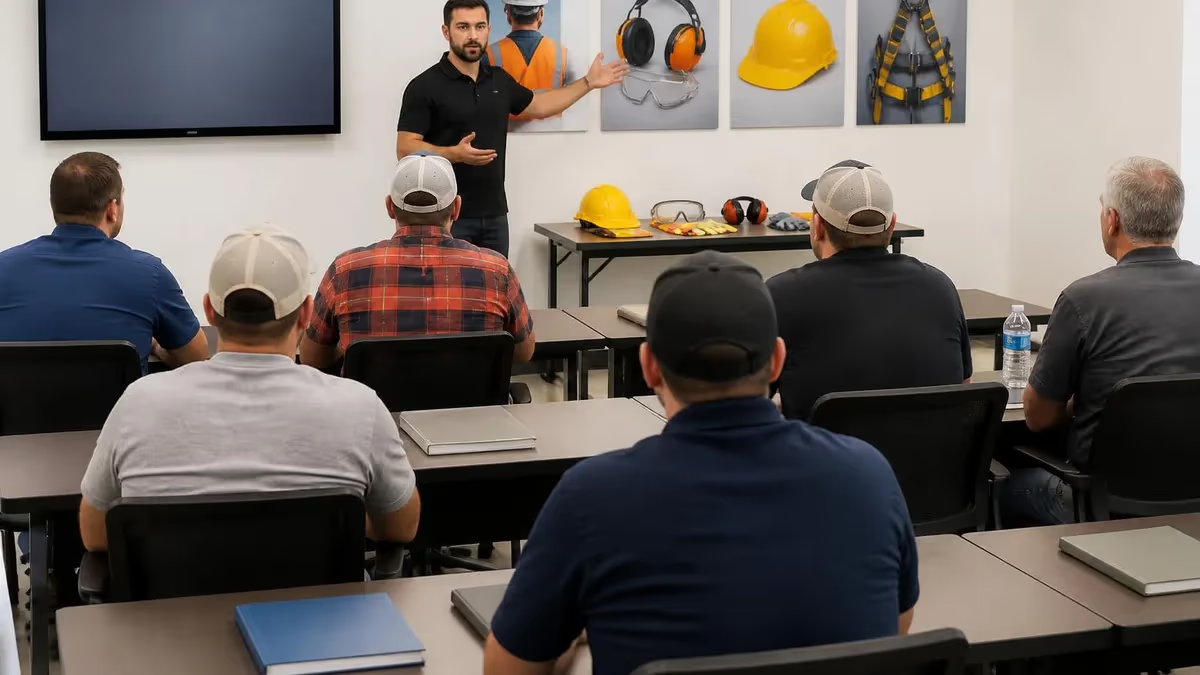
The OSHA fall protection standard is the most frequently cited regulation in American workplaces, and for good reason — falls are the leading cause of fatalities in the construction industry, accounting for roughly one in three worker deaths every single year.
Governed primarily by 29 CFR 1926.502 for construction and 29 CFR 1910.28 for general industry, this standard defines when fall protection is required, which systems are acceptable, and how employers must train their workers before they ever set foot near an unprotected edge. Understanding this regulation is not just a compliance checkbox; it is the foundation of a functioning safety program.
At its core, the osha fall protection standard establishes a clear hierarchy of controls that employers must follow. The preferred approach is always elimination — redesigning the task so workers never need to operate at height. When elimination is not feasible, passive systems such as guardrails and safety nets take priority. Personal fall arrest systems (PFAS), which include uses, lanyards, and anchorage points, are used when passive systems cannot be practicably implemented. This hierarchy ensures that the most reliable, least human-dependent solutions are deployed first, reducing the chance that a momentary lapse in attention leads to a fatal incident.
Construction employers face the six-foot trigger height: any employee working at or above six feet over a lower level must be protected. General industry workplaces have a four-foot trigger. Shipyards follow a five-foot threshold, and longshoring operations apply a different set of rules still. These thresholds are not arbitrary — they reflect injury data that shows fatal falls are highly likely beyond these heights, even onto relatively soft surfaces. Knowing the specific trigger for your industry is the first step toward building a compliant fall protection program that actually protects workers rather than simply satisfying an inspection.
Employers are required to provide fall protection at no cost to employees, and the regulation does not allow workers to opt out of protection because it feels cumbersome or slows down the job. OSHA citations for fall protection violations can reach $16,131 per serious violation, and willful or repeated violations can climb to $161,323 per instance. Beyond the financial penalties, the reputational damage and potential for criminal liability when a fatality occurs make non-compliance a genuinely existential risk for smaller contractors. Staying current with the standard is not optional — it is a business survival requirement.
The standard covers far more than just hard construction sites. Roofing operations, steel erection, scaffolding, leading edges, holes in walking surfaces, wall openings, and even certain improved work platforms all fall under specific subsections of the fall protection requirements. Each scenario comes with its own set of permissible systems, load ratings, and inspection protocols. A safety professional who understands the full breadth of 29 CFR 1926.502 is equipped to audit diverse job sites, identify overlooked hazards, and implement solutions that hold up under regulatory scrutiny.
Training is a separate but equally critical component of the standard. Employers must provide fall protection training for each worker exposed to fall hazards, and the training must be conducted by a competent person. Workers must be able to recognize fall hazards in their specific work environment and understand the procedures necessary to minimize those hazards. Retraining is required whenever a worker demonstrates inadequate understanding or whenever changes in the workplace render previous training obsolete. Documentation of training, while not explicitly mandated in every subpart, is strongly recommended as evidence of compliance during an OSHA inspection.
This guide walks through every major element of the OSHA fall protection standard — from the equipment specifications and installation requirements to inspection protocols, training obligations, and common citations that show up on OSHA's most-cited list year after year. Whether you are studying for the OSHA 10 or 30 exam, preparing for a site audit, or building your company's safety management system from scratch, the information here will give you a solid, practical foundation for working safely at height and staying compliant with federal law.
- OSHA does not require a test or set a passing score to earn an OSHA 10-hour or 30-hour Outreach course completion card, but trainers may give a test to check learning. (U.S. Department of Labor, Occupational Safety and Health Administration (OSHA), Outreach Training Program)
- OSHA does not set one price for its 10-hour and 30-hour Outreach classes; the class fee is set by each independent OSHA-authorized trainer or online provider. (U.S. Department of Labor, Occupational Safety and Health Administration (OSHA), Outreach Training Program)
- An OSHA 10-hour or 30-hour card can be replaced only once per class and only within five years of the class; after that, the student has to retake the class to get a card. (U.S. Department of Labor, Occupational Safety and Health Administration (OSHA), Outreach Training Program)
- OSHA Outreach student course completion cards for Construction, General Industry, Maritime and Disaster Site do not have an expiration date, and Maritime cards stopped expiring as of April 1, 2019. (U.S. Department of Labor, Occupational Safety and Health Administration (OSHA), Outreach Training Program)
- Students do not renew OSHA Outreach cards, but OSHA-authorized Outreach trainers must complete an update course every four years to stay authorized. (U.S. Department of Labor, Occupational Safety and Health Administration (OSHA), Outreach Training Program)
- OSHA 10-hour and 30-hour Outreach classes are taught in person by OSHA-authorized trainers or online by OSHA-accepted independent providers; OSHA does not run online classes itself. (U.S. Department of Labor, Occupational Safety and Health Administration (OSHA), Outreach Training Program)
- The OSHA Outreach Training Program has no minimum age, but to get an OSHA card a student must complete the entire class, including all required topics and the minimum number of contact hours. (U.S. Department of Labor, Occupational Safety and Health Administration (OSHA), Outreach Training Program)
- After finishing an OSHA 10-hour or 30-hour Outreach class, students get their course completion card from the trainer or online provider, who has 90 days to issue it. (U.S. Department of Labor, Occupational Safety and Health Administration (OSHA), Outreach Training Program)
Facts verified Oct 16, 2026 against U.S. Department of Labor, Occupational Safety and Health Administration (OSHA), Outreach Training Program. Dates that have passed are removed automatically.
OSHA Exam at a Glance
Facts verified Oct 16, 2026 against U.S. Department of Labor, Occupational Safety and Health Administration (OSHA), Outreach Training Program. Dates that have passed are removed automatically.
OSHA Fall Protection Standard by the Numbers

The Three Primary Fall Protection Systems
Physical barriers erected along open sides and edges. Top rails must withstand 200 lbs of force in any direction. This is the preferred passive system because it protects workers without any action required on their part and does not rely on correct equipment use.
Installed below the work area to catch falling workers and debris. Nets must be as close as practicable under the work surface and never more than 30 feet below. They must be tested after installation and after any alteration, repair, or relocation of the system.
A combination of a full-body use, connecting lanyard or self-retracting lifeline, and a secure anchorage point rated for 5,000 lbs minimum. PFAS must stop a fall before the worker contacts the lower level and limit deceleration forces to 1,800 lbs on the body.
Allow workers to be supported on a vertical surface (such as a wall or formwork) with both hands free. Must be rigged so a worker cannot free-fall more than two feet. These are common in reinforced concrete and masonry work where workers need hands-free operation at elevation.
A rope, wire, or chain erected around roof work areas to warn workers of a fall hazard. Only permissible on low-slope roofs and must be used in conjunction with a safety monitor or another fall protection system when workers are in the area between the warning line and the roof edge.
Guardrail systems are the backbone of passive fall protection and the first choice employers should consider whenever workers operate near unprotected edges. Under 29 CFR 1926.502(b), the top rail of a guardrail system must be between 39 and 45 inches above the walking-working surface. Mid-rails, when required, must be positioned at the midpoint between the top rail and the walking surface.
Every component of the system must be able to withstand a 200-pound force applied within two inches of the top edge in any outward or downward direction. Wire rope used as a top rail must be flagged every six feet with high-visibility material so workers can see it clearly.
Openings in the guardrail system — such as gates or gaps for equipment passage — must be protected by chains, removable guardrail sections, or other equivalent measures while workers are in the area. Guardrail surfaces must be free of sharp edges or projections that could snag clothing or lacerate hands.
When employees use stilts on a low-slope roof, the height of the guardrail must be increased by the height of the stilts being used, an often-overlooked requirement that catches many contractors during inspections. Steel banding and plastic banding must never be used as top rails or mid-rails in any guardrail system regardless of their tensile strength.
Safety net systems, governed by 29 CFR 1926.502(c), must be installed as close as practical under the walking-working surface on which employees are working, but never more than 30 feet below that surface. The safety net must extend outward from the outermost projection of the work surface based on the height of the net below the surface — the farther below, the wider the net must extend.
Nets must be capable of absorbing the impact force of a 400-pound drop bag of sand dropped from the highest point from which an employee could fall, proving the system can catch and hold a real worker.
Personal fall arrest systems bring their own detailed requirements. The full-body use is the only acceptable body wear; body belts were phased out for fall arrest purposes in 1998 because they concentrated all stopping force on the abdomen, causing internal injuries. Lanyards and vertical lifelines must have a minimum breaking strength of 5,000 pounds.
Horizontal lifelines must be designed, installed, and used under the supervision of a qualified person. Self-retracting lifelines and lanyards must automatically limit free-fall distance to two feet or less and must be capable of sustaining a minimum tensile load of 3,000 pounds applied to the device with the lifeline fully extended.
Anchorage points are perhaps the most critical and most frequently deficient component of a PFAS. Each anchorage must be capable of supporting at least 5,000 pounds per worker attached, or must be designed, installed, and used as part of a complete personal fall arrest system that maintains a safety factor of at least two, under the supervision of a qualified person. Structural steel members, concrete columns, and purpose-built anchor sockets all qualify if properly rated. Common failures include workers clipping to scaffolding horizontal members, unrated pipe, or electrical conduit — none of which meet the standard's load requirements.
Connecting components — snap hooks, carabiners, D-rings — must be compatible with the components to which they connect. Large throat opening snap hooks must be equipped with a self-locking mechanism to prevent rollout. The connecting hardware must be capable of supporting the required load and must be inspected prior to each use.
If any component of a PFAS has been subjected to fall forces, every part of the system must be removed from service immediately, even if no visible damage is apparent. The energy absorbed during a fall can permanently deform internal structures that look intact from the outside, compromising the system's ability to arrest a future fall.
Personal fall arrest systems must be rigged to prevent a worker from free-falling more than six feet or contacting any lower level. When calculating free-fall clearance, safety professionals must account for the deceleration distance (typically 3.5 feet for shock-absorbing lanyards), the D-ring shift on the use, use elongation, and the worker's height. This full calculation often reveals that a six-foot lanyard attached at shoulder height on a standard floor level provides very little clearance before the worker contacts the next level below. Shorter lanyards, self-retracting lifelines, or overhead anchorage are frequently required to achieve compliant clearance distances.
OSHA Practice Test Questions
Prepare for the OSHA - Safety Certificate exam with our free practice test modules. Each quiz covers key topics to help you pass on your first try.
OSHA Basic OSHA Practice
OSHA Exam Questions covering Basic OSHA Practice. Master OSHA Test concepts for certification prep.
OSHA Confined Space Entry
Free OSHA Practice Test featuring Confined Space Entry. Improve your OSHA Exam score with mock test prep.
OSHA Fall Protection
OSHA Mock Exam on Fall Protection. OSHA Study Guide questions to pass on your first try.
OSHA - Safety Certificate Electrical Safet...
Free OSHA Quiz on OSHA - Safety Certificate Electrical Safety Standards Questions and Answers. OSHA Exam prep questions with detailed explanations.
OSHA - Safety Certificate Emergency Action...
OSHA Practice Questions for OSHA - Safety Certificate Emergency Action and Fire Plans Questions and Answers. Build confidence for your OSHA certification exam.
OSHA - Safety Certificate Hazard Communica...
OSHA Test Online for OSHA - Safety Certificate Hazard Communication Standard Questions and Answers. Free practice with instant results and feedback.
OSHA - Safety Certificate Introduction to ...
OSHA Study Material on OSHA - Safety Certificate Introduction to OSHA Questions and Answers. Prepare effectively with real exam-style questions.
OSHA - Safety Certificate Lockout/Tagout P...
Free OSHA Test covering OSHA - Safety Certificate Lockout/Tagout Procedures Questions and Answers. Practice and track your OSHA exam readiness.
OSHA - Safety Certificate Machine Guarding...
OSHA Exam Questions covering OSHA - Safety Certificate Machine Guarding Requirements Questions and Answers. Master OSHA Test concepts for certification prep.
OSHA - Safety Certificate OSHA Recordkeepi...
Free OSHA Practice Test featuring OSHA - Safety Certificate OSHA Recordkeeping and Reporting Questions and Answers. Improve your OSHA Exam score with mock test prep.
OSHA - Safety Certificate Personal Protect...
OSHA Mock Exam on OSHA - Safety Certificate Personal Protective Equipment (PPE) Questions and Answers. OSHA Study Guide questions to pass on your first try.
OSHA - Safety Certificate Walking and Work...
OSHA Test Prep for OSHA - Safety Certificate Walking and Working Surfaces Questions and Answers. Practice OSHA Quiz questions and boost your score.
OSHA - Safety Certificate Electrical Safet...
OSHA Mock Test covering - Safety Certificate Electrical Safety Standards. Online OSHA Test practice with instant feedback.
OSHA - Safety Certificate Emergency Action...
Free OSHA Quiz on - Safety Certificate Emergency Action and Fire Plans. OSHA Exam prep questions with detailed explanations.
OSHA - Safety Certificate Hazard Communica...
OSHA Practice Questions for - Safety Certificate Hazard Communication Standard. Build confidence for your OSHA certification exam.
OSHA - Safety Certificate Introduction to ...
OSHA Test Online for - Safety Certificate Introduction to OSHA. Free practice with instant results and feedback.
OSHA - Safety Certificate Lockout/Tagout P...
OSHA Study Material on - Safety Certificate Lockout/Tagout Procedures. Prepare effectively with real exam-style questions.
OSHA - Safety Certificate Machine Guarding...
Free OSHA Test covering - Safety Certificate Machine Guarding Requirements. Practice and track your OSHA exam readiness.
OSHA - Safety Certificate OSHA Recordkeepi...
OSHA Exam Questions covering - Safety Certificate OSHA Recordkeeping and Reporting. Master OSHA Test concepts for certification prep.
Fall Protection Rules by Industry Sector
In construction, 29 CFR 1926.502 applies to all workers exposed to fall hazards of six feet or more. Specific subparts address leading and trailing edges, excavations, formwork and reinforcing steel, ramps, runways, holes, wall openings, roofing work, and steel erection. Each subpart specifies which fall protection systems are permissible and which are prohibited for that particular task. For example, employees engaged in leading edge work may use a fall restraint system as an alternative to PFAS if the system is rigged to prevent a worker from reaching the leading edge.
Low-slope roofing operations — defined as roofs with a slope of four in 12 or less — allow the use of a warning line system combined with a safety monitor system as a substitute for guardrails, PFAS, or safety nets. However, the warning line must be erected at least six feet from the roof edge on all sides and the safety monitor must maintain visual and voice contact with all workers within the warning line. Steep-roof work (slope greater than four in 12) requires guardrails, PFAS, or safety nets on all open sides and edges of the roof, with no exception for warning lines.

Guardrails vs. Personal Fall Arrest Systems: Which Is Right for Your Site?
- +Guardrails provide passive protection — workers are protected without any required action or equipment donning
- +No training is required for workers to benefit from a properly installed guardrail system
- +Guardrails protect all workers simultaneously, including visitors and new employees unfamiliar with PFAS
- +No post-fall inspection or equipment replacement required — the system remains functional after a worker contacts it
- +Guardrails can double as material containment, preventing tools and debris from falling to lower levels
- +Lower long-term cost when work is in a fixed location — no recurring use inspection, replacement, or storage overhead
- −Guardrails are often impractical for mobile or leading-edge work where the edge location changes as work progresses
- −Installation and dismantling of guardrails takes time and labor, which can increase project scheduling pressure
- −Guardrails can interfere with certain construction operations such as concrete formwork placement or steel member erection
- −Not suitable for pitched or irregular roof surfaces where standard rail geometry cannot be maintained
- −PFAS allows workers to access areas that cannot be guarded, providing fall protection in more versatile scenarios
- −Workers wearing PFAS have continuous personal protection even when moving through areas where guardrails are temporarily removed
OSHA Fall Protection Compliance Checklist for Job Sites
- ✓Identify all fall hazards at six feet or higher (construction) or four feet or higher (general industry) before work begins.
- ✓Select the appropriate fall protection system — guardrails, safety nets, or PFAS — based on the hierarchy of controls.
- ✓Verify guardrail top rails are between 39 and 45 inches high and can withstand 200 lbs of force in any direction.
- ✓Confirm all PFAS anchorage points are rated for at least 5,000 pounds per attached worker.
- ✓Inspect every use, lanyard, snap hook, and self-retracting lifeline before each use for cuts, fraying, corrosion, or deformation.
- ✓Remove from service any PFAS component that has been subjected to fall arrest forces, regardless of visible damage.
- ✓Calculate free-fall clearance for each PFAS installation, accounting for deceleration distance, D-ring shift, and worker height.
- ✓Ensure all workers exposed to fall hazards have received fall protection training from a competent person.
- ✓Post a site-specific fall protection plan when conventional systems are claimed to be infeasible in residential construction.
- ✓Document all training, equipment inspections, and near-miss incidents to demonstrate ongoing compliance during an OSHA audit.
The Competent Person Requirement Is Non-Negotiable
OSHA requires that fall protection training be conducted by a competent person — someone who can identify existing and predictable fall hazards and who has the authority to take prompt corrective action. Simply watching a safety video or signing a form does not satisfy this requirement. The competent person must be able to demonstrate knowledge of the specific hazards present at the worksite and the fall protection systems selected to control them. During an OSHA inspection, compliance officers will ask workers to name their competent person and describe what fall protection training they received.
Training under the OSHA fall protection standard is one of the most consequential and most misunderstood components of compliance. The requirement is straightforward on its face: employers must train each worker who might be exposed to fall hazards so that the worker can recognize such hazards and knows the procedures to follow to minimize the hazards. But in practice, effective fall protection training requires far more than a brief safety talk at the beginning of a shift. It demands a structured program that covers hazard recognition, system selection, correct equipment use, inspection procedures, and emergency rescue.
The competent person who delivers fall protection training must understand the specific conditions of the worksite, not just the generic requirements of the standard. A trainer who covers guardrails in abstract but fails to address the leading edges, floor openings, and skylight covers actually present on the job has not met the standard's intent.
Workers must be able to look at their actual work environment, identify where they could fall, and know exactly which system is in place to protect them. Abstract knowledge of PFAS components is not sufficient if a worker cannot correctly don a use, locate the anchorage point, and calculate whether the clearance is adequate for the lanyard being used.
Retraining requirements are often overlooked by employers who conduct initial training but never revisit the subject. OSHA requires retraining whenever the employer has reason to believe that a worker who has already been trained does not have the understanding and skill required by the standard.
This occurs when a worker is observed misusing equipment, when workplace changes introduce new hazards not covered in previous training, or when new fall protection equipment is deployed that workers have not used before. Seasonal and temporary workers present a particular challenge because they may arrive with training records from another employer that do not reflect the specific hazards of the new worksite.
Training documentation, while not always explicitly required by every section of the fall protection standard, is a critical practical defense during OSHA inspections and litigation. A training record should capture the date of training, the content covered, the name and qualification of the trainer, and the signature of each worker trained.
When an OSHA compliance officer arrives on site and interviews workers who cannot identify what fall protection systems are in use or cannot demonstrate proper use donning, the employer faces a difficult position even if training was theoretically conducted. Good documentation gives employers a fighting chance to demonstrate that training was completed and meaningful.
Rescue planning is a component of fall protection that many employers handle inadequately. A personal fall arrest system that stops a fall is only the first step — a worker suspended in a use after a fall can experience suspension trauma (orthostatic intolerance) within minutes, which can be fatal. Employers must have a rescue procedure in place before work begins at height.
The procedure must identify who will perform the rescue, what equipment is available, and how quickly a suspended worker can be reached and lowered to safety. Calling 911 as a rescue plan is not compliant; emergency services may take too long and will not have site-specific knowledge needed for a safe extraction.
Employers in multi-employer worksite settings must understand how the OSHA multi-employer citation policy applies to fall protection. The creating, exposing, correcting, and controlling employer framework means that a general contractor can be cited for fall hazards created by a subcontractor, even if the GC's own employees are not directly exposed. General contractors who control the worksite have an obligation to ensure that all employers and workers on the site are protected, which typically means including fall protection requirements in subcontracts, conducting joint safety inspections, and stopping work when fall hazards are observed regardless of which employer created them.
Equipment selection mistakes are among the most common compliance failures seen by safety professionals doing pre-OSHA inspections. Workers and supervisors routinely select snap hooks that are incompatible with D-rings due to size mismatches, use body belts that were permissible before 1998 for fall arrest purposes, rely on horizontal lifelines that were installed without the oversight of a qualified person, or attach lanyards to anchorage points that are structurally inadequate.
Each of these errors can result in catastrophic failure during a real fall, and each can be detected and corrected through a systematic pre-work equipment inspection combined with periodic unannounced audits by a safety professional familiar with the full technical requirements of 29 CFR 1926.502.

If any personal fall arrest system component has been subjected to fall arrest forces, remove every part of the system from service immediately — use, lanyard, anchorage connector, and self-retracting lifeline. Do not reuse components even if no visible damage is present. Internal deformation from the arrest forces compromises future performance. Tag the equipment as out of service and follow the manufacturer's instructions for inspection, repair, or destruction before disposal.
OSHA enforcement data consistently shows that fall protection violations dominate the agency's annual top-ten most cited standards list. In fiscal year 2024, fall protection in construction (29 CFR 1926.501) was cited more than 6,000 times, making it the single most frequently cited standard for the twenty-second consecutive year. Ladders came in second, followed by scaffolding — all three of which are directly related to fall hazards in construction. This data is not coincidental; it reflects the reality that falls are common, visible, and preventable, making them a natural focus for OSHA compliance officers conducting site inspections.
Penalty calculations under OSHA's current structure depend on the severity classification of the violation and the employer's size, history, and good faith. A serious violation — one where there is a substantial probability that death or serious physical harm could result — carries a maximum penalty of $16,131 per violation as of 2024.
Willful violations, where the employer knowingly disregarded the law or showed plain indifference to employee safety, carry maximums of $161,323 per violation. Repeat violations, issued when an employer is cited for substantially similar violations within the previous five years, carry the same $161,323 maximum. These are per-violation figures; a single site inspection that yields multiple citation items can result in total penalties in the hundreds of thousands of dollars.
The informal conference process is often underutilized by cited employers. After receiving a citation, employers have 15 working days to contest it or negotiate informally with the OSHA Area Director. Informal conferences frequently result in penalty reductions of 25 to 50 percent in exchange for a signed settlement agreement that commits the employer to abatement, enhanced training, and sometimes enhanced monitoring.
Employers who can demonstrate financial hardship, a strong safety history, or that they had made a good faith effort to comply before the inspection may receive additional reductions. Understanding this process allows employers to manage the financial impact of citations while still coming into full compliance.
Programmed versus unprogrammed inspections follow different protocols. Programmed inspections are scheduled based on OSHA targeting criteria — high-hazard industries, employers with improved injury and illness rates, or participants in special emphasis programs like the National Emphasis Program on Falls in Construction.
Unprogrammed inspections are triggered by a specific event: a worker fatality, a catastrophic incident involving three or more hospitalizations, an employee complaint, or a referral from another agency. In construction, the National Emphasis Program on Falls means that compliance officers may visit sites specifically to inspect fall protection, independent of any complaint or incident, simply because the industry profile matches targeting criteria.
The Site-Specific Targeting (SST) program uses injury and illness data from OSHA's Form 300A summaries to prioritize inspections of establishments with high days away, restricted, or transferred (DART) rates. Employers who underreport injuries to stay off this list face a double exposure — not only the underlying recordkeeping violation but also the inference of willfulness that comes from deliberate underreporting.
The relationship between fall incidents, injury recording, and inspection targeting is therefore direct: a serious fall that is not properly recorded can trigger a recordkeeping citation and draw the kind of scrutiny that leads to a comprehensive inspection of all safety programs on the site.
Variance procedures allow employers to implement alternative compliance measures when strict adherence to a standard's specifications is technically infeasible or creates a greater hazard. Temporary variances, permanent variances, and experimental variances each have different procedural requirements and timelines. A permanent variance application requires demonstration that the proposed alternative provides protection at least as effective as the standard requires. The process is time-consuming and rarely used, but for employers with genuinely unique operations — historic preservation work on ornate facades, for example — it offers a legal pathway to compliance that does not force dangerous improvisation.
Multi-employer citation policy plays an outsized role in fall protection enforcement on construction sites with multiple trades. When a general contractor observes a subcontractor's employee working without fall protection and takes no corrective action, the GC can be cited as a controlling employer. This creates strong financial incentives for general contractors to actively monitor fall protection compliance across all trades on their sites. The practical implication is that safety managers at general contracting firms must be trained to identify fall protection deficiencies across all applicable subparts of 29 CFR 1926, not just the work their own crews perform.
Building a durable fall protection program requires more than distributing uses and posting the OSHA standard on a bulletin board. The most effective programs embed fall protection into every stage of the project lifecycle — from the pre-bid estimate and project planning phases through daily hazard assessments and closeout inspections.
Safety professionals who are involved in pre-construction planning can identify fall hazards before workers arrive on site and specify the systems that will be used, the anchorage locations that will be engineered, and the equipment that will be purchased. This upstream investment pays dividends throughout the project by eliminating the improvised, non-compliant solutions that emerge when fall protection is treated as an afterthought.
Daily planning meetings — toolbox talks — are one of the most cost-effective fall protection tools available to any employer. A five-minute discussion at the start of each shift that reviews the fall hazards for the day's work, confirms that the correct equipment is available and in good condition, and identifies who is responsible for monitoring compliance costs nothing but the workers' attention.
Studies of serious injury prevention in construction consistently identify daily safety communications as a leading indicator of injury rate reduction. The content of these talks should be specific to the actual work being performed that day, not a generic safety message read from a laminated card.
Hazard recognition training is a distinct skill from equipment operation training, and the best fall protection programs develop both. A worker who can correctly don a use but cannot identify that the skylight cover they are walking past is not rated for foot traffic has a dangerous gap in their safety knowledge.
Hazard recognition exercises — walking a job site with a safety professional who points out and explains each fall hazard — build the observational habits that allow workers to protect themselves even when supervision is not present. This type of training is especially valuable for new hires who may have theoretical knowledge from a safety course but lack the site experience to recognize hazards in context.
Equipment maintenance programs extend the service life of fall protection equipment and ensure that uses, lanyards, and hardware perform as designed when needed. Most manufacturers recommend annual inspection of all PFAS components by a competent person, in addition to the user inspection that must occur before each use. Records of periodic inspections, including the date, the inspector's name and qualification, the findings, and the disposition of any deficient equipment, provide documentation of a functioning maintenance program. Equipment that fails inspection must be immediately tagged out of service and either repaired according to manufacturer specifications or destroyed to prevent inadvertent reuse.
Fall protection equipment selection should always involve consultation with manufacturer literature and, for engineered systems, a qualified person review. Self-retracting lifelines, in particular, come in a wide range of configurations with different free-fall ratings, breaking strengths, and clearance requirements that vary significantly by product.
A self-retracting lifeline rated for overhead use may be entirely inappropriate when used from a side anchor at waist height — the forces and geometry change dramatically with anchorage position, and the manufacturer's clearance calculations may not apply. Taking the time to read the manufacturer's data sheet and confirm compatibility with the anchorage, use, and work scenario prevents the equipment substitution errors that show up repeatedly in fall fatality investigations.
Emergency rescue planning deserves its own section in any fall protection program. The plan must address how a suspended worker will be reached, how they will be lowered or retrieved, and how quickly the rescue can be completed given the specific geometry of the worksite. Rescue drills, conducted at least annually and ideally on the actual structures where workers will be attached, reveal the logistical gaps that written plans fail to anticipate.
Equipment needed for rescue — retrieval systems, rope grabs, hauling devices — must be staged at the worksite and accessible to trained rescuers. After any near-miss or actual fall, the program should conduct a root cause analysis to identify which elements of the fall protection system failed and implement corrective action before resuming work.
For workers preparing for OSHA certification exams, fall protection questions appear across multiple sections of the OSHA 10, OSHA 30, and construction safety professional exams. Understanding the specific numerical thresholds — six feet, four feet, 200 pounds, 5,000 pounds, 1,800 pounds deceleration force — and the hierarchy of controls is essential for answering scenario-based questions correctly. Practice tests that focus on OSHA standards in context, rather than isolated fact recall, are the most effective preparation tool because they mirror the applied reasoning required by the actual exam and by real-world safety practice.
OSHA Questions and Answers

OSHA TRIR Calculator: Formula, Calculation Steps, and Industry Benchmarks

OSHA Approved Hard Hats: Complete 2026 Guide to ANSI Z89.1 Compliance, Types, and Workplace Requirements

OSHA.gov: Your Complete Guide to the Official OSHA Website

OSHA 510: Course Content, Path to Trainer, and Realistic Path

OSHA Eyewash Requirements: Complete 2026 Guide to Eye Wash Stations, ANSI Z358.1 Compliance, and Workplace Standards
How this page was made: written with AI tools. Exam facts are checked against the official sources listed below. Not reviewed by a subject-matter expert. Editorial policy
Sources & references
Exam facts on this page (fees, format, dates, passing scores) are checked against these official sources; the date is our last check. Editorial policy
- osha.gov — Test delivery, eligibility, fees, passing score, renewal, retake policy, score validity, score release · verified Oct 2026