
OSHA Step Height Requirements: Complete Guide to Stair, Ladder, and Walking Surface Standards
OSHA step height rules for stairs, ladders & walking surfaces. Learn rise limits, tread depths & compliance tips. ✅ Stay safe & avoid fines.
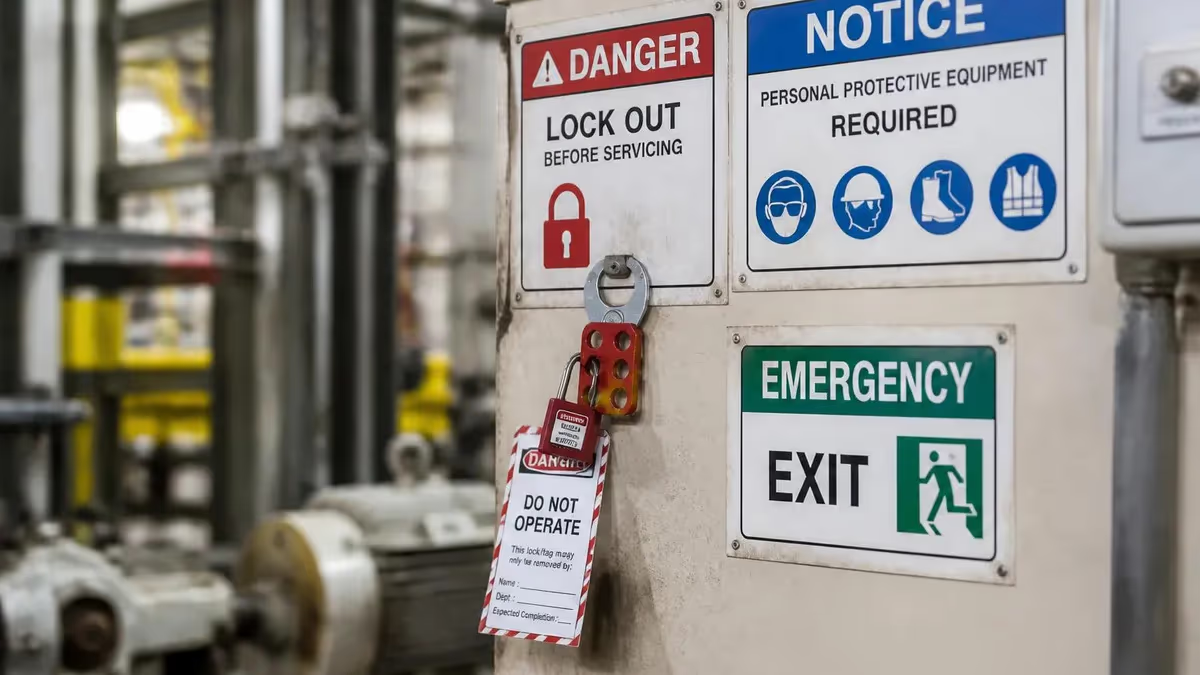
Understanding OSHA step height requirements is essential for anyone responsible for workplace safety, construction site management, or facility maintenance. OSHA's regulations under 29 CFR 1910 (General Industry) and 29 CFR 1926 (Construction) establish precise dimensional standards for stair risers, ladder rungs, and walking surface transitions. When these measurements fall outside the permitted range, workers face elevated risks of slips, trips, and falls — the leading cause of workplace fatalities in the United States, accounting for over 800 deaths annually. Staying current with these standards protects both workers and employers.
OSHA step height rules are not arbitrary numbers. They are grounded in decades of biomechanical research showing that human gait patterns are optimized for specific riser heights. When a stair riser deviates even slightly from a consistent height, the brain's automatic foot-placement calculation is disrupted, dramatically increasing the chance of a misstep. This is why OSHA mandates not only maximum and minimum riser heights but also uniformity requirements within a single stairway run. Employers who overlook these nuances during construction or renovation often face costly retrofits after inspection.
The General Industry standard at 29 CFR 1910.25 requires that stair risers be between 6 and 7.5 inches in height, with a preferred range that keeps walking ergonomically natural. The Construction standard at 29 CFR 1926.1052 applies similar principles but with slightly different tolerances appropriate to temporary structures. Fixed industrial stairs, portable ladders, fixed ladders, and mobile scaffolding each carry their own dimensional requirements, and compliance professionals must know which standard applies to a given structure before conducting an inspection or designing a new installation. Misapplying standards is a common and costly mistake.
Beyond the riser height itself, OSHA regulations address tread depth, stair width, handrail height, and the relationship between rise and run. These dimensions work together as a system. A stairway with a compliant riser height but an undersized tread depth is still a violation — and still dangerous. The Occupational Safety and Health Administration uses a blended approach, recognizing that safe passage depends on the holistic geometry of the stair system rather than any single measurement in isolation. Employers should treat each element as part of an interconnected compliance package.
For facilities with existing non-compliant stairs, OSHA provides an abatement process. When an inspection reveals a violation, employers receive a citation with a proposed penalty and an abatement deadline. The severity of the penalty depends on whether the violation is classified as serious, willful, or repeat. A first-time serious violation related to step height currently carries a maximum penalty of $16,550 per violation under 2024 adjusted figures. Repeat or willful violations can reach $165,514 per violation, making proactive compliance far less expensive than after-the-fact correction.
Workers who want to deepen their knowledge of fall prevention and stair safety standards often pursue OSHA 10-hour or 30-hour training programs. These courses cover not only the dimensional standards discussed here but also hazard recognition, personal protective equipment, and emergency procedures. For those preparing for OSHA-related exams or certifications, reviewing osha step height alongside other fall protection requirements provides a comprehensive foundation. Combining regulatory knowledge with hands-on site assessment skills is the mark of a truly safety-competent professional.
This guide breaks down every major OSHA step height standard you need to know — from fixed industrial stairs in warehouses to portable ladders on construction sites. We cover the exact dimensional requirements, the most common violations cited by compliance officers, practical measurement techniques, and the documentation practices that protect employers during OSHA inspections. Whether you are a safety manager, a general contractor, or a worker seeking to understand your rights and responsibilities, this resource gives you the specific numbers and practical context you need to stay compliant and keep your coworkers safe.
OSHA Step Height by the Numbers
Key OSHA Step Height Standards at a Glance
29 CFR 1910.25 requires risers between 6 and 7.5 inches high. Tread depth must be at least 9.5 inches. Riser height must be uniform throughout the flight, with no single riser deviating more than 3/16 inch from the others.
29 CFR 1926.1052 applies to temporary stairways on construction sites. Maximum riser height is 9.5 inches; minimum tread depth is 9.5 inches. Temporary stairs must have uniform riser heights within 3/8 inch of each other.
29 CFR 1910.28 and 1926.1053 govern fixed ladder rung spacing, requiring uniform intervals not exceeding 12 inches. The first rung must be no more than 24 inches from the lower landing, ensuring safe access and egress.
29 CFR 1910.22 covers transitions between surface elevations. Any vertical change of 19 inches or more requires a guardrail. Abrupt changes exceeding 0.5 inches at floor-level transitions must be beveled or ramped to prevent tripping hazards.
The dimensional requirements for fixed industrial stairs under 29 CFR 1910.25 reflect a careful balance between ergonomic efficiency and structural practicality. A riser height between 6 and 7.5 inches allows most adults to ascend and descend stairs with a natural stride length, minimizing muscular fatigue during repeated use throughout a workday. Facilities with stairs outside this range — even by a fraction of an inch — are technically in violation, and OSHA compliance officers are trained to measure multiple risers per flight during inspections. Employers should not assume that legacy stairs built before current standards are grandfathered in without verification.
Uniformity is just as important as the absolute height measurement. Research in occupational biomechanics consistently shows that irregular riser heights — where one step is noticeably taller or shorter than its neighbors — cause more falls than uniformly non-standard stairs. The human nervous system adapts to a consistent pattern; it is the unexpected variation that causes the brain to miscalculate foot placement.
This is why OSHA's standard under 1910.25(b)(2) specifies that the variation in riser height between any two risers in the same flight shall not exceed 3/16 of an inch. Contractors who build stairs in stages, pouring individual landings at different times, must be especially careful to maintain this consistency.
Tread depth works in tandem with riser height. The classic stair design principle — sometimes called the riser-run rule — holds that twice the riser height plus the tread depth should equal approximately 25 to 26 inches. For a 7-inch riser, this formula suggests a 12-inch tread, which falls comfortably within OSHA's minimum of 9.5 inches.
Deeper treads give workers more secure footing but require more horizontal space, which can be a constraint in tight mechanical rooms or mezzanine access areas. When space is limited, architects and facility managers sometimes opt for the minimum tread depth, which is permissible but leaves less margin for safe footing when carrying loads.
Stair width is a related requirement that affects egress capacity rather than individual fall risk. General Industry standards require a minimum clear width of 22 inches for fixed industrial stairs. Construction stairways must be at least 18 inches wide. Emergency egress stairways in multi-story buildings are governed by both OSHA and local building codes, which often impose more stringent width requirements. When OSHA and a local fire code differ, employers must comply with whichever standard is more protective of employee safety — in practice, this almost always means the local fire code sets the governing dimension for egress stairways.
Handrail requirements are closely tied to step height standards. OSHA requires handrails on all stairways with four or more risers, or those with a total vertical rise greater than 30 inches. Handrail height must be between 30 and 37 inches measured vertically from the stair nosing. The grip surface must be continuous along the full length of the stair flight, and the rail must withstand a 200-pound load applied in any direction. Workers carrying tools or materials while ascending stairs rely heavily on handrails for balance, making these requirements as safety-critical as the step dimensions themselves.
For facilities undergoing renovation or new construction, the best time to achieve OSHA step height compliance is during the design phase. Architects and engineers who are familiar with OSHA's specific tolerances can incorporate them into construction documents from the outset, eliminating the need for costly field adjustments.
A detail as simple as specifying a 7-inch riser on architectural drawings, and verifying it during the framing and concrete-forming stages, prevents the common scenario where finished stairs measure 7.75 inches because of variations in flooring material thickness. Understanding these practical construction realities is part of what separates a minimally compliant facility from one that is robustly safe.
Workers and safety managers seeking to reinforce their understanding of stair and fall protection requirements will find that hands-on practice with regulatory text is the most effective study method. Reading the actual CFR sections, measuring existing stairs against the standards, and reviewing OSHA inspection records from similar facilities all build the practical knowledge base that formal training can sometimes lack. The combination of regulatory literacy and field experience is what allows safety professionals to anticipate violations before they occur rather than simply responding to citations after an inspection has already found problems.
OSHA Step Height: General Industry, Construction, and Ladder Standards
The General Industry standard at 29 CFR 1910.25 governs fixed industrial stairs in facilities such as warehouses, manufacturing plants, and office buildings. Risers must be between 6 and 7.5 inches, treads must be at least 9.5 inches deep, and the variation between any two risers in the same flight cannot exceed 3/16 of an inch. Stairs must be at least 22 inches wide and must have handrails on all open sides when four or more risers are present or the total rise exceeds 30 inches.
The 2017 update to Subpart D significantly modernized General Industry walking-working surface requirements. Prior to this revision, many stair standards dated back to the 1970s. The updated rules aligned OSHA more closely with the International Building Code and introduced new requirements for stair nosings, which must not project more than 1.5 inches beyond the riser face. These nosing projections are specifically designed to prevent toe catches — a common fall mechanism when workers carry items down stairs and cannot see the nosing edge clearly.

Strict Step Height Compliance: Benefits vs. Operational Challenges
- +Dramatically reduces slip, trip, and fall incidents — the leading cause of workplace fatalities
- +Protects employers from serious violation fines that can reach $16,550 per citation
- +Creates predictable, ergonomically efficient movement patterns that reduce worker fatigue over a full shift
- +Simplifies insurance audits and workers' compensation reviews by demonstrating proactive hazard control
- +Builds a culture of safety accountability that extends beyond stair dimensions to all hazard categories
- +Aligns OSHA compliance with local building code requirements, avoiding dual-agency enforcement conflicts
- −Retrofitting non-compliant existing stairs in older facilities can involve significant structural modifications and cost
- −Achieving the required 3/16-inch uniformity tolerance during concrete pours requires careful formwork and skilled labor
- −Tight spaces — mechanical rooms, mezzanines, ship's ladders — may require variance requests or alternative means of access
- −Frequent regulatory updates require safety managers to continuously monitor Federal Register notices for standard revisions
- −Workers accustomed to non-compliant stairs may initially resist changes to familiar pathways, creating temporary training burdens
- −Multi-employer construction sites create complex compliance responsibility questions that require clear contractual allocation
Pros and Cons at a Glance
| Pros | Cons |
|---|---|
| Dramatically reduces slip, trip, and fall incidents — the leading cause of workplace fatalities | Retrofitting non-compliant existing stairs in older facilities can involve significant structural modifications and cost |
| Creates predictable, ergonomically efficient movement patterns that reduce worker fatigue over a full shift | Tight spaces — mechanical rooms, mezzanines, ship's ladders — may require variance requests or alternative means of access |
| Simplifies insurance audits and workers' compensation reviews by demonstrating proactive hazard control | Frequent regulatory updates require safety managers to continuously monitor Federal Register notices for standard revisions |
| Builds a culture of safety accountability that extends beyond stair dimensions to all hazard categories | Workers accustomed to non-compliant stairs may initially resist changes to familiar pathways, creating temporary training burdens |
| Aligns OSHA compliance with local building code requirements, avoiding dual-agency enforcement conflicts | Multi-employer construction sites create complex compliance responsibility questions that require clear contractual allocation |
OSHA Step Height Compliance Inspection Checklist
- ✓Measure every riser in each stair flight and confirm all fall between 6 and 7.5 inches (General Industry) or do not exceed 9.5 inches (Construction).
- ✓Verify that no two adjacent risers in the same flight differ by more than 3/16 inch (General Industry) or 3/8 inch (Construction).
- ✓Confirm tread depth is at least 9.5 inches from riser face to riser face, measured horizontally at the nosing.
- ✓Check that stair nosings do not project more than 1.5 inches beyond the face of the riser below.
- ✓Measure stair width and confirm it is at least 22 inches clear (General Industry) or 18 inches (Construction).
- ✓Inspect handrails on all stairways with four or more risers, verifying height between 30 and 37 inches above stair nosing.
- ✓Test handrail grip surface continuity from top to bottom of each flight without interruption by newel posts or wall returns.
- ✓Check fixed ladder rung spacing with a tape measure, confirming uniform 12-inch maximum center-to-center intervals throughout.
- ✓Verify first ladder rung is positioned no more than 24 inches above the lower level or landing.
- ✓Document all measurements with photographs and a dated inspection log to demonstrate good-faith compliance efforts.
The 3/16-Inch Uniformity Rule Is the Most Cited Stair Violation
OSHA compliance officers report that the single most frequently cited stair violation is not riser height itself — it is non-uniformity within a flight. A stairway where all risers measure 7 inches except one that measures 7.5 inches is still a violation. When measuring for compliance, always measure every riser, not just a sample, and record the variance between the tallest and shortest riser in the flight.
OSHA enforcement data consistently shows that stair and ladder violations rank among the top ten most frequently cited standards across both General Industry and Construction. In fiscal year 2023, fall protection violations collectively accounted for nearly one-third of all OSHA citations. Stairway and ladder requirements under 1910.25 and 1926.1053 each appeared in the top 25 most cited standards list, reflecting how commonly these hazards are overlooked or deprioritized in busy operational environments. Employers who treat stair compliance as a low-priority checklist item are statistically likely to face eventual citations.
The penalty structure for step height violations depends heavily on the classification OSHA assigns to the citation. An other-than-serious violation — where the condition does not directly cause death or serious injury — carries a maximum fine of $16,550 as of 2024 adjusted figures.
A serious violation, where the condition could cause death or serious physical harm and the employer knew or should have known about it, carries the same maximum. A willful violation — where the employer intentionally disregards the standard — carries a maximum of $165,514 per violation. Repeat violations within a five-year period carry the same maximum as willful violations, regardless of intent.
Employers have several procedural rights when cited for step height violations. Within 15 business days of receiving a citation, an employer may contest the citation, the proposed penalty, or the abatement deadline by filing a Notice of Contest with the OSHA area office. This triggers a formal hearing before the Occupational Safety and Health Review Commission, an independent federal agency separate from OSHA itself. Many employers successfully negotiate reduced penalties through informal settlement conferences with OSHA, particularly when they can demonstrate immediate corrective action, a strong safety program, and good faith compliance history.
The abatement process requires employers to correct cited conditions and certify in writing to OSHA that the hazard has been eliminated. For stair riser violations, abatement might involve shimming or rebuilding individual treads, adding non-slip overlay materials to correct effective riser geometry, or in severe cases, completely reconstructing a stair flight.
Employers must post the OSHA citation near the cited condition until the hazard is abated or the violation is resolved through the contest process. This posting requirement means that workers are formally notified of known hazards, which can influence workers' compensation claims if an injury occurs during the abatement period.
Multi-employer construction sites present unique challenges for step height compliance. When a general contractor builds temporary stairs that are used by multiple subcontractors, OSHA's multi-employer citation policy determines who bears responsibility for compliance. The creating employer — the one who built the non-compliant stairs — is always citable.
The controlling employer — typically the general contractor who supervises the site — is also citable if they had the authority to correct the hazard and failed to do so. Exposing employers — subcontractors whose workers used the non-compliant stairs — may also be cited if they knew or should have known about the hazard.
State-plan OSHA programs add another layer of complexity. Twenty-two states and two territories operate their own OSHA-approved safety programs, which must be at least as effective as federal OSHA but may have additional or more stringent requirements. California's Division of Occupational Safety and Health (Cal/OSHA), for example, has its own stairway standards that in some respects are more detailed than federal OSHA.
Employers operating in multiple states must be aware of which standard applies at each location and cannot assume that federal OSHA compliance is sufficient in all jurisdictions. This is particularly relevant for national retailers, construction firms, and logistics companies with facilities across many states.
Training plays a central role in sustained compliance. Workers who understand why step height standards exist — and who can identify non-compliant conditions themselves — become an active part of the compliance system rather than passive subjects of it. OSHA's Hazard Communication Standard requires employers to train workers on hazards present in their workplace, and stairway hazards certainly qualify. Effective training programs include practical exercises where workers measure stairs, identify violations, and practice the reporting procedures that ensure management learns about hazardous conditions before an injury occurs or an inspector arrives.
Many facility managers incorrectly believe that stairs built before the 2017 update to Subpart D are exempt from current dimensional requirements. OSHA's general position is that existing conditions must be brought into compliance with current standards, and the grandfathering concept applies only to specific situations explicitly noted in the regulatory text. If your facility has stairs that were built to older code, have them measured against current 29 CFR 1910.25 requirements as soon as possible.
Practical measurement techniques are among the most underemphasized skills in workplace safety programs. Many safety professionals own tape measures but have never been formally trained on the correct measurement points for OSHA stair compliance.
Riser height is measured vertically from the top surface of one tread to the top surface of the next tread, not from the structural tread substrate to the substrate — finished flooring materials must be in place before the final measurement is taken. A stair riser that measures 7 inches at the substrate level may measure 7.25 or 7.5 inches once carpet, rubber treads, or tile is added, pushing it toward or beyond the maximum.
Digital levels and laser measurement tools have made compliance measurement more precise and faster than traditional tape measure methods. A digital angle finder can instantly display the pitch of a stair flight, which can be used to cross-check individual riser height measurements. Laser distance meters allow inspectors to measure tread depths quickly and with greater repeatability than manual methods.
However, OSHA compliance officers still primarily use steel tape measures during inspections, which means employers should verify compliance using the same tool type that will be used during an official inspection. A measurement that appears compliant on a laser tool might show a marginal non-compliance on a steel tape if the tool's calibration differs.
Documentation practices are a critical and often overlooked component of stair compliance management. An employer who has measured their stairs, found them compliant, and documented the results with dated photographs and a signed inspection log is in a significantly stronger position during an OSHA inspection than one who believes the stairs are compliant but has no records to prove it. OSHA's recordkeeping requirements under 29 CFR 1904 focus on injury and illness records, but voluntary documentation of hazard identification and abatement activities is a legitimate and effective defense strategy in enforcement proceedings.
Preventive maintenance programs should include periodic re-inspection of stair dimensions. Building settling, thermal expansion and contraction cycles, and wear on tread surfaces can all cause dimensional changes over time in stairs that were originally compliant. Stairs in warehouses and manufacturing facilities that bear heavy foot traffic from workers wearing steel-toed boots experience accelerated wear on tread nosings, which can effectively reduce tread depth below the minimum over a period of years. A re-inspection schedule of at least once per year — with more frequent checks in high-traffic areas — is a reasonable standard for most facilities.
When designing new stair systems, facility managers and architects benefit from choosing riser heights and tread depths that land comfortably within OSHA's permitted ranges rather than at the boundary. A 7-inch riser with a 11-inch tread, for example, provides construction tolerance on all sides — even if the concrete work comes in 3/16 inch high and the finish flooring adds another 1/4 inch, the result still meets the 7.5-inch maximum. Designing to the midpoint of the permitted range rather than the edge of it is the professional approach to sustainable compliance in the face of real-world construction variability.
Workers who believe they have been asked to use stairs or ladders that do not meet OSHA standards have explicit rights under Section 11(c) of the Occupational Safety and Health Act. They may report the condition to OSHA confidentially, and retaliation by the employer for making such a report is a federal violation that carries its own penalties. OSHA's whistleblower protection programs cover complaints about walking-working surface hazards, and workers should be aware that they cannot be fired, demoted, or otherwise disciplined for raising legitimate safety concerns about stair and ladder conditions in their workplace.
Safety managers who want to stay current with evolving OSHA step height requirements should subscribe to the OSHA Federal Register update service, which provides notification when proposed or final rules are published. OSHA's website also maintains a current version of the CFR standards, a library of compliance directives and letters of interpretation, and an extensive database of past citations that can be searched by standard number.
Letters of interpretation are particularly valuable resources — they represent OSHA's official answers to specific compliance questions, and many address exactly the kind of edge cases that arise in real facility design and construction scenarios.
Preparing for OSHA compliance inspections related to step height requires both technical knowledge and organizational readiness. Before a compliance officer arrives, employers should conduct a thorough self-audit using the same measurement techniques and documentation standards that OSHA uses. Walk every stair flight in the facility with a steel tape measure, document each riser height to the nearest 1/16 inch, calculate the maximum variance within each flight, and photograph any condition that appears marginal. This self-audit process, conducted in good faith and documented thoroughly, demonstrates the kind of proactive safety management that OSHA looks for when assessing the appropriateness of penalties.
The Voluntary Protection Programs (VPP) administered by OSHA recognize employers with exemplary safety management systems. VPP Star status — the highest recognition level — requires applicants to demonstrate, among other things, that their facilities meet all OSHA standards and that they have implemented safety management systems that go beyond minimum compliance. Facilities that pursue VPP certification typically have fully documented stair inspection programs, employee safety committee involvement in hazard identification, and measurable metrics for fall prevention performance. The process of preparing a VPP application is itself an effective way to find and fix compliance gaps before they result in citations.
Contractor management is an important dimension of step height compliance that often receives insufficient attention. When contractors perform construction or maintenance work in an existing facility, they may introduce temporary access structures — portable stairs, ladder access platforms, scaffolding with stair towers — that do not meet OSHA's dimensional requirements.
Facility owners are responsible for the safety of contractor employees working in their buildings under the General Duty Clause, which requires employers to provide a workplace free from recognized hazards. Including stair dimensional requirements in contractor safety specifications and pre-construction meetings is an effective way to prevent this class of violation.
The relationship between OSHA step height requirements and workers' compensation insurance deserves attention from a risk management perspective. Insurers who conduct loss control surveys of insured facilities routinely check stair compliance as part of their assessment. A facility with documented stair violations that subsequently experiences a fall injury may face claim denial arguments based on negligence per se — the legal theory that violation of a safety regulation automatically establishes negligence. Conversely, a facility that can demonstrate thorough, documented stair compliance has a strong defense in workers' compensation disputes and general liability claims arising from employee or visitor falls.
Technology is increasingly playing a role in stair compliance monitoring. Building information modeling (BIM) software allows architects and engineers to specify and verify stair dimensions in a digital building model before any physical construction begins. During construction, laser scanning technology can create a three-dimensional point cloud of completed stair structures, which can then be compared against the design specifications and OSHA requirements with sub-millimeter precision. For existing facilities, mobile scanning devices allow safety professionals to document stair conditions quickly and generate compliance reports that can be shared with management and retained for inspection preparation purposes.
Community colleges and technical training centers throughout the United States offer hands-on OSHA standards training that includes practical measurement exercises for stair and walking-working surface compliance. OSHA's Susan Harwood Training Grants fund non-profit organizations to develop and deliver free training on high-hazard topics, including fall prevention and stair safety. Workers who participate in these programs gain both the theoretical knowledge and practical measurement skills needed to identify and report non-compliant conditions. Employers who support worker participation in these training programs build stronger safety cultures and benefit from having multiple trained observers monitoring compliance conditions throughout their facilities.
The bottom line for anyone responsible for workplace safety is straightforward: OSHA step height requirements are specific, measurable, and actively enforced. The six-to-seven-and-a-half-inch riser range for fixed industrial stairs is not a suggestion — it is a legally binding requirement backed by decades of injury data and biomechanical research.
Understanding the exact numbers, knowing how to measure correctly, maintaining documentation, and training workers to recognize hazards are the four pillars of a sustainable stair compliance program. Facilities that invest in these fundamentals avoid costly citations, prevent painful injuries, and build the safety culture foundation that supports broader workplace health and performance goals.
Sample OSHA Safety Certificate Practice Questions
Try these questions from our free OSHA Safety Certificate practice tests. The correct answer and an explanation follow each question.
Which of the following conditions would constitute a violation of OSHA walking-working surface standards?
- A. Using anti-slip floor coatings in a kitchen
- B. Allowing tools and materials to accumulate on a stairway passage
- C. Installing handrails on both sides of a stairway
- D. Providing adequate lighting in a corridor
Answer: B. Allowing tools and materials to accumulate on a stairway passage
Accumulation of tools and materials on stairways creates tripping hazards and violates housekeeping requirements.
According to OSHA 29 CFR 1910 Subpart D, at what minimum height must fall protection be provided on a walking-working surface with an unprotected side or edge in a general industry setting?
- A. 6 feet
- B. 4 feet
- C. 8 feet
- D. 10 feet
Answer: B. 4 feet
OSHA standard 1910.28(b)(1)(i) requires employers in general industry to provide fall protection for each employee on a walking-working surface with an unprotected side or edge that is 4 feet or more above a lower level.
A worker is using a portable extension ladder to access a roof. To comply with OSHA standards, the ladder must extend at least how far above the upper landing surface?
- A. 1 foot
- B. 2 feet
- C. 3 feet
- D. 4 feet
Answer: C. 3 feet
OSHA requires that when portable ladders are used for access to an upper landing surface, the ladder side rails must extend at least 3 feet above the upper landing surface to provide a secure grasping point for employees.
A maintenance worker needs to access a fixed ladder that extends 30 feet above the lower level. What is required on this ladder according to the final rule on Walking-Working Surfaces?
- A. A cage or well is sufficient for compliance.
- B. A personal fall arrest system or a ladder safety system.
- C. Rest platforms every 15 feet.
- D. The ladder must be inspected monthly by a qualified person.
Answer: B. A personal fall arrest system or a ladder safety system.
For fixed ladders that extend more than 24 feet above a lower level, OSHA's final rule requires employers to install a personal fall arrest system or a ladder safety system.
OSHA Questions and Answers

OSHA Approved Safety Glasses: Complete 2026 Guide to ANSI Z87.1 Eye Protection Standards, Selection, and Workplace Compliance

OSHA Lightning Safety: Standards, Rules & Outdoor Worker Protection Guide for 2026

OSHA 10 Hour General Industry: Complete 2026 Guide to Training, Topics, Costs, and DOL Card

Is OSHA a Government Agency? The Federal Body Behind US Workplace Safety

How to Get OSHA Certified: Complete 2026 Guide to Training, Cards & Compliance
About the Author

Certified Safety Professional & OSHA Compliance Expert
Indiana University of Pennsylvania Safety SciencesDr. William Foster holds a PhD in Safety Science from Indiana University of Pennsylvania and is a Certified Safety Professional (CSP) and Certified Hazardous Materials Manager. With 20 years of occupational health and safety management experience across construction, manufacturing, and chemical industries, he coaches safety professionals through OSHA certification, CSP, CHST, and safety management licensing programs.
Join the Discussion
Connect with other students preparing for this exam. Share tips, ask questions, and get advice from people who have been there.
View discussion (8 replies)