
MRI Scan Cost in 2026: Full Price Guide by Body Part, Insurance & Country
Full mri scan cost guide for 2026: prices by body part ($400-$5,000), with/without insurance, US vs abroad, and ways to slash your bill. ✅
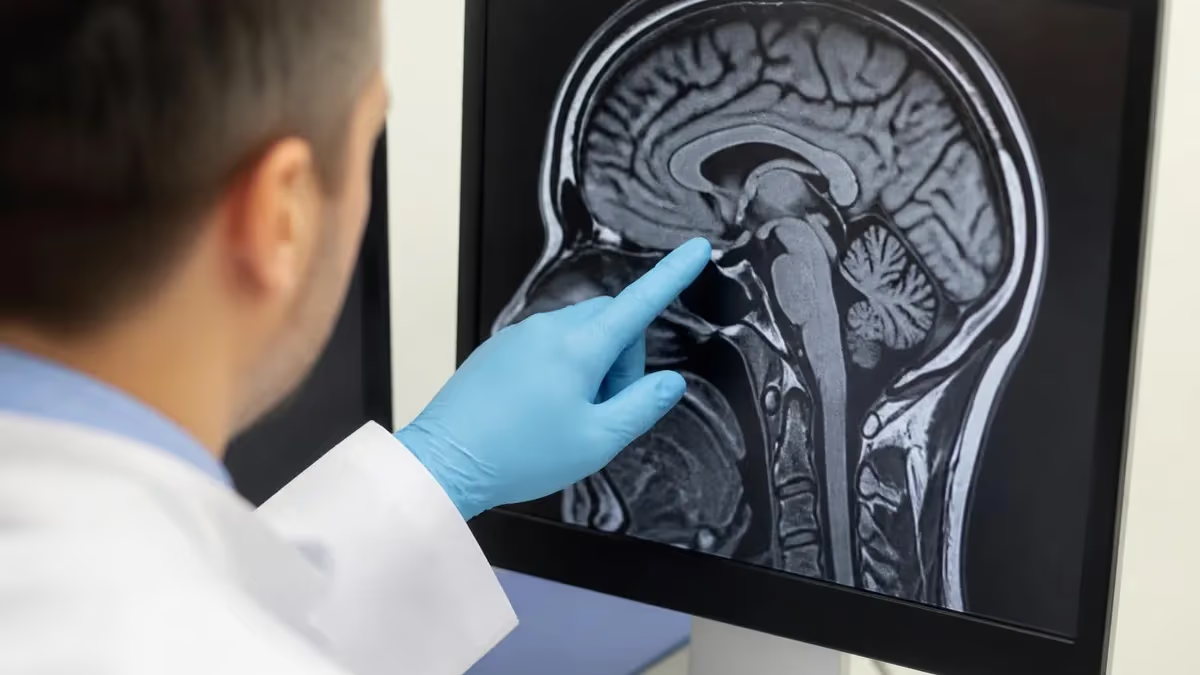
What an MRI Actually Costs in 2026
If you've just been told you need an MRI, the first question after "why" is usually "how much?" And the honest answer is: it depends. A basic MRI scan in the US can run anywhere from about $400 at a budget imaging center to over $5,000 at a major hospital. That's a 12x spread for the exact same picture of your body. Crazy, right? Practice with the free MRI - Magnetic Resonance Imaging practice test on PracticeTestGeeks (200+ questions with answer explanations).
This guide breaks down what you'll actually pay in 2026. We'll cover prices by body part, what insurance does (and doesn't) cover, how hospitals compare to standalone imaging centers, what overseas scans cost, and the real tactics people use to cut their bill in half. No fluff, no medical jargon you can't follow.
Here's the thing nobody tells you upfront. The price isn't really set by what the scan costs to perform. It's set by who owns the machine, what they negotiated with insurers, and whether you bothered to ask for a cash rate. Two clinics on the same block can quote you wildly different numbers. So before you book, it pays to shop. Yes, really. Like you'd shop for a fridge or a flight.
One more thing before we dive in. The number on the bill is rarely the number you actually owe. There's the sticker price (sometimes called "chargemaster"), the insurance-negotiated rate, the cash-pay discount, and the patient responsibility after deductible. All four can be different by thousands of dollars. Knowing which one you're being quoted is half the battle. Ask the question directly when you call: "Is this a cash-pay rate, an insured rate, or sticker price?" If the receptionist can't answer, ask for the billing manager. They always can.
MRI: upcoming dates and official changes
- Aug 17, 2026: ARRT launched a separate entry-level Imaging Assistant, Magnetic Resonance (I.A.) credential. A reduced $75 fee applied to applications made Aug. 17–Oct. 14, 2026, for testing Oct. 15–Nov. 30, 2026. Later applicants pay $225 and can test on or after Jan. 1, 2027.[4]
- The ARRT MRI exam for postprimary-pathway candidates has 220 questions: 200 scored and 20 unscored pilot items.[1]
- The ARRT MRI exam for primary-pathway candidates has 230 questions: 200 scored and 30 unscored pilot items.[2]
- Postprimary-pathway candidates get 210 minutes for the ARRT MRI exam, inside a 230-minute (3 hours, 50 minutes) appointment.[1]
- Primary-pathway candidates get 230 minutes for the ARRT MRI exam, inside a 250-minute (4 hours, 10 minutes) appointment that also covers the tutorial, the NDA and a survey.[2]
- To pass the ARRT MRI exam you need a total scaled score of 75 on ARRT's 1–99 scale. This is not a percentage.[3]
- The ARRT MRI exam through the postprimary pathway costs $225, or $450 for candidates whose supporting credential is from NMTCB or ARDMS.[4]
- The ARRT MRI certification exam costs $225 to apply for through the primary eligibility pathway.[4]
- ARRT MRI candidates have three attempts to pass the exam, all within three years of the date their first exam window opens.[2]
- ARRT MRI certification and registration lasts 10 years, even with annual renewal. After that, holders must complete Continuing Qualifications Requirements (CQR).[5]
Numbers in brackets link to the official sources listed under Sources & last verified. Dates that have passed are removed automatically.
MRI Exam at a Glance
| Item | Detail | Source · Verified |
|---|---|---|
| Number of questions (Postprimary pathway) | 220 questions (200 scored + 20 unscored pilot)[1] | assets-us-01.kc-usercontent.com · Oct 15, 2026 |
| Number of questions (Primary pathway) | 230 questions (200 scored + 30 unscored pilot)[2] | assets-us-01.kc-usercontent.com · Oct 15, 2026 |
| Time limit (Postprimary pathway) | 210 minutes test time (230-minute appointment)[1] | assets-us-01.kc-usercontent.com · Oct 15, 2026 |
| Time limit (Primary pathway) | 230 minutes test time (250-minute appointment)[2] | assets-us-01.kc-usercontent.com · Oct 15, 2026 |
| Passing score | Scaled score of 75 (scale 1–99)[3] | The American Registry of Radiologic Technologists · Oct 15, 2026 |
| Exam fee (Postprimary pathway) | $225 application fee ($450 with an NMTCB or ARDMS supporting credential)[4] | The American Registry of Radiologic Technologists · Oct 15, 2026 |
| Exam fee (Primary pathway) | $225 application fee[4] | The American Registry of Radiologic Technologists · Oct 15, 2026 |
| Retake policy | 3 attempts within 3 years of the first exam window[2] | assets-us-01.kc-usercontent.com · Oct 15, 2026 |
| Validity | 10 years, then Continuing Qualifications Requirements (CQR)[5] | assets-us-01.kc-usercontent.com · Oct 15, 2026 |
| Renewal | Annual renewal, $65/year; 24 CE credits every 2 years[5] | assets-us-01.kc-usercontent.com · Oct 15, 2026 |
| Delivery | Computer-based at Pearson VUE test centers[2] | assets-us-01.kc-usercontent.com · Oct 15, 2026 |
| Eligibility (Postprimary pathway) | Supporting ARRT credential (or NMTCB/ARDMS) + structured education + clinical experience[1] | assets-us-01.kc-usercontent.com · Oct 15, 2026 |
| Eligibility (Primary pathway) | ARRT-recognized MRI program + associate degree or higher + ethics[2] | assets-us-01.kc-usercontent.com · Oct 15, 2026 |
| Score release | Preliminary score at the test center; official results in about 10 business days[3] | The American Registry of Radiologic Technologists · Oct 15, 2026 |
| Testing window | One-year (365-day) exam window per application[2] | assets-us-01.kc-usercontent.com · Oct 15, 2026 |
Free MRI - Magnetic Resonance Imaging Study Tools
Interactive MRI - Magnetic Resonance Imaging resources on PracticeTestGeeks, free to start:
- Free MRI Knowledge Questions and Answers — 11 questions with instant scoring and answer explanations
- MRI - Magnetic Resonance Imaging flashcards — review key terms and concepts card by card
- MRI - Magnetic Resonance Imaging study guide — topic-by-topic overview of what the exam covers
- MRI - Magnetic Resonance Imaging cheat sheet — one-page printable summary for last-minute review
Quick answer: The average MRI scan cost in the US in 2026 sits between $400 and $3,500 without insurance. With insurance, you'll usually pay a copay of $0 to $300+, plus whatever's left on your deductible. Standalone imaging centers are typically 30-60% cheaper than hospitals for the same scan.
MRI Cost at a Glance
How Much Does an MRI Cost by Body Part?
Different body parts mean different scan times, different protocols, and sometimes different scanner attachments. That all feeds back into the price. The tabs below give you a real-world range for each common scan type, drawn from imaging center cash rates and hospital outpatient charges across the US in 2026. Use these as your reality check before you accept any quote. If you're being charged way above the high end, push back hard or shop elsewhere.
MRI Cost by Body Part
$1,000 - $5,000 without insurance
Brain MRIs are among the most commonly ordered scans, used for headaches, suspected stroke, tumors, MS, and trauma. The price climbs if your doctor orders contrast (gadolinium) to highlight blood vessels or lesions. Hospital-based brain MRIs often hit the top of that range; an outpatient imaging center can get you a quality brain scan for around $700-$1,500 cash. Add another $200-$300 if contrast is required.
Hospital vs Imaging Center: Where Should You Get Scanned?
Notice how the spread on every body part is huge? That's because the underlying MRI machine matters too. A 1.5 Tesla scanner produces solid images at a lower price point. A 3T scanner gives sharper detail (especially for brain and joints) and usually costs more. A 7T research-grade machine? You're not getting that on insurance unless you're in a clinical trial. For 95% of clinical questions, a 1.5T scan does the job perfectly. Don't pay extra for a 3T unless your doctor specifically requests it.
The hospital vs imaging center gap is the single biggest lever you can pull on price. Same scanner make, same radiologist reading the images sometimes, just a different building. If your doctor sends a hospital order, ask: "Can this be done at an outpatient center instead?" The answer is almost always yes for routine scans. Hospitals charge facility fees that can double or triple the bill, even when the actual imaging is identical to what an outpatient center provides.
Where to Get Your MRI
- Typical cost (no insurance): $1,500 - $5,000
- Wait time: 1-3 weeks
- Pros: Same-day if urgent, full medical team on site
- Cons: Highest sticker price, facility fees added
- Typical cost (no insurance): $400 - $1,500
- Wait time: 2-7 days
- Pros: 30-60% cheaper, faster scheduling, cash discounts
- Cons: May not handle very complex cases
- Typical cost (no insurance): $500 - $1,200
- Wait time: Varies by route
- Pros: Useful in rural areas, often cheaper
- Cons: Limited to lower-field strength scanners
- Typical cost: $1,500 - $5,000+
- Wait time: Same week often
- Pros: No referral needed, glossy reports
- Cons: Not insured, may flag harmless findings
Insurance, Medicare, and What You'll Actually Pay
Most US health plans cover MRI when it's medically necessary. That's the catch - your insurer (not your doctor) decides what counts as necessary. Pre-authorization is the norm. If you skip that step, even a fully covered scan can come back as a denied claim and you'll get the entire sticker bill. Always confirm pre-auth has been filed before you walk in. Call your insurer 48 hours before the scan to confirm the authorization is actually approved in their system, not just "submitted" by the doctor's office. There's a difference, and it can cost you thousands.
Once auth is locked in, you still owe whatever's left on your deductible plus your coinsurance percentage. On a high-deductible plan, that can easily be $1,000+ out of pocket even though insurance "covered" it. Plans with copay-only MRI benefits are gold - usually $50-$300 flat and you're done. If your employer offers multiple plans during open enrollment and you know you'll need imaging, the higher-premium copay plan often beats the cheap high-deductible plan once you do the math on a single MRI.
Medicare covers MRI under Part B at 80% of the approved amount once you hit the annual deductible ($240 in 2026). You're on the hook for the remaining 20% unless you have supplemental coverage. Medicare Advantage plans vary wildly - some are great, others charge 30% coinsurance. Always check before scheduling. A quick call to the member services number on the back of your card takes 5 minutes and can save you hundreds.
Medicaid coverage depends on your state. Most state Medicaid programs cover medically necessary MRI with little to no out-of-pocket cost, but pre-authorization rules are stricter and approved facilities may be limited. If you're on Medicaid, your provider's billing office is your best friend - let them handle the paperwork and confirm your scan is at an in-network facility before booking.
Don't skip pre-authorization. Even with great insurance, an MRI without prior approval can be denied 100%. You'll get the full sticker bill. Call your insurer 48 hours before the scan to confirm the authorization is in their system - not just "submitted" by the doctor's office.
How MRI Costs Compare Around the World
If you're uninsured or facing a $4,000+ quote, looking abroad can be a serious option. The same scan that costs $3,500 in a US hospital might be $250 in Mexico or $150 in India, performed on the same brand of scanner by US-trained radiologists. Medical tourism for MRI alone is rare, but if you're already traveling, take advantage. Some patients on the southern US border drive an hour to Tijuana for a $300 MRI rather than pay $2,500 locally. The math works out even after gas, parking, and a hotel night.
International MRI Cost Comparison
$400 - $5,000
Highest prices globally, but also the largest spread. Imaging centers can be reasonable; hospitals rarely are. Insurance is almost mandatory for affordability. If you're uninsured, cash-pay rates at outpatient centers are your best bet domestically.
Pros and Cons of MRI vs Cheaper Imaging
International scans are tempting on price alone, but factor in travel, lodging, and the headache of getting the images back to your US doctor. For uninsured patients facing a $4,000 quote, a $300 scan in Mexico plus $200 in travel is still a massive win. For someone with decent insurance, it's usually not worth the trip. Always confirm your US doctor will accept foreign-read images before you book international travel for a scan.
If you're trying to understand whether MRI is even the right test for you, it's worth comparing modalities. MRI vs CT scan is the most common question. CT is faster, cheaper ($300-$1,500 typical), and uses radiation. MRI is slower, pricier, and radiation-free with better soft-tissue detail. For broken bones, lung issues, or emergency trauma, CT usually wins on speed and cost. For brain, spinal cord, joints, and most soft-tissue work, MRI is the gold standard. Ultrasound is even cheaper ($100-$500) and works great for soft tissue near the surface, but can't see through bone or air.
MRI: Worth the Money?
- +MRI gives unmatched soft-tissue detail - no other imaging comes close
- +No ionizing radiation, unlike CT scans or X-rays
- +Safe to repeat over time for monitoring chronic conditions
- +Can detect issues months earlier than ultrasound or X-ray
- +Insurance usually covers when medically necessary
- −Most expensive routine imaging modality in the US
- −Long scan times (30-90 minutes) mean you can't fit it in lunch break
- −Claustrophobic patients struggle in closed-bore machines
- −Pre-authorization adds days to scheduling
- −Contrast and radiologist fees often billed separately, hidden from initial quote
Pros and Cons at a Glance
| Pros | Cons |
|---|---|
| MRI gives unmatched soft-tissue detail - no other imaging comes close | Most expensive routine imaging modality in the US |
| No ionizing radiation, unlike CT scans or X-rays | Claustrophobic patients struggle in closed-bore machines |
| Safe to repeat over time for monitoring chronic conditions | Pre-authorization adds days to scheduling |
| Can detect issues months earlier than ultrasound or X-ray | Contrast and radiologist fees often billed separately, hidden from initial quote |
The Step-by-Step Process to Get the Cheapest MRI
Here's the playbook smart patients follow. None of these steps require insider knowledge - just a willingness to pick up the phone and treat your scan like a major purchase. Done well, this whole process takes about an hour spread over a few days, and saves between $500 and $2,000 in most cases. That's not bad for an hour of work, especially if you're paying out of pocket.
How to Save on Your MRI
Get the order
Price-shop
Verify insurance
Compare cash vs insured
Book and confirm
Request itemized bill
Hidden Costs Most Patients Miss
Here's a money tip people sleep on. Ask for the bill to be itemized line by line. Hospitals and imaging centers make billing errors constantly. Charges for services you didn't get, double-billed contrast, or facility fees that shouldn't apply to outpatient cash-pay scans. A 10-minute phone call disputing a few line items can knock hundreds off your final balance. Some patients report shaving 20-40% off their bill just by requesting itemization and questioning anything that looks duplicated or unfamiliar. The billing departments expect this. They have discount codes ready for patients who push back.
The number you're quoted on the phone is rarely all-in. The radiologist read fee is the biggest hidden cost. The technician runs the scan, but a radiologist (a specialized doctor) reads the images and writes the report. At hospitals, this fee is usually bundled. At standalone centers, it's often separate - $100 to $400. Always ask: "Is the read fee included in your quote?" If they say no, get the dollar figure in writing before you book.
Contrast is the second hidden cost. If your scan needs gadolinium contrast (most brain, abdomen, pelvis, and breast MRIs do), expect another $100-$300 added. Some centers include it in their cash rate; many don't. Ask up front. Sedation is rarer - adults usually don't need it, but kids and severely claustrophobic patients sometimes do. Conscious sedation runs $200-$500. General anesthesia (rare, mostly for young children) can add $1,000+ plus the anesthesiologist's separate professional fee.
Cancellation fees catch a lot of people too. Miss your appointment without 24-hour notice and you're often billed $100-$250. Some hospitals will bill the full scan fee. Read the fine print when you confirm. Repeat scans are another gotcha. If you move during the scan and the images are unusable, you may be charged for a repeat. Stay still. It really matters - and the techs are trained to spot motion artifacts immediately, so they may stop and restart on the spot.
Pre-Scan Money-Saving Checklist
- ✓Confirm pre-authorization is approved (not just submitted) before scan day
- ✓Ask whether the scan can be done at an imaging center instead of hospital
- ✓Request a cash-pay rate even if you have insurance - sometimes it's lower
- ✓Get the CPT code from your doctor and price-shop with it
- ✓Check if your plan has a preferred imaging network with lower cost-sharing
- ✓Ask if the radiologist's reading fee is bundled or billed separately
- ✓Verify whether contrast (gadolinium) is needed - it adds $100-$300
- ✓Use FSA or HSA dollars to pay - you're spending pre-tax money
Smart Strategies to Cut Your MRI Bill
Want to understand what an MRI is at a deeper level before you spend the money? It can help you have a smarter conversation with your doctor about whether the scan is truly needed or whether a cheaper alternative (ultrasound, X-ray, or CT) might answer the same clinical question. Sometimes the cheapest MRI is the one you don't get because a $200 ultrasound answers the question just as well.
Now the strategies that actually work for cutting your bill. None of these require insider knowledge - just a willingness to make a few phone calls and ask uncomfortable questions. Start with price comparison tools. Healthcare Bluebook, NewChoiceHealth, and MDsave let you compare MRI prices in your zip code. MDsave even sells pre-paid MRI vouchers at fixed cash rates - sometimes 70% off hospital sticker prices. You buy the voucher online, walk in, hand it over, done. No surprise bills.
Ask for the cash-pay or self-pay rate everywhere you call. Many facilities have a discounted cash rate that's lower than what they bill insurance. If you have a high-deductible plan and haven't met your deductible, paying cash can be cheaper than running it through insurance. The catch is that cash payments don't count toward your deductible - so weigh that if you expect more medical costs this year. Sometimes the right call is to run it through insurance even at a higher rate, just to chip away at the deductible for future bills.
Negotiate. Yes, medical bills are negotiable. Call the billing office and ask for a financial hardship discount or a prompt-pay discount. 10-30% off is common if you ask. If you can pay the whole balance same-day, ask for a deeper cut. Many billing offices have authority to discount 20-40% for immediate payment without escalating to a manager. Use FSA or HSA dollars whenever possible. Pre-tax money saves you 20-37% depending on your tax bracket. A $1,000 MRI paid with HSA dollars effectively costs you about $700-$800. That's free money sitting in your HSA - use it.
Check hospital charity care. Nonprofit hospitals are required by law to offer financial assistance to patients who qualify. If you're under 400% of the federal poverty level, you may qualify for a 50-100% discount. Always ask. The application is a 2-3 page form and proof of income. Many hospitals don't advertise charity care, so you have to bring it up. The financial counselor's office is the right place to start.
You can continue preparing with the mri abdomen and pelvis cpt code, which includes answer explanations for every question.
You can continue preparing with the open mri near me, which includes answer explanations for every question.
Regional Pricing and the Bottom Line
One final point on regional variation. MRI prices in the US correlate roughly with cost of living, but not always. New York City and San Francisco are predictably expensive. But mid-size cities in the South and Midwest sometimes have surprisingly high prices because there's less competition. Rural areas often beat suburban ones because hospitals there compete harder for patient volume. Don't assume your local area is cheaper or pricier - check the actual numbers using comparison tools. A scan in a town 30 minutes away could be $1,000 less than the one in your neighborhood.
Putting it all together: for a routine MRI in 2026, a savvy uninsured US patient should be paying $500-$1,200 cash at a quality outpatient imaging center. If you're being quoted more than $2,000 for a single body part scan and you don't have insurance, you're being overcharged. Walk away and call somewhere else. There's almost always a cheaper option within driving distance, especially in any city of decent size.
The bottom line on MRI scan cost is this. It's one of the most price-variable medical services you'll ever buy in the US. Two clinics, same scan, different prices by thousands of dollars. The patients who pay the least are the ones who treat it like any other major purchase - get multiple quotes, ask for the cash rate, verify exactly what's included, and don't assume your insurance has it handled. Spend an hour on the phone before booking and you can save four-figure sums. That's a pretty good hourly rate, even if you hate making phone calls.
Sample MRI - Magnetic Resonance Imaging Practice Questions
Try these questions from our free MRI - Magnetic Resonance Imaging practice tests. The correct answer and an explanation follow each question.
Which sequence parameter directly controls the slice thickness in a 2D spin-echo acquisition?
- A. Bandwidth of the readout gradient
- B. Bandwidth of the RF pulse divided by the slice-select gradient amplitude
- C. TE duration
- D. TR duration
Answer: B. Bandwidth of the RF pulse divided by the slice-select gradient amplitude
Slice thickness = RF pulse bandwidth ÷ slice-select gradient amplitude; thicker slices can be produced by widening the RF bandwidth or reducing the gradient strength.
In cardiac MRI, which sequence is used to assess myocardial viability and detect scar tissue?
- A. True FISP cine imaging
- B. Late gadolinium enhancement (LGE) with inversion recovery
- C. First-pass perfusion with adenosine stress
- D. Black-blood T2 STIR
Answer: B. Late gadolinium enhancement (LGE) with inversion recovery
Late gadolinium enhancement (LGE) uses an inversion recovery sequence 10–15 minutes after GBCA injection; scarred myocardium retains gadolinium and appears bright against nulled normal myocardium.
Which labeling term indicates that an item has been tested and poses no known hazards in ALL MRI environments?
- A. MR Conditional
- B. MR Compatible
- C. MR Safe
- D. MR Approved
Answer: C. MR Safe
The ASTM 'MR Safe' label means the item poses no known hazards in all MRI environments and is made of non-conductive, non-magnetic, non-RF-reactive materials.
Gibbs ringing artifact is caused by:
- A. Truncation of k-space data at high spatial frequencies
- B. Motion during phase encoding
- C. Chemical shift between fat and water
- D. RF pulse imperfections
Answer: A. Truncation of k-space data at high spatial frequencies
Gibbs ringing (truncation artifact) occurs when k-space is sampled with insufficient high-frequency data, causing oscillating bands near sharp tissue interfaces.
Take the full MRI - Magnetic Resonance Imaging practice test
MRI Scan Cost Questions and Answers
Sources & last verified
- assets-us-01.kc-usercontent.com — number of questions, time limit, eligibility (official source). “MRI Scored Items 200 Pilot Items 20 Total Items 220 Test Time 210 min” Verified Oct 15, 2026.
- assets-us-01.kc-usercontent.com — number of questions, time limit, retake policy, delivery (official source). “MRI Scored Items 200 Pilot Items 30 Total Items 230 Test Time 230 min” Verified Oct 15, 2026.
- The American Registry of Radiologic Technologists — passing score, score release (official source). “Our exam scoring scale ranges from 1 to 99, and you’ll need a total score of 75 to pass the exam.” Verified Oct 15, 2026.
- The American Registry of Radiologic Technologists — exam fee, other (official source). “Postprimary (M, CT, MR, BD, CI, VI, VS, BS, R.R.A.): $225 Postprimary (CT, MR, BD, or VS—using NMTCB as supporting category): $450 Postprimary (MR, VS,…” Verified Oct 15, 2026.
- assets-us-01.kc-usercontent.com — validity, renewal (official source). “ARRT certification and registration—even with annual renewal—is limited to 10 years.” Verified Oct 15, 2026.
How we verify: editorial & fact-checking policy. Report an error: contact us.
How this page was made: written with AI tools and published by Nathan Beja, founder of Practice Test Geeks, who is responsible for its content. Exam facts are checked against the official sources listed below. Not reviewed by a subject-matter expert. Editorial policy
Sources & references
Exam facts on this page (fees, format, dates, passing scores) are checked against these official sources; the date is our last check. Editorial policy
- arrt.org — Passing score, score release, fees, exam information · verified Oct 2026
- assets-us-01.kc-usercontent.com — Renewal, score validity, test delivery, eligibility, exam format, test dates, time limit · verified Oct 2026