
MRI Medical Abbreviation: What MRI Stands For and Why It Matters 2026 October
MRI medical abbreviation stands for Magnetic Resonance Imaging. 📝 Learn what MRI means in charts, prescriptions, and reports, plus related terms.
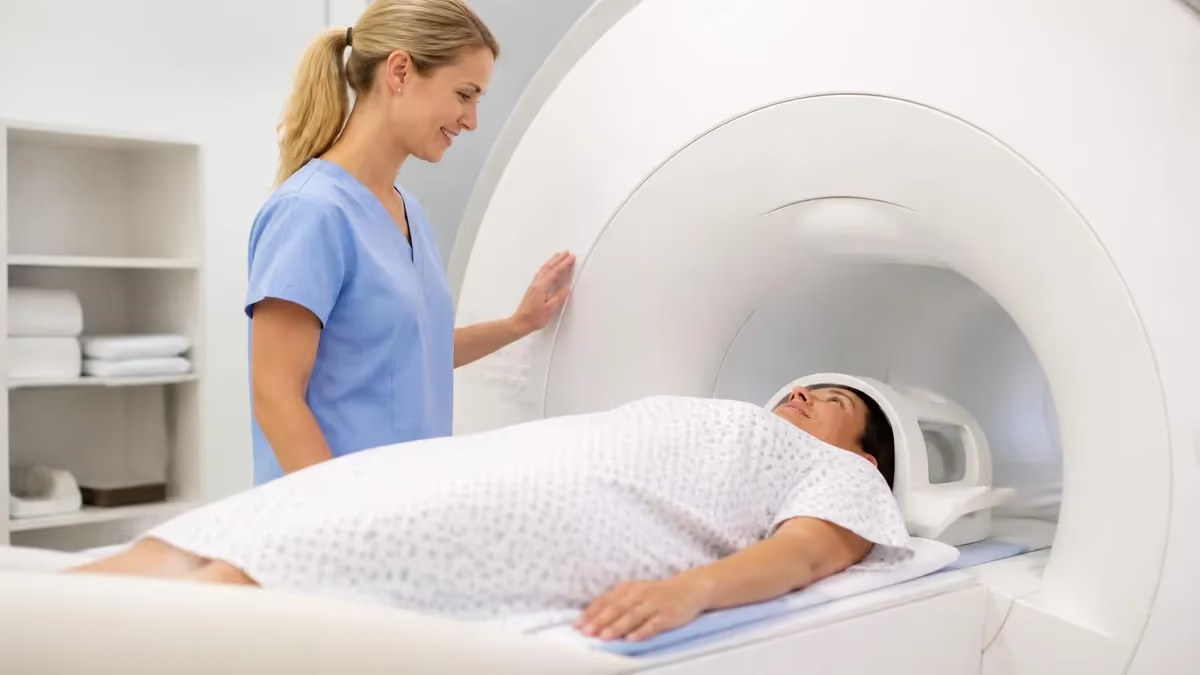
You spotted three letters on a referral slip, a hospital chart, or a doctor's note: MRI. The MRI medical abbreviation stands for Magnetic Resonance Imaging, and it's one of the most common acronyms you'll meet inside any modern healthcare setting. Yet the meaning runs deeper than a simple definition.
MRI represents an entire family of non-radiation imaging tests that uses powerful magnets and radio waves to produce highly detailed pictures of soft tissues, bones, joints, blood vessels, and the brain. The abbreviation pops up across radiology orders, insurance pre-authorizations, surgical reports, and emergency triage notes.
Knowing what it stands for, and the related abbreviations that often surround it, helps you decode your own records, follow conversations with clinicians, and make informed decisions. This guide unpacks the abbreviation in clinical context, walks through the most common related medical shorthand, and explains how to read MRI references inside a chart.
Beyond the basic three letters, hospital paperwork stacks abbreviations together. You might see cMRI, fMRI, MRA, MRV, or MRCP on a single page. Each variant carries a specific clinical meaning and signals which body part the radiologist scanned, whether contrast was used, and what condition the doctor wanted to investigate.
MRI by the Numbers
What Does MRI Stand For in Medical Terms?
MRI is the official acronym for Magnetic Resonance Imaging. The name describes exactly how the technology works. A strong magnet aligns the hydrogen atoms in your body, then radio-frequency pulses knock those atoms out of alignment for a moment.
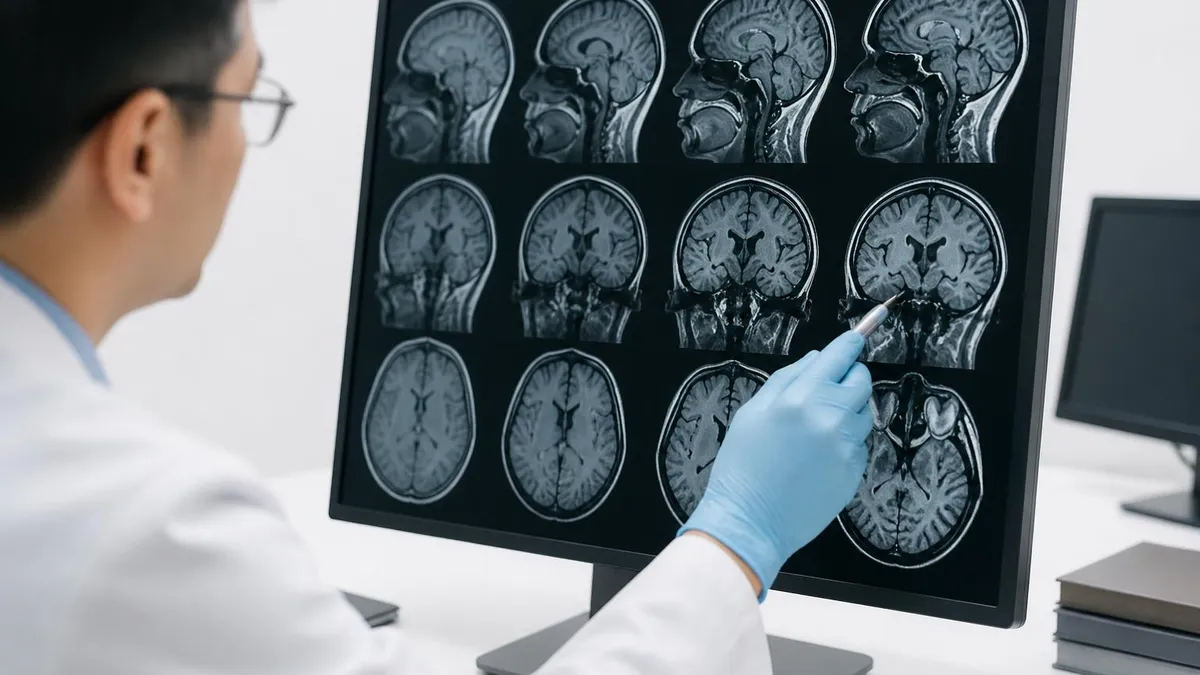
As they snap back, they release energy. The MRI scanner picks up the energy and a computer translates it into the cross-sectional images radiologists read on their screens.
You'll also see the abbreviation written as M.R.I. with periods in older textbooks, but modern style guides drop the periods. Some European countries use MR (Magnetic Resonance) on its own or NMR (Nuclear Magnetic Resonance), which is the original physics term. Hospitals dropped the word "nuclear" decades ago because patients confused it with nuclear medicine or radioactive isotopes.
Inside a patient chart, the abbreviation rarely appears by itself. It almost always sits next to a body part or a qualifier. A line might read "MRI L-spine w/o contrast" or "f/u MRI brain." Reading those notes becomes much easier once you recognize the surrounding shorthand. If you want a deeper background, our guide on what an MRI is walks through the physics in plain language.
Quick Answer
MRI = Magnetic Resonance Imaging. It's a non-radiation imaging test that uses magnets and radio waves to produce detailed pictures of organs, soft tissues, joints, and blood vessels.
Why Doctors Use the Abbreviation Instead of the Full Name
Time is the simplest reason. Three letters fit on a prescription pad, a sticky note, an EHR field, or a phone screen far faster than thirteen. Radiology departments process hundreds of orders a day and abbreviations let staff move through schedules without rewriting Magnetic Resonance Imaging on every form.
Insurance companies also rely on the abbreviation in CPT codes and pre-authorization documents. There's also a clarity angle. Once you've seen the abbreviation once, you instinctively know what test is being discussed.
Doctors group MRI with other imaging shorthand like CT (Computed Tomography), US (Ultrasound), and X-ray. A radiology requisition might list options as checkboxes: CT, MRI, US, NM (Nuclear Medicine), or Mammo. Quick selection means fewer transcription errors and faster patient throughput in busy departments.
Where You'll See the MRI Abbreviation
- ✓Referral slips and order forms from primary care or specialists
- ✓Pharmacy notes when a medication might interact with contrast
- ✓Hospital discharge summaries describing imaging performed during your stay
- ✓Insurance Explanation of Benefits (EOB) documents listing covered services
- ✓Surgical operative reports referencing pre-op imaging
- ✓Physical therapy intake forms asking about recent diagnostic tests
- ✓Radiology reports describing scan technique and findings
MRI Variants You Should Recognize
The base abbreviation MRI sits at the head of a small family of related acronyms. Each one tells you what part of the body or what physiological feature was being studied. Knowing the variants helps you understand exactly which test was performed.
Six Common MRI Variants
Magnetic Resonance Imaging — the base abbreviation. Always non-radiation, magnet-based imaging.
Magnetic Resonance Angiography — MRI focused on arteries to look for narrowing, aneurysm, or clot.
Magnetic Resonance Venography — MRI focused on veins, often used to investigate clot or sinus thrombosis.
Magnetic Resonance Cholangiopancreatography — MRI of bile ducts and pancreatic duct, no oral contrast needed.
Functional MRI — measures brain activity by detecting blood flow changes, used in research and pre-surgical mapping.
Cardiac MRI — heart-focused imaging that evaluates muscle, valves, and scar tissue with high precision.
Common MRI-Related Abbreviations Decoded
When you read a chart that mentions MRI, you're rarely seeing just those three letters. Surrounding abbreviations describe the body part, the technique, and whether contrast dye was injected. Here's a clinician-style breakdown of the shorthand you'll meet most often.
Body-Part Modifiers
Hospitals shorten anatomy too. L-spine means lumbar spine, C-spine means cervical spine, T-spine means thoracic spine mri cpt. UE stands for upper extremity, LE for lower extremity. RUQ and LUQ refer to right and left upper quadrants of the abdomen.
So a line like "MRI L-spine w/ and w/o contrast" decodes to: lumbar spine MRI performed both with and without contrast injection. For an in-depth look at this specific scan, our lumbar spine MRI guide covers indications, sequences, and what your report means.
Contrast Shorthand
Two of the most important MRI abbreviations describe whether contrast was used. w/c or w/contrast indicates gadolinium-based contrast was injected, helping radiologists see blood vessels, inflammation, or tumors more clearly.
w/o or w/o contrast means no contrast was given. Gad is shorthand for gadolinium itself. You'll often see notes like "MRI brain w/ and w/o gad" which means both sequences were obtained. Learn more in our overview of MRI contrast agents.
Where MRI Appears in Healthcare Documents
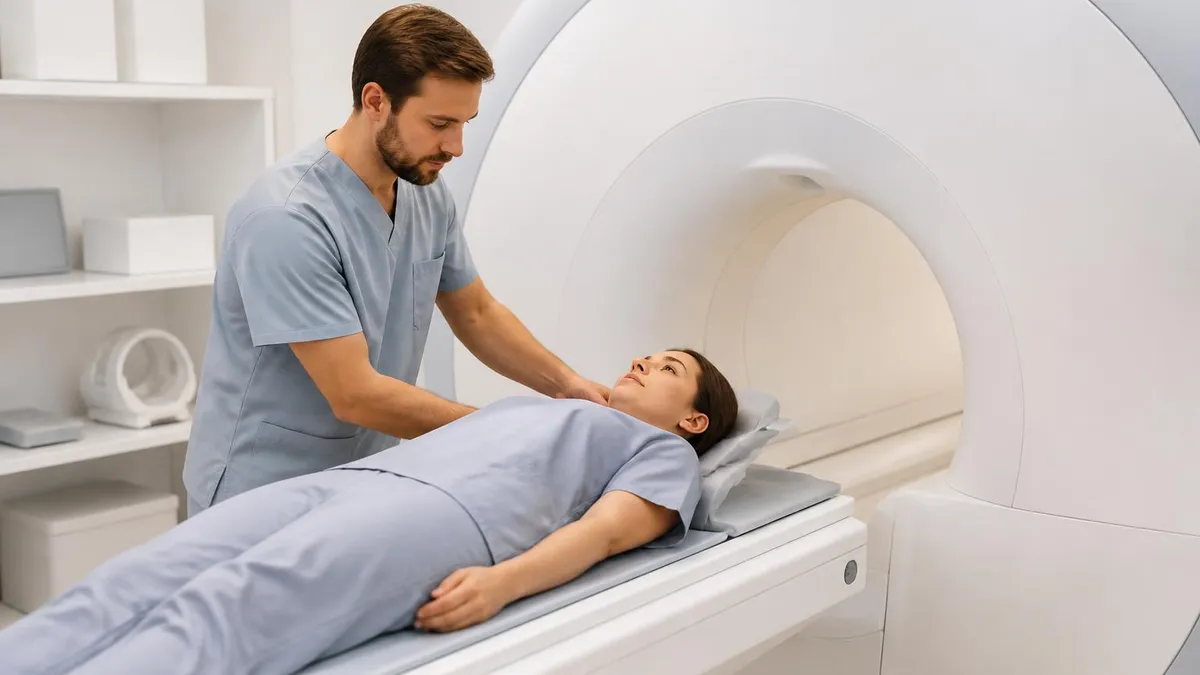
Inside EHR systems like Epic or Cerner, MRI appears as a structured order. The chart shows the date, ordering provider, body part, contrast use, and clinical indication. Look for fields labeled 'Imaging Orders' or 'Radiology.' The abbreviation usually appears with a hyphenated body part right after it.
Sequence Names You'll See in Reports
Two fundamental weighting schemes — each highlights different tissue properties and forms the backbone of any MRI study.
Fluid-Attenuated Inversion Recovery — suppresses CSF to reveal brain pathology near fluid spaces. Key for MS and stroke.
Diffusion-Weighted Imaging — critical for stroke detection. Acute infarcts light up within minutes of symptom onset.
Short Tau Inversion Recovery — suppresses fat signal. Highlights bone marrow edema and inflammation.
Gradient Echo and Susceptibility-Weighted Imaging — extremely sensitive to blood products, microbleeds, and iron.
Vascular sequences that isolate arteries (MRA) or veins (MRV) for aneurysm, clot, or stenosis assessment.
Always confirm with your provider exactly which type of MRI is being ordered. The difference between MRI, MRA, MRV, MRCP, and cMRI affects scheduling, preparation, contrast use, and the cost you may pay out of pocket.
The Difference Between MRI, MRA, and Other Imaging Acronyms
The MRI abbreviation belongs to a whole alphabet soup of imaging tests. Knowing what separates each one stops the confusion when a doctor mentions multiple options.
MRI vs CT. CT stands for Computed Tomography and uses X-ray radiation to build cross-sectional images. CT scans are fast and excellent for bones, lung tissue, and acute bleeding. MRI takes longer but gives far superior soft-tissue contrast. Brain, spine, joint, and pelvic imaging usually favors MRI when time allows.
MRI vs Ultrasound. Ultrasound (US) uses sound waves and is the lowest-cost imaging method. It's safe, real-time, and ideal for pregnancy, gallbladder, thyroid, and superficial structures. MRI provides far more detail and reaches structures ultrasound cannot, like the brain or deep joints.
MRA vs MRI. MRA isolates blood vessels. Standard MRI shows surrounding anatomy. If a doctor wants to look for an aneurysm or arterial blockage, they'll order an MRA. If they want to look at brain tissue itself, they'll order an MRI. Sometimes both are performed in the same visit.
fMRI vs MRI. Functional MRI measures brain activity by tracking blood-oxygen-level-dependent (BOLD) signals. Standard MRI shows structure only. Neurosurgeons use fMRI to map speech and motor areas before tumor surgery.
How to Pronounce and Spell MRI Correctly
MRI is spoken letter by letter: "em-ar-eye." It's never pronounced as a single word like "mree" or "mry." The same goes for the variants. fMRI becomes "eff-em-ar-eye," MRA is "em-ar-ay," and MRCP is "em-ar-see-pee."
Saying the letters individually matches the clinical convention and avoids confusion when discussing tests with your care team. For written records, capitalize all three letters with no periods.
Hyphens are unnecessary unless a body part follows: MRI-brain is acceptable shorthand but MRI brain without a hyphen is more common. In formal documentation, the full term "Magnetic Resonance Imaging" appears once with the abbreviation in parentheses, then the abbreviation is used throughout.
Decoding Charts Yourself: Should You?
- +Faster comprehension of your own medical records
- +Better conversations with doctors and nurses
- +Easier insurance claim review
- +Confidence asking follow-up questions
- +Ability to research your imaging results online with the right terms
- +Useful background for healthcare careers and exams
- −Self-decoding never replaces professional interpretation
- −Some abbreviations vary by hospital or country
- −Context-dependent meanings can mislead novices
- −Easy to misread similar acronyms (MRI vs MRA)
- −Always confirm critical findings with your clinician
Pros and Cons at a Glance
| Pros | Cons |
|---|---|
| Faster comprehension of your own medical records | Self-decoding never replaces professional interpretation |
| Better conversations with doctors and nurses | Some abbreviations vary by hospital or country |
| Easier insurance claim review | Context-dependent meanings can mislead novices |
| Confidence asking follow-up questions | Easy to misread similar acronyms (MRI vs MRA) |
| Ability to research your imaging results online with the right terms | Always confirm critical findings with your clinician |
When You Should Recognize the Abbreviation
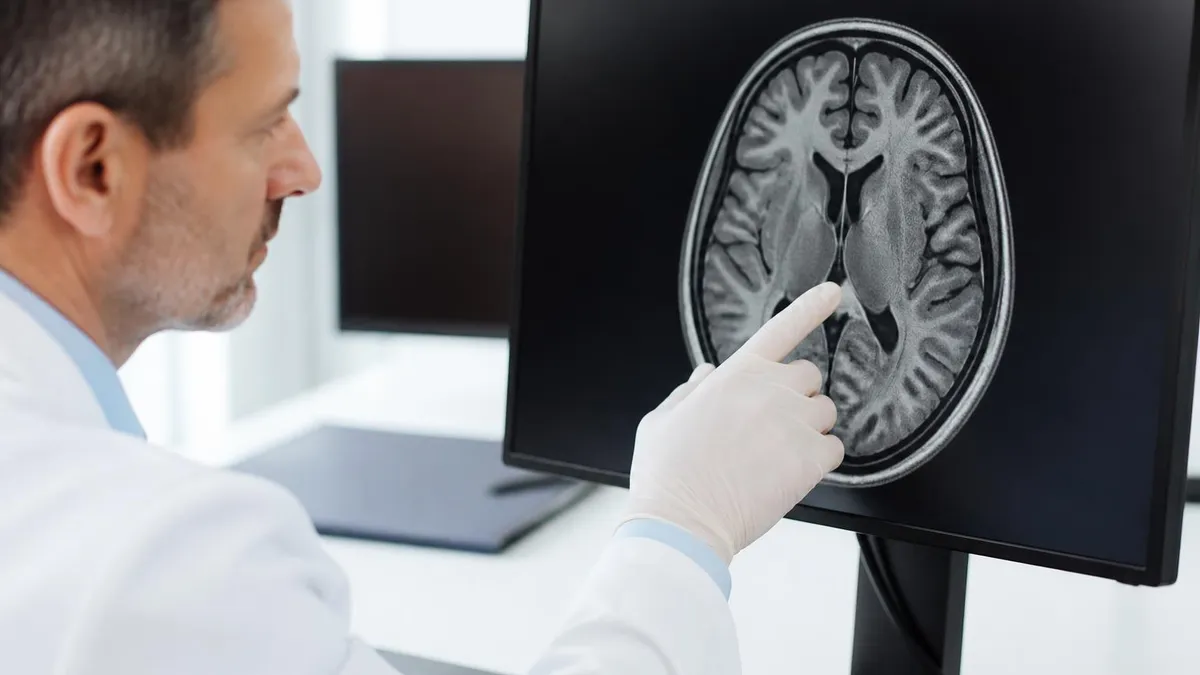
You don't need a medical degree to benefit from knowing what MRI stands for. Plenty of everyday scenarios call for the knowledge. Maybe your insurance portal lists a charge for an MRI you don't remember scheduling. Maybe a parent's discharge summary mentions an MRI ordered during a hospital stay.
Maybe a coach forwards a sports physical that references an MRI of the knee. In each case, you read the abbreviation, recognize it as Magnetic Resonance Imaging, and have a starting point for follow-up questions.
For students preparing for healthcare careers or certification exams, abbreviations like MRI form the bedrock of medical terminology. Our MRI practice tests drill the abbreviations, anatomy, safety rules, and contrast indications you'll meet on the registry exam.
Even non-clinical staff who work in scheduling, billing, or front-desk roles use the abbreviation daily and benefit from understanding the underlying meaning. The investment of learning the shorthand pays back every shift.
Decoding an MRI Order in a Chart
- ✓Locate the three letters MRI in the order
- ✓Identify the body part that follows (brain, knee, L-spine, etc.)
- ✓Look for contrast notation: w/c, w/o, or w/ and w/o
- ✓Note any qualifier like f/u (follow-up) or r/o (rule out)
- ✓Cross-reference the CPT code if listed
- ✓Check the clinical indication line for the suspected diagnosis
- ✓Confirm the ordering provider and date
- ✓Verify any prep instructions attached to the order
Less Common MRI Abbreviations Worth Knowing
Beyond the headline variants, several rarer MRI abbreviations show up in specialty practice. MRE stands for Magnetic Resonance Elastography, used to assess liver stiffness in suspected fibrosis. MRS is Magnetic Resonance Spectroscopy, which measures chemical metabolites inside tissue and is particularly useful for brain tumor characterization.
DTI is Diffusion Tensor Imaging, an advanced sequence that maps white-matter tracts in the brain. BOLD describes the contrast mechanism behind fMRI: Blood-Oxygen-Level Dependent. SWI is Susceptibility-Weighted Imaging, sensitive to small amounts of blood, calcium, or iron.
MRgFUS stands for Magnetic Resonance-guided Focused Ultrasound, a treatment modality that uses MRI to target therapeutic ultrasound waves, often for essential tremor or uterine fibroids. Cardiology specialists use LGE (Late Gadolinium Enhancement) on cardiac MRI to detect scar tissue from previous heart attacks.
SSFP (Steady-State Free Precession) is a sequence that gives excellent contrast between blood and heart muscle. Musculoskeletal radiologists use FS (Fat Saturation) or STIR sequences to highlight bone marrow edema and inflammation. Each abbreviation tells a story about what the scanner was set up to find.
Quick Reference for MR-Family Abbreviations
The History Behind the Abbreviation
The term Magnetic Resonance Imaging emerged in the 1970s. The underlying physics, Nuclear Magnetic Resonance, was discovered in 1946 by Felix Bloch and Edward Purcell, who shared the Nobel Prize in Physics for their work on the spin properties of atomic nuclei.
Raymond Damadian filed the first patent for using NMR to detect cancer in 1972. Paul Lauterbur and Peter Mansfield then developed the spatial encoding methods that allowed NMR signals to be turned into images, and they shared the Nobel Prize in Physiology or Medicine in 2003 for that contribution.
Originally the test was called NMRI (Nuclear Magnetic Resonance Imaging). In the early 1980s, hospital marketing teams pushed to drop the word "nuclear" because patients associated it with radiation and atomic energy. The shorter, friendlier MRI took over and never looked back.
The abbreviation is now recognized worldwide, even in non-English-speaking countries where local-language phrases exist alongside the universal three letters. Few medical acronyms have achieved that level of universal currency in such a short span of time, and even fewer have remained stable across decades of new scanner generations.
The persistence of the abbreviation also reflects the technology's central place in modern diagnostics. Hospitals built dedicated imaging suites around MRI scanners, insurance plans built coverage policies around the abbreviation, and patient education materials standardized around those same three letters. That consistency makes the abbreviation easier to learn and remember.
Looking back at how quickly MRI displaced longer alternatives shows how powerful a clean, memorable acronym can be in medicine. Even radiology training textbooks and Medicare billing codes now treat the three-letter abbreviation as the canonical form, with the full term appearing only in formal academic citations and patent literature for completeness.
Putting the Abbreviation in Real-World Context
Consider a typical visit. Sarah, 42, slips on icy steps and lands hard on her right shoulder. Her primary care doctor orders an X-ray, which rules out fracture. The pain persists for three weeks. Her doctor writes a new order: MRI R shoulder w/o contrast, r/o rotator cuff tear.
Sarah reads the slip and now understands every piece. MRI is the test. R shoulder is right shoulder. W/o contrast means no dye. R/o rotator cuff tear means the doctor is checking for a torn tendon.
She schedules the scan, gets the imaging, and downloads her report from the patient portal. The report opens with the same MRI heading. The findings section uses sequence names like T1, T2, and STIR. The impression confirms a partial-thickness supraspinatus tear.
Because Sarah understands what each abbreviation means, she walks into her follow-up appointment ready to discuss treatment options instead of asking the doctor to translate. Our dedicated rotator cuff MRI guide walks through this exact scenario in clinical depth.
The same logic applies in higher-stakes scenarios. An emergency department physician evaluating a possible stroke writes STAT MRI brain w/ DWI. STAT means immediately. DWI is diffusion-weighted imaging, the sequence that lights up an acute stroke within minutes of onset.
A neurologist scanning a patient for multiple sclerosis writes MRI brain and C-spine w/ and w/o gad, MS protocol. The protocol tells the technologist which specific sequences to acquire. Each abbreviation drives a real clinical action.
MR alone can mean Mitral Regurgitation in cardiology notes. MRSA is a bacterial infection. MS can mean multiple sclerosis or mitral stenosis. Always read the surrounding sentence to confirm which definition applies in context.
Avoiding Confusion with Similar Abbreviations and Final Thoughts
A handful of abbreviations look or sound like MRI but refer to completely different things. Reading the surrounding sentence usually clarifies which definition applies. Inside a radiology setting, MRI is unambiguous and unmistakable.
If you ever see the abbreviation outside a clinical context, the surrounding words will tell you whether it's imaging or something else. A medical record will pair MRI with a body part and a contrast notation. A cardiology note will pair MR with a heart valve. The pattern is consistent and recognizable once you've read a few charts.
Magnetic Resonance Imaging earned its three-letter shorthand for good reason. The test is one of the most powerful tools in modern medicine, and the abbreviation now travels with patients across every healthcare touchpoint, from the smallest rural clinic to the largest academic medical center.
Understanding what MRI stands for, what surrounds it on a chart, and which variants exist gives you a measurable advantage when navigating your own care or supporting a family member. Don't stop at the basic definition. Learn the body-part shorthand, the contrast notation, and the sequence names that fill out a real radiology order.
Each piece you decode makes the next medical conversation easier and the next chart less intimidating. The investment is small, the payoff stretches across every future appointment, scan, and report you'll ever encounter in the healthcare system.
Sample MRI - Magnetic Resonance Imaging Practice Questions
Try these questions from our free MRI - Magnetic Resonance Imaging practice tests. The correct answer and an explanation follow each question.
What is the purpose of crusher (spoiler) gradients in a spin echo sequence?
- A. To dephase residual transverse magnetization before the next RF pulse
- B. To refocus magnetization after the 180° pulse
- C. To select the imaging slice thickness
- D. To encode spatial position in the frequency direction
Answer: A. To dephase residual transverse magnetization before the next RF pulse
Crusher gradients surround the 180° refocusing pulse to eliminate stimulated echoes from imperfect flip angles that could contaminate image quality.
When performing MRI on a patient with an insulin pump, which step is essential before beginning the exam?
- A. Increase the insulin dose before scanning
- B. Remove the pump (if removable) or verify the pump is MR-conditional with the manufacturer before scanning
- C. Tape the pump to the patient's leg during the scan
- D. Leave the pump in place since insulin is not ferromagnetic
Answer: B. Remove the pump (if removable) or verify the pump is MR-conditional with the manufacturer before scanning
Insulin pumps may malfunction, heat, or be damaged in the MRI environment; removal or manufacturer verification of MR-conditional status is mandatory.
A patient reports a prior allergic-like reaction to a GBCA. Which of the following is the recommended premedication protocol?
- A. Antihistamine only, 1 hour before
- B. Corticosteroid + antihistamine, with the first steroid dose 13 hours before injection
- C. Aspirin 24 hours before
- D. No premedication is effective for GBCA reactions
Answer: B. Corticosteroid + antihistamine, with the first steroid dose 13 hours before injection
The ACR-recommended premedication protocol for prior GBCA reactions includes corticosteroids given 13, 7, and 1 hour before contrast, combined with an antihistamine 1 hour before.
Under ARRT policy, which scenario would trigger an automatic ethics review before an MRI registry application is processed?
- A. Candidate holds a second radiography credential
- B. Candidate has a prior misdemeanor conviction on record
- C. Candidate has exceeded the CE deadline by one week
- D. Candidate previously worked as a radiography aide
Answer: B. Candidate has a prior misdemeanor conviction on record
ARRT requires candidates with prior criminal history to undergo an ethics review to determine eligibility before the application proceeds.
Take the full MRI - Magnetic Resonance Imaging practice test
MRI Questions and Answers
About the Author

Medical Laboratory Scientist & Clinical Certification Expert
Johns Hopkins UniversityDr. Sandra Kim holds a PhD in Clinical Laboratory Science from Johns Hopkins University and is certified as a Medical Technologist (MT) and Medical Laboratory Scientist (MLS) through ASCP. With 16 years of clinical laboratory experience spanning hematology, microbiology, and molecular diagnostics, she prepares candidates for ASCP board exams, MLT, MLS, and specialist certification tests.
Join the Discussion
Connect with other students preparing for this exam. Share tips, ask questions, and get advice from people who have been there.
View discussion (8 replies)