
Home Health Aide Training Videos: The Complete Guide to HHA Certification and Career Success
Master home health aide videos, HHA exchange login, and certification steps. Free training resources, exam prep tips, and career guidance. 🎯
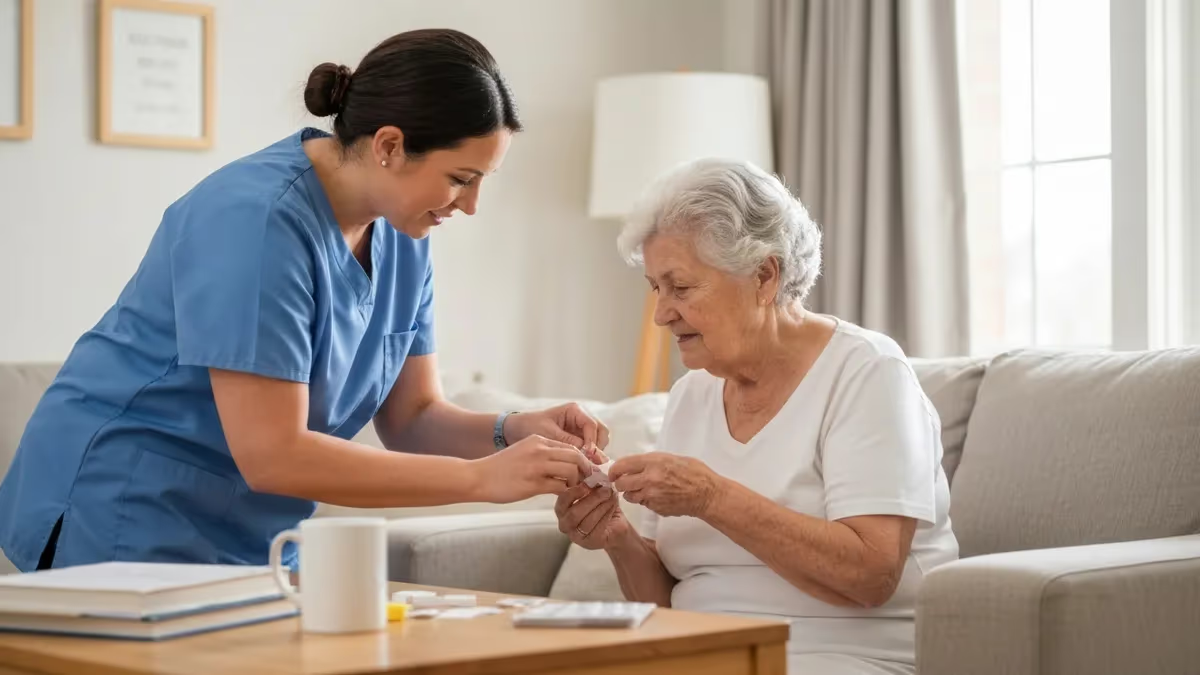
Home health aide videos have transformed how aspiring HHAs prepare for their certification exam and build the hands-on skills employers demand. Whether you are exploring the hha exchange platform, looking for structured home health aide training content, or simply trying to understand what a certified home health care aide actually does on the job, video-based learning offers a flexible, visual pathway that textbooks alone cannot replicate. This guide walks you through every resource, platform, and study strategy you need.
The hha exchange is one of the most widely recognized continuing education portals in the home care industry. Thousands of aides across the country log in each week to complete mandatory in-service hours, review state-specific compliance modules, and track their professional development records. If you have been searching for your hha exchange login credentials or trying to understand what the platform offers, this article covers both the technical side and the educational content available to registered users.
Home health aide certification is not simply a formality — it is the legal gateway to working with vulnerable patients in their homes. The requirements vary by state, but most programs combine classroom instruction, clinical skills demonstration, and a competency evaluation. Video training accelerates all three components because you can pause, rewind, and re-watch complex procedures like transfers, vital sign measurement, and infection control until you feel genuinely confident, not just passingly familiar.
Many candidates underestimate how visual and procedural the hha certification exam actually is. Written questions on the NNAAP or state-specific competency tests frequently describe clinical scenarios that come to life far more clearly on screen than on a printed page. Watching a skilled aide perform a bed bath, apply compression stockings, or assist a patient with range-of-motion exercises gives your brain a mental model that sticks when exam day arrives.
This guide is designed specifically for people who learn best when they can see and hear instruction rather than just read it. We cover free and paid video resources, how to navigate the hha exchange login portal, what to expect inside a home health aide training program, and how to connect your video learning to real practice test preparation. If you want free hha training near me options paired with solid video content, keep reading — we have mapped out the full landscape.
Whether you are brand new to caregiving or a seasoned CNA looking to expand your credentials, the information ahead will save you hours of research. We break down the most effective video topics, the platforms that host them, the competency areas your state board will test, and the study habits that separate candidates who pass on the first attempt from those who need a second try. The path to becoming a home health aid is clearer than you think when you have the right visual resources in front of you.
Finally, keep in mind that video training works best when it is paired with deliberate practice and active recall testing. Watching a procedure is the first step; being able to explain it, demonstrate it, and answer scenario-based questions about it is the real goal. Throughout this article we embed free practice quizzes tied directly to the skills covered in the most popular HHA training video topics, so you can test your retention in real time as you study.
HHA Certification by the Numbers

How to Complete Your HHA Training Program Step by Step
Choose a State-Approved Training Program
Complete Classroom and Video Instruction Hours
Practice Clinical Skills Under Supervision
Pass the Written and Skills Competency Evaluation
Register on the State Aide Registry
Complete Annual In-Service Hours via HHA Exchange
The hha exchange platform is the industry-standard continuing education management system for home health aides employed by Medicare-certified home health agencies. If your employer uses it, you will receive a username and temporary password during onboarding. The hha exchange login page is accessible from any browser, and the platform is fully mobile-responsive, meaning you can watch training videos on your phone during a lunch break or complete a quiz module while commuting on public transit between patient visits.
Once you complete the hha exchange login, your dashboard displays all assigned modules with due dates, your completion percentage for the current compliance period, and any certificates you have already earned. Agencies typically assign a mix of mandatory compliance topics — things like HIPAA privacy rules, abuse and neglect prevention, and emergency procedures — alongside clinical refresher videos covering wound care, medication reminders, and infection control updates. Each module combines a short instructional video with a knowledge check quiz you must pass before the system logs your completion.
For aides pursuing their home health aide certification rather than just maintaining it, the hha exchange also hosts preparatory content. Some agency accounts include pre-employment training tracks that walk new hires through the core competency areas tested on the state evaluation. These tracks are particularly useful for candidates who completed their classroom hours at one provider but want additional video reinforcement before sitting for the skills demonstration portion of their exam.
One frequently asked question is whether hha exchange login credentials transfer between employers. They generally do not — each agency administers its own instance of the platform with its own user database. If you change jobs, your new employer will create a fresh account for you. However, you can download PDF certificates of completion from your previous account before your access expires, and these documents can serve as professional development evidence when applying to new positions.
The home health aide training program experience on hha exchange is structured around adult learning principles: short video segments of 8 to 15 minutes each, immediate knowledge checks, and printable reference summaries you can save for offline review. Research consistently shows that learners retain significantly more when content is broken into smaller chunks with retrieval practice between segments, which is exactly the format the platform uses. If you want a home health aide certificate recognized across agencies, completing modules on accredited platforms like this one strengthens your professional profile considerably.
A practical tip for new hha exchange users: complete your assigned modules at least a week before each quarterly due date. Last-minute rushes on deadline day often coincide with server slowdowns when thousands of aides across the country try to log completions simultaneously. Spreading your viewing across several shorter sessions also dramatically improves retention compared to binge-watching an entire quarterly assignment in one sitting, which tends to produce passive viewing rather than active learning.
Beyond compliance, the platform occasionally releases elective modules on specialty topics like pediatric home care, hospice support techniques, and caring for clients with dementia or Alzheimer's disease. These optional courses are visible in your elective library tab and can be completed at any time without affecting your mandatory compliance record. Completing two or three elective modules per quarter signals professional initiative to supervisors and can support conversations about advancement into specialized care roles or lead aide positions.
Home Health Aide Training Video Topics by Competency Area
Basic care videos cover the procedures you will perform most frequently as a home health aide: bed baths, shampoos, oral hygiene, nail care, dressing assistance, and repositioning to prevent pressure injuries. These modules typically run 10 to 20 minutes each and include close-up camera angles showing proper hand placement and body mechanics. Watching these videos before your clinical hours dramatically reduces the anxiety most students feel when performing procedures on real patients for the first time.
The most effective basic care training videos include both the correct technique and common errors to avoid, because understanding what can go wrong is just as important as knowing what to do right. Look for modules that demonstrate skin inspection during care routines, since early identification of redness, breakdown, or swelling is one of the most clinically significant skills an HHA can possess. Programs that skip error demonstration leave students underprepared for the real variability they will encounter in patients' homes.
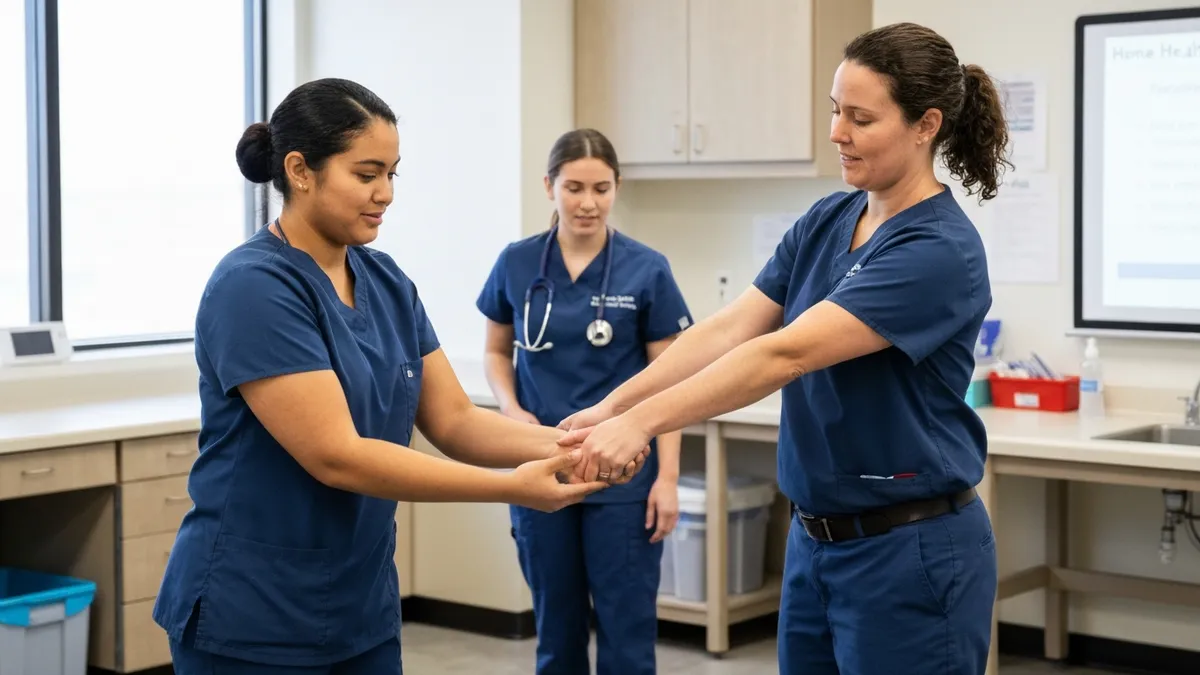
Video-Based HHA Training vs. Traditional Classroom-Only Programs
- +Learn at your own pace — pause and rewind complex clinical procedures as many times as needed
- +Visual demonstrations of skills like transfers and vital signs are far clearer on video than in textbooks
- +Flexible scheduling allows working adults to study during evenings, weekends, or breaks between shifts
- +Platforms like HHA Exchange automatically track your progress and generate compliance certificates
- +Access to a broader library of specialty topics not always covered in local classroom programs
- +Reduces travel time and cost compared to attending every session in person at a fixed location
- −Cannot replicate the tactile feedback of practicing hands-on skills with a real patient or mannequin
- −Self-paced formats require strong personal discipline — procrastination is a common completion barrier
- −Internet connectivity issues can interrupt video playback, especially in rural areas with limited broadband
- −Some state boards require a minimum number of in-person clinical hours regardless of video completions
- −Quality varies widely across free video platforms — not all content is clinically accurate or up to date
- −Lack of immediate instructor feedback means errors in technique may go unnoticed until skills evaluation
HHA Certification Exam Preparation Checklist
- ✓Confirm your training program is approved by your state health department before enrolling
- ✓Complete all required classroom and video instruction hours and obtain dated sign-off from your instructor
- ✓Log at least 16 supervised clinical hours and document every skill your instructor observes
- ✓Review your state's specific competency skill list — procedures tested vary by state
- ✓Watch at least one training video for each of the 25 most commonly evaluated HHA skills
- ✓Take at least 3 full-length practice tests and review every question you answered incorrectly
- ✓Memorize normal vital sign ranges: temp 97.8–99.1°F, pulse 60–100 bpm, respirations 12–20/min
- ✓Practice each physical skill from memory, then watch the video again to self-correct technique errors
- ✓Prepare your exam-day documents: government ID, training completion certificate, and registration confirmation
- ✓Get 8 hours of sleep the night before — cognitive performance on clinical scenario questions drops sharply with fatigue
The Skills Demo Is Where Most Candidates Struggle — Video Practice Closes the Gap
National pass rate data consistently shows that the live skills demonstration portion of the HHA competency evaluation has a lower first-attempt pass rate than the written test. Candidates who watch procedure videos at least five times per skill before their evaluation date perform measurably better. Do not treat video content as background noise — watch actively, narrate the steps aloud, and then practice without the video before your exam date.
Maximizing your video study sessions requires a deliberate approach that goes beyond passive watching. Cognitive science research on learning and memory consistently shows that active retrieval — pausing a video to recall and explain what you just watched before continuing — produces far stronger retention than simply watching content from start to finish. Set a personal rule: every 10 minutes of video is followed by 2 minutes of self-testing. Write down the three most important things you just learned, then check your notes against the video if needed.
Organize your video study by competency domain rather than by video length or platform. Spend one study session entirely on basic personal care procedures, another on mobility and transfer techniques, and a third on vital signs and observation skills. Domain-focused sessions build coherent mental schemas that make it easier to retrieve information under exam pressure. Jumping randomly between topics — watching a hand washing video, then a nutrition module, then a transfer technique — produces fragmented knowledge that is harder to access when you face a scenario-based question.
Use the pause-and-predict technique for procedural videos. Before the instructor in the video performs the next step, pause the video and say aloud what you predict comes next. This technique activates prior knowledge and forces you to engage with the logical sequence of the procedure rather than just observing. When your prediction is wrong, that error creates a stronger memory trace than simply watching the correct step would have. This is why getting questions wrong on practice tests actually accelerates learning more than reviewing material you already know.
Take notes in a skills checklist format rather than writing paragraphs of prose. For each procedure you watch, create a numbered step list in your own words. This format mirrors how competency evaluators assess you during the live skills demonstration — they follow a checklist and check off each step you complete correctly. If you have been studying from prose notes, you will likely perform the steps in a disorganized order during the demo because you never practiced the sequential structure explicitly.
Join online HHA study communities on platforms like Reddit, Facebook Groups, or Discord servers dedicated to CNA and HHA exam preparation. These communities frequently share links to high-quality free training videos, discuss which topics appeared on recent state exams in their area, and offer encouragement during the weeks leading up to the competency evaluation. Members who recently passed often post detailed accounts of which skills were selected for their demo, giving you valuable intelligence about regional testing patterns.
Schedule your video study sessions at the same time each day if possible. Habit stacking — attaching your study session to an existing daily routine like morning coffee or a lunch break — eliminates the friction of deciding when to study and makes it far more likely you will complete your planned content. Candidates who study in consistent daily sessions of 45 to 60 minutes typically outperform those who cram in marathon sessions on weekends, both on exam scores and on practical skill retention when they begin working with real patients.
Finally, simulate exam conditions periodically during your preparation. After completing your video study for a given topic, put away your notes and attempt a full practice quiz on that content without any aids. Review your wrong answers, watch the relevant video segment again, and then quiz yourself a second time. This spaced repetition cycle — watch, recall, test, review, retest — is the single most evidence-backed study strategy available for health care certification exams and will serve you well not just for the HHA exam but throughout your entire career in home health care.

Passing your competency evaluation does not mean you can legally work as a home health aide the same day. Most state registries take 4 to 6 weeks to process new listings after your training program submits your paperwork. Do not accept a job offer that requires you to work with patients before your registry listing is confirmed — doing so exposes you to legal liability and can disqualify you from future healthcare employment. Verify your listing online before your first patient visit.
Career outcomes for home health aides are genuinely strong by the standards of entry-level health care roles that require less than two years of postsecondary education. The Bureau of Labor Statistics projects 22 percent employment growth for home health and personal care aides through 2032, driven by the aging of the Baby Boomer generation and a sustained national preference for receiving care at home rather than in institutional settings.
In raw numbers, the profession is expected to add more than 800,000 new jobs over the decade — making it one of the largest sources of employment growth in the entire United States economy.
Starting wages for a certified home health care aide vary significantly by geography, employer type, and specialization. In major metropolitan areas like New York City, San Francisco, and Boston, entry-level HHA pay frequently exceeds $18 to $22 per hour. Rural areas and smaller markets typically start lower, around $14 to $16 per hour, but cost-of-living differences often make these wages equally competitive in purchasing power terms. Agency aides may earn slightly less per hour than those employed directly by hospital systems or staffing firms but often receive more consistent scheduling and supervisor support.
Home health aide certification opens doors to several meaningful career advancement paths. Many aides use the role as a bridge to becoming a certified nursing assistant, licensed practical nurse, or registered nurse. The patient care experience and clinical skill foundation built during HHA work are directly relevant to nursing school applications and clinical rotations. Some employers offer tuition reimbursement programs that help aides fund nursing school while continuing to work, making HHA an affordable entry point into a long-term health care career without taking on substantial student debt upfront.
Specialization is another career growth lever. Aides who complete elective training in hospice care, pediatric home health, behavioral health support, or technology-assisted care for patients using ventilators or feeding tubes command higher wages and are far more difficult to replace. These specialty skills are increasingly in demand as patients with complex medical needs are discharged from hospitals earlier and require more sophisticated support at home. Specialty-trained aides often earn $3 to $8 per hour more than generalists and experience significantly greater job stability because their skill set is narrower and harder to source.
For those wondering about the path to becoming a home health aide certification online free, several legitimate options exist through community health organizations, state Medicaid-funded training initiatives, and non-profit workforce development programs. Free training slots are limited and competitive, but they are a real pathway for candidates who face financial barriers to enrollment in paid programs. Most free programs require a commitment to work for a partnering agency for a specified period after certification, which is a reasonable trade for fully subsidized training.
The emotional rewards of home health aide work are significant and frequently cited by experienced aides as the primary reason they remain in the field despite physically demanding conditions. Building long-term relationships with clients and their families, witnessing the direct impact of your care on a person's quality of life, and developing genuine expertise in supporting human dignity during vulnerable moments are dimensions of the role that most aides find deeply meaningful.
High-quality video training — by building genuine clinical competence — directly contributes to this sense of professional fulfillment because competent aides feel confident rather than anxious during patient care.
Looking ahead, the integration of remote monitoring technology into home care is creating new opportunities for HHAs who develop basic digital literacy. Aides who can help clients use telehealth platforms, operate blood pressure and glucose monitoring devices that transmit data to clinical teams, and troubleshoot simple connectivity issues are increasingly valued by agencies investing in technology-enabled care models. Future-proofing your HHA career means combining the human care skills that video training builds with comfort in a progressively more technology-mediated care environment.
Practical preparation for your HHA competency evaluation should begin at least four weeks before your scheduled exam date. Candidates who start their targeted review late — two weeks or fewer before the evaluation — consistently report higher anxiety, lower confidence during the skills demonstration, and more frequent needs for a second attempt. Four weeks gives you enough time to cover every competency area at least twice, address gaps identified by practice testing, and develop genuine procedural fluency rather than last-minute memorization that evaporates under stress.
Build a video playlist organized by the exact skill categories your state tests. Every state publishes its competency skill list, usually available as a PDF on your state health department's website. Download this list, highlight every skill you feel less than fully confident performing, and build your video study plan around those weaknesses. It is a common mistake to spend most of your study time watching videos about topics you already understand well because they feel comfortable — prioritize discomfort, because that is where your exam risk actually lives.
Practice your skills demonstration out loud with narration. During your competency evaluation, the evaluator is scoring not just whether you complete each step but often whether you verbalize key safety steps — for example, announcing that you are raising the side rail before moving to the other side of the bed, or stating that you are checking the water temperature before starting a bed bath.
Training videos frequently include this narration, but many candidates forget to replicate it during practice because they are focused on the physical movements. Add the verbal components from your very first practice run so they become automatic.
The written portion of most HHA competency evaluations includes clinical scenario questions that describe a patient situation and ask what the aide should do. These questions reward candidates who have internalized the logical principles behind care procedures — patient safety first, report and document before acting beyond scope, use standard precautions consistently — rather than those who have memorized isolated facts. Video training accelerates principle absorption because seeing procedures in context makes the underlying reasoning visible in a way that reading a definition does not.
Time management during the written exam matters more than most candidates anticipate. A common pattern is spending too long on early questions, leaving insufficient time for scenario questions near the end where points are most valuable. If you have completed three full-length practice tests before exam day, you will already know your typical pace and can set internal benchmarks — for example, targeting completion of the first 25 questions within 30 minutes. Practice tests are the only reliable way to develop this situational awareness about your own test-taking speed.
On skills demonstration day, arrive 15 minutes early, complete a brief physical warm-up of the procedures you are least confident about in your car or a private area before entering, and remember that evaluators are not trying to trick you. They are assessing whether you can safely care for a patient using the skills your training program taught. If you forget a step, pause, breathe, and reason through the procedure logically from safety and patient dignity principles — this composure under pressure is itself a professional skill that evaluators are trained to recognize and credit.
After you pass your evaluation and begin working with patients, continue using video resources for professional growth. The HHA field evolves constantly — new infection control guidance, updated transfer technique recommendations, changes to documentation requirements — and the aides who maintain the strongest patient outcomes are those who treat learning as an ongoing professional obligation rather than a box checked at certification. Your hha exchange account, agency training library, and free online resources all provide a continuous stream of short video updates that keep your skills current, your patients safe, and your career trajectory moving forward.
HHA Questions and Answers



About the Author

Registered Nurse & Healthcare Educator
Johns Hopkins University School of NursingDr. Sarah Mitchell is a board-certified registered nurse with over 15 years of clinical and academic experience. She completed her PhD in Nursing Science at Johns Hopkins University and has taught NCLEX preparation and clinical skills courses for nursing students across the United States. Her research focuses on evidence-based exam preparation strategies for healthcare certification candidates.
Join the Discussion
Connect with other students preparing for this exam. Share tips, ask questions, and get advice from people who have been there.
View discussion (8 replies)