
HHA Meaning: What HHA Stands For in Home Healthcare Explained 2026 October
🏆 HHA meaning explained: Home Health Aide, plus other acronym uses. Job role, training, certification, and how HHA differs from CNA, PCA, and CHHA.

Looking up HHA meaning usually leads you to one answer in healthcare: Home Health Aide. That's the role most people end up at when they search the acronym. But the three letters get reused across other industries too — public health, geology, civil engineering — which is why the same Google search sometimes spits out wildly different definitions. Let's clear it up.
In a healthcare context, HHA stands for Home Health Aide. It's a paraprofessional caregiver who provides personal care, light medical support, and daily-living assistance to clients in their own homes. The role appears in job listings, Medicare billing forms, agency websites, and home health aide. If you've seen home health aide abbreviated to HHA on a resume or care plan, that's exactly what it means.
Outside of healthcare, HHA also refers to Health Hazard Assessment (used by the U.S. Army and OSHA), Highway Heritage Asphalt (a road-construction term you'll rarely encounter unless you're a civil engineer), and Hereditary Hemorrhagic Telangiectasia — a rare genetic disorder more commonly abbreviated HHT but occasionally shortened to HHA in older papers. The healthcare meaning dominates search results because demand for home care workers has exploded since 2020.
This guide focuses on what HHA means in healthcare: who uses the term, where it appears (Medicare paperwork, job ads, state registries), and how it compares to similar roles like CNA, PCA, and CHHA. By the end you'll know exactly what HHA refers to in any context you're likely to encounter — and why employers favor the acronym over the full job title.
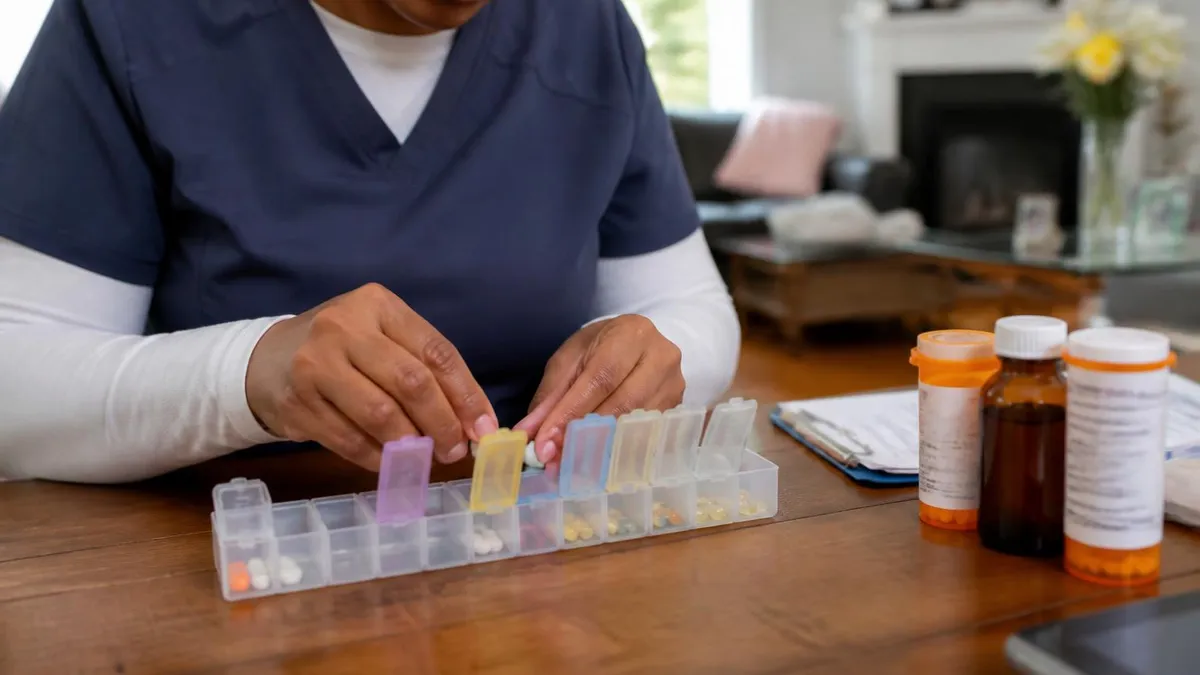
HHA at a Glance — Quick Facts
Why do employers and agencies abbreviate Home Health Aide to HHA in the first place? Three reasons. First, the full title is long and clunky — try fitting "Home Health Aide Certification Practice Test" into a job ad header. Second, the acronym appears everywhere on Medicare and CMS paperwork, so industry insiders just use the shorthand. Third, it differentiates the role from other in-home workers like personal care aides or companions who don't have clinical training.
If you're searching for an hha agency in your area, you'll see the acronym used in agency names, advertising, and state license records. Medicare-certified agencies in particular use HHA consistently because the federal Conditions of Participation (the rules agencies must follow to bill Medicare) use the term throughout the regulations.
Another reason: the acronym signals a level of training that "caregiver" or "home aide" doesn't. A HHA certification means someone has completed at least 75 hours of state-approved training and passed a competency evaluation. Anyone can call themselves a caregiver. Not everyone can legally call themselves an HHA.
So when you see HHA in a job posting, certification badge, or agency name — it's not just a shortcut. It's a credential indicator that carries regulatory weight, especially for Medicare-funded care.
HHA = Home Health Aide
In healthcare, HHA almost always means Home Health Aide — a paraprofessional who provides personal care and basic medical support to clients in their homes. The acronym appears in job titles, Medicare billing codes, state certification registries, and CMS forms like the CMS-485.
Other meanings exist (Health Hazard Assessment, Highway Heritage Asphalt, Hereditary Hemorrhagic Telangiectasia), but you'll rarely encounter them unless you're in a very specific industry. If you found this page through a healthcare-related search, the role definition below is the one you need.
Where does HHA show up in official paperwork? The Centers for Medicare & Medicaid Services (CMS) uses the term throughout its Home Health Prospective Payment System (HH PPS). Medicare reimburses home health agencies based on 30-day episodes of care, and the billing forms — including the well-known CMS-485 plan-of-care document — list HHA services as a specific line item. The aide's visits are tracked, documented, and billed under that designation.
On the CMS-485 form (Home Health Certification and Plan of Care), there's a section where the physician orders specific services. HHA visits get their own checkbox, separate from skilled nursing, physical therapy, occupational therapy, and medical social work. The form also specifies frequency and duration — for example, "HHA visits 3x/week for 60 days." That's the legal authorization for the aide's work, and it's why agencies need certified HHAs to bill Medicare.
OASIS (the Outcome and Assessment Information Set) is another federal document where HHA appears. Nurses complete OASIS assessments at admission, discharge, and recertification, and the document references HHA services and goals throughout. If you work for a Medicare-certified agency, you'll see your visits documented in the OASIS care plan.
The takeaway: the acronym isn't just industry jargon. It's baked into the federal regulations that govern how home care gets delivered and paid for. That official status is part of why HHA training programs follow specific federal minimums — 75 hours, 16 hours of supervised practical training, and a competency evaluation.
HHA Meanings Outside Healthcare
Used by U.S. Army Public Health Command and OSHA in occupational health reports. HHA here refers to systematic evaluation of workplace exposures — chemicals, noise, ergonomics — that could harm workers. You'll see this acronym in military preventive medicine documents and federal workplace safety guidance.
More commonly abbreviated HHT (Osler-Weber-Rendu syndrome). Some older medical literature uses HHA. It's a rare genetic disorder causing abnormal blood vessel formation, recurrent nosebleeds, and potential complications in lungs, liver, and brain. Outside of specialist genetics papers, this usage is uncommon.
Civil engineering term for asphalt road construction methods used on historic highways. Rarely seen outside transportation engineering reports and state DOT documentation. If you're not working in road construction or historic preservation, you won't encounter this.
Trade association for hotels in Hawaii. Appears in tourism industry contexts, hospitality news, and Hawaiian business listings. Useful to know if you're researching Hawaii tourism but unrelated to healthcare.

What does an HHA actually do during a shift? The work breaks into three buckets — personal care, household support, and clinical observation. Personal care covers bathing, grooming, dressing, toileting, and transfers (moving the client from bed to chair, chair to walker). These are the most physical parts of the job and require proper body mechanics to avoid injury.
Household support includes light housekeeping (the client's living area, not the whole house), meal preparation, laundry, and grocery shopping. Some clients need help managing appointments — scheduling rides, accompanying them to the doctor, picking up prescriptions. The exact scope depends on the care plan written by the supervising nurse and what state law allows.
Clinical observation is where the HHA role gets serious. Aides monitor vital signs (in some states), watch for changes in skin condition, breathing, mental status, and report anything unusual to the supervising nurse. They don't make medical decisions, but they're often the first to notice something's wrong — a UTI starting, dehydration, early signs of pneumonia. Good observation skills save lives.
What HHAs cannot do: administer medications (only remind), give injections, change sterile dressings, perform catheter care in most states, or make any diagnostic judgments. The scope of practice is narrower than CNAs working in facilities, but the work requires more judgment because aides operate without immediate clinical backup.
A typical shift runs four to twelve hours depending on the care plan. Some HHAs spend a full day with a single client. Others rotate between three or four clients in the same neighborhood, spending an hour or two with each. Travel between clients is usually unpaid time, though some agencies reimburse mileage. Documentation happens at the end of every visit — sometimes paper logs, sometimes a phone app that timestamps your arrival and departure. Agencies bill Medicare based on those visit records, so accuracy matters.
HHA vs CNA vs PCA vs CHHA — Role Comparison
Home Health Aide. Federal minimum 75 hours of training plus a competency evaluation. Works in clients' homes, often through a Medicare-certified agency. Can monitor vital signs in some states, assist with personal care, prepare meals, do light housekeeping, and report changes to the supervising nurse. Cannot administer medications. Median pay around $36,220 annually per BLS data.
Where you'll actually encounter HHA in the wild: job postings, agency websites, state registries, and Medicare documentation. Indeed, ZipRecruiter, and the major job boards list thousands of HHA positions at any given time. The job titles vary — "Home Health Aide," "HHA," "Certified HHA," "Home Health Care Aide" — but they're all the same role.
On agency websites you'll often see HHA used in service descriptions: "Our HHAs provide compassionate in-home care..." or "Medicare-certified HHA services available." Those references typically mean the agency employs aides who meet the federal training and competency standards. If an agency uses the term "caregiver" or "companion" instead, that's usually a signal they offer non-medical care only — no Medicare billing.
State registries are another place you'll encounter the acronym. Most states with HHA certification maintain a searchable database where employers can verify your credential. Florida calls it the Nurse Aide Registry. New York has its own HHA registry. HHA certification Florida and other state-specific certifications appear there with your name, certification date, and current status (active, expired, revoked).
One quirk worth knowing: a few states don't maintain an HHA registry at all. In those states, the credential is essentially a training certificate from your school or agency — there's no central database employers can check. That's part of why HHA credentials don't transfer cleanly between states. If you certify in California and move to Texas, you may need to retrain.
Job ads sometimes use "HHA," "caregiver," "personal care aide," and "companion" interchangeably — but they're not the same. A real HHA has completed at least 75 hours of state-approved training and passed a competency evaluation. PCAs and companions may have no formal training at all, depending on state rules.
If you're hiring help, ask specifically whether the worker is certified as a Home Health Aide. If you're job hunting, check that the agency is Medicare-certified — that's the cleanest signal they need real HHAs.
Want to actually become one? The HHA path is shorter than most healthcare credentials. Federal regulations require at least 75 hours of training (16 of which must be supervised practical training before the aide can have direct contact with patients). Most state programs run 75 to 120 hours total. Some states add their own requirements on top — California requires 120 hours, New York requires 75 plus an additional 5-hour competency exam.
Training programs are offered by community colleges, vocational schools, Red Cross chapters, and many home health agencies themselves. Agency-sponsored programs are often free if you commit to working there for 6 to 12 months after certification. HHA training covers personal care techniques, infection control, nutrition basics, patient rights, documentation, and basic vital signs in states where aides can take them.
After training, candidates take a competency evaluation. The format varies — some states use the NNAAP exam (same as CNAs in those states), others use a custom HHA evaluation. The test includes a written knowledge section and a skills demonstration. Pass both parts, and you're listed on the state registry (if your state has one) or you receive your HHA certification certificate.
Total time investment: 2 to 6 weeks full-time, or 6 to 12 weeks part-time evenings and weekends. Total cost: $200 to $800 at community colleges and vocational schools, sometimes free through agency-sponsored programs. Compare that to a CNA program at $500–$2,000 and 4–12 weeks, and you see why HHA is the faster entry point into healthcare.

Verifying Someone's HHA Status — What to Check
- ✓Ask for a copy of their HHA training certificate from a state-approved program
- ✓Verify their name on the state nurse aide registry (if your state maintains one)
- ✓Confirm the training program covered the federal minimum 75 hours
- ✓Check that they passed a competency evaluation, not just completed coursework
- ✓Verify the certification is current — most states require annual in-service education
- ✓Ask which state they certified in if they're a recent transplant from elsewhere
- ✓Confirm they completed 16 hours of supervised practical training before direct patient contact
- ✓Check whether their agency is Medicare-certified (signals legitimate HHA employment)
- ✓Ask about specialty training: dementia care, hospice support, pediatric home health
- ✓Request references from previous clients or supervising nurses
What do HHAs earn? The Bureau of Labor Statistics pegs the median annual wage for home health and personal care aides at $36,220 as of the most recent data. That breaks down to roughly $17.40 per hour. But the spread is wide: HHAs in Massachusetts, Alaska, and Washington state often earn over $40,000 annually, while those in Mississippi, Alabama, and Louisiana may earn below $28,000.
Pay varies based on employer type too. Medicare-certified agencies typically offer better wages and benefits — health insurance, paid time off, retirement contributions — than private-pay home care companies. Private clients who hire HHAs directly sometimes pay $20–$30 per hour, but you're responsible for your own taxes and benefits in that arrangement.
Job outlook is the strongest argument for entering the field. The BLS projects 22% growth from 2022 to 2032 — much faster than the national average of 3%. That translates to 820,000 new positions over the decade. The aging Baby Boomer population is the driver, plus a strong preference for home-based care over institutional settings. Agencies struggle to fill positions, and turnover hovers around 40% annually.
Career advancement is real but requires extra effort. Many HHAs use the role as a stepping stone to CNA, LPN, or RN programs. Your HHA clinical hours often count toward CNA training requirements, shortening the path. Other HHAs specialize — dementia care, hospice support, pediatric home health — and command higher hourly rates with experience.
The HHA Path — Pros and Cons
- +Shortest entry path into healthcare — 75 to 120 hours of training versus years for nursing
- +Strong job demand with 22% projected growth through 2032
- +Free training available through agency-sponsored programs in many states
- +One-on-one client relationships often span months or years
- +Flexible scheduling with options for part-time, evening, or weekend shifts
- +Clear career ladder to CNA, LPN, RN, or care coordinator roles
- −Median pay of $36,220 trails most other healthcare positions
- −Credentials don't transfer cleanly between states — some states have no registry
- −Physical demands include lifting, transferring, and prolonged standing
- −Working alone means less clinical backup during client emergencies
- −Private-pay agency benefits are often minimal compared to facility-based jobs
- −Annual in-service training and recertification requirements add ongoing time commitments
A few things people get wrong about HHA. First: "HHA" and "home health nurse" are not the same. A home health nurse is an RN or LPN with full nursing credentials, performing clinical procedures, managing medications, doing wound care. An HHA is a paraprofessional supporting daily-living tasks and personal care. The pay difference reflects the training difference.
Second: HHA is not a stepping stone you have to take before becoming a nurse. Plenty of people skip HHA entirely and go straight into CNA or LPN programs. The HHA route makes sense if you want to start earning quickly while studying, or if you're not sure yet whether healthcare is the right field.
Third: not every "home care worker" is an HHA. Many in-home workers are personal care aides or companions with minimal training. The HHA designation specifically refers to someone who's completed 75+ hours of state-approved training and passed competency evaluation. The distinction matters for Medicare billing and for protecting vulnerable clients.
Fourth: HHA jobs aren't going anywhere. Despite occasional headlines about automation and AI in healthcare, the physical work of helping someone bathe, dress, and transfer safely can't be automated. Robots aren't lifting Grandma out of bed. The role is durable in a way that many other entry-level jobs aren't, and demand will keep climbing as the population ages.
Fifth: HHA is not a regional or state-specific term. The acronym appears in federal Medicare regulations, so it's used the same way across all 50 states. State-level differences exist in training hours, registry requirements, and scope of practice — but the meaning of the acronym itself is consistent nationwide.
So circling back to the original question — what does HHA mean? In nearly every context you'll encounter, it stands for Home Health Aide. The acronym appears on job listings, Medicare paperwork, state registries, agency websites, and training certificates. It signals a specific credential — minimum 75 hours of state-approved training plus a competency evaluation — and carries regulatory weight in Medicare-funded home care.
The other meanings (Health Hazard Assessment, Highway Heritage Asphalt, Hereditary Hemorrhagic Telangiectasia) exist but show up in very narrow industries. If you found this page through a search related to home care, jobs, or healthcare certifications, the Home Health Aide definition is the one that matters.
The role itself sits at the entry point of the healthcare workforce. HHAs provide personal care, light medical support, and crucial observation services to clients who'd otherwise need to live in nursing homes or assisted living facilities. The work isn't glamorous, the pay isn't high, but the demand is enormous and the human impact is real. People stay in their homes longer because HHAs make that possible.
If you're considering the field, start by checking your state's training requirements and finding a state-approved program nearby. If you're hiring help for a family member, verify HHA credentials before signing anyone on. And if you stumbled here because you saw the acronym on a Medicare form or care plan — now you know exactly what it refers to.
HHA Questions and Answers
About the Author

Registered Nurse & Healthcare Educator
Johns Hopkins University School of NursingDr. Sarah Mitchell is a board-certified registered nurse with over 15 years of clinical and academic experience. She completed her PhD in Nursing Science at Johns Hopkins University and has taught NCLEX preparation and clinical skills courses for nursing students across the United States. Her research focuses on evidence-based exam preparation strategies for healthcare certification candidates.
Join the Discussion
Connect with other students preparing for this exam. Share tips, ask questions, and get advice from people who have been there.
View discussion (8 replies)