
HHA Certificate: Home Health Aide Certification Complete Guide 2026 October
Complete HHA certificate guide: 🧠 75-hour federal training, state-by-state hours, exam structure, registry, salary range, and free practice tests.

A Home Health Aide (HHA) certificate is the credential that lets you legally provide hands-on personal care, vital sign monitoring, and basic clinical support to patients in their own homes — under the supervision of a registered nurse or therapist — for any agency that bills Medicare or Medicaid. If you are weighing whether to spend the next 75 to 120 hours of your life training for this role, this guide is built to give you the unvarnished answer.
The reason the credential exists is regulatory. The 1987 Omnibus Budget Reconciliation Act required the federal Centers for Medicare and Medicaid Services (CMS) to set a minimum training standard for any aide working for a Medicare-certified or Medicaid-certified home health agency. That standard locked in at 75 hours of combined classroom and supervised practical instruction, plus a competency evaluation. Every state must meet or exceed that floor — and several do, sometimes by a lot.
What follows walks through the federal minimum, the state-by-state variations (New York wants 100 hours, California demands 120, Florida sits on the federal 75), exactly what topics get covered, how the written and skills-demonstration exam works, what the state HHA registry actually does, the difference between a federal and a state-issued certificate, realistic salary expectations, and the career ladder from HHA into Certified Nursing Assistant (CNA) work. There is a section comparing free and paid training pathways, a day-in-the-life walkthrough, and quick links to free HHA practice tests so you can start studying today.
If you already know you want to enroll, skip ahead to the program selection section. If you are still deciding, the salary and job-outlook section is probably the most useful place to start. Either way, bookmark this page — every section answers a specific question on the path from civilian to credentialed home health aide.
HHA Certificate at a Glance
Key Facts at a Glance
| Item | Value | Details |
|---|---|---|
| Federal CMS minimum training requirement | 75 hrs | |
| Minimum supervised practical training hours | 16 hrs | |
| States requiring 100+ training hours | 5 |
The 75-Hour Federal Baseline (And Why It Matters)
Here is the part that confuses most candidates: there is no single national HHA license. CMS does not issue HHA certificates directly. What CMS does is set a minimum training and competency standard that every Medicare-certified and Medicaid-certified home health agency must meet before it can put an aide in a patient’s home. That floor is 75 hours total — 59 hours of classroom or laboratory instruction plus 16 hours of supervised practical training in a patient-care setting. Everyone — in every state, working for any federally reimbursed agency — clears that bar or the agency loses its certification.
The competency evaluation that ends the training has two pieces. First, a written or oral exam covering the 12 federally mandated content areas (we list them below). Second, a hands-on skills demonstration where a registered nurse watches you perform a defined set of procedures — bed bath, vital signs, transfer, ambulation, and so on — and grades each on a pass-or-redo basis. Federal law spells out which specific skills must be tested.
Once you pass both, the training agency or state issues your certificate and lists you on the state HHA registry. The registry is searchable by any home-health agency that wants to verify your credential before hiring. That registry listing — not the paper certificate — is what makes you employable in regulated home care. We come back to the registry in detail in its own section.
One thing the 75-hour floor does not do: it does not preempt state law. States are free to require more hours, more content areas, more clinical supervision, or a different exam — and many do. New York runs a 100-hour program. California requires 120. Florida holds the federal line at 75. The most common pattern across states is the federal 75 plus 16 to 40 additional hours in disease-specific care, mental health, or geriatric-focused content. Always check your state health department site for the exact requirement before paying tuition.
An HHA certificate is proof that you completed a CMS-compliant training program, passed both a written and a skills-demonstration exam, and were placed on your state’s home health aide registry. With it, you can legally work for any Medicare-certified or Medicaid-certified home health agency in your state, providing hands-on personal care, monitoring vital signs, assisting with mobility, supporting basic nutrition, and reporting changes in patient condition to a supervising nurse.
Practical translation: the certificate is your entry ticket to the highest-demand entry-level role in healthcare. It is also the cleanest stepping stone into Certified Nursing Assistant (CNA), Licensed Practical Nurse (LPN), or Registered Nurse (RN) training if you decide to climb further.
What an HHA Actually Does on a Shift
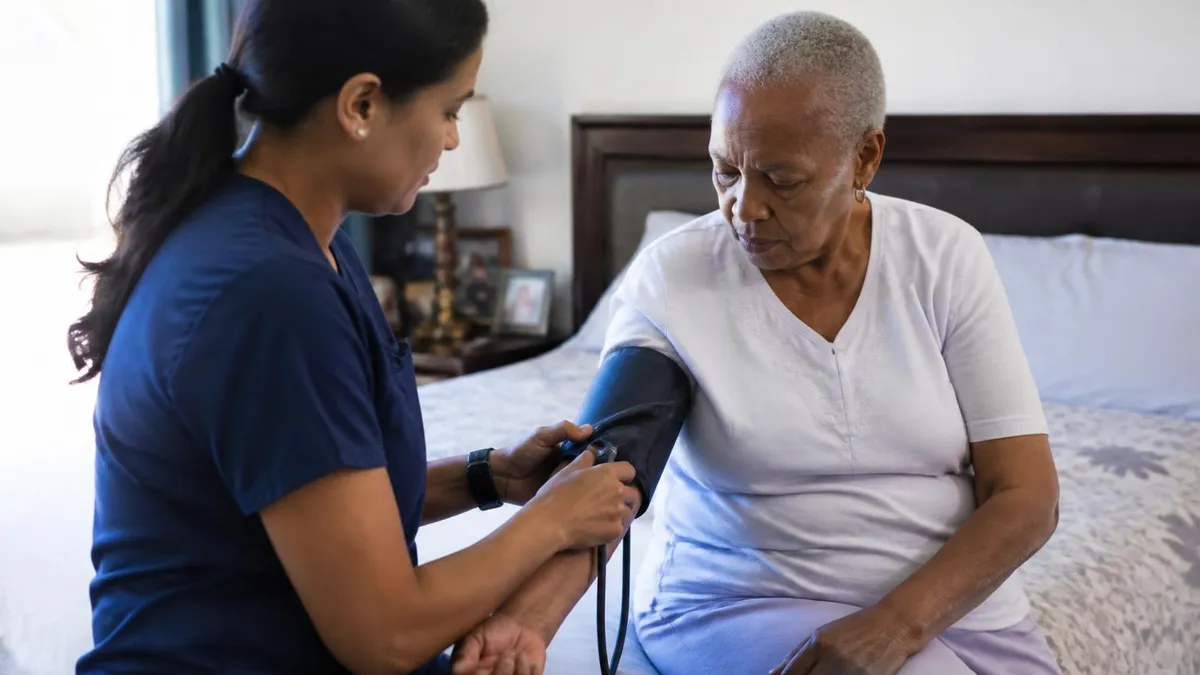
So what does a Home Health Aide do on a Tuesday morning? You arrive at a patient’s home, review the care plan posted by the supervising RN, and start with the basics: take vital signs (blood pressure, pulse, respirations, temperature, sometimes pulse oximetry), help the patient bathe and dress, prepare a simple meal that fits the prescribed diet, assist with mobility from bed to chair or to the bathroom, and document everything you did and observed.
Within those broad strokes, the work splits roughly four ways. Activities of Daily Living (ADLs) — bathing, dressing, grooming, toileting, feeding, ambulation — eat the largest share of the shift, usually 40 to 60% of contact time. Health monitoring (vital signs, weight, intake-and-output, skin checks for breakdown) takes another 15 to 20%. Light household support directly tied to patient care (changing bed linen, laundering soiled clothing, meal prep, light tidying of patient areas) absorbs maybe 15 to 25%. Documentation and communication with the supervising nurse handle the rest.
What an HHA does not do: administer medications (with very narrow state-specific exceptions for medication reminders), perform sterile procedures, change wound dressings beyond simple clean-and-dry coverings, perform tube feedings, or operate any equipment that requires nursing-level training. Those are LPN or RN tasks. The line between aide and nurse functions is drawn explicitly in your state nurse practice act and in your agency’s job description — cross it without authorization and you and your agency lose your credentials.
Workflow varies wildly by patient population. A geriatric patient with congestive heart failure needs daily weights, careful intake monitoring, and watchful skin checks. A patient recovering from a stroke needs ambulation practice, swallowing precautions, and a lot of patient encouragement. A pediatric ventilator-dependent patient sits in a completely different regulatory bucket and usually requires an aide with additional training on top of the basic HHA certificate. Your agency will match you to populations that fit your training and experience.
Federal Training Content Areas
Bathing (bed bath, tub, shower), oral care including dentures, hair and nail care, dressing and undressing, toileting and incontinence care, perineal hygiene, feeding assistance, and grooming. This is the bedrock skill set — every HHA program devotes the largest single chunk of classroom and lab hours here, because these tasks fill the majority of every shift.
Manual and electronic blood pressure measurement, radial and apical pulse, respirations, oral and tympanic temperature, weight, intake and output, pulse oximetry where state law permits. Recognizing abnormal values and knowing when to call the supervising nurse is graded as carefully as the technique itself.
Standard precautions, hand hygiene, glove and PPE use, handling of contaminated linens and waste, bloodborne pathogen procedures, isolation precautions, and prevention of healthcare-associated infections. After ADLs, this is the second most-tested content domain on every state exam and competency evaluation.
Verbal and nonverbal communication, active listening, communicating with patients who have hearing loss, vision loss, dementia, or aphasia, family communication, and reporting to the supervising nurse using SBAR or agency-specific formats. Cultural and religious sensitivity is folded into this domain in every CMS-compliant curriculum.
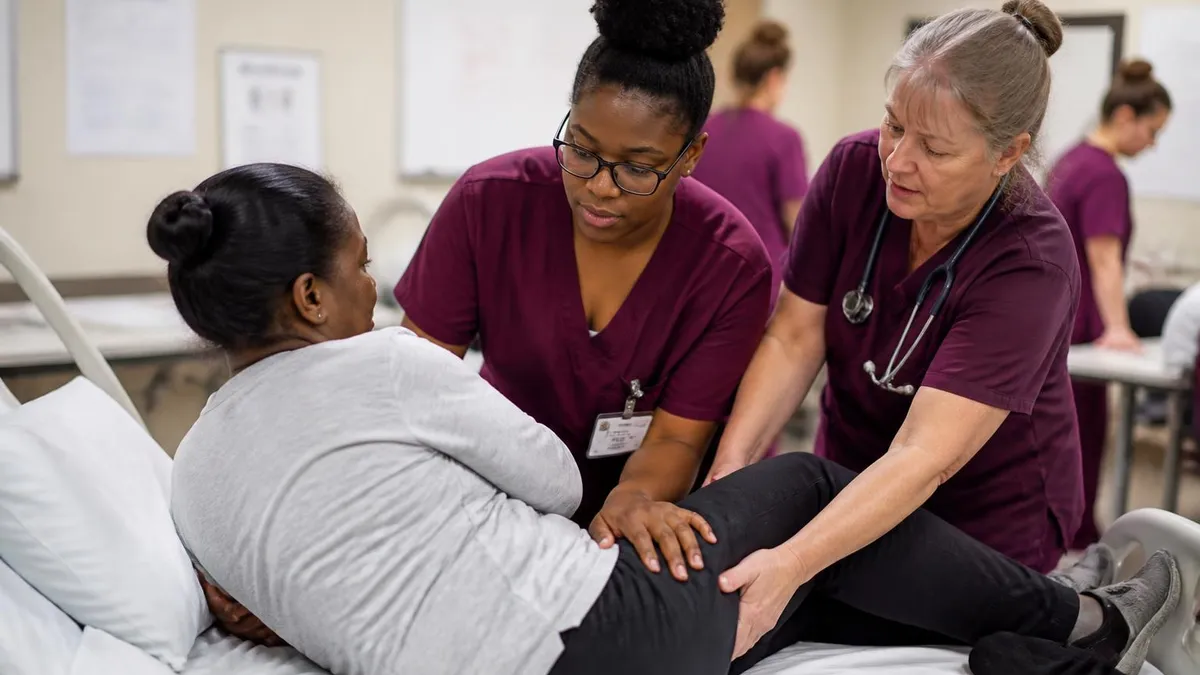
Body mechanics for the aide, range of motion exercises, ambulation with and without an assistive device, transfers from bed to chair using gait belts and mechanical lifts, positioning for pressure injury prevention, and fall prevention. This is the highest-injury content area for aides — programs devote heavy lab time here.
Skills for observing patient condition (skin integrity, mental status, mobility, pain, appetite), recognizing changes from baseline, distinguishing what to report immediately versus document for the next nurse visit, and completing the visit-by-visit care record in either paper or electronic form. Documentation accuracy is what protects your license.
Who Can Enroll, How Long It Takes, and What It Costs
The basic eligibility bar is short. Most programs require you to be 18 or older (16 with restrictions in a few states), have a high school diploma or GED (some states waive this for HHA, though not for CNA), pass a criminal background check and fingerprint screening, clear a tuberculosis screening and current vaccinations including COVID-19, and demonstrate basic English literacy — or in some states, complete the program in Spanish, Mandarin, Vietnamese, or another locally common language.
How long does it take from sign-up to certificate in hand? A full-time program covering the federal 75 hours typically runs three to four weeks. State-extended programs (New York’s 100 hours, California’s 120) stretch to six weeks full-time or three months part-time. Evening-and-weekend tracks designed for working adults usually run six to twelve weeks. Add another two to three weeks for the competency exam scheduling and the state registry processing.
Cost is where the math gets interesting. Tuition for paid HHA programs ranges roughly $400 to $1,500 depending on the state, the school, and the included materials. The American Red Cross, regional community colleges, and some technical schools run programs in that band. But the bigger story is the free pathway: most large home health agencies and many state workforce-development programs cover HHA training in exchange for an employment commitment of three to twelve months.
Visiting Nurse Service of New York, Bayada, Amedisys, and most regional Medicare-certified agencies run no-cost training cohorts continuously. State Medicaid programs in California, New York, Massachusetts, and several others fund free training for residents who agree to work in designated shortage areas.
Beyond tuition, plan for some smaller line items. Background check and fingerprinting cost $50 to $100. TB test, physical, and required vaccinations cost $50 to $150 if not covered by insurance. Scrubs, a watch with a second hand, and a stethoscope cost $80 to $150. State registry application fees range from zero in Massachusetts to about $50 in Florida. Books and online learning portal fees are usually included in tuition. Total out-of-pocket for a paid program is around $700 to $2,000; for a free agency-sponsored program it is essentially zero plus the cost of your scrubs.
State-by-State HHA Training Hours
Florida holds the federal CMS minimum of 75 hours (59 classroom plus 16 supervised clinical) under Florida Statute 400.4626 and Florida Administrative Code 59A-8. The Florida Agency for Health Care Administration (AHCA) oversees the HHA registry. No state-level licensing exam beyond the agency-administered competency evaluation; passing the in-program exam plus the skills demonstration triggers AHCA registry listing. Renewal every 24 months requires 12 hours of in-service education and ongoing agency employment, otherwise re-evaluation is required.
The Exam: Written Plus Skills Demonstration
Every CMS-compliant HHA program ends in a two-part competency evaluation: a written or oral examination, and a hands-on skills demonstration evaluated by a registered nurse. You have to pass both. Failing either one means re-training and re-testing.
The written exam typically runs 50 to 100 multiple-choice questions covering the 12 federally mandated content areas plus any state-specific add-ons. Most programs administer it on the last day of classroom instruction. The pass mark is generally 70 to 80%, depending on the state and the training agency.
Questions favor clinical reasoning over rote memorization — expect scenario-style items like "you walk in to find your patient slumped over and unresponsive, what is your first action?" rather than "define hypertension." Plan your study time around the four highest-yield content domains: personal care and ADLs (about 25% of items), infection control (about 15%), vital signs and observation (about 15%), and communication and patient rights (about 15%).
The skills demonstration is where most candidates feel the most pressure, and rightly so. A registered nurse watches you perform a defined set of procedures — commonly handwashing, taking a blood pressure, transferring a patient from bed to chair using a gait belt, partial bed bath, dressing assistance, and feeding — and grades each skill on a pass-or-redo basis. You usually get one redo per skill.
The evaluation runs 60 to 120 minutes total, and the procedures themselves are not difficult; the trap is forgetting a step like introducing yourself and explaining the procedure, or skipping privacy precautions like closing the door and drawing the curtain. Rehearse the whole sequence — greeting through cleanup — until it feels automatic, not just the technical task itself.
If you fail the skills demonstration on a particular procedure, most programs let you re-attempt that single skill within 14 days. If you fail the written exam, you generally get one retake in the same window. Beyond that, you have to re-enroll. State retake rules vary — California and New York are stricter than the federal floor, Florida and Texas are closer to the federal rule.
CMS requires the competency evaluation to test, at minimum: handwashing, communication, taking and recording vital signs, measuring and recording fluid intake and output, observation and reporting changes in patient condition, basic infection control, transfer of a patient, ambulation of a patient, range-of-motion exercises, bathing (bed bath or tub), oral care, dressing, feeding, and toileting. The evaluation must be performed by a registered nurse. Re-test windows vary by state but generally allow one to two retake attempts within 30 days before re-training is required. Federal regulation: 42 CFR §484.36(b).
The State HHA Registry: Why It Is the Real Credential
Here is the part new candidates underestimate: the paper certificate from your training program is not what makes you employable. The state HHA registry listing is. Every state operates a searchable online registry of home health aides who have completed CMS-compliant training and passed the competency evaluation. Federal law requires hha agency agencies to verify a candidate’s registry listing before hiring — not the certificate, the registry. If your name is not on the registry, you are not legally an HHA in that state, regardless of what your training program told you.
The listing process is straightforward but not always fast. Your training program (or you, depending on the state) submits the completion documentation and competency-evaluation results to the state health department. The department verifies, processes, and adds your name. Florida runs about 5 to 10 business days. New York runs 15 to 30. California is the slowest, sometimes 30 to 60 days during high-volume periods. Plan your job-search timeline around the slowest realistic registry processing time for your state, not the fastest.
The registry stays current as long as you stay employed by a Medicare-certified or Medicaid-certified home health agency and complete the required in-service education hours (usually 12 per year). Federal regulation defines "lapse" as 24 consecutive months without paid work providing nursing or nursing-related services for an HHA agency.
If you lapse, your registry listing goes inactive and you have to either re-train or pass a re-evaluation before working as an HHA again. Most state registries also include an abuse-and-neglect findings section — a substantiated finding here permanently bars HHA work in that state and is reciprocally honored by most other states.
Reciprocity between state registries is uneven. Some states (most of the Southeast and Midwest) accept other states’ registry listings with minimal paperwork; you fill out a transfer application and you are listed. Other states (California, New York, Illinois) require you to either re-test or complete a bridge program covering state-specific content. Always check before you relocate.
Before You Enroll in an HHA Program
- ✓Confirm the program is CMS-compliant and approved by your state department of health, listed on the official state HHA-training program list
- ✓Verify the program ends in both a written exam and a hands-on skills demonstration evaluated by a registered nurse (federal requirement)
- ✓Ask whether the program is free (agency-sponsored or workforce-grant funded) or paid — both routes are legitimate, but free routes carry an employment commitment
- ✓Document your current immunizations and TB screening — programs require these before clinical hours, not after
- ✓Schedule your fingerprinting and criminal background check at least two weeks before the program start date
- ✓Confirm the program’s recent first-time written-exam pass rate — aim for 85% or higher; below 70% is a red flag
- ✓Verify the school’s job-placement rate within 90 days of registry listing; reputable programs publish this number
- ✓Ask whether scrubs, stethoscope, and required textbooks are included in tuition or extra
- ✓If you might want to bridge into CNA later, confirm the HHA program credits transfer toward CNA training in your state
- ✓Schedule your state registry application immediately upon program completion — do not wait, processing times can be long
- ✓Plan for the realistic gap between program completion and first paycheck (usually 4 to 8 weeks including registry listing and agency onboarding)
Federal Certificate vs State License vs Agency Training
One thing that trips up many candidates is the difference between a federal certificate, a state-issued credential, and an agency-issued training completion. Let us straighten it out. The federal government does not issue HHA certificates. CMS sets the minimum training and competency standard, then delegates enforcement to states through Medicare-certification surveys of home health agencies. So when someone says "federal HHA certificate," they usually mean a program that meets the federal 75-hour standard — the credential is still issued by either your state health department or the training agency on behalf of the state.
The state-issued credential is the registry listing itself. Some states issue a physical certificate that goes with the registry listing; others issue only the listing and a database entry. The agency-issued training-completion certificate is what your school hands you on graduation day. It proves you finished the program, but it does not by itself make you legally employable as an HHA — the registry listing does.
This brings up the free-vs-paid training decision in clearer terms. A free agency-sponsored program (Bayada, VNSNY, Amedisys, regional Medicare-certified agencies, and most state Medicaid waiver programs) covers your tuition, materials, and often a small stipend, in exchange for a commitment to work for that agency for three to twelve months after registry listing. The terms vary — some agencies require you to repay tuition pro-rated if you leave early; others simply absorb the cost as a recruiting expense. Read the contract carefully.
A paid program (community college, technical school, Red Cross, private vocational school) costs $400 to $1,500 out of pocket but leaves you free to pick any employer after credentialing. Federal Pell Grants, state workforce-development grants, Workforce Innovation and Opportunity Act (WIOA) funding, and Veterans Affairs education benefits can offset paid-program tuition for eligible candidates. If you qualify for Pell or WIOA, the paid route often ends up cheaper than the free route’s employment commitment in terms of long-term wage flexibility.
The middle option is hybrid: a community-college HHA program that has a partnership with one or more local agencies, where the agency reimburses your tuition after you complete 90 to 180 days of post-credential employment. This is increasingly common and gives you the flexibility of a community-college credential plus the cost relief of agency sponsorship.
Becoming an HHA: Pros and Cons
- +Lowest barrier to entry in regulated healthcare — 75 to 120 hours of training and you are employable
- +Strong job market with 21% projected growth through 2032 — among the fastest-growing occupations in the country
- +Free training pathways through agency sponsorship and state workforce-development programs
- +Cleanest stepping stone into CNA, LPN, and RN training — HHA hours often credit toward CNA programs
- +Flexible scheduling — per-visit, hourly, live-in, weekend-only, and overnight shifts available depending on agency
- +Direct patient relationships — you see the same patients for weeks or months, not just a single shift
- +Stable demand regardless of economic cycle — aging baby boomers keep home care growth recession-resistant
- −Entry-level pay is modest — median around $30,180 nationally with significant geographic variation
- −Physical work — lifting, transferring, repetitive bending all contribute to one of the highest injury rates in healthcare
- −Emotional labor — patients you connect with will decline or die; that wears over time and the support is thin
- −Driving and travel time often unpaid or under-paid — check the per-visit-versus-per-hour structure carefully
- −Limited scope of practice can frustrate aides who want more clinical responsibility — medication administration is off limits in almost every state
- −Inconsistent supervision quality — some agencies pair you with an excellent RN supervisor, others leave you mostly on your own
Salary, Outlook, and Where the Job Market Is Strongest
What does the credential do for your bank account? The Bureau of Labor Statistics 2024 median annual wage for home health and personal care aides combined was $30,180, or roughly $14.51 per hour. The middle 50% of the field earned between $25,800 and $36,000. The top 10% cleared $40,000, mostly in metro markets with shortage premiums or specialty agencies serving pediatric or ventilator-dependent patients.
Geography drives a huge share of the variation. Washington state, Massachusetts, North Dakota, and Minnesota lead the country at $36,000 to $40,000 median, with metro markets in Seattle, Boston, and Minneapolis frequently above that. Mississippi, Louisiana, West Virginia, and Alabama sit at the other end, in the $22,000 to $26,000 band. New York City and the Bay Area run high in absolute dollars but cost of living wipes out most of the premium.
The hidden levers on pay are shift type, certification stack, and agency tier. Per-visit pay (where you are paid a flat rate per patient encounter rather than hourly) generally beats hourly pay for fast, experienced aides — you finish three or four visits in the time it would take an hourly aide to finish two, and the per-visit rate stays constant.
Live-in shifts (24-hour or 12-hour blocks where you reside at the patient’s home) pay flat day rates of $180 to $300 and can stack up to attractive weekly totals. Overnight shifts pay 10 to 25% premiums in most agencies. Stacking the HHA credential with a CNA license bumps base pay 15 to 25%.
Where does the role go from here? Two paths are common. The first is the CNA bridge — usually 60 to 120 additional hours of training plus a state CNA exam. CNAs work in nursing facilities, hospitals, and rehab centers, and earn 15 to 25% more than HHAs on average.
The second is the LPN ladder — a 12 to 18 month program costing $10,000 to $30,000, leading to a state-licensed practical nurse role at $50,000 to $65,000 median. Many home health agencies will pay for CNA bridge training in exchange for an employment commitment; a smaller number will fund LPN tuition for high-performing aides willing to commit two to three years post-graduation.
A third path that is growing fast is the specialty-population route: pediatric home care, mental-health home aide, hospice aide, and dementia-specialty aide. Each adds 16 to 40 hours of supplementary training, often paid by the agency, and bumps hourly rates by $2 to $5. Hospice aide is particularly demand-heavy as the population ages, and is one of the most emotionally rewarding subspecialties in the field if end-of-life care fits your temperament.
Choosing a Program and Studying Smart
Picking a program comes down to three checks. First, is it on your state department of health’s list of approved HHA-training programs — not just "accredited" in some general sense, but specifically state-approved for HHA training? If it is not on that list, the registry will not recognize your completion.
Second, what is the program’s first-time pass rate on the competency evaluation over the most recent two to three years? Reputable schools publish this; if you cannot get a straight number, that is a useful signal. Third, what does the job-placement record look like within 90 days of registry listing? Programs partnered with active hiring agencies should be placing 80% or more of completers within that window.
For the studying itself, the single most common mistake is treating the written exam like a vocabulary quiz. It is a clinical-reasoning test in multiple-choice clothing. Most questions describe a scenario at the bedside or in the home and ask what you would do next. Drill scenario-based practice questions, not flashcard-style definitions. The free HHA practice tests linked from this page are scenario-formatted on purpose.
Time your practice sessions. Most state written exams give you 60 to 90 minutes for 50 to 100 questions, which works out to a question every 45 to 90 seconds. Train under that time pressure and the actual exam feels comfortable. Skim the stem first, glance at the answer choices to see what is being asked, then re-read the stem looking for the disqualifying detail — one phrase like "patient is on contact precautions" or "patient is NPO" usually decides the answer.
For the skills demonstration, rehearsal beats reading every time. Run the full sequence at home with a family member as the patient: knock, identify yourself, explain the procedure, wash hands, gather supplies, ensure privacy, perform the skill, clean up, document. Record yourself on your phone and watch the video back — you will spot the skipped steps the examiner will notice. Examiners grade hand hygiene and privacy precautions as harshly as they grade the technical procedure itself.
A frequently asked question: can you work for a non-Medicare-certified private duty agency without a registry-listed HHA certificate? In some states, yes — private-pay caregiving is less regulated than Medicare-reimbursed home health. But every legitimate private-duty agency still verifies state HHA registry listing or CNA licensure before hiring, because they are protecting themselves against negligent-hire liability. The unregulated cash-only market for caregivers exists, but it is shrinking and is not where you want to build a career.
A day in the life looks roughly like this for a full-time HHA: 7:30 a.m. start at your first patient’s home, vital signs and morning ADL routine done by 9:15, drive to second patient, second-patient care complete by 11:30, lunch and documentation by 12:15, two or three more visits through the afternoon, last patient finished by 4:30, end-of-day documentation submitted to the agency electronic system by 5:00. Per-visit aides may run more or fewer patients depending on visit complexity. Live-in aides have a completely different rhythm built around the single patient’s full daily schedule.
Sample HHA Practice Questions
Try these questions from our free HHA practice tests. The correct answer and an explanation follow each question.
A home health aide notices a patient has developed a new pressure ulcer on the coccyx. The aide's first action should be to:
- A. Apply an over-the-counter ointment and cover with gauze
- B. Document the observation and report it to the supervising nurse immediately
- C. Reposition the patient and monitor the area for 24 hours before reporting
- D. Consult a family member about wound care preferences
Answer: B. Document the observation and report it to the supervising nurse immediately
Pressure ulcers must be reported to the supervising nurse right away so that a licensed professional can assess and initiate a care plan. The aide should never treat wounds independently or delay reporting.
Mr. Stone is 76 years old, he needs help with bathing, and he has a Foley catheter in place. He has great difficulty walking and uses a wheelchair. He is on a law-salt diet. The home health aide is to give Mr. Stone a bed bath. To be sure the water is not too hot what should you, the aide, do?
- A. Ask Mr. Stone to place his hand in the basin to test the water temperature.
- B. Use half hot water and half cold water to ensure the proper water temperature
- C. Test the water temperature on your inner wrist.
- D. Allow the basin of water to stand for onehalf hour so that it reaches room temperature.
Answer: C. Test the water temperature on your inner wrist.
The skin on the inner wrist is thin and sensitive, making it an accurate and safe spot to test water temperature for a client, especially an elderly or frail one who may have reduced sensation or fragile skin. This prevents accidental burns, as water that feels acceptable to an aide's hands might be too hot for a patient. Asking the patient or using a fixed ratio of hot/cold water is less reliable for ensuring a safe temperature.
A home health aide notices a patient's skin over the bony prominence of the hip looks reddened and does not blanch when pressed. The aide should:
- A. Apply a thick layer of lotion and continue with the care plan
- B. Reposition the patient and report the finding to the supervising nurse
- C. Leave the area exposed to air and reassess in 24 hours
- D. Place a heating pad over the area to increase circulation
Answer: B. Reposition the patient and report the finding to the supervising nurse
Non-blanchable redness over a bony prominence is a Stage 1 pressure injury. The aide must reposition the patient to relieve pressure and report immediately to the supervising nurse for further assessment.
Mrs. Amos has not had a bowel movement for three days. She has always given herself an enema if she does not have a bowel movement for that long a time. Mrs. Amos asks the home health aide to give her an enema. What should the aide do?
- A. Give Mrs. Amos an enema
- B. Tell Mrs. Amos to wait another day.
- C. Suggest that Mrs. Amos take a laxative first.
- D. Contact the agency supervisor to discuss the situation.
Answer: D. Contact the agency supervisor to discuss the situation.
Administering an enema is a medical procedure that typically falls outside the scope of practice for a home health aide unless specifically delegated by a licensed nurse and included in the care plan. Even if the client usually self-administers, the aide should not perform it without explicit instruction and supervision. The correct action is to report the client's condition and request to the supervisor, who can then consult with the physician and provide appropriate directives.
HHA Questions and Answers
About the Author

Registered Nurse & Healthcare Educator
Johns Hopkins University School of NursingDr. Sarah Mitchell is a board-certified registered nurse with over 15 years of clinical and academic experience. She completed her PhD in Nursing Science at Johns Hopkins University and has taught NCLEX preparation and clinical skills courses for nursing students across the United States. Her research focuses on evidence-based exam preparation strategies for healthcare certification candidates.
Join the Discussion
Connect with other students preparing for this exam. Share tips, ask questions, and get advice from people who have been there.
View discussion (8 replies)