
Ham Radio License Study Guide: Complete Technician Exam Preparation Roadmap
Complete ham radio license study guide with study schedule, question pool tips, and exam strategies to pass the Technician test on your first attempt. ✍🏼
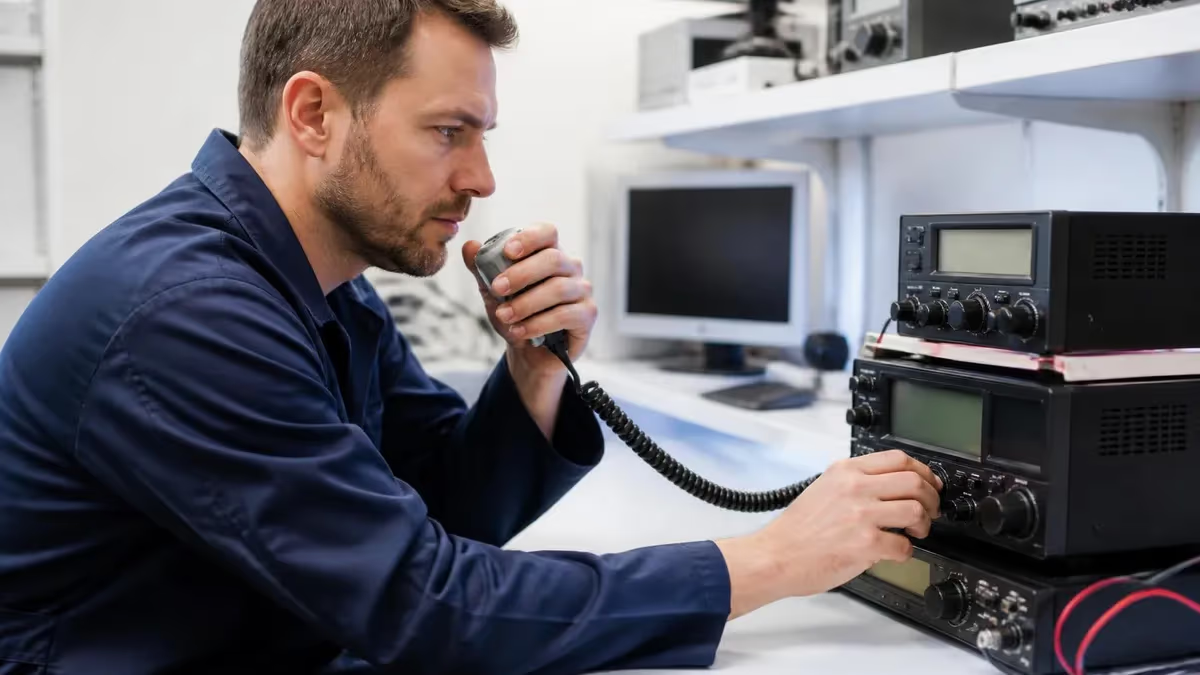
Welcome to the most comprehensive ham radio license study guide built specifically for the Technician Class exam. Whether you are a complete beginner curious about amateur radio or a hobbyist ready to legally transmit, this roadmap walks you through every concept tested by the FCC. A ham radio license unlocks emergency communication, satellite contacts, and worldwide friendships, but earning one requires structured preparation. We will cover the question pool, study schedules, exam logistics, and the critical regulatory knowledge needed to pass with confidence on your first attempt at the test session.
The Technician exam contains 35 multiple-choice questions pulled from a public pool of 423 questions, and you need 26 correct answers to pass. That sounds intimidating until you realize the questions never change between exam updates, which currently runs through June 2026. Smart candidates memorize patterns, understand core electronics, and drill with practice tests until accuracy stabilizes above 85 percent. This guide replaces scattered YouTube videos and outdated PDFs with one organized plan you can follow from day one to exam day.
You will learn how to register for free at the ham radio prep level, where to find Volunteer Examiner test sessions in your area, and how the $35 FCC application fee fits into the total cost. We also explain why the Technician license is the gateway to VHF and UHF privileges that power local repeater networks, severe weather nets, and digital modes like DMR and System Fusion. By the end, you will know exactly what to study, when to take practice tests, and how to walk into the exam room calm.
This guide treats the exam like an engineering challenge rather than rote memorization. We break the question pool into ten subelements covering FCC rules, operating procedures, radio wave propagation, amateur radio practices, electrical principles, electronic components, station equipment, modulation modes, antennas and feed lines, and electrical safety. Each subelement gets a dedicated study block with concrete examples, mnemonic devices, and links to drill questions. The result is a system that works for retired engineers and high schoolers alike, regardless of prior radio experience or technical background.
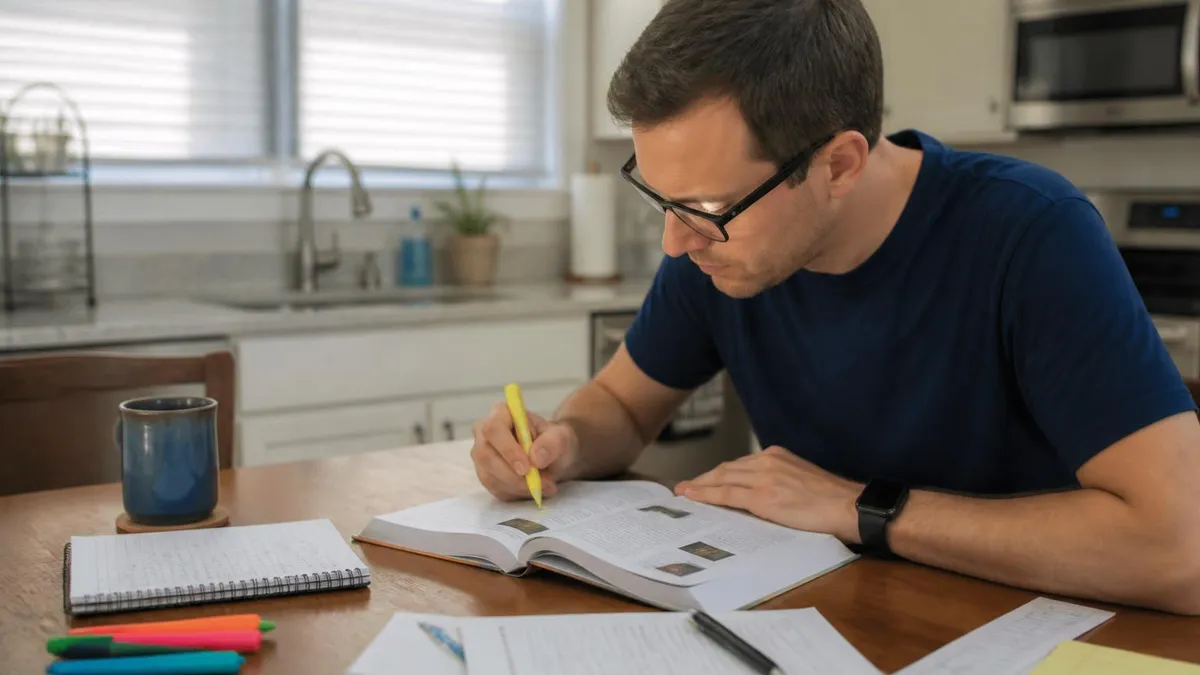
Realistic timelines matter, so we will be honest about the workload. Most candidates pass with 20 to 40 hours of focused study spread over two to six weeks. Cramming in a weekend works for some, but retention suffers and the practical skills you need on the air evaporate. Our recommended schedule blends reading, video lectures, and timed practice exams to build both knowledge and test-taking stamina. You will see steady score improvements when you follow the daily structure rather than binge studying the night before your scheduled session.
Finally, this study guide treats the license as a beginning, not an end. We sprinkle in real operating tips so you can transition smoothly from passing the exam to making your first contact. Understanding why a J-pole antenna outperforms a rubber duck at the same height, or why CTCSS tones unlock repeater access, transforms abstract test questions into practical knowledge. Bookmark this page, set aside thirty minutes a day, and you will hold a callsign issued by the FCC within four weeks of starting your preparation journey from scratch today.
Ham Radio License Exam by the Numbers
4-Week Ham Radio Technician Study Schedule
- ▸Read Subelements T1 and T2 from ARRL manual
- ▸Memorize band privileges chart for Technicians
- ▸Take diagnostic practice test to establish baseline
- ▸Watch video lessons on repeater operation and tones
- ▸Study Ohm's Law and power formulas with examples
- ▸Learn schematic symbols for resistors, capacitors, diodes
- ▸Review RF exposure limits and grounding requirements
- ▸Complete 50 practice questions on T5, T6, and T0 subelements
- ▸Understand VHF/UHF propagation and line-of-sight
- ▸Calculate antenna lengths for 2-meter and 70-cm bands
- ▸Study SSB, FM, CW, and digital mode characteristics
- ▸Take two full timed practice exams aiming for 80%+
- ▸Drill weak topics identified in practice tests
- ▸Take five full practice exams scoring 85% or higher
- ▸Register for VE session at hamstudy.org or ARRL.org
- ▸Prepare ID, FRN number, and exam fee for test day
The Technician question pool is divided into ten subelements, and understanding the weight of each section guides your study time allocation. Subelement T1 covers FCC rules and amateur radio principles with six questions on the exam, making it tied for the heaviest category. T2 handles operating procedures including phonetic alphabet, repeater etiquette, and emergency communications with three questions. T3 tests radio wave propagation knowledge with three questions covering ionospheric effects, line-of-sight, and tropospheric ducting that occasionally extends VHF range.
Subelement T4 examines amateur radio practices including station setup, transmitter adjustments, and RF interference mitigation with two questions. T5 dives into electrical principles like Ohm's Law, decibels, frequency, and wavelength relationships with four questions. T6 covers electrical components and circuits including resistors, capacitors, inductors, transistors, and integrated circuits with four questions. Together, T5 and T6 form the electronics backbone that intimidates non-technical candidates, but the formulas reduce to four memorizable equations once you see how they connect to real radio circuits.
Subelement T7 tests practical circuits including receivers, transmitters, power supplies, and digital modes with four questions on the exam. T8 examines signals and emissions including modulation types, bandwidth, and the specific characteristics of FM, AM, SSB, CW, and digital protocols with four questions. T9 covers antennas and feed lines with two questions on dipoles, verticals, Yagis, and the SWR meter readings that indicate antenna health. Reviewing ham radios tutorials helps cement these concepts visually for learners who struggle with text-only descriptions of equipment.
Subelement T0 closes the pool with three questions on electrical and RF safety including grounding, lightning protection, battery acid hazards, and human RF exposure limits at various frequencies. Total that up and you get 35 questions distributed across ten topics with predictable proportions. Smart candidates spend roughly 30 percent of study time on T1 regulations because the rules are memorization-heavy but yield reliable points. Another 35 percent goes to T5, T6, T7, and T8 electronics because conceptual understanding earns multiple correct answers across related questions.
The remaining 35 percent splits between T2 operating procedures, T3 propagation, T4 practices, T9 antennas, and T0 safety. None of these subelements should be skipped, even the two-question categories, because missing both questions in T9 plus a few electronics questions can sink an otherwise prepared candidate. The exam is generous in that you can miss nine questions and still pass, but most failures come from candidates who ignored entire subelements assuming they could afford the loss. Cover everything at least once, then drill weak spots.
Question wording on the actual exam matches the public question pool exactly, which is both the gift and the trap of amateur radio testing. The gift is that you can memorize correct answer letters if you really must, though this strategy fails when the question order randomizes. The trap is that subtle distractors appear in answer choices, and rote memorizers stumble when stress changes their pattern recognition. The reliable approach combines understanding with repetition, using flashcards for vocabulary and full practice tests for stamina building under simulated exam conditions.
Free question pool resources include the ARRL website, HamStudy.org, QRZ.com practice tests, and the NCVEC official PDF release. Paid options include the Gordon West book and audio course, the ARRL Technician License Manual, and Ham Radio Prep online video courses. The best resource depends on your learning style, but all of them draw from the same fixed question pool, so you cannot study the wrong material as long as you use any current source dated July 2022 through June 2026.
Ham Radio Technician Practice Test Questions
Prepare for the Ham Radio Technician Test exam with our free practice test modules. Each quiz covers key topics to help you pass on your first try.
Ham Radio Technician Antennas & Feedlines
Ham Radio Technician Exam Questions covering Antennas & Feedlines. Master Ham Radio Technician Test concepts for certification prep.
Ham Radio Technician Basic Electronics & C...
Free Ham Radio Technician Practice Test featuring Basic Electronics & Circuitry. Improve your Ham Radio Technician Exam score with mock test prep.
Ham Radio Technician Equipment & Tools Usage
Ham Radio Technician Mock Exam on Equipment & Tools Usage. Ham Radio Technician Study Guide questions to pass on your first try.
Ham Radio Technician Amateur
Ham Radio Technician Test Prep for Amateur. Practice Ham Radio Technician Quiz questions and boost your score.
Ham Radio Technician General
Ham Radio Technician Questions and Answers on General. Free Ham Radio Technician practice for exam readiness.
Ham Radio Technician III
Ham Radio Technician Mock Test covering III. Online Ham Radio Technician Test practice with instant feedback.
Ham Radio Technician II
Free Ham Radio Technician Quiz on II. Ham Radio Technician Exam prep questions with detailed explanations.
Ham Radio Technician I
Ham Radio Technician Practice Questions for I. Build confidence for your Ham Radio Technician certification exam.
Ham Radio Technician License
Ham Radio Technician Test Online for License. Free practice with instant results and feedback.
Ham Radio Technician Licensing Regulations...
Ham Radio Technician Study Material on Licensing Regulations & Standards. Prepare effectively with real exam-style questions.
Ham Radio Technician Operating Procedures ...
Free Ham Radio Technician Test covering Operating Procedures & Etiquette. Practice and track your Ham Radio Technician exam readiness.
Ham Radio Technician Radio Wave Propagatio...
Ham Radio Technician Exam Questions covering Radio Wave Propagation & Modulation. Master Ham Radio Technician Test concepts for certification prep.
Ham Radio Technician Safety Procedures & R...
Free Ham Radio Technician Practice Test featuring Safety Procedures & Risk Management. Improve your Ham Radio Technician Exam score with mock test prep.
Ham Radio Prep Methods Compared
Books like the ARRL Technician License Manual and Gordon West's Technician Class provide structured chapters mapped to question pool subelements. They include diagrams, formula explanations, and end-of-chapter review questions that mirror exam style. Self-study suits independent learners who absorb material through reading and can stay disciplined without external accountability or scheduled lessons throughout their preparation period.
The downside is pace control and feedback latency. You will not know if you misunderstand a concept until practice tests reveal the gap, and some electronics topics genuinely benefit from animated explanations. Budget around 25 dollars for a quality book and supplement it with free online practice exams. This combination remains the most cost-effective ham radio prep path for motivated adult learners who prefer text-based study materials.

Is the Technician License Worth Pursuing?
- +Lifetime FCC license valid for 10 years and easily renewable online
- +Access to VHF and UHF repeaters extending range up to hundreds of miles
- +Emergency communication capability when cell networks fail during disasters
- +Entry into satellite communication including the International Space Station
- +Permission to build and modify your own radio equipment legally
- +Connection to a worldwide community of operators across all age groups
- +Foundation for upgrading to General and Amateur Extra class privileges
- −Initial equipment investment of $50 to $300 for a usable handheld station
- −Limited HF privileges restrict worldwide voice communication to General class
- −Some technical learning curve for non-engineers studying electronics topics
- −FCC database lists your name and address publicly with your callsign
- −Requires Volunteer Examiner test session attendance in person or online
- −Ongoing learning needed to operate digital modes, satellites, and contests effectively
Pros and Cons at a Glance
| Pros | Cons |
|---|---|
| Access to VHF and UHF repeaters extending range up to hundreds of miles | Limited HF privileges restrict worldwide voice communication to General class |
| Emergency communication capability when cell networks fail during disasters | Some technical learning curve for non-engineers studying electronics topics |
| Entry into satellite communication including the International Space Station | FCC database lists your name and address publicly with your callsign |
| Permission to build and modify your own radio equipment legally | Requires Volunteer Examiner test session attendance in person or online |
| Connection to a worldwide community of operators across all age groups | Ongoing learning needed to operate digital modes, satellites, and contests effectively |
Ham Radio License Test Day Checklist
- ✓Bring two forms of identification including one government-issued photo ID
- ✓Have your FCC Registration Number (FRN) printed and ready to provide
- ✓Bring $15 cash or check for Volunteer Examiner team test session fee
- ✓Pack a basic calculator without programmable memory or wireless features
- ✓Arrive at the test location at least 15 minutes before scheduled start
- ✓Eat a substantial meal and hydrate to maintain focus during the exam
- ✓Print or save your CSCE confirmation immediately after passing the test
- ✓Set up an FCC ULS account in advance to simplify license issuance
- ✓Review your weak-topic flashcards for 20 minutes before walking into session
- ✓Silence your phone and remove smart watches before entering the testing room
Take Practice Tests Until You Score 85% or Higher Three Times in a Row
The single strongest predictor of passing the Technician exam is consistent practice test performance. Candidates who score 85 percent or above on three consecutive full-length practice exams pass the real test 96 percent of the time. Do not schedule your VE session until you hit this benchmark, because rushed exam attempts waste time and the optional $15 fee.
Once you pass the Technician exam, your license privileges activate within 7 to 10 business days when the FCC issues your callsign in the Universal Licensing System database. You will receive an email notification with your new callsign, and you can immediately begin transmitting on all authorized Technician frequencies. The license costs 35 dollars from the FCC plus the optional 15 dollar Volunteer Examiner fee, and it remains valid for 10 years with free online renewal through the ULS portal before expiration.
Technician privileges include full voice, data, and CW operation on the 6-meter, 2-meter, 1.25-meter, 70-centimeter, 33-centimeter, and 23-centimeter bands. These VHF and UHF allocations support local repeaters, simplex communications, satellite work, and digital modes including DMR, D-STAR, System Fusion, and APRS packet networks. The 2-meter band at 144 to 148 MHz remains the most popular for new licensees because handheld radios and repeater coverage are widely available across the United States and almost every metropolitan area.
HF privileges for Technicians are limited but valuable for learning worldwide propagation. You get CW privileges on portions of 80, 40, and 15 meters, plus voice and data privileges on a small 10-meter segment from 28.300 to 28.500 MHz. During solar maximum years, that 10-meter slice opens reliably for transcontinental and international SSB contacts using modest dipole antennas. Reviewing different ham radio frequencies available on common handheld radios helps new operators identify the most useful repeaters in their region.
Beyond the spectrum, your Technician license authorizes you to build transmitters, modify commercial equipment, and operate emergency communications under FCC Part 97 rules. Many new operators join the Amateur Radio Emergency Service (ARES) or Radio Amateur Civil Emergency Service (RACES) to support local agencies during disasters. Skywarn weather spotter training pairs naturally with the Technician license because storm spotters report directly to National Weather Service offices via VHF repeaters during severe weather events affecting communities across the country.
Your callsign reflects your license class and geographic district at the time of issuance. New Technicians receive 2x3 format callsigns like KO4ABC or KQ4XYZ, with the prefix indicating the FCC district where you applied. You can request a vanity callsign later for a free application that lets you choose any available shorter or personally meaningful combination. Many operators upgrade to General class within six months because the HF privileges dramatically expand worldwide voice and digital communication opportunities across all amateur radio bands.
The Technician license also serves as your gateway to amateur radio satellites operated by AMSAT and other organizations. Using a handheld radio with a directional Arrow antenna, you can work FM repeater satellites in low Earth orbit and even contact astronauts aboard the International Space Station during scheduled school events. Linear transponder satellites support SSB and CW for longer conversations across continents using minimal power. This satellite work counts toward various awards and provides unique stories that distinguish amateur radio from any other hobby available today.
Public service events represent another rewarding application of your new privileges. Marathons, parades, bike races, and search and rescue operations rely on amateur radio operators to coordinate communications when commercial systems are overwhelmed or unavailable. Local clubs typically welcome new Technicians to assist with these events as a way to gain experience working in nets, using directories, and operating under field conditions. The relationships formed during public service work often become lifelong friendships within the amateur radio community in your area.
You have 10 calendar days from passing your exam to pay the 35 dollar FCC application fee through the ULS system. Missing this deadline cancels your application and forces you to retake the entire exam at a new VE session, including paying the optional VE fee again at considerable inconvenience.
Choosing your first ham radio equipment shapes how quickly you transition from licensed operator to active participant in the hobby. Most new Technicians start with a dual-band handheld transceiver covering 2-meter and 70-centimeter bands, with popular models including the Yaesu FT-65R, Icom IC-V86, and Kenwood TH-D74. Budget Chinese imports like the Baofeng UV-5R cost under 30 dollars but require careful programming and emit more spurious signals than name-brand alternatives. Investing 100 to 200 dollars in a quality handheld pays back in audio quality, durability, and reliable repeater access.
Antenna upgrades produce the biggest performance gains for the lowest cost in amateur radio. The stock rubber duck antenna shipped with every handheld radio is a compromise designed for portability, not performance. Swapping it for a Signal Stick, Diamond SRH77CA, or Comet SMA-503 nearly doubles your effective range on most repeaters. Moving up to a roll-up J-pole hung from a tree branch or a quarter-wave ground plane mounted on a mast extends VHF range to 30 miles or more depending on terrain and local repeater coverage in your area.
Programming your radio efficiently requires CHIRP software, a programming cable, and a list of local repeater frequencies. RepeaterBook and the ARRL Repeater Directory provide accurate frequency, offset, and CTCSS tone information for repeaters within your area. Spending an hour programming 30 to 50 channels into your handheld transforms it from a frustrating mystery into a reliable communication tool. Practice scanning, manual frequency entry, and emergency channel access until these operations become second nature on the radio you carry daily.
Mobile stations expand your reach significantly and support both stationary home use and vehicle operation. A 50-watt dual-band mobile radio like the Yaesu FTM-300DR or Icom IC-2730A mounted in your car with a quality magnet-mount or NMO antenna reaches repeaters 50 miles away and supports cross-band repeat for advanced tactical communications. Powering a mobile radio at home requires a 30-amp regulated power supply costing around 100 dollars and good grounding to prevent RF feedback into nearby consumer electronics during transmissions.
Specialty modes broaden the hobby beyond basic voice contacts on local repeaters. APRS packet radio shares your GPS position and weather data over the 144.390 MHz national frequency, useful for tracking hikes and emergency operations. DMR, D-STAR, and System Fusion digital voice modes link repeaters worldwide through internet bridges, letting you talk to operators in other countries using your handheld radio. Visit ham radio outlet for practice tests that include questions about these modern digital protocols and operating procedures.
Joining a local amateur radio club accelerates your learning more than any other single action. Clubs run weekly nets where new operators practice making contacts in a structured environment with friendly elmers (experienced mentors) ready to answer questions. Club Field Day operations every June give you hands-on experience operating multiple bands and modes in 24 hours of intense activity. ARRL.org maintains a club locator that lists organizations within any zip code along with meeting times and contact information for local volunteer leaders.
Documenting your contacts in a logbook builds the foundation for amateur radio awards programs. Worked All States, DX Century Club, and Worked All Continents recognize operators who confirm contacts with stations across geographic regions. Logbook of the World (LoTW) from the ARRL provides free electronic confirmation of contacts, replacing the paper QSL card tradition for award credit. Even casual operators benefit from logging because it captures the stories, propagation conditions, and memorable conversations that make amateur radio a lifelong hobby worth pursuing seriously.
Final exam preparation in the last 72 hours before your VE session should focus on confidence building rather than learning new material. Take two full practice exams at different times of day to simulate test conditions and verify consistent scoring above 85 percent. Review the questions you missed and trace each error back to its underlying concept, then re-read the relevant section in your study material. Avoid cramming new topics the night before because anxiety reduces retention and disrupts sleep that you absolutely need for sharp recall during the actual exam.
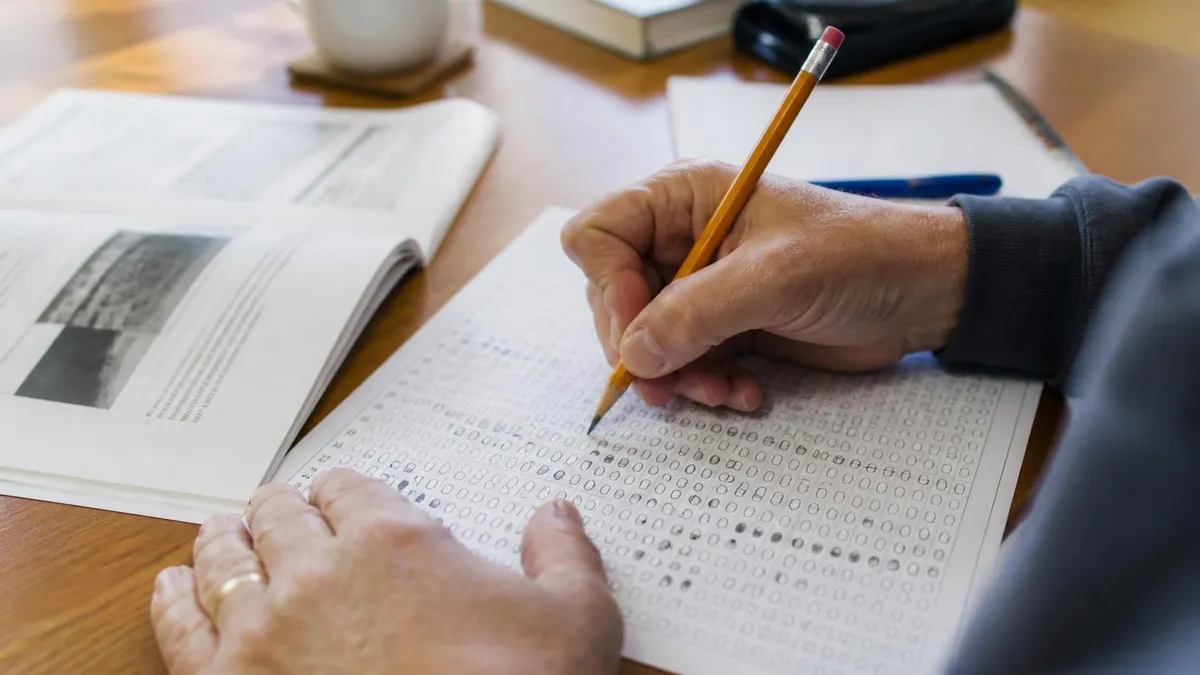
The Volunteer Examiner session itself runs efficiently and lasts about an hour from check-in to results. After verifying your identification and FRN, the VE team hands you a paper exam booklet with 35 randomly selected questions and an answer sheet. You bubble in your choices with a pencil, and most candidates finish in 15 to 25 minutes. The VE team grades your exam on the spot using an answer key, then provides your Certificate of Successful Completion of Examination (CSCE) within minutes if you pass the required threshold.
Online remote exam sessions through groups like GLAARG, W5YI, and Anchorage VEC have become standard since 2020 and offer scheduling flexibility unavailable in physical sessions. You will need a webcam, second camera or phone showing your workspace, stable internet, and a quiet room without papers or electronics. Remote sessions cost the same 15 dollar VE fee and produce instant results identical to in-person testing. Many candidates prefer remote exams because they eliminate driving to distant test locations and accommodate evening or weekend schedules.
If you do not pass on your first attempt, you can retake the exam immediately at the same session for an additional VE fee, though the VE team will give you a different version of the test. Most teams allow up to three attempts per session, and the failure rate drops sharply on retakes because candidates have already seen the exam structure. Use the failure as diagnostic information about which subelements need more work, and schedule another session two weeks out after focused review of your weak areas using targeted practice tests.
After passing, monitor the FCC ULS database daily for your callsign to appear at fcc.gov/uls. You cannot transmit until your callsign is officially issued, even if you have your CSCE in hand. This typically takes 7 to 10 business days, though delays of two to three weeks happen during high-volume periods. Use this waiting time to program repeaters into your radio, join a local club, and listen to the bands so you understand operating conventions before making your first transmission with your shiny new callsign on the air.
Your first contact on the air feels like a milestone, and it should. Most new operators make their first call on a local repeater during a club net, where experienced operators warmly welcome new callsigns. Listen first to learn the net's check-in procedure, then key up confidently using phonetics: This is Kilo Oscar Four Alpha Bravo Charlie checking in. The community will celebrate your accomplishment, and you will discover the genuine friendliness that has defined amateur radio for over a century of continuous on-air operation.
Looking beyond Technician, the General class license dramatically expands HF privileges and opens worldwide voice communication on 80, 40, 20, 17, 15, 12, and 10 meters. The General exam covers another 35 questions from a 432-question pool and most candidates pass within three months of earning their Technician license. The Amateur Extra license adds final HF segment access and completes the upgrade path with 50 questions from a 622-question pool. Many operators progress through all three licenses within their first year as their interest grows naturally beyond local VHF operations.
Sample Ham Radio Technician Test Practice Questions
Try these questions from our free Ham Radio Technician Test practice tests. The correct answer and an explanation follow each question.
How long is a Technician class amateur radio license valid?
- A. 5 years
- B. 10 years
- C. 2 years
- D. Lifetime
Answer: B. 10 years
Amateur radio licenses issued by the FCC are valid for 10 years from the date of issue.
What is the minimum age requirement to obtain a Technician class amateur radio license in the US?
- A. 13 years old
- B. 16 years old
- C. 18 years old
- D. There is no minimum age requirement
Answer: D. There is no minimum age requirement
The FCC imposes no minimum age requirement for an amateur radio license; anyone of any age may be licensed.
How many Volunteer Examiners (VEs) must be present to administer a Technician license exam session?
- A. At least 2
- B. At least 3
- C. At least 5
- D. At least 1
Answer: B. At least 3
FCC rules require a minimum of three accredited Volunteer Examiners to be present and supervise any amateur radio exam session.
What is required for a Technician Class license exam?
- A. Morse code exam
- B. Written exam
- C. Physical test
- D. Interview with FCC
Answer: B. Written exam
To obtain a Technician Class license, applicants are required to pass a written examination. This exam consists of 35 multiple-choice questions covering fundamental radio theory, operating procedures, and FCC rules, with a passing score of 26 correct answers.
Ham Radio Technician Questions and Answers
Ham Radio License Practice Test: Free Technician Exam Prep & Question Pool
Ham Radio Handheld: Complete Guide to HT Selection, Programming, and Technician License Use
Ham Radio Technician
Ham Radio License: What It Is and How to Get One
Ham Radio Modes: Complete Guide to RTTY, FT8, SSB, CW, and Digital Operating for Technicians
About the Author

Educational Psychologist & Academic Test Preparation Expert
Columbia University Teachers CollegeDr. Lisa Patel holds a Doctorate in Education from Columbia University Teachers College and has spent 17 years researching standardized test design and academic assessment. She has developed preparation programs for SAT, ACT, GRE, LSAT, UCAT, and numerous professional licensing exams, helping students of all backgrounds achieve their target scores.
Join the Discussion
Connect with other students preparing for this exam. Share tips, ask questions, and get advice from people who have been there.
View discussion (3 replies)