
How to Get Forklift Certification: Complete 2026 Guide to OSHA-Compliant Training, Costs, and Career Pathways
Learn how to get forklift certification in 2026. OSHA training steps, costs, online vs in-person options, renewal rules, and free practice tests. ⏳
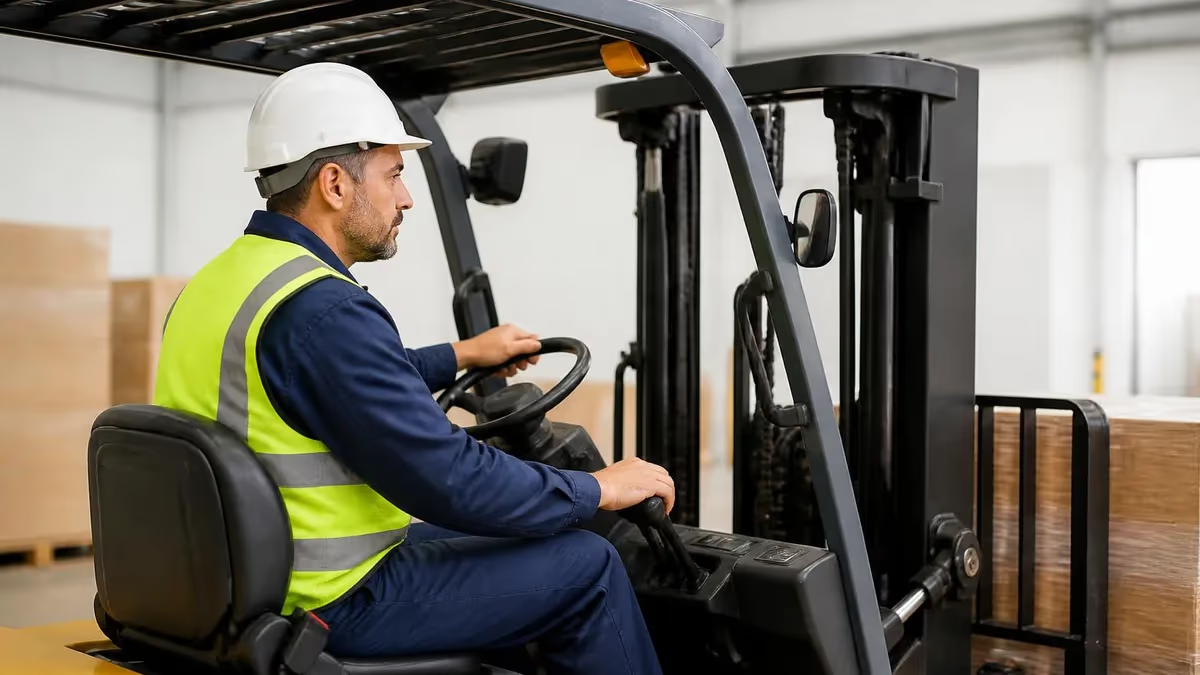
Learning how to get forklift certification is the single most important step toward landing a stable, well-paying warehouse, construction, or logistics job in 2026. Whether you operate a sit-down counterbalance, reach truck, cherry picker forklift, or electric forklift in a cold-storage facility, the Occupational Safety and Health Administration (OSHA) requires every operator to complete formal training, hands-on evaluation, and employer authorization before touching the controls. This guide walks you through every step, cost, and shortcut so you can earn your card quickly and legally.
OSHA standard 29 CFR 1910.178(l) governs the certification of forklift operators in general industry, while 29 CFR 1926.602 covers construction sites. The rule has three non-negotiable components: formal instruction (lecture, video, or interactive computer-based modules), practical training (hands-on demonstration with the actual equipment), and a workplace evaluation conducted by a qualified trainer. Skipping any one of these three pillars renders the certification invalid, even if a third-party provider issued a glossy laminated card.
The good news is that getting forklift certified is faster and cheaper than most people assume. A typical class runs four to eight hours, costs between $50 and $200 online or $150 to $300 in person, and remains valid for three years. Employers usually cover the cost when they hire you, but holding a current card before you apply dramatically improves your odds of landing the interview, especially at Amazon, Walmart, Home Depot, FedEx, UPS, and major staffing agencies that staff distribution centers nationwide.
Certification is not just paperwork. The agency cites forklift-related violations more than 7,000 times each year, and untrained operators account for roughly 70 percent of the 85 fatal forklift incidents recorded annually in the United States. A properly trained operator knows how to inspect the data plate, calculate load center, recognize tip-over conditions, and refuel or recharge safely. Those skills protect your life, your coworkers, and the equipment, which often costs $25,000 to $75,000 per unit new.
This article covers every angle: who needs certification, what the training actually involves, online versus in-person formats, total cost breakdowns, renewal timelines, state-by-state variations, and how to convert a card into a higher salary. You will also find free practice questions modeled after real OSHA evaluations so you can walk into the written test with confidence. By the end, you will have a clear, actionable roadmap to becoming a certified forklift operator in two to four weeks.
One myth worth dispelling immediately: there is no such thing as a federal forklift license issued by OSHA itself. The agency does not print cards, run a national registry, or charge a licensing fee. Instead, the employer is legally responsible for certifying that each operator has been trained and evaluated. Third-party schools and online providers issue completion certificates that document the formal portion, but the hands-on evaluation must occur on the specific equipment and in the specific environment where you will actually work.
Whether your goal is a $19-an-hour warehouse job, a $32-an-hour union construction gig, or simply the ability to legally move pallets at your family business, the path is the same. Read on, take the practice tests, and you will be ready to pass the evaluation on your first attempt.
Forklift Certification by the Numbers

Step-by-Step Path to Forklift Certification
Confirm Eligibility
Choose Training Provider
Complete Formal Instruction
Hands-On Evaluation
Receive Certification Card
Schedule Three-Year Renewal
OSHA's powered industrial truck standard divides forklifts into seven classes, and your certification must specify exactly which classes you are authorized to operate. Class I covers electric motor rider trucks like the common sit-down counterbalance. Class II includes narrow-aisle reach trucks and order pickers. Class III is electric pallet jacks and walkies. Class IV and V are internal-combustion sit-downs with cushion and pneumatic tires. Class VI covers tractors, and Class VII includes rough-terrain forklifts used on construction sites and lumber yards.
A common misconception is that one card covers every machine. It does not. If you certify on a Class IV propane sit-down and later transfer to a department using Class II reach trucks, your employer must provide additional training on the new class before you operate it. The same rule applies when switching attachments such as paper-roll clamps, slip-sheet push-pull units, or carton clamps, because they change the load center and stability triangle in ways that can surprise even experienced forklift truck operators.
The formal instruction portion must cover specific truck-related topics and workplace-related topics. Truck-related content includes operating instructions, differences from automobiles, controls and instrumentation, engine or motor operation, steering and maneuvering, visibility limitations, fork attachments, vehicle capacity, stability, inspection procedures, refueling or recharging, and any operating limitations listed in the manufacturer's manual. Workplace topics cover surface conditions, load composition, stacking practices, pedestrian traffic, narrow aisles, hazardous classified locations, ramps, and closed environments where carbon monoxide can accumulate from propane or diesel exhaust.
The agency does not specify a minimum number of training hours, which is why you see programs ranging from one-hour online crash courses to multi-day vocational school programs. What matters legally is content coverage and demonstrated competency, not seat time. That said, a one-hour course almost certainly skips required topics, and OSHA inspectors routinely invalidate certifications when documentation shows insufficient depth. A reasonable benchmark is four hours of formal instruction plus one to two hours of hands-on practice and evaluation per equipment class.
Trainer qualifications are also defined. The person delivering instruction must have the knowledge, training, and experience to train operators and evaluate their competence. There is no federal trainer certification, but reputable programs require their trainers to hold a Train-the-Trainer credential from organizations like the National Safety Council, NCCER, or the manufacturer itself. If your employer is the trainer, that person should be able to produce documentation of their own training and a written lesson plan upon request.
Documentation is the piece most operators overlook until an OSHA inspector arrives. Your employer must maintain a written record showing the name of the operator, the date of training, the date of evaluation, and the identity of the person performing the training and evaluation. The record must be available for the duration of employment plus three years. Losing this paperwork can trigger citations even if the operator is genuinely competent, so request a copy for your personal file.
Finally, OSHA mandates refresher training whenever certain trigger events occur, regardless of how recently you certified. Triggers include an observed unsafe operation, involvement in an accident or near-miss, assignment to a different type of truck, or a change in workplace conditions such as a new layout, surface, or load type. Treat these triggers seriously, because operating after a trigger without refresher training is one of the most commonly cited violations in distribution-center inspections.

Forklift certification Practice Test Questions
Prepare for the Forklift certification Certification exam with our free practice test modules. Each quiz covers key topics to help you pass on your first try.
Forklift certification Certification Forkl...
Forklift certification Exam Questions covering Certification Forklift certification Maintenance and Repairs. Master Forklift certification Test concepts for certification prep.
Forklift certification Certification Forkl...
Free Forklift certification Practice Test featuring Certification Forklift certification Maintenance and Repairs Questions and Answers. Improve your Forklift certification Exam score with mock test prep.
Forklift certification Certification Forkl...
Forklift certification Mock Exam on Certification Forklift certification Operator Training and Certification Requirements. Forklift certification Study Guide questions to pass on your first try.
Forklift certification Certification Forkl...
Forklift certification Test Prep for Certification Forklift certification Operator Training and Certification Requirements Questions and Answers. Practice Forklift certification Quiz questions and boost your score.
Forklift certification Load Handling and S...
Forklift certification Questions and Answers on Load Handling and Stability. Free Forklift certification practice for exam readiness.
Forklift certification OSHA Regulations an...
Forklift certification Mock Test covering OSHA Regulations and Compliance. Online Forklift certification Test practice with instant feedback.
Forklift certification Pre-Operation Inspe...
Free Forklift certification Quiz on Pre-Operation Inspections. Forklift certification Exam prep questions with detailed explanations.
Forklift certification Refueling and Recha...
Forklift certification Practice Questions for Refueling and Recharging Procedures. Build confidence for your Forklift certification certification exam.
Forklift certification Safe Driving and Ma...
Forklift certification Test Online for Safe Driving and Maneuvering. Free practice with instant results and feedback.
Forklift certification Workplace Hazard Id...
Forklift certification Study Material on Workplace Hazard Identification. Prepare effectively with real exam-style questions.
Forklift certification Forklift Instructions
Free Forklift certification Test covering Forklift Instructions. Practice and track your Forklift certification exam readiness.
Forklift certification Forklift MCQ
Forklift certification Exam Questions covering Forklift MCQ. Master Forklift certification Test concepts for certification prep.
Forklift certification Forklift Employer R...
Free Forklift certification Practice Test featuring Forklift Employer Responsibilities. Improve your Forklift certification Exam score with mock test prep.
Forklift certification Forklift Penalties ...
Forklift certification Mock Exam on Forklift Penalties for Non-Compliance. Forklift certification Study Guide questions to pass on your first try.
Forklift Training Formats: Online, In-Person, and Hybrid
Fully online forklift training has exploded in popularity since 2020, with providers like CertifyMe, ForkliftCertification.com, and OSHA Education Center charging $50 to $90 for the formal-instruction portion. You complete video modules at your own pace, take a written exam, and download a temporary certificate within minutes. The format is convenient, affordable, and covers every OSHA classroom requirement.
The catch is that online programs satisfy only one of three OSHA requirements. You still need hands-on training and a workplace evaluation conducted by a qualified person on the actual equipment. Online providers make this clear in their fine print, but applicants often miss it. Employers love the format because it lets new hires arrive with classroom work complete, shortening on-the-job training to a single shift.
Online Forklift Certification: Is It Worth It?
- +Costs only $50 to $90 versus $150 to $300 in person
- +Complete on your phone or laptop in four hours
- +Instant printable certificate after passing the written exam
- +Satisfies OSHA's formal-instruction requirement nationwide
- +Lets you apply to jobs as a pre-trained candidate
- +Available 24/7 with no scheduling conflicts
- −Does not include hands-on training or workplace evaluation
- −Employer must still verify competence on actual equipment
- −Some staffing agencies refuse online-only cards
- −Quality varies widely among unaccredited providers
- −No instructor available for real-time questions
- −Refund policies are often restrictive if you fail

Pre-Class Checklist Before You Pay for Forklift Training
- ✓Confirm the provider specifies OSHA 29 CFR 1910.178 compliance in writing
- ✓Verify the program covers all seven forklift classes or the specific class you need
- ✓Check that the certificate includes trainer name, date, and equipment class
- ✓Read recent reviews on Google, Trustpilot, or Reddit's r/forklift community
- ✓Ask whether the price includes the hands-on evaluation or only classroom content
- ✓Confirm acceptance by major employers in your area before purchasing
- ✓Bring government-issued photo ID and proof of age to in-person classes
- ✓Wear closed-toe steel-toed boots and long pants for hands-on portions
- ✓Block out a full day for in-person courses including travel and lunch
- ✓Have your employer's name and address ready for the certificate
- ✓Save the digital certificate to cloud storage and email it to yourself
- ✓Schedule your three-year renewal reminder before leaving the parking lot
Always Get Class-Specific Certification
A wallet card that simply says 'forklift operator' without specifying Class I, II, III, IV, V, VI, or VII gives you almost no use when switching jobs. Insist on a certificate that lists every class you trained on. Multi-class cards command 12 to 18 percent higher starting wages and dramatically widen the range of warehouses, lumber yards, and construction sites that will hire you on the spot.
Cost is usually the first question applicants ask, and the honest answer is that you can spend anywhere from zero to $500 depending on the route you choose. Employer-sponsored training is free and paid at your normal hourly rate. Online-only programs run $50 to $90 for the classroom portion. Full in-person courses including evaluation cost $150 to $300 in most markets and up to $500 in high-cost metros like San Francisco, New York, and Seattle. Renewal courses typically cost half the initial price.
Hidden costs surprise some applicants. A pre-employment physical or drug screen runs $50 to $150 if your employer does not pay for it. Steel-toed boots that meet ASTM F2413 standards cost $80 to $200. A high-visibility vest is usually provided but sometimes deducted from your first paycheck. If you need to rent a forklift for a private evaluation, expect to pay $200 to $400 per day at a used forklifts for sale dealer or rental yard, though most schools include this in tuition.
Renewal timing is strict. OSHA requires evaluation at least every three years, and many employers conduct internal observations annually as a best practice. If your card expires on March 15, 2027, you must complete refresher training and evaluation before that date or stop operating equipment. Operating with an expired card exposes both you and your employer to citations averaging $16,131 per violation as of the 2026 penalty schedule, with willful or repeat violations reaching $161,323.
Reciprocity is another frequent question. Because OSHA certification is employer-specific rather than license-based, your card does not automatically transfer when you change jobs. Your new employer must conduct their own evaluation on their equipment in their facility, but they can usually skip the formal-instruction portion if your existing documentation is complete and current. Bring your wallet card, the original certificate, and the trainer's contact information to your first day to make this process smooth.
State and local variations exist on top of federal OSHA rules. California, Michigan, Oregon, Washington, and 22 other states operate their own OSHA-approved programs that may add requirements such as Spanish-language training, specific written-test pass rates, or annual rather than triennial renewal for certain industries. Construction-specific certifications under 29 CFR 1926 require additional training on rough-terrain machines and overhead power-line clearance that general-industry cards do not cover.
Employer obligations extend well beyond paying for the class. The employer must designate a competent person to conduct evaluations, maintain training records for the duration of employment plus three years, provide refresher training after any trigger event, ensure the operator wears required PPE, maintain equipment in safe operating condition, and prohibit unauthorized use of forklifts by uncertified personnel. Failure on any of these points generates citations even when the operator personally did nothing wrong.
Finally, consider the lifetime value of certification. A three-year card costing $200 unlocks access to jobs paying $18 to $28 per hour, which translates to roughly $37,000 to $58,000 annually before overtime. Add a second class certification and union membership in markets like Chicago, Las Vegas, or Newark, and total compensation easily exceeds $75,000 with benefits. Few credentials in the American economy offer that return on a single-day investment.
The Federal Trade Commission has issued repeated warnings about websites selling 'instant lifetime forklift licenses' for $19.99 with no training content. These cards are worthless under OSHA, and using one to apply for a job can constitute fraud. Always verify the provider lists their physical address, trainer credentials, and a refund policy. If the site promises certification in under one hour with no exam, walk away.
Once you hold a current forklift certification, the career runway opens dramatically. The Bureau of Labor Statistics reports a median annual wage of $42,180 for material moving machine operators as of May 2025, with the top 10 percent earning more than $61,840. Specialty roles such as high-reach VNA operators in Amazon Robotics facilities, port container handlers in Long Beach and Newark, and union construction operators at $44 per hour plus benefits push compensation well into six figures with overtime.
Industries hiring certified operators in 2026 include e-commerce fulfillment, traditional retail distribution, cold-chain food storage, beverage and brewery, building materials, automotive parts, aerospace manufacturing, paper and packaging, ports and intermodal terminals, and waste-management transfer stations. Each industry has slightly different equipment preferences. E-commerce favors electric reach trucks and pallet jacks. Lumber and steel yards rely on rough-terrain machines and large pneumatic-tire sit-downs. Beverage warehouses use Class I sit-downs with slip-sheet attachments.
The fastest salary jump comes from adding endorsements. After your initial Class IV or V certification, ask your employer to train you on Class II reach trucks within the first six months. Reach-truck operators earn 10 to 15 percent more than basic sit-down operators because the equipment is more complex and the productivity per labor hour is higher. After another year, pursue a Class VII rough-terrain or telehandler certification for construction work, which adds another 15 to 25 percent and opens union-hall opportunities in most major metros.
Certification also serves as a stepping stone to supervisory and trainer roles. Most warehouse leads, shift supervisors, and operations managers started as certified operators. After three to five years on the floor, you can complete a Train-the-Trainer course through the National Safety Council or NCCER for $400 to $800 and qualify to certify other employees, which is typically a salaried position starting at $58,000 plus bonuses. This path is especially common at 3PL operators like XPO, GXO, and Ryder.
Geographic flexibility is a major advantage. A current OSHA-compliant card combined with a clean driving record and a willingness to relocate makes you employable in every state and most Canadian provinces under reciprocal arrangements. Travel-operator contracts at $35 to $50 per hour plus per diem and lodging are routinely posted on Indeed and ZipRecruiter, particularly for short-term projects involving plant relocations, inventory cycle counts, and seasonal peaks in distribution centers.
Look for employers who run modern equipment because operating a worn-out machine on smooth floors with a damaged stand up forklift tire creates daily safety risks and reduces your productivity, hurting your bonus eligibility. Walk the facility before accepting any offer, check the age of the fleet, ask about preventive maintenance schedules, and verify that battery rooms or fuel stations are properly ventilated. The best operators choose workplaces that invest in their equipment because those workplaces also invest in their people.
Finally, never stop learning. The forklift industry is transitioning rapidly toward lithium-ion electric power, automated guided vehicles, and operator-assist technologies like proximity detection and pedestrian alert systems. Operators who understand both traditional propane and modern electric equipment, who can read telematics dashboards, and who actively coach pedestrians on safe behavior will command premium wages throughout the 2030s. Your certification is the door; continuous skill development is what keeps you walking through better and better ones.
Passing the certification exam on your first attempt is the most cost-effective way to enter the workforce, so invest the few hours of preparation it takes to walk in confident. The written test typically contains 25 to 50 multiple-choice questions, requires a 70 to 80 percent pass rate depending on the provider, and draws from a predictable bank of topics: OSHA regulations, stability principles, daily inspections, load handling, pedestrian safety, refueling and charging, and emergency procedures. Free practice tests like the ones linked above match the real exam closely.
For the hands-on evaluation, the single best preparation is to watch other certified operators on YouTube channels such as Forklift Trainer, then practice mental rehearsal of the maneuvers. Common evaluation tasks include performing a complete pre-shift inspection while narrating each step, mounting the forklift safely with three-point contact, sounding the horn at intersections, traveling with forks four to six inches above the floor and tilted slightly back, picking up and setting down a loaded pallet at floor level, and stacking at six to eight feet of elevation.
Inspection skills carry heavy weight in any evaluation. Memorize the standard pre-shift checklist: tires for damage and pressure, forks for cracks and proper spacing, mast chains for slack or wear, hydraulic hoses for leaks, overhead guard for cracks or impact damage, seat belt operation, horn function, headlights and warning lights, gauges, parking brake, service brake, steering response, and load backrest extension. Most evaluators want you to verbalize each check, so practice talking through the inspection aloud the night before.
Load center and stability are the most-failed conceptual topics. The standard 24-inch load center means the forklift is rated to carry a uniformly distributed load whose center of gravity sits 24 inches from the vertical face of the forks. If the load extends farther, capacity drops dramatically. Know how to read the data plate, which shows base capacity, capacity at various heights, attachment derates, and tire type. Bring a calculator if your provider permits it; many do.
Pedestrian and intersection rules are the second-biggest source of failures. Always sound the horn at blind corners, doorways, and aisle intersections. Maintain at least three forklift lengths of distance from other powered industrial trucks. Never allow anyone to walk under improved forks or stand within the swing radius of the rear end. When pedestrians are present, make eye contact, stop completely, and gesture them through before resuming. Evaluators often plant a pedestrian to test these reflexes.
Refueling and charging procedures are heavily emphasized for propane and electric machines. For propane, shut off the engine, set the parking brake, dismount, close the service valve, disconnect the hose, swap the tank with proper lifting technique, reconnect, open the valve slowly, check for leaks with soapy water, and only then restart. For electric, verify the battery weight matches the counterweight requirement, use proper PPE including face shield and apron when handling acid batteries, and ensure the charging area is ventilated to dissipate hydrogen gas.
Test-day logistics matter too. Sleep eight hours the night before, eat a moderate breakfast, arrive 30 minutes early, bring photo ID and any prerequisite paperwork, and wear ASTM-rated steel-toed boots, long pants, and a high-visibility vest. Avoid loose clothing, jewelry, and dangling lanyards that can catch on controls. Treat the evaluator with respect, ask clarifying questions if instructions are unclear, and never operate beyond your comfort level; a confident 'I would like to repeat that maneuver' beats a rushed mistake.
Forklift Questions and Answers
Forklift Tires: Complete Guide to Types, Sizing, Wear Patterns, and Replacement Costs
Forklift Safety Training: Complete OSHA Compliance Guide for Operators and Employers
Forklift Repair Service: Complete Guide to Costs, Common Repairs, and Choosing the Right Technician
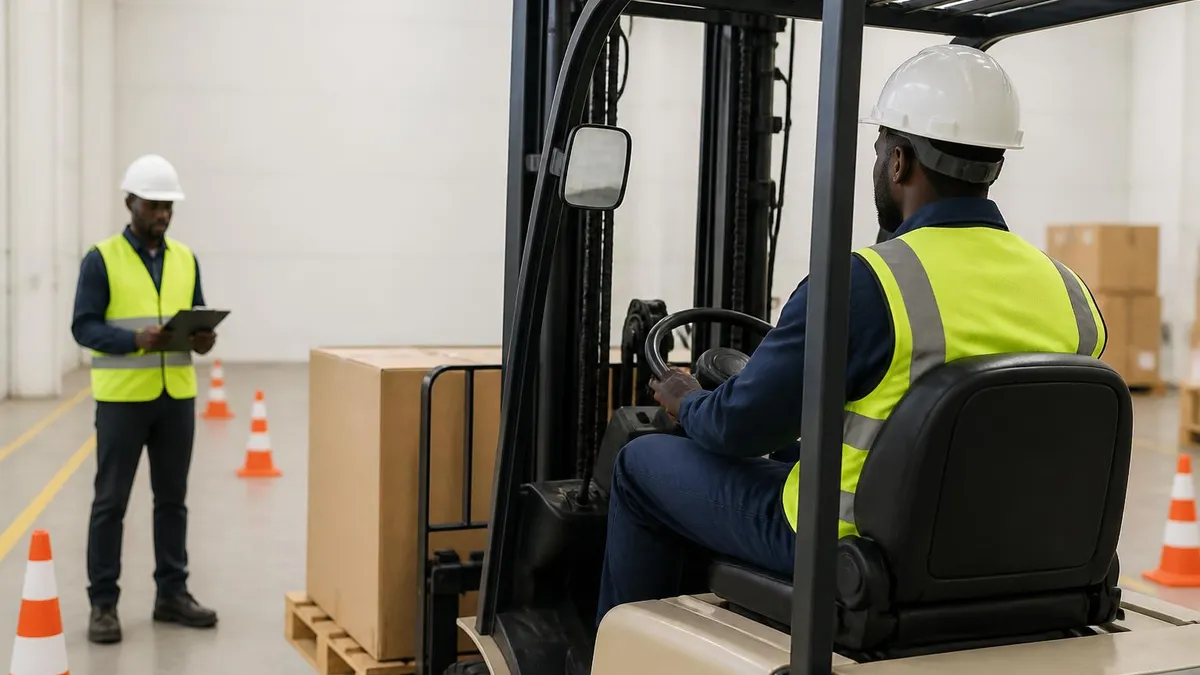
Forklift Certification by State: Complete 50-State Guide to OSHA-Compliant Operator Training, Costs, and Renewal Requirements
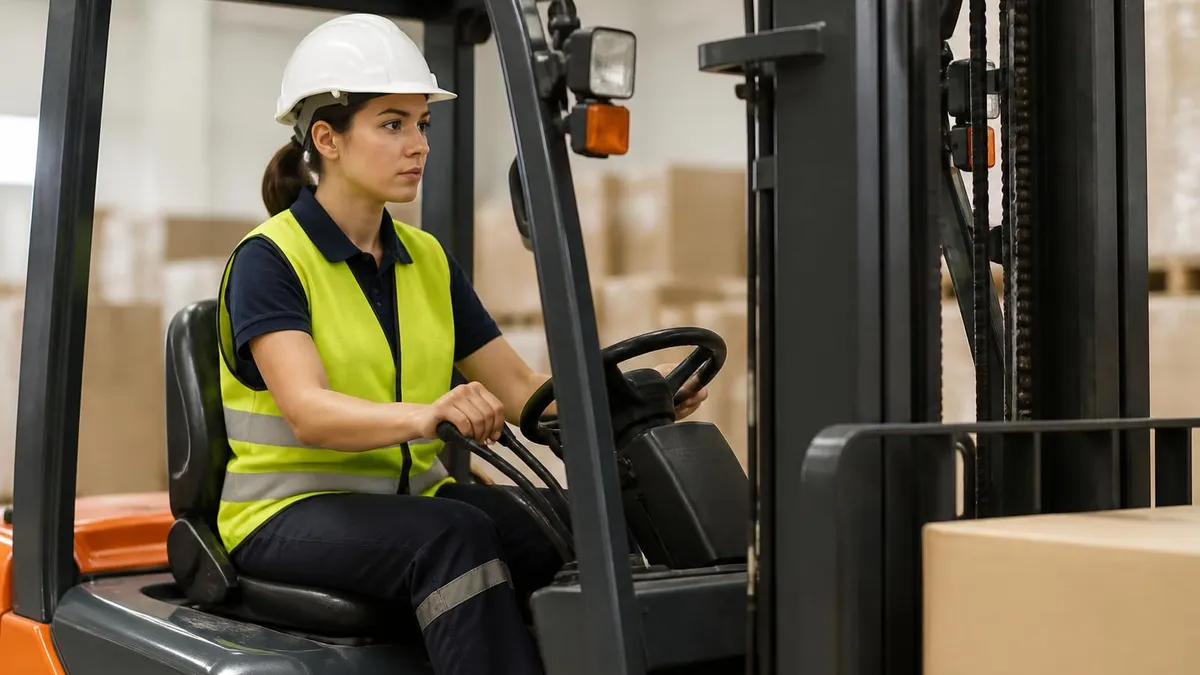
Forklift Price Guide 2026: New, Used, Rental, and Total Cost of Ownership Breakdown
How this page was made: written with AI tools. Exam facts are checked against the official sources listed below. Not reviewed by a subject-matter expert. Editorial policy
Sources & references
Exam facts on this page (fees, format, dates, passing scores) are checked against these official sources; the date is our last check. Editorial policy
- osha.gov — Test delivery, eligibility, renewal · verified Oct 2026