
When Is the Next NYC Firefighter Test? Complete 2026–2026 Exam Guide
🎯 When is the next NYC firefighter test? Dates, salary, eligibility & prep tips. Learn how to become a firefighter in New York City.
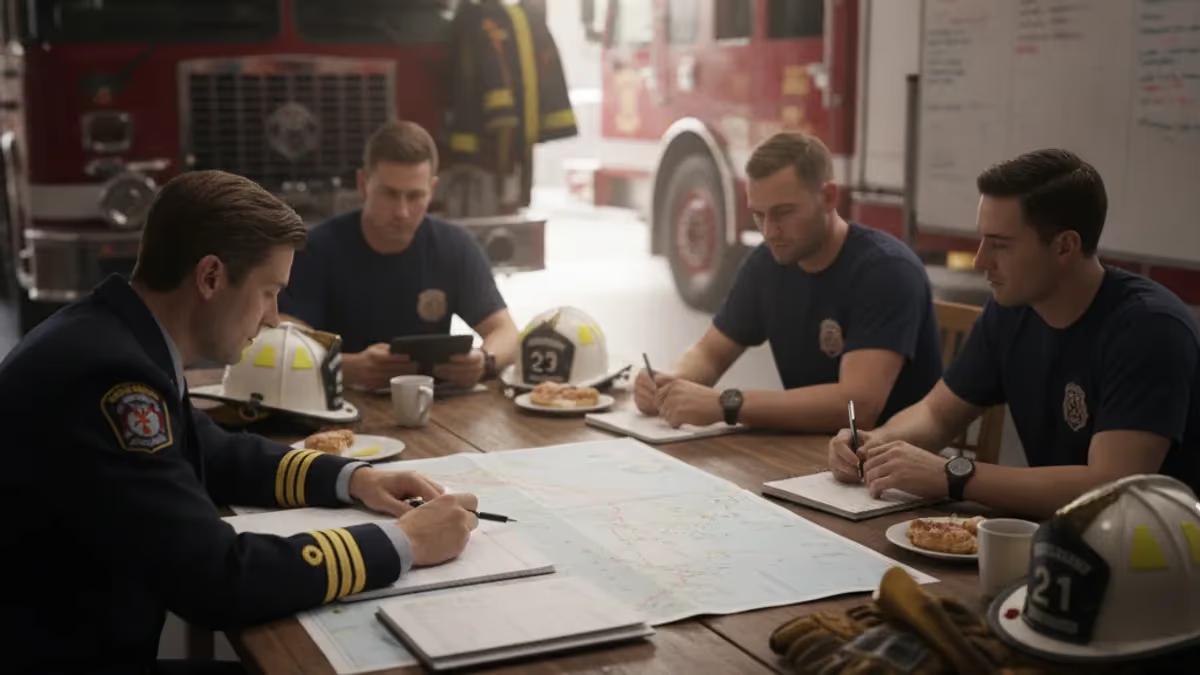
If you've been asking when is the next NYC firefighter test, you're not alone — thousands of aspiring firefighters across New York City search for this answer every year. The FDNY Written Exam is one of the most competitive civil service tests in the United States, and knowing exactly when it opens, how to register, and what to expect on test day can be the difference between landing your dream career and waiting another cycle. Exam windows typically open every three to five years, making each announcement critically important for candidates who are ready to serve.
The FDNY firefighter exam is administered by the New York City Department of Citywide Administrative Services (DCAS). When an exam period opens, candidates have a limited window — often just a few weeks — to file an application online and pay a modest fee. After filing, you receive a notice of examination, study the required subject areas, and then appear on your assigned test date. Missing the filing window means waiting for the next cycle, which is why staying informed about announcements is so essential for serious candidates.
New York City firefighting is one of the most respected and well-compensated public safety careers in the country. Understanding firefighter salary expectations from day one helps candidates gauge whether this career aligns with their financial goals. Starting salaries for FDNY firefighters are among the highest of any fire department in the nation, and compensation grows substantially with seniority, overtime, and specialty assignments. The total compensation package — including health benefits, pension, and job security — makes the FDNY an exceptionally attractive employer.
Beyond compensation, many people want to know how to become a firefighter in New York City specifically, since the FDNY process differs from departments in other states. NYC uses a strict civil service list system: your exam score determines your rank on the eligible list, and candidates are appointed in score order as positions become available. This means every point on the written exam matters, and thorough preparation is not optional — it's the most direct path to a high list number and a faster appointment to the Fire Academy.
This guide covers everything you need to know about the NYC firefighter exam timeline, eligibility requirements, what subjects appear on the written test, physical ability standards, and how to build an effective study plan. Whether you're a first-time applicant or someone who missed a previous exam cycle and is determined to be ready for the next one, the information here will help you approach the process with confidence and clarity.
Events like the tragic idaho firefighter shooting incidents have highlighted across the country just how critical and dangerous this profession truly is, reinforcing the importance of thorough preparation — both mentally and physically — for every candidate who wants to join the firefighting ranks. The FDNY specifically trains its recruits to handle not just fires but complex emergency medical scenarios, hazardous materials, and high-risk rescues in one of the world's most densely populated urban environments.
By the end of this guide, you'll understand the full FDNY application timeline, know exactly what to study, and have a realistic picture of the salary and career trajectory that awaits you once you earn your spot in a Fire Academy class. Let's start with the most important question every candidate has: when does the next exam open, and how do you make sure you don't miss it?
NYC Firefighter Exam by the Numbers
NYC Firefighter Written Exam Format
| Section | Questions | Time | Weight | Notes |
|---|---|---|---|---|
| Written Comprehension & Expression | 20 | ~55 min | 24% | Reading passages, written scenarios |
| Mathematical Reasoning | 15 | ~40 min | 18% | Arithmetic, basic algebra, proportions |
| Problem Sensitivity & Deductive Reasoning | 20 | ~50 min | 24% | Identifying problems and logical conclusions |
| Spatial Orientation | 15 | ~35 min | 18% | Map reading, directional awareness |
| Memorization & Visualization | 15 | ~40 min | 16% | Study a scene, answer from memory |
| Total | 85 | Approximately 4 hours | 100% |
One of the most frequently asked questions by FDNY candidates is: how much do firefighters make in New York City? The answer depends on where you are in your career, but the trajectory is genuinely impressive. A newly appointed FDNY firefighter starts at approximately $45,000 per year during their probationary period, which covers the duration of the Fire Academy. This starting figure is deceptively low — it jumps significantly the moment you complete training and receive your full firefighter designation as a regular member of the department.
Once a firefighter completes probation and begins active duty, the salary increases through a structured pay scale tied to years of service. After five years with the FDNY, a firefighter earns approximately $94,000 in base pay. This figure does not include overtime, which is common in a department that runs 24-hour shifts and frequently requires extended response during major incidents or staffing shortages. Many experienced FDNY firefighters earn well over $100,000 annually when overtime is factored into total compensation.
The firefighter salary picture becomes even more compelling when you include the full benefits package. FDNY members are enrolled in the New York City pension system, which provides a defined benefit retirement plan. Firefighters who serve 22 years are eligible to retire with a pension equal to half their final average salary — a level of retirement security that is increasingly rare in the private sector. Health insurance for active firefighters and their dependents is also provided at minimal cost, adding thousands of dollars in annual value.
Specialty assignments further boost earning potential. Firefighters who qualify for positions in specialized units — such as the Marine Division, Hazmat Operations, or Technical Rescue teams — may receive additional compensation tied to the demands and training requirements of those roles. Promotions to Lieutenant, Captain, Battalion Chief, and beyond each bring substantial salary increases and expanded leadership responsibilities. The promotion process is also exam-based, rewarding firefighters who continue studying and advancing throughout their careers.
For candidates comparing firefighting to other public safety careers, the FDNY compensation package consistently ranks among the most generous in the nation. It compares favorably even to careers that require extensive graduate education, particularly when the pension, health coverage, and job stability are factored in alongside base pay. The 20-hour average work schedule (with 24-on, 24-off rotation) also provides a quality-of-life advantage that many private sector workers can't access.
Understanding how to become a firefighter in NYC means recognizing that the written exam score is the single most important factor in determining your timeline to appointment. Because candidates are called from the eligible list in rank order, a score difference of even a few points can mean waiting months or years longer for your Fire Academy appointment.
That's why high-scoring candidates invest in structured practice well before exam day — not just reading the study guide, but actively testing themselves under timed conditions to build both knowledge and confidence. Learning about volunteer firefighter simulation tools can also give candidates a meaningful edge in understanding real-world firefighting scenarios before they ever enter the Academy.
The FDNY also offers a strong pathway for candidates who enter as EMTs or paramedics. Some candidates use EMS experience as a stepping stone to the firefighter exam, gaining both practical emergency experience and a deeper understanding of the medical components that appear on the written test. This dual-track experience is viewed favorably throughout the hiring process and can enhance your performance in the oral psychological interview and background investigation that occur after the written exam.
How to Become a Firefighter in NYC: Step-by-Step
The first step to becoming an FDNY firefighter is filing an application during the open exam period announced by DCAS. Applications are submitted online through the NYC DCAS exam portal, and the filing fee is typically around $68. During this window — which usually lasts three to four weeks — you must create an account, verify your eligibility, and pay the fee. Missing this window means waiting for the next exam cycle, which could be three or more years away. Set calendar reminders and check the DCAS website and FDNY recruitment page regularly, especially in years when the previous eligible list is expected to expire.
After filing, DCAS mails you a notice of examination that includes your test date, assigned test site, and a list of approved study materials. Test sites are distributed throughout the five boroughs to accommodate the volume of applicants. You must bring acceptable photo identification on exam day and arrive at least 30 minutes early. Latecomers are not admitted after testing begins, and no exceptions are made regardless of circumstances. The written exam itself takes approximately four hours, so candidates should plan their entire exam day around this commitment and avoid scheduling anything immediately after.
Pros and Cons of Pursuing an FDNY Firefighter Career
- +Top-tier salary reaching $94K+ base pay after five years of service
- +Defined benefit pension after 22 years — rare in today's job market
- +Comprehensive health insurance for you and your dependents at minimal cost
- +Strong brotherhood culture and team-based work environment
- +Opportunity for specialty units — Hazmat, Marine, Technical Rescue, and more
- +Promotional advancement through exam-based system that rewards continued study
- −Exam cycles open only every three to five years, requiring long-term patience
- −High competition: tens of thousands of applicants compete for limited spots
- −Starting salary during probation (~$45K) is significantly below the post-training rate
- −Shift work, including nights and holidays, affects family scheduling
- −Physical and psychological demands of the job carry real health risks over time
- −Background investigation is thorough — minor past issues can delay or end candidacy
NYC Firefighter Exam Application Checklist
- ✓Monitor the DCAS and FDNY recruitment websites daily during anticipated exam announcement periods.
- ✓Create a DCAS online account in advance so you can file immediately when the exam opens.
- ✓Confirm you meet all age requirements — at least 17.5 at filing, under 29 at appointment.
- ✓Ensure your driver's license is valid and will remain valid through your appointment date.
- ✓Request official copies of your high school diploma, GED certificate, or college transcripts.
- ✓Begin a structured 12-week CPAT preparation program as soon as you file your application.
- ✓Review FDNY drug use policies and consult recruitment staff if you have any questions about eligibility.
- ✓Assemble all background investigation documents: employment history, residency records, and references.
- ✓Study every subject area listed in the official Notice of Examination — do not skip any section.
- ✓Take timed practice exams weekly during the 8 weeks leading up to your written test date.
Your Exam Score Determines Your Entire Timeline
Every point on the NYC firefighter written exam directly affects how quickly you are called from the eligible list. Candidates ranked in the top 10% of scorers are typically appointed within the first year of the list's life. Lower-ranked candidates may wait three or more years — sometimes aging off the list entirely before their number is called. Invest in rigorous preparation: the exam is the single greatest lever you control in this process.
Preparing effectively for the NYC firefighter written exam requires a structured, multi-week approach that addresses each cognitive ability area the DCAS tests. Many candidates make the mistake of reading through a single study guide once and considering themselves prepared — this passive approach rarely produces top-quartile scores. The candidates who consistently earn the highest rankings are those who engage actively with practice material, simulate real test conditions, and systematically identify and address their weakest subject areas weeks before exam day.
The memorization and visualization section deserves special attention from candidates who haven't practiced this skill recently. In this section, you are shown a scene — typically a floor plan, a street map, or a detailed image of an emergency scene — and given a fixed amount of time to study it. Then the image is removed and you must answer multiple questions from memory. This skill can be developed rapidly with deliberate practice: start with simple diagrams, time yourself, and gradually increase complexity as your recall improves. Don't wait until the week before the exam to begin this practice.
Spatial orientation questions test your ability to navigate using maps and understand directional relationships even when perspective changes. These questions are designed to simulate the real-world demands of navigating unfamiliar buildings and streets during emergency responses. Practice with street maps of different NYC boroughs, work through directional reasoning exercises, and pay attention to questions that ask you to identify the shortest or most efficient route between two points. Many candidates find spatial orientation easier to improve than reading comprehension because it responds quickly to targeted practice.
Mathematical reasoning on the firefighter exam is not advanced — it covers arithmetic, ratios, basic algebra, and percentage calculations. However, exam anxiety can cause candidates who know this material to make careless errors under time pressure. The solution is practice under timed conditions. Work through math sections on practice tests with a stopwatch running, and review every error carefully to distinguish between knowledge gaps and careless mistakes. Both types of errors are correctable, but they require different remediation strategies.
Reading comprehension passages on the FDNY exam often use firefighting-related content — department policies, safety procedures, incident reports — to test whether candidates can extract accurate information from dense text under time constraints. The best preparation is regular reading of FDNY operations manuals, training bulletins, and policy documents available on the FDNY public website. This serves a dual purpose: it sharpens your comprehension skills while also building the domain knowledge that will serve you throughout your career and the oral psychological interview.
Recent news events involving dangerous emergency responder situations — including incidents where the danger firefighters face from violence was tragically demonstrated, much like what occurred in cases involving the swat firefight scenarios that have made national headlines — underscore how critical mental preparation is alongside technical knowledge.
The FDNY's psychological evaluation process specifically assesses candidates' ability to handle high-stress, life-threatening situations with clear thinking and sound judgment. Candidates who have researched real emergency scenarios, taken practice tests under pressure, and reflected on their own stress responses tend to perform better in this portion of the assessment. Reviewing resources like green firefighter training materials can help build that foundational scenario-based awareness.
Community preparation programs are an underutilized resource for many FDNY candidates. Programs like the FDNY Cadet Corps, community fire safety education, and auxiliary volunteer programs give candidates exposure to firefighting operations, department culture, and basic equipment before the Academy. Participation in these programs demonstrates commitment and initiative during the background investigation and interview phases, and the practical knowledge you gain — even at a basic level — makes the Fire Academy curriculum easier to absorb when your appointment finally comes.
The FDNY exam application window is typically open for only three to four weeks. DCAS does not accept late applications under any circumstances, and the next exam cycle may not open for three to five years. Sign up for official notifications at the DCAS website and follow the FDNY Recruitment Division on social media to receive announcements the moment a new exam is authorized. Missing this window means restarting your timeline from scratch.
For candidates who want to build firefighting experience while waiting for the next NYC exam cycle, exploring wildland firefighter opportunities or volunteer fire service is an excellent strategy. Wildland firefighting roles are available through the U.S. Forest Service, Bureau of Land Management, and state forestry agencies across the country. These seasonal positions provide hands-on experience fighting large-scale fires, operating equipment, and working within the Incident Command System — all experiences that demonstrate initiative and build real competency for a future career in a paid department like the FDNY.
The green firefighter concept — referring to entry-level firefighters who are new to the field — is widely used in wildland fire service to describe those in their first few seasons. Green firefighters typically start in hand crew positions, learning fire behavior, line construction, and safety protocols under experienced supervision.
Even one or two seasons as a wildland firefighter builds the kind of physical endurance, situational awareness, and team communication skills that the FDNY values in its recruits and that the psychological evaluation specifically probes for. You can explore preparation resources and simulation equipment to help with this in our guide to volunteer firefighter training props and tools.
Volunteer fire departments represent another powerful pathway for NYC firefighter candidates who want to build experience before their written exam appointment. Thousands of volunteer departments operate across New York State, New Jersey, and Connecticut — all within reasonable distance of the city. Joining a volunteer department means receiving formal Firefighter I and II training, responding to real emergencies, and becoming familiar with department operations in a context where experienced firefighters mentor you through every call. This training is formally recognized and can be noted on your FDNY application and background investigation paperwork.
Candidates who pursue the how to become a firefighter path through volunteer service often report that the Fire Academy feels significantly less overwhelming because they already understand fire behavior basics, equipment nomenclature, and the physical and emotional demands of emergency response. The Academy's curriculum moves quickly, and candidates who arrive with zero exposure to firefighting operations sometimes struggle to absorb new material fast enough. Any practical experience you can build before your Academy start date is a genuine advantage.
Emergency Medical Technician (EMT) certification is another widely recommended preparatory credential for aspiring FDNY firefighters. New York State EMT training is available through community colleges, private training centers, and FDNY's own EMS Academy. Becoming an EMT costs between $1,000 and $2,500 depending on the provider and takes approximately three to six months. The medical knowledge you gain is directly relevant to the emergency medical care sections of the firefighter written exam and to the practical demands of FDNY response, where firefighters regularly provide first response medical care before ambulances arrive.
Physical fitness is a year-round commitment for serious FDNY candidates, not a six-week sprint before the CPAT. The specific physical demands of firefighting — carrying 50-plus pounds of gear up multiple flights of stairs, dragging heavy hose under heat stress, performing forcible entry with an axe or Halligan bar — require a base of functional strength and cardiovascular endurance that takes months of consistent training to build.
Candidates who begin a dedicated training program 6 to 12 months before their expected physical test date arrive far better prepared than those who start in the final weeks. Find a training program specifically designed for CPAT preparation rather than a generic gym routine — the CPAT's eight events have unique demands that general fitness training doesn't fully address.
Department demographics also matter for candidates thinking strategically about their career. The FDNY actively recruits from underrepresented communities and offers specific outreach programs through organizations like the Vulcan Society and the Uniformed Women's Firefighters Association. Candidates from these communities who connect with these organizations gain mentorship, peer support, and access to study groups that can meaningfully improve exam performance. Networking with current FDNY firefighters through these channels also gives you insights into department culture that no study guide can provide.
As you finalize your preparation strategy for the next NYC firefighter exam, it helps to work backward from your target score. If your goal is to rank in the top 10% — the tier most likely to receive appointments within the first year of an eligible list — you need to be scoring at that level on practice exams consistently, not just occasionally.
Build your prep schedule around weekly full-length timed practice tests, with the intervening days dedicated to targeted review of your lowest-scoring sections. Treat each practice test as a diagnostic, not just a score — analyze every wrong answer to understand whether you missed it because of a knowledge gap, a misread question, or a calculation error.
Study groups are underestimated by many candidates who prefer to prepare alone. Working through practice questions with other candidates creates accountability, exposes you to different problem-solving approaches, and provides the kind of social support that makes a long preparation cycle sustainable. FDNY-specific study groups form naturally through recruitment events, community programs, and online forums. If you can't find one, start one — the leadership initiative itself reflects positively on your candidacy profile during the background investigation and oral interview.
Your physical preparation and your written exam preparation should be happening simultaneously during the months leading up to exam day, not in sequence. Many candidates make the mistake of focusing entirely on the written exam first and then pivoting to physical training afterward — but if your written exam and CPAT are scheduled close together (as they sometimes are in compressed hiring cycles), you won't have enough time to build the physical foundation the CPAT demands. Integrate both into a weekly schedule that balances cognitive and physical demands, using your rest days from intense physical training for focused study sessions.
Nutrition, sleep, and stress management are not soft concerns — they directly affect both your physical performance and your cognitive function on test day. Research consistently shows that sleep deprivation reduces performance on reasoning, memory, and comprehension tasks — exactly the skills the written exam measures. In the two weeks before your exam, prioritize getting seven to nine hours of sleep per night, reduce alcohol consumption, and limit high-intensity training to avoid accumulated fatigue. Arrive on exam day rested, nourished, and confident in your preparation.
On the day of the written exam, time management within each section is critical. Do not spend more than 90 seconds on any single question during your first pass through the exam. Mark questions you're uncertain about and move forward — you can return to them if time permits.
Many candidates lose points not because they don't know the material but because they get stuck on hard questions early and run out of time for easier questions later in the section. A disciplined first-pass strategy maximizes your score by ensuring you answer every question you can answer quickly before circling back to the harder ones.
After the written exam, the wait for score notifications can feel interminable. DCAS typically releases exam results several months after the test date — this timeline varies depending on the volume of applicants and the complexity of the scoring process.
During this waiting period, maintain your fitness, continue building relevant experience, and stay connected to FDNY recruitment channels so you receive immediate notification when your score and list number are published. If your score is lower than you hoped, many candidates begin preparing immediately for the next cycle while remaining on the current list — every point of improvement matters for your next attempt.
The FDNY is one of the most prestigious fire departments in the world, and earning a spot in its ranks is a genuine achievement that opens a career of service, growth, and financial stability. The path is demanding — the exam is competitive, the physical standards are rigorous, and the wait between exam announcement and Fire Academy appointment can span years.
But for candidates who approach the process with discipline, preparation, and patience, the reward is a career that combines meaningful public service with exceptional compensation and the kind of brotherhood that most workplaces can't replicate. Start preparing today, and make sure you're ready when the next exam window opens.
Firefighter Questions and Answers

Firefighter CPAT Test: Complete Guide to Passing the Candidate Physical Ability Test
What is the Firefighter Exam?
Firefighter Video Questions and Answers

Training Props for Firefighters: Complete Guide to Simulation Equipment & Career Prep

Firefighters Training: Complete Guide to Becoming a Firefighter in the US
About the Author
Emergency Manager & FEMA Certification Specialist
Naval Postgraduate SchoolCommander Lisa Foster holds a Master of Science in Emergency Management from the Naval Postgraduate School and is a FEMA-certified emergency manager and Certified Emergency Manager (CEM). With 18 years of emergency response coordination experience across federal and state agencies, she coaches emergency management professionals through ICS, NIMS, and FEMA Independent Study certification programs.
Join the Discussion
Connect with other students preparing for this exam. Share tips, ask questions, and get advice from people who have been there.
View discussion (6 replies)