
Training Props for Firefighters: Complete Guide to Simulation Equipment & Career Prep
Master training props for firefighters — simulation tools, salary data, how to become a firefighter & volunteer paths. 🎯 Full career guide.
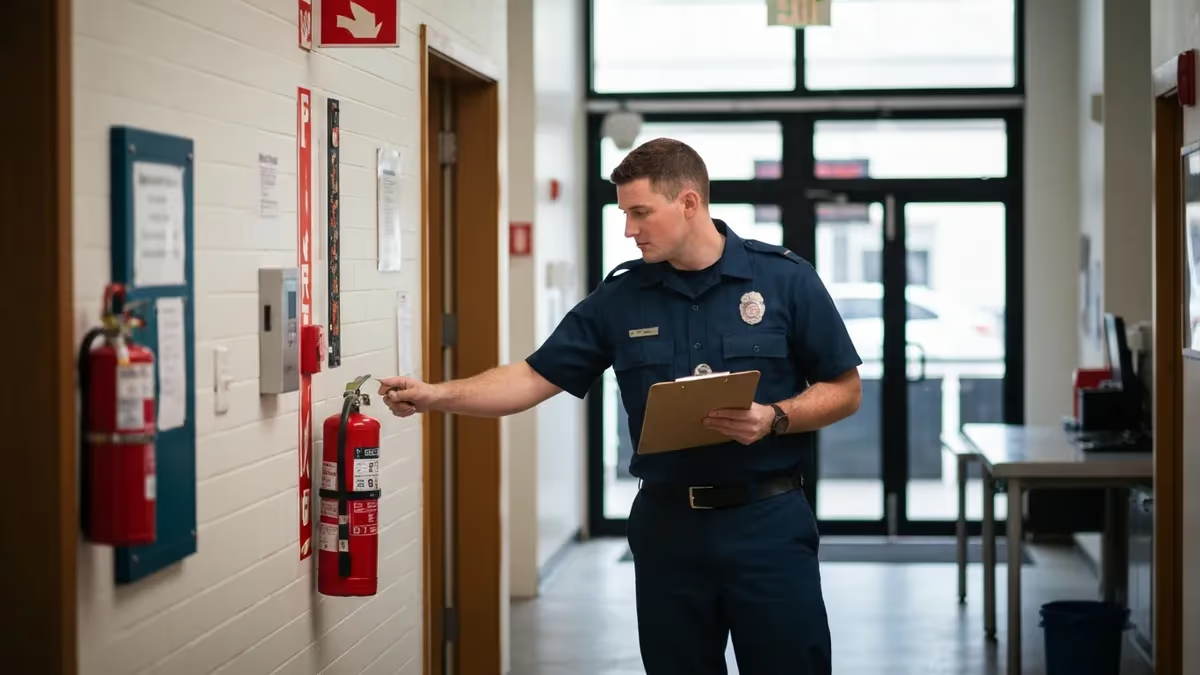
Training props for firefighters are the backbone of realistic, high-stakes emergency simulation that prepares recruits and veterans alike for the unpredictable dangers of the job. From smoke-filled maze trainers to forcible-entry doors and live-fire burn buildings, these purpose-built props replicate the sensory overload and physical demands of real incidents. Departments across the United States have invested heavily in prop-based training because research consistently shows that hands-on repetition reduces response time, improves decision-making under pressure, and lowers line-of-duty injuries. If you are exploring how to become a firefighter, understanding the training infrastructure is an essential first step.
The scope of firefighter training props has expanded dramatically over the past two decades. Early programs relied on abandoned structures and static wooden facades; today's regional training centers deploy modular, reconfigurable props made from heavy-gauge steel and heat-resistant composites. These modern systems can simulate residential fires, high-rise stairwell rescues, vehicle extrication scenarios, confined-space emergencies, and even mass-casualty events involving hazardous materials. The investment signals how seriously the fire service takes preparedness — and how critical ongoing training is throughout a firefighter's career.
Beyond the equipment itself, training props set the stage for evaluating a candidate's readiness during hiring processes. Many departments integrate prop-based assessments directly into their written and practical examinations. Knowing the types of props you will encounter — and the skills each one tests — gives candidates a measurable advantage. Whether you are preparing for a municipal department, pursuing a green firefighter pathway through a volunteer station, or studying for a certification exam, this guide covers everything you need to know about the tools that define modern firefighter training.
Firefighter salary and long-term career trajectory are also directly tied to training qualifications. Departments that maintain advanced prop facilities often attract more competitive candidates, and municipalities with strong training programs tend to promote from within faster. Understanding the relationship between prop-based certification and compensation is valuable for anyone mapping out a firefighting career. Across the country, how much do firefighters make varies widely by region, department size, and certification level — all of which connect back to documented training hours and prop proficiency.
The national spotlight on firefighter safety intensified following high-profile incidents in recent years, including the tragic event in which idaho firefighters shot during an emergency response call drew attention to the dangers first responders face both at fire scenes and in broader community contexts. These incidents reinforce why comprehensive, scenario-based training — using realistic props — is not optional. Every hour spent on a prop building or forcible-entry trainer is an investment in both competence and survivability on the fireground.
This article walks through the major categories of training props, explains what skills each prop develops, and connects those skills to the written knowledge tested on firefighter certification exams. You will also find salary benchmarks, volunteer firefighter information, study checklists, and a curated FAQ section. Whether you are a recruit just entering the fire academy, a career firefighter pursuing advanced certification, or a student building context for an exam, the information here will give you a complete picture of the training environment you are stepping into.
Finally, this guide is designed to complement the practice quizzes and study resources available throughout PracticeTestGeeks.com. The theoretical knowledge tested on firefighter written exams — building construction, fire behavior, emergency medical care — maps directly onto what training props are designed to replicate physically. When you understand both the "why" behind each prop and the written concepts it tests, you build a more durable, transferable understanding of firefighting that will serve you through hiring, probation, and decades of service.
Firefighter Training by the Numbers
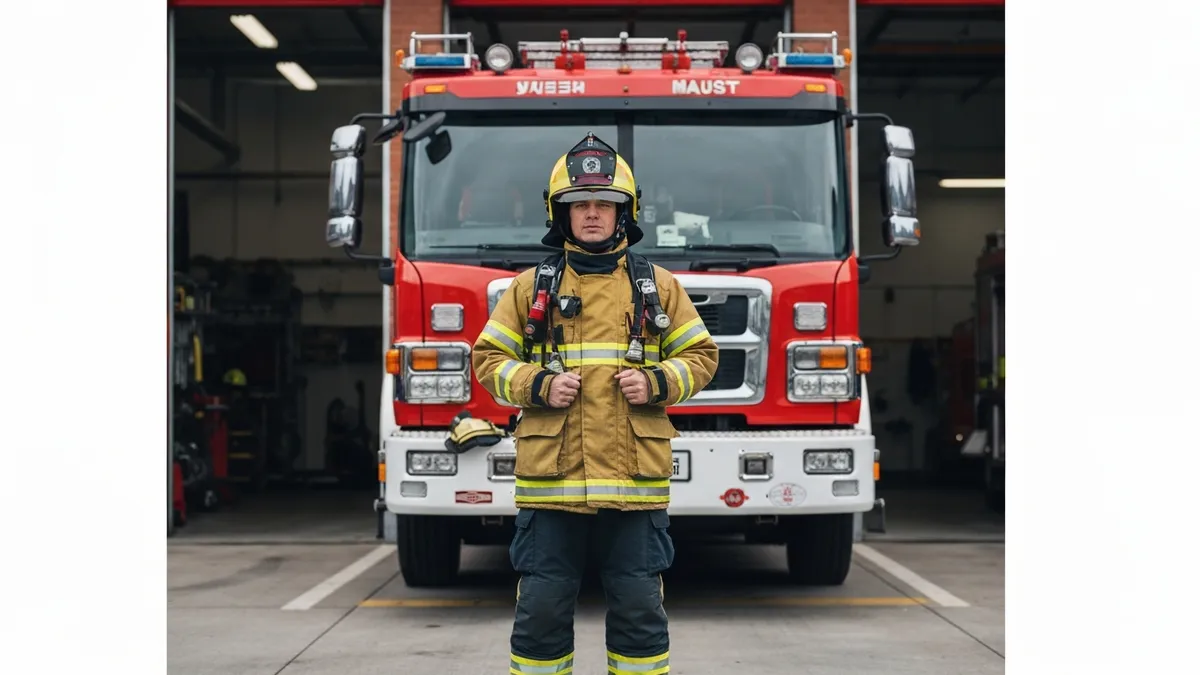
Core Categories of Firefighter Training Props
Steel-constructed multi-story structures designed for controlled live-fire training. Recruits practice attack line advancement, vent-enter-search techniques, and thermal recognition. NFPA 1403 governs all live-fire evolutions to ensure safety during these high-risk but essential exercises.
Reinforced door frames, padlocked panels, and wall-breach stations that simulate real residential and commercial entry points. Firefighters develop axe, Halligan, and power-tool proficiency. Timed repetitions on these props build the muscle memory needed for rapid entry under smoke and stress.
Blacked-out, confined crawlspace systems that simulate zero-visibility search conditions. Recruits navigate while wearing full SCBA gear. These props develop orientation skills, air management discipline, and the ability to remain calm while conducting primary and secondary searches without visual cues.
Salvaged and purpose-built vehicle frames used to practice spreader, cutter, and ram operations. Trainees learn patient packaging, disentanglement sequences, and tool coordination with EMS. Extrication props are critical for departments that respond to high-frequency vehicle accident calls.
Simulated manholes, storage tanks, and high-angle anchor systems used for technical rescue training. These props support NFPA 1006 Technical Rescuer certification and prepare firefighters for industrial emergencies, collapse scenarios, and below-grade rescue operations requiring specialized rigging skills.
Firefighter salary is one of the most frequently researched topics by career-seekers entering the fire service, and the numbers vary considerably depending on geographic location, department size, union agreements, and certification level. According to the Bureau of Labor Statistics, the median annual wage for firefighters in 2024 sits at approximately $64,000.
However, firefighters in high-cost metropolitan areas such as San Jose, California; Seattle, Washington; and New York City regularly earn base salaries exceeding $100,000 — and that figure climbs further with overtime, hazard pay, and specialized assignment stipends. Understanding this landscape helps recruits set realistic expectations and choose target departments strategically.
The connection between prop-based training certification and firefighter compensation is more direct than many recruits realize. Departments that require Firefighter II certification as a condition of hire typically start candidates at a higher pay grade than those that accept Firefighter I alone. Earning additional endorsements — such as Hazmat Operations, Technical Rescue, or Emergency Medical Technician — adds another layer of compensation through assignment pay differentials. In many departments, each additional certification adds anywhere from $1,500 to $5,000 annually to base pay, making the time invested in prop-based training a genuine financial return.
Volunteer firefighter roles represent a different economic equation but are no less demanding in terms of training requirements. The vast majority of fire departments in the United States — roughly 70 percent — are staffed entirely or predominantly by volunteers. These individuals complete the same Firefighter I/II curriculum as their career counterparts, participate in the same prop-based training evolutions, and respond to the same types of emergencies.
The difference is compensation: most volunteers receive either no pay, nominal per-call stipends ranging from $10 to $25, or annual length-of-service awards. Some states offer pension benefits after a defined number of years of volunteer service.
For candidates weighing a full-time career path, the hiring pipeline typically runs through a written exam, a physical ability test such as the CPAT, an oral interview board, a background investigation, and a medical evaluation — in that order. Prop-based performance is most directly assessed during the CPAT and any practical skills testing conducted after conditional hire.
Candidates who have logged hours on forcible-entry props, hose deployment stations, and dummy drags before their CPAT date consistently outperform those who rely on general fitness alone. Physical strength matters, but prop familiarity reduces wasted motion and mental hesitation, both of which cost valuable seconds on a timed assessment.
The question of do volunteer firefighters get paid reflects a broader public confusion about the fire service workforce model. In many suburban and rural communities, volunteer departments are the only fire protection available, and without those unpaid responders, coverage gaps would leave entire regions vulnerable. Some states and localities have created hybrid compensation models — known as combination departments — where a small core of career firefighters handles daytime coverage while volunteers supplement nights and weekends. These arrangements are increasingly common as rural populations age and volunteer recruitment becomes more challenging.
Beyond base salary, firefighters in career positions typically receive a comprehensive benefits package that includes health insurance, pension contributions, paid leave, and in many cases tuition reimbursement for continuing education. The pension benefit is particularly significant: many career firefighters can retire after 20 to 25 years of service with pensions worth 50 to 80 percent of their final salary. When total compensation is calculated, the effective value of a firefighter's package often exceeds the base salary by 30 to 40 percent, making the profession financially competitive with many other careers requiring similar or greater levels of education.
Recruits interested in maximizing earnings should also research the impact of shift structure on take-home pay. Most career firefighters work a modified schedule — commonly 24 hours on followed by 48 or 72 hours off — which creates built-in overtime opportunities. Firefighters who volunteer for additional shifts, serve as instructors at regional training academies, or pick up emergency medical shifts can meaningfully supplement their base income. For many career firefighters, total annual compensation including overtime runs 20 to 35 percent above listed base salary, a factor that recruitment advertisements often understate.
Volunteer Firefighter vs. Career Firefighter vs. Green Firefighter Paths
Volunteer firefighters complete the same fundamental training as career firefighters, including Firefighter I and II coursework, SCBA operations, hose advancement, and prop-based evolutions. The primary difference is scheduling flexibility — volunteers typically train on evenings and weekends, allowing them to hold full-time jobs simultaneously. Many recruits use volunteer service as a deliberate stepping stone toward a career department appointment, building documented hours and references in the process.
Joining a volunteer department is often the fastest way to gain real incident experience. Most volunteer departments accept applications year-round, whereas career departments open hiring windows infrequently. A candidate with two years of active volunteer service — including documented responses to structure fires, vehicle accidents, and EMS calls — enters a career hiring process with a significant edge over applicants who have only completed academic coursework without field exposure.
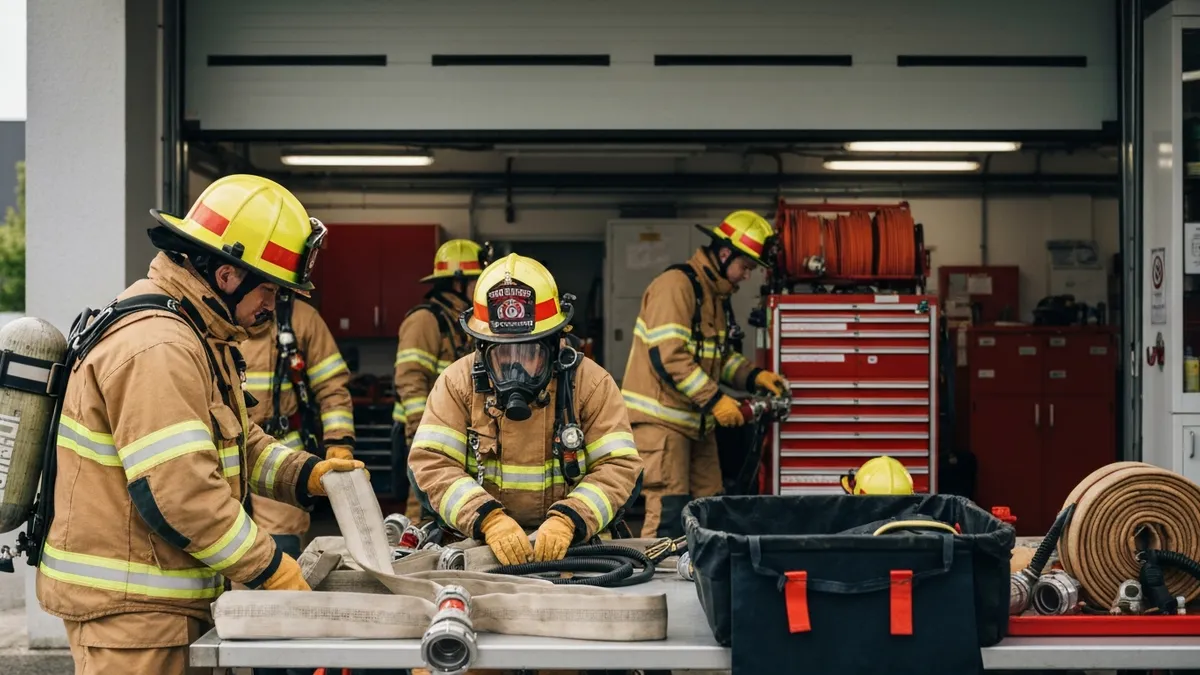
Pros and Cons of Prop-Based Firefighter Training
- +Replicates real fire conditions safely, building genuine muscle memory without life-safety risk
- +Allows repeated, controlled repetition of high-stakes skills such as SCBA donning and forcible entry
- +Provides objective pass/fail assessment criteria for certifying officer candidates
- +Bridges the gap between written knowledge and physical skill application on the fireground
- +Modern modular props can be reconfigured to simulate different building types and emergency scenarios
- +Documented prop training hours strengthen a candidate's application for career department positions
- −High upfront cost — quality burn buildings and modular prop systems can exceed $500,000
- −Maintenance requirements are substantial; steel props degrade under repeated live-fire use
- −Regional training centers may be far from rural departments, limiting volunteer access
- −Prop evolutions require minimum staffing for safety, creating scheduling complexity for small departments
- −Live-fire props introduce genuine injury risk if NFPA 1403 safety protocols are not rigorously followed
- −Simulation can create overconfidence — some prop environments do not replicate the chaos of real incidents
Firefighter Training Readiness Checklist: Props & Exam Prep
- ✓Complete Firefighter I coursework and document all prop-based practical evolutions with instructor sign-off.
- ✓Log a minimum of 10 supervised SCBA evolutions, including at least 3 in low-visibility or blacked-out conditions.
- ✓Practice forcible-entry techniques on a door prop until Halligan-and-flat-head-axe set operations are consistent under 30 seconds.
- ✓Complete at least 2 live-fire attack evolutions in a certified burn building under NFPA 1403 supervision.
- ✓Demonstrate ladder deployment and climbing proficiency on a 24-foot and 35-foot extension ladder prop.
- ✓Practice hose deployment — pulling and advancing a charged 1.75-inch line at least 150 feet — for timed assessment.
- ✓Conduct 5 or more search maze runs in blacked-out SCBA conditions, varying entry points and routes each time.
- ✓Study building construction types I through V and correlate each with associated fire behavior and collapse risk.
- ✓Review NFPA 1001 Firefighter I and II performance objectives and self-assess against each task list.
- ✓Take at least 3 full-length firefighter written practice exams and review all missed questions with reference materials.
The Best Exam Prep Mirrors What Props Train
Firefighter certification exams test the same concepts that training props physically develop — building construction, fire behavior, search patterns, and hose operations. Candidates who study written material alongside prop training retain concepts significantly longer and score higher on practical assessments. Use practice quizzes to reinforce theory, then verify your understanding on the prop itself.
The written firefighter exam and the physical training prop are two sides of the same preparation coin. Building construction questions — one of the highest-weighted topic areas on most Firefighter I/II written exams — directly correspond to what recruits practice on structural props. Understanding why a Type III ordinary construction building presents a different fire attack challenge than a Type II non-combustible structure is knowledge that comes alive during a live-fire evolution in a burn building designed to replicate those construction characteristics. The theory and the prop reinforce each other in both directions.
Fire behavior concepts such as flashover, backdraft, and thermal layering are abstract on a page but viscerally immediate inside a training prop. Recruits who have experienced controlled smoke conditions in a burn building describe a shift in comprehension — the written definition of flashover transition becomes anchored to a sensory memory that is far more durable than rote memorization. This is why prop-based training is not supplemental to academic study; it is the primary mechanism through which firefighting knowledge becomes actionable skill under stress.
Emergency medical care is another domain where simulation props have become increasingly sophisticated. EMS manikins with programmable vital signs, realistic airway anatomy, and compressible chests allow recruits to practice intubation, CPR, and hemorrhage control in conditions that closely approximate real patients. Many departments have invested in full-body trauma simulators that can bleed, seize, and respond to interventions, giving firefighter-EMTs practice opportunities that go far beyond tabletop review of protocols.
Hose operation props — sometimes as simple as a marked parking lot with hydrant connections and nozzle targets — develop the coordination and physical conditioning that written exams assume candidates have. The written exam may ask about friction loss calculations and nozzle pressure requirements; the prop is where those numbers become tactile reality. A firefighter who has repeatedly pulled and advanced charged lines knows instinctively how much force a 2.5-inch line requires at high flow, giving them a practical check on classroom calculations.
The SWAT firefight scenarios that appear in advanced tactical training programs illustrate an important evolution in prop design philosophy. As the fire service has responded to incidents involving active threats — including situations where, as in the case of films about firefighters have depicted, responders face violence at emergency scenes — departments have begun integrating law enforcement coordination props and warm-zone medical intervention training into their facilities. These props include simulated cover-and-concealment environments, ballistic protection stations, and controlled-access staging areas that mirror TECC (Tactical Emergency Casualty Care) doctrine.
The connection between prop training and exam success extends to the way study resources are organized. PracticeTestGeeks quiz modules for building construction and emergency medical care are sequenced to mirror the progression of prop-based training — from foundational concepts to scenario-based application. Candidates who alternate between quiz sessions and hands-on prop work find that each activity surfaces gaps the other cannot catch. A missed quiz question about Type V wood-frame construction vulnerability might prompt a closer look at a forcible-entry prop's door construction; a fumbled SCBA evolution might send a candidate back to the written checklist for donning procedures.
Documentation of prop training is also increasingly important for career advancement beyond the firefighter rank. Engineer and Driver/Operator promotional processes typically require demonstrated pump operations on apparatus training props, with evaluators scoring speed, accuracy, and decision-making under simulated emergency conditions. Lieutenant and Captain promotional processes in many departments include command simulation exercises conducted in tabletop or full-scale props. Building a portfolio of documented prop competencies from the earliest days of a firefighting career creates a professional record that supports advancement at every rank.
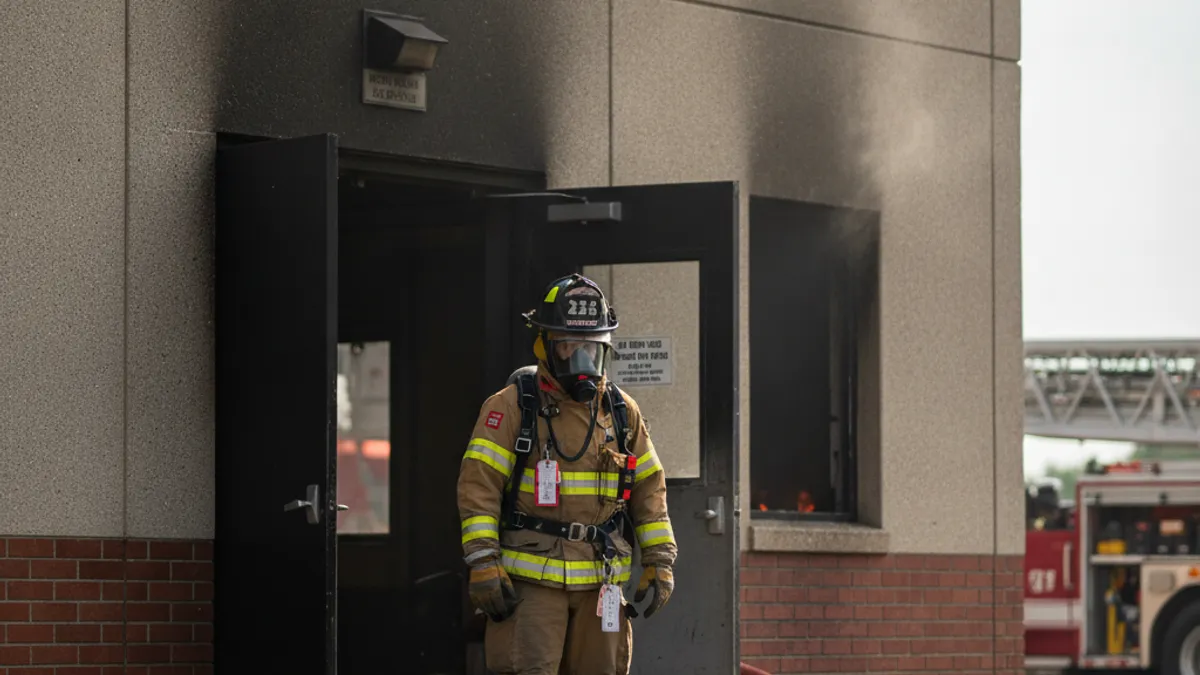
All live-fire training evolutions conducted in burn buildings or acquired structures must comply with NFPA 1403 Standard on Live Fire Training Evolutions. Violations — including unauthorized fuel loads, insufficient instructor-to-student ratios, or missing pre-burn inspections — have resulted in firefighter fatalities during training. Before any live-fire prop evolution, confirm that your instructor holds current live-fire instructor certification and that the site has been formally inspected and documented per NFPA 1403 requirements.
Advanced training props represent a significant financial investment for fire departments, and understanding the funding landscape helps explain why prop quality varies so widely across the country. Large urban departments with strong tax bases and active union contracts often maintain on-site training centers featuring multiple burn buildings, high-rise simulation towers, confined-space prop systems, and dedicated apparatus driver training tracks.
These facilities may cost tens of millions of dollars to build and hundreds of thousands annually to maintain. The recruits who train in these environments enter their probationary period with substantially more repetitions — and therefore more confidence — than those from under-resourced departments.
Federal grants through FEMA's Assistance to Firefighters Grant (AFG) program and Staffing for Adequate Fire and Emergency Response (SAFER) grants have helped smaller and volunteer departments acquire training props that would otherwise be out of financial reach. The AFG program specifically funds equipment, training, and wellness initiatives, and prop purchases — including modular forcible-entry trainers, maze systems, and hose evolution setups — are eligible expenditures. Departments that successfully write AFG grant applications can upgrade their training infrastructure without placing the full burden on local budgets.
Regional training academies serve as a critical resource for departments that cannot build or maintain their own prop facilities. These multi-department facilities pool resources to construct and operate high-quality props that individual departments share through scheduled training blocks. A rural volunteer department might send its recruits to a regional academy for a six-week Firefighter I course that includes live-fire burns, vehicle extrication, and SCBA maze training — returning them to the home department with skills and certifications that local props alone could never provide.
Mobile training props have also emerged as an important tool for reaching departments in remote areas. Trailer-mounted forcible-entry stations, self-contained smoke houses, and deployable confined-space systems can be transported to host departments for weekend or week-long training sessions. State fire training systems in Montana, Wyoming, Idaho, and other large-geography states have invested in mobile prop fleets precisely because the distances between rural departments and regional academies make routine travel impractical. These mobile props also serve as recruitment tools — visible, hands-on training events attract prospective volunteers who might not have sought out the fire service otherwise.
The Idaho firefighter shooting incidents — including the high-profile case in which idaho firefighters shot at an emergency response made national headlines — have accelerated investment in props that prepare firefighters for the "warm zone" threat environment. Idaho and several neighboring states have updated their training standards to require TECC training for all certified firefighters, and new prop systems have been designed specifically to simulate hostile-environment medical care scenarios. These developments reflect a broader national reckoning with the evolving threat landscape that firefighters face on every response.
Technology is rapidly changing what training props can simulate. Virtual reality (VR) prop systems now allow recruits to practice incident command decision-making, thermal imaging camera interpretation, and search patterns in fully immersive digital environments. Augmented reality overlays on physical props can project simulated fire conditions onto blank steel structures, allowing departments to run scenario variations without the cost and complexity of live fire. While VR and AR systems do not replace the physical conditioning and sensory experience of traditional props, they are proving highly effective for cognitive skill development — particularly for incident command, situational awareness, and radio communication training.
Rope rescue and technical rescue props round out the specialized training infrastructure at advanced academies. High-angle rescue towers — typically steel structures 40 to 80 feet tall with anchor rigging points, litter stations, and patient packaging platforms — support NFPA 1006 Technical Rescuer certification. Confined-space prop systems consisting of interconnected tanks, pipes, and access ports simulate the disorienting geometry of industrial confined-space emergencies.
Collapse rescue props built from concrete rubble simulate void searches and shoring operations used in building collapse incidents. Each of these specialized props trains skills that are rarely needed but absolutely critical when they are — making the investment in maintaining them a genuine public safety priority.
Practical preparation for firefighter training props begins long before academy enrollment. Candidates who arrive physically conditioned for the specific demands of prop training — crawling under load, pulling hose while wearing 50 pounds of gear, operating tools overhead — adapt faster and perform better during timed evaluations. A targeted fitness program that includes loaded carries, stair climbing with weight vests, grip-strength training, and crawling movements directly mirrors the physical demands of the most common prop evolutions. Six to eight weeks of structured prop-specific conditioning before academy start is a realistic preparation window for most candidates.
Study habits matter as much as physical preparation. The written knowledge tested on firefighter certification exams is best absorbed through spaced repetition rather than marathon cramming sessions. Taking 20 to 30 practice questions per day across a four-to-six-week preparation period consistently outperforms a single week of intensive study in the days before testing. PracticeTestGeeks building construction and emergency medical care quizzes are designed to support this distributed practice model, providing immediate feedback on incorrect answers with explanations that connect back to NFPA 1001 reference material.
Candidates should also familiarize themselves with the specific props used at their target department's training academy before arrival if possible. Many regional academies publish training facility photos, equipment lists, and course outlines on their websites. Watching department training videos — many of which are publicly available — allows candidates to visualize the prop layouts, identify the tools used in each evolution, and mentally rehearse the sequences before attempting them under instructor evaluation. Visualization combined with physical conditioning and written study creates the most complete pre-academy preparation possible.
Time management during prop evolutions is a skill in itself. Timed stations — such as the CPAT events or department practical exams — reward candidates who have internalized efficient movement sequences rather than those who are simply strongest or fastest in isolation.
The difference between a pass and a fail on a timed forcible-entry station is often not raw power but rather the ability to set the Halligan correctly on the first attempt, apply force in the right direction immediately, and avoid wasted repositioning. That efficiency only comes from repeated practice on a real prop — or on purpose-built home practice setups that approximate prop dimensions.
Mental preparation is the final and often most underestimated component of prop training readiness. Firefighting involves making consequential decisions under conditions of sensory deprivation, physical exhaustion, and time pressure. Props that intentionally induce stress — smoke, noise, heat, disorientation — are designed to identify candidates who remain methodical and communicative under pressure versus those who freeze or become impulsive. Mindfulness training, controlled breathing practice, and deliberate exposure to uncomfortable physical conditions (cold showers, loaded carries in heat) all build the stress tolerance that prop training evaluators are looking for.
The most successful firefighter candidates approach training props as learning laboratories rather than pass/fail obstacles. Every failed evolution is diagnostic data — an indication of which skill, which knowledge gap, or which physical limitation needs targeted attention. Departments that develop a culture of open, non-punitive debriefing after prop evolutions produce faster-improving candidates and more cohesive crews. If your training environment does not naturally provide that culture, seek it out through peer debriefs, recorded evolution reviews, and conversations with senior firefighters who are willing to share honest feedback.
Ultimately, training props for firefighters exist because the real emergencies they simulate cannot be practiced safely in any other way. The burn building, the search maze, and the forcible-entry trainer are not just evaluation tools — they are the primary classrooms of the fire service, where abstract knowledge becomes embodied skill.
Candidates who take prop training seriously, invest in preparation, and approach each evolution with intentional focus build the professional foundation that sustains a long, effective, and safe firefighting career. The written exam tests what you know; the prop tests who you are under pressure — and the best preparation develops both simultaneously.
Firefighter Questions and Answers



About the Author

Emergency Manager & FEMA Certification Specialist
Naval Postgraduate SchoolCommander Lisa Foster holds a Master of Science in Emergency Management from the Naval Postgraduate School and is a FEMA-certified emergency manager and Certified Emergency Manager (CEM). With 18 years of emergency response coordination experience across federal and state agencies, she coaches emergency management professionals through ICS, NIMS, and FEMA Independent Study certification programs.
Join the Discussion
Connect with other students preparing for this exam. Share tips, ask questions, and get advice from people who have been there.
View discussion (6 replies)