
Training Props for Firefighters: How to Master Simulation Equipment & Build a Career
Master training props for firefighters, learn how to become a firefighter, salary data & exam prep tips. 🎓 Complete US career guide.
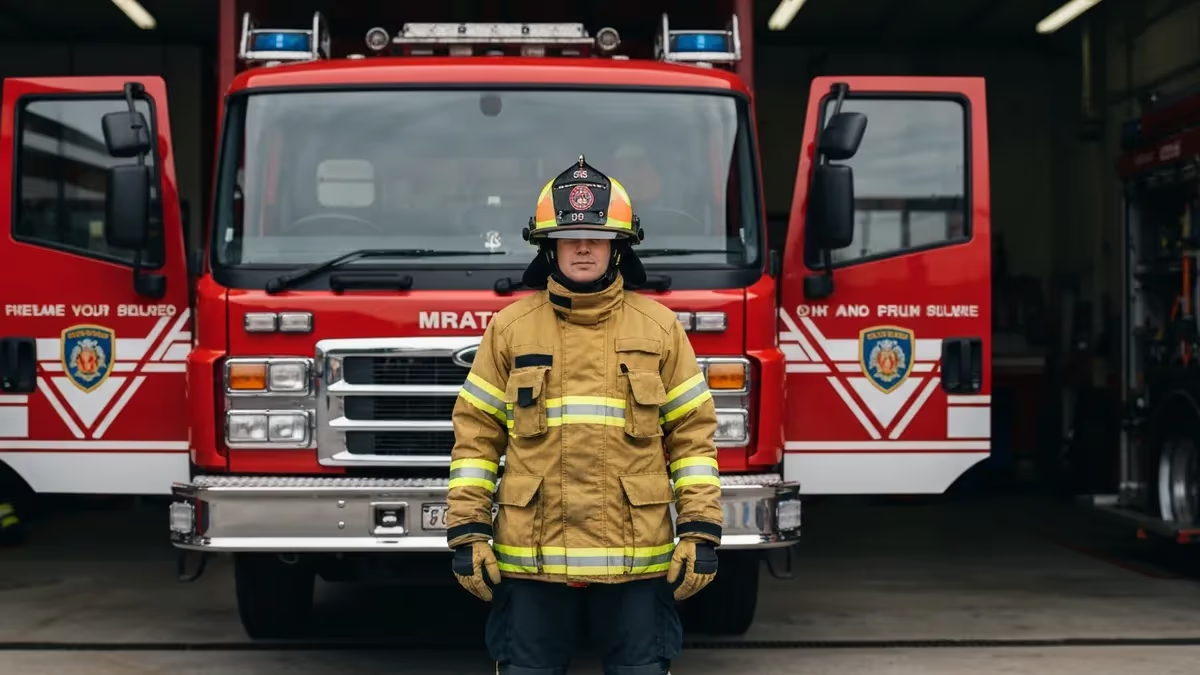
Training props for firefighters are the backbone of realistic, hands-on emergency preparation, and every aspiring firefighter needs to understand exactly how these simulation tools shape a career from day one. Whether you are preparing for your written exam, your physical ability test, or your first live-fire evolution, the props you train on determine how ready you will be when the alarm sounds for real. These specialized pieces of equipment replicate the hazards, tight spaces, heavy loads, and unpredictable conditions that career firefighters face on every shift, making authentic practice possible long before a recruit ever steps inside a burning building.
Understanding how to become a firefighter means recognizing that written knowledge alone is never enough. Departments across the United States require candidates to demonstrate physical and tactical competency, and that competency is built almost exclusively through repetition on high-quality training props. From forcible-entry doors and roof-ventilation panels to confined-space rescue simulators and multi-story burn towers, each prop addresses a specific skill set that the National Fire Protection Association and local civil service boards expect candidates to master. The sooner you engage with this equipment during your preparation, the more confident you will feel on exam day and on the job.
The national conversation about firefighter safety has intensified in recent years, particularly following incidents like the idaho firefighters shot tragedy that reminded every department how dangerous emergency response can be. These events underscore the urgency of elite preparation. The better trained a firefighter is — on props, in simulations, and through written study — the better equipped they are to make split-second decisions that protect both citizens and crew members. Safety is not an afterthought; it is built into every properly designed training prop and every thoughtful practice session.
Firefighter salary data shows that well-trained candidates consistently advance faster and earn more over the course of their careers. According to the Bureau of Labor Statistics, the median annual wage for firefighters in the United States sits around $56,000 to $64,000, with experienced firefighters in high-cost metropolitan areas regularly exceeding $90,000 when overtime and hazard pay are factored in. Departments that invest heavily in simulation props and structured training programs also tend to promote from within at higher rates, meaning the investment in your own preparation pays dividends for decades.
The green firefighter — the industry term for a brand-new recruit fresh out of the fire academy — faces one of the steepest learning curves of any first responder profession. Training props flatten that curve dramatically by allowing repetitive practice of high-stakes skills in a controlled environment. A recruit who has performed a hundred forcible-entry repetitions on a prop door will move with far greater confidence on an actual structure fire scene than one who only studied the technique in a textbook. Muscle memory, developed through prop-based training, is the difference between hesitation and decisive action.
The volunteer firefighter community also relies heavily on training props, even when budgets are tight. More than two-thirds of all fire departments in the United States are staffed primarily or entirely by volunteers, and these men and women face the same emergencies as their career counterparts. Portable, modular, and shared training prop systems have made it possible for smaller volunteer departments to access the same quality of simulation training that large urban departments have offered for years. The gap in preparation between career and volunteer firefighters continues to close precisely because of innovations in prop design and availability.
This guide covers everything you need to know about training props for firefighters — what they are, how they are used, how much a firefighter career pays, what the path to becoming a firefighter looks like, and how to build a study and training schedule that gets you hired and keeps you safe on the job. By the time you finish reading, you will have a clear roadmap for turning classroom knowledge into real-world readiness.
Firefighter Career by the Numbers
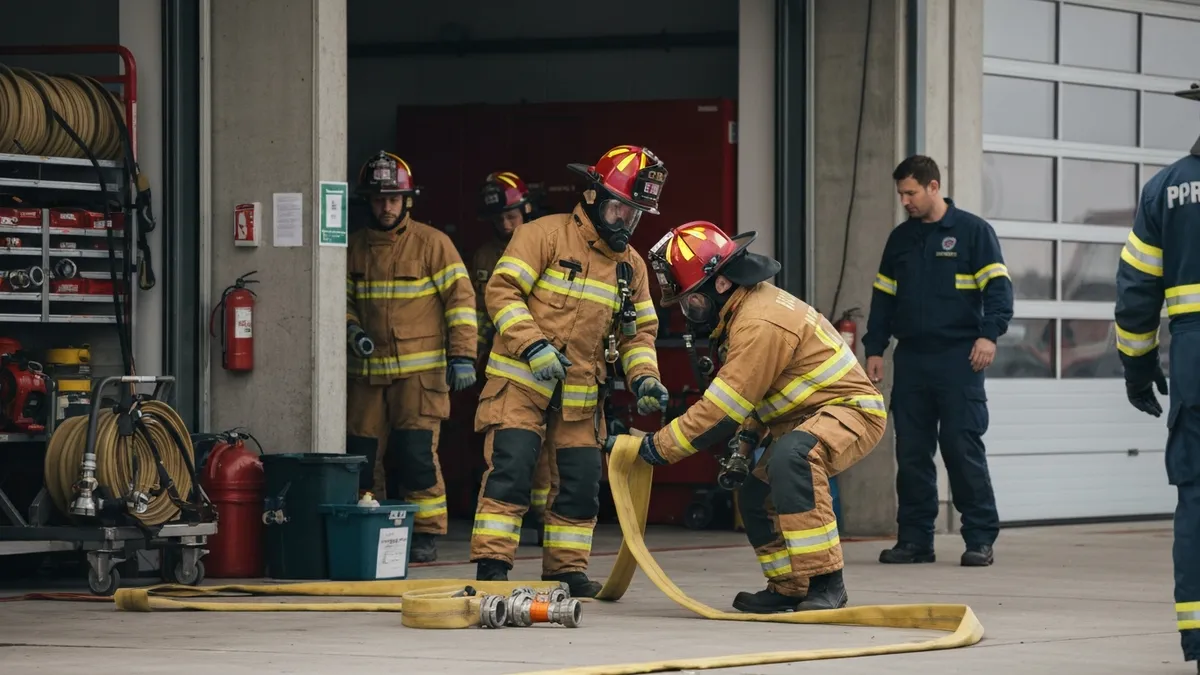
Types of Firefighter Training Props You Need to Know
Replicate residential and commercial door systems, complete with dead bolts, padlocks, and reinforced frames. Recruits practice Halligan bar techniques, door-gap analysis, and two-person entry coordination until the motion becomes automatic under stress.
Angled panels that mimic low-slope and steep-pitch roofing materials allow recruits to practice cutting ventilation holes safely. Props include simulated sheathing layers and ridge lines that respond realistically to axe and saw pressure.
Narrow tunnels, angled chutes, and maze structures train candidates for the CPAT tunnel event and real rescue scenarios. Recruits wearing full SCBA gear must navigate tight corners that demand spatial awareness and controlled breathing.
Weighted hose assemblies and drag handles simulate the resistance of a charged 1.75-inch attack line. Candidates practice correct body position, foot placement, and pull mechanics to move hose efficiently without injuring their backs.
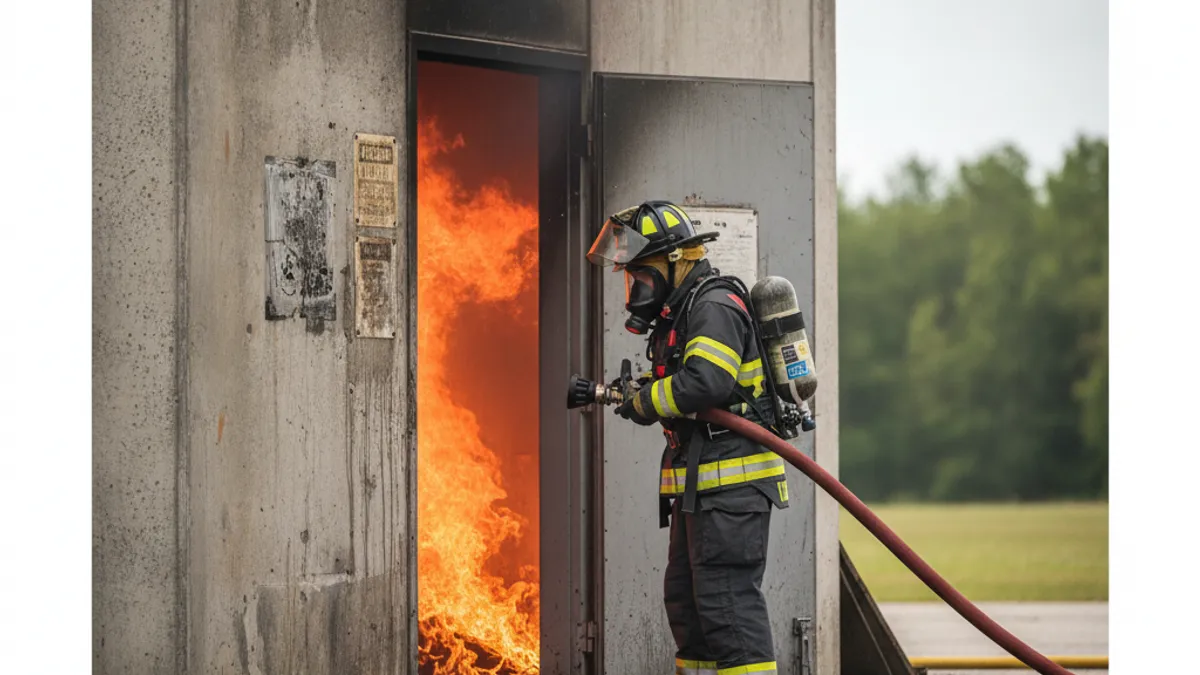
Controlled burn structures, often modular steel or concrete, allow recruits to experience actual fire behavior including rollover, flashover indicators, and thermal layering under instructor supervision with real suppression equipment.
Understanding how to become a firefighter requires navigating a multi-step process that combines written testing, physical ability evaluation, background investigation, medical screening, and — ultimately — academy training. Each stage filters the candidate pool, and understanding what each phase demands allows you to prepare strategically rather than simply hoping your general fitness and life experience are enough. The process is competitive: major urban departments like Los Angeles, Chicago, and New York City often receive tens of thousands of applications for a few hundred openings.
The written civil service exam is almost always the first formal hurdle. Depending on your jurisdiction, this test may cover reading comprehension, mechanical aptitude, mathematics, spatial reasoning, map reading, and — in some progressive departments — situational judgment scenarios designed to assess your decision-making under ambiguous conditions. Studying for this exam requires dedicated time with practice questions, not just casual review. The candidates who score in the top percentiles are the ones who consistently used timed practice tests to sharpen both speed and accuracy.
After the written exam, departments typically administer the Candidate Physical Ability Test, better known as the CPAT. This standardized eight-event circuit was developed by the International Association of Fire Fighters and tests stair climb endurance, hose drag, equipment carry, ladder raise, forcible entry, search, rescue, and ceiling breach and pull — all within a time limit of 10 minutes and 20 seconds. Every single one of these events maps directly to a training prop you can practice on before test day. Candidates who have rehearsed on actual or replica props consistently outperform those who relied solely on gym training.
The background investigation phase surprises many first-time applicants with its depth. Departments investigate your driving record, credit history, criminal record, employment history, and — increasingly — your social media presence. Honesty during this phase is non-negotiable; falsification of any application material is an automatic disqualification and a permanent bar from most departments. This phase typically takes four to twelve weeks, so use the waiting period productively to continue your prop training and written exam preparation.
Medical and psychological evaluations follow the background check. The medical exam includes vision, hearing, pulmonary function, cardiovascular stress testing, and musculoskeletal assessment. The psychological evaluation, often a combination of written instruments and a one-on-one interview with a licensed psychologist, assesses stress tolerance, impulse control, teamwork orientation, and ethical judgment. Candidates who have prior first-responder experience, military service, or extensive volunteer firefighting background often perform more naturally in these evaluations because they have already internalized the professional norms the department is screening for.
Once you receive a conditional job offer, you enter the fire academy. Academy programs in the United States typically run sixteen to twenty-four weeks, depending on the department size and certification requirements. During this time, recruits spend the majority of their training hours on props — the same types of forcible-entry doors, hose drag setups, and ladder systems described throughout this article.
The academic portion of the academy covers building construction, fire behavior, hydraulics, hazardous materials operations, and emergency medical care, all of which are testable topics you should begin studying now. To learn more about do volunteer firefighters get paid and other critical compensation and career questions, explore our dedicated resource covering interview preparation and compensation structures.
State and national firefighter certifications — including Firefighter I and Firefighter II under NFPA 1001, as well as Emergency Medical Technician certification in most states — form the credential foundation of a firefighting career. Many departments require candidates to hold or obtain these certifications within a defined period after hire. Proactively pursuing your EMT-Basic certification before applying can dramatically improve your competitiveness in any department's hiring pool, since it signals both commitment and the ability to handle high-stress learning environments.
Firefighter Salary: What You Can Really Earn
Entry-level firefighters in the United States typically earn between $38,000 and $52,000 per year during their probationary period, which usually lasts twelve to eighteen months. In high cost-of-living cities like San Francisco, Boston, and Seattle, starting salaries can reach $65,000 or higher when base pay is combined with uniform allowances, shift differentials, and required certification bonuses that many departments attach to Firefighter II and EMT credentials.
Beyond base salary, entry-level firefighters accumulate overtime pay relatively quickly. The nature of shift work — most departments operate 24-hour on, 48-hour off schedules — creates natural overtime opportunities during staffing shortages, special details, and mutual aid responses. A first-year firefighter willing to pick up extra shifts can realistically add $8,000 to $15,000 to their annual earnings without waiting for their first raise or step increase.
Career Firefighting vs. Volunteer Firefighting: Key Differences
- +Career firefighters receive full salary, benefits, and pension — financial security for the entire family
- +Consistent training schedules with access to department-owned props and burn buildings
- +Structured promotional pathways from Firefighter to Captain to Chief Officer
- +Full-time exposure to a wide variety of emergency call types accelerates skill development
- +Union representation in most departments provides strong job protections and negotiated wages
- +Access to specialized teams — SWAT firefight support, technical rescue, hazmat — as a career firefighter
- −Extremely competitive hiring process; many departments hire fewer than one percent of applicants
- −Academy training is physically and academically demanding, with high dropout rates in some programs
- −Shift work disrupts family schedules, holidays, and social life in ways that take years to adjust to
- −Chronic exposure to smoke, carcinogens, and traumatic scenes increases long-term health risks significantly
- −Starting salaries in smaller municipalities can be low relative to the physical demands of the job
- −Physical fitness requirements must be maintained throughout the career, not just at entry
Pros and Cons at a Glance
| Pros | Cons |
|---|---|
| Career firefighters receive full salary, benefits, and pension — financial security for the entire family | Extremely competitive hiring process; many departments hire fewer than one percent of applicants |
| Consistent training schedules with access to department-owned props and burn buildings | Academy training is physically and academically demanding, with high dropout rates in some programs |
| Structured promotional pathways from Firefighter to Captain to Chief Officer | Shift work disrupts family schedules, holidays, and social life in ways that take years to adjust to |
| Full-time exposure to a wide variety of emergency call types accelerates skill development | Chronic exposure to smoke, carcinogens, and traumatic scenes increases long-term health risks significantly |
| Union representation in most departments provides strong job protections and negotiated wages | Starting salaries in smaller municipalities can be low relative to the physical demands of the job |
| Access to specialized teams — SWAT firefight support, technical rescue, hazmat — as a career firefighter | Physical fitness requirements must be maintained throughout the career, not just at entry |
Complete Firefighter Training Prep Checklist
- ✓Register for a CPAT orientation session at your nearest testing facility at least eight weeks before your test date.
- ✓Practice the stair climb event three to four times per week using a StepMill or equivalent machine with a weighted vest.
- ✓Locate a fire academy or training center that allows public access to forcible-entry and hose drag props for rehearsal.
- ✓Complete your EMT-Basic certification before submitting your firefighter application to gain a competitive edge.
- ✓Take at least three timed practice written exams to identify weak areas in reading comprehension and mechanical aptitude.
- ✓Review NFPA 1001 Firefighter I and II standards to understand exactly what knowledge the academy and certification exams expect.
- ✓Study building construction types — Type I through Type V — since this topic appears on virtually every firefighter written exam.
- ✓Prepare a detailed personal history statement and gather all required documentation before the background investigation begins.
- ✓Research the specific department's fitness standards, shift schedule, and promotional requirements before applying.
- ✓Join a volunteer fire department or ride-along program to gain practical exposure before your paid career begins.
Prop Training Directly Predicts CPAT and Academy Success
Candidates who complete at least twenty practice sessions on CPAT-specific training props before their test date pass at rates significantly higher than those who rely on general fitness conditioning alone. Each CPAT event has a specific body mechanics pattern that only repetition on the actual equipment ingrains. Do not wait until the week before your test — start prop training the moment you submit your application.
The distinction between volunteer firefighter service and career firefighting is more nuanced than most people outside the profession realize. Volunteer departments handle approximately 65 to 70 percent of all fire and emergency calls in the United States — a staggering share of the national emergency response workload that is almost entirely invisible to urban residents who assume all firefighters are paid professionals. In rural areas, small towns, and suburban communities across the country, volunteer departments protect millions of Americans with little or no municipal budget and equipment purchased through grant funding and community fundraising.
The question of whether a firefighter costume or uniform signals career or volunteer status is often the first thing civilians notice, but the training requirements behind that uniform have converged significantly over the past two decades. Many states now require volunteer firefighters to complete the same NFPA 1001 Firefighter I certification that career recruits earn in paid academies. This standardization means that the same training props — forcible entry doors, ladder systems, hose evolution setups — are equally relevant whether you are a salaried battalion member or a volunteer who responds from home on weekends.
Recruitment and retention of volunteer firefighters has become a critical national issue. The number of active volunteer firefighters peaked at approximately 897,750 in 1984 and has declined steadily since, largely because of demographic shifts, longer commutes, dual-income households with less discretionary time, and the increasing technical complexity of modern emergency response. Departments are responding by streamlining their training programs, investing in portable props that reduce travel time to training sites, and offering stipends and other incentive structures to make volunteering more financially viable for working adults.
The swat firefight concept — close-quarters coordination between law enforcement tactical teams and specially trained firefighters — has become an increasingly important subject in modern fire service training. Active shooter and mass casualty events have created a new operational reality in which firefighters must sometimes enter scenes before they are fully secured by law enforcement. Warm zone medical operations, rescue task forces, and integrated incident command training all require firefighters to understand police tactics, ballistic protection equipment, and staged medical intervention protocols that were not part of traditional fire academy curriculum even a decade ago.
National tragedies, including the events surrounding the how much do firefighters make coverage that sparked wider conversations about first responder compensation and risk, have accelerated investment in tactical emergency casualty care training for firefighters. Departments across the country are now integrating TECC and TCCC-derived curricula into their standard training rotations, using purpose-built props that simulate ballistic wound scenarios, improvised tourniquet applications, and mass casualty triage under simulated threat conditions.
For aspiring firefighters, understanding this expanding scope of the profession is essential for both exam preparation and long-term career development. The firefighter exam — whether a civil service written test or a department-specific assessment — increasingly includes questions about incident command structure, tactical operations on complex scenes, and emergency medical protocols that reflect the real-world demands of modern fire service. Studying building construction, fire behavior, and emergency medical care together, rather than treating them as separate disciplines, mirrors how these skills are actually applied on incidents.
The green firefighter entering today's fire service will face a career defined by technological change, evolving hazard profiles, and expanding community expectations. Electric vehicle fires, lithium-ion battery storage facility incidents, wildland-urban interface conflagrations, and high-rise firefighting in increasingly dense urban cores all present hazards that require specialized props and training evolutions beyond the traditional structure fire curriculum. Starting your preparation now — with written study, physical conditioning, and hands-on prop experience — positions you to adapt throughout a career that will look very different in 2040 than it does today.
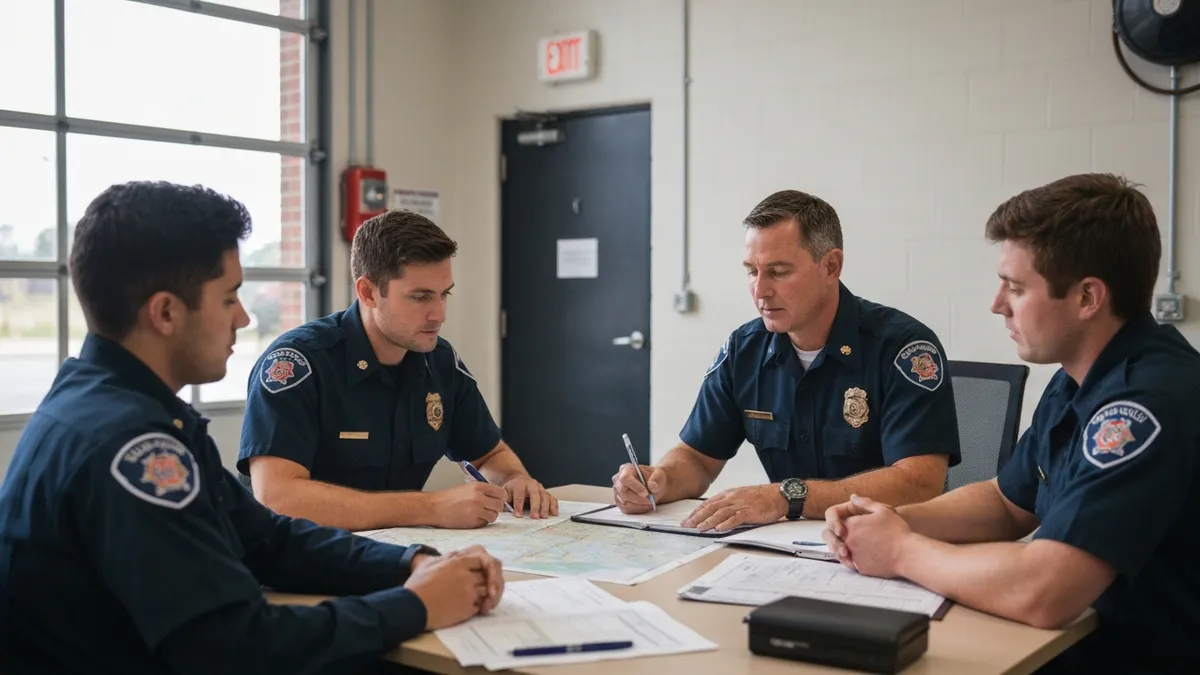
Most fire department civil service lists open for only a brief window — sometimes as short as two weeks — before applications close for months or years. Sign up for job alert notifications through your state's civil service commission, USAJOBS for federal fire positions, and individual department HR portals. Missing the application window by even one day means waiting for the next hiring cycle, which can be one to three years away in competitive markets.
Exam preparation for the firefighter written test demands a structured approach that goes far beyond casual reading. The most common mistake candidates make is treating exam prep as a passive activity — reading through textbooks and assuming familiarity equals readiness. Active recall, timed practice sessions, and deliberate review of wrong answers are the study techniques that actually move the needle on exam day. Think of written exam prep the same way you think about prop training: repetition in realistic conditions builds the neural pathways that allow fast, accurate performance under pressure.
Building construction is consistently one of the highest-weighted topic areas on firefighter written exams across the country. The five construction types defined by NFPA 220 — fire-resistive, non-combustible, ordinary, heavy timber, and wood frame — each present distinct fire spread patterns, structural collapse timelines, and tactical considerations that firefighters must understand to make safe decisions inside burning buildings. Exam questions on this topic often present scenario-based situations where you must identify the construction type from a description and predict how fire will behave or how long the structure will remain safe to operate inside.
Emergency medical care is the second major pillar of written exam content and, for departments that run dual-role firefighter-paramedic models, is the topic with the highest real-world consequence. Exam questions typically cover patient assessment, airway management, shock recognition and treatment, trauma care principles, and the incident command structure for mass casualty events. Many of these concepts map directly to hands-on props: airway mannequins, trauma simulation suits, IV practice arms, and CPR feedback devices that allow candidates to practice clinical skills repetitively before their first real patient encounter.
Hazardous materials operations represent a growing portion of both written exam content and real-world emergency response. The proliferation of lithium-ion battery storage systems, alternative fuel vehicles, solar panel installations, and industrial chemical facilities means that virtually every fire company in the country will encounter hazmat scenarios with increasing frequency. Hazmat operations-level training — the minimum certification for entry-level firefighters under NFPA 472 — covers recognition and identification of hazardous materials, defensive actions, decontamination procedures, and incident command integration that protect both responders and the public during chemical, biological, radiological, and nuclear events.
Many candidates overlook the importance of studying firefighter interview preparation alongside written exam content, but structured oral board interviews are a standard part of most departments' hiring processes and are scored as heavily as the written test in many jurisdictions. Interview panels typically ask behavioral questions using the STAR format — Situation, Task, Action, Result — and assess candidates on communication skills, situational judgment, ethical reasoning, and knowledge of the fire service.
Reviewing the department's mission statement, understanding its community demographics, and preparing specific examples from your own experience that demonstrate integrity, teamwork, and physical courage will give your interview responses the concrete specificity that panels reward.
For candidates who want to explore the full scope of firefighter career resources including films about firefighters and other supplementary study materials that provide context for the culture and demands of the profession, our resource library offers a wide range of content beyond traditional practice questions. Understanding what the fire service looks and feels like through the eyes of experienced professionals helps calibrate your expectations and strengthens the authenticity of your interview responses when panels ask why you want to serve.
The written exam and interview together typically account for 60 to 80 percent of your overall application score in most civil service hiring processes. Physical ability test results, background investigation findings, and medical or psychological evaluation outcomes are often pass-fail screens rather than scored components, meaning that maximizing your written and oral performance gives you the greatest control over your final ranking on the eligibility list. Every point matters in competitive processes where the difference between rank one and rank fifty on the list can be fractions of a percentage point.
Building a realistic training schedule in the weeks before your exam requires balancing physical conditioning, written study, and hands-on prop practice without overtraining or burning out. A twelve-week prep calendar works well for most candidates: the first four weeks focus on establishing baseline fitness and identifying written exam weaknesses, the middle four weeks increase intensity on both dimensions simultaneously, and the final four weeks shift toward simulation and full-dress rehearsal of every component you will face in the hiring process. Writing this schedule down and tracking your daily completion rate is significantly more effective than informal, improvised prep.
Physical conditioning specifically for CPAT events requires targeted training rather than general fitness work. The stair climb event, which accounts for more failures than any other CPAT component, demands sustained cardiovascular output at a set pace while wearing a 50-pound vest for three minutes.
Training on a StepMill at 60 steps per minute with your weighted vest three to four times per week is the most direct preparation method available. Supplementing with loaded carries, sled drags, and farmer walks builds the functional strength needed for the equipment carry and rescue events without creating unnecessary fatigue in the days before your actual test.
Written study sessions should be no longer than 60 to 90 minutes before taking a meaningful break. Cognitive fatigue degrades retention and causes careless errors on practice questions that can distort your understanding of where your actual knowledge gaps are. Use a spaced repetition approach: review material you found difficult yesterday before introducing new content, and circle back to every wrong answer within 24 hours rather than moving immediately to the next topic. This method, supported by decades of learning science research, produces better long-term retention than marathon study sessions.
Many fire training facilities and community colleges offer open prop sessions on weekends or evenings for candidates preparing to test. Contacting your local fire training authority or state fire marshal's office to ask about public access to training props is a step that many candidates never take — and that creates an immediate advantage for those who do. Some departments also run formal candidate preparation programs in the weeks before major civil service exams, often free of charge, as a way to improve the quality of their incoming applicant pool.
Nutrition and recovery deserve as much attention during your prep period as the training itself. Firefighting demands sustained physical output across long shifts, and the habits you develop during exam preparation set the foundation for how you will manage your body throughout your career. Prioritizing protein intake, hydration, and sleep quality — particularly in the two weeks before major physical tests — is not optional self-care but a professional preparation strategy. Candidates who show up to physical ability tests fatigued, dehydrated, or underfed are compromising months of preparation in the final hours.
Mental preparation is the final and most underrated component of firefighter exam readiness. The oral board interview, the high-pressure CPAT environment, the written exam time limits, and the psychological evaluation all assess how you perform when stakes are high and the clock is running.
Visualization — mentally rehearsing each CPAT event, each interview question, each exam section — is a validated technique used by elite athletes and military operators that translates directly to first responder preparation. Spend five to ten minutes each morning during your final two weeks visualizing yourself executing each component of the hiring process with calm, precise competence.
When you finally put on a firefighter costume for the first time — whether that is an academy turnout gear set or a ceremonial uniform at your swearing-in ceremony — it should represent the culmination of months of deliberate, structured preparation on props, in study sessions, and in your mental rehearsal.
The men and women who succeed in this profession are not the ones with the most natural talent; they are the ones who take preparation seriously from day one and build habits of excellence that carry them through a career defined by service, courage, and continuous learning. Your preparation starts now.
Sample Firefighter Practice Questions
Try these questions from our free Firefighter practice tests. The correct answer and an explanation follow each question.
A firefighter is conducting a search in a smoke-filled structure and becomes motionless after a partial ceiling collapse. After approximately 30 seconds of no movement, their SCBA harness begins to emit a loud, audible alarm. This alarm is generated by which piece of equipment?
- A. End-of-Service-Time Indicator (EOSTI)
- B. Personal Alert Safety System (PASS)
- C. Heads-Up Display (HUD)
- D. Pressure-Demand Regulator
Answer: B. Personal Alert Safety System (PASS)
The Personal Alert Safety System (PASS) is a device designed to emit a loud alarm if a firefighter remains motionless for a set period (usually around 30 seconds). [8, 10, 13] It can also be activated manually to signal distress. Its purpose is to help locate firefighters who are lost, trapped, or incapacitated. [8, 10, 13]
A firefighter needs to create a secure loop in the middle of a rope to use as an attachment point for hoisting equipment. Which knot is most suitable for this purpose?
- A. Clove Hitch
- B. Figure-eight on a bight
- C. Becket Bend
- D. Half Hitch
Answer: B. Figure-eight on a bight
A figure-eight on a bight is the standard knot for creating a strong, secure loop in the middle of a rope or at the working end. It is reliable and easy to inspect. A clove hitch is used to secure a rope to an object, a becket bend joins two ropes of unequal size, and a half hitch is a simple knot used to temporarily secure a line but is not suitable for creating a secure loop on its own for hoisting.
Your engine company is loading equipment back onto the engine after putting out a structural fire. A newbie firefighter injures their leg after tripping over some hose. They stand up, limping, and assist with the loading of equipment. What's the best thing you can do in this situation?
- A. Tell the firefighter that he or she should seek medical help.
- B. Suggest to the firefighter that they take a break and sit in the engine.
- C. Wow, that was a rookie move, say to the firefighter.
- D. Continue working and tell the firefighter to "walk it off."
Answer: A. Tell the firefighter that he or she should seek medical help.
As a supervisor or colleague, the primary responsibility is the safety and well-being of team members. An injury, even if seemingly minor, should always be assessed by a medical professional to prevent potential complications or worsening of the condition. Encouraging immediate medical attention ensures proper care and adherence to safety protocols.
Before climbing a ground ladder, what safety check should a firefighter perform on its placement?
- A. Confirm proper climbing angle, footing stability, and that it is heeled or secured
- B. Verify the ladder is painted the correct color
- C. Ensure it extends at least three stories
- D. Check that it is made of wood
Answer: A. Confirm proper climbing angle, footing stability, and that it is heeled or secured
A stable footing, correct angle, and securing/heeling the ladder prevent slips and tip-overs during climbing.
Firefighter Questions and Answers



About the Author

Emergency Manager & FEMA Certification Specialist
Naval Postgraduate SchoolCommander Lisa Foster holds a Master of Science in Emergency Management from the Naval Postgraduate School and is a FEMA-certified emergency manager and Certified Emergency Manager (CEM). With 18 years of emergency response coordination experience across federal and state agencies, she coaches emergency management professionals through ICS, NIMS, and FEMA Independent Study certification programs.
Join the Discussion
Connect with other students preparing for this exam. Share tips, ask questions, and get advice from people who have been there.
View discussion (6 replies)