
Firefighter Polygraph Questions: Complete Guide to Passing the Lie Detector Test
Master firefighter polygraph questions with our complete guide. Learn what to expect, how to prepare, and avoid common mistakes. 🎯 Real tips inside.
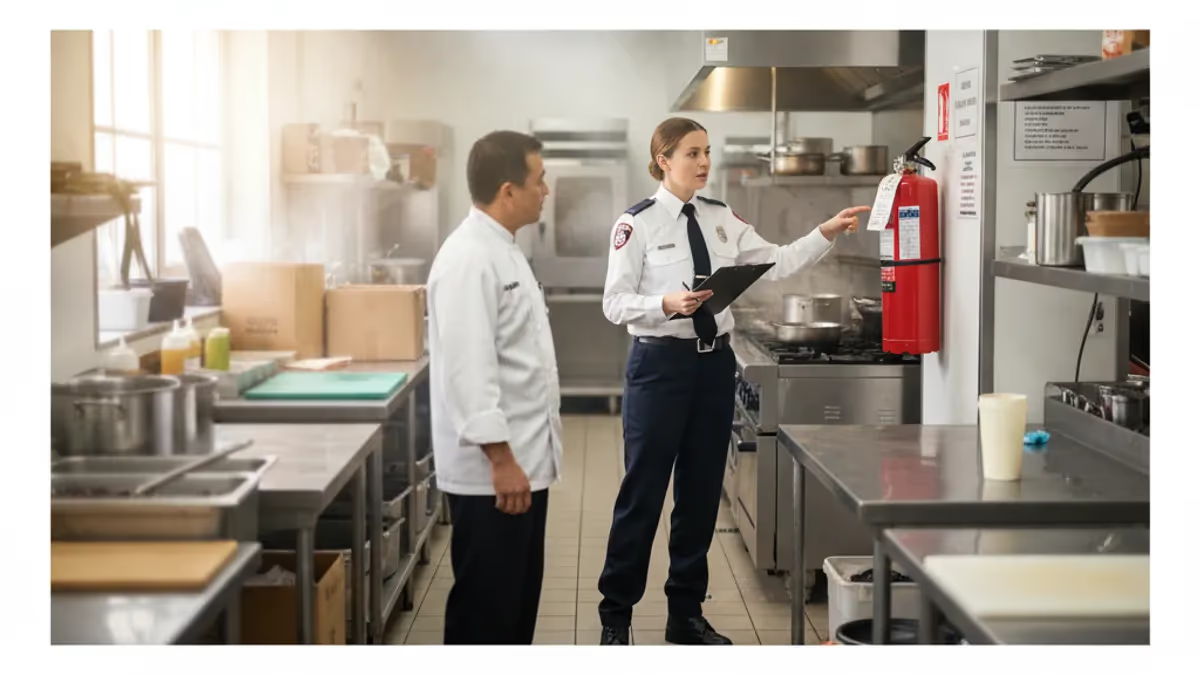
Firefighter polygraph questions are among the most anxiety-inducing parts of the entire hiring process, yet they are also one of the most predictable if you know what to expect. Every major fire department in the United States — from small volunteer companies to large urban agencies — uses some form of background investigation, and an increasing number now require a formal polygraph examination as part of that vetting process. Understanding the structure of these tests, the types of questions examiners ask, and the best mental approach to take can dramatically reduce your stress and improve your performance on exam day.
The polygraph test for firefighter candidates is not designed to trick you or catch you in minor slip-ups. Its primary purpose is to verify the accuracy of the information you provided on your application, background questionnaire, and during interviews. Departments want to confirm that you have been truthful about your criminal history, drug use, financial background, and personal conduct. Candidates who approach the polygraph with complete honesty and thorough self-reflection consistently outperform those who try to game the system or conceal relevant details they believe might disqualify them.
Knowing how to become a firefighter involves understanding every stage of the selection process, and the polygraph is a critical hurdle that eliminates a surprising number of otherwise qualified candidates. Studies suggest that between 10 and 25 percent of firefighter applicants fail their polygraph examination — not always because they lied, but often because they were unprepared for how the test works, failed to disclose information proactively, or let anxiety distort their physiological responses during the control question phase.
Modern law enforcement and fire service polygraph exams use the Computerized Polygraph System (CPS) or similar digital platforms that measure respiratory rate, electrodermal activity (sweat gland response), cardiovascular activity, and limb movement simultaneously. These four physiological channels create a detailed picture of your autonomic nervous system's response to each question. Examiners are trained for hundreds of hours to interpret these readings, and they conduct a thorough pre-test interview to establish your baseline before the formal examination even begins.
This guide covers everything you need to know about firefighter polygraph questions: what topics are covered, how the examination is structured, what happens if you fail, how departments like those involved in the widely reported idaho firefighter shooting cases use background investigations, and how to mentally and physically prepare for success. Whether you are applying to a career department, a combination department, or exploring options as a volunteer firefighter, this information applies directly to your situation.
The salary and career stakes are real. With a median firefighter salary hovering around $52,500 nationally and top-tier departments in states like California, New York, and New Jersey paying $90,000 or more, passing every phase of the hiring process — including the polygraph — is essential to securing one of the most competitive and rewarding careers in public service. One failed polygraph can mean a multi-year wait before you can reapply to the same department, so thorough preparation is not optional — it is mandatory.
Throughout this article you will find detailed breakdowns of polygraph question categories, a step-by-step walkthrough of what to expect on test day, expert strategies for managing anxiety, and a comprehensive FAQ addressing the questions candidates ask most often. Read every section carefully, take notes, and use the practice quizzes embedded below to sharpen your overall firefighter exam readiness as you approach the most transparent, honest, and confident version of yourself heading into the examination room.
Firefighter Polygraph by the Numbers
Firefighter Polygraph Exam Format & Structure
| Section | Questions | Time | Weight | Notes |
|---|---|---|---|---|
| Pre-Test Interview | — | 45–90 min | Setup | Examiner reviews your background questionnaire, explains the process, and establishes a physiological baseline |
| In-Test Examination | — | 45–60 min | Core Test | Formal polygraph with relevant, control, and irrelevant questions administered in multiple chart runs |
| Post-Test Interview | — | 30–60 min | Debrief | Examiner may ask follow-up questions if charts indicate deception; opportunity to clarify ambiguous responses |
| Total | 3 | 2–4 hours | 100% |
The firefighter polygraph examination is divided into very specific question categories, each designed to probe a different dimension of your personal history and character. Knowing these categories in advance allows you to do the necessary self-reflection before you ever sit in the examination chair. The examiner is not your adversary — they are a trained professional whose job is to surface inconsistencies, and the best way to pass is to give them nothing inconsistent to find. Preparation through honest self-audit is the single most effective strategy available to any candidate.
The first major category is criminal history. Examiners will ask whether you have been arrested, charged, or convicted of any crime, including offenses that were expunged or that occurred as a juvenile. Many candidates mistakenly believe that sealed or expunged records are permanently invisible. While departments cannot always access these records officially, the polygraph examiner will ask you directly, and a physiological stress response to a question about criminal history can trigger a deceptive indication even if no records exist in any database. Honesty is always the safer path.
Drug use is the second major category and frequently the most problematic for younger candidates applying in today's competitive market. Examiners ask about marijuana use (including frequency and recency), hard drug use such as cocaine, methamphetamine, ecstasy, and hallucinogens, and prescription drug misuse.
They also ask about drug sales and whether you have been in the presence of illegal drug use without reporting it. Many departments have modernized their standards — for example, allowing past marijuana use if it occurred more than one to three years ago — so it is critical to know your target department's specific policy before your examination.
The financial responsibility category covers unpaid debts, bankruptcies, tax liens, and whether you have stolen money or property from an employer. Fire departments view financial irresponsibility as a risk factor for corruption, theft, and susceptibility to bribery. If you have a complicated financial history, such as a bankruptcy from a medical emergency or a period of unemployment, be prepared to explain the context clearly and honestly. Context matters enormously, and examiners are experienced at distinguishing between situational hardship and reckless financial behavior that reflects character flaws.
Employment history questions focus on whether you have been terminated for cause, whether you have lied on previous job applications, whether you have stolen from employers, and whether you have engaged in workplace misconduct such as harassment or insubordination. Like the green firefighter entering the workforce for the first time, you may have limited employment history — but even a few past jobs can introduce complications if there were conflicts or terminations you have not disclosed fully on your application.
Personal conduct and integrity questions round out the examination. These include whether you have made false statements during the hiring process, whether you have cheated academically, whether you have engaged in domestic violence or restraining order violations, and whether you have associations with criminal organizations. Some departments also ask about gambling habits, alcohol dependency, and past use of steroids or performance-enhancing drugs, particularly given the physical demands of the firefighter role and the competitive nature of the hiring process.
Wildland firefighter and urban firefighter candidates face similar polygraph structures, though departments serving high-risk areas — those operating near jurisdictions that have experienced critical incidents like the SWAT firefight or large-scale emergency responses — tend to have more rigorous background investigation protocols overall. The intensity of the examination correlates directly with the level of public trust the position requires and the potential consequences of placing an unfit individual in an emergency response role.
Understanding these question categories empowers you to conduct a thorough self-review before your test. Sit down with your background questionnaire and honestly compare every entry against your actual memory of events. If you find discrepancies, report them proactively during the pre-test interview. Examiners consistently report that candidates who volunteer additional information during the pre-test — rather than waiting to be caught — are far more likely to receive a favorable outcome, even when the disclosed information is potentially disqualifying on its surface.
Volunteer vs. Career vs. Wildland Firefighter Polygraphs
Career firefighter positions at full-time municipal departments almost universally require a comprehensive polygraph examination. These departments invest enormous resources in recruiting, testing, and training each candidate — often $50,000 to $100,000 before a new hire completes their probationary year — so they conduct the most rigorous background investigations in the fire service. The polygraph for career positions typically covers all five major question categories and may include multiple chart runs spanning ninety minutes or more of active testing time.
Candidates applying to high-volume departments in major metropolitan areas — New York, Los Angeles, Chicago, Houston, Phoenix — should expect an especially thorough pre-test interview. These departments receive thousands of applications per hiring cycle and use the polygraph partly as a screening tool to narrow the field. If your background questionnaire contains any ambiguities, inconsistencies, or omissions, they will be identified here. Preparation means reconciling every date, employer, address, and incident in your application memory against what actually happened.
Advantages and Disadvantages of the Firefighter Polygraph Process
- +Levels the playing field by applying uniform standards to all candidates regardless of background
- +Encourages complete honesty, which builds the foundation for a trustworthy fire service culture
- +Allows candidates with minor past issues to explain context rather than being silently disqualified
- +Weeds out candidates with serious integrity issues before they enter a high-trust, life-safety role
- +Pre-test interview provides an opportunity to proactively correct application errors without penalty
- +Standardized format means candidates can prepare thoroughly and know what to expect in advance
- −Polygraph results are not 100 percent accurate — false positives occur even with honest candidates
- −Test anxiety can produce physiological responses that mimic deception, disadvantaging nervous candidates
- −Question interpretation varies by examiner, introducing subjectivity into an ostensibly objective process
- −Some protected information — medical history, religious beliefs — may be touched on indirectly
- −A single failed polygraph can bar reapplication to a department for two to five years
- −Candidates from communities with historical negative experiences with law enforcement may face additional stress
Pros and Cons at a Glance
| Pros | Cons |
|---|---|
| Levels the playing field by applying uniform standards to all candidates regardless of background | Test anxiety can produce physiological responses that mimic deception, disadvantaging nervous candidates |
| Encourages complete honesty, which builds the foundation for a trustworthy fire service culture | Question interpretation varies by examiner, introducing subjectivity into an ostensibly objective process |
| Allows candidates with minor past issues to explain context rather than being silently disqualified | Some protected information — medical history, religious beliefs — may be touched on indirectly |
| Weeds out candidates with serious integrity issues before they enter a high-trust, life-safety role | A single failed polygraph can bar reapplication to a department for two to five years |
| Pre-test interview provides an opportunity to proactively correct application errors without penalty | Candidates from communities with historical negative experiences with law enforcement may face additional stress |
Pre-Polygraph Preparation Checklist for Firefighter Candidates
- ✓Complete a thorough written self-audit of your entire background at least two weeks before the exam date
- ✓Review every entry on your background questionnaire and correct any dates, names, or details that are inaccurate
- ✓Research your target department's specific drug use standards (marijuana timelines, hard drug policies)
- ✓Get a full night of sleep — at least seven to eight hours — the night before the examination
- ✓Avoid caffeine and stimulants for at least 24 hours before the test to reduce baseline cardiovascular activity
- ✓Prepare clear, concise explanations for any negative incidents in your background before the pre-test interview
- ✓Practice slow, controlled diaphragmatic breathing to lower your baseline respiratory rate under questioning
- ✓Arrive at the examination site at least 15 minutes early to reduce situational stress before the pre-test interview
- ✓Dress professionally and conservatively — first impressions affect how examiners perceive your credibility
- ✓Do not discuss the polygraph content with other applicants or attempt to research specific question wording online
Proactive Disclosure Beats Concealment Every Time
Experienced polygraph examiners consistently report that candidates who voluntarily disclose sensitive information during the pre-test interview — before being asked — receive significantly more favorable treatment than those whose concealment is detected during the examination. If something in your history makes you nervous, the best strategy is almost always to bring it up first, explain the context clearly, and demonstrate the maturity and self-awareness that fire departments value in their personnel.
Understanding the financial and career stakes attached to the firefighter polygraph examination can be a powerful motivator for thorough preparation. The firefighter salary is one of the most compelling aspects of this career path — and one of the most misunderstood by outsiders. The question of how much do firefighters make has a complex answer that depends heavily on location, rank, overtime, and specialty assignments. Entry-level firefighters in rural areas may start at $35,000 to $42,000 per year, while experienced captains in high-cost-of-living metropolitan markets can earn $130,000 or more when overtime is included.
Beyond base salary, career firefighters typically receive a comprehensive benefits package that includes health insurance (often covering the entire family at no cost to the employee), pension plans that vest after 20 to 25 years of service, paid vacation and sick leave, disability protection, and life insurance. When you factor in the total compensation value, the effective annual package for a mid-career urban firefighter frequently exceeds $100,000. This is why fireighter positions attract thousands of applicants for every available slot, and why departments invest in rigorous screening processes including the polygraph examination.
The polygraph disqualification process is serious and has lasting consequences. Most departments impose a mandatory waiting period of two to five years before a failed polygraph candidate can reapply. Some departments permanently disqualify candidates who are found to have deliberately lied during the examination, as opposed to those who simply had an inconclusive result or admitted to disqualifying conduct during the pre-test interview. Understanding this distinction is critical: an admission of past drug use may be a temporary disqualifier, but active deception during the test itself is typically a permanent bar.
The high-profile incidents involving firefighters — including events that generated significant search volume around terms like SWAT firefight situations and the widely covered Idaho firefighters shot stories — underscore why fire departments take character screening so seriously. When firefighters respond to active shooter scenes, domestic violence incidents, or major civil unrest, they operate in close coordination with law enforcement and rely on mutual trust between agencies. A department cannot afford to place personnel whose background integrity is questionable into these high-stakes, high-visibility situations.
Disqualifying factors vary by department, but common automatic disqualifiers during the polygraph process include recent violent felony convictions, sexual offenses of any kind, recent hard drug use (typically within the past three to five years), domestic violence convictions, and active gang affiliations. These are absolute bars that no amount of context or explanation will overcome. Non-automatic disqualifiers — things like misdemeanor arrests, minor drug experimentation in the distant past, or a single workplace termination — are evaluated holistically alongside your overall application strength, interview performance, and demonstrated rehabilitation or growth.
The intersection of firefighter salary expectations and polygraph consequences creates a high-stakes decision point for candidates who are tempted to conceal negative information. The math is simple: if you lie and get caught, you lose access to a career worth potentially $3 to $5 million in lifetime earnings (including pension). If you disclose honestly and the information is temporarily disqualifying, you may simply need to wait one or two years and reapply.
The expected value calculation overwhelmingly favors honesty in virtually every scenario. The only situations where concealment might seem tempting are precisely the ones where the disqualifying factor is serious enough that concealment carries the greatest risk of permanent consequence.
For candidates wondering about the relationship between the written firefighter exam, the CPAT physical test, the psychological evaluation, and the polygraph, it is worth understanding that these components are not ranked by importance — they are all eliminatory gates. You must pass every one to advance.
Departments typically administer the polygraph relatively late in the hiring process, after you have already passed the written test, the CPAT, the oral board interview, and the initial background investigation. This sequencing means that by the time you sit for the polygraph, you are among the most competitive candidates in the applicant pool — which makes passing it all the more critical to your ultimate success.
Searching for and attempting to apply polygraph countermeasures — physical techniques designed to manipulate your physiological responses — is a serious mistake that can result in permanent disqualification from any department connected to the law enforcement or fire service community. Trained examiners are specifically taught to identify countermeasure attempts, and a detected countermeasure is treated as an admission of deception regardless of what the charts show. Legitimate preparation means honest self-review, good sleep, controlled breathing, and truthful answers — nothing more.
The practical tips for passing your firefighter polygraph on the first attempt begin long before you walk into the examination room. The most important preparation happens weeks in advance, during what examiners call the self-audit phase.
Sit down with a blank legal pad and write out, in chronological order, every significant event in your life that could conceivably appear on a background questionnaire: every job, every residence, every arrest or citation, every significant drug or alcohol experience, every financial crisis, and every interpersonal conflict that resulted in formal action. Be brutally honest in this private inventory — no one will see it but you.
Once you have your complete self-inventory, compare it line by line against your submitted background questionnaire. Highlight every discrepancy, however minor. A date that is off by six months, an employer name that is slightly wrong, or a residence you forgot to list — each of these is a potential source of stress during the pre-test interview. Contact the department's background investigator before your polygraph date to submit corrections to any factual errors you identify. Departments uniformly view proactive corrections as evidence of integrity, not as a red flag about the underlying information.
On the day of the examination, your physiological state matters significantly. Your cardiovascular response, respiratory rate, and electrodermal activity are all heavily influenced by sleep quality, caffeine intake, hydration, and baseline stress levels. Sleep deprivation increases baseline heart rate and decreases heart rate variability, making it harder for examiners to establish a clean baseline and potentially causing more chart runs.
Aim for at least eight hours of sleep the night before. Avoid caffeine from the morning of the test. Eat a normal, moderate meal two to three hours before your appointment — low blood sugar causes fidgeting and cardiovascular fluctuation that can complicate chart interpretation.
During the pre-test interview, let the examiner lead the conversation but do not volunteer information that is not relevant to the question asked. Answer questions fully and honestly, but do not ramble or over-explain. If you feel that an explanation is necessary to provide context for a factual answer, provide it concisely and then stop. Examiners are trained interviewers and will ask follow-up questions if they need more information. Your goal during the pre-test is to establish yourself as a calm, cooperative, and fully honest candidate — not to convince the examiner of anything specific.
During the actual chart-recording phase of the examination, focus on answering each question with a simple yes or no. Do not think about whether the examiner will believe you — think only about whether your answer is truthful. Mental activity beyond the literal answer — second-guessing, planning your explanation, wondering what the examiner is thinking — generates cognitive load that manifests as physiological noise on the charts.
The quieter your mind during this phase, the cleaner your charts will be. Practice this mental stillness in the days leading up to your exam through meditation, controlled breathing exercises, or simple mindfulness practice.
If you receive an inconclusive result rather than a clear pass, do not panic. Inconclusive results occur for a variety of reasons including test anxiety, physical discomfort, fatigue, or ambiguous chart readings. Many departments allow a re-examination under these circumstances, particularly if your overall background is strong. An inconclusive result is not a failure — it is an invitation to try again under better conditions. Use the feedback from the first examination to identify what contributed to the ambiguous reading and address those factors before your second attempt.
Finally, remember that the polygraph is just one component of the firefighter selection process. Your performance on the written exam, your CPAT results, your oral board scores, and your references all contribute to your overall candidacy. If you are preparing for the written examination portion of the process, the practice resources at this site — including materials for the how to become a firefighter journey — can help you build the comprehensive knowledge base that fire departments expect from their recruits. A strong overall application provides context that helps departments evaluate borderline polygraph situations favorably.
The mental game of the firefighter polygraph is as important as the factual preparation. Many candidates who are completely honest still struggle with the examination because they approach it with the wrong psychological framework. They treat the polygraph as an adversarial interrogation rather than what it actually is: a structured conversation designed to confirm what you have already disclosed. Shifting your mental model from "I must not get caught" to "I have nothing to hide and I am here to confirm that" produces a fundamentally different physiological state — one that is far more conducive to clean chart results.
Breathing technique is perhaps the single most actionable skill you can develop before your polygraph examination. The examiner attaches pneumographs (breathing sensors) to your chest and abdomen to measure your respiratory pattern. An elevated breathing rate, irregular rhythm, or sudden breath-holds following specific questions are all potential deception indicators. Practice diaphragmatic breathing — slow, deep breaths that expand your belly rather than your chest — for ten to fifteen minutes per day in the week before your exam. This lowers your resting respiratory rate and trains your nervous system to maintain a calm, regular pattern even under mild stress.
Candidates frequently ask whether they should disclose past marijuana use, given the rapidly changing legal landscape around cannabis in the United States. The answer depends entirely on your target department's written policy, which you should research before your application. In general, departments specify a minimum abstinence period — commonly one to three years for casual marijuana use — and candidates who meet that threshold can answer relevant questions truthfully without concern.
If you do not meet the abstinence threshold, the polygraph will expose recent use, and concealment will compound the disqualifying factor with an integrity violation. Honesty about recent use, paired with a commitment to abstain going forward, is always the preferred approach.
The post-test interview, which occurs after the examiner has reviewed your charts, is an opportunity — not a punishment. If the examiner indicates that your charts showed reactions to certain questions, they will typically give you a chance to provide additional information or clarify your previous answers. This is not a trap.
Examiners who conduct post-test interviews are often genuinely seeking to understand whether a chart reaction reflects deception or simply anxiety about a particular topic. Answer follow-up questions honestly and provide the additional context that was missing from your original responses. Many candidates who appeared to have problematic charts have been cleared through a thorough and honest post-test conversation.
For candidates who have experienced genuinely traumatic events — abuse, witnessing violence, involvement in incidents related to events like the widely covered firefighters shot in Idaho story or similar high-profile emergencies — the polygraph process may trigger stress responses that are unrelated to deception. If you have a history of PTSD or significant trauma, it may be worth discussing this with a mental health professional before your examination. Some departments allow accommodations for documented conditions, and pre-disclosing a medical context for your physiological responses — before the examination — gives examiners important interpretive information that can prevent false positive readings.
The preparation timeline for a firefighter polygraph should begin as soon as you submit your application. If you are six months from your expected polygraph date, use that time to stabilize your financial situation, maintain clean employment records, continue abstaining from any drug use, and address any pending legal matters (traffic tickets, outstanding court dates) that could create complications during background investigation. Think of the polygraph not as an isolated event but as a snapshot of your entire lifestyle and character — and shape that lifestyle accordingly in the months leading up to your examination.
Ultimately, the candidates who pass firefighter polygraph examinations on their first attempt share a common characteristic: they have done the work to become genuinely comfortable with complete transparency about their past. They have reviewed their history thoroughly, made peace with the parts they cannot change, and arrived at the examination confident that they have already disclosed everything relevant.
That confidence — real, earned, not performed — is what produces the calm physiological baseline that examiners describe as the hallmark of a truthful and well-prepared candidate. Preparation is not about passing a test; it is about becoming the kind of person the fire service can trust with the lives of the community.
Sample Firefighter Practice Questions
Try these questions from our free Firefighter practice tests. The correct answer and an explanation follow each question.
A firefighter is preparing to cut a metal roll-up door with a gasoline-powered rescue saw (e.g., K-12). Immediately after starting the saw and before beginning the cut, what is a critical operational step?
- A. Bring the saw to full RPM to allow the blade to reach maximum cutting speed.
- B. Immediately apply the blade to the metal at low RPM to avoid skipping.
- C. Tap the blade on the ground to ensure it is seated correctly.
- D. Set the saw to idle and verify that the blade is not spinning.
Answer: A. Bring the saw to full RPM to allow the blade to reach maximum cutting speed.
Gasoline-powered rescue saws use a centrifugal clutch. The blade only engages and spins when the engine is brought to a high RPM. Before cutting, the operator must bring the saw to full throttle to ensure the blade is spinning at its optimal (and safest) cutting speed. Applying a blade at low RPM can cause it to bind or skip.
A firefighter is tasked with carrying a 24-foot extension ladder from the apparatus to the building by themselves. Which method is the standard and most efficient technique for this task?
- A. The high-shoulder carry
- B. The low-shoulder carry
- C. The two-person suitcase carry
- D. The overhead carry
Answer: B. The low-shoulder carry
The low-shoulder carry is the standard and most commonly used method for a single firefighter to carry a ground ladder. It provides good balance and control while keeping one arm free to carry other tools. The high-shoulder carry is typically used for maneuvering through tighter spaces.
What device is used to test confined-space atmospheres before entry?
- A. Thermal imaging camera
- B. Four-gas monitor
- C. Pulse oximeter
- D. Sound meter
Answer: B. Four-gas monitor
A four-gas monitor checks oxygen, combustibles, CO, and hydrogen sulfide.
While bucking a large log that is supported on both ends, a firefighter's chainsaw bar becomes pinched in the cut. What is the most likely mechanical reason for this?
- A. The chain was too dull to clear wood chips from the kerf.
- B. Tension forces on the bottom of the log pulled the cut open.
- C. The bar oil was too thin and failed to provide adequate lubrication.
- D. Compression forces on the top of the log caused the cut (kerf) to close.
Answer: D. Compression forces on the top of the log caused the cut (kerf) to close.
A log supported at both ends is under compression on its top surface and tension on its bottom surface. When a cut is made from the top down, it relieves the compression, causing the wood to squeeze or close in on the guide bar, pinching it.
Firefighter Questions and Answers

Firefighter CPAT Test: Complete Guide to Passing the Candidate Physical Ability Test
What is the Firefighter Exam?

When Is the Next NYC Firefighter Test? Complete 2024–2025 Exam Guide
Firefighter Video Questions and Answers

Training Props for Firefighters: Complete Guide to Simulation Equipment & Career Prep
About the Author
Emergency Manager & FEMA Certification Specialist
Naval Postgraduate SchoolCommander Lisa Foster holds a Master of Science in Emergency Management from the Naval Postgraduate School and is a FEMA-certified emergency manager and Certified Emergency Manager (CEM). With 18 years of emergency response coordination experience across federal and state agencies, she coaches emergency management professionals through ICS, NIMS, and FEMA Independent Study certification programs.
Join the Discussion
Connect with other students preparing for this exam. Share tips, ask questions, and get advice from people who have been there.
View discussion (6 replies)