
How To Pass Theory Test: Free DVSA Practice & Pass First Time (2026 October)
✏️ How to pass theory test first time: a 4-week DVSA study plan, free mocks, hazard perception tips, sign meanings, and test-day strategy you can use today.
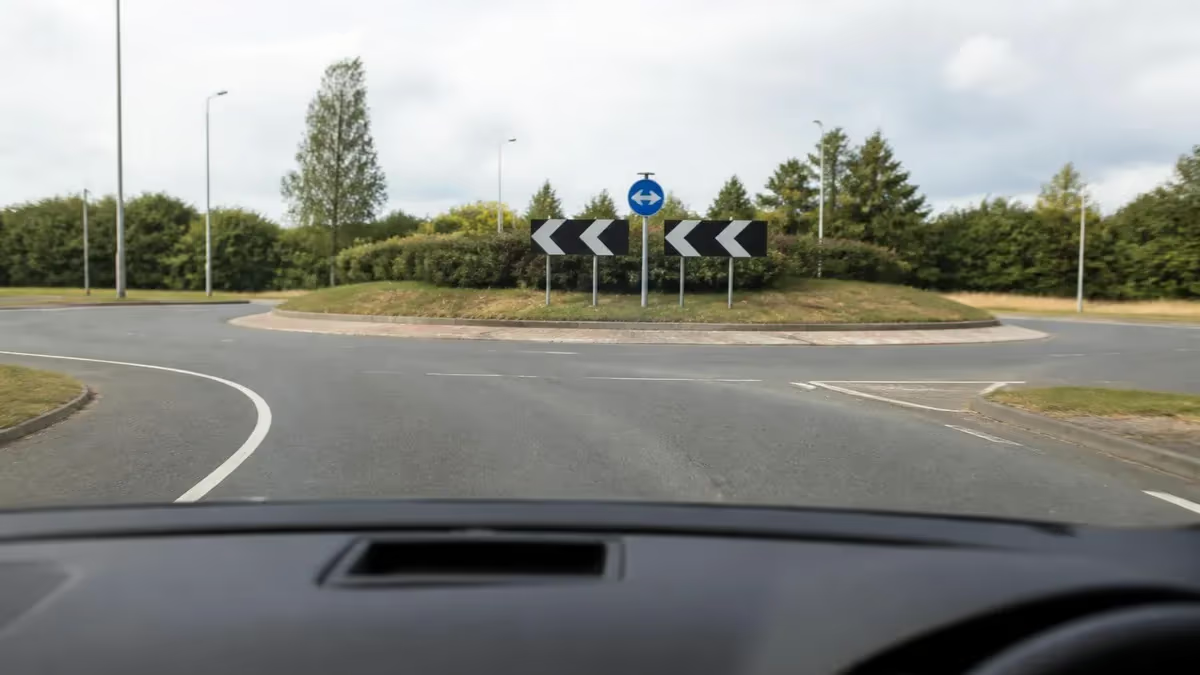
How to pass the theory test on your first attempt
You can book theory test slots online in minutes. Booking is the easy part. Passing it on the first try? That's where most learners stumble — and the official DVSA figures show a pass rate hovering around 46% to 48% in recent years. You're not failing because the test is unfair. You're failing because you walked in under-prepared, or you sat down nervous and forgot half of what you knew. Both are fixable.
This guide gives you a full, week-by-week plan to pass the DVSA theory test, the free and paid resources actually worth using, the five topic areas where candidates lose marks most often, and a calm, practical strategy for test day itself. Read it once, then come back to the bits you need. By the end you should know exactly what to revise, when, and how to spot a developing hazard before the timer punishes you.
If you're short on time and want to jump straight into a free mock, try our DVSA Rules of the Road practice test first. It mirrors the format and will tell you within fifteen minutes whether you're ready or whether you still need a few weeks of revision. Use that result honestly — it's a diagnostic, not a verdict.
What's actually in the DVSA theory test
The test has two parts and you must pass both on the same day. Part one is multiple choice: fifty questions drawn from a bank covering road signs, alertness, attitude, safety margins, hazard awareness, vulnerable road users, vehicle handling, motorway rules, rules of the road, and dealing with incidents. You need 43 correct out of 50 to pass. You get 57 minutes. That's around 68 seconds per question, which sounds generous until you hit a long scenario question and freeze.
Part two is the hazard perception test. You'll watch 14 short video clips and click each time you spot a developing hazard. One clip has two scorable hazards; the other thirteen have one. Each hazard is worth up to 5 points, and the score depends on how early you spot it. The pass mark is 44 out of 75. You can't click randomly — that flags as cheating and scores zero for that clip.
Both sections run back-to-back on a computer at a DVSA-approved test centre. You'll get your result within minutes. If you pass, you'll receive a theory test pass certificate valid for two years; you must take and pass your practical driving test within that window or sit theory again.

DVSA Theory Test By The Numbers
Key Facts at a Glance
| Item | Value | Details |
|---|---|---|
| Multiple choice questions | 50 | |
| Pass mark (86%) | 43/50 | |
| Hazard perception pass mark | 44/75 | |
| Time for part one | 57 min | |
| Test fee | £23 | |
| Certificate validity | 2 years |
The 4-week DVSA study schedule that works
Four weeks is the sweet spot. Less than that and you're cramming, which is how candidates blow easy questions on road signs. Much more than that and you start forgetting Week 1 material before test day. Here's how to structure each week so revision compounds instead of slipping away.
Week 1: Highway Code skim + free DVSA mock
Start by reading the Highway Code once, cover to cover. The full text is online free at gov.uk and takes around three to four hours total. Don't try to memorise it — just get a feel for what's there. On day three or four, sit your first free DVSA mock test cold. Note your weak topics. They'll guide everything that follows.
Week 2: Highway Code deep dive + revision aids
Now go back into the Highway Code with intent. Pay extra attention to the rules around stopping distances, motorway signals, and traffic signs. Buy or download a revision aid — the DVSA Official Theory Test Kit at £4.99 is the gold standard, but the free practice theory test sessions on Practice Test Geeks cover the same bank and won't cost you anything. Do at least three short topic-based quizzes a day.
Week 3: Hazard perception focus
Most learners ignore hazard perception until the final week. Don't. It's a learned skill — clicking too late costs you points, clicking too early sometimes too. Use the Theory Test Pro app or the DVSA's official hazard clips. Aim for 50 to 60 practice clips this week. By Sunday you should be able to identify a developing hazard within the first two seconds of it appearing.
Week 4: Timed mocks and weak-topic refresh
Final stretch. Sit one full timed mock per day, alternating multiple choice and hazard perception. Track which questions you keep getting wrong — that's your weak topic. Spend twenty minutes each evening reading the relevant Highway Code chapter. The night before test day, do a light traffic signs refresh and then stop. Trust your preparation.
Your 4-Week Theory Test Study Plan
Week 1 — Read the Highway Code
Week 2 — Deep revision with aids
Week 3 — Hazard perception focus
Week 4 — Timed mocks + weak-topic refresh
Resource Costs Compared
Free and paid resources worth using
You don't need to spend a fortune. The Highway Code is free online at gov.uk. The DVSA's own practice page lets you try sample questions at no cost. Free theory test mocks on Practice Test Geeks mirror the real format and are unlimited. If you want everything in one paid bundle, the official DVSA Theory Test Kit (£4.99 on iOS and Android) gives you every revision question in the live bank plus the official hazard perception clips — it's the only product DVSA themselves endorse.
The Theory Test Pro app is another solid choice, with a free tier and a £4.95 premium tier. AA Driving School offers theory revision as part of its lesson packages, useful if you're already taking practical lessons. The Driving Test Success app bundles theory questions, hazard clips, and Highway Code reference for around £4.99 — popular with learners who want one all-in-one tool.
Skip anything that promises "guaranteed pass" tricks or "real exam questions leaked." DVSA changes its bank regularly and copying is illegal. Stick with official or well-reviewed third-party tools.
The top 5 topic areas most candidates fail on
DVSA doesn't publish detailed fail-topic data, but instructor surveys and our own quiz analytics show the same five problem areas year after year. If you're tight on time, focus revision here.
1. Road and traffic signs. The single biggest source of wrong answers. There are over a hundred signs in the Highway Code and they're easy to confuse. Memorise the shape-and-colour rule — red circles are prohibitive, blue circles are mandatory, triangles are warnings, rectangles are informational. Our road and traffic signs questions and answers quiz drills this in around twenty minutes.
2. Alertness. Questions about tiredness, distraction, mobile phones, and how long you should rest on a long drive. Easy marks if you've read the relevant Highway Code chapter; brutal if you haven't.
3. Vehicle handling. Wet weather, fog, snow, night driving, skids. Stopping distances catch people out — the typical stopping distance at 70 mph is 96 metres, not 53.
4. Safety margins. Following distances, the two-second rule, braking on different surfaces. Learn the numbers cold. They're frequently tested.
5. Hazard awareness. Not the same as hazard perception — this is the multiple-choice version. Spotting risk before it becomes a problem. Pedestrians, cyclists, children near schools, animals on rural roads.
Pre-Test Revision Checklist
- ✓Memorised the shape-and-colour rule for road signs (red circle = prohibit, blue circle = mandatory, triangle = warning)
- ✓Know typical stopping distances at 30, 50, and 70 mph
- ✓Can recite the two-second following rule and when it doubles
- ✓Have completed at least 50 hazard perception practice clips
- ✓Scored 47/50 or higher on three consecutive timed mocks
- ✓Know what to do at a pelican, puffin, and zebra crossing
- ✓Have provisional licence ready for test day
- ✓Booked test for a time of day when you're alert, not groggy
- ✓Located the test centre and worked out parking the day before
Test day: a calm and practical strategy
The best preparation is wasted if you arrive frazzled. Here's the rhythm that works.
The night before, get seven to eight hours of sleep. Lay out your provisional licence and a printed booking confirmation. Don't cram past 9pm — late-night revision damages recall more than it helps. In the morning, eat something with slow-release energy: porridge, eggs, wholegrain toast. Skip the energy drinks; you don't want a caffeine spike crashing mid-test.
Arrive at the test centre at least 15 minutes early. You'll need to show your provisional driving licence (photo ID). Phones, smart watches, bags, and notes go in a locker — you cannot take anything into the test room. Bring a bottle of water if the centre allows it; some do, some don't.
When you sit down, you'll get a brief instruction screen and three practice questions. Use them. They don't count, and they let your nerves settle. Then the real test starts.
Pace yourself. You've got 57 minutes for 50 questions. Aim for one question per minute on the first pass, flag anything you're unsure about, and come back to flagged ones in the final ten minutes. There's no penalty for guessing, so never leave a question blank — but always flag-and-review rather than locking in a guess too early.
How to read a tricky question (without panicking)
Long scenario questions are where careful candidates trip up. The trick is simple: read the question twice, slowly. Once for the situation, once for what's actually being asked. Then read all four options before choosing.
If you're stuck, eliminate obvious wrong answers first. Most DVSA questions have one clearly correct option, two plausible distractors, and one obviously wrong "filler." Knock out the filler and you've already improved your odds from 25% to 33%. Knock out one more and you're at 50-50, and at that point trust your instinct — your first read is usually right.
Watch for negative wording. "Which of these is NOT a reason to use your horn?" trips up tired candidates. If the question feels weirdly phrased, read it a third time. That's what the flag button is for.
Sign meanings: the shape-and-colour rule
If you remember nothing else, remember this: red circles are prohibitive (don't do this), blue circles are mandatory (you must do this), triangles are warnings (something's coming), and rectangles give information. That single sentence unlocks roughly twenty percent of the question bank.
Octagonal stop signs are the only octagons used in the UK — designed that way so they're recognisable even if covered in snow. Diamonds you'll only see on roads with tram routes. Inverted triangles always mean "give way." The colour scheme on motorway signs is blue with white text; primary routes (A-roads) use green; local roads use white. If you can match shape to colour to meaning, you've cracked the hardest section.
DIY Free Revision Pros and Cons
- +Costs nothing — Highway Code and free mocks are unlimited
- +Forces deeper reading of the source material
- +No subscription traps or upsells
- +Same question style as paid apps
- −Requires more discipline — no daily reminders
- −No built-in progress tracking
- −Hazard perception clips on free sites are simulations, not DVSA originals
- −Easy to miss topic areas if you don't follow a plan
Theory Test Sections Explained
50 questions over 57 minutes. Pass mark 43/50. Covers ten topic bands: alertness, attitude, safety margins, hazard awareness, vulnerable road users, vehicle handling, motorway rules, rules of the road, road and traffic signs, and incidents/first aid. Each question has four options and one correct answer. Flag-and-review is your friend — never leave a question blank.
How to nail the hazard perception part
This is the part most learners undertrain on. Here's what actually scores points.
A hazard becomes "developing" the moment you'd need to take action — slow down, change lane, swerve, or stop. Clicking before that earns nothing. Clicking after it's already happened earns nothing. The five-point sweet spot is roughly half a second after you first spot the change.
Train your eye to scan continuously. Don't lock onto the centre of the screen. The hazard often appears at the edge — a child stepping off a kerb, a car pulling out of a side street, a cyclist drifting into your lane. Click once when you spot the developing hazard, then click again a beat later. Two clicks per hazard is normal and won't trigger the cheating flag. Five rapid clicks will.
The DVSA's own hazard perception clips are the best practice material — every other app uses simulations. If you can score above 60 out of 75 on the official clips a week before test day, you'll comfortably clear the 44 pass mark.
What if you fail? Retake rules and rebooking
About half of candidates don't pass first time. It's not the end of the world. You can rebook the moment you walk out — but DVSA requires a minimum three working day wait before your next sitting. That's three weekdays, so a Monday fail means a Thursday earliest retake.
You can rebook the same day for the next available slot. Don't pay third parties offering "early rebook" services; they charge a premium for the same booking system you can use free at gov.uk. Cost stays £23 per attempt.
Use that three-day window. Pull the breakdown of which sections you scored lowest on (you get it on the spot) and revise hard on those topics. Most second-attempt candidates pass — the DVSA's second-attempt rate runs around 60%, noticeably higher than the first-time rate. That's because you now know exactly what to revise.
If you fail twice, take it as a sign you need a more structured approach. Book a couple of theory-focused lessons with an instructor, or work through a paid app like the DVSA Theory Test Kit. The third sitting almost always passes if you've put in the work.
The 5 Topic Areas Where Candidates Lose Most Marks
Largest single source of wrong answers. Memorise the shape-and-colour rule.
- ▸Red circles = prohibitive (don't do this)
- ▸Blue circles = mandatory (you must do this)
- ▸Triangles = warnings (something's coming)
- ▸Rectangles = informational
Tiredness, distraction, mobile phones, rest stops on long drives.
- ▸Take a break at least every two hours
- ▸Open windows for fresh air if drowsy
- ▸Hands-free phones are still a distraction
- ▸Never drink and drive — zero is the safe limit
Wet weather, fog, snow, night driving, and skids.
- ▸Wet roads double your stopping distance
- ▸Fog lights only when visibility is under 100 metres
- ▸Dipped headlights at dawn, dusk, and in rain
- ▸Steer into a skid — never brake hard
Following distances and the two-second rule.
- ▸Two seconds on a dry road
- ▸Four seconds in the wet
- ▸Ten seconds on ice or snow
- ▸Stopping distance at 70 mph: 96 metres
Spotting risk before it becomes a problem.
- ▸Watch for pedestrians near schools and bus stops
- ▸Anticipate cyclists drifting into your lane
- ▸Slow approaching parked vans — kids may emerge
- ▸Animal warning signs on rural roads aren't decoration
Avoid These Common Mistakes
- ✓Don't rush — you have nearly a minute per question, use it
- ✓Don't skip hazard perception practice — it's half the test
- ✓Don't memorise answers — learn the principle behind each rule
- ✓Don't book the test until you're scoring 47/50 on mocks
- ✓Don't leave any question blank — flag and review instead
- ✓Don't click rhythmically on hazard clips — DVSA flags it as cheating
- ✓Don't ignore the practice questions at the start — they steady your nerves
Common mistakes to avoid
Rushing is the number one killer. You've got nearly a minute per question — use it. Candidates who finish in twenty minutes almost never pass.
Skipping hazard perception practice is the second killer. You can ace the multiple choice and still fail the test because you ignored the clip-clicking section. Treat both halves equally.
Relying on memorisation without understanding is the third. The DVSA rewords questions constantly. If you've memorised "the answer to question 47 is C," you'll fail. Learn the principle behind the rule and you can answer any variant.
Finally — don't book the test too early. Wait until you're consistently scoring above 47 out of 50 on practice mocks. Walking into the test centre at 38 out of 50 just wastes £23 and a morning.
A final word on staying calm
You've done the work. Walking into that test centre, the biggest enemy is nerves, not knowledge. Slow your breathing before you start. Sit down, hands flat on the desk for three seconds, take a breath, begin. If a question throws you, flag it and move on — never let one bad question wreck the next ten.
One more thing. The DVSA isn't trying to trick you. The questions are written to test whether you'd be safe on a real road. Read each one as if you're actually behind the wheel, and the right answer usually picks itself.
If you walk in with four solid weeks of revision behind you, a full night's sleep, and a calm head, your odds of passing first time jump well above the national average. For a fuller breakdown of what to expect, see our driving theory test overview. Pace yourself, flag what you're unsure about, and trust the prep. The candidates who fail are usually the ones who rushed through the multiple choice in twenty minutes or who never bothered with hazard perception practice. Don't be either of those candidates.
One last thing worth remembering: the theory test isn't the finish line, it's the warm-up. Once you've got your pass certificate in hand, the practical is where the real learning happens — and the principles you drilled for theory (stopping distances, sign meanings, hazard awareness) will keep paying dividends every time you sit behind the wheel. Best of luck. Once you've passed, come back and try our DVSA practice tests as quick refreshers before your practical.
Sample DVSA UK Driving Theory Practice Questions
Try these questions from our free DVSA UK Driving Theory practice tests. The correct answer and an explanation follow each question.
Your car breaks down on a motorway with a hard shoulder. After pulling over to the hard shoulder, what is the first thing you should do?
- A. Attempt to carry out simple repairs on your vehicle.
- B. Place a warning triangle 45 metres behind your vehicle.
- C. Switch on your hazard warning lights.
- D. Get out of your vehicle and stand in front of it to warn oncoming traffic.
Answer: C. Switch on your hazard warning lights.
If you break down on a motorway, the first priority is to warn other drivers. You should switch on your hazard warning lights immediately. You should not use a warning triangle on a motorway. Exit the vehicle from the left-hand side and wait behind the safety barrier.
What hazard should you be particularly aware of at a junction near a school during term time?
- A. Heavy goods vehicles delivering supplies
- B. Parked cars reducing visibility and children crossing unexpectedly
- C. Road works near the school entrance
- D. Cyclists using the bus lane
Answer: B. Parked cars reducing visibility and children crossing unexpectedly
Near schools during term time, parked cars from parents dropping off or collecting children can severely restrict visibility. Children may also dash across the road unexpectedly, especially at the start and end of the school day.
You are approaching a horse and rider on a country lane. What is the maximum speed at which you should pass?
- A. 10 mph
- B. 20 mph
- C. 30 mph
- D. The speed is not specified, but you must pass 'wide and slow'
Answer: A. 10 mph
The Highway Code (Rule 215) is very specific about passing horses. You must slow down to a maximum of 10 mph and allow at least 2 metres of space. Horses are flight animals and can be easily scared by vehicles that are moving too fast or are too close.
Which of the following road markings indicates that you must not stop your vehicle at any time?
- A. A single yellow line along the edge of the road
- B. A broken white line in the centre of the road
- C. Double red lines along the edge of the road
- D. Yellow zigzag lines outside a school
Answer: C. Double red lines along the edge of the road
Double red lines, found on 'Red Routes', mean that no stopping is allowed at any time for any reason (except for licensed taxis or Blue Badge holders in some cases). This is a stricter control than single or double yellow lines.
DVSA Theory Test Questions and Answers
About the Author

Licensed Driving Instructor & DMV Test Specialist
Penn State UniversityRobert J. Williams graduated from Penn State University with a degree in Transportation Management and has spent 20 years as a certified driving instructor and DMV examiner consultant. He has personally coached thousands of applicants through written knowledge tests, skills assessments, and commercial driver licensing programs across more than 30 states.