
Free Theory Test Online: The Complete UK 2026 September Guide to Passing the DVSA Test With Unlimited Practice Questions
Theory test online free: 🆕 unlimited UK DVSA practice questions, mock tests, hazard perception tips and a proven study plan to pass first time in 2026 September.

Taking a theory test online free of charge is the single smartest move any UK learner driver can make before booking the real DVSA exam. The official theory test costs £23, and with a current first-time pass rate hovering at just 44.2%, walking in unprepared is an expensive mistake. A genuinely free online theory test mirrors the real exam format — 50 multiple-choice questions in 57 minutes, plus 14 hazard perception clips — and lets you practise unlimited times without paying a penny or entering card details.
The DVSA bases every theory test question on three official sources: The Highway Code, Know Your Traffic Signs, and the Driving Skills for Life series. Our free online practice tests draw from the same revision bank that powers the live exam, so the questions you see here are the same style, difficulty, and topic mix you will face at the test centre. You can attempt any quiz as many times as you like, track your score, and revisit the explanations until every concept clicks.
Learners who complete at least 12 hours of practice across multiple free mock tests are statistically far more likely to pass on the first attempt. That is because repetition builds the recall speed you need when the clock is ticking. Most candidates who fail do not lack knowledge — they run out of time second-guessing themselves on questions they had actually revised. Free online practice eliminates that hesitation by training your brain to recognise the correct answer pattern almost instinctively.
Beyond the obvious cost saving, practising your theory test online free of fees also helps you identify weak spots early. The DVSA splits questions across 14 topic categories, from alertness and attitude to vehicle handling and motorway rules. A good online platform will show you exactly which categories you keep getting wrong, so you can spend your study time where it matters most rather than re-reading sections you already understand.
This 2026 guide walks you through everything: how the test is structured, what to expect on the day, the best free study schedule, hazard perception tactics, common trap questions, and how to use unlimited online mocks to lock in a pass. Whether you have six weeks or six days, the methods below have helped tens of thousands of UK learners cross the line on their first try without spending anything on revision.
You can start right now — no signup, no email, no payment details. Every practice test on this page is genuinely free, mobile-friendly, and updated for the 2026 DVSA syllabus. If you are also planning your practical test, you may want to bookmark our complete guide on how to Learn to Drive UK alongside your theory revision so the two halves of your licence journey stay perfectly aligned.
By the end of this article you will know exactly how to revise, when to book, what to do the night before, and how to stay calm in the testing booth. Most importantly, you will have a clear path from your first practice question to holding a pass certificate in your hand — all at zero cost.
UK Theory Test by the Numbers (2026)
DVSA Theory Test Format
| Section | Questions | Time | Weight | Notes |
|---|---|---|---|---|
| Multiple Choice | 50 | 57 min | Pass: 43/50 | Touchscreen, 4 options |
| Hazard Perception | 14 | ~20 min | Pass: 44/75 | Clips with developing hazards |
| Practice Session | 0 | Up to 15 min | Optional | Familiarise with system |
| Break (Optional) | 0 | 3 min | Between sections | Encouraged but not required |
| Total | 64 | 1 hour 57 minutes | 100% |
Using a theory test online free platform works exactly the same way as the real exam, which is precisely the point. You sit at a computer or mobile screen, see one question at a time with four possible answers, and tap the option you believe is correct. The interface used by the DVSA is deliberately simple, and the best free practice sites replicate that minimalism so test day feels like just another revision session rather than an intimidating new environment.
What separates serious free practice from random quiz apps is the depth of the question bank. The official DVSA revision pool contains over 700 questions, and any worthwhile free platform should rotate through all of them across multiple categories. Each time you start a new mock, you should see a different selection, weighted to match the real test distribution — roughly four questions from each of the 14 topics. That randomised mix is what stops you from memorising answers in order rather than understanding the underlying rules.
Hazard perception is where most free apps fall short, but the technique can absolutely be practised online without paying. The official clips show developing hazards — situations that start as potential risks and become actual ones requiring you to slow down, change direction, or stop. You score between 0 and 5 points per clip depending on how early you click. Clicking too early or too rapidly triggers an anti-cheat penalty, so timing matters as much as recognition.
One major advantage of practising online is instant feedback. The moment you submit an answer, a good free platform tells you whether you were right, explains why, and links the rule back to The Highway Code section it came from. This loop of question, answer, explanation, and reference is what cements knowledge in long-term memory. Reading the Code in isolation is far less effective than answering questions and looking up only the rules you got wrong.
Mobile practice is another quiet game-changer. Twenty minutes on the bus, ten minutes in a coffee queue, fifteen minutes before bed — these micro-sessions add up to several hours of revision per week without ever feeling like a study chore. The brain actually retains short, frequent sessions better than long crammed blocks, which is why learners who use free apps on their phone tend to outperform those who only revise at a desk.
If your test date is approaching faster than expected, online practice also gives you the agility to ramp up intensity. Some learners do two mocks a day in the final week and see their scores climb from the high 30s to a confident 48 out of 50. If you are juggling theory revision with rebooking your slot, our guide on test date walks you through the official rebooking process step by step.
Finally, free online practice is the lowest-risk way to discover whether you are actually ready. Sitting three consecutive mocks at 45+ correct, with hazard perception averaging 48+, is the unofficial industry benchmark for being test-ready. Anything less and you are gambling £23 plus the emotional cost of a fail. Twenty more hours of practice almost always closes the gap.
DVSA Practice Test Questions
Prepare for the DVSA - UK Driving Theory Test exam with our free practice test modules. Each quiz covers key topics to help you pass on your first try.
DVSA Eco-Friendly Driving and Vehicle Loading
DVSA Exam Questions covering Eco-Friendly Driving and Vehicle Loading. Master DVSA Test concepts for certification prep.
DVSA Hazard Awareness
Free DVSA Practice Test featuring Hazard Awareness. Improve your DVSA Exam score with mock test prep.
DVSA Incidents, Accidents and First Aid
DVSA Mock Exam on Incidents, Accidents and First Aid. DVSA Study Guide questions to pass on your first try.
DVSA Motorway Rules and Smart Motorways
DVSA Test Prep for Motorway Rules and Smart Motorways. Practice DVSA Quiz questions and boost your score.
DVSA Rules of the Road (Highway Code)
DVSA Questions and Answers on Rules of the Road (Highway Code). Free DVSA practice for exam readiness.
DVSA - UK Driving Theory Hazard Awareness ...
DVSA Mock Test covering - UK Driving Theory Hazard Awareness and Perception. Online DVSA Test practice with instant feedback.
DVSA - UK Driving Theory Motorway Rules an...
Free DVSA Quiz on - UK Driving Theory Motorway Rules and Regulations. DVSA Exam prep questions with detailed explanations.
DVSA - UK Driving Theory Road and Traffic ...
DVSA Practice Questions for - UK Driving Theory Road and Traffic Signs. Build confidence for your DVSA certification exam.
DVSA - UK Driving Theory Rules of the Road
DVSA Test Online for - UK Driving Theory Rules of the Road. Free practice with instant results and feedback.
Free DVSA Theory Test Topic Breakdown
The 50 multiple-choice questions are drawn from 14 DVSA-defined categories: alertness, attitude, safety and your vehicle, safety margins, hazard awareness, vulnerable road users, other types of vehicle, vehicle handling, motorway rules, rules of the road, road and traffic signs, documents, incidents/accidents/emergencies, and vehicle loading. Each free online mock you take should rotate questions across all 14 categories proportionally.
Some categories carry slightly more weight than others. Rules of the road, road signs, and hazard awareness typically account for around 30% of your test combined. That does not mean you should ignore the smaller categories — losing four marks on documents because you skipped a 10-minute revision block is exactly the kind of avoidable failure that pushes learners over the seven-question failure threshold.
Free Online Practice vs Paid Apps: An Honest Comparison
- +Zero cost — practise unlimited times without entering card details
- +Same question style and format as the real DVSA exam
- +Instant feedback with explanations linked to Highway Code rules
- +Mobile-friendly so you can revise during short commutes or breaks
- +Builds the speed and recall needed to finish within 57 minutes
- +Helps identify weak topic categories before you book the £23 test
- −Free hazard perception clips are reconstructions, not the official DVSA videos
- −Some free sites have outdated questions from pre-2020 syllabus
- −Ads can interrupt flow on lower-quality platforms
- −No personal tutor or human review of your weak areas
- −Progress tracking is sometimes basic compared to paid premium tools
- −Requires self-discipline to revise consistently without a paid commitment
Free Theory Test Online Preparation Checklist
- ✓Read The Highway Code cover to cover at least once before starting mocks
- ✓Complete at least 10 full 50-question free online mock tests
- ✓Score 47/50 or higher on three consecutive mocks before booking the real test
- ✓Practise hazard perception clips for a minimum of 6 hours total
- ✓Review every incorrect answer and read the explanation fully
- ✓Identify your two weakest topic categories and do focused revision
- ✓Time yourself on each mock — aim to finish in under 45 minutes
- ✓Take at least one mock on your phone to simulate touch screen tapping
- ✓Read Know Your Traffic Signs for the road signs and markings section
- ✓Book your test only after three weeks of consistent daily practice
Aim for 47 out of 50, not the 43 pass mark
The official pass mark is 43, but test-day nerves typically cost candidates 2 to 4 marks compared to home practice scores. If you can comfortably score 47/50 on free online mocks across three different sessions, you have built enough margin to absorb nerves and still pass. Stopping at 43 in practice almost guarantees a borderline fail on the day.
The single biggest predictor of passing your theory test online or in person is not raw study hours — it is study quality. Two learners can each spend 30 hours revising, and one will pass with 49/50 while the other fails with 38/50. The difference comes down to method. Active recall, spaced repetition, and mock-test simulation outperform passive reading by a factor of four to one in retention studies. Free online practice tests force active recall by design, which is why they work so well as a primary revision tool rather than a final check.
Spaced repetition means revisiting the same content at increasing intervals: day one, day three, day seven, day fourteen, day thirty. The free online format lets you implement this naturally — take a mock today, retake a similar one in three days, do a different category mid-week, and revisit the original on day fourteen. By the time test day arrives, the knowledge has moved from short-term recognition to permanent recall, which is exactly what the DVSA examiners are measuring.
The Highway Code itself has been updated several times since 2022, with the hierarchy of road users now a central concept. The new rules give priority to pedestrians waiting to cross, cyclists going straight at junctions, and horse riders. Many older free practice apps still have questions reflecting the pre-2022 hierarchy, which is why you must use a platform updated for the 2026 syllabus. Outdated questions will not just confuse you — they will actively teach you wrong answers that the real test will mark as failures.
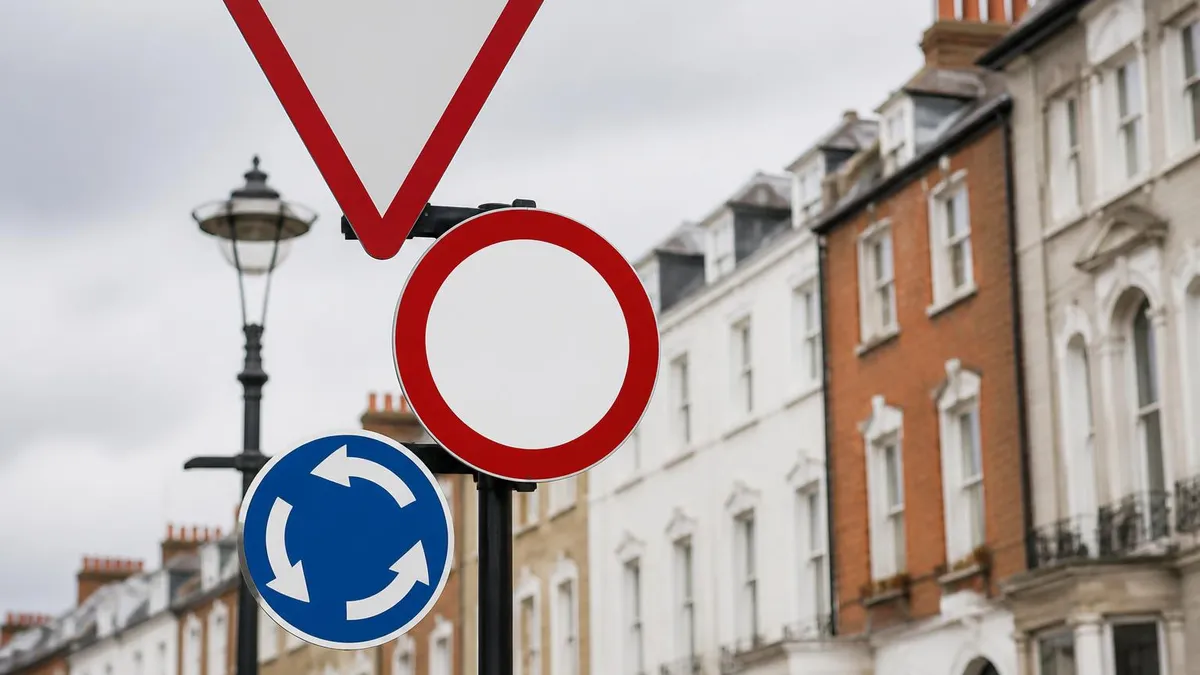
Most failures happen on the same handful of trap categories. The top three are: road signs (especially blue circular signs versus blue rectangular signs, which have opposite meanings), stopping distances (which roughly double in wet weather and increase tenfold on ice), and motorway rules (lane discipline, hard shoulder use, and matrix signal interpretation). Devote at least one focused free mock to each of these traps before you sit the real exam.
Hazard perception is the section where free practice has the steepest learning curve. The technique most candidates miss is the difference between a potential hazard (a parked car you can see) and a developing hazard (the brake lights of that parked car suddenly illuminating, suggesting the driver is about to pull out). Only developing hazards score points. Click on potential hazards too early and you waste mental energy; click too late on developing ones and you score zero. The sweet spot is about one to three seconds after the situation begins to change.
Another underrated tactic is what trainers call the second-pass review. After completing a free mock, instead of just looking at your score, go back through every single question — including the ones you got right — and ask yourself why the other three options were wrong. This trains your brain to eliminate distractors, which is exactly the skill the DVSA tests. Over time, you will recognise the wrong-answer patterns the test writers use, and your speed will climb dramatically.
Finally, keep a simple written log of every question you get wrong. Just topic plus key fact: "Stopping distance, 50mph dry = 53 metres" or "Blue circular sign = mandatory." After a few weeks you will have a personal cheat sheet of your own weak spots that is more valuable than any textbook. Review it for 10 minutes the morning of the test and you will walk in with the highest-leverage information fresh in your mind.
Scam sites charge £80–£140 to book your theory test, claiming faster slots or guaranteed dates. The only official booking website is gov.uk and the real fee is £23. If a site asks for payment to access free practice questions, it is not a legitimate DVSA partner. Always check the URL ends in gov.uk before paying anything.
Knowing how the actual test centre experience unfolds removes most of the anxiety that costs learners marks. You should arrive at least 15 minutes early with two forms of identification — your provisional licence card is essential, and a second ID such as a passport or utility bill is required for some learners. Without correct ID you will be turned away and lose your fee with no refund. The centre will check you in, lock away your phone, and walk you to a numbered booth with a touchscreen computer.
The system gives you an optional 15-minute practice session before the real test begins. Most learners skip this thinking it wastes time, but it is genuinely useful. The practice questions are not scored, do not appear on the real test, and let you get used to the exact tapping responsiveness of that specific screen. Taking even five minutes of the practice session calms nerves and prevents misclicks on the first few real questions, where anxiety is highest.
You can flag questions for review and return to them before submitting. The smart approach is to answer every question on the first pass — even if uncertain, select your best guess — and flag the ones you want to revisit. This guarantees you never run out of time with unanswered questions, which would automatically count as wrong. After flagging, you typically have 15 to 20 minutes left to review, which is more than enough to revisit five or six tricky ones.
Between the multiple choice and hazard perception sections you can take an optional three-minute break. Use it. Stand up, stretch, drink water, and reset your concentration. Hazard perception is mentally exhausting because you must stay focused on a screen for nearly 20 minutes without losing alertness. A genuine break between sections is one of the cheapest performance boosts available, and a surprising number of candidates skip it and then underperform on the clips.
If you do fail, the system tells you immediately and provides a breakdown of which categories cost you marks. The DVSA enforces a three-working-day cooling-off period before you can retake, which is actually a useful buffer. Use those three days to focus exclusively on the weak categories from your fail report, and most candidates pass on their second attempt.
There is no limit on the number of times you can retake the theory test, but each attempt costs another £23 — which is why free online practice before booking matters so much. If you also need to manage a practical test booking around your theory result, our guide on driving test covers refunds and rebooking timelines.
The pass certificate is emailed and printed on the day. Keep both copies safe — you must produce the certificate (or its number) when booking your practical test. The two-year validity window starts immediately, so if you have not yet had any driving ls, start the practical booking conversation with your instructor on the same day you pass your theory. Waiting six months and then discovering practical test slots in your area are eight months out is one of the most common ways theory certificates expire before being used.
One last piece of mindset advice: treat the theory test as a skill you are practising, not an obstacle blocking your licence. Every free online mock you complete is genuinely useful for real-world driving — recognising signs, judging stopping distances, and anticipating hazards are lifelong skills, not just exam content. Learners who internalise this mindset tend to pass first time and become safer drivers afterwards.
The final week before your theory test should follow a deliberate taper, just like an athlete preparing for a competition. Cramming new material in the last three days actively hurts performance because it introduces fresh uncertainty without leaving time to consolidate. Instead, the last seven days should be 70% review of what you already know, 20% targeted weak-spot drilling, and 10% mental and logistical preparation. This balance keeps confidence high and information cleanly accessible under pressure.
The night before the test, stop revising by 8pm at the latest. Watch something light, eat a normal dinner, and aim for seven to eight hours of sleep. Sleep is when the brain consolidates the day's revision into long-term memory, and learners who pull a late-night cram session typically score worse than those who slept properly. Lay out your ID, your booking confirmation email or reference number, and a bottle of water by the door. Removing morning decision-making lowers cortisol on test day.
The morning of the test, eat a real breakfast — protein and slow-release carbohydrates, not just coffee and toast. Blood sugar dips during the 80-minute test are a documented cause of late-stage mistakes, particularly in the hazard perception section that comes after the longer multiple-choice block. Avoid energy drinks and limit caffeine to one cup; the jitters from over-caffeination cause premature hazard clicks and misreading of question wording.
Plan to arrive at the test centre 20 to 30 minutes before your appointment. Centres are often in industrial estates with limited parking, and being rushed at check-in spikes your heart rate exactly when you want it lowest. Use the waiting time to glance through your personal weak-spot log — the one you built from every mock you got wrong — for five quiet minutes. Do not start fresh revision; just refresh the patterns already in your head.
Inside the testing room, the first 60 seconds are critical. Take three slow breaths before tapping anything, read the first question completely before looking at the answers, and commit to your first instinct unless you have a specific reason to change it. Research on multiple-choice exams consistently shows that changed answers are wrong more often than right. Trust the version of you that spent weeks practising free online tests — that version knows the answer.
For hazard perception, the technique that wins points is double-clicking gently with a small pause between clicks. The system penalises rapid clicking patterns but rewards clicks that bracket the developing hazard window. A click as the hazard starts to develop, followed by a confirmation click one to two seconds later, typically yields four or five points per clip. Try to maintain that rhythm across all 14 clips rather than panicking when you think you missed one — there is always another hazard coming.
If anxiety spikes mid-test, use the 4-7-8 breathing technique discreetly: breathe in for four counts, hold for seven, exhale for eight. Three cycles of this reset your nervous system without anyone in the room noticing. Theory test failures often come not from lack of knowledge but from anxiety scrambling recall in the last 15 questions. The candidates who pass first time are not necessarily the smartest — they are the ones who stayed calm enough to access the knowledge they had already built through consistent free online practice.
DVSA Questions and Answers

Cancelling Driving Test: The Complete UK Guide to Refunds, Rebooking and Avoiding Lost Fees in 2026
Cancel Driving Test UK: Complete DVSA Guide to Refunds, Rebooking & Avoiding Lost Fees in 2026

DVSA Car Practical Test: Complete Guide to Passing First Time
How to Change Theory Test Date: Complete DVSA Rebooking Guide for 2026
Learn to Drive UK: The Complete 2026 Beginner's Guide to Lessons, Tests and Licence Success
About the Author

Licensed Driving Instructor & DMV Test Specialist
Penn State UniversityRobert J. Williams graduated from Penn State University with a degree in Transportation Management and has spent 20 years as a certified driving instructor and DMV examiner consultant. He has personally coached thousands of applicants through written knowledge tests, skills assessments, and commercial driver licensing programs across more than 30 states.