
Can I Drive My Own Car on My Driving Test? The Complete UK Guide to Vehicle Requirements, Insurance and DVSA Rules for 2026 October
📗 Can I drive my own car on my driving test? Complete UK guide to DVSA vehicle requirements, insurance, mirrors, L-plates and rules for 2026 October.

If you have been wondering, can i drive my own car on my driving test, the short answer is yes — the DVSA permits candidates to bring their own vehicle to the practical test, provided it meets a strict list of legal and technical requirements. Thousands of learners across the UK choose this option each year because it feels familiar, costs less than hiring an instructor's car, and removes the anxiety of driving an unfamiliar gearbox or clutch biting point on test day.
However, the rules are unforgiving. A car that fails even one DVSA criterion — a missing interior mirror, a chipped windscreen, an expired MOT, or even a tyre worn just below the legal 1.6mm tread depth — will lead the examiner to cancel the test before it begins. Worse, you will lose your test fee, your slot, and possibly weeks of waiting time. Understanding the requirements in detail is therefore essential before you commit to using your personal vehicle.
This guide walks you through every single DVSA rule applied to candidate-supplied cars in 2026, from insurance categories and L-plate placement to dual-controls, smoke emissions, and the often-overlooked passenger seatbelt requirement for the examiner. We also cover real-world scenarios such as using a parent's car, a leased vehicle, or a recently bought used hatchback that has not yet been MOT-checked.
You will learn how the examiner inspects the vehicle in the test centre car park, what paperwork to bring, how to handle a last-minute mechanical issue, and what to do if your insurance company refuses to add driving-test cover. We also tackle the practical question of whether bringing your own car genuinely improves your chances of passing first time — the data is more nuanced than many learners assume.
For broader context on the whole practical experience, you may also want to read our DVSA Car Practical Test: Complete Guide to Passing First Time, which explains the manoeuvres, independent driving section, and show-me-tell-me questions in depth. That guide pairs neatly with the vehicle rules covered here.
Whether your car is a 10-year-old Ford Fiesta you learned in with a family member, a brand-new Vauxhall Corsa bought specifically for the test, or your instructor's dual-control Vauxhall Astra, this article will tell you exactly what to check, what to fix, and what to avoid. By the end you will know, with absolute certainty, whether your vehicle meets the standard.
The rules below reflect the latest DVSA guidance current as of 2026, including changes introduced after the post-pandemic test-backlog reforms. Bookmark this page and return to it the night before your test to run a final compliance check — that single habit has saved countless candidates from a cancelled appointment.
Driving Test Car Requirements by the Numbers
Key Facts at a Glance
| Item | Value | Details |
|---|---|---|
| Standard Practical Test Fee | £62 | Lost if car fails check |
| Minimum Legal Tread Depth | 1.6mm | Across central 75% of tyre |
| Required Mirrors | 3 | Interior + 2 exterior |
| Valid MOT Required | 12 months | If car is over 3 years old |
| Minimum Top Speed | 62 mph | Must reach national limits |
Core DVSA Vehicle Requirements
The car must be fully roadworthy, with a valid MOT certificate if older than three years, current road tax, and no outstanding manufacturer recall notices that affect safety-critical systems.
Your insurance must explicitly cover driving on a DVSA practical test, including being driven by a learner and accompanied by an examiner. Standard learner policies usually require an endorsement.
Red L-plates (or D-plates in Wales) must be displayed on the front and rear of the vehicle, clearly visible, and removed only after a successful pass result.
All seatbelts must function correctly, including the front passenger belt the examiner will use throughout the test. A single faulty belt is enough to fail the check.
An additional interior rear-view mirror must be fitted for the examiner, alongside a working head restraint on the passenger seat that meets safety standards.
Choosing between your own car and your instructor's vehicle is one of the biggest decisions a learner makes before booking the practical test. Both options come with measurable trade-offs in cost, familiarity, mechanical reliability, and examiner expectation, and the right choice depends heavily on how you have been learning to drive over the previous months.
Learners who have completed the majority of their lessons in their instructor's car typically perform best when they continue using that vehicle on test day. The clutch biting point, brake sensitivity, mirror angles, and steering response are already calibrated into muscle memory. Switching to an unfamiliar family car for the test introduces a layer of cognitive load at the worst possible moment, when nerves are already high.
On the other hand, candidates who have used a relative's car for private practice — perhaps with a parent supervising them on quiet local roads — may genuinely feel more at home in that vehicle. If you have logged dozens of hours in your own car, switching to an instructor's car you have only driven during four or five lessons can be equally disorienting. The familiarity argument runs both ways.
Cost is the second major factor. Instructors typically charge between £70 and £110 for use of their car on the test, which usually includes a one-hour warm-up lesson immediately beforehand. Using your own car eliminates this fee entirely. Over multiple attempts — and many candidates do not pass first time — these savings add up quickly, particularly when combined with the £62 test fee itself.
However, the savings can evaporate instantly if your car fails the pre-test inspection. The lost £62 test fee, plus the wait for a new slot (often six to ten weeks in busy regions), means a single failed check effectively costs more than several instructor-car hires combined. This is why thorough vehicle preparation is non-negotiable for candidates going down the own-car route.
Insurance complications also push some learners back toward instructor cars. Standard short-term learner policies frequently exclude driving on a DVSA test, requiring an additional endorsement or a separate test-day policy that can cost £40 to £80. Always confirm in writing with your insurer before the test date. If you are still weighing up your overall learning strategy, our Learn to Drive UK: The Complete 2026 Beginner's Guide breaks down the full journey from provisional licence to pass certificate.
The third consideration is dual controls. Instructor cars are fitted with a passenger-side clutch and brake, giving the examiner an emergency intervention option. Your personal car will not have these, which places the entire safety burden on you. Examiners are trained to verbal-instruct in emergencies, but the absence of dual controls slightly raises the bar of confidence required.
DVSA Practice Test Questions
Prepare for the DVSA - UK Driving Theory Test exam with our free practice test modules. Each quiz covers key topics to help you pass on your first try.
DVSA Eco-Friendly Driving and Vehicle Loading
DVSA Exam Questions covering Eco-Friendly Driving and Vehicle Loading. Master DVSA Test concepts for certification prep.
DVSA Hazard Awareness
Free DVSA Practice Test featuring Hazard Awareness. Improve your DVSA Exam score with mock test prep.
DVSA Incidents, Accidents and First Aid
DVSA Mock Exam on Incidents, Accidents and First Aid. DVSA Study Guide questions to pass on your first try.
DVSA Motorway Rules and Smart Motorways
DVSA Test Prep for Motorway Rules and Smart Motorways. Practice DVSA Quiz questions and boost your score.
DVSA Rules of the Road (Highway Code)
DVSA Questions and Answers on Rules of the Road (Highway Code). Free DVSA practice for exam readiness.
DVSA - UK Driving Theory Hazard Awareness ...
DVSA Mock Test covering - UK Driving Theory Hazard Awareness and Perception. Online DVSA Test practice with instant feedback.
DVSA - UK Driving Theory Motorway Rules an...
Free DVSA Quiz on - UK Driving Theory Motorway Rules and Regulations. DVSA Exam prep questions with detailed explanations.
DVSA - UK Driving Theory Road and Traffic ...
DVSA Practice Questions for - UK Driving Theory Road and Traffic Signs. Build confidence for your DVSA certification exam.
DVSA - UK Driving Theory Rules of the Road
DVSA Test Online for - UK Driving Theory Rules of the Road. Free practice with instant results and feedback.
Insurance, MOT and Documents for Your Driving Test Car
Your insurance must specifically cover use on a DVSA practical driving test. Standard provisional-licence learner policies often exclude this scenario, treating the test as a commercial use because a DVSA employee is being transported. Always phone your insurer at least a week before the test and ask for written confirmation in an email.
Short-term learner policies from providers like Marmalade, Collingwood and Veygo typically include test-day cover automatically, but read the small print. If the examiner sees no proof of valid insurance on request, the test will not proceed and your fee is forfeit. Bring printed proof rather than relying on a phone signal at the test centre.
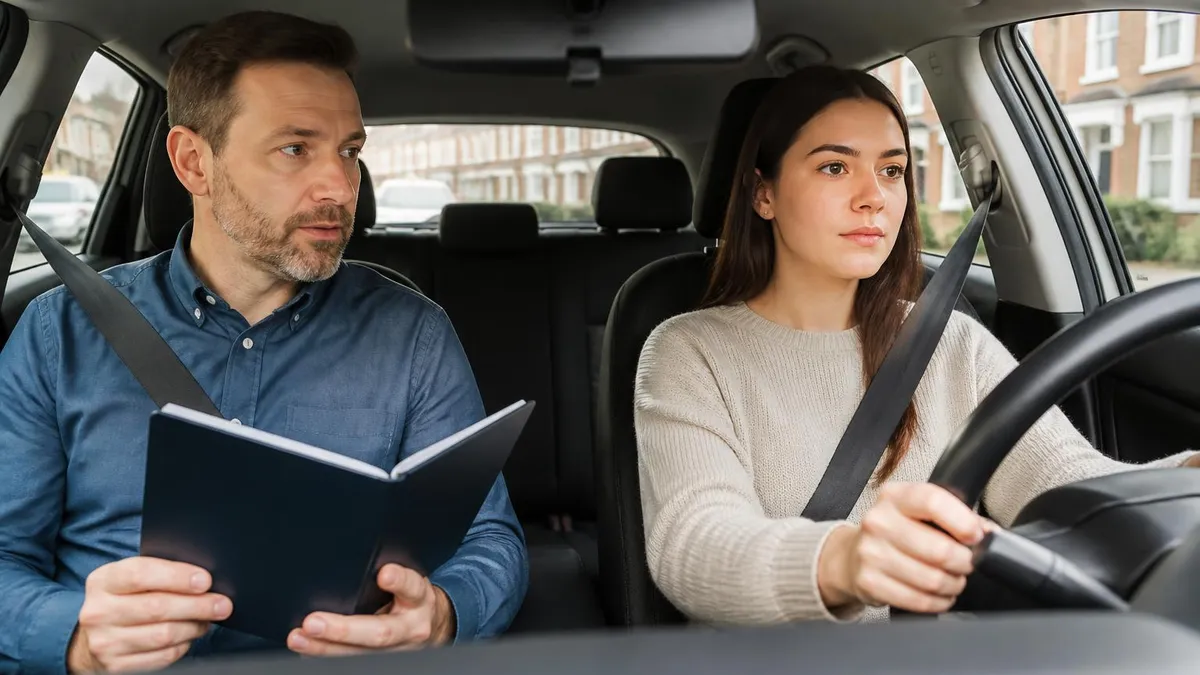
Using Your Own Car: Pros and Cons Compared
- +You drive a vehicle you already know intimately, reducing test-day anxiety
- +Significant cost savings — no instructor car hire fee of £70 to £110
- +No risk of an unfamiliar clutch biting point causing a stall on the manoeuvres
- +Flexibility to drive home afterwards without arranging a lift
- +You can fit your own preferred mirror angles and seat position without rushing
- +Useful if your instructor is unavailable on your preferred test date
- +No pressure of using a stranger's expensive vehicle for high-stakes driving
- −No dual controls means the examiner cannot intervene in an emergency
- −Insurance can be complicated, expensive, or refused entirely by some insurers
- −Any mechanical fault on the day forfeits the £62 test fee with no refund
- −You must fit an additional interior mirror for the examiner before arrival
- −L-plates must be applied front and rear without obscuring the licence plate
- −No included pre-test warm-up lesson as you would get from an instructor
- −Examiners may scrutinise vehicle condition more carefully than they would an instructor car
Pre-Test Vehicle Inspection Checklist
- ✓Confirm a valid MOT certificate is in place if the car is over three years old
- ✓Phone your insurer and obtain written confirmation of DVSA test-day cover
- ✓Fit red L-plates to the front and rear, not obscuring the registration plate
- ✓Install an additional interior rear-view mirror angled for the examiner
- ✓Check all four tyres exceed the 1.6mm legal minimum tread depth
- ✓Test every seatbelt — particularly the front passenger belt the examiner will use
- ✓Top up screenwash, oil and coolant the night before the test
- ✓Ensure all bulbs work: headlights, brake lights, indicators, fog lights, reverse lights
- ✓Clean the windscreen inside and outside, and the side windows for full visibility
- ✓Remove personal clutter from footwells, dashboard and rear seats
- ✓Make sure the head restraint on the passenger seat is fitted and adjustable
- ✓Bring your provisional photocard licence and theory test pass certificate
Phone your insurer in writing — verbal confirmation is not enough
The single most common reason candidate-supplied cars are turned away is invalid insurance. Phone your insurer at least 7 days before the test, ask specifically about DVSA practical-test cover, and request written confirmation by email. Print this email and bring it to the test centre. Verbal assurances on a phone call cannot be checked by the examiner.
The DVSA's most-overlooked rule is the requirement for an additional interior rear-view mirror, fitted specifically for the examiner's use. This is non-negotiable — without it, the test will not proceed, regardless of how compliant the rest of the vehicle is. The mirror must be securely attached, ideally suction-mounted or clipped to the existing mirror, and angled so the examiner can monitor the road behind without leaning across the cabin.
You can buy a suitable examiner mirror online for between £8 and £20. Universal-fit clip-on models attach over the standard interior mirror in seconds and are easily removed afterwards. Avoid cheap suction-cup mirrors that detach in warm weather — examiners have cancelled tests when the mirror fell off during the initial reverse manoeuvre. Test it on a long drive the day before to ensure it stays firm.
L-plate placement is the second area where candidates routinely make mistakes. Plates must be displayed clearly on the front and rear of the vehicle, in red on a white background, and conforming to the legal dimensions of 178mm by 178mm. They must not obscure the registration plate, headlights, or rear lights. Magnetic plates are popular but blow off at speed — adhesive vinyl is more reliable, though harder to remove after passing.
In Wales, candidates may use either L-plates or D-plates (representing the Welsh word "Dysgwr", meaning learner). Both are equally legal. Outside Wales, only L-plates are accepted. If you display Welsh D-plates in England or Scotland, the examiner has discretion to refuse the test, though in practice many will overlook this if the rest of the vehicle is compliant.
Dual controls are not required for your own car, and the absence of them does not affect your eligibility to take the test. The examiner will rely entirely on verbal instructions and your own driving response in any emergency. Some candidates find this slightly liberating — knowing nobody can grab the wheel forces total focus — while others find it adds pressure. Reflect on which mindset suits you better.
Headrest and seatbelt compliance affects the passenger seat specifically. The examiner sits there for the full 40-minute test, and the headrest must adjust to support an adult head. Many older vehicles have removable rear headrests; ensure yours is fitted and locked into place before arrival. The seatbelt must extend, lock, and retract smoothly. A sticky retractor is enough to fail the check.
Finally, the windscreen must be free of cracks or chips larger than 10mm in the driver's primary field of vision, or larger than 40mm anywhere else on the windscreen. A small chip near the edge is usually acceptable; a star crack in front of the steering wheel is not. If you have any damage, get it repaired by a windscreen specialist — most insurers cover this at no excess.
Tyre tread depth is the most-cited reason for test cancellation at the centre. The legal minimum is 1.6mm across the central three-quarters of the tyre, around the entire circumference. Use a 20p coin — if the outer band of the coin disappears into the tread, you are above the limit. Check all four tyres, plus the spare if you carry one, the night before the test.
If your car fails the pre-test vehicle check at the centre, the examiner will explain the specific reason and then formally cancel the test. You will not receive a refund of the £62 test fee, and you will need to book a fresh slot — currently subject to waiting times of six to ten weeks in many regions, and longer in London and the South East where demand consistently outstrips supply.
The most common failure reasons, in order of frequency, are: missing or improperly fitted examiner mirror; invalid or unverifiable insurance; lapsed MOT; insufficient tyre tread; faulty seatbelt or seatbelt warning light; cracked windscreen in the driver's vision zone; non-functioning brake light or indicator; and L-plates missing, damaged, or obscuring the licence plate. Run through each of these methodically the day before.
If the failure is due to something minor and repairable on the spot — such as a missing examiner mirror — the examiner may, at their discretion, allow you a short window to resolve the issue if there is time before the next candidate. However, do not rely on this. Most examiners are scheduled tightly and have no flexibility to delay subsequent appointments because of your oversight.
A cancelled test does not affect your theory test pass certificate, which remains valid for two years from the original date. However, if your theory pass expires before you successfully retake the practical, you must sit the theory test again. If your theory date is approaching expiry, our guide on test date explains the full rebooking process step by step.
To rebook the practical test, log into the DVSA booking portal at gov.uk/book-driving-test using the same account you originally used. Slots open daily, and cancellations from other candidates appear unpredictably — checking the portal in the early morning often reveals same-week openings released by other learners. There are also third-party slot-checker apps, though the DVSA does not officially endorse them.
If the failure was due to a mechanical issue with your own car, consider switching to your instructor's vehicle for the retest. Many instructors offer a test-day package even to learners they have not regularly taught — typically a one-hour warm-up lesson plus the use of their dual-control car for the test itself, for around £80 to £110.
Finally, learn from the experience. Keep a written log of what failed, take a photograph of the issue, and create a personal pre-test checklist that you run through 48 hours before any future test. Many candidates who fail the vehicle check on a first attempt pass the second time without issue — and never repeat the same mistake.
With the rules and risks understood, the final piece of the puzzle is execution. Arrive at the test centre at least 15 minutes early, with the car already L-plated, examiner mirror fitted, and all documents arranged on the passenger seat ready for inspection. Walking in calm and organised projects confidence — and examiners do notice candidates who appear flustered, even before the test has begun.
Park in a clearly marked candidate bay, not in disability bays or staff parking. Switch the engine off, leave the keys in the ignition, and wait in the waiting room until the examiner calls your name. Resist the urge to do last-minute manoeuvres in the test centre car park — these are visible from inside, and erratic last-second practice can give examiners an early impression of nervousness.
When the examiner approaches your vehicle, they will first check your licence, then walk around the car for a brief visual inspection. They will look at L-plate placement, tyre condition at a glance, and overall roadworthiness. Stand calmly beside the vehicle and be ready to answer any direct question — they will not make small talk during this phase, so do not feel obliged to fill silences.
The show-me-tell-me questions begin before you set off, and they may relate to your specific vehicle. Examples include opening the bonnet to identify the engine oil dipstick, locating the windscreen washer reservoir, or demonstrating how to check the handbrake for excessive wear. Knowing your own car gives you an advantage here — practise these checks several times in the week leading up to the test.
During the test itself, focus on smooth, controlled inputs. Examiners are not looking for racing-driver precision; they are looking for safe, considerate, defensive driving that demonstrates you are ready to drive unsupervised. Mirror-signal-manoeuvre routines, appropriate observation at junctions, and accurate speed control matter far more than perfect parallel parking. For more detail on what the examiner watches for, revisit our practical-test guide.
If you make a small mistake, do not dwell on it. Candidates who fixate on one earlier fault tend to accumulate further faults later in the test through distracted concentration. The pass mark allows up to 15 minor driving faults — known as driver faults — provided none are serious or dangerous. Move on mentally and refocus on the road ahead.
Finally, when the test ends and you return to the test centre, the examiner will deliver the result in the car. A pass means immediate eligibility to drive unsupervised — remove your L-plates before leaving the car park if you passed. A fail means you can book again from 10 working days later, and the examiner will hand you a copy of the marking sheet so you can address weaknesses. Either way, the experience builds the foundation for confident lifelong driving.
Sample DVSA UK Driving Theory Practice Questions
Try these questions from our free DVSA UK Driving Theory practice tests. The correct answer and an explanation follow each question.
When loading a vehicle, which items should be placed lowest and closest to the centre of the vehicle?
- A. Light, bulky items
- B. The heaviest items
- C. Fragile items wrapped in packaging
- D. Items needed most frequently during the journey
Answer: B. The heaviest items
Heavy items should be secured as low and central as possible to keep the vehicle's centre of gravity low and maintain stability.
You approach an unmarked crossroads where another vehicle is approaching from the right. Who has priority?
- A. The vehicle approaching from the right.
- B. You have priority as you are on their left.
- C. The vehicle that arrived at the junction first.
- D. No one has automatic priority.
Answer: D. No one has automatic priority.
The Highway Code (Rule 146) states that at an unmarked crossroads, no driver has priority. You should slow down, be prepared to stop, and only proceed when it is safe, taking into account the speed and position of other road users.
What is the maximum overhang allowed at the rear of a load on a UK vehicle before a marker board is required?
- A. 1 metre
- B. 2 metres
- C. 3 metres
- D. 4 metres
Answer: B. 2 metres
In the UK, a rear overhang exceeding 2 metres must be indicated by a marker board to warn following drivers of the projection.
What is the minimum engine size of a vehicle permitted to use a motorway in the UK?
- A. There is no minimum engine size — the restriction is based on vehicle type and capability
- B. 500 cc
- C. 50 cc
- D. 1000 cc
Answer: A. There is no minimum engine size — the restriction is based on vehicle type and capability
There is no minimum engine size requirement for motorways. However, vehicles must be capable of maintaining a reasonable speed. Learner drivers, pedestrians, cyclists, horse riders, and certain slow-moving vehicles are prohibited from using motorways.
DVSA Questions and Answers

Cancelling Driving Test: The Complete UK Guide to Refunds, Rebooking and Avoiding Lost Fees in 2026

DVSA Car Practical Test: Complete Guide to Passing First Time
How to Change Theory Test Date: Complete DVSA Rebooking Guide for 2026
Learn to Drive UK: The Complete 2026 Beginner's Guide to Lessons, Tests and Licence Success
Intensive Driving Course With Test: Complete UK Guide to Fast-Track Your Licence in 2026
About the Author

Licensed Driving Instructor & DMV Test Specialist
Penn State UniversityRobert J. Williams graduated from Penn State University with a degree in Transportation Management and has spent 20 years as a certified driving instructor and DMV examiner consultant. He has personally coached thousands of applicants through written knowledge tests, skills assessments, and commercial driver licensing programs across more than 30 states.