
Motorcycle Practice Test: Complete UK Study Guide to Passing Your DVSA Theory Test First Time (2026 September)
Pass your motorcycle theory test first time 🏆 Free DVSA practice tests, hazard perception tips, exam format and revision strategies for UK riders.
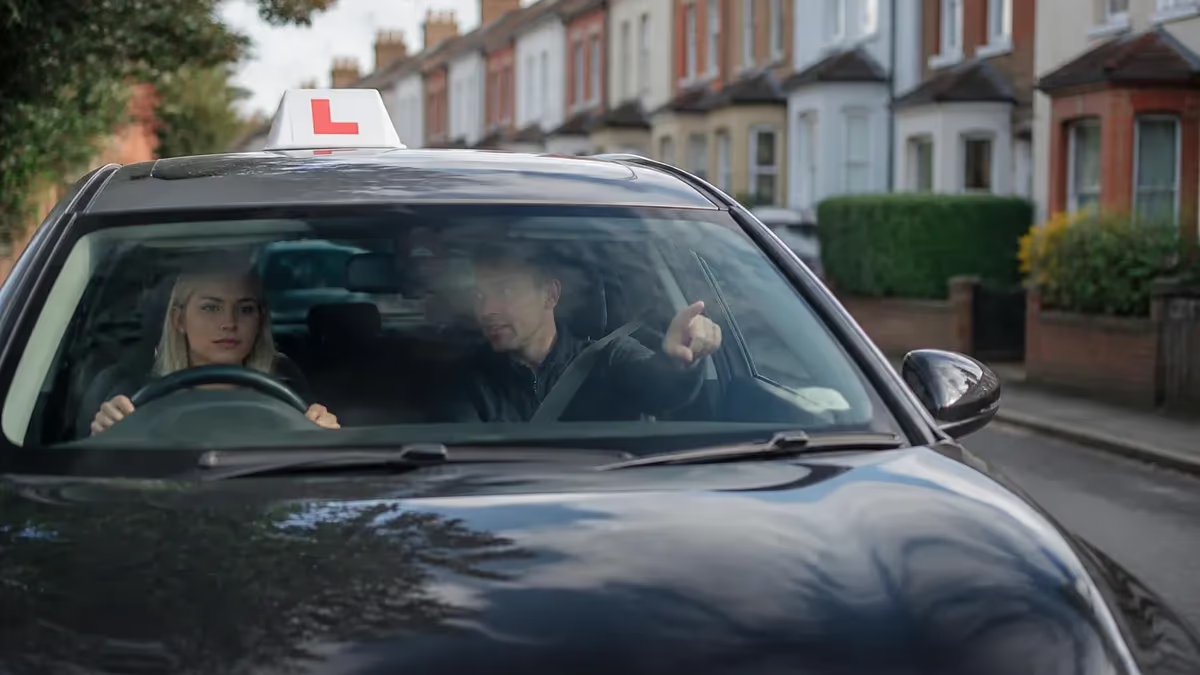
The motorcycle practice test is the essential first step every aspiring UK rider must complete before booking a practical riding assessment. Administered by the Driver and Vehicle Standards Agency (DVSA), the motorcycle theory test evaluates your knowledge of road rules, hazard awareness, and safe riding principles. It consists of two distinct parts — a multiple-choice question bank and a hazard perception video segment — both of which must be passed in the same sitting. Without a valid theory test pass certificate, you cannot proceed to your Module 1 or Module 2 practical riding tests.
Many learner riders underestimate the difficulty of the DVSA motorcycle theory test. The national pass rate for car drivers sits around 47–49%, and motorcycle candidates face similarly challenging statistics. The multiple-choice section draws from a bank of over 900 official DVSA questions, covering topics as diverse as eco-friendly riding, vehicle loading, alertness, attitude, documents, incidents and emergencies, motorway rules, and vulnerable road users. Thorough preparation using structured practice tests is the single most reliable way to build the knowledge and confidence you need on test day.
One of the most common mistakes new riders make is focusing only on memorising question answers without understanding the reasoning behind them. The DVSA designs its question bank so that genuine comprehension — not rote recall — is what separates candidates who pass from those who fail. When you practise with realistic test simulations, you develop the mental pattern recognition needed to handle unfamiliar phrasing or questions you have not seen before. This adaptive thinking is crucial, particularly in the final weeks of revision when consolidating knowledge across all topic areas.
The hazard perception portion of the motorcycle theory test is frequently the section that trips up otherwise well-prepared candidates. Scored out of 75 (five marks per clip, with fifteen video clips including one featuring two hazards), you need a minimum of 44 out of 75 to pass.
Unlike the multiple-choice section, hazard perception rewards timing and attentiveness rather than factual knowledge. You must click as soon as you detect a developing hazard — one that would require you to take action as a rider — without clicking so frequently that the system flags your responses as a pattern rather than genuine hazard detection.
Structuring your revision intelligently is far more productive than cramming the night before your test. Most successful candidates spread their preparation across four to six weeks, dedicating regular short sessions to different topic areas rather than attempting marathon cramming. Starting with an overview of all DVSA topics, then drilling weaker areas through targeted practice sets, and finally completing full mock tests under timed conditions mirrors the actual exam experience and reduces test-day anxiety considerably. Consistency, not intensity, is the hallmark of riders who pass first time.
The practical benefits of thorough theory test preparation extend well beyond passing the exam itself. Riders who genuinely understand the Highway Code, stopping distances, alcohol and drug impairment thresholds, and hazard identification are measurably safer on the road in their first months of independent riding. The knowledge embedded during theory revision forms the cognitive foundation on which your practical riding skills are built. It is not simply a regulatory hurdle — it is the academic underpinning of responsible motorcycling that will serve you throughout your riding life.
This comprehensive guide walks you through every element of the DVSA motorcycle theory test in 2026: the official exam format and scoring thresholds, the highest-yield topic areas to master, tested revision strategies that experienced instructors recommend, and the practical steps to book and attend your test with confidence. Whether you are preparing for your first attempt or returning after an unsuccessful sitting, the information and free practice resources here will give you the clearest possible path to passing.
UK Motorcycle Theory Test by the Numbers
DVSA Motorcycle Theory Test: Exam Format
| Section | Questions | Time | Weight | Notes |
|---|---|---|---|---|
| Multiple-Choice Questions | 50 | 57 min | Pass/Fail | Must score 43/50 (86%) — computer-based, can flag and review answers |
| Hazard Perception | 15 | Included | Pass/Fail | 15 video clips; score at least 44/75 — cannot review clips after viewing |
| Total | 65 | 57 minutes | 100% |
Mastering the DVSA motorcycle theory test requires a clear understanding of which topic areas carry the most weight and which are most commonly misunderstood by candidates. The official DVSA question bank groups its 900-plus questions into fourteen broad categories, but not all of these appear with equal frequency in any given sitting. Alertness, hazard awareness, and attitude questions typically feature prominently, often accounting for a quarter of the fifty questions you face. Candidates who invest disproportionate revision time on obscure technical categories at the expense of these core areas frequently underperform on test day.
Road and traffic signs represent one of the most consistently tested categories in the motorcycle theory test, and they catch out a surprising number of otherwise well-prepared candidates. The UK uses over 500 official signs, and the DVSA regularly includes questions on lesser-known regulatory signs, advisory speed plates, and temporary construction signs that riders encounter rarely in day-to-day training.
A systematic approach — working through the full Highway Code signs appendix, then testing yourself with flashcard-style practice — is significantly more effective than relying on road experience alone, because learner riders simply have not encountered the full range of signs at that stage of their training.
Safety margins are another category where motorcycle candidates consistently lose points they should not. Questions on stopping distances under different conditions, safe following distances, and the additional stopping distances required when towing appear regularly and require numerical recall as well as conceptual understanding. For example, at 70 mph on a dry road, the overall stopping distance is 96 metres — roughly 24 car lengths. In wet conditions this doubles. Many candidates know the dry-road figures but fail to apply the wet or adverse weather multipliers when answering test questions that specify environmental conditions.
Vehicle handling questions specific to motorcycles test your understanding of how a bike behaves differently from a car, including the risks of aquaplaning, how engine braking works on a motorcycle, the effect of carrying a pillion passenger on braking distances, and the instability created by a poorly secured or uneven load. These questions reward riders who have read the official DVSA motorcycling guidance — Know Your Traffic Signs and The Official DVSA Guide to Riding — rather than relying solely on generic theory test apps that focus primarily on car-driver content.
The documents and regulations category is straightforward for most candidates but contains a few perennial traps, including the specific rules around Compulsory Basic Training (CBT) certificates, the A1 and A2 licence sub-categories, the progressive access system for full A licences, and the insurance requirements for riding on a provisional licence. Getting these procedural details correct matters not just for passing the theory test but for ensuring your riding licence journey is legally compliant throughout. A single misunderstood rule about when a full-licence holder must supervise a learner, for instance, could create genuine legal risk.
Eco-friendly riding and vehicle loading is a category that candidates frequently neglect because it feels less dramatic than hazard perception or road sign recognition. However, the DVSA consistently includes six to nine questions from this area in motorcycle theory tests, making it one of the higher-yield categories relative to its perceived difficulty.
Understanding how to reduce fuel consumption through smooth throttle control, appropriate gear selection, tyre pressure maintenance, and efficient route planning — as well as the rules governing maximum load weights and load security — can make the difference between a comfortable pass margin and a borderline result on the multiple-choice section.
Incidents, accidents, and first aid is another category where focused practice pays significant dividends. Questions in this area cover the priorities at accident scenes, how to handle casualties, when and how to call emergency services, the dangers of moving injured riders, fuel spillage protocols, and the correct use of first aid techniques such as the recovery position. Many candidates find this category intuitive once they study it systematically, but those who skip it in favour of more test-feeling topics often regret losing marks on questions that could easily have been answered correctly with modest preparation time.
Motorcycle Theory Test Revision Strategies
The most effective strategy for the multiple-choice section is spaced repetition — reviewing questions at increasing intervals so that correct answers move into long-term memory rather than short-term recall. Start with the full DVSA question bank, work through each category systematically, and flag questions you answer incorrectly. Return to flagged questions every two to three days, reducing that interval only when you consistently answer them correctly. Apps and practice platforms that track your performance by topic allow you to identify weak areas quickly and allocate revision time where it will have the greatest impact on your overall score.
In the final week before your test, shift from topic-by-topic drilling to full mock tests under timed conditions. Completing a fifty-question mock in the same fifty-seven-minute window as the real exam trains your pacing and highlights any remaining gaps under pressure. Aim for a consistent mock score of 47 out of 50 before sitting the real test — this three-mark buffer above the 43/50 pass mark accounts for the specific questions your sitting happens to include and gives you meaningful confidence heading into the exam room.
Online Motorcycle Practice Tests vs Official DVSA Materials
- +Unlimited free practice with instant feedback on correct and incorrect answers
- +Topic-based filtering lets you target weak areas identified through performance analytics
- +Mobile-friendly platforms allow revision during commuting, lunch breaks, or short gaps
- +Mock tests simulate real exam timing and format to reduce test-day anxiety
- +Hazard perception practice videos train the click-timing instinct in a low-stakes environment
- +Progress tracking shows improvement over time and identifies knowledge gaps before test day
- −Third-party apps may use outdated question banks that do not reflect current DVSA wording
- −Some free platforms omit motorcycle-specific questions and focus predominantly on car content
- −Over-reliance on practice tests can create false confidence if questions are memorised rather than understood
- −Hazard perception simulators vary significantly in clip quality and scoring accuracy from real test
- −Screen-based revision does not replace reading the Highway Code in full for contextual understanding
- −No substitute for actual riding experience when it comes to internalising hazard awareness instincts
Motorcycle Theory Test Preparation Checklist
- ✓Download or purchase the official DVSA Highway Code and read it cover to cover at least once before drilling practice questions.
- ✓Create an account on a reputable DVSA-approved practice platform that tracks your performance by topic category.
- ✓Complete at least one diagnostic test across all fourteen topic categories to establish your baseline knowledge before targeted revision.
- ✓Practise hazard perception using official DVSA clips rather than third-party alternatives to match real test video quality and scoring.
- ✓Study all road signs systematically using the Know Your Traffic Signs publication, including lesser-known regulatory and temporary signs.
- ✓Memorise all key stopping distances — both dry and wet conditions — for speeds from 20 mph to 70 mph in numerical form.
- ✓Revise eco-friendly riding techniques and vehicle loading rules, including maximum load weights and load security requirements.
- ✓Complete a minimum of five full mock tests under timed conditions with scores consistently at or above 47 out of 50 before booking.
- ✓Confirm your test centre address, allowed identification documents, and exact arrival time at least 48 hours before your sitting.
- ✓Rest properly for two nights before your test — sleep deprivation impairs reaction time and concentration, both of which are directly tested.

The Pass Mark Is Higher Than You Think
Many candidates assume the motorcycle theory test pass mark mirrors the car test at around 43/50, which is correct — but what surprises riders is that 86% is a genuinely high bar. In the hazard perception section, you also need 44 out of 75, and both sections must be passed in the same sitting. There are no second chances on either section: if you pass multiple-choice but fail hazard perception, you must rebook and retake the entire test, paying the full £23 fee again.
Common mistakes made by motorcycle theory test candidates can be grouped into several recurring patterns, and awareness of these patterns is itself a useful preparation tool. The first and most pervasive error is insufficient hazard perception practice. Candidates who spend ninety percent of their revision time on multiple-choice questions frequently arrive at test day with a solid factual knowledge base but underdeveloped clip-watching instincts.
Because hazard perception cannot be revised through reading — it requires active visual training with video clips — leaving it too late in your preparation timeline creates a skill deficit that even intensive last-minute practice struggles to remedy.
A second common mistake is failing to read each multiple-choice question completely before selecting an answer. The DVSA frequently uses qualifiers — words like 'most', 'least', 'except', 'always', and 'never' — that fundamentally change the correct answer.
Candidates who skim questions under time pressure or who pattern-match based on familiar answer options without fully parsing the question text regularly lose marks on questions they technically knew the correct answer to. In a 57-minute window for 50 questions, you have over a minute per question — there is no need to rush, and reading carefully is among the highest-value habits you can develop during practice.
Neglecting the flagging and review feature is another error that costs marks unnecessarily. The motorcycle theory test's computer interface allows you to flag questions you are uncertain about and return to them before submitting. Candidates who treat the test as a linear exercise — answering each question definitively as they go — miss the opportunity to reconsider borderline answers with fresh eyes.
Experienced candidates recommend answering all questions first, flagging any where you are less than fully confident, then using remaining time to review flagged items before final submission. This two-pass approach consistently yields better results than a single linear run-through.
Overconfidence following a CBT course is a mistake that catches riders who have recently completed their Compulsory Basic Training. The CBT covers essential on-road skills but does not systematically address the full range of DVSA theory test topics, particularly more obscure areas like first aid at accidents, motorway rules for motorcycles, and environmental considerations. Riders who assume their CBT experience has adequately prepared them for the theory test without structured revision often find themselves short of the pass mark in areas that felt familiar but were never formally studied.
Attempting the test too early — before achieving consistent mock test scores of 45 or above out of 50 — is a costly mistake both financially and in terms of confidence. The £23 test fee and the disruption of taking time off for a test appointment make a premature sitting expensive. More significantly, failing can undermine your motivation and create test anxiety that affects subsequent attempts. The discipline to wait until your practice scores reliably exceed the pass mark, rather than booking out of impatience, is one of the most practically valuable things a motorcycle candidate can do.
Ignoring motorcycle-specific content in favour of generic car-oriented practice materials is a surprisingly common error, particularly among candidates who previously passed a car theory test and assume the content is identical. While significant overlap exists between car and motorcycle theory test content, the DVSA motorcycle test includes specific questions about pillion passengers, protective clothing requirements, the effects of alcohol on riding balance and perception, bike-specific hazards like road surface irregularities, and the progressive access licensing system. Using practice materials explicitly designed for motorcycle candidates ensures this bike-specific content receives appropriate revision attention.
Failing to take a short break between the multiple-choice and hazard perception sections is a self-imposed disadvantage that costs nothing to avoid. The testing centre will offer you the option of a brief pause between the two sections — take it. Stand up, stretch, look at something distant to rest your eyes, and consciously reset your mental state before beginning the video clips.
The shift from knowledge-recall mode to visual-detection mode benefits from a moment of mental transition, and candidates who proceed directly from fifty multiple-choice questions into fifteen video clips without pause frequently report that their concentration quality drops during the hazard perception section.
Your motorcycle theory test pass certificate is valid for only two years from the date of your test. If you do not pass your Module 1 practical riding test within this two-year window, your theory test pass expires and you must rebook and retake the full theory test — including both the multiple-choice and hazard perception sections — before you can attempt the practical again. Plan your practical test bookings accordingly to avoid this avoidable setback.
Booking your DVSA motorcycle theory test is a straightforward online process through the official GOV.UK booking portal, but there are several practical details worth knowing before you reach the booking page. You will need your UK driving licence number — found on the front of your photocard licence — as well as a valid email address and a debit or credit card to pay the £23 fee.
You cannot book a theory test without a provisional driving licence for category A motorcycles; if you have not yet applied for a provisional licence, this must be your first step before any theory test preparation becomes relevant to an imminent exam date.
Test centre availability varies significantly by location and time of year. In major cities like London, Manchester, Birmingham, and Glasgow, appointments in popular weekday morning slots are often booked two to three weeks in advance. In rural areas, the nearest DVSA-approved theory test centre may require travel of thirty miles or more, and appointment availability may be similarly constrained. Checking availability early — even if you intend to book several weeks before your target date — gives you a clearer picture of realistic timescales and helps you structure your revision schedule around actual test date options rather than hypothetical ones.
On the day of your motorcycle theory test, arrive at the test centre at least fifteen minutes before your appointment time. You will be required to present a valid form of photo identification — your photocard driving licence is strongly recommended and is the most commonly accepted document.
The DVSA also accepts a valid passport as identification, but the photocard licence is preferred because it confirms your provisional motorcycle entitlement directly. You are not permitted to bring mobile phones, smart watches, food, or drinks into the testing room; a locker will be provided for personal items. The test centre staff will photograph you before you enter the testing room as an additional identity verification measure.
The testing room itself contains individual computer terminals separated by privacy screens. A staff member will explain the test interface before you begin, and you will have the opportunity to complete a short tutorial practice session to familiarise yourself with how to navigate questions, flag items for review, and submit your answers.
Do not rush through this tutorial — it is a genuine opportunity to settle your nerves and confirm that you understand the interface mechanics before the timed test begins. Any technical issues with your terminal should be reported immediately to the invigilator rather than attempting to resolve them yourself.
Your motorcycle theory test result is delivered at the test centre immediately after you complete both sections. You will receive a printed pass notification — commonly referred to as a theory test pass certificate — which includes your certificate number, the date of your pass, and the two-year expiry date.
This document, or its digital equivalent accessible through the GOV.UK service, is required when you book your Module 1 and Module 2 practical riding tests. Keep it safe: loss of your certificate can create delays when booking practical tests, as DVSA staff will need to verify your pass details through their own records, which can take additional time.
If you do not pass on your first attempt, the DVSA requires a minimum waiting period of three clear working days before you can rebook. Use this cooling-off period constructively: review which topics generated the most incorrect answers, assess whether your hazard perception timing needs recalibration, and address the specific gaps your unsuccessful attempt revealed rather than broadly repeating the same revision approach. Candidates who diagnose their failure accurately and target their subsequent preparation precisely tend to pass on their second attempt with a comfortable margin rather than scraping through narrowly.
The broader licensing journey following your theory test pass is worth understanding as context for your preparation.
After passing the theory test, motorcycle candidates must complete a Module 1 test (off-road manoeuvres at a DVSA driving test centre) and a Module 2 test (on-road riding assessment with a DVSA examiner). The progressive access system means that the engine size and power output you can ride legally depends on your age and licence category — A1, A2, or full A — so understanding where your theory test fits within this broader pathway helps motivate consistent, high-quality revision rather than treating it as a box-ticking exercise.
Practical preparation tips from riders who have recently passed the DVSA motorcycle theory test consistently emphasise the value of active recall over passive reading. Rather than re-reading the Highway Code repeatedly — a technique that creates familiarity without genuine retention — experienced theory test candidates recommend closing the book after each section and attempting to write down or recite the key rules from memory.
This active retrieval process identifies gaps in your knowledge more precisely than passive reading, and the slight difficulty of effortful recall has been shown in educational research to produce significantly stronger long-term memory formation than recognition-based study.
Building a personal question bank of topics you consistently misunderstand is another technique that high-scoring candidates recommend. Rather than marking incorrect practice answers and moving on, create a simple notes document or flashcard set that captures not just the correct answer but the reasoning behind it.
For example, if you repeatedly confuse the stopping distance at 50 mph versus 60 mph, writing out the rule and its basis — and returning to that note at the start of each revision session — creates a targeted reinforcement loop that generic practice apps do not replicate. This personalised error log becomes increasingly valuable in the final week before your test when you want to consolidate specific weaknesses rather than broadly reviewing material you already know well.
Understanding the structure of distractor answers — the plausible but incorrect options in multiple-choice questions — gives you a significant advantage when facing unfamiliar question phrasings. The DVSA designs incorrect options to appeal to common misconceptions: overly generous stopping distances, incorrect speed limits in specific conditions, wrong document retention periods, and imprecise rules about alcohol and medication.
When you study why each wrong answer is wrong, not just why the correct answer is correct, you build the discriminative knowledge needed to navigate questions you have not seen before. This approach transforms practice from answer memorisation into genuine legal and safety understanding.
For the hazard perception section, many candidates benefit from watching and analysing official scored example clips before practising unseen material. These demonstration clips — available through the official DVSA theory test resources — show the developing hazard highlighted in real time, with commentary explaining why particular moments in the clip were scored at five, three, or zero points. Seeing this scoring logic explicitly demystifies the timing window that many candidates find opaque, and having a clear mental model of what the system is detecting helps you calibrate your own click responses during practice sessions.
Physical preparation on test day should not be overlooked. Candidates who arrive at their theory test hungry, dehydrated, or sleep-deprived perform measurably worse on timed cognitive tasks than those who arrive physically well-prepared. Eat a moderate meal before your test — not so heavy that it causes drowsiness, but sufficient to maintain blood sugar stability through the fifty-plus minutes of focused concentration the test requires.
Hydration matters for cognitive function: even mild dehydration has been linked in research to impaired reaction time and reduced working memory capacity, both of which directly affect hazard perception performance. Treat your theory test appointment with the same physical preparation discipline you would apply to an important sporting event.
Consider forming a small study group with other motorcycle learners preparing for the same test. Testing each other verbally on Highway Code rules, explaining your reasoning when answering practice questions aloud, and discussing why particular hazard perception scenarios unfolded as they did deepens understanding through social reinforcement that solitary screen-based revision cannot provide. Many motorcycle training schools run informal theory revision evenings where learners and instructors work through practice questions together — ask your CBT provider whether they offer this, as the combination of peer discussion and instructor expertise creates an exceptionally rich learning environment.
Finally, remember that passing your motorcycle theory test is the beginning of your safety education, not the end of it. The knowledge you build during theory revision informs how you approach hazards, road positioning, speed selection, and risk management for your entire riding career.
Riders who engage with the theory test material as genuine safety learning rather than an administrative obstacle emerge as more situationally aware, better-prepared road users from the first day they ride independently. The investment of five to six weeks of structured preparation yields returns that extend far beyond a pass certificate — it contributes materially to you returning home safely every time you ride.
DVSA Questions and Answers
UK Theory Test Pass Mark: Car, Bike, LGV, PCV & ADI Scores
Theory Test Certificate: Complete UK Guide to Passing and Using Your DVSA Pass Letter in 2026
UK Driving Test Pass Rate: Complete 2026 Guide to Statistics, Centre Comparisons and How to Beat the Odds
How To Pass Theory Test: Free DVSA Practice & Pass First Time (2026)
Intensive Driving Test: Complete UK Guide to Fast-Track Courses, Booking and Passing First Time in 2026
About the Author
Licensed Driving Instructor & DMV Test Specialist
Penn State UniversityRobert J. Williams graduated from Penn State University with a degree in Transportation Management and has spent 20 years as a certified driving instructor and DMV examiner consultant. He has personally coached thousands of applicants through written knowledge tests, skills assessments, and commercial driver licensing programs across more than 30 states.