
UK Theory Test Pass Mark: Car, Bike, LGV, PCV & ADI Scores 2026 October
🧠 The pass mark for driving theory in the UK is 43/50 on multiple choice plus 44/75 hazard perception. Full scores for car, bike, LGV, PCV and ADI.
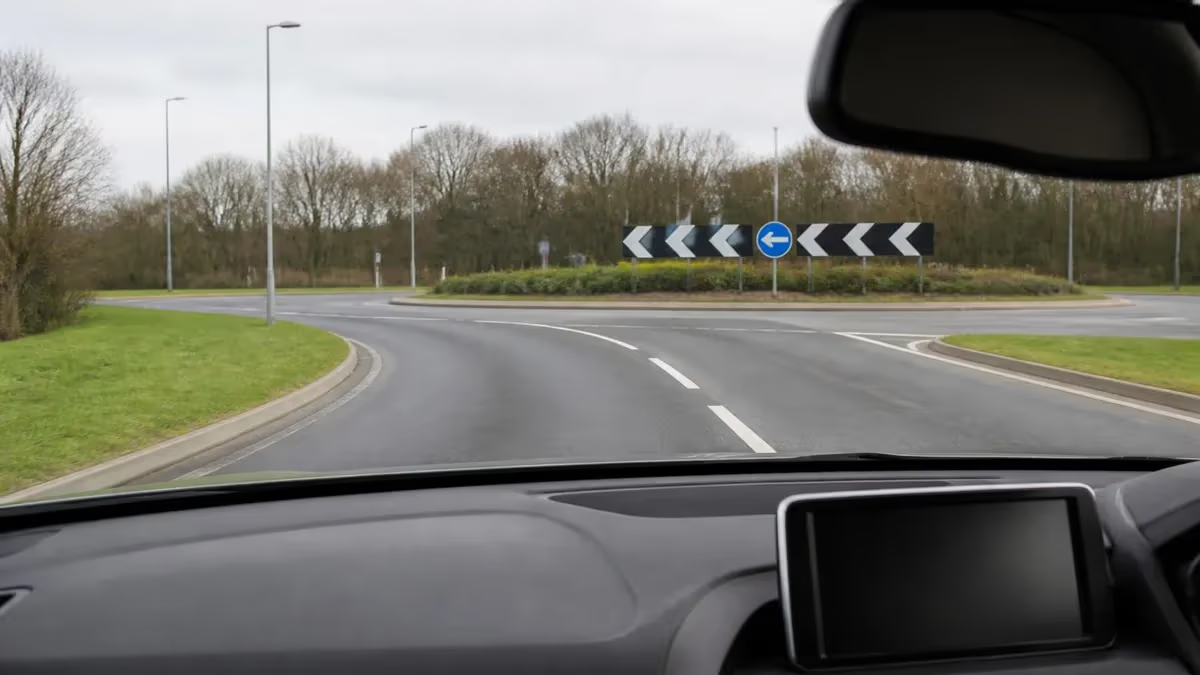
The UK theory test isn't a single exam. It's two timed sections stitched together — 50 multiple-choice questions, then 14 hazard-perception clips — and you have to clear the bar on both. Miss either, and the whole sitting counts as a fail. That's the part most candidates overlook when they're skimming the official guidance the night before. The pass mark for driving theory is therefore not one number. It's two.
For the standard car category, the multiple-choice section requires 43 correct answers out of 50, which works out at 86%. The hazard-perception section needs at least 44 points out of a possible 75. Both targets sit on the same screen at the same test centre, and the system will not let you pick up a certificate until you've cleared both. The motorbike test runs to identical numbers. Lorry and bus drivers face longer papers and higher absolute pass marks. Approved driving instructors taking the Part 1 qualifying exam face the steepest bar of all.
This guide walks through every category, every score, every clip, and the small procedural rules that surprise people on the day. We'll cover the fees, the wait times for retakes, what to bring with you to the test centre, and the specific reasons examiners see candidates fail clips that look easy on paper. If you're booking a pass mark in theory test, this should be the only reference you need before you settle into the booth.
A quick word on language. DVSA uses 'theory test' as the umbrella term covering both halves; some learners call the second half the 'hazard test' and treat it like a separate exam. It's not. The certificate covering both is valid for two years from the day you pass — and you cannot sit your practical until you've got that paperwork in hand.
One more thing before we dig in. Pass marks have shifted over the years. When the theory test launched in 1996, it was a paper-based exam, no clips, and the pass mark sat at 26 out of 35. The hazard-perception section was added in 2002 — that's where the click-window scoring originates. Today's 43/50 and 44/75 thresholds have held since 2007, with minor tweaks to the underlying question bank. So if you're being coached by a friend who passed in the early 2000s, double-check their advice against the current numbers. The format and the bar have moved.
Get 50/50 on the multiple choice and 43 on hazard perception? Fail. You'll need to rebook the entire test — both halves — and pay the full fee again. DVSA does not let you carry a passed multiple-choice score into a fresh hazard sitting, and there's no partial credit. The two scores live or die together on the day. Plan your revision time so neither half is the weak link.
The pass-mark numbers at a glance
Five test categories, each with its own pair of targets. The stat grid below summarises the exact scores you need, but here's the short version: the car and motorbike tests share the same paper format, while LGV (lorry) and PCV (bus) candidates sit longer multiple-choice papers and need 85 out of 100 correct.
The hazard perception section also grows — 100 clips and a pass mark of 67 — for the vocational categories. Approved driving instructors sitting Part 1 face 85 out of 100 on the theory side and 57 out of 75 on the hazard side, with banded scoring across four hazard topics.
One more wrinkle worth flagging. The LGV and PCV multiple-choice tests include a case-study element where you answer questions about a short scenario rather than a single stand-alone fact. It's the same scoring system — every question is worth one mark — but the format catches first-time candidates off guard. Bookmark that detail.

UK Theory Test Pass Marks by Category
How the multiple-choice section actually works
You sit at a touchscreen booth at a Pearson VUE-operated theory test centre. The clock starts the moment you confirm the practice instructions, and you've got 57 minutes for the 50 car or motorbike questions. That's roughly 68 seconds per question, which sounds generous until you hit the scenario questions — the ones with a road sketch, weather conditions, and four near-identical answer options. Those eat time. The system lets you flag questions for review, skip ahead, and come back at the end with whatever time you have left. Use the flag feature aggressively.
LGV and PCV candidates get longer. Their multiple-choice section is 115 minutes for 100 questions — about 69 seconds per question on average — and includes the case-study format mentioned earlier. ADI Part 1 candidates get 90 minutes for 100 questions, but they also face a banding rule: at least 20 of 25 marks in each of the four topic bands. You can score 85 overall and still fail Part 1 if you flunked one band. That catches more would-be instructors than the raw score does.
All questions are drawn from the official DVSA question bank. There are thousands of variants, refreshed annually, and they cover the Highway Code, road and traffic signs, vehicle safety, vehicle handling, motorway driving, rules of the road, road and traffic safety, hazard awareness, vulnerable road users, other types of vehicle, vehicle handling under different conditions, motorway driving rules, eco-friendly driving, and incidents, accidents and first aid. That's a lot to cover. The official DVSA app and the free practice on this site are the two cheapest ways to drill through the bank before test day.
Skipped Questions Count as Wrong
If you flag a question for review and run out of time before answering it, the system marks it incorrect. There's no neutral 'skipped' category. On a 50-question car paper that needs 43 correct, three flagged-and-forgotten questions can drop you from a pass to a fail. Always make a best guess on every question before moving on, even if you plan to come back. A 25% shot at a multiple-choice answer beats a guaranteed zero.
Hazard perception — the part everyone underestimates
Here's the bit that trips up the most candidates. Hazard perception is not multiple choice. It's a series of one-minute video clips filmed from the driver's seat, and your job is to click the moment a developing hazard appears. A developing hazard is something that would, if you did nothing, force you to brake, swerve, or change speed.
Each clip contains exactly one scored developing hazard — except one of the 14 clips for the car test, which contains two. That's why a car candidate faces 15 scored hazards across 14 clips, with a maximum of 5 marks per scored hazard and a total ceiling of 75 marks.
The scoring is brutal. Click in the first window after the hazard begins to develop and you score the full 5 marks. Click later in the window and you drop to 4, then 3, then 2, then 1. Click after the window closes and you score zero on that hazard. Click too early, or click in a steady rhythm the software flags as random, and the whole clip scores zero. There is no 'best of three' for early clicks. The system zeroes that clip and moves on.
The 44/75 car pass mark therefore works out at roughly a 3-out-of-5 average per scored hazard. That's achievable — but only if you avoid clip-zeroes. One disastrous over-clicked clip can sink an otherwise solid performance. The hazard perception pass mark guidance from DVSA is explicit about the no-click-spamming rule, and it's the single most common reason examiners cite for marginal fails.
Hazard Perception Clip Mechanics
One clip contains two scored developing hazards; the other 13 each contain one. Maximum 5 marks per hazard, 75 marks total. Pass mark: 44. Identical structure for the motorcycle test.
Same 5-mark scoring scale per hazard, but 100 marks available across 20 scored hazards. Pass mark sits at 67. Clips also feature a small number of double-hazard sequences.
Same clip count as the car test but a much higher 57/75 pass mark — roughly a 3.8-out-of-5 average per hazard. Instructor candidates are expected to spot hazards earlier than learners.
Each developing hazard has a roughly 12-15 second click window. First fifth of the window: 5 marks. Then 4, 3, 2, 1, zero. Click too early or spam-click and the entire clip scores zero.
Steady-rhythm clicking, machine-gun bursts, and patterns that look algorithmic are all flagged. The software has been tuned for two decades; assume it knows every shortcut you've heard about. Click only when you genuinely see something developing.
Category-by-category breakdown
The tabs below break out each test category with the precise pass-mark, duration, fee and any quirks unique to that licence type. Use them as a quick reference before you finalise your booking. If you're moving between categories — say, from a car licence to an LGV — note that the LGV theory is a fresh sitting, not a top-up exam. You'll resit both sections under the longer LGV format, and the certificate of completion you already hold from your car test doesn't carry over.
Worth knowing too: candidates with certain reading difficulties or other documented support needs can request extra time, a voiceover, or BSL interpretation when booking. DVSA grants these accommodations as standard where supporting evidence is provided. Apply via the standard pass mark for driving theory flow and tick the support-needs option.
Pass Marks by Test Category
The car theory test is the most common DVSA sitting — well over 1.5 million candidates a year. Multiple choice: 50 questions, 57 minutes, pass mark 43. Hazard perception: 14 clips, 15 scored hazards, pass mark 44 out of 75. Test fee in 2026 is £23. You'll need your UK provisional driving licence at the test centre — no licence, no test, no refund. After both sections, the result prints automatically; pass and you receive a theory test pass certificate valid for two years.
Best preparation route: official DVSA app or book bundle, plus free online practice. Aim for 47/50 and 55/75 on mocks before booking — that buffer absorbs nerves on the day.
Booking, fees and what to bring on the day
The only legitimate booking portal is gov.uk/book-theory-test. Third-party sites quote markup prices, sometimes triple the official fee, and provide no service the gov.uk site doesn't. Bookmark the official URL now. You'll need your provisional licence number, an email address, and a debit or credit card. Slots open roughly six months in advance at major centres in London, Birmingham, Manchester, Glasgow, Cardiff and Edinburgh, with shorter horizons at regional sites.
On the day, bring your photocard provisional driving licence. That's the only document DVSA accepts. No paper counterpart, no passport-as-backup, no expired licence. Forget it and you'll be turned away — and the fee is non-refundable. Arrive 15 minutes early. The booth area requires you to leave bags, phones, watches and any paper in a locker. You'll be scanned, photographed, and walked to your booth by a Pearson VUE invigilator.
Centre availability varies wildly. Major cities — London, Birmingham, Manchester, Leeds, Glasgow — typically have slots within a fortnight. Rural Wales, the Highlands, parts of Cornwall and Norfolk can stretch to ten or twelve weeks. If you're flexible, set a saved search for cancellations: DVSA's booking system updates in near-real-time and short-notice slots open up daily as other candidates reschedule. The official site has a 'change my booking' function buried two clicks deep; learn it before you book, because rearranging by phone costs the same as a fresh sitting.
Fee structure for 2026, for clarity: car £23, motorbike £26, LGV/PCV theory £26 each, ADI Part 1 £81. Driver CPC Case Studies (Module 2) is an additional £23 sat separately. None of these fees are refundable on a no-show. They are partially refundable if you give DVSA at least three clear working days' notice via the official portal — so cancelling on a Friday for a Monday slot doesn't qualify; you'd need to cancel by the previous Tuesday. Keep the email receipt — it's your audit trail.
Retakes and the three-working-day rule
Fail either section and you have to wait at least three clear working days before you can sit the test again. Working days exclude Saturdays, Sundays and bank holidays. So if you fail on a Friday, the earliest available date is the following Thursday — Monday counts as day one, not day zero. There's no formal limit on the number of retakes per year, but each attempt is a fresh £23 (or £26 / £81 for other categories) and you have to resit both sections every time. There's no half-credit for a passed multiple-choice section sitting on file.
If you've failed three times in a row, examiners and instructors consistently flag the same root cause: under-prepared on the hazard perception clips. Multiple-choice you can grind through with the official app and a fortnight of evenings. Hazard perception needs actual practice against the clip format — early clicks lose you marks, late clicks lose you marks, spam-clicking loses you the whole clip. Use the free practice on this site or the official DVSA app, and rehearse against pass mark for driving theory scenarios specifically.
Plan around real revision hours, not just calendar days. DVSA's own guidance suggests 20-30 hours of preparation for car candidates with no prior driving knowledge. That includes Highway Code study, mock papers, and a minimum of 6-8 hours on hazard clips. LGV and ADI candidates should plan for double that. Booking a pass mark in theory test-led revision session in the final week before your sitting is a low-cost insurance policy.
Theory Test Day Checklist
- ✓UK photocard provisional driving licence — original, not a photocopy or scan
- ✓Booking confirmation email with reference number (printed or on phone before lockup)
- ✓Arrive 15 minutes early to allow time for ID check and locker storage
- ✓Empty pockets — no phone, no smartwatch, no chewing gum, no paper notes
- ✓Dress in layers — booth temperatures vary and you can't take a jumper on/off mid-test
- ✓Water and snacks left in the locker — short breaks are allowed but bring nothing in
- ✓Glasses or contact lenses if you wear them — the touchscreen sits roughly 60cm from your face
- ✓Practice run-through on the booth done before clicking start on the real test
- ✓Flag-and-review strategy clear in your head before the multiple-choice clock starts
- ✓Mental note to click ONCE per hazard you spot — never spam, never rhythm-click
Why people fail — and how to dodge each trap
DVSA publishes pass-rate statistics every quarter, and the long-running average for car candidates sits around 44-48%. That means slightly more than half of first-time sitters fail. Examiner debriefs cluster the failure reasons into a handful of patterns. The biggest single cause is hazard-perception over-clicking — candidates who watched a YouTube tutorial telling them to click 'as soon as anything moves' and ended up flagged for machine-gun input. That zeroes clips. Several zeroed clips and you cannot recover the 44 marks needed.
Second-biggest cause: panicking on tricky Highway Code questions. The DVSA writes some questions deliberately to test whether you'll second-guess yourself on edge cases — pedestrian-crossing variations, traffic-light priority at unmarked junctions, motorway lane discipline at slip roads. Candidates who fail tend to revise correct answers and then change them to wrong ones in the last few minutes. If you've flagged a question, change your answer only if you've genuinely seen new information; otherwise stick with your first instinct.
Third cause: running out of time. The 57-minute window for 50 questions feels generous on paper, but the scenario questions eat minutes. Pace yourself: 25 questions answered at the 25-minute mark, 50 by the 50-minute mark, then five minutes to review flagged questions. The clock counts down on screen; trust it. Booking a pass mark in theory test-prep mock at a driving school often includes a timed-theory dry-run, which is the cheapest way to learn the pacing.
Official DVSA App vs Free Online Practice
- +Official DVSA app uses the actual question bank you'll face on test day
- +App includes the genuine hazard-perception clips DVSA has filmed and rated
- +One-off £4.99 cost (Android/iOS) and lifetime updates included
- +Offline mode works on the Tube and on flights, no signal needed
- +Progress tracking shows weak topics so you can target revision
- +Practice Test Geeks free online quizzes mirror DVSA formatting without payment
- −App requires modern Android (10+) or iOS (15+) — older phones miss out
- −No live tutor or chat feature; self-study only with no peer help
- −Hazard clips can feel dated — filmed up to a decade ago in some cases
- −Free third-party sites occasionally use outdated wording or removed questions
- −Single-user account means you can't share progress across family devices
- −No printed workbook; some learners genuinely revise better with paper
Pros and Cons at a Glance
| Pros | Cons |
|---|---|
| Official DVSA app uses the actual question bank you'll face on test day | No live tutor or chat feature; self-study only with no peer help |
| App includes the genuine hazard-perception clips DVSA has filmed and rated | Hazard clips can feel dated — filmed up to a decade ago in some cases |
| Offline mode works on the Tube and on flights, no signal needed | Free third-party sites occasionally use outdated wording or removed questions |
| Progress tracking shows weak topics so you can target revision | Single-user account means you can't share progress across family devices |
| Practice Test Geeks free online quizzes mirror DVSA formatting without payment | No printed workbook; some learners genuinely revise better with paper |
After you pass — and what the certificate actually covers
Pass both sections and the result prints at the centre. Keep that certificate safe. It's valid for two years from the date of issue, and you cannot book your practical driving test without the certificate number. Lose it and DVSA can reissue, but it's a multi-week process and you'll need photocopies of your provisional plus proof of the original test date. Photograph the certificate the moment you walk out of the centre.
The two-year clock is strict. If you don't pass your practical within those 24 months, the theory expires and you have to sit it again — same fee, same format, same 43/50 and 44/75 thresholds. DVSA has rejected every lobbying effort to extend or freeze the expiry, including during the Covid-19 backlog. Plan your practical bookings accordingly. If you're looking at a pass mark for driving theory-style fast-track approach, the theory-practical sequencing matters: sit your theory first, then book the intensive practical course inside the two-year window.
One last note for movers. A UK theory test pass is recognised across England, Scotland and Wales. Northern Ireland operates a separate DVA theory test with its own pass marks (essentially the same numbers) and its own certificate; the two aren't transferable. If you've passed in NI and you're moving to Great Britain, you'll resit the GB version. Same the other way round.
Sample DVSA UK Driving Theory Practice Questions
Try these questions from our free DVSA UK Driving Theory practice tests. The correct answer and an explanation follow each question.
You are approaching a horse and rider on a country lane. What is the maximum speed at which you should pass?
- A. 10 mph
- B. 20 mph
- C. 30 mph
- D. The speed is not specified, but you must pass 'wide and slow'
Answer: A. 10 mph
The Highway Code (Rule 215) is very specific about passing horses. You must slow down to a maximum of 10 mph and allow at least 2 metres of space. Horses are flight animals and can be easily scared by vehicles that are moving too fast or are too close.
What does a triangular sign containing an exclamation mark (!) indicate?
- A. A speed camera is ahead
- B. A general hazard that is not covered by a specific sign
- C. Road works beginning in 200 metres
- D. A pedestrian crossing is ahead
Answer: B. A general hazard that is not covered by a specific sign
An exclamation mark in a red triangle is a general warning sign indicating an unspecified hazard ahead.
What colour are the reflective road studs (cat's eyes) that mark the central reservation of a motorway?
- A. Red
- B. White
- C. Green
- D. Amber
Answer: D. Amber
Amber cat's eyes mark the central reservation on a motorway, warning drivers they are near the central barrier.
A casualty is bleeding heavily from an arm wound. What is the most effective immediate action?
- A. Apply a tourniquet above the wound
- B. Elevate the arm and apply firm pressure
- C. Pour cold water over the wound
- D. Give the casualty a warm drink
Answer: B. Elevate the arm and apply firm pressure
Elevating the injured limb and applying firm direct pressure is the recommended first aid for controlling severe bleeding.
DVSA Theory Test Questions and Answers
About the Author

Licensed Driving Instructor & DMV Test Specialist
Penn State UniversityRobert J. Williams graduated from Penn State University with a degree in Transportation Management and has spent 20 years as a certified driving instructor and DMV examiner consultant. He has personally coached thousands of applicants through written knowledge tests, skills assessments, and commercial driver licensing programs across more than 30 states.