
CPR Instructor Training: Complete 2026 October Guide to Becoming a Certified CPR Instructor
CPR instructor training guide: 📚 requirements, costs, certification paths, ACLS algorithm review, and how to become a certified CPR instructor in 2026 October.
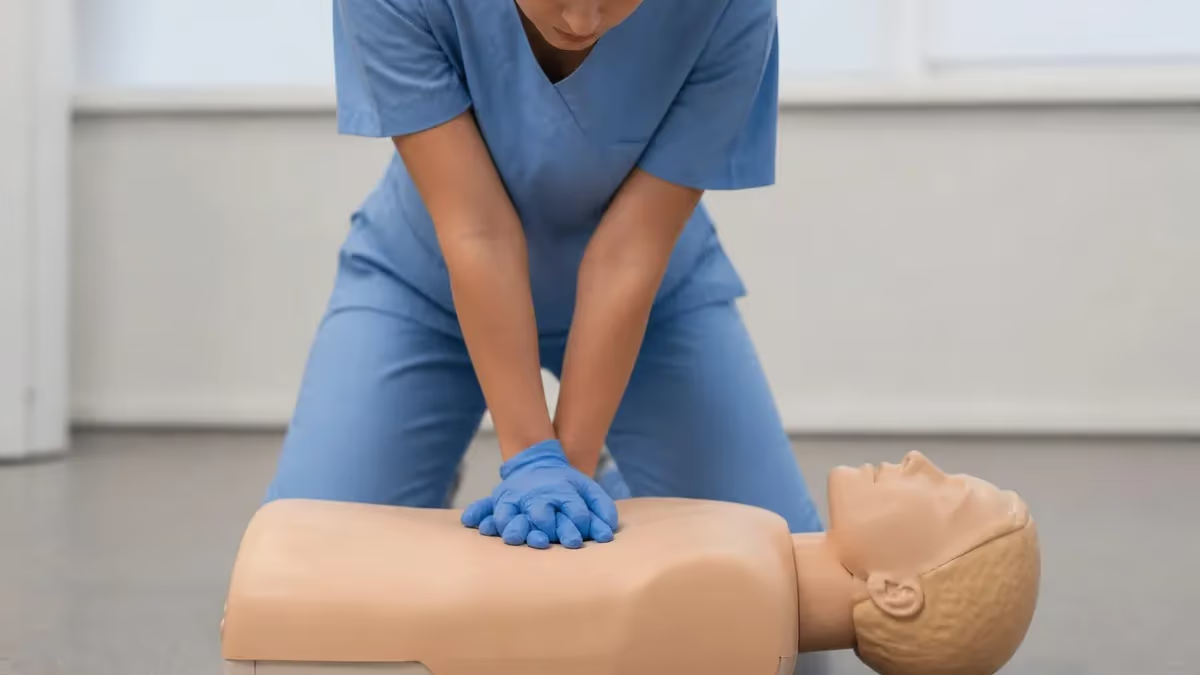
CPR instructor training is the structured process that prepares experienced rescuers to teach Basic Life Support, Heartsaver, ACLS, and PALS courses to laypeople and healthcare professionals. If you have ever wanted to translate your bedside knowledge into classroom influence, becoming a certified instructor is the most direct way to multiply lives saved. The pathway involves prerequisite provider certification, an instructor essentials course, alignment with a Training Center, and a monitored teaching practicum. Demand has surged in 2026 as workplace AED laws expand and parents seek pediatric coaching.
Most candidates underestimate how much pedagogy matters. Knowing the acls algorithm cold is necessary but not sufficient — you must also coach a panicked nursing student through her first compression, debrief a megacode scenario, and remediate a learner who cannot count cycles. The instructor essentials course spends as much time on adult learning theory, feedback techniques, and skill remediation as it does on clinical content. Strong instructors are equal parts clinician, coach, and classroom manager who can read a room.
The major issuing bodies — American Heart Association, American Red Cross, national cpr foundation, ASHI, and the Health & Safety Institute — each operate slightly different instructor pipelines, but the skeleton is similar. You select a discipline (BLS, ACLS, PALS, or Heartsaver), complete an Instructor Candidate course, align with a Training Center, and then teach a monitored class before being signed off. Renewal cycles typically run two years, with teaching minimums of three to four classes per cycle to stay active.
Costs vary widely. Expect to pay $200 to $400 for the instructor course itself, $35 to $75 for the instructor manual, $50 to $150 in alignment fees, and another $200 to $600 for a manikin set if your Training Center does not loan equipment. Many hospitals reimburse these costs because a single in-house instructor saves the facility thousands annually in vendor fees. For independent instructors, the unit economics are also favorable — most break even after teaching just two or three private classes.
Eligibility prerequisites are stricter than for provider courses. You must hold current provider certification in the discipline you intend to teach, demonstrate skills competency at the instructor level, and pass a written exam typically requiring 84% or higher. Some agencies also require a clinical background or letter of recommendation for ACLS and PALS instructor candidacy. If you want a refresher before applying, our malibu cpr walkthrough breaks down the adult sequence used in every classroom demo.
This guide consolidates everything a 2026 candidate needs: prerequisites, costs, the day-by-day instructor essentials schedule, your first teaching practicum, equipment lists, ACLS and PALS instructor specifics, marketing your own classes, and the renewal cadence that keeps your card active. We will also cover the most common pitfalls — failed monitored teaches, expired alignments, and equipment compliance gaps — that derail otherwise qualified candidates from completing the pathway.
By the end you should be able to choose an agency, budget your investment, schedule your instructor essentials course, identify a sponsoring Training Center, and map out the timeline from application to first paid class. The work is meaningful and the income is real, but the path rewards candidates who treat instruction as a craft rather than a credential.
CPR Instructor Training by the Numbers

Your Path to Becoming a Certified CPR Instructor
Hold Current Provider Card
Complete Instructor Essentials
Align with a Training Center
Complete Monitored Teach
Receive Instructor Card
Prerequisites for CPR instructor training are straightforward but enforced rigorously. Every agency requires that you hold a current, unexpired provider card in the exact discipline you intend to teach. A BLS Instructor candidate must have a BLS Provider card; an ACLS Instructor candidate must hold both BLS and ACLS Provider cards because megacode scenarios rely on flawless compression coaching. Mixing these up is the single most common application rejection seen by Training Centers across the United States during initial credentialing reviews.
Age and licensing requirements vary by discipline. Heartsaver and BLS instructors typically need only be 16 or 18 years old with no clinical license. ACLS and PALS instructor candidates almost always need either an active healthcare license — RN, paramedic, RT, PA, MD, DO — or documented professional clinical experience. The reasoning is practical: when a student asks a clarifying question about pharmacology or pediatric airway adjuncts, your answer must reflect real-world clinical judgment rather than rote memorization of slides.
Skills competency is verified before you ever step into the instructor essentials classroom. Expect a pre-course skills check covering high-quality compressions, bag-mask ventilation, AED operation, and team dynamics. Candidates who cannot perform at the provider level are sent back to remediate before continuing. This is non-negotiable because you cannot coach a skill you have not mastered. Reviewing the recommended cpr compression rate and verifying your own technique on a feedback-enabled manikin pays off significantly.
Background checks are required by some Training Centers, especially those operating in hospitals, schools, or government facilities. A typical check covers criminal history, OIG exclusion lists, and license verification. The cost is usually $40 to $75 and is bundled into the alignment fee at most centers. Standalone instructors who teach in corporate offices may not need a check, but expect that any contract with a school district or healthcare system will require it before you are credentialed onto their roster system.
A common eligibility nuance involves lapsed providers. If your provider card expired more than 30 days ago, you must retake the full provider course before instructor candidacy resumes. Some Training Centers allow a 60-day grace window with documented continuing education, but never assume — confirm in writing. Candidates have lost thousands in instructor course tuition because they did not verify provider currency before enrolling. Always screenshot your eCard expiration date and store it with your application materials.
Letters of recommendation are required for ACLS and PALS instructor candidacy by approximately 40% of Training Centers. The letter should come from a current instructor, medical director, or clinical supervisor and attest to your clinical judgment, communication skills, and reliability. A strong letter mentions specific resuscitation events you have led or supported, not just generic praise. If you do not know an instructor personally, attend a few continuing-education sessions at your local Training Center to build that relationship before applying.
Finally, understand the discipline ladder. BLS Instructor is the foundational credential and is required before most candidates pursue ACLS or PALS Instructor. Heartsaver Instructor stands on its own and targets lay-rescuer audiences. Many candidates start with BLS Instructor, teach for six months to build classroom comfort, then layer on ACLS Instructor when clinical demand justifies the upgrade. This stepwise approach reduces overwhelm and improves long-term retention rates significantly across every Training Center pipeline.
CPR Practice Test Questions
Prepare for the CPR Cardiopulmonary Resuscitation Practice exam with our free practice test modules. Each quiz covers key topics to help you pass on your first try.
CPR Basic CPR
CPR Exam Questions covering Basic CPR. Master CPR Test concepts for certification prep.
CPR and First Aid
Free CPR Practice Test featuring and First Aid. Improve your CPR Exam score with mock test prep.
CPR (Cardiopulmonary Resuscitation) Adult ...
CPR Mock Exam on (Cardiopulmonary Resuscitation) Adult CPR and AED Usage. CPR Study Guide questions to pass on your first try.
CPR (Cardiopulmonary Resuscitation) Airway...
CPR Test Prep for (Cardiopulmonary Resuscitation) Airway Obstruction and Choking. Practice CPR Quiz questions and boost your score.
CPR (Cardiopulmonary Resuscitation) Cardio...
CPR Questions and Answers on (Cardiopulmonary Resuscitation) Cardiopulmonary Emergency Recognition. Free CPR practice for exam readiness.
CPR (Cardiopulmonary Resuscitation) Child ...
CPR Mock Test covering (Cardiopulmonary Resuscitation) Child and Infant CPR. Online CPR Test practice with instant feedback.
CPR (Cardiopulmonary Resuscitation) High-P...
Free CPR Quiz on (Cardiopulmonary Resuscitation) High-Performance Team Dynamics. CPR Exam prep questions with detailed explanations.
CPR (Cardiopulmonary Resuscitation) Legal ...
CPR Practice Questions for (Cardiopulmonary Resuscitation) Legal and Ethical Considerations. Build confidence for your CPR certification exam.
CPR for Specific Populations
CPR Test Online for for Specific Populations. Free practice with instant results and feedback.
CPR Airway & Breathing Management
CPR Exam Questions covering Airway & Breathing Management. Master CPR Test concepts for certification prep.
CPR Assessment & Recognition of Cardiac Ar...
Free CPR Practice Test featuring Assessment & Recognition of Cardiac Arrest. Improve your CPR Exam score with mock test prep.
CPR Chest Compressions & Defibrillation
CPR Mock Exam on Chest Compressions & Defibrillation. CPR Study Guide questions to pass on your first try.
CPR Post-Resuscitation Care & Recovery
CPR Test Prep for Post-Resuscitation Care & Recovery. Practice CPR Quiz questions and boost your score.
ACLS, BLS, and PALS Certification Instructor Tracks
The BLS Instructor track is the most accessible entry point and the foundation for nearly every other discipline. Candidates must hold a current BLS Provider card, pass the BLS Instructor Essentials course, and complete a monitored teach within six months of course completion. The curriculum emphasizes high-quality CPR coaching, AED demonstration, and team dynamics — answering exactly what does aed stand for is a frequently asked learner question you must address with confidence.
BLS Instructor pay ranges from $30 to $90 per hour depending on geography and employer type. Hospital-employed instructors often teach during paid shifts, while independent contractors can scale to multiple weekend classes. Renewal requires teaching a minimum of four BLS courses every two years plus completion of an instructor update aligned with the latest guidelines release cycle. This is the most flexible credential for educators just entering the resuscitation training market today.
Is CPR Instructor Training Worth It for You?
- +Flexible income stream — teach evenings and weekends around your primary job
- +Hospital employers often reimburse 100% of instructor course tuition and equipment
- +Independent instructors earn $400 to $1,200 per weekend class taught
- +Reinforces your own clinical skills through repeated high-quality practice
- +Builds professional network with physicians, paramedics, and corporate safety leads
- +Career mobility — instructor credentials transfer across employers and states easily
- +Personal fulfillment from training learners who will save real lives in their communities
- −Upfront investment of $500 to $1,200 for course, manual, alignment, and manikins
- −Required teaching minimums can be hard to hit if classes get cancelled or postponed
- −Training Center alignment audits demand careful documentation of every roster and skill check
- −Manikin maintenance, cleaning, and replacement parts cost $200 to $500 annually
- −Renewal cycles repeat every two years with continuing education hours required
- −Classroom no-shows and last-minute cancellations cut into independent instructor margins
- −Liability insurance is strongly recommended and adds $200 to $500 per year in overhead

Pre-Class CPR Instructor Training Checklist
- ✓Verify your provider card is unexpired and matches the discipline you will teach
- ✓Confirm your Training Center alignment is active and roster access is enabled
- ✓Print or download the current course agenda, skills sheets, and learner workbooks
- ✓Inspect all adult, child, and infant manikins for cleanliness and feedback function
- ✓Charge or replace AED trainer batteries and confirm pads are present and unopened
- ✓Verify barrier devices, gloves, and disinfection wipes are stocked for every learner pair
- ✓Confirm classroom AV: laptop, projector cable, speakers, and current video files load correctly
- ✓Print attendance roster, course evaluation forms, and post-test answer sheets in advance
- ✓Set up skills stations with manikins, AEDs, and BVMs spaced for two-rescuer practice
- ✓Review remediation script and have backup activities ready for early-finishing learners
Your first monitored teach is graded on coaching, not lecturing
Training Center Faculty evaluators score your monitored teach against a rubric that weights feedback quality, remediation skill, and pacing far more heavily than slide delivery. Spend more prep time rehearsing how you will correct a learner who compresses at the wrong depth than memorizing course statistics. Strong coaches pass on the first attempt. Lecturers often need a second monitored teach to demonstrate active learner engagement.
Equipment is the largest hidden cost of CPR instructor training, and underestimating it is the most common reason new instructors fail their first compliance audit. A baseline classroom kit includes six adult manikins, three child manikins, three infant manikins, one AED trainer per two learners, bag-mask ventilation devices, and a refreshable inventory of barrier shields, gloves, and disinfectant wipes. Expect to invest $1,500 to $4,000 building a starter fleet, depending on whether you choose feedback-enabled manikins or basic torsos.
Feedback-enabled manikins are now considered the standard of care. Guidelines emphasize objective measurement of compression depth, rate, and recoil. Manikins like the Laerdal Little Anne QCPR, Prestan with feedback, and Brayden Pro report real-time metrics to a tablet app, allowing learners to self-correct and instructors to deliver precise debriefs. A respectable life support classroom in 2026 should not rely on torsos without feedback unless they are paired with a metronome and visual cue cards for compression depth coaching.
AED trainers must match the brand of AED most commonly deployed in your students' workplaces. Hospital classes typically use Zoll or Philips trainers; corporate classes lean Cardiac Science or HeartSine; school district contracts often standardize on Philips HeartStart. Owning two or three brands lets you tailor each class authentically. Pair the trainer with an electrode pad chart and explain pad placement using the same anatomical landmarks as what is aed guides taught in provider courses.
Maintenance routines protect both your investment and your students. Skin replacements on adult manikins should be swapped every 100 learner uses or sooner if discoloration appears. Lung bags must be replaced after every class to prevent cross-contamination. Disinfect manikin faces with hospital-grade wipes between learners and document the cleaning log. AED trainer batteries should be tested monthly and replaced every twelve to eighteen months even if they still power on, because mid-class failure ruins both pacing and student confidence in your delivery.
Classroom setup matters more than most new instructors realize. Allow at least 25 square feet of floor space per learner pair so they can perform two-rescuer CPR without bumping into adjacent teams. Set up a U-shape rather than rows so you can circulate efficiently. Place a small table for each AED trainer at hip height, and store backup BVMs in a labeled bin within arm's reach. Good ergonomics directly translate to better skills retention and higher pass rates on first attempt.
Liability insurance is the equipment line item nobody warns you about. A professional liability policy for an independent CPR instructor runs $200 to $500 annually and protects you against learner injury claims, equipment damage, and contract disputes. Your homeowners or auto policy will not cover instructional activities. Most Training Centers strongly recommend a $1 million per occurrence policy, and many corporate clients now require proof of coverage as a condition of booking your classes for their employees in 2026.
Finally, consider digital infrastructure. You will need a reliable laptop with HDMI output, a portable speaker, a wireless presenter remote, and a tablet for QCPR feedback apps. Many instructors invest in a small wheeled case to transport equipment efficiently between sites. Cloud storage for course rosters, eCard issuance logs, and continuing education documentation is essential for surviving Training Center audits. The instructors who treat this as a small business from day one are the ones who scale into full-time teaching incomes within two years.
The top three failure modes during monitored teach evaluations are: rushing through skills stations without giving learners adequate practice repetitions, providing only positive feedback without specific correction when learners err, and skipping the team-dynamics debrief at the end of megacode or two-rescuer scenarios. Faculty evaluators score these rubric items strictly. Plan your timing carefully — under-teaching is far more common than over-teaching among first-time candidates seeking instructor certification.
Renewal of your CPR instructor credential happens every two years and requires three elements: a current provider card in the same discipline, completion of the instructor update aligned with current guidelines, and documentation that you have taught the minimum number of classes during your cycle. For BLS instructors that is typically four courses; for ACLS and PALS it is three courses each. Your Training Center tracks these numbers, but you should keep an independent log of every class taught, roster issued, and eCard distributed.
The instructor update is a 2–4 hour online module released after each guideline cycle. It covers what changed, why it changed, and how to teach the new content. Skipping the update means your eCard issuance privileges are suspended until completion. Recent updates have refined coaching around chest compression fraction, ventilation timing for advanced airways, and pediatric drug dosing. Treat the update as a mini-conference and take notes for your next class refresh, not as a check-the-box obligation.
Reciprocity between agencies is limited but improving. An AHA BLS Instructor cannot simply teach Red Cross BLS classes; the credentials are not transferable. However, some agencies offer crosswalk pathways that compress the second instructor course into a 4–8 hour bridge if you hold an active instructor credential elsewhere. Crosswalks are most common between AHA and ASHI, and between Red Cross and Health & Safety Institute. Always confirm in writing before paying for any crosswalk course because policies change annually.
Career growth from instructor to Training Center Faculty is the next rung on the ladder. Faculty candidates must hold an active instructor credential for at least two years, teach a substantial volume of classes, attend a Training Center Faculty Development course, and be recommended by an existing Training Center Coordinator. Faculty members can monitor and sign off new instructor candidates, audit instructor performance, and develop course materials. Faculty roles often come with stipends or hourly premiums above standard instructor rates.
Beyond faculty, some instructors open their own Training Site or Training Center. A Training Site operates under an existing Training Center's authority, while a Training Center is the top-tier credential that allows you to credential other instructors directly. Training Center applications require significant infrastructure: dedicated office space, equipment inventory thresholds, a Training Center Coordinator role, and a Training Center Faculty roster. This path is best suited for instructors with strong business acumen and a demonstrated multi-year teaching track record.
Specialization is another growth avenue. Instructors who add Heartsaver Pediatric First Aid, Bloodborne Pathogens, Stop the Bleed, and Mental Health First Aid to their portfolio can offer one-stop training to school districts, daycare centers, and corporate clients. Bundling certifications dramatically improves per-class revenue. A combined Heartsaver CPR + First Aid + Bloodborne Pathogens class taught to 12 learners can gross $1,800 in a single day with materials costs of roughly $250 in 2026 pricing across most US markets.
Finally, document your impact. Track classes taught, learners certified, employer types, and any case reports of students using their training in real emergencies. This portfolio supports your renewal, your faculty application, your liability rate negotiations, and your marketing. Instructors who can credibly say "in five years I trained 1,200 healthcare professionals and 400 lay rescuers" command premium rates and choice contracts. The instructor credential is genuinely a career, not a side hustle, when treated with that level of professionalism.
Practical tips from veteran instructors compound over time. The first is to rehearse your opening five minutes word-for-word until it is conversational. Learners decide within those minutes whether you are credible and whether the class will be tolerable. Open with a brief authentic story — a code you ran, a save you witnessed, or a family member who survived because someone knew compressions. Then state objectives plainly, set the schedule, and move quickly into skills practice. Lectures kill energy; demos start it.
Time-box every skills station. Allocate exactly the minutes your instructor manual specifies, and use a visible timer. New instructors routinely run long on the first station and then sprint through the last, which is exactly when fatigue makes coaching most valuable. Practice your transitions: "Excellent work, team — switch to the AED station in two minutes." Consistent pacing across stations is one of the highest-scoring rubric items during monitored teach evaluations and Training Center audits throughout the renewal cycle.
Master the art of corrective feedback. The sandwich method — positive, correction, positive — works for novice learners but feels patronizing to clinicians. For healthcare audiences, use direct specific language: "Your compressions are 4 cm; aim for 5 to 6. Try again with hands lower on the sternum." Then watch them adjust and confirm. Specific feedback retained immediately outperforms general praise every single time. Learners respect instructors who hold the standard rather than soften it for comfort during skills practice.
Manage the dominant learner. Every class has one student who answers every question and turns small-group discussions into monologues. Address this privately during the first break: "You clearly have strong background — I want to make sure quieter learners get reps too. Could you help by partnering with someone newer?" This redirects the energy positively rather than embarrassing the learner publicly. Quiet learners then open up and class dynamics improve significantly through the remainder of the day's stations.
Debrief megacodes with structure. The plus-delta method works well: ask each team member what went well (plus) and what they would change (delta), then add your observations using rubric-aligned language. Cover team dynamics, closed-loop communication, the position recovery transition if applicable, drug dosing accuracy, and rhythm interpretation timing. Keep debriefs to 8–10 minutes per scenario; longer debriefs lose momentum. End every debrief with one specific actionable change for the next scenario the team will run.
Build a referral engine. Ninety percent of independent instructor business in year two comes from word-of-mouth from year-one students. Make your contact information easy to share, follow up after every class with a thank-you email, and offer a small discount for group bookings. Many instructors print a referral card with a promo code that learners hand to HR or office managers. The customer acquisition cost for a referred class is effectively zero, and gross margins on referral business are noticeably higher than paid acquisition.
Stay current on guidelines beyond the mandatory updates. Subscribe to the resuscitation councils' newsletters, follow leading resuscitation researchers on professional networks, and attend at least one annual conference. Be ready when a learner asks about a recent journal article. This level of fluency separates the instructor who teaches the slides from the instructor whose classes get rebooked year after year. Continuous learning is what transforms a credentialed instructor into a respected community resource and a sustainable career.
CPR Questions and Answers
CPR vs BLS: Complete Comparison Guide for 2026 — Which Certification Do You Need?
CPR Card Lookup: How to Verify, Replace, and Access Your CPR Certification in 2026
AHA CPR: What It Is, Which Course You Need, and How to Get Certified
Adult CPR: Complete Step-by-Step Guide to Hands-Only and Standard CPR in 2026
CPR - Cardiopulmonary Resuscitation: Complete Study Guide 2026
About the Author

Registered Nurse & Healthcare Educator
Johns Hopkins University School of NursingDr. Sarah Mitchell is a board-certified registered nurse with over 15 years of clinical and academic experience. She completed her PhD in Nursing Science at Johns Hopkins University and has taught NCLEX preparation and clinical skills courses for nursing students across the United States. Her research focuses on evidence-based exam preparation strategies for healthcare certification candidates.
Join the Discussion
Connect with other students preparing for this exam. Share tips, ask questions, and get advice from people who have been there.
View discussion (5 replies)