
ServSafe Food Temperatures — Complete Guide (2026)
ServSafe food temperatures: ✅ danger zone 41-135F, poultry 165F, ground meats 155F, cooling 6-hour rule. Full FDA Food Code 2026 reference.
ServSafe Food Temperatures — Complete Guide (2026)
Forty-one to one thirty-five. Memorize that range. Those two numbers — 41°F on the cold end, 135°F on the hot end — are the difference between food that's safe and food that's growing pathogens fast enough to make your guests sick before they finish dessert. Every ServSafe food temperatures question, every health inspector visit, every servsafe food safety citation eventually traces back to that one window.
The window is called the temperature danger zone, and bacteria like Salmonella, Listeria, and E. coli double their populations every 20 minutes inside it. That's the entire reason ServSafe exists — to drill these numbers into food workers so the chain from receiving to plate stays out of that range, or moves through it fast enough to keep pathogen counts low.
This guide compiles every temperature the 2022 FDA Food Code requires you to know. Cooking, holding, cooling, reheating, thawing. Each section gives you the number, the hold time, the why, and a real-world example. By the end you'll be ready for the servsafe manager exam temperature questions and for the actual job they're meant to prep you for.
Worth knowing upfront: some temperatures changed in the 2022 update. Eggs hot-held jumped from 145°F to 155°F. Ground meat hold time tightened. If you studied an older book — even a 2017 edition — some of what you memorized is now wrong. We'll flag those updates as we go.
One more thing before we dive in. The numbers in this guide are the federal floor. Your state or county health department can — and many do — adopt stricter requirements. California, New York City, and several other jurisdictions add local rules on top of the FDA Food Code. Always check your local code if you're studying for a regional exam or working in a state with its own food safety regulator.
ServSafe Temperature Numbers You Must Know
The Temperature Danger Zone: 41°F to 135°F
The servsafe temperature danger zone is the range where pathogens multiply fastest. ServSafe defines it as 41°F to 135°F (5°C to 57°C). Anything in that range — raw chicken on a prep table, cooked rice cooling on a shelf, soup pulled off the steam table — is on a clock.
The clock is 4 hours total cumulative time in the zone for ready-to-eat TCS food. After 4 hours you discard. Not refrigerate. Not reheat. Discard.
Here's the thing inspectors look for: cumulative means added up. A chicken breast that sat at room temp for 90 minutes during prep, then went into a 40°F walk-in, then came out for 90 more minutes during lunch service has used 3 of its 4 hours. The clock doesn't reset when the food goes cold.
Within the zone there's an even worse sub-range. Pathogens grow fastest between 70°F and 125°F (21°C to 52°C). That's why cooling protocols are so aggressive about getting food through that band quickly — we'll get to the 2-hour/4-hour rule in a minute.
Danger Zone in Practice
Full danger zone: 41°F–135°F (5°C–57°C).
Rapid-growth sub-zone: 70°F–125°F (21°C–52°C) — pathogens double roughly every 20 minutes here.
Maximum cumulative time: 4 hours for ready-to-eat TCS food. After that, discard.
Minimum Internal Cooking Temperatures
ServSafe cooking temps follow one core principle: hotter and faster for higher-risk foods. Poultry sits at the top because it's the most likely source of Salmonella. Ground meats come next — grinding spreads surface bacteria throughout the meat, so the whole thing has to hit a kill temperature. Whole-muscle cuts get a lower temp because pathogens stay on the outside, which sears in the pan.
Poultry, Stuffed Foods, and Stuffing: 165°F (74°C) for 15 Seconds
Chicken, turkey, duck, ground poultry — all 165°F. Same for any food stuffed with poultry, meat, fish, or pasta (stuffed chicken breast, stuffed pork chop, stuffed pasta dishes). The stuffing itself must reach 165°F because it traps moisture and slows heat penetration.
Ground Meats and Ground Fish: 155°F (68°C) for 17 Seconds
Ground beef, ground pork, ground lamb, sausage, ground fish, ground game meat, mechanically tenderized meat. The 17-second hold is short but not zero — the temperature must be maintained that long for proper pathogen reduction. Alternative: 158°F instant kill.
Whole-Muscle Beef, Pork, Veal, Lamb: 145°F (63°C) for 4 Minutes
Steaks, roasts, pork chops, lamb chops — the cuts where bacteria live only on the surface. The 4-minute hold is mandatory and it's where most line cooks slip up. Note: roasts can also use the FDA-approved time-temperature alternative table (130°F for 112 minutes, for example).
Fish, Shellfish, Eggs Served Immediately: 145°F for 15 Seconds
Whole fish fillets, shrimp, scallops, lobster. Shell eggs cooked to order and served right away also fall here. If eggs are being held for later service — say, on a hot buffet — they jump to 155°F (more on that in the next section).
Commercially Raised Game, Exotic Species, Mechanically Tenderized: 145°F (15 sec)
Quail, venison from licensed sources, ostrich. Mechanically tenderized beef cuts (jaccard-pierced or needled) follow ground-meat rules in some jurisdictions — check your local code.
Vegetables, Fruit, Grains, Legumes Held Hot: 135°F
Cooked vegetables, rice, pasta, beans — if they're going to a hot-hold station, they must reach 135°F. There's no specific cook temp for plant foods (they don't carry the same pathogen risk), but the hot-hold floor is non-negotiable. This is also why servsafe test prep drills you on the 135°F number alongside the meat temps.
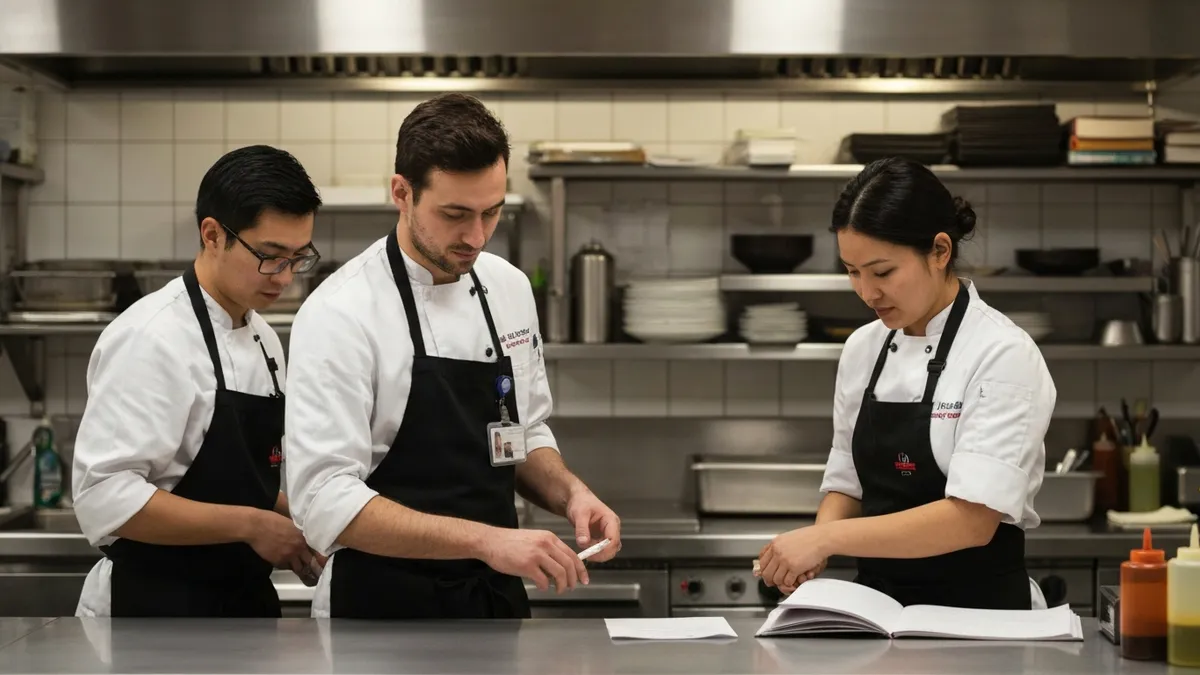
Minimum Internal Cook Temperatures by Food Group
Highest cook temp. Salmonella risk drives the rule.
- Temperature: 165°F (74°C)
- Hold Time: 15 seconds
- Examples: Chicken, turkey, duck, stuffed chicken breast, stuffed pasta
Grinding spreads surface bacteria throughout the meat.
- Temperature: 155°F (68°C)
- Hold Time: 17 seconds
- Alt: 158°F instant-kill, no hold required
Surface pathogens only. The interior stays sterile.
- Temperature: 145°F (63°C)
- Hold Time: 4 minutes
- Examples: Steaks, roasts, pork chops, lamb chops
Lower risk, faster service. Eggs jump to 155°F if held.
- Temperature: 145°F (63°C)
- Hold Time: 15 seconds
- Examples: Salmon fillet, shrimp, scallops, eggs to order
No specific cook temp — just the hot-hold floor.
- Temperature: 135°F (57°C)
- Hold Time: Continuous while holding
- Examples: Steamed rice, roasted potatoes, baked beans
Anything cooled and brought back up.
- Temperature: 165°F (74°C)
- Hold Time: 15 seconds
- Time Limit: Reach 165°F within 2 hours of start
Eggs: The Two-Number Rule That Trips Everyone Up
Eggs are sneaky. The cook temp depends entirely on what happens next. servsafe food handler candidates lose points here constantly, and the 2022 Food Code made it harder by bumping the hot-held number up.
If you crack eggs to order and the plate leaves the line in under a minute — sunny side, over-easy, scrambled to order — cook them to 145°F for 15 seconds. Same as fish. That's the served-immediately rule.
If you're cooking eggs to hold on a buffet, in a pan on a steam table, or anywhere they'll sit before service, you must cook them to 155°F for 15 seconds. This is the 2022 update. Older books say 145°F for held eggs. Wrong now.
The minimum internal temp for scrambled eggs ServSafe wants on your exam answer depends entirely on the held-vs-immediate context. Test writers will set up the scenario carefully. Read every question twice. If the question mentions a buffet, steam table, hot well, or any kind of hold — it's 155°F. If the question says "cooked to order" or "plated directly" — it's 145°F.
Pasteurized eggs (liquid or shell) bypass the issue for high-risk populations like nursing homes, hospitals, and pre-K facilities. If you're serving raw or undercooked egg dishes — Caesar dressing, hollandaise, tiramisu — you must use pasteurized eggs. Not optional. The Food Code is explicit.
Pros and Cons of the Temperature Hold-Time Rule
- +Hold time guarantees a pathogen kill — instant-read temps lie when food is moving
- +Same temperature reached briefly vs maintained gives radically different kill rates
- +Health inspectors can verify hold by watching probe display, not just peak temp
- +Aligns U.S. food safety with global HACCP standards
- +Lower-temp options (145°F roasts) let chefs serve medium-rare safely
- +Documented hold protects the operation in a foodborne illness investigation
- −Line cooks often miss the 17-second ground meat hold under service pressure
- −Inexpensive probe thermometers respond too slowly to verify short holds
- −Roast time-temperature tables confuse staff who didn't see them in training
- −Pulling a steak at 145°F to rest doesn't satisfy the rule — it must hold there
- −Reheating shortcut (microwave 165°F) gets skipped when staff rush
- −Egg hot-held update (145°F → 155°F) caught many operators off guard in 2023
Cooling: The 2-Hour / 4-Hour Rule (6 Hours Maximum)
Cooling is where most ServSafe questions get sneaky. The rule has two stages and one total cap. Memorize all three.
Stage 1: From 135°F down to 70°F in 2 hours. This is the critical stage because food passes through the rapid-growth sub-zone (70°F–125°F) during this drop.
Stage 2: From 70°F down to 41°F or below in 4 more hours.
Total cap: 6 hours, start to finish. If food hasn't reached 41°F within 6 hours of leaving 135°F, it's done. Discard.
Here's the catch most students miss: the 2-hour stage is not negotiable on its own. If your soup is still 100°F at the 2-hour mark, you can't "use the extra time from stage 2." The temperature must hit 70°F by hour 2 or the food is unsafe. Don't try to reheat and start over either — the FDA Food Code doesn't permit that as a corrective action for stage 1 cooling failures.
How to actually do it in a real kitchen: shallow pans (4 inches deep maximum), ice paddles in stockpots, ice water baths around containers, blast chillers if you have them, separating large batches into multiple smaller portions before chilling. Never just pop a hot 5-gallon stockpot of chili into the walk-in and expect it to cool — the center will sit above 70°F for hours.
Check actual temps with a calibrated probe at hours 0, 2, and 6. Document in a cooling log. servsafe food storage protocols expect that documentation; health inspectors will ask to see it.
Cooling Timeline: From Cook to Cold
Hour 0
Hour 1
Hour 2
Hour 3–5
Hour 6
After Hour 6
Reheating: 165°F Within 2 Hours
Anything you've cooked, cooled, and want to serve hot again must be reheated to 165°F (74°C) for 15 seconds. And it must reach that temperature within 2 hours of leaving cold storage.
The 2-hour limit catches people. You can't pull a tray of chili out of the walk-in, set it on a low-heat steam table, and hope it climbs to 165°F by lunch service. Steam tables aren't designed to heat food — they hold food that's already hot. Reheat on the stove, in the oven, or in the microwave first, then transfer to the hot well.
Reheating for hot holding is the only path back to hot service. You can't put cooled food directly on a hot-hold line at lower temps. The 165°F reheating spike serves the same function as the original cook — it knocks pathogen counts back down before the food enters a holding environment where some growth is inevitable.
Reheat once and once only. If reheated food gets cooled again, that batch is done at the second cool-down. You don't get a third heat cycle. The Food Code doesn't explicitly ban it, but every legitimate operation treats two heat cycles as the lifetime maximum.
One exception worth knowing: commercially processed, ready-to-eat foods (like canned soup or pre-cooked sausage from a sealed package) only need to be reheated to 135°F for hot holding, not 165°F. The lower temp applies because the food was already commercially sterilized. Anything you cooked in-house follows the full 165°F rule.
Microwaved reheats are tricky. Microwaves heat unevenly. The Food Code requires you to stir or rotate the food midway through reheating, let it stand covered for 2 minutes after heating, and verify 165°F at multiple locations in the dish before service. We'll cover full microwave rules in the next section.
Reheating Safety Checklist
- ✓Reheat to 165°F (74°C) for 15 seconds — every time, regardless of original cook temp
- ✓Reach 165°F within 2 hours of pulling food from cold storage
- ✓Use stove, oven, or microwave — never steam tables or warming drawers to bring food up
- ✓Stir thick foods (chili, sauces, casseroles) during reheating for even temperature
- ✓Probe at multiple points — center, edges, top — to verify uniform 165°F
- ✓Calibrate probe before each shift with an ice-water slurry (32°F reading)
- ✓For microwave: stir or rotate midway, cover, then stand 2 minutes after heating
- ✓Transfer to hot-hold equipment only after verifying 165°F throughout the food
- ✓Discard food that doesn't reach 165°F within the 2-hour window — no second tries
- ✓Log every reheat with time, food, temperature, and initials — inspectors check
Hot and Cold Holding
Holding is where the danger zone wins or loses. Hot food must stay at or above 135°F (57°C). Cold food must stay at or below 41°F (5°C). Anything in between for more than 4 cumulative hours is discard-only.
Hot Holding Rules
Hot-hold equipment includes steam tables, soup kettles, heated bain-maries, holding cabinets, heat lamps. Every piece of equipment must keep TCS food at 135°F or hotter. Check internal food temp — not air temp — every 4 hours. Stir thick foods (mashed potatoes, stews) before checking; the surface always reads hotter than the center.
Heat lamps don't reliably hold temperature on their own. Use them as a finish-and-serve tool, not as a holding solution. If food sits under a lamp longer than 4 hours total, it's done.
Cold Holding Rules
Cold-hold equipment includes refrigerated display cases, salad bars with iced wells, walk-in coolers. The food itself must read 41°F or below — again, internal temp, not ambient. Ice baths for cold-held food (think shrimp cocktail or sushi) must surround the food container, not just sit underneath. Replenish ice frequently as it melts.
Time as a Public Health Control (TPHC)
An alternative to temperature control for limited use. You can hold TCS food without temperature control for up to 4 hours if you have written procedures, label the food with start time, and discard at the 4-hour mark. After that the food is gone. TPHC isn't a shortcut — it's a documented controlled exception for specific service models like banquets or food trucks.
A longer 6-hour TPHC window exists too, but only if the food starts at 41°F or below and stays under 70°F the entire time. Most operations stick to the 4-hour rule because the 6-hour variant requires temperature monitoring at the start and tighter staff discipline. Both versions demand written, regulator-approved procedures.
Holding Equipment: Cost vs Reliability
Safe Thawing Methods
Microwave Cooking Rules
Thawing is one of the most-failed inspection points because the easy way — leaving meat on the counter overnight — is the unsafe way. ServSafe recognizes temp danger zone servsafe four legal thaw methods, and only four.
Method 1: Refrigeration (≤41°F)
The safest and slowest. Move frozen food from freezer to a 41°F refrigerator and let it thaw at that temperature. Plan ahead: a whole turkey takes 4–5 days, a large roast 1–2 days, ground meat 12–24 hours. Always thaw on the lowest shelf in a leak-proof container to prevent cross-contamination.
Method 2: Running Water at 70°F or Below
Submerge sealed food in a sink under continuously running cold water at or below 70°F. The water flow must be strong enough to flush warmed water away. Maximum thaw time is 2 hours for foods that won't be cooked immediately afterward, 4 hours total for foods that go straight to cooking.
Method 3: Microwave (Cook Immediately)
You may thaw in the microwave but you must cook the food immediately after thawing, in the same continuous process. No transferring to the fridge, no "thaw now, cook later." Microwaves heat unevenly and partial cook-thaw cycles in the danger zone breed bacteria.
Method 4: As Part of Cooking
Cook food directly from frozen, like dropping a frozen shrimp into boiling water or a frozen patty onto a flat-top. Just make sure the food reaches its required internal temperature.
Microwave Cooking Specifics
If you're cooking food from raw in a microwave (not just thawing or reheating), the Food Code requires you to cook to 165°F throughout, stir or rotate midway, cover during cooking, and let stand covered for 2 minutes after the microwave stops. The stand time finishes the cook through residual heat and equalizes hot spots. Skip the stand, and the cold center sits inside the danger zone while you serve it.
Never thaw on the counter. Never thaw in warm water. Never thaw and refreeze without cooking in between. These three errors cause more failed inspections than any other thawing mistake combined.
🌡️ What is the full ServSafe temperature danger zone?
The temperature danger zone runs from 41°F to 135°F (5°C to 57°C). TCS food cannot stay in this range for more than 4 cumulative hours, or it must be discarded.
START DANGER ZONE PRACTICE TEST🔥 What internal temperature does poultry need to reach?
Poultry, stuffed foods, and stuffing must reach 165°F (74°C) held for 15 seconds. This is the highest cooking temperature on the ServSafe food temperature chart because of elevated Salmonella risk.
START SERVSAFE PRACTICE TEST🍗 What temperature do ground meats need to hit?
Ground beef, pork, lamb, sausage, and ground fish must reach 155°F (68°C) for 17 seconds. Grinding spreads surface bacteria throughout the meat, so the whole product needs the kill temperature.
START COOKING TEMPS PRACTICE TEST🥩 What temperature is required for whole-muscle beef, pork, veal, and lamb?
Whole-muscle cuts need 145°F (63°C) held for 4 minutes. Pathogens live only on the surface of intact muscle, which is why the required temperature is lower than for poultry or ground meat.
START SERVSAFE PRACTICE TEST⏱️ How fast must food cool from 135°F to 70°F?
Stage 1 of cooling requires food to drop from 135°F to 70°F within 2 hours. This stage is non-negotiable — if food is still above 70°F at the 2-hour mark, it must be discarded, not carried into stage 2.
START COOLING RULES PRACTICE TEST❄️ What is the total maximum cooling window under ServSafe food temperature guidelines?
Cooling has a 6-hour hard cap: 2 hours to get from 135°F to 70°F, then 4 more hours to reach 41°F or below. Food that has not hit 41°F within 6 total hours must be thrown out.
START SERVSAFE PRACTICE TEST♻️ What temperature must reheated food reach, and how fast?
Reheated TCS food must reach 165°F (74°C) for 15 seconds within 2 hours of leaving cold storage. Steam tables and warming drawers cannot be used to bring food up to temperature — only a stove, oven, or microwave.
START REHEATING RULES PRACTICE TEST🍲 What is the minimum hot holding temperature on the ServSafe food holding temperature chart?
Hot-held TCS food must stay at 135°F (57°C) or above, checked by internal food temperature rather than equipment air temperature. Heat lamps alone are not reliable enough to hold temperature past 4 hours.
START SERVSAFE PRACTICE TEST🧊 What is the maximum cold holding temperature?
Cold-held TCS food must stay at 41°F (5°C) or below at the internal food temperature, not the ambient air temperature. Iced wells must surround the food container, and ice needs to be refreshed as it melts.
START COLD HOLDING PRACTICE TEST🥚 Do eggs cooked to order and eggs held on a buffet need the same temperature?
No. Eggs cooked to order and served immediately need 145°F for 15 seconds. Eggs held for later service, like on a steam table or buffet, must reach 155°F for 15 seconds under the 2022 Food Code update.
START SERVSAFE PRACTICE TESTServSafe Questions and Answers
Official Resources
- FDA Food Code 2022 — the federal source document for every temperature, hold time, and cooling rule on this page.
- FDA Food Code 2022 (full PDF) — the complete downloadable Food Code text, including Chapter 3 cooking, cooling, and holding requirements.
- ServSafe Manager Certification — the official National Restaurant Association ServSafe program page for exam and study details.
Related ServSafe Guides
ServSafe Temperature Danger Zone: The Complete 41°F–135°F Food Safety Guide for Certification
ServSafe Food Safety — Complete Guide (2026)
ServSafe Food Hierarchy Chart: Complete Guide to Proper Food Storage Order
ServSafe Test Prep: A 4-Week Study Plan to Pass on Your First Try
ServSafe Manager Exam: Format, Passing Score, and the Study Plan That Works
About the Author

Registered Sanitarian & Food Safety Certification Expert
Cornell University College of Agriculture and Life SciencesThomas Wright is a Registered Sanitarian and HACCP-certified food safety professional with a Bachelor of Science in Food Science from Cornell University. He has 17 years of experience in food safety auditing, regulatory compliance, and foodservice management training. Thomas prepares food industry professionals for ServSafe Manager, HACCP certification, and state food handler examinations.