
ServSafe Test Prep: A 4-Week Study Plan to Pass on Your First Try 2026
✍🏼 ServSafe test prep that actually works. Get a 4-week study plan, the 8 exam domains, score targets, and free practice questions for first-try success.
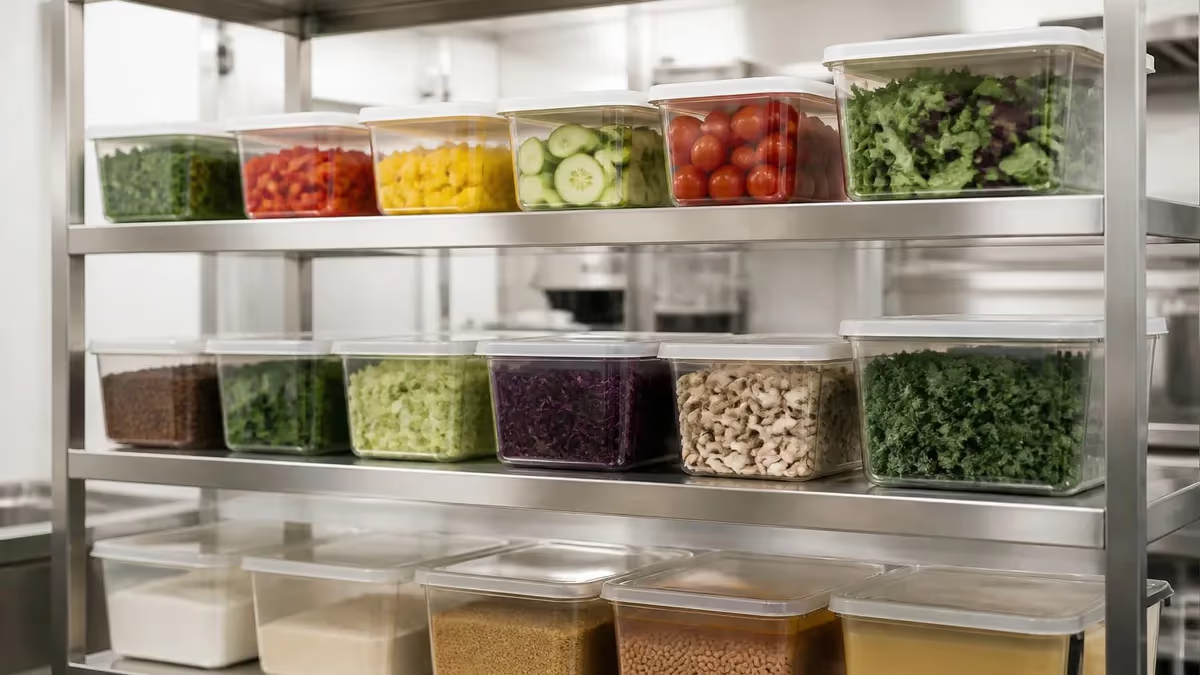
Walking into a ServSafe exam unprepared is rough. You sit down, the timer starts, and suddenly every question reads like a riddle written by a health inspector with a grudge. Good ServSafe test prep flips that script. You walk in knowing the danger zone cold, the cooling method by heart, and the allergen response without hesitation. That is the difference between a 75% squeak-by and a confident 90+.
This guide gives you a real four-week plan, not a list of buzzwords. We break down the eight exam domains, the score you need, what to study first, and where most candidates lose points. Whether you are sitting the Manager exam or the Food Handler version, the prep structure is the same: a little every day, plus full-length practice tests on the weekends.
And yes, free practice matters. You cannot pass by reading alone. Doing 50 questions a day, reviewing every wrong answer, and tracking your weak domains is what gets people across the line. That is true for first-timers, recertifiers, and anyone retaking after a failed attempt.
One more thing before we dig in. ServSafe is not the kind of test you can fake your way through. Proctors watch closely. Test centers are quiet. You have no notes, no phone, no second chances within a 24-hour window. That makes preparation the only variable you control. Control it well and the exam becomes routine. Control it poorly and you will be back at the testing center within a month, paying the retake fee and starting over. Either way, the time investment is similar — so you might as well do it right the first time.
ServSafe Exam at a Glance
Key Facts at a Glance
| Item | Value | Details |
|---|---|---|
| Minimum passing score | 70% | |
| Total questions | 90 | |
| Time limit | Not published | |
| Certificate validity | 5 years |
What ServSafe Actually Tests You On
ServSafe covers eight content domains, and they are not weighted equally. About one-third of the exam centers on time and temperature control for safety, often called TCS foods. Another big chunk is contamination, allergens, and pests. The remaining questions split across personal hygiene, purchasing and receiving, sanitation, facilities, and regulatory matters.
Knowing the weights helps you study smart. If you spend three nights memorizing pest control and one night skimming temperature charts, you are setting yourself up to fail. Flip that ratio. Master the temperature danger zone first, then build outward.
One detail trips up nearly everyone: the difference between hot holding, cold holding, and rapid cooling. Hot food stays at 135°F or above. Cold food at 41°F or below. Cooling drops from 135°F to 70°F within two hours, then from 70°F to 41°F within four more hours. Six total. Write those numbers down. Tape them to your fridge. Test yourself daily. They will appear on your exam three or four times in slightly different wording.

The 135-70-41 Rule (Memorize This)
Cool hot food from 135°F down to 70°F within 2 hours. Then from 70°F down to 41°F within 4 more hours. Total cooling time: 6 hours. If you only remember one number set on exam day, make it this one. Bacteria multiply fastest between 70°F and 125°F, which is why the first stage of cooling has a tighter window. Walk-in coolers, ice baths, ice paddles, and shallow pans are all acceptable methods. Just track the time and temperature with a calibrated thermometer.
The 4-Week ServSafe Study Plan That Works
Cramming the night before does not work for this exam. The vocabulary is too specific, the scenarios too nuanced. You need spaced repetition, which is fancy talk for studying a little every day over several weeks. Four weeks gives most people enough runway. Two weeks is doable if you have food service experience. One week? Possible, but expect to feel rushed.
Here is the structure that gets the best pass rates. Week 1 is foundations — what the exam covers, key vocabulary, and the temperature rules. Week 2 dives into contamination, allergens, and hygiene. Week 3 hits purchasing, receiving, storage, and sanitation. Week 4 is full practice tests, weak-area review, and final polish.
Block 30-45 minutes a day. Mornings work best for retention, but consistency beats timing. Pair your study sessions with our ServSafe practice test for live question exposure. The brain learns better when it has to recall under mild pressure, not just re-read passively.
Your 4-Week ServSafe Study Schedule
Read the official ServSafe handbook chapters 1 through 3 over five days. Memorize the temperature danger zone of 41°F to 135°F, the full cooling rule (135 to 70 in two hours, 70 to 41 in four hours), and all hot and cold holding requirements for TCS foods. End the week with a 40-question practice quiz focused entirely on temperatures and time controls. Score under 80%? Reread chapter 3 before moving on.
Study biological, chemical, and physical contamination in depth. Master the Big 9 allergens: milk, eggs, fish, shellfish, tree nuts, peanuts, wheat, soy, and sesame. Learn the FDA's Big 6 foodborne pathogens — Salmonella, Shigella, E. coli, hepatitis A, norovirus, and nontyphoidal Salmonella — and which foods each is associated with. Take two 30-question practice sets, one mid-week and one at the weekend.
Cover purchasing standards, receiving temperatures, FIFO storage rotation, cleaning versus sanitizing, dishwasher temperature requirements, three-compartment sink procedures, pest control protocols, and facility design basics including handwashing station placement. Mix 60 practice questions across all these topics. Build a one-page summary sheet of every numeric standard.
Take two full 90-question timed practice tests under realistic exam conditions — no breaks, no notes, 2-hour limit. Review every wrong answer using the official book, not the practice test explanations. Rebuild a quick-recall sheet of your weakest 20 facts. The final day is for light review only. Sleep at least 8 hours. Eat a normal breakfast on test day.
The Tools You Actually Need (And Don't)
You do not need to buy every study product on the market. The official ServSafe Manager Book from the National Restaurant Association is the source of truth — every exam question maps to its content. If you only buy one thing, buy that. Used copies are fine as long as the edition matches what the test uses (currently the 7th edition).
Beyond the official book, what helps? Flashcards for vocabulary. Practice tests for retention. A simple study schedule taped above your desk. What does not help? Random YouTube videos with no structure, blog posts from 2014, and study apps that recycle the same 30 questions over and over. Quality matters more than quantity.
If English is your second language, the exam is available in Spanish, Mandarin, Korean, Japanese, French Canadian, and a few other languages. Check the Spanish ServSafe option if that helps you read scenarios faster. Reading speed matters when you have under 90 seconds per question on the timed version.
A small notebook beats a fancy app for most learners. Write your weak topics on the left page and the correct answer or rule on the right page. Review during commutes, lunch breaks, and the five minutes before bed. Spaced repetition is the most powerful learning technique we know of, and a 99-cent notebook delivers it just as well as any premium subscription.
Prep Path by ServSafe Exam Type
High-Yield Topics That Always Appear
After looking at thousands of student post-exam reports, certain topics show up almost every single time. If you only have 48 hours to prep, hammer these. Temperature danger zone and the cooling rule. Cross-contamination prevention between raw meats and ready-to-eat foods. The Big 9 allergens and how to handle a guest reaction. Proper handwashing — 20 seconds, all surfaces, double rinse if you handled raw poultry.
Also: the difference between cleaning and sanitizing. Cleaning removes visible dirt. Sanitizing reduces pathogens to safe levels. Both matter, both are tested, and they are not interchangeable. The same applies to wiping cloths. Single-use towels for one task, then changed. Reusable cloths stored in sanitizer solution between uses, never on a counter.
Receiving temperatures show up a lot. Meat, poultry, and fish should arrive at 41°F or below. Live shellfish at 45°F or below. Shell eggs at 45°F or below. Hot TCS foods at 135°F or above. If a delivery does not meet these temps, refuse it. The exam loves to test whether you would accept or reject a borderline shipment.
Pathogens and their reservoirs are a frequent question pattern. Salmonella with poultry and eggs. E. coli O157:H7 with undercooked ground beef and produce. Norovirus with shellfish and infected food handlers. Hepatitis A with infected food handlers and contaminated produce. Listeria with deli meats and soft cheeses. Clostridium with improperly cooled foods. Memorize the pathogen-to-food pairings and the question becomes easy regardless of how it is worded.
Personal hygiene topics also appear often. When to wash hands. When to change gloves. What to do if a staff member has been vomiting. Reporting requirements for the Big 5 illnesses: salmonella, shigella, E. coli, hepatitis A, and norovirus. If a food handler has any of these, they must be excluded from work. Know that list cold.
ServSafe questions are scenario-based. They give you a situation and ask what you would do. If you only memorize numbers without understanding why they matter, you will struggle with the wording. Always ask yourself: why is this rule here? What pathogen does it prevent? Connect the rule to the consequence, and the answer becomes obvious. For example, the 41°F upper limit for cold holding is not arbitrary — it is the temperature above which bacteria like Listeria begin multiplying rapidly.
How to Use Practice Tests the Right Way
Most candidates use practice tests wrong. They take one, see their score, sigh, and move on. That is a waste. The score does not matter — the wrong answers do. Every missed question is a gap in your knowledge that will likely repeat on the real exam in a different wording.
Here is the better method. Take a 30-question practice set. Mark every question you got wrong, plus every question where you guessed correctly. Look up the answer in the official book, not the explanation in the quiz. Read the surrounding paragraph. Write a one-line note in your study journal. Move on. Two days later, retest yourself on those exact questions. If you still miss any, the topic needs more time.
Mix question sources. Three different practice banks expose you to three different question styles, and the real exam will pull from a mix of phrasings. If you only practice on one source, you risk learning that source's quirks rather than the underlying material. A common trap: scoring 95% on a familiar bank, then bombing the actual exam because the question wording is unfamiliar.
Free options are plentiful. Start with our SafeServ practice test and the complete study guide. These cover the most common patterns. Once you can score 85%+ on a fresh question bank you have not seen before, you are ready for the real exam.

Your ServSafe Prep Checklist
- ✓Buy or borrow the official ServSafe Manager Book in the 9th edition — used copies are fine if the edition is current
- ✓Block 30 to 45 minutes per day on your calendar for the full 4 weeks before your exam date
- ✓Memorize the temperature danger zone of 41°F to 135°F and write it on a sticky note for your fridge
- ✓Memorize the cooling rule precisely: 135°F to 70°F within 2 hours, then 70°F to 41°F within 4 more hours
- ✓Learn all Big 9 allergens by name: milk, eggs, fish, shellfish, tree nuts, peanuts, wheat, soy, and sesame
- ✓Practice the handwashing technique correctly — 20 seconds of scrubbing, all surfaces including under nails, double rinse after handling raw poultry
- ✓Take at least 3 full-length 90-question timed practice exams before test day, under realistic conditions with no breaks
- ✓Review every wrong answer in detail by looking up the topic in the official book, not just reading the practice test explanation
- ✓Sleep at least 8 hours the night before the exam — cramming reduces recall and increases anxiety
- ✓Arrive 30 minutes early with two forms of valid photo ID, one primary with photo and signature and one secondary
- ✓Memorize the Big 6 pathogens and their associated foods: Salmonella with poultry, E. coli with ground beef, Norovirus with shellfish, Hep A with produce, Listeria with deli meats, Shigella with raw produce
- ✓Know the Big 5 reportable illnesses that exclude a food handler from work: salmonella, shigella, E. coli, hepatitis A, and norovirus
What Test Day Actually Looks Like
You arrive at the testing center. You hand over a government-issued photo ID. They check you in, give you a brief tutorial on the testing software, and seat you at a computer. No food, no drinks, no phones, no notes. The exam begins.
Pace yourself. With 90 questions and 120 minutes, you have roughly 80 seconds per question. That feels generous in theory, but a few tricky scenarios can eat into that fast. Skip and flag any question that stumps you for more than 90 seconds. Come back after you have done everything else. Often a later question will jog your memory and you will see the earlier one with fresh eyes.
Watch for absolute words like always, never, only, and must. These often signal a wrong answer in food safety because most rules have exceptions or context. Phrases like generally, typically, and most cases tend to mark correct answers. Not always — but it is a useful tiebreaker when two options look equally good.
Bring two forms of ID just to be safe. Many testing centers require a primary ID with photo and signature, plus a secondary ID like a credit card or insurance card. If your name on the ID does not match the name you registered with exactly, you will be turned away. Sad but true. Double-check spelling and middle initials when you book the exam.
Plan for the unexpected. Traffic happens. Parking lots get full. Sign-in lines move slowly. Aim to arrive 30 minutes early, not 5. The mental calm of having time to settle, take a breath, and review your one-page cheat sheet of key numbers makes a measurable difference. Anxiety steals working memory, and working memory is what you need to recall the cooling rule under pressure.
Your score appears on the screen at the end. Pass or fail. A pass means you will receive your official certificate in about two weeks. A fail means you can retake — but read your ServSafe score breakdown carefully so you know what to study.
ServSafe Pros and Cons
- +Industry-standard certification recognized by every state and most national chains
- +Valid for 5 years before renewal is required
- +Available in 10+ languages including Spanish and Mandarin
- +Costs less than $200 in most states for the Manager exam
- +Online proctoring option available in most regions
- +Free practice tests and study materials widely accessible
- −75% passing score with no curve — every domain matters
- −Exam vocabulary is very specific and requires memorization
- −Recertification required every 5 years (no grandfathering)
- −Some states require additional local certifications on top of ServSafe
- −Failing means waiting 24 hours minimum before a retake
Common Mistakes That Cost People the Exam
People do not usually fail because the exam is impossible. They fail because of preventable mistakes. The biggest one: skipping the official book in favor of free YouTube videos. The videos cover broad strokes, but they miss the precise language ServSafe uses. The exam tests the precise language. Mismatch, and you lose points.
Another common slip-up is confusing similar terms. Sanitizing and disinfecting. Foodborne illness and foodborne infection. Symptom and pathogen. These distinctions matter. Spend 20 minutes building a vocabulary list in your study journal — just the terms that confuse you — and review it daily.
The third mistake is over-relying on common sense. You might think, of course you wash your hands after using the bathroom. But ServSafe might ask whether you wash before, during, or after a specific step in a multi-step task. The answer is sometimes counterintuitive. Trust the book, not your gut.
A fourth mistake is studying in long marathon sessions instead of short spaced bursts. Your brain consolidates information during breaks and sleep, not during the actual study session. Two 30-minute sessions on Monday and Tuesday beat one 60-minute session on Monday. The science is clear. So is the result on test day.
Finally, do not skip the exam tips guide. It covers small details — like how the question writer phrases double-negatives — that catch even well-prepared candidates off guard.
Why People Fail the First Time
The single most common cause of failure is underestimating how detail-heavy the exam is. Candidates assume that food safety is mostly common sense. It is not. The exam tests precise numbers, exact procedures, and specific terminology. If you can name the Big 6 foodborne pathogens but not the foods they are associated with, you will miss those questions. If you know cooling happens fast but cannot recite the 2-hour and 4-hour windows, you will miss those questions too.
The second-most-common cause is anxiety. People walk in nervous, blank on a few questions, and spiral. The fix is exposure. Take so many practice tests that the real exam feels routine. By the time you sit for it, you should have completed 200-300 practice questions across multiple sources. At that volume, no question wording will be truly new to you.
Sample ServSafe Practice Questions
Try these questions from our free ServSafe practice tests. The correct answer and an explanation follow each question.
A food manager reviews HACCP temperature logs every week and confirms the plan is effective. This is an example of which HACCP principle?
- A. Monitoring
- B. Record keeping
- C. Verification
- D. Corrective action
Answer: C. Verification
Verification (Principle 6) involves reviewing records and other activities to confirm that the HACCP plan is working as intended.
What is the first step in developing a HACCP plan?
- A. identify corrective actions
- B. conduct a hazard analysis
- C. establish monitoring procedures
- D. determine critical control points
Answer: B. conduct a hazard analysis
The first and foundational step in developing a HACCP (Hazard Analysis and Critical Control Points) plan is to conduct a hazard analysis. This involves identifying potential biological, chemical, and physical hazards that could occur at each step of the food preparation process and determining which hazards are significant and must be controlled.
Two guests at the bar begin shoving each other after several drinks. What should staff do FIRST?
- A. Separate the parties verbally, alert the manager, and call police if it escalates
- B. Physically restrain both guests immediately
- C. Serve free drinks to distract them
- D. Ask other guests to break up the fight
Answer: A. Separate the parties verbally, alert the manager, and call police if it escalates
Staff should try to defuse conflict verbally and involve management, using police for situations they cannot safely control.
What is the FIFO (first-in, first-out) method?
- A. Storing food items so that the oldest is used first
- B. Marking packaged food items with a used-by date
- C. Washing hands before and after each task
- D. Rotating food pans on a buffet line so that the food remains fresh
Answer: A. Storing food items so that the oldest is used first
The FIFO (First-In, First-Out) method is a critical inventory management practice in food service. It ensures that older food items are used before newer ones, minimizing waste and preventing spoilage. This practice helps maintain food quality and safety by ensuring products are consumed within their shelf life.
ServSafe Questions and Answers
The Bottom Line on ServSafe Prep
Passing ServSafe is not about being a genius. It is about being consistent. Four weeks of 30-minute sessions beats one week of 4-hour marathons every single time. The brain needs spacing to convert short-term memory into long-term recall, and the ServSafe exam demands long-term recall — you cannot Google during the test.
Start with the official book. Master temperatures and the cooling rule first. Build outward into contamination, allergens, and sanitation. Use practice tests as diagnostic tools, not just score checks. Track your weak domains in a study journal. Sleep well the night before. Show up early. Trust your prep.
If you do those things, you will not just pass — you will pass comfortably, often with a score in the high 80s or 90s. That margin matters because a borderline pass and a strong pass open the same doors at first, but the confidence boost from a strong score carries forward into the rest of your food safety career. Whether you are running a kitchen, managing a catering company, or just leveling up your resume, a solid ServSafe pass is a foundation worth building well.
One more thing worth saying clearly: do not let perfectionism slow you down. You do not need a 100% score. You need a 75%. If you score 78% on your last two practice tests, you are ready. Book the exam. Waiting another two weeks for a 'better' practice score often produces no gain at all, because by then you have forgotten material you knew earlier. Momentum matters. Schedule, study, sit.
A final word on mindset. ServSafe certification is not just a hoop to jump through. It is the minimum standard for keeping the public safe in foodservice. The rules you learn — temperature controls, cross-contamination prevention, allergen management — exist because people have gotten sick and even died from food handled carelessly. Take that seriously, and the material becomes less of a chore and more of a professional responsibility worth mastering.
Ready to start? Pick your exam version, grab the official book, set up your 4-week calendar, and take your first practice test today. The clock starts when you do.
About the Author

Registered Sanitarian & Food Safety Certification Expert
Cornell University College of Agriculture and Life SciencesThomas Wright is a Registered Sanitarian and HACCP-certified food safety professional with a Bachelor of Science in Food Science from Cornell University. He has 17 years of experience in food safety auditing, regulatory compliance, and foodservice management training. Thomas prepares food industry professionals for ServSafe Manager, HACCP certification, and state food handler examinations.
Join the Discussion
Connect with other students preparing for this exam. Share tips, ask questions, and get advice from people who have been there.
View discussion (7 replies)