
ServSafe Certification 2026: Complete Guide to Getting Certified
📗 Prepare for the how much does servsafe certification cost certification. Practice questions covering all exam domains with explanations and instant


The ServSafe certification is issued by the National Restaurant Association and is the most widely recognized food safety credential in the United States. Over 5 million certifications are awarded annually across all 50 states. Whether you are a food handler, kitchen manager, or restaurant owner, understanding which ServSafe certification you need is essential for compliance and career advancement. Prepare for your exam with our ServSafe food safety exam. Practice with the free ServSafe practice test on PracticeTestGeeks (1,350+ questions with answer explanations).
Free ServSafe Study Tools
Interactive ServSafe resources on PracticeTestGeeks, free to start:
- ServSafe practice test — 1,350+ questions with instant scoring and answer explanations
- ServSafe flashcards — review key terms and concepts card by card
- ServSafe study guide — topic-by-topic overview of what the exam covers
- ServSafe cheat sheet — one-page printable summary for last-minute review
Each ServSafe certification targets a different level of food safety responsibility. The Food Handler certificate is for frontline staff and takes about 90 minutes online. The Manager Certification is the most comprehensive — it requires a proctored 90-question exam and is often required by state or local health departments for at least one manager per food establishment.
ServSafe Exam Format by Certification
The ServSafe Manager exam consists of 90 multiple-choice questions, but only 80 are scored — 10 are unidentified pilot questions used to validate future exams. You have 105 minutes to complete the exam. The passing score is 70%, which means you must answer at least 56 of the 80 scored scored questions correctly. The exam covers 8 core domains:
1. Providing Safe Food (15%) — contamination sources, foodborne illness risks, role of the food handler
2. Forms of Contamination (13%) — biological, chemical, physical, allergenic hazards
3. The Safe Food Handler (8%) — personal hygiene, health policies, handwashing procedures
4. The Flow of Food (16%) — purchasing, receiving, storing, thawing, preparing, cooking, holding, cooling, reheating
5. Food Safety Management Systems (13%) — HACCP, active managerial control, regulatory compliance
6. Safe Facilities and Pest Management (11%) — equipment, facility design, pest prevention
7. Cleaning and Sanitizing (13%) — sanitizer types/concentrations, cleaning procedures, dishwashing
8. The Safe Food Handler (Advanced) (11%) — policy enforcement, training, health codes
Practice with our free ServSafe practice test covering all 8 domains before sitting the proctored exam.
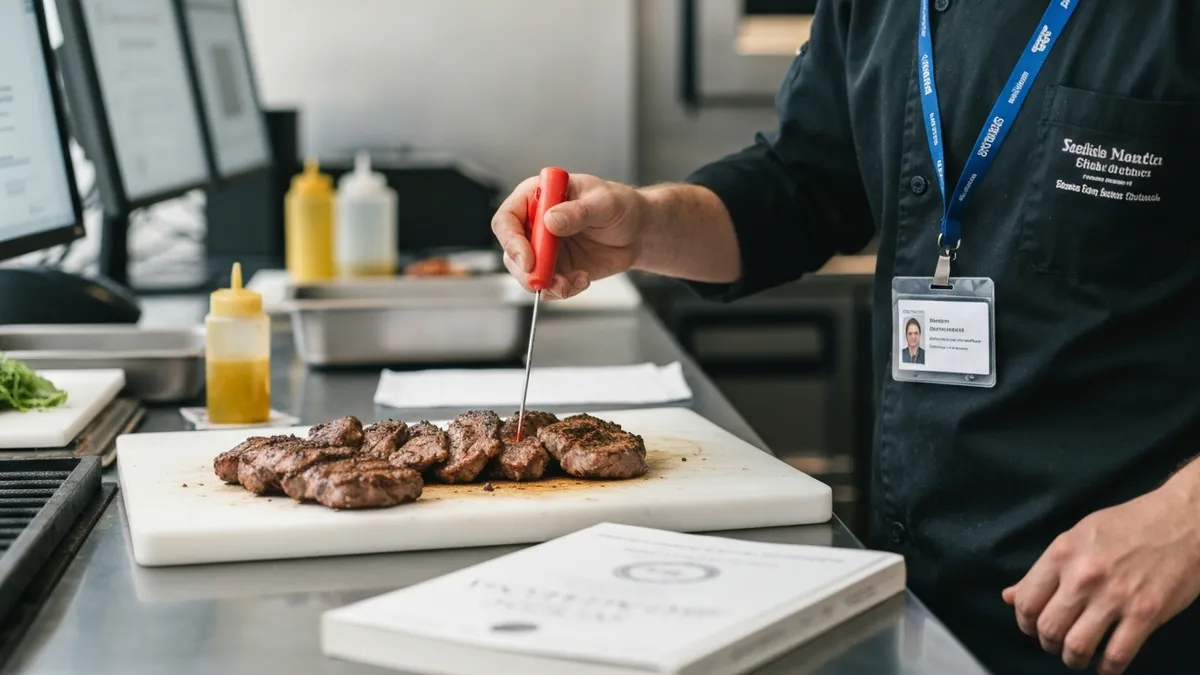
The exam format varies depending on which ServSafe certification you pursue. The Manager exam is the most rigorous — 90 questions in 2 hours with a 70% passing threshold. All ServSafe exams are available in multiple languages and can be taken online or at an approved testing center.
ServSafe certification costs range from $22 for the Allergens course to $149 for the full Manager exam with online course bundle. Many employers cover the cost of certification as part of onboarding. Group pricing is available for restaurants certifying multiple employees at once.

ServSafe Certification Requirements Checklist
- ✓Identify your required credential: Food Handler, Manager, Alcohol, or Allergens
- ✓Purchase the official course bundle at ServSafe.com (do not use third-party sites)
- ✓Study the temperature danger zone: 41°F–135°F (TCS foods must not stay in this range more than 4 hours total)
- ✓Memorize cooking temperatures: 165°F poultry, 155°F ground meat, 145°F whole fish/pork, 135°F hot-holding
- ✓Review the 5 Big 8 foodborne illness risk factors: improper holding temps, inadequate cooking, contaminated equipment, food from unsafe sources, poor personal hygiene
- ✓Practice at least 3 full-length timed mock exams using our free ServSafe practice tests
- ✓Review HACCP principles: 7 principles and how to apply Critical Control Points
- ✓Know the 9 major allergens: milk, eggs, fish, shellfish, tree nuts, peanuts, wheat, soy, sesame
- ✓For Manager exam: schedule your proctored session at least 48 hours in advance (remote proctoring books fast)
- ✓On exam day: eat beforehand, bring valid government-issued photo ID, arrive 15 minutes early
Before scheduling your ServSafe exam, make sure you have completed all prerequisites for your chosen certification level. The Manager certification requires completion of an approved training program before you can sit for the proctored exam. Food Handler certification can be completed entirely online with no prerequisites.
For more details, see our ServSafe Manager Test: Format, Passing Score, and a Smart Prep Plan guide. For more details, see our ServSafe Manager Exam: Format, Passing Score, and the Study Plan That Works guide.ServSafe Certification: Benefits vs Challenges
- +Nationally recognized and accepted in all 50 states by health departments
- +ANAB-accredited Manager certification satisfies legal requirements in most jurisdictions
- +Multiple credential types cover every role from entry-level to management
- +Online courses are self-paced with no travel or scheduling constraints
- +Certificate available immediately after passing — no waiting period
- +Food Handler exam includes unlimited free retakes in the purchase price
- +5-year validity for Manager certification reduces renewal frequency
- +Strong employer brand recognition — widely listed in job postings as required
- −Manager exam requires a proctored session — remote proctoring technology can be frustrating
- −No partial credit — each attempt requires full repurchase if the Manager exam is failed
- −Online course content can be dry and text-heavy compared to instructor-led alternatives
- −Certificate is not a license — some states require additional state-specific food handler permits
- −Renewal requires a completely new exam (no abbreviated renewal test available)
- −Third-party prep materials vary widely in quality — unofficial practice tests may not match real exam format
Pros and Cons at a Glance
| Pros | Cons |
|---|---|
| ANAB-accredited Manager certification satisfies legal requirements in most jurisdictions | Manager exam requires a proctored session — remote proctoring technology can be frustrating |
| Multiple credential types cover every role from entry-level to management | No partial credit — each attempt requires full repurchase if the Manager exam is failed |
| Online courses are self-paced with no travel or scheduling constraints | Online course content can be dry and text-heavy compared to instructor-led alternatives |
| Certificate available immediately after passing — no waiting period | Certificate is not a license — some states require additional state-specific food handler permits |
| Food Handler exam includes unlimited free retakes in the purchase price | Renewal requires a completely new exam (no abbreviated renewal test available) |
| Strong employer brand recognition — widely listed in job postings as required | Third-party prep materials vary widely in quality — unofficial practice tests may not match real exam format |
Sample ServSafe Practice Questions
Try these questions from our free ServSafe practice tests. The correct answer and an explanation follow each question.
Which method of thawing frozen food is NOT approved by the ServSafe guidelines?
- A. Thawing under refrigeration at 41°F or lower
- B. Thawing submerged in running water at 70°F or lower
- C. Thawing on a counter at room temperature overnight
- D. Thawing as part of the cooking process
Answer: C. Thawing on a counter at room temperature overnight
Thawing food at room temperature is never approved because it allows the outer layers of food to enter the temperature danger zone (41°F–135°F) for more than 4 hours while the center may remain frozen.
Under the ServSafe Alcohol program, which group of guests requires extra attention during alcohol service?
- A. Guests celebrating a birthday
- B. Visibly pregnant guests, minors, and already-intoxicated guests
- C. Guests ordering premium spirits
- D. Guests seated at the bar rather than at tables
Answer: B. Visibly pregnant guests, minors, and already-intoxicated guests
ServSafe Alcohol specifically identifies visibly pregnant individuals, minors, and guests already showing intoxication as high-risk groups requiring heightened server vigilance.
What does the acronym ALERT stand for in the ServSafe food defense framework?
- A. Assess, Limit, Evaluate, Record, Train
- B. Assure, Look, Employees, Reports, Threat
- C. Analyze, Label, Equipment, Regulate, Test
- D. Audit, Locate, Enforce, Report, Track
Answer: B. Assure, Look, Employees, Reports, Threat
ALERT stands for Assure (suppliers are safe), Look (monitor the security of products), Employees (know who is in the facility), Reports (keep records), and Threat (know what to do in an emergency). This framework is designed to protect food from deliberate contamination or tampering.
What is the temperature danger zone for TCS (Temperature Control for Safety) foods according to ServSafe?
- A. 32°F to 100°F (0°C to 38°C)
- B. 41°F to 135°F (5°C to 57°C)
- C. 40°F to 140°F (4°C to 60°C)
- D. 38°F to 165°F (3°C to 74°C)
Answer: B. 41°F to 135°F (5°C to 57°C)
ServSafe defines the temperature danger zone as 41°F to 135°F (5°C to 57°C). Within this range, pathogens can multiply rapidly. Keeping TCS foods below 41°F (refrigeration) or above 135°F (hot holding) prevents dangerous bacterial growth.
ServSafe Questions and Answers



About the Author

Registered Nurse & Healthcare Educator
Johns Hopkins University School of NursingDr. Sarah Mitchell is a board-certified registered nurse with over 15 years of clinical and academic experience. She completed her PhD in Nursing Science at Johns Hopkins University and has taught NCLEX preparation and clinical skills courses for nursing students across the United States. Her research focuses on evidence-based exam preparation strategies for healthcare certification candidates.