
ServSafe Manager Exam: Format, Passing Score, and the Study Plan That Works
ServSafe Manager exam guide: 🟢 90 questions, 80 scored, 70% pass mark (56/80). Format options, 8 domains, study plan, and free practice tests.
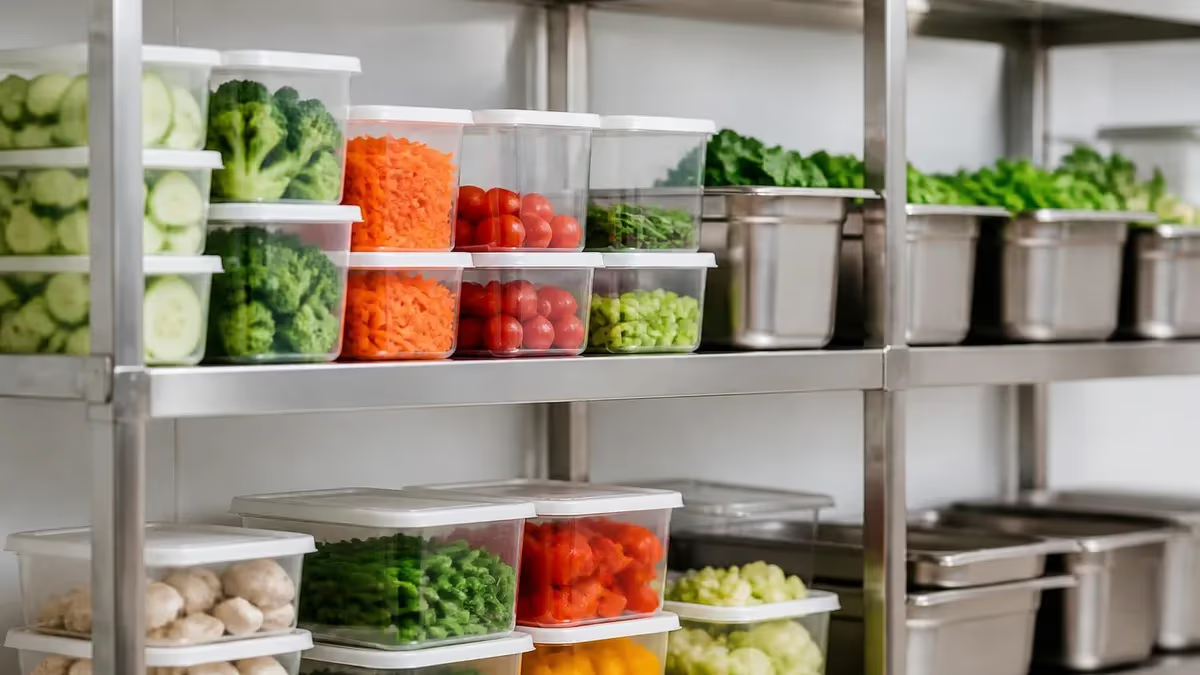
You signed up for the ServSafe Manager test, the date is on the calendar, and now you are staring at a stack of food safety material that feels three times too thick. Take a breath. The exam looks intimidating because the official handbook is dense, but the test itself follows a predictable pattern. Once you see that pattern, prep becomes a matter of hours, not weeks.
The ServSafe Manager exam is the proctored, 90-question certification that proves you can run a foodservice operation without making the public sick. It is recognized by all 50 states, accepted by the FDA Food Code, and required for the person-in-charge role in most jurisdictions. Pass it and you carry a credential good for five years; fail it and you re-pay, re-study, re-sit — usually with a 60-day cooldown depending on your state.
Here is the part nobody puts in the marketing copy. Roughly 25% of first-time candidates fail. They don't fail because the material is impossible. They fail because they cram the wrong chapters, ignore the FDA temperature numbers, and walk in unprepared for situation-based questions where two answer choices look equally correct.
This guide fixes that. We'll walk through the actual exam blueprint, the eight knowledge domains, the cut score most people get wrong by one or two questions, and the exact study sequence that takes a working line cook from "never read the book" to passing in about three weeks. If you want to test your knowledge cold before you start, jump to the ServSafe manager practice test first and bookmark this page for the breakdown.
ServSafe Manager Exam at a Glance
Key Facts at a Glance
| Item | Value | Details |
|---|---|---|
| Total questions on the exam | 90 | |
| Minimum passing score (60/80 scored) | 70% | |
| Time limit for paper or online format | Not published | |
| Certification validity period | 5 yr |
What the ServSafe Manager Exam Actually Tests
The current edition pulls every question from one of eight knowledge domains, and the National Restaurant Association weights them deliberately. Knowing the weight tells you where to spend your hours.
The biggest single chunk — about 25% of the test — sits on temperature control and time-temperature abuse. Cold holding, hot holding, cooking minimums, the 41 to 135 danger zone, the four-hour rule for ready-to-eat food. If you only have one weekend to study, study this.
The second-largest section covers contamination, allergens, and pathogens — roughly 18% combined. Expect questions on the Big 9 allergens, the difference between Salmonella and Norovirus symptoms, and cross-contact scenarios. Our servsafe covers this domain in depth.
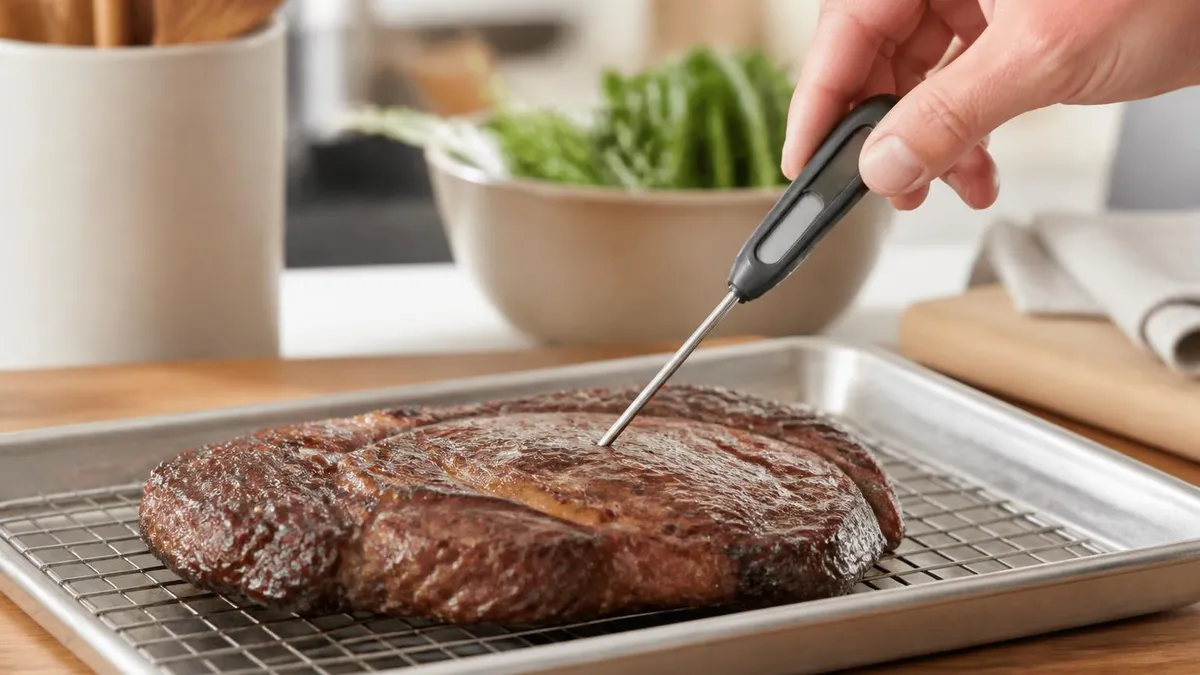
One domain people consistently underestimate is HACCP. It is only about 8% of the questions, but those questions are written to trip you up. They give you a scenario — a sous-vide rib eye, a salad bar, a chili held overnight — and ask you to identify the critical control point. If you can't name the seven HACCP principles in order, you will lose easy points. The ServSafe HACCP guide walks through each principle with sample scenarios.

The 70-out-of-90 Rule
The official passing score is 75%, but here's the catch: 10 of the 90 questions on your exam are unscored pilot items. That means only 80 questions actually count toward your score, and you need to answer 56 of the 80 scored correctly. You won't know which questions are the pilot ones — they look identical to scored items — so treat every question as if it matters. Plan to miss no more than 20 total, and aim for 75 right to give yourself a safety cushion.
Exam Format, Delivery Options, and What to Expect on Test Day
You can take the exam in three formats: paper-and-pencil with an authorized instructor, online proctored from home, or at a Pearson VUE testing center. The content is identical across all three; only the logistics differ.
Paper-and-pencil is the original format, still common in community-college food safety classes and corporate training sessions. You'll sit in a room with a proctor, fill in bubble sheets, and wait two to three weeks for results. The advantage is cost — the bundled course plus exam often runs cheaper through a local instructor than buying the components separately.
Online proctored has become the most popular option since 2020. You install ProctorU's secure browser, point your webcam at your testing space, show ID, and the proctor watches you for the full two hours. You get results the moment you click submit.
The catch is the environment requirements: no second monitor, no phone in the room, no other person walking in, no food or drink on the desk. People fail the security check more often than they fail the exam, so read the requirements twice.
Pearson VUE testing centers offer a middle path. You drive to a center, lock your belongings in a locker, sit at a workstation in a quiet room, and take the test on their hardware. No webcam stress, no internet hiccups, and you get your score immediately. Centers cost a bit more but cause fewer headaches. Use the ServSafe Manager online course if you want the official slide deck.
The Eight Knowledge Domains, Ranked by Exam Weight
About 25% of questions. Cold holding 41°F or below, hot holding 135°F or above, cooking minimums (poultry 165°F, ground meat 155°F, fish 145°F), and the danger zone math. Memorize every number.
Around 12%. Big 6 pathogens — Norovirus, Hepatitis A, Salmonella Typhi, Shigella, Shiga toxin E. coli, nontyphoidal Salmonella. Know symptoms, sources, and exclusion rules.
Around 10%. Biological, chemical, physical contamination. Big 9 allergens (added sesame in 2023). Cross-contact prevention in prep, cooking, and service.
Around 10%. Handwashing steps, glove use, bare-hand contact rules with ready-to-eat food, and when to exclude or restrict a sick employee.
Around 10%. Approved suppliers, receiving temperatures, signs of spoilage, FIFO storage rotation, shellfish tags retained 90 days.
Around 10%. Three-compartment sink setup, dishwasher water temps, lighting requirements, pest IPM, garbage disposal procedures.
Around 10%. Chlorine, quat, and iodine sanitizer concentrations. Surface contact times. Cleaning vs. sanitizing distinction (always cleaning first).
Around 13%. Seven HACCP principles, active managerial control, inspection procedures, FDA Food Code basics, and the role of the local health department.
You cannot just walk in and take this exam. You need a registered proctor, an exam access code purchased from ServSafe.com or a course package, and a valid government-issued photo ID. If you bought the manager coursebook, the access code is in the back pages — don't tear that out before you've registered. New to the credential? Start with the ServSafe manager certification page for the full enrollment walkthrough.
A Realistic Three-Week Study Plan That Actually Works
Most candidates do one of two things wrong. They either crack the coursebook open the night before and panic-flip through 300 pages, or they buy every prep product on the market and never finish any of them.
The plan below splits the difference. It assumes you have a job, a life, and maybe 45 to 60 minutes a day to study. It is the same plan used by hundreds of line cooks and shift managers who passed on the first try.
Week one is foundation. Read the official coursebook chapters on time and temperature, foodborne pathogens, and personal hygiene. Don't take notes yet. Read like you're skimming a long magazine article. The goal is to let the vocabulary settle in — TCS food, ready-to-eat, the Big 6, the danger zone — before you try to memorize anything.
End each session with a 20-question practice quiz on that day's chapter. Your scores will be ugly. That's fine. The point is to expose your weak spots early, not to feel good about yourself in week one.
Week two is targeted weakness work. Pull up the score breakdowns from your week-one quizzes and identify the two lowest-scoring domains. Spend three days on the worst one and two days on the second-worst. This is where you start writing things down — index cards for temperatures, a single page of pathogen symptoms, a checklist for receiving deliveries.
Quiz yourself daily. By Friday of week two, you should be hitting 75% on mixed-domain practice tests. If you're stuck below 70%, slow down — don't move to week three until the fundamentals are solid.
Week three is full simulation. Take three full-length 90-question practice exams under timed conditions — no phone, no notes, no pausing. The goal is endurance and pacing. Most people get fatigued around question 60 and start clicking through carelessly. Train past that. Our 30-day ServSafe certification study plan has a printable calendar version of this same sequence if you want a tracker.
Common Question Patterns That Trip Up Candidates
The exam writers love multi-correct-looking scenarios. A question gives you a sick employee with vomiting and asks what to do. Three of the four answers sound reasonable — send them home, exclude them, restrict them to non-food-handling tasks. Only one is correct under the FDA Food Code (exclude until cleared by a doctor after symptoms stop for at least 24 hours). Read every option twice. The right answer follows the regulation, not what your manager would actually do.
Day-of-Exam Checklist
- ✓Valid government photo ID (driver's license, passport, military ID — student IDs don't qualify)
- ✓Confirmation email or exam access code printed or saved to phone
- ✓Arrive 30 minutes early for paper/Pearson VUE, log in 15 min early for online proctored
- ✓Calculator? No. The exam does not require math beyond temperature reading
- ✓Water bottle and snack? Only outside the testing room — nothing on the desk
- ✓Backup ID for online proctored — proctor may ask for a second form mid-exam
- ✓Charged phone with battery backup for online format (in case Wi-Fi drops)
- ✓Quiet space cleared of all paper, books, second screens, and other people
What Happens After You Pass — and What Happens if You Don't
Pass and you get a printable certificate within 24 hours and a wallet card mailed in seven to ten business days. Your certification is good for five years from the date you passed, recognized in all 50 states for the person-in-charge requirement under the FDA Food Code.
A few jurisdictions — notably California, Texas, and Illinois — have additional state-level requirements layered on top, but the ServSafe credential is the foundation.
Fail and the rules vary by state. Most allow an immediate retake with a new access code. Some impose a 60-day waiting period. A handful require you to retake the prep course before sitting the exam again. The good news: your second attempt has a noticeably higher pass rate, probably because you now know what to expect. Use the how to pass the ServSafe exam guide for a targeted second-attempt strategy.
One detail that catches employers off guard: certification doesn't transfer. If you pass in Ohio and move to Florida, you keep your credential. But if your local health department requires its own state-specific food handler card on top of ServSafe, you'll need that separately. Check with the inspector before you assume you're covered. The ServSafe career and salary guide breaks down typical pay bumps by role.

Online Proctored vs. In-Person Testing Centers
- +Online proctored: results in seconds, take it from home, no commute
- +Online proctored: cheaper bundled with the online course package
- +Online proctored: schedule any time of day or night, 24/7 availability
- +Pearson VUE center: no webcam or environment-check stress, locked locker for personal items
- +Pearson VUE center: provided workstation, no internet or hardware issues
- +In-person classroom: bundled with instructor-led course for hands-on learners
- −Online proctored: strict environment rules — one wrong move and you forfeit the attempt
- −Online proctored: requires solid Wi-Fi and a working webcam plus mic
- −Pearson VUE center: limited locations in rural areas, may require driving 60+ miles
- −Pearson VUE center: scheduling fills up in busy months (March, August)
- −In-person classroom: paper results take 2 to 3 weeks to process
- −In-person classroom: tied to instructor schedule — less flexibility for shift workers
How the Exam Compares to Other Food Safety Certifications
If you're shopping certifications, ServSafe Manager is the most widely accepted, but it's not the only option. Prometric's Food Protection Manager Certification and the National Registry of Food Safety Professionals (NRFSP) both offer ANSI-accredited alternatives. All three are accepted by the FDA Food Code.
Where they differ is exam length, cost, and study-material availability. ServSafe sells the most prep material — coursebooks, online classes, study guides, practice tests — because the National Restaurant Association built an ecosystem around the credential. Prometric and NRFSP exams are slightly shorter (around 80 questions) but ship with thinner prep packages.
If you're a self-starter who can study from any FDA Food Code summary, the cheaper exams work fine. If you want maximum support material, stick with ServSafe.
One thing all three share: a focus on managerial-level food safety, not basic food handler content. ServSafe also offers a separate Food Handler credential — shorter, easier, valid for three years instead of five, and aimed at line-level employees rather than managers. Don't confuse the two when you're registering. The full ServSafe complete study guide has a side-by-side comparison.
One last note about practice material. The free practice quizzes online are useful for getting a feel for the question style, but they tend to be easier than the real exam. The official ServSafe practice exam (sold as a separate add-on) is the closest match in difficulty. Our ServSafe practice test set is calibrated to match real-exam difficulty, and the ServSafe manager practice test PDF works for offline study sessions.
The Domains Where Candidates Lose the Most Points
After grading thousands of practice exam results, the same three sections show up as failure zones again and again. The first is sanitizer concentration math. Candidates know chlorine, quat, and iodine exist as sanitizers, but they confuse the concentration ranges and the contact times.
Chlorine bleach is the cheapest and most common, but it's also the most fussy: 50 to 99 parts per million at 75°F, with at least seven seconds of contact. Cooler water needs higher concentration. Heavy organic load (food bits, grease) deactivates chlorine fast. Get one of these variables wrong on a real-world prep surface and your sanitizing step is useless.
The second leak point is the FIFO rotation and receiving section. Questions look easy — "What temperature should refrigerated milk be when delivered?" — but they bury secondary details inside. The milk should be 41°F or colder, yes, but the question may also ask whether you should reject a delivery if the truck temperature gauge reads 38°F but the milk feels warm on inspection. The right answer is reject and document, because you can't trust gauges alone. Our guide on food contamination and pest control covers the receiving inspection checklist that candidates underrate.
The third weak area is regulatory authority — specifically who has the power to do what during an inspection. The local health inspector can suspend your permit, embargo suspect food, and require an immediate closure. The FDA writes the model Food Code but doesn't inspect restaurants directly.
The USDA regulates meat and poultry processing but not retail foodservice. The state health department sets the rules your local inspector enforces. Five candidates out of ten get the order of authority wrong on the practice exam because the textbook explanation runs only one paragraph long. Read it twice.
A fourth quiet failure point worth naming: pest management. The questions look like throwaways — name the three main pest types, name two signs of cockroach activity, name the IPM principle — but the answer choices include nearly-identical wording that swaps one word and makes the option wrong. Read each pest-related option slowly and underline the verb.
Sample ServSafe Practice Questions
Try these questions from our free ServSafe practice tests. The correct answer and an explanation follow each question.
A food manager is setting up a HACCP plan for a chicken dish that is cooked, cooled, and reheated the next day. Which step represents a Critical Control Point (CCP) for this process?
- A. Cooking the chicken to an internal temperature of 165°F (74°C)
- B. Receiving the raw chicken from a supplier
- C. Storing the raw chicken in the walk-in cooler
- D. Plating the dish for service
Answer: A. Cooking the chicken to an internal temperature of 165°F (74°C)
Cooking is a Critical Control Point because it is the step where the biological hazard (pathogens such as Salmonella in chicken) can be eliminated by reaching the required internal temperature of 165°F (74°C). Cooling and reheating are also CCPs in this process, but cooking is the primary CCP where pathogen elimination occurs.
A manager implementing a HACCP plan identifies the step in food preparation where a specific hazard can be prevented or eliminated. What is this step called?
- A. A critical limit
- B. A critical control point
- C. A hazard analysis
- D. A corrective action
Answer: B. A critical control point
A Critical Control Point (CCP) is a step in the food preparation process where a control measure can be applied to prevent, eliminate, or reduce a food safety hazard to an acceptable level.
What is the BEST method for a food manager to verify that sanitizer solutions in the three-compartment sink are at the correct concentration?
- A. Smell the sanitizer to detect a strong chemical odor
- B. Use a chemical test kit or test strips for the specific sanitizer
- C. Verify the amount of sanitizer added by measuring it before mixing
- D. Check the color of the sanitizer solution
Answer: B. Use a chemical test kit or test strips for the specific sanitizer
Chemical test kits or test strips calibrated for the specific sanitizer (chlorine, quaternary ammonium, or iodine) provide accurate concentration readings.
Sort food that has been stored by use-by date so that you can start with the oldest items.
- A. False
- B. True
Answer: B. True
This statement accurately describes the First-In, First-Out (FIFO) method, a fundamental principle of inventory management in food service. By sorting food by use-by date and placing older items in front, establishments ensure that products are used before they expire. This practice prevents spoilage, reduces waste, and maintains food quality and safety.
ServSafe Questions and Answers
The Bottom Line on Passing First Try
Three things separate first-try passers from the people who pay twice. First, they front-load temperature memorization — every cold-holding, hot-holding, and cooking minimum locked in by the end of week one. Second, they actually take full-length timed practice exams instead of skimming chapter quizzes.
The fatigue at question 70 is real, and the only way to train for it is to sit through 90 questions in a row. Third, they don't ignore HACCP. It's only 13% of the test, but it's where careless studiers leak the five or six points that turn a 76% into a 73%.
You're going to pass this. The material is finite, the format is predictable, and the resources to prepare are everywhere. Pick a date three to four weeks out, block 45 minutes a day on the calendar, and stay with the plan. When you're a week out, run a few manager practice tests back-to-back and review every miss. When you're a day out, sleep instead of cramming. On test day, read every question twice, trust your prep, and click submit.
If you want a deeper breakdown of any single domain, the HACCP principles, the servsafe, or the broader ServSafe exam tips guide go far beyond what fits here.
One more piece of advice nobody hands out for free: stop studying the night before. The marginal value of cramming after 9 p.m. on exam eve is negative. Your brain consolidates memory during sleep, and a sleep-deprived candidate misses the situational reasoning questions every time. Get eight hours of real, uninterrupted rest the night before the test.
Eat protein in the morning instead of a sugar-loaded breakfast. Show up at the test location twenty minutes early. Trust your three weeks of focused work and let your training do the lifting. The certificate will land in your inbox by lunch on most online attempts. Good luck — you have got this.
About the Author

Registered Sanitarian & Food Safety Certification Expert
Cornell University College of Agriculture and Life SciencesThomas Wright is a Registered Sanitarian and HACCP-certified food safety professional with a Bachelor of Science in Food Science from Cornell University. He has 17 years of experience in food safety auditing, regulatory compliance, and foodservice management training. Thomas prepares food industry professionals for ServSafe Manager, HACCP certification, and state food handler examinations.
Join the Discussion
Connect with other students preparing for this exam. Share tips, ask questions, and get advice from people who have been there.
View discussion (7 replies)