
ASCP Phlebotomy Certification: Complete PBT Exam & Career Guide 2026 October
Complete ASCP phlebotomy certification guide: PBT(ASCP) eligibility routes, exam format, costs, salary data, and study strategies for 2026 October candidates. 🏆
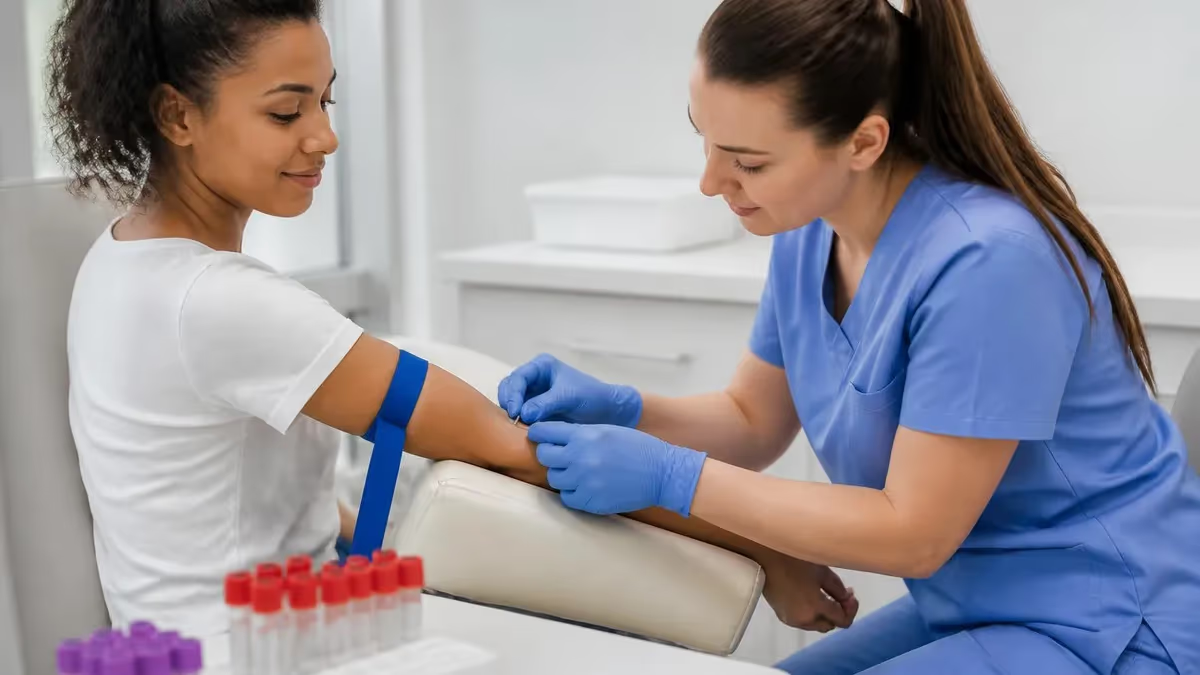
The ascp phlebotomy certification, officially called the PBT(ASCP) credential, is widely regarded as the gold standard for entry-level blood collection professionals in the United States. Administered by the American Society for Clinical Pathology Board of Certification, this credential signals that you have completed structured training, documented clinical hours, and passed a rigorous 80-question computer-adaptive examination. Hospitals, reference labs, and outpatient draw centers actively recruit PBT(ASCP)-credentialed technicians because the exam reflects the real competencies needed at the bedside, from venipuncture technique to specimen handling under CLIA-regulated workflows.
If you have been searching for phlebotomy program near me options, the ASCP route is one of five major credentialing pathways available, alongside the NHA CPT, AMT RPT, NCCT NCPT, and ASPT credentials. The ASCP exam is unique because it accepts five distinct eligibility routes, ranging from completion of an NAACLS-approved program to one full year of supervised on-the-job experience. This flexibility makes it appealing to career changers, military medics transitioning to civilian roles, and medical assistants seeking specialty certification without restarting their education.
Pass rates for the PBT(ASCP) exam typically hover near 71 percent for first-time candidates, which is competitive but achievable with structured preparation. The exam runs two hours and uses adaptive logic, meaning the difficulty of each question adjusts based on your performance on prior items. Topics span circulatory anatomy, the order of draw, additive chemistry, pediatric and geriatric collection, point-of-care testing, infection control, and laboratory operations. Understanding the weighting of each domain is critical because adaptive scoring penalizes weak areas more aggressively than it rewards strong ones.
The financial argument for certification is compelling. According to Bureau of Labor Statistics May 2024 data, the median phlebotomy technician salary is approximately 41,810 dollars per year, with top-quartile earners crossing 50,000 dollars, especially in metropolitan areas like San Francisco, Seattle, and Boston. ASCP-credentialed phlebotomists frequently command 8 to 12 percent salary premiums over uncredentialed peers, and many hospital systems require the PBT(ASCP) credential as a condition of employment or post-hire promotion. Employers view the credential as proof of standardized competency.
Beyond salary, the ASCP credential opens doors to specialty paths most people never see in entry-level training. Therapeutic phlebotomy roles, where technicians perform clinically indicated bloodletting for hemochromatosis or polycythemia vera patients, often require certification plus additional documented training. Donor center phlebotomists handling apheresis procedures earn higher hourly rates, and lead phlebotomist supervisory roles in large hospital labs are almost universally restricted to credentialed staff with two or more years of bench experience.
This guide walks you through every component of the ASCP certification process: the five eligibility routes, the application timeline, the exam blueprint, recommended study schedules, and the practical workflow for renewing your credential through the Credential Maintenance Program every three years. Whether you are a high school graduate looking at hospital-sponsored training, a military veteran with corpsman experience, or a working medical assistant ready to specialize, the information below will help you move from inquiry to credential efficiently.
Before you commit to a single training pathway, take time to compare the ASCP credential against the NHA CPT and AMT RPT alternatives. Each credential carries different prestige, fee structures, and renewal obligations. ASCP carries the strongest brand recognition inside hospital laboratory medicine, but if your career goal is exclusively physician-office or urgent-care work, a lower-cost credential may be just as effective for hiring. The right credential depends on your geography, your employer ecosystem, and your long-term career goals in laboratory science.
PBT(ASCP) Certification by the Numbers

The Five ASCP Eligibility Routes
Complete a NAACLS-approved phlebotomy program within the last five years. This is the fastest route for new students because clinical hours are embedded in the curriculum and no additional work experience is needed.
Finish an accredited training program of at least 40 classroom hours and document 100 successful venipunctures plus 5 skin punctures on live patients. Most community college programs qualify under this route.
Document at least one full year of acceptable full-time phlebotomy experience within the last five years under a qualified supervisor. Best for medical assistants and EMTs already drawing blood at work.
Hold a U.S. high school diploma or equivalent plus an accredited training program that included 40 classroom hours, 100 venipunctures, and 5 skin punctures completed in the past five years.
Complete an accredited U.S. military phlebotomy or medical laboratory technician training program. Navy corpsmen and Army 68K medical laboratory specialists frequently qualify under this pathway.
Choosing the right training program is the single most important decision you will make on the path to ASCP certification, because the program determines which eligibility route you can use and how prepared you will be on exam day. There are three main categories of programs: NAACLS-approved programs at hospitals and community colleges, state-licensed proprietary schools that meet the 40-hour minimum, and hospital-based internal training programs that prepare existing staff for certification. Each category has trade-offs in cost, schedule flexibility, clinical placement quality, and certification eligibility.
NAACLS-approved programs are the most rigorous and the most respected by hospital recruiters. These programs typically run 12 to 16 weeks, include 90 to 120 classroom hours, and embed 120 or more supervised venipunctures with documented competency checks. Graduates qualify for ASCP Route 1, the cleanest path to certification. Tuition ranges from 1,200 dollars at community colleges to 4,500 dollars at private career schools. Many hospital-affiliated NAACLS programs include guaranteed clinical placement, which is a major advantage in competitive job markets.
State-licensed proprietary schools are widely available and often advertised heavily online through searches for phlebotomy training specialists. These programs satisfy ASCP Routes 2 and 4 if they include the required 40 classroom hours and document 100 venipunctures plus 5 skin punctures. Quality varies dramatically between providers. Before enrolling, verify that the school is licensed by your state board of postsecondary education, that the program has a published job-placement rate above 60 percent, and that clinical hours occur in actual healthcare facilities rather than simulated mannequin labs alone.
Hospital-based internal training is the lowest-cost option for people already employed in healthcare. Many large hospital systems run 4 to 8 week training programs for new hires or for medical assistants transitioning into phlebotomy roles. These programs are often free, paid as part of orientation, and lead directly to ASCP eligibility through Route 3 once the trainee has accumulated one year of supervised experience. The catch is that these programs are usually restricted to current employees and require a hiring commitment.
Curriculum content is highly standardized across reputable programs because all routes prepare candidates for the same ASCP exam blueprint. Core topics include circulatory and lymphatic anatomy, vein selection and palpation, the standardized order of draw across tube colors, additive chemistry and how each anticoagulant affects test results, pediatric heelsticks, geriatric vein fragility considerations, point-of-care glucose and INR testing, specimen labeling and chain of custody, OSHA bloodborne pathogen standards, and basic specimen processing. The strongest programs add a customer service module and a workplace ethics component.
When evaluating a program, ask three specific questions before you pay tuition. First, ask the program director to show you their most recent ASCP pass-rate data and graduate placement statistics. Second, ask exactly where clinical rotations occur and how many live venipunctures you will complete before graduation. Third, ask whether the program includes an exam prep module or paid practice tests in the tuition. Reputable programs answer all three questions in writing without hesitation and provide documentation supporting their claims.
Online and hybrid programs deserve special caution. The lecture portion of phlebotomy training translates well to online delivery, but live clinical hours cannot be simulated. Be wary of any program advertising fully online certification with no in-person component, because ASCP will not accept candidates who lack documented hands-on venipuncture experience. Hybrid programs that combine online lectures with weekend clinical labs at partner facilities can be excellent options for working adults, particularly those balancing a full-time job with retraining for a healthcare career change.

Phlebotomy Practice Test Questions
Prepare for the Phlebotomy Test exam with our free practice test modules. Each quiz covers key topics to help you pass on your first try.
Phlebotomy American Medical Certification ...
Phlebotomy Exam Questions covering American Medical Certification Association Phlebotomy. Master Phlebotomy Test concepts for certification prep.
Phlebotomy American Medical Technologists ...
Free Phlebotomy Practice Test featuring American Medical Technologists Phlebotomy. Improve your Phlebotomy Exam score with mock test prep.
Phlebotomy American Society for Clinical P...
Phlebotomy Mock Exam on American Society for Clinical Pathology Phlebotomy. Phlebotomy Study Guide questions to pass on your first try.
Phlebotomy Association of Phlebotomy Techn...
Phlebotomy Test Prep for Association of Phlebotomy Technicians. Practice Phlebotomy Quiz questions and boost your score.
Phlebotomy National Center for Competency ...
Phlebotomy Questions and Answers on National Center for Competency Testing Phlebotomy. Free Phlebotomy practice for exam readiness.
Phlebotomy National Healthcareer Associati...
Phlebotomy Mock Test covering National Healthcareer Association Phlebotomy. Online Phlebotomy Test practice with instant feedback.
Phlebotomy Order of Draw and Additives
Free Phlebotomy Quiz on Order of Draw and Additives. Phlebotomy Exam prep questions with detailed explanations.
Phlebotomy Legal and Ethics
Phlebotomy Practice Questions for Phlebotomy Legal and Ethics. Build confidence for your Phlebotomy certification exam.
Phlebotomy Safety and Infection Control
Phlebotomy Test Online for Safety and Infection Control. Free practice with instant results and feedback.
Phlebotomy Special Collection Procedures
Phlebotomy Study Material on Special Collection Procedures. Prepare effectively with real exam-style questions.
Phlebotomy Specimen Processing and Handling
Free Phlebotomy Test covering Specimen Processing and Handling. Practice and track your Phlebotomy exam readiness.
Phlebotomy Test Arterial Blood Gas Collection
Phlebotomy Exam Questions covering Test Arterial Blood Gas Collection. Master Phlebotomy Test concepts for certification prep.
Phlebotomy Test Capillary and Dermal Puncture
Free Phlebotomy Practice Test featuring Test Capillary and Dermal Puncture. Improve your Phlebotomy Exam score with mock test prep.
Phlebotomy Test Pediatric Blood Collection
Phlebotomy Mock Exam on Test Pediatric Blood Collection. Phlebotomy Study Guide questions to pass on your first try.
Phlebotomy Test Phlebotomy Anatomy and Phy...
Phlebotomy Test Prep for Test Phlebotomy Anatomy and Physiology. Practice Phlebotomy Quiz questions and boost your score.
Phlebotomy Test Phlebotomy Exam Simulation
Phlebotomy Questions and Answers on Test Phlebotomy Exam Simulation. Free Phlebotomy practice for exam readiness.
Phlebotomy Test Phlebotomy Patient Identif...
Phlebotomy Mock Test covering Test Phlebotomy Patient Identification and Communication. Online Phlebotomy Test practice with instant feedback.
Phlebotomy Test Point of Care Testing
Free Phlebotomy Quiz on Test Point of Care Testing. Phlebotomy Exam prep questions with detailed explanations.
What Is Phlebotomy on the ASCP Exam: Three Critical Domains
Specimen collection accounts for roughly 47 percent of the PBT(ASCP) exam content and is the single largest domain. Expect heavy testing on vein selection, evacuated tube system mechanics, butterfly versus straight needle indications, pediatric heelstick technique, and the standardized order of draw. You must know the additive in each tube color, the inversions required, and which tests are invalidated when the order is broken.
Capillary collection questions trip up many candidates. Be ready to explain when capillary samples are inappropriate, such as for erythrocyte sedimentation rate, blood cultures, and coagulation studies. Questions also test the warming of heels in newborns to a maximum of 42 degrees Celsius, the correct lancet depth for premature infants, and the documentation expected when an arterial puncture is required for blood gas analysis on a critically ill patient.
ASCP Certification vs Other Phlebotomy Credentials
- +Strongest brand recognition in hospital laboratory medicine nationwide
- +Five flexible eligibility routes accommodate diverse backgrounds
- +Adaptive testing format finishes faster for well-prepared candidates
- +Credential transfers across all 50 states without restriction
- +CMP renewal supports ongoing professional development credibility
- +Higher employer salary premiums of 8 to 12 percent on average
- +Accepted by California CDPH for state CPT1 licensure pathway
- −Application fee of 135 dollars is higher than some competitors
- −Strict five-year recency requirement on training and experience
- −Renewal requires 36 continuing education points every three years
- −Limited to single attempt per 90-day waiting window after failure
- −Documentation burden is heavy for Routes 2, 3, and 4 applicants
- −Adaptive format can feel disorienting on first exam attempt

ASCP Phlebotomy Certification Near Me Application Checklist
- ✓Confirm which eligibility route fits your training and work history
- ✓Gather official transcripts from your phlebotomy training program
- ✓Obtain signed clinical documentation showing required venipuncture counts
- ✓Verify your training was completed within the past five calendar years
- ✓Request employer verification letters for Route 3 work experience
- ✓Scan U.S. high school diploma or GED for Routes 2 and 4 submission
- ✓Create your ASCP BOC online account at ascp.org/certification
- ✓Submit the application form and pay the 135 dollar non-refundable fee
- ✓Receive your authorization to test email within 7 to 10 business days
- ✓Schedule your Pearson VUE exam appointment at a center near you
Document everything before you click submit
The single most common reason ASCP applications get delayed is missing or incomplete documentation. Before you pay the application fee, scan every required document into a single PDF folder: transcripts, clinical hour logs with supervisor signatures, employer verification letters, and your photo ID. ASCP gives you a strict 90-day window to provide missing documentation after the initial submission, and applications that fail to complete within that window forfeit the entire 135 dollar fee.
The full cost of ASCP certification goes well beyond the 135 dollar application fee, and prospective candidates should budget realistically before committing to the pathway. Training tuition is the largest expense, ranging from roughly 700 dollars at the most affordable community colleges to 4,500 dollars at private career schools that include uniforms, textbooks, and exam vouchers. Add the application fee, exam prep materials averaging 150 to 300 dollars, transportation to clinical sites, and the opportunity cost of unpaid clinical hours, and the realistic total investment lands between 1,800 dollars and 6,000 dollars depending on your geography.
The return on that investment is generally strong, particularly compared to other allied health credentials with similar training timelines. Bureau of Labor Statistics May 2024 data shows the median phlebotomy salary at 41,810 dollars annually, with the top 10 percent of earners exceeding 56,000 dollars. Hourly wages typically range from 17 dollars at entry-level outpatient draw stations to 28 dollars for experienced lead phlebotomists in metropolitan hospital systems. Geographic variation is significant: California, Massachusetts, and Washington consistently report the highest wages, while rural Southern markets pay closer to the federal median.
The detailed phlebotomy technician salary breakdown by setting shows clear patterns. Hospital-based phlebotomists earn an average of 19.42 dollars per hour with benefits that include health insurance, paid time off, retirement matching, and tuition reimbursement. Reference laboratory phlebotomists in companies like Quest and LabCorp earn slightly less in base wage but often receive predictable schedules and clear advancement ladders into specimen processing, lab assisting, and eventually medical laboratory technician roles requiring associate degree completion.
Specialty phlebotomy roles command substantial premiums. Therapeutic phlebotomy technicians performing scheduled blood removal for hemochromatosis or polycythemia vera patients typically earn 2 to 4 dollars per hour above standard rates because of the clinical decision-making involved. Plasma donor center phlebotomists handling automated apheresis machines often earn shift differentials and quarterly performance bonuses that can add 5,000 dollars or more to annual compensation. Mobile phlebotomy contractors serving home health agencies frequently bill 25 to 40 dollars per draw as independent contractors.
Career progression within laboratory medicine is one of the most attractive aspects of the ASCP pathway. Many medical laboratory scientists, supervisors, and even pathology assistants began their careers as PBT(ASCP)-credentialed phlebotomists, using tuition reimbursement and on-the-job experience to climb into roles requiring associate or bachelor degrees. The ASCP credential is portable across this entire career ladder because the same Board of Certification administers credentials at every level, allowing seamless verification and transfer of CMP points across multiple certifications.
Cost of living adjustments matter when evaluating salary data. A 22 dollar per hour position in San Francisco delivers less purchasing power than a 19 dollar per hour position in Dallas after accounting for housing, taxes, and transportation. Use salary benchmarking tools like the BLS Occupational Employment Statistics state-level data, Indeed salary tools, and Glassdoor employer-specific reports before negotiating a job offer. ASCP-credentialed candidates have measurable negotiating use and should expect to negotiate at least 5 to 8 percent above the initial offer.
Benefits valuation is often overlooked in salary comparisons. A hospital position paying 18 dollars per hour with full medical, dental, vision, retirement matching, and 80 hours of annual paid time off can deliver substantially higher total compensation than a 21 dollar per hour position with no benefits at a small physician office. Calculate the full annual compensation package by adding the dollar value of insurance premiums, employer retirement matches, and paid leave to the base wage before comparing competing offers from different employer types.
ASCP requires that your phlebotomy training or work experience be completed within five years of your application date. Candidates who finished training six or more years ago must retake an accredited program or document one year of recent supervised experience to regain eligibility. Do not assume older training will be accepted under appeal; the policy is applied uniformly across all five eligibility routes without exception or grandfather provisions.
Once you pass the PBT(ASCP) exam, your credential is valid for three years, after which you must complete the Credential Maintenance Program to retain certification. The CMP requires 36 continuing education points across specific categories: laboratory practice, professional ethics, safety, and management or supervision. Points are earned through accredited continuing education providers, conference attendance, peer-reviewed publications, and select online courses. Failure to renew on time results in suspended credential status and requires re-examination if lapsed beyond the grace period.
Strategic CMP planning saves time and money over the three-year cycle. Many phlebotomists wait until the final six months to scramble for points, then pay premium prices for last-minute online courses. A better approach is to schedule one accredited continuing education activity per quarter, averaging 3 points per session, which delivers 36 points across three years with no end-of-cycle pressure. ASCP members receive discounted access to a continuing education library covering most CMP categories at significantly reduced costs compared to non-member rates.
Beyond renewal, certified phlebotomists have multiple advancement pathways within laboratory medicine. The most common progression is into specimen processing and accessioning roles, where ASCP-credentialed technicians handle high-volume central laboratory intake, perform aliquoting, and resolve specimen integrity issues. These roles typically pay 2 to 4 dollars per hour above bedside phlebotomy and serve as stepping stones into medical laboratory technician training, which requires an associate degree but pays in the 50,000 to 60,000 dollar range upon completion of MLT(ASCP) certification.
Specialty certifications stack effectively on top of the foundational PBT(ASCP). Donor phlebotomy technicians serving blood banks pursue the DPT(ASCP) certification, which validates competency in pre-donation screening, apheresis collection, and adverse reaction management. The DLM(ASCP) credential supports laboratory management career paths for phlebotomists who move into supervisory roles. Each stacked credential strengthens employer pricing power during salary negotiations and creates resilience against role displacement during healthcare workforce reorganization events.
Networking and professional engagement materially affect long-term career outcomes for credentialed phlebotomists. Joining the ASCP membership organization provides access to local chapter meetings, mentorship matching, conference discounts, and a peer-reviewed publication called Lab Medicine that delivers free CMP-eligible reading credits to active members. State affiliate organizations such as the California Association of Medical Laboratory Technology and the Texas Society for Pathology offer regional networking and job placement support that hospital HR portals cannot match.
Documentation discipline during clinical work protects your renewal eligibility and creates a portfolio for advancement applications. Keep a personal log of every continuing education activity, every workplace competency assessment, and every specialty procedure you observe or perform. Many hospital systems require documentation of annual competency assessment for high-risk procedures including pediatric draws, blood culture collection, and arterial blood gas sample acquisition. Your personal documentation file is the strongest defense if a workplace incident triggers an internal investigation or external regulatory review.
Understanding the standardized phlebotomy order of draw is foundational not just for the exam but for your entire career, because incorrect draw order remains one of the top three causes of laboratory test errors nationally. Hospital quality improvement committees regularly audit phlebotomy teams for compliance with the CLSI GP41 standard, and individual technicians whose specimens generate repeated additive contamination errors face progressive discipline. Strong technique built during training and reinforced through ASCP-aligned continuing education is the practical safeguard against avoidable career risk.
Practical preparation for the ASCP exam follows a predictable structure that experienced test takers have refined over many certification cycles. Most successful candidates dedicate 8 to 12 weeks of focused study, averaging 8 to 12 hours per week of mixed content review and active practice testing. The most effective study plans front-load content review during weeks 1 through 4, transition to mixed-domain practice questions during weeks 5 through 8, and finish with full-length timed simulations and weak-area remediation during the final 2 to 4 weeks before the scheduled exam date.
Active recall consistently outperforms passive rereading in certification exam preparation research. Rather than highlighting textbook pages, convert each chapter into flashcards covering vocabulary, mechanism explanations, and decision algorithms. Spaced repetition apps like Anki and Quizlet automate review intervals so that material you struggle with appears more frequently while mastered material recedes. A typical PBT(ASCP) candidate accumulates 800 to 1,200 flashcards across the full content blueprint, reviewed daily in 20 to 30 minute sessions during the study period.
Practice testing serves two functions: content reinforcement and format familiarization. The ASCP exam uses computer-adaptive testing, which means the question difficulty changes based on your performance. Practice exams that mirror this format help you build the pacing instincts needed on test day. Aim to complete at least 1,500 practice questions before sitting for the actual exam, with detailed review of every incorrect answer to identify whether the gap was content knowledge, question interpretation, or careless reading error.
Build a personal error log throughout your study period, recording every incorrect practice question with the topic, the answer you chose, the correct answer, and a brief explanation of why your reasoning was wrong. After accumulating 200 to 300 entries, patterns emerge clearly: many candidates discover they consistently miss questions on additive chemistry, pediatric collection volumes, or quality control statistics. Targeted remediation against these patterns delivers faster score improvement than additional general practice testing in the final weeks.
The day before your exam, resist the temptation to cram new content. Instead, review your error log, your highest-yield flashcards, and the standardized order of draw mnemonic until it is fully automatic. Get a full night of sleep, eat a balanced breakfast on exam day, and arrive at the Pearson VUE testing center 30 minutes early with your government-issued photo identification and your authorization to test confirmation. Anxiety management is a measurable score variable that responds to preparation and routine.
During the exam, pace yourself to roughly 90 seconds per question, but do not rush through items where you feel confident. Adaptive testing rewards accuracy over speed, so taking an extra 20 seconds on a difficult question to eliminate two wrong answers is almost always worth the investment. Use the cross-out and flag-for-review tools strategically, and remember that you cannot return to previous questions in adaptive format, so commit to your answer with confidence and move forward without second-guessing prior decisions.
Working through high-quality phlebotomy practice test banks during your final preparation weeks is the single highest-yield activity for boosting your exam-day performance. Free question banks aligned to the ASCP content outline help you identify content gaps without exhausting your paid practice resources prematurely. Pair free practice with one premium prep program that offers explanations, performance analytics, and full-length simulations to maximize both breadth and depth of preparation before your scheduled exam appointment.
Phlebotomy Questions and Answers
Phlebotomy Exam 2026: Complete Certification Study Guide & Practice
Phlebotomy: Classes, Certification, Salary & Career Guide
Phlebotomy Certification Exam 2026: Complete Guide to NHA CPT, ASCP PBT, AMT, NCCT & ASPT
Phlebotomy Test 2026: Complete Practice Exam Prep Guide
Phlebotomy Practice Exam: Free Questions, Format, and Scoring
About the Author

Registered Nurse & Healthcare Educator
Johns Hopkins University School of NursingDr. Sarah Mitchell is a board-certified registered nurse with over 15 years of clinical and academic experience. She completed her PhD in Nursing Science at Johns Hopkins University and has taught NCLEX preparation and clinical skills courses for nursing students across the United States. Her research focuses on evidence-based exam preparation strategies for healthcare certification candidates.