
OSHA Violations: Types, Penalties, and How to Avoid Them 2026
Learn about OSHA violation types, penalty amounts, inspection triggers, and proven strategies to keep your workplace compliant and citation-free. 🧠
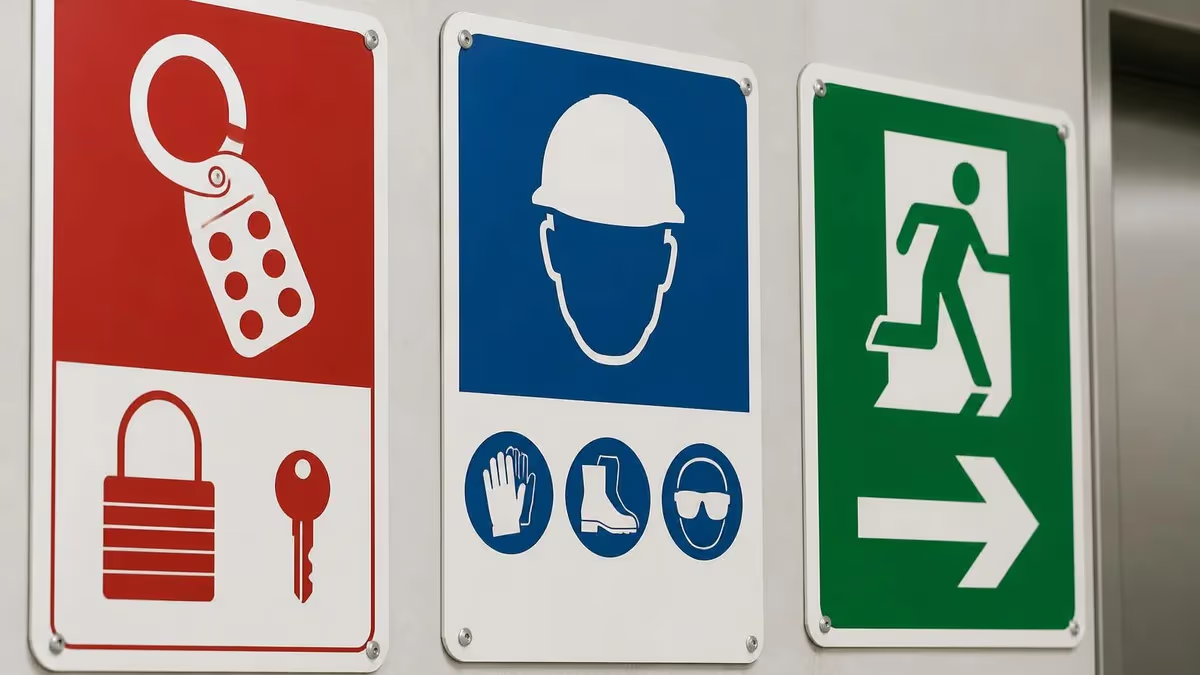
An osha violation occurs when an employer fails to meet the safety and health standards established by the Occupational Safety and Health Administration under the OSH Act of 1970. These violations range from missing safety signage to life-threatening hazards like unguarded machinery or toxic chemical exposure. OSHA conducts tens of thousands of workplace inspections annually, and citations carry penalties that can climb into the millions of dollars for the most serious offenses. Understanding what qualifies as a violation is the first step toward genuine compliance.
OSHA classifies violations into several distinct categories, each carrying its own penalty range and legal implications. The classification depends on the severity of the hazard, how likely it is to cause injury or death, and whether the employer knew — or should have known — about the dangerous condition. A willful violation, for example, signals that management was aware of the problem and chose not to fix it, which triggers the highest penalties and can even lead to criminal prosecution in cases involving worker fatalities.
Inspections are triggered by multiple pathways: programmed inspections of high-hazard industries, worker complaints filed anonymously with OSHA, referrals from other agencies, follow-up checks on prior citations, and imminent danger reports. Every employer in the country is subject to federal OSHA jurisdiction or an equivalent state plan program. Currently, 29 states and territories operate their own OSHA-approved state plans, which must be at least as effective as the federal program and often carry comparable or higher penalties.
The financial impact of a single inspection can be staggering. In fiscal year 2023, OSHA proposed over $298 million in penalties across all inspections. Individual citations for willful or repeat violations can reach $156,259 per violation as of 2024, and those amounts are adjusted annually for inflation. Beyond fines, employers face increased insurance premiums, damaged reputation, worker turnover driven by safety concerns, and the potential for costly civil litigation filed by injured employees or their families.
For workers, understanding OSHA violations matters just as much as it does for employers. Section 11(c) of the OSH Act prohibits employers from retaliating against workers who report hazards, file complaints, or exercise their safety rights. Employees who face retaliation have 30 days from the adverse action to file a complaint with OSHA. The agency can order reinstatement, back pay, and other relief. This protection is fundamental: safe workplaces depend on workers being able to speak up without fear of punishment.
Safety professionals, supervisors, and workers who understand the full landscape of OSHA violations are far better positioned to prevent them. Proactive hazard identification, regular self-audits, strong safety training programs, and open communication channels between management and employees all reduce the probability of a citation. Companies with strong safety cultures also tend to have lower injury rates, which directly impacts their OSHA Total Recordable Incident Rate — a metric that influences bid eligibility, insurance costs, and public perception.
This guide covers every major aspect of OSHA violations: the classification system, specific penalty amounts, the inspection process, the most frequently cited standards, and practical compliance strategies you can implement immediately. Whether you are a first-time safety coordinator or a seasoned EHS professional preparing for a certification exam, this resource provides the foundational knowledge and actionable steps needed to protect your workers and your organization.
Free OSHA Safety Certificate Study Tools
Interactive OSHA Safety Certificate resources on PracticeTestGeeks, free to start:
- OSHA Safety Certificate flashcards — review key terms and concepts card by card
- OSHA Safety Certificate study guide — topic-by-topic overview of what the exam covers
- OSHA Safety Certificate cheat sheet — one-page printable summary for last-minute review
OSHA Violations by the Numbers

Types of OSHA Violations Explained
The employer intentionally disregarded OSHA standards or showed plain indifference to employee safety. Penalties range from $11,524 to $156,259 per violation. Criminal charges are possible if a worker dies as a direct result of the willful act.
A hazard that could cause death or serious physical harm and the employer knew or should have known about it. Mandatory penalty up to $15,625 per violation. The most common citation type issued during OSHA inspections.
A violation that has a direct relationship to job safety and health but probably would not cause death or serious harm. Discretionary penalty up to $15,625. Often issued for paperwork errors, missing labels, or minor procedural gaps.
A violation of the same or similar standard found within five years of a final order for a prior violation. Penalties up to $156,259 per citation. OSHA checks its national database, so a violation at a different company location still counts.
An employer who does not correct a cited violation by the abatement deadline faces a civil penalty of up to $15,625 per day the violation continues past the deadline. These accumulate quickly and can dwarf the original citation penalty.
OSHA penalty amounts are not static — they are adjusted each January 1 under the Federal Civil Penalties Inflation Adjustment Act Improvements Act of 2015. The 2024 maximums set serious, other-than-serious, and failure-to-abate penalties at $15,625 per violation per day, while willful and repeat violations cap at $156,259. These figures represent the ceiling, not the floor. OSHA compliance officers use a penalty calculation worksheet that considers the gravity of the hazard, employer size, good faith demonstrated by the company, and prior violation history before arriving at a proposed penalty.
Gravity is the most heavily weighted factor in penalty calculation. OSHA evaluates both the severity of potential injury and the probability that an injury could actually occur given the conditions observed. A gravity-based penalty is first established, then adjustments are applied. Employers with ten or fewer employees receive a 70 percent reduction. Employers with 11 to 25 employees receive 60 percent off. Companies with 26 to 100 employees get 40 percent, and those with 101 to 250 workers receive a 20 percent reduction. These small-employer adjustments are not available for willful violations.
Good faith reductions of up to 25 percent are available when an employer has a documented, functioning safety and health program in place at the time of inspection. This is a powerful incentive to maintain written programs, conduct regular training, and keep records current. OSHA also provides up to a 10 percent penalty reduction for employers with no prior violations in the past three years — the clean history reduction. Layering these deductions can significantly reduce the final proposed penalty, but they require documented evidence at the time of inspection.
State plan states set their own penalty schedules, which must be at least as effective as the federal program. Some states, such as California (Cal/OSHA), Oregon (OR-OSHA), and Washington (WISHA), impose penalties that meet or exceed federal levels. California's maximum serious penalty is $25,000 per violation, and repeat or willful violations carry even steeper fines. Multi-state employers must track both federal OSHA and state plan requirements simultaneously — the applicable standard is whichever provides greater worker protection.
Beyond the direct penalty cost, employers must factor in indirect costs. Studies consistently show that the indirect cost of a workplace injury — including lost productivity, medical management time, retraining, equipment repair, and administrative burden — is four to ten times greater than the direct cost (workers' compensation and medical bills). A single serious injury resulting from a citation-worthy hazard can therefore cost a medium-sized employer hundreds of thousands of dollars even before litigation enters the picture. The ROI on proactive safety investment is overwhelmingly positive.
Informal conferences are available to employers who want to discuss a citation with the OSHA Area Director before the 15-day contest deadline expires. These meetings frequently result in penalty reductions in exchange for documented abatement plans, enrollment in a compliance assistance program, or evidence of corrective action already taken. Employers who are financially strained can sometimes negotiate installment payment plans. Attending an informal conference does not waive the right to later contest the citation formally before the Occupational Safety and Health Review Commission (OSHRC).
Understanding the penalty structure is essential preparation for the OSHA 10-hour and 30-hour outreach training programs, as well as for the OSHA Safety Certificate examinations. Questions about violation categories, penalty amounts, and the inspection process appear regularly on practice tests. Knowing the specific dollar thresholds — $15,625 for serious violations, $156,259 for willful and repeat — and understanding the penalty reduction factors will help you answer calculation-based and scenario questions with confidence on exam day.
OSHA Practice Test Questions
Prepare for the OSHA - Safety Certificate exam with our free practice test modules. Each quiz covers key topics to help you pass on your first try.
OSHA Basic OSHA Practice
OSHA Exam Questions covering Basic OSHA Practice. Master OSHA Test concepts for certification prep.
OSHA Confined Space Entry
Free OSHA Practice Test featuring Confined Space Entry. Improve your OSHA Exam score with mock test prep.
OSHA Fall Protection
OSHA Mock Exam on Fall Protection. OSHA Study Guide questions to pass on your first try.
OSHA - Safety Certificate Electrical Safet...
Free OSHA Quiz on OSHA - Safety Certificate Electrical Safety Standards Questions and Answers. OSHA Exam prep questions with detailed explanations.
OSHA - Safety Certificate Emergency Action...
OSHA Practice Questions for OSHA - Safety Certificate Emergency Action and Fire Plans Questions and Answers. Build confidence for your OSHA certification exam.
OSHA - Safety Certificate Hazard Communica...
OSHA Test Online for OSHA - Safety Certificate Hazard Communication Standard Questions and Answers. Free practice with instant results and feedback.
OSHA - Safety Certificate Introduction to ...
OSHA Study Material on OSHA - Safety Certificate Introduction to OSHA Questions and Answers. Prepare effectively with real exam-style questions.
OSHA - Safety Certificate Lockout/Tagout P...
Free OSHA Test covering OSHA - Safety Certificate Lockout/Tagout Procedures Questions and Answers. Practice and track your OSHA exam readiness.
OSHA - Safety Certificate Machine Guarding...
OSHA Exam Questions covering OSHA - Safety Certificate Machine Guarding Requirements Questions and Answers. Master OSHA Test concepts for certification prep.
OSHA - Safety Certificate OSHA Recordkeepi...
Free OSHA Practice Test featuring OSHA - Safety Certificate OSHA Recordkeeping and Reporting Questions and Answers. Improve your OSHA Exam score with mock test prep.
OSHA - Safety Certificate Personal Protect...
OSHA Mock Exam on OSHA - Safety Certificate Personal Protective Equipment (PPE) Questions and Answers. OSHA Study Guide questions to pass on your first try.
OSHA - Safety Certificate Walking and Work...
OSHA Test Prep for OSHA - Safety Certificate Walking and Working Surfaces Questions and Answers. Practice OSHA Quiz questions and boost your score.
OSHA - Safety Certificate Electrical Safet...
OSHA Mock Test covering - Safety Certificate Electrical Safety Standards. Online OSHA Test practice with instant feedback.
OSHA - Safety Certificate Emergency Action...
Free OSHA Quiz on - Safety Certificate Emergency Action and Fire Plans. OSHA Exam prep questions with detailed explanations.
OSHA - Safety Certificate Hazard Communica...
OSHA Practice Questions for - Safety Certificate Hazard Communication Standard. Build confidence for your OSHA certification exam.
OSHA - Safety Certificate Introduction to ...
OSHA Test Online for - Safety Certificate Introduction to OSHA. Free practice with instant results and feedback.
OSHA - Safety Certificate Lockout/Tagout P...
OSHA Study Material on - Safety Certificate Lockout/Tagout Procedures. Prepare effectively with real exam-style questions.
OSHA - Safety Certificate Machine Guarding...
Free OSHA Test covering - Safety Certificate Machine Guarding Requirements. Practice and track your OSHA exam readiness.
OSHA - Safety Certificate OSHA Recordkeepi...
OSHA Exam Questions covering - Safety Certificate OSHA Recordkeeping and Reporting. Master OSHA Test concepts for certification prep.
How OSHA Inspections Are Triggered and Conducted
OSHA prioritizes inspections using a strict hierarchy. Imminent danger situations — where a hazard is likely to cause death or serious injury before it can be corrected through normal enforcement channels — receive the highest priority. Next come fatality and catastrophe investigations, which are mandatory when a worker dies or three or more workers are hospitalized as a result of a workplace incident. Worker complaints, whether filed online or by phone, rank third. Referrals from other federal or state agencies and media reports round out the reactive triggers.
Programmed inspections form the proactive side of OSHA enforcement. Industries with historically high injury rates — construction, agriculture, logging, roofing, and manufacturing — appear on scheduling lists generated from OSHA's data systems. Establishments that have never been inspected and that operate in high-hazard Standard Industrial Classification codes are prime candidates. Follow-up inspections verify that cited violations from a prior inspection have been corrected within the agreed abatement period, closing the loop on the enforcement cycle.

Benefits of Proactive OSHA Compliance vs. Risks of Violations
- +Reduced injury rates lower workers' compensation premiums by an average of 20–40% over time
- +Documented safety programs qualify employers for penalty reductions of up to 25% during inspections
- +Strong safety culture improves employee morale, retention, and productivity across all departments
- +Compliance with OSHA standards reduces civil litigation exposure from injured worker lawsuits
- +Many large clients and government contracts require clean OSHA inspection history for bid eligibility
- +Proactive hazard abatement prevents costly production downtime caused by equipment failures or injuries
- −Willful violations carry penalties up to $156,259 per citation — enough to threaten small business survival
- −Repeat violations within five years trigger the maximum penalty tier with no small-employer discount
- −Criminal prosecution is possible when a willful violation directly causes a worker fatality
- −Failure-to-abate penalties accumulate daily at up to $15,625 per day after the deadline passes
- −OSHA citations become public record, damaging company reputation with clients, insurers, and job seekers
- −State plan states like California impose penalties that exceed federal maximums, compounding risk
Pros and Cons at a Glance
| Pros | Cons |
|---|---|
| Strong safety culture improves employee morale, retention, and productivity across all departments | Repeat violations within five years trigger the maximum penalty tier with no small-employer discount |
| Compliance with OSHA standards reduces civil litigation exposure from injured worker lawsuits | Criminal prosecution is possible when a willful violation directly causes a worker fatality |
| Many large clients and government contracts require clean OSHA inspection history for bid eligibility | OSHA citations become public record, damaging company reputation with clients, insurers, and job seekers |
| Proactive hazard abatement prevents costly production downtime caused by equipment failures or injuries | State plan states like California impose penalties that exceed federal maximums, compounding risk |
OSHA Compliance Checklist: 10 Actions to Prevent Violations
- ✓Conduct a comprehensive annual hazard assessment covering all work areas, equipment, and job tasks.
- ✓Maintain current written safety programs for all applicable OSHA standards (HazCom, LO/TO, PPE, etc.).
- ✓Ensure OSHA 300, 300A, and 301 injury logs are complete, accurate, and posted from February 1 through April 30.
- ✓Provide documented, topic-specific safety training for every new hire before their first exposure to a hazard.
- ✓Implement a formal Lockout/Tagout (LOTO) program with machine-specific procedures for all energy-controlled equipment.
- ✓Inspect and maintain all fall protection systems, including guardrails, uses, and anchor points, before each use.
- ✓Keep Safety Data Sheets (SDS) accessible to all employees in areas where hazardous chemicals are present.
- ✓Perform regular safety walkthroughs and document findings with corrective action deadlines and responsible parties.
- ✓Establish a written emergency action plan and conduct evacuation drills at least annually.
- ✓Investigate all near-misses and recordable incidents within 24 hours and implement corrective actions promptly.
The Fatal Four Still Kill More Than 60% of Construction Workers
Falls, struck-by objects, electrocution, and caught-in/between hazards — collectively called the Fatal Four — account for more than 60% of all construction fatalities each year. OSHA's corresponding standards for fall protection (1926.501), scaffolding (1926.451), and ladders (1926.1053) consistently top the most-cited list. Addressing these four hazard categories alone would save nearly 600 construction lives annually and eliminate the majority of serious construction citations.
OSHA publishes its list of the ten most frequently cited standards every fiscal year, and the rankings rarely change dramatically from year to year. Fall protection in construction (29 CFR 1926.501) has held the top spot for over a decade, with compliance officers issuing thousands of citations annually for missing guardrails, lack of personal fall arrest systems, and inadequate roof work procedures. The consistency of this citation reflects both the physical reality of construction work at height and the persistent gap between employer awareness and actual implementation of fall protection plans.
Hazard Communication (29 CFR 1910.1200) ranks near the top every year across general industry, construction, and maritime. The standard requires written HazCom programs, proper labeling of all hazardous chemicals, accessible Safety Data Sheets, and employee training on chemical hazards and protective measures. Despite being in place since 1983 and updated in 2012 to align with the Globally Harmonized System (GHS), HazCom violations remain pervasive. Common deficiencies include unlabeled secondary containers, outdated SDS binders, and training that was delivered once at onboarding and never refreshed.
Respiratory Protection (29 CFR 1910.134) generates a high volume of citations in industries involving dust, fumes, mists, gases, and vapors. The standard requires a written respiratory protection program, medical evaluations before respirator use, fit testing for tight-fitting respirators, and employee training. Many employers provide respirators to employees without fulfilling the full program requirements — a shortcut that OSHA consistently cites. Voluntary respirator use still requires the employer to provide users with the informational appendix and ensure that use does not create a hazard.
Scaffolding violations (29 CFR 1926.451) remain a perennial top-ten citation in construction. Common deficiencies include missing guardrails on platforms more than ten feet above lower levels, inadequate platform planking, failure to have scaffolds designed by a qualified person, and lack of training for scaffold erectors and users. Scaffold collapse incidents often result in multiple fatalities in a single event, making this one of OSHA's highest-consequence standard areas. Compliance requires attention to load ratings, weather considerations, and the specific training requirements for each type of scaffold system.
Lockout/Tagout (29 CFR 1910.147) protects workers from the unexpected energization or startup of machinery and equipment during service and maintenance. OSHA's most cited LOTO deficiencies are failure to develop machine-specific energy control procedures, missing annual inspections of the LOTO program, and inadequate employee training. The standard requires that each piece of energy-controlled equipment have its own written procedure identifying every energy source, isolation point, and verification step. Generic LOTO programs that do not go to the machine level are invariably cited when inspected.
Powered Industrial Trucks (29 CFR 1910.178) cover forklifts and other material-handling equipment used in warehouses, manufacturing facilities, and distribution centers. With nearly 100 fatalities and 95,000 injuries occurring annually in forklift-related incidents, OSHA inspectors focus heavily on operator training certification, pre-shift inspections, and safe operating procedures in pedestrian areas. Repeat violations in this category often result from companies certifying operators once and never refreshing their training after incidents or observed performance deficiencies, which OSHA's standard requires.
Ladder violations (29 CFR 1926.1053 for construction; 1910.23 for general industry) complete the picture of the most frequently cited standards. Specific violations include using ladders on unstable surfaces, failing to extend extension ladders three feet above the landing point, not maintaining three points of contact, and using ladders with broken or missing rungs. The 2019 update to the general industry ladder standard added new requirements for fixed ladders including ladder safety systems for ladders more than 24 feet in unbroken length. Many general industry employers are still catching up to these changes.
Employers have exactly 15 working days from receipt of a citation to formally contest it before the Occupational Safety and Health Review Commission (OSHRC). If you miss this deadline, the citation and proposed penalty become a final order, legally binding and non-appealable. Even if you believe the citation is factually incorrect, the OSHRC has no authority to hear your case after the deadline. Mark your calendar immediately upon receiving any OSHA citation and consult with a qualified safety attorney or consultant before the window closes.
Contesting an OSHA citation is a legal right available to every cited employer, and it is sometimes the most prudent course of action even when a violation did occur. The contest process begins with filing a written notice of contest with the OSHA Area Director within 15 working days of receiving the citation. This notice does not need to be elaborate — a brief letter stating the employer's intent to contest is sufficient. Once filed, the matter is docketed with the Occupational Safety and Health Review Commission, an independent adjudicative agency separate from OSHA itself.
After docketing, the case is typically assigned to an Administrative Law Judge (ALJ) who holds a formal hearing. Both sides present evidence, call witnesses, and make legal arguments. OSHA bears the burden of proving the violation by a preponderance of the evidence. Employers can challenge the citation on multiple grounds: arguing that the standard does not apply, that the conditions observed did not constitute a violation, that the exposure was not recognized or foreseeable, that the penalty amount is inappropriate, or that the abatement deadline is unrealistic given the technical or financial challenges involved.
Settlement is the most common resolution of contested OSHA cases. Before a formal hearing, the parties typically negotiate with the assistance of the ALJ. Settlements can result in reduced penalties, reclassification of the violation type (for example, from willful to serious), extended abatement deadlines, or in some cases withdrawal of citations. Employers who demonstrate a genuine commitment to correcting the hazard — by submitting abatement documentation and evidence of systemic safety improvements — are generally in a stronger negotiating position than those who contest primarily to delay payment.
Employers who lose at the ALJ level may appeal to the full OSHRC and subsequently to a federal Circuit Court of Appeals. These higher-level appeals are relatively rare and typically involve novel legal questions about regulatory interpretation or constitutional issues. For most small to mid-sized employers, the ALJ hearing or pre-hearing settlement represents the practical end of the contest process. The cost of litigating to the appellate level — in both attorney fees and management time — usually exceeds the penalty being contested.
Workers and their representatives also have rights in the contest process. If an employer contests a citation, affected employees and their union (if any) may elect party status and participate in the OSHRC proceedings. This gives workers a direct voice in ensuring that abatement requirements are upheld even if the employer is challenging the penalty amount. Worker party status is an important safeguard against situations where employers contest citations primarily to delay correcting dangerous conditions, using the legal process as a tool to avoid accountability.
One often-overlooked aspect of the citation process is the abatement certification requirement. Even when an employer contests a citation, most abatement obligations remain in effect during the contest unless a stay is specifically granted by the OSHRC. This means employers generally must continue correcting the hazard while simultaneously pursuing a legal challenge to the citation's validity or penalty amount. Failure to continue abatement while contesting can result in failure-to-abate penalties accumulating throughout the contest period — adding to the employer's ultimate financial exposure.
Documenting every step of your response to an OSHA citation is critical regardless of whether you contest or accept it. Keep copies of the citation, your abatement log, training records, corrective action photos, and any correspondence with OSHA. This documentation protects you during follow-up inspections, demonstrates good faith to reduce penalties in future citations, and provides evidence for your defense if a cited hazard later contributes to an injury. Thorough recordkeeping is not just good compliance practice — it is your primary legal asset in any enforcement proceeding.
Building a culture of safety that prevents OSHA violations requires more than posting rules and conducting annual training. The most effective safety programs share common structural features: visible leadership commitment, employee involvement in hazard identification, consistent accountability for safety performance, and integration of safety metrics into business decision-making. When workers see that management walks safety protocols themselves — wearing PPE, conducting walkthroughs, stopping unsafe work immediately — they internalize that safety is a genuine organizational value, not just a compliance box to check before inspections.
Job Hazard Analysis (JHA), also called Job Safety Analysis (JSA), is one of the most powerful tools available for preventing violations before they arise. A JHA breaks a job into sequential steps, identifies the potential hazards at each step, and specifies the recommended controls to eliminate or reduce each hazard. Conducting JHAs with input from the workers who actually perform the tasks produces more accurate hazard identification and stronger worker buy-in for the resulting procedures. OSHA compliance officers often review JHA documentation during inspections as evidence of a functioning safety management system.
Hierarchy of controls is the framework OSHA expects employers to apply when addressing identified hazards. Elimination — physically removing the hazard — is most effective. Substitution replaces a hazardous material or process with a safer alternative. Engineering controls isolate workers from hazards through physical means such as machine guarding, ventilation systems, or interlocks. Administrative controls change how work is done through scheduling, rotation, procedures, and training. Personal protective equipment (PPE) is last in the hierarchy because it only protects the individual worker and can fail. Relying primarily on PPE when engineering controls are feasible is a pattern OSHA frequently cites.
Near-miss reporting programs are statistically proven to reduce serious injuries and fatalities. For every fatality that occurs, there are approximately 30 serious injuries, 300 minor injuries, and thousands of near-misses. By capturing and analyzing near-misses before they progress up this pyramid, organizations can identify systemic hazards and implement corrective actions proactively. A psychologically safe environment — where workers can report near-misses without blame — is a prerequisite for effective reporting programs. Employers who track and act on near-misses consistently demonstrate lower OSHA Total Recordable Incident Rates over time.
Safety audits and self-inspections are the employer's opportunity to find and fix hazards before an OSHA compliance officer does. Effective self-inspection programs use the same checklists and standards that OSHA inspectors apply, walk every area of the workplace on a regular schedule, involve both safety professionals and front-line workers, generate written reports with specific corrective action assignments and deadlines, and track completion of those actions to closure. Some employers also use third-party consultants or voluntary OSHA consultation services — available free to small and medium employers through OSHA's On-Site Consultation Program — to gain an unbiased outside perspective.
Training frequency and quality matter enormously for OSHA compliance. Many citations result not from a complete absence of training but from training that was too brief, too generic, too long ago, or conducted in a language workers did not fully understand. OSHA standards generally require training in a language and vocabulary the employee understands. Refresher training after incidents, when workers change jobs, or when new hazards are introduced is a best practice that also reflects specific requirements in several standards. Documenting training — capturing the date, content, trainer's name, and each attendee's signature — is as important as delivering it.
Finally, using OSHA's free and low-cost resources can dramatically accelerate your compliance program without significant budget investment. OSHA's On-Site Consultation Program sends trained safety consultants to small businesses at no charge, with a guarantee that findings will not be shared with enforcement staff. OSHA's eTools, QuickTakes newsletter, and Alliance Program publications provide industry-specific guidance on the most common hazards. The OSHA Training Institute Education Centers offer affordable courses for safety personnel. Proactively using these resources signals good faith and builds the documented foundation that can reduce penalties if an inspection does occur.
Readers who want more detail usually continue with osha violation.
For a deeper look at this topic, see our guide to osha violation.
Sample OSHA Safety Certificate Practice Questions
Try these questions from our free OSHA Safety Certificate practice tests. The correct answer and an explanation follow each question.
Which event must be reported to OSHA within 24 hours?
- A. An in-patient hospitalization of a worker due to a work-related incident
- B. A work-related fatality
- C. A near-miss incident with no injuries
- D. An employee complaint about unsafe conditions
Answer: A. An in-patient hospitalization of a worker due to a work-related incident
Work-related in-patient hospitalizations, amputations, and losses of an eye must be reported to OSHA within 24 hours.
At what height above a lower level does OSHA require fall protection in general industry walking-working surfaces?
- A. 4 feet
- B. 6 feet
- C. 10 feet
- D. 15 feet
Answer: A. 4 feet
General industry (1910 Subpart D) requires fall protection when a walking-working surface is 4 feet or more above a lower level.
How often must the LOTO energy control procedures be inspected under OSHA?
- A. Every five years
- B. At least annually
- C. Only when an accident occurs
- D. Every ten years
Answer: B. At least annually
OSHA requires a periodic inspection of energy control procedures at least annually.
Under OSHA's walking-working surfaces standard, what is the maximum load rating information that must be marked on a floor or roof opening cover?
- A. The cover must be able to support the maximum intended load
- B. The cover must support at least 100 pounds
- C. The cover must support twice the weight of the heaviest employee
- D. The cover must support at least 500 pounds
Answer: A. The cover must be able to support the maximum intended load
Covers must be capable of supporting the maximum intended load that may be imposed on them per 29 CFR 1910.29.
OSHA Questions and Answers

OSHA TRIR Calculator: Formula, Calculation Steps, and Industry Benchmarks

OSHA Approved Hard Hats: Complete 2026 Guide to ANSI Z89.1 Compliance, Types, and Workplace Requirements

OSHA.gov: Your Complete Guide to the Official OSHA Website

OSHA 510: Course Content, Path to Trainer, and Realistic Path

OSHA Eyewash Requirements: Complete 2026 Guide to Eye Wash Stations, ANSI Z358.1 Compliance, and Workplace Standards
About the Author

Certified Safety Professional & OSHA Compliance Expert
Indiana University of Pennsylvania Safety SciencesDr. William Foster holds a PhD in Safety Science from Indiana University of Pennsylvania and is a Certified Safety Professional (CSP) and Certified Hazardous Materials Manager. With 20 years of occupational health and safety management experience across construction, manufacturing, and chemical industries, he coaches safety professionals through OSHA certification, CSP, CHST, and safety management licensing programs.
Join the Discussion
Connect with other students preparing for this exam. Share tips, ask questions, and get advice from people who have been there.
View discussion (8 replies)