
NCAE Reviewer for Grade 10 (2026 September): Subjects, Sample Questions and a 4-Week Study Plan
NCAE reviewer for Grade 10: every CB-NCAE subtest, free sample questions, what your RIASEC profile means and a 4-week plan. 📝 Official DepEd facts, no fee.

If you're in Grade 10 in the Philippines this school year, the National Career Assessment Examination is coming for you, not for the Grade 9 batch below you. That's the biggest change since the exam went computer-based. DepEd Memorandum No. 108, s. 2025 moved the test to Grade 10 learners in public schools and in private schools with a government permit, and it runs on a computer instead of a paper booklet. Old reviewers written for the Grade 9 paper version still help with the questions, but they miss the new format entirely.
This NCAE reviewer for Grade 10 is built around the current CB-NCAE: what each subtest measures, how the career inventory works, what kind of items you'll meet, and a realistic four-week plan you can follow alongside your regular classes. It also covers the part most reviewers skip, which is how to read your results once they arrive and use them to pick a Senior High School strand. When you're ready to try real items, the ncae test hub on this site has timed practice sets for every domain.
One quick note on what the NCAE is and isn't. It's not a pass-or-fail exam. Nobody repeats a grade because of it. It's an aptitude and interest profile that DepEd uses to give you a track recommendation, and that some scholarship programs and schools look at. Treating it seriously helps you, but panicking over it doesn't.
CB-NCAE for Grade 10 at a Glance
The key facts every Grade 10 examinee should know before opening a reviewer, taken from DepEd's official memoranda.
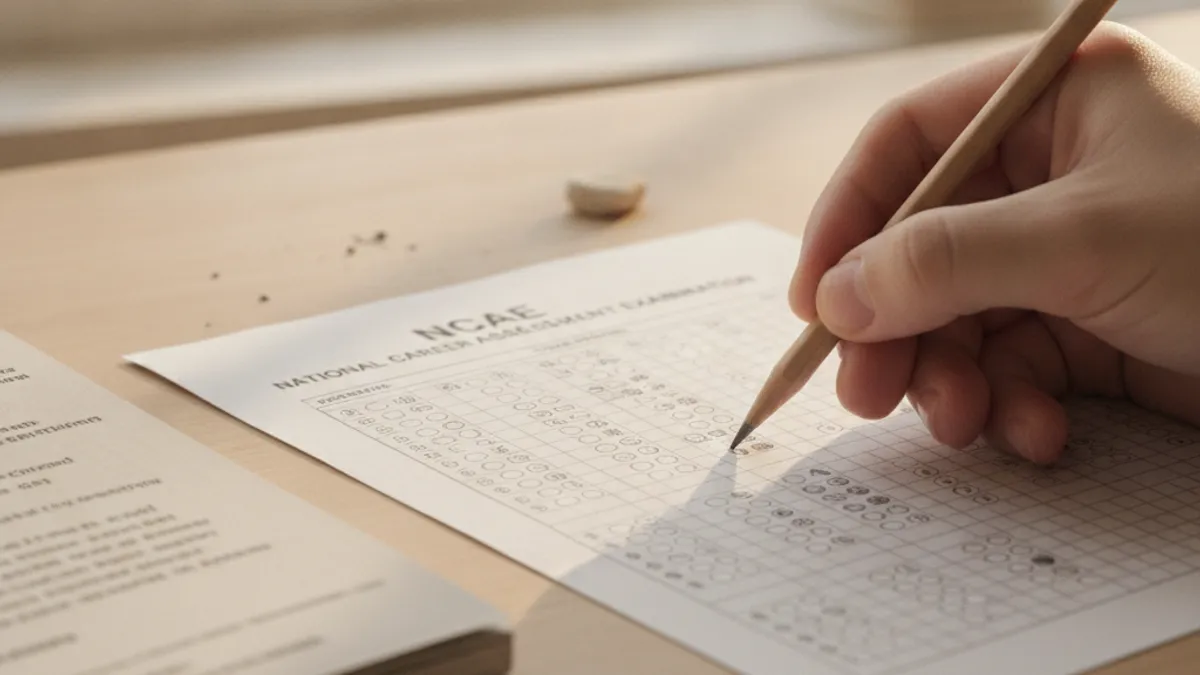
What Changed: The CB-NCAE Moves to Grade 10
For years the NCAE was a Grade 9 paper test. That ended with DepEd Memorandum No. 108, s. 2025, dated December 11, 2025. The memo directed the Bureau of Education Assessment, working with the schools division offices, to give the Computer-Based National Career Assessment Examination to all Grade 10 learners for School Year 2025-2026. The legal basis is still DepEd Order No. 55, s. 2016, the same policy that governs the other national assessments, so the purpose of the exam didn't change.
In practice, that means the aptitude scores and the interest profile still serve one job: giving you and your guidance counsellor a data point for choosing a Senior High School track. Only the grade level and the delivery did.
The testing window opened in December 2025 and was supposed to close at the end of January 2026.
Regional and division offices asked for more time, and BEA extended the window to February 28, 2026. Your own test date inside that window is set by your schools division office together with the regional office, which is why two schools in different provinces can sit the same exam weeks apart. If you missed the window or you're reading this ahead of the next cycle, DepEd hasn't yet posted the administration memo for SY 2026-2027, so watch your school's announcements rather than trusting a date from a random reviewer.
The other new piece is the mandatory mock test. Every Grade 10 learner takes a practice run on the computer platform starting December 1, 2025, at least a week before the real administration. It exists to get you comfortable clicking through items, flagging questions and navigating between subtests. Treat it as a free rehearsal, because that's exactly what it is. If you want to know what the exam looks like beyond the mock, what is ncae walks through the history and purpose in more depth.
The Subtests You'll Face on the Grade 10 NCAE
The CB-NCAE has two domains. The first is General Scholastic Aptitude, or GSA, which is the part that feels like a test. It has seven subtests: Abstract Reasoning, Logical Reasoning, Mechanical Reasoning, Numerical Reasoning, Spatial Reasoning, Verbal Reasoning in both English and Filipino, and Perceptual Accuracy and Response Efficiency, usually shortened to PARE. Each one is timed on its own. You can't borrow minutes from a subtest you finished early to spend on one you found hard.
The second domain is the Career and Occupational Roles Explorer, split into CORE-A and CORE-B. CORE-A is a RIASEC interest inventory. CORE-B uses the Thurstone approach. Neither has right or wrong answers, so you can't study for them in the usual sense. What you can do is understand what they measure so your answers reflect what you actually like rather than what sounds impressive. We'll get to that in its own section below.
Notice what's missing from that list: there's no Science subtest and no Araling Panlipunan subtest as separate sections. Older Grade 9 reviewers spent pages on biology and Philippine history because the earlier NCAE had a Scientific Ability section. The current GSA tests reasoning, not memorised content.
Science knowledge still helps on mechanical and numerical items, so an ncae science reviewer isn't wasted, but reasoning practice should take most of your time. Learners with disabilities can be assessed under Section 9 of DO 55, s. 2016, and learners who have difficulty seeing may skip the image-heavy subtests: Abstract, Mechanical, Spatial and PARE.
Subject-by-Subject: What Each GSA Subtest Really Tests
Abstract Reasoning — You get a row or grid of shapes that change by a rule, and you pick the shape that continues the pattern. The rules are usually one of five things: rotation, reflection, a count that goes up or down, a colour or shading swap, or two rules layered together. The trick is to name the rule out loud before you look at the choices. If you can't name it, you're guessing.
Logical Reasoning — These are short verbal puzzles: if all A are B and some B are C, what follows? Also sequences of letters or numbers, and odd-one-out sets. Draw a tiny diagram for syllogisms instead of holding them in your head. Most wrong answers on this subtest come from reading too fast, not from the logic being hard.
The Career Interest Inventory: CORE-A and CORE-B
Half of the exam isn't a test at all. CORE-A is built on the RIASEC model, which sorts interests into six types: Realistic, Investigative, Artistic, Social, Enterprising and Conventional. You'll read statements like "I would enjoy repairing a bicycle" or "I would enjoy organising a school event" and say how much each one appeals to you. Your three highest types become a code such as ISA or REC, and that code is what feeds the strand recommendation.
CORE-B takes the Thurstone approach, which is a different way of ranking interests, often by choosing between paired activities rather than rating each one alone. It's a cross-check. If your CORE-A code says Investigative and your CORE-B choices lean the same way, the profile is stable. If they disagree, the report is telling you something honest: you're still figuring out what you like, and that's normal at fifteen.
Here's the mistake that ruins the inventory for a lot of Grade 10 students. They answer as the person they think their parents want, or as the friend beside them in the computer lab. A learner who says she loves lab work because STEM sounds prestigious, when she actually spends every free hour drawing, gets a recommendation she won't enjoy following. Answer honestly. There's no score to protect. Before test day, run through the free ncae practice test for the interest inventory so the statement style doesn't feel strange when it counts.
How Each GSA Subtest Connects to a Senior High Strand
Strong Numerical, Logical and Abstract Reasoning, usually paired with an Investigative or Realistic RIASEC code. Mechanical Reasoning matters if you're eyeing engineering later.
Numerical Reasoning plus Verbal Reasoning, with Enterprising or Conventional interests. Table and graph items on the numerical subtest are the closest thing to real ABM work.
Verbal Reasoning in both English and Filipino, Logical Reasoning, and Social or Artistic interests. Reading comprehension speed is the skill to build.
Mechanical, Spatial and PARE strength with a Realistic code. TVL specialisations in ICT, industrial arts, home economics and agri-fishery reward hands-on aptitude, not memorised facts.
An Artistic or Realistic profile with any GSA pattern. These tracks lean on the interest inventory more than the aptitude scores, so answer CORE-A honestly.

Reading Your NCAE Results and Using Them for Strand Selection
Results come back through your school, usually as an individual report handed to you by the guidance counsellor or adviser. The exact release date varies by division because the testing dates vary, so if your classmates in another town already have theirs, that's not a sign yours went missing. The page on how to get ncae results explains who to ask and what to do if the report never reaches you.
The report shows your standing on each GSA subtest, typically as a percentile rank rather than a raw score, alongside your interest profile and a recommended track. A percentile rank of 85 on Numerical Reasoning means you did better than roughly 85 out of every 100 examinees, not that you got 85 percent right.
Percentiles compare you to the whole Grade 10 population that took the exam, which is why a modest raw score can still land in a high band on a hard subtest. If you want the full breakdown of bands and what counts as strong, the guide to national career assessment examination results goes line by line through a sample report.
The recommendation is advice, not a requirement. Schools don't refuse a strand because of an NCAE result, and plenty of students enrol in a track their report didn't suggest and do fine. Where the result carries real weight is with certain scholarship and admission screening. Some programs ask for the NCAE report, so keep the original safe. The ncae scholarship page lists which grants look at it and what else they require.
Following Your NCAE Recommendation: Weigh It Honestly
Students ask whether to trust the recommended track. Here's the fair case on both sides.
- +It's built from measured aptitude plus your own stated interests, not from one bad quarter's grades
- +Percentile ranks compare you to the whole national batch, which is more objective than a single school's ranking
- +Some scholarships and admission screens use the report, so aligning early keeps those doors open
- +The interest profile often confirms something you already sensed but hadn't said out loud
- +Counsellors can explain your report in a one-on-one session at no cost
- +Switching strands later is possible but costs time, so an informed first choice saves a year of friction
- −One timed morning on a school computer can't capture everything about you, especially if you were sick or nervous
- −If you answered the interest inventory to impress someone, the recommendation is built on the wrong data
- −Your school may not offer the recommended strand, and commuting far for it has real costs
- −Aptitude at fifteen isn't fixed; a weak Numerical score can be trained up before Grade 11 starts
- −Family, finances and local job prospects matter and the report doesn't weigh them
- −The recommendation is advisory; nobody enforces it, so don't treat it as a verdict
A 4-Week NCAE Study Plan for Grade 10
You don't need months. You need four focused weeks that fit around regular classes, because the exam lands in the middle of the school year. Week one is diagnosis. Take one full-length practice set for every GSA subtest without studying first, and write down your score and how the time felt on each. That list tells you where the next three weeks go. Most Grade 10 students find two weak subtests and four that are fine, and the two weak ones are almost always Mechanical Reasoning and Filipino Verbal.
Week two attacks your weakest subtest every day for twenty minutes and rotates the others. For numbers, work through the ncae math reviewer grade 10 topic list: fractions, percentages, ratios, averages, simple equations and reading a table. For patterns and syllogisms, the ncae logical reasoning guide has worked examples for each rule type. For the Filipino verbal section, a daily article plus the ncae reviewer filipino vocabulary sets is enough to stop it dragging your profile down.
Week three is timed mixed practice. Sit two or three subtests back to back with a clock running, the way the real exam does it, and don't check answers until the whole block ends. Week four is light: one short set a day, review your error log, and sleep properly. The night before, do nothing. The mandatory mock test from DepEd will already have shown you the software, so the only thing left to rehearse is your own calm.
The 4-Week Plan, Week by Week
Diagnose
Attack the weak spots
Timed mixed blocks
Taper and rest
Grade 10 NCAE Reviewer Checklist
- ✓Confirm your exact test date and room with your class adviser, since dates differ by schools division
- ✓Complete DepEd's mandatory mock test and note anything confusing about the on-screen navigation
- ✓Take a diagnostic set for all seven GSA subtests and record scores plus how the time felt
- ✓Learn the five abstract-pattern rule types: rotation, reflection, count change, shading swap, combined rules
- ✓Memorise the three mechanical basics: bigger gear turns slower, longer lever arm means less force, liquid stays level
- ✓Drill percentages, ratios, averages and table reading until each takes under a minute
- ✓Read one Filipino article a day and keep a running list of new words for the Filipino verbal subtest
- ✓Practise PARE-style string matching for accuracy first, then speed
- ✓Answer every RIASEC interest statement as yourself, not as who you think you should be
- ✓Bring your school ID, arrive early, and eat breakfast; the computer session is long and there's no re-take for nerves

A word about materials. The market is full of "NCAE reviewer 2026" PDFs that are really the old Grade 9 paper reviewers with a new cover. They still contain usable reasoning items, but they often include full Science and Araling Panlipunan sections that don't map to the current GSA, and their timing advice assumes a booklet. Use them for extra practice questions, not as your map of the exam.
A quick test for any reviewer you download: if it has a long Science section, a Filipino history section, and no mention of PARE or the computer platform, it predates the CB-NCAE. Keep it for the reasoning items and ignore the rest. The free ncae reviewer pdf on this site has been trimmed to the current subtests, and the ncae test sample pack gives you printable sets if you'd rather review offline.
Common mistakes are boring but worth listing. Rushing PARE and losing accuracy. Skipping the Filipino verbal section because it feels easy, then discovering the vocabulary is harder than expected. Spending the whole review on Numerical because it looks like schoolwork, while Mechanical and Spatial go untouched. And the big one: treating the interest inventory as a test with a right answer. Every counsellor we've read about says the same thing, that the inventory only works when you're honest.
If your school runs review sessions, go. They're free, they use the current format, and the guidance office often has last year's item types. Pair those with online timed sets, and you've covered both the content and the pace. For a broader walkthrough of every section with full explanations, the ncae reviewer on this site is the long-form companion to this Grade 10 guide.
Verified against DepEd issuances (September 2026)
Everything in this reviewer about who takes the exam, the computer-based format, the testing window and the mock test comes from the Department of Education's Bureau of Education Assessment. Read the primary documents yourself: DepEd Memorandum No. 108, s. 2025 (announcement), the full DM 108 PDF with the subtest list and accommodation rules, and the Caraga Regional Memorandum No. 0044, s. 2026 that extended the window to February 28, 2026. Questions about the exam go to BEA's Education Assessment Division at bea.ead@deped.gov.ph or (02) 8631-2589.
What happens after the NCAE? For most Grade 10 learners, the report lands right as Senior High School enrolment conversations begin, so the timing is deliberate. Sit down with the report, your grades, and one honest adult who knows you, and ask three questions: which strand does the report point to, which strand does your school actually offer, and which strand can you picture yourself doing homework for at eleven at night in Grade 12. Where all three overlap is your answer. Where they don't, the strand you'd happily work for beats the one on paper.
Ask your counsellor for the one-on-one session too. Most schools offer it after results come out and hardly anyone takes it up, which is a waste of the only person in the building trained to read that report.
Keep a copy of your report. Beyond strand selection, it can matter for scholarship screening and for some college programs that ask about aptitude history. If your school lost the original, the guidance office can usually request a reprint through the division office, though that takes time, so ask early rather than in the week an application is due.
Finally, remember the scale of the thing. The NCAE is one morning in Grade 10. It's a useful mirror, and preparing for it sharpens reasoning skills you'll use in every strand. But it doesn't decide your life, and the students who do best on it are usually the ones who treated it as practice for thinking clearly under a clock, not as a judgement. Prepare well, answer honestly, then get on with Grade 10.
As of this writing, DepEd has not posted the memorandum for the next CB-NCAE cycle. Test dates, the mock-test start and any format tweaks for SY 2026-2027 will appear in a new DepEd Memorandum and in your regional office's issuances. Don't rely on dates from unofficial reviewers or social media posts. Ask your adviser or check deped.gov.ph directly, and treat the SY 2025-2026 window described here as last cycle's reference, not a promise for the next one.
Where should you practise? Start with the timed sets on this site, because they're organised by the current GSA subtests and every item comes with an explanation of why the wrong choices are wrong. Work in short sessions. Twenty minutes on one subtest, then stop and read the explanations for everything you missed, beats an hour of clicking through items without reviewing. Your error log, a plain notebook page with the item type and the rule you missed, is worth more than any reviewer you can buy.
If you'd rather test yourself on a phone during the commute, the ncae test online free sets load fast and score instantly, and the abstract and logical reasoning sets below are good for the last few days before the exam. For the wider picture of exam-day tactics and how DepEd scores the reasoning subtests, the guide on the ncae exam fills in what this Grade 10 reviewer leaves out.
One last practical thing: the exam is free. No school or reviewer seller should charge you a testing fee for the NCAE itself. If someone does, ask your division office. Paid review classes are a separate choice and entirely optional; plenty of Grade 10 students score well using only free practice sets and their own teachers.
To pull it all together: the Grade 10 NCAE is computer-based, free, split into seven reasoning subtests and a two-part interest inventory, and administered inside a window your division office sets. Your job in the weeks before is simple. Diagnose your weak subtests, drill them in short daily sessions, rehearse under time, and answer the interest questions as yourself. Then read the report with a counsellor and let it inform, not dictate, your strand choice.
Everything on this page came from DepEd's own memoranda and from the structure of the current CB-NCAE, not from a recycled Grade 9 booklet. When DepEd posts the SY 2026-2027 administration memo, the dates will change but the subtests and the advice above will still hold. Bookmark this reviewer, work through the practice sets linked throughout, and go into the computer lab knowing exactly what's on the screen.
Good luck. And if a friend is still studying from a photocopied Grade 9 reviewer full of Science trivia, send them here. They'll thank you when the first item on screen is a rotating shape instead of a question about the water cycle.
NCAE Questions and Answers
More NCAE Guides

NCAE Complete Reviewer 2026: All Subjects for Grade 9

NCAE Strand Recommendation — How NCAE Results Affect Senior High School Strand Choice 2026

NCAE Exam Tips 2026: How to Prepare and Pass on Exam Day

NCAE Social Science Reviewer 2026 — Araling Panlipunan

NCAE English Reviewer 2026 — Reading, Vocabulary, Grammar & Language Use
About the Author

Educational Psychologist & Academic Test Preparation Expert
Columbia University Teachers CollegeDr. Lisa Patel holds a Doctorate in Education from Columbia University Teachers College and has spent 17 years researching standardized test design and academic assessment. She has developed preparation programs for SAT, ACT, GRE, LSAT, UCAT, and numerous professional licensing exams, helping students of all backgrounds achieve their target scores.