
NCAE Social Science Reviewer 2026 September — Araling Panlipunan
Pass the NCAE Social Science Reviewer 2026 September exam with confidence. 🆕 Practice questions with detailed explanations and instant feedback on every answer.

What the NCAE Social Science Section Covers
The Social Science component of the NCAE (National Career Assessment Examination) tests Grade 9 students on their understanding of Araling Panlipunan — the integrated social studies curriculum used in Philippine K-12 schools. It is one of several assessed domains alongside Mathematics, Science, English, and Filipino.
The Social Science strand is drawn directly from the DepEd Araling Panlipunan framework for Grades 7–9, which covers four broad learning domains: Philippine History, World History and Geography, Economics, and Civics and Government. Questions test factual recall, reading of maps and timelines, basic economic reasoning, and understanding of democratic institutions.
For a full breakdown of all exam domains and scoring, visit the NCAE Complete Reviewer. If you want targeted practice, try the NCAE Practice Tests or the NCAE Vocational Aptitude strand.
Key Topics and Exam Tips per Area
Philippine History
NCAE history questions most commonly focus on cause-and-effect relationships — why the Katipunan was founded, what led to the Fil-Am War, the significance of the 1935 Constitution. Memorise key dates (1521 Magellan arrival, 1896 Philippine Revolution, 1898 Proclamation of Independence, 1946 Republic, 1972 Martial Law, 1986 EDSA) and the names of key figures (Bonifacio, Aguinaldo, Rizal, Quezon, Marcos, Aquino). Timeline questions — placing events in chronological order — appear regularly.
World History & Geography
Focus on map identification: ASEAN member states and their capitals, major rivers (Nile, Amazon, Yangtze), mountain ranges, and climate zones. For world history, prioritise the causes and outcomes of World War I and II, the UN founding (1945), and ASEAN formation (1967). Know the difference between absolute and relative location.
Economics
The NCAE tests conceptual understanding, not complex calculations. Understand the law of supply and demand, what happens when prices rise or fall, and how the government intervenes in markets. Know the three types of economic systems (traditional, command, market/mixed). Questions on taxes and the national budget also appear — know that the Bureau of Internal Revenue (BIR) collects national taxes.
Civics & Government
Know the three branches of Philippine government and their specific powers. The Supreme Court has 15 justices; the Senate has 24 members; the House of Representatives has district and party-list members. Understand what a quo warranto petition is, how bills become laws, and the distinction between civil and political rights. The Bill of Rights is found in Article III of the 1987 Constitution.
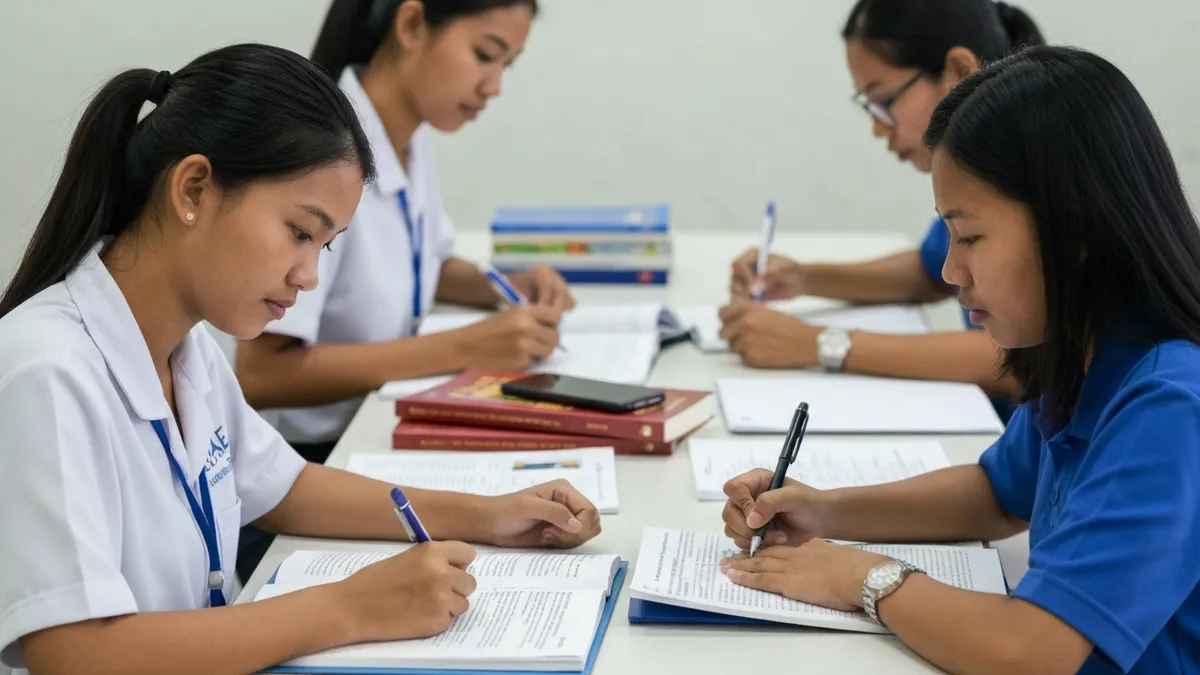
- ✓Review Philippine history timeline from pre-colonial period to present — focus on causes and key figures
- ✓Memorise ASEAN member states, capitals, and the year ASEAN was founded (1967)
- ✓Study the three branches of the 1987 Philippine Constitution and their specific powers and compositions
- ✓Practice reading political and physical maps — identify continents, oceans, major rivers, and climate zones
- ✓Understand the law of supply and demand with simple price-change scenarios
- ✓Know the three economic systems and examples of countries that use each type
- ✓Learn key World War II events in the Philippines: Japanese occupation, Bataan, liberation, and MacArthur
- ✓Take at least two full NCAE practice tests under timed conditions to build exam stamina
- +Industry-recognized credential boosts your resume
- +Higher earning potential (10-20% salary increase on average)
- +Demonstrates commitment to professional development
- +Opens doors to advanced career opportunities
- −Exam preparation requires significant time investment (4-8 weeks)
- −Certification fees can be $100-$400+
- −May require continuing education to maintain
- −Some employers may not require certification
About the Author

Educational Psychologist & Academic Test Preparation Expert
Columbia University Teachers CollegeDr. Lisa Patel holds a Doctorate in Education from Columbia University Teachers College and has spent 17 years researching standardized test design and academic assessment. She has developed preparation programs for SAT, ACT, GRE, LSAT, UCAT, and numerous professional licensing exams, helping students of all backgrounds achieve their target scores.