
NCAE English Reviewer 2026 September — Reading, Vocabulary, Grammar & Language Use
🔎 Pass the NCAE English Reviewer 2026 September exam with confidence. Practice questions with detailed explanations and instant feedback on every answer.
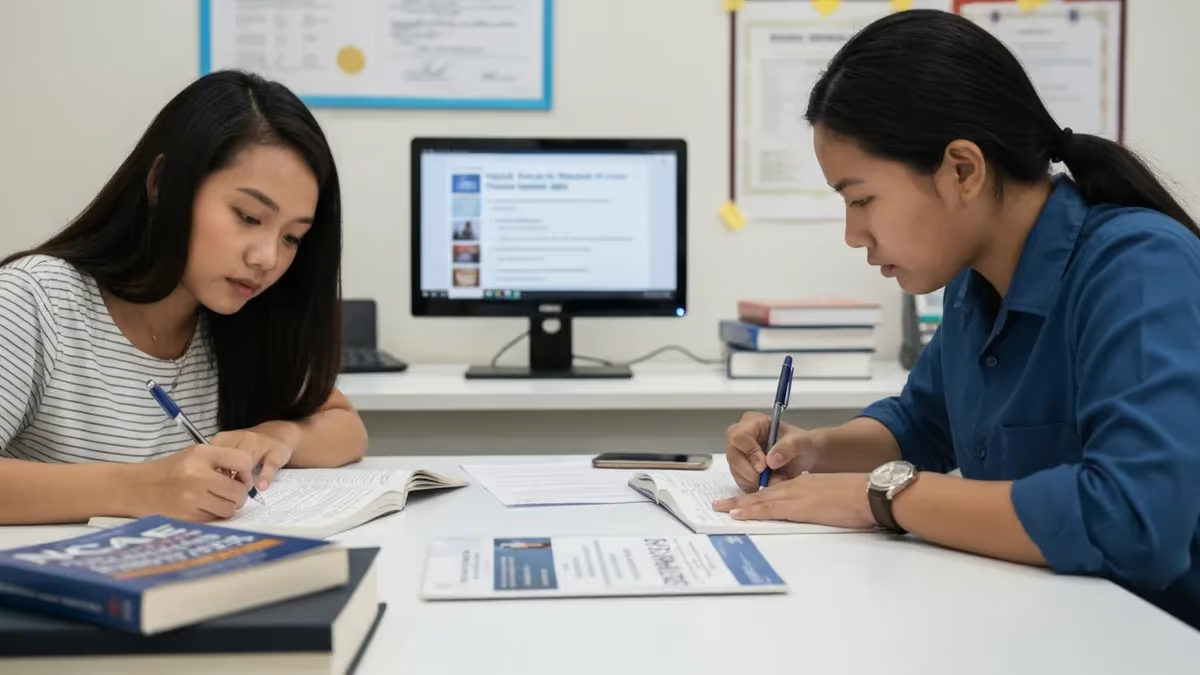
What the NCAE English Proficiency Section Covers
The NCAE English Proficiency subtest evaluates how well Grade 9 students understand and use the English language. It is one of the core subtests administered by the Department of Education (DepEd) as part of the National Career Assessment Examination. The results help guide strand recommendations for Academic Track (Humanities and Social Sciences, STEM, ABM, General Academic) as well as Technical-Vocational-Livelihood tracks.
Strong English proficiency is especially important for students targeting Humanities and Social Sciences (HUMSS) and General Academic Strand (GAS), where reading and communication skills are central. Even STEM and ABM students benefit from a high English score because it contributes to the overall NCAE percentile rank used in SHS admissions.
To measure your current readiness, take a full NCAE practice test before starting your review — this will reveal which English sub-sections need the most attention. If you want a structured plan that covers all NCAE subjects at once, the NCAE Complete Reviewer is an excellent starting point alongside this English-focused guide.
The English subtest is divided into four major areas, each testing a distinct language skill. Understanding what each area covers lets you allocate your study time efficiently.
Study Tips for Each NCAE English Sub-Section
Reading Comprehension Tips
Reading comprehension is the highest-weighted part of the NCAE English subtest. The key to improving your score is active reading — do not simply read passively. Before reading a passage, skim the questions so you know what details to look for. Underline the main idea sentence, usually found in the first or last paragraph of each section.
Practice reading different text types: news articles, science passages, short stories, and informational texts. DepEd materials and Grade 8–9 English textbooks are excellent sources. Aim to read at least one passage per day during your review. When answering inference questions, remember that the answer must be supported by the text — do not add information from your personal knowledge.
For the NCAE practice test, you can simulate real exam conditions by setting a timer of 45–60 seconds per reading question. This builds the reading speed needed on exam day.
Vocabulary Tips
Vocabulary questions on the NCAE test your ability to determine word meaning from context, not just dictionary definitions. Focus on learning high-frequency academic vocabulary — words commonly used in school textbooks across all subjects. Study prefixes (un-, re-, pre-, mis-), suffixes (-tion, -ment, -ful, -less), and Latin/Greek roots (bio-, geo-, chron-, dict-) to decode unfamiliar words during the exam.
Make a personal vocabulary journal: write new words, their meanings, and an example sentence. Aim for 10 new words per day in the weeks before the NCAE. Review all words from the previous week every Monday to reinforce retention.
Grammar Tips
Grammar is rule-based — every rule you memorize earns you direct points. Start with the most commonly tested rules: subject-verb agreement (singular subjects take singular verbs, even when a prepositional phrase comes between the subject and verb), verb tenses (simple past, present perfect, future), and pronoun agreement (everyone/someone/anyone takes a singular pronoun).
For error-identification questions, read each underlined portion and ask: Is the verb tense correct? Is the subject-verb agreement correct? Is the pronoun form correct? Is the preposition correct? Eliminate wrong choices by testing one rule at a time. Pair your grammar review with the NCAE Math Reviewer to balance your overall NCAE preparation schedule.
Language Use Tips
Language use questions test your judgment about how English works in real communication. Study common Filipino-English idiomatic errors (e.g., "I will go to buy" vs. "I will buy") and practice identifying which word choice makes a sentence clearer or more appropriate. For paragraph coherence questions, look for logical flow: does the second sentence logically follow the first? Use transitional words (however, therefore, in addition, consequently) as cues to sentence order.
Review your preparation strategy by reading how to pass the NCAE — it includes a full subject-by-subject breakdown with time management strategies for the entire exam.

NCAE English Study Plan — 6 Weeks Before the Exam
- ✓Week 1: Take a baseline NCAE English practice test to identify your weakest sub-section
- ✓Week 1–2: Study reading comprehension — practice 2 passages daily from Grade 9 DepEd textbooks
- ✓Week 2: Build vocabulary — learn 10 new academic words per day; use a vocabulary journal
- ✓Week 3: Master grammar rules — subject-verb agreement, verb tenses, pronoun agreement first
- ✓Week 3: Practice error-identification grammar questions under 30-second time limits per item
- ✓Week 4: Focus on language use — idiomatic expressions, register, sentence coherence exercises
- ✓Week 4: Review all grammar rules once more using practice sets of at least 20 items per session
- ✓Week 5: Do full mixed-format English practice tests (reading + vocab + grammar + language use)
- ✓Week 5: Review every wrong answer — identify the rule or skill that caused each mistake
- ✓Week 6: Timed full practice sessions only — aim for exam-pace (60–90 seconds per item)
- ✓Final 3 days: Light review only — re-read key grammar rules and vocabulary lists
- ✓Night before the exam: No cramming — rest well; fatigue impairs reading comprehension significantly
- +Industry-recognized credential boosts your resume
- +Higher earning potential (10-20% salary increase on average)
- +Demonstrates commitment to professional development
- +Opens doors to advanced career opportunities
- −Exam preparation requires significant time investment (4-8 weeks)
- −Certification fees can be $100-$400+
- −May require continuing education to maintain
- −Some employers may not require certification
NCAE English Questions and Answers
More NCAE Study Resources
About the Author

Educational Psychologist & Academic Test Preparation Expert
Columbia University Teachers CollegeDr. Lisa Patel holds a Doctorate in Education from Columbia University Teachers College and has spent 17 years researching standardized test design and academic assessment. She has developed preparation programs for SAT, ACT, GRE, LSAT, UCAT, and numerous professional licensing exams, helping students of all backgrounds achieve their target scores.