
NCAE Math Reviewer 2026 September — Key Topics, Formulas & Study Tips
🎓 Prepare for the NCAE Math Reviewer 2026 September certification. Practice questions with answer explanations covering all exam domains.
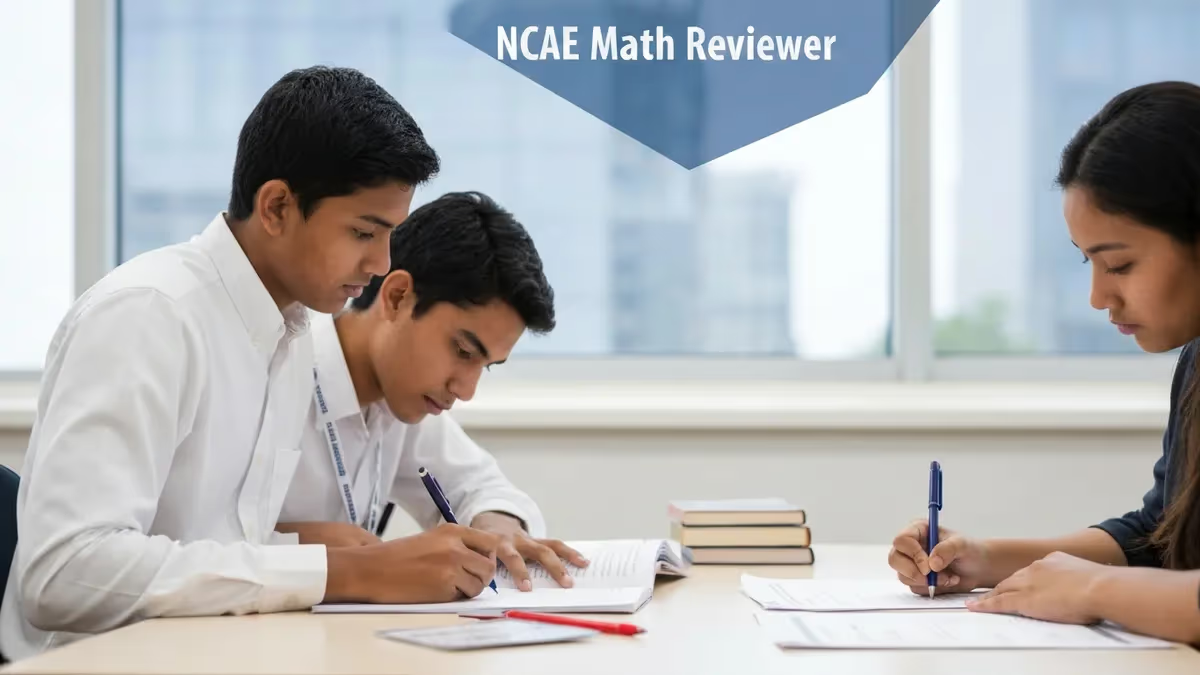
Math Topics Tested in NCAE
The NCAE Mathematical Ability subtest for Grade 9 students covers a broad range of topics from the K-10 curriculum. Understanding the scope of what is tested helps you focus your review time effectively. The exam uses multiple-choice questions that test both computation and conceptual understanding. Students aiming for Science, Technology, Engineering, and Mathematics (STEM) tracks must score especially well on this section. For a full overview of all NCAE subtests, visit the National Career Assessment Examination masterpage.
The Mathematical Ability subtest typically contains 40–60 items covering the following major areas: number sense and operations, fractions and decimals, percentages and ratios, basic algebra, plane geometry, measurement, and data analysis. Each of these areas is equally important, and no single topic dominates the exam. You can practice all of these skills with the NCAE Mathematical Ability practice test, which mirrors the real exam format.

Key Formulas to Memorize Before the NCAE Math Section
Memorizing core formulas saves precious exam time. The NCAE does not provide a formula sheet, so every formula below should be committed to memory before test day. Work through the NCAE Mathematical Ability 2 practice set to apply these formulas under timed conditions. For additional computation practice including ratio and proportion, try the NCAE Mathematical Ability 3 set.
Essential NCAE Math Formulas by Topic
Rectangle: Area = length × width; Perimeter = 2(l + w)
Square: Area = side²; Perimeter = 4 × side
Triangle: Area = ½ × base × height; Perimeter = sum of all sides
Circle: Area = πr²; Circumference = 2πr (use π ≈ 3.14)
Cylinder: Volume = πr²h; Lateral Surface Area = 2πrh
Rectangular Prism: Volume = l × w × h
Pythagorean Theorem: a² + b² = c² (right triangles only)
Sample NCAE Math Question Types with Step-by-Step Solutions
Knowing how to solve NCAE-style problems is just as important as knowing the formulas. The questions below represent the most common item types you will encounter. Notice how each solution shows a clear step-by-step method — this is exactly how you should approach problems on exam day to avoid careless errors. For more practice with NCAE test reading and context questions, also check the NCAE Reading Comprehension practice test, as math word problems require strong reading skills too. Students targeting a Science strand should also review NCAE Scientific Ability and Critical Thinking alongside math preparation.
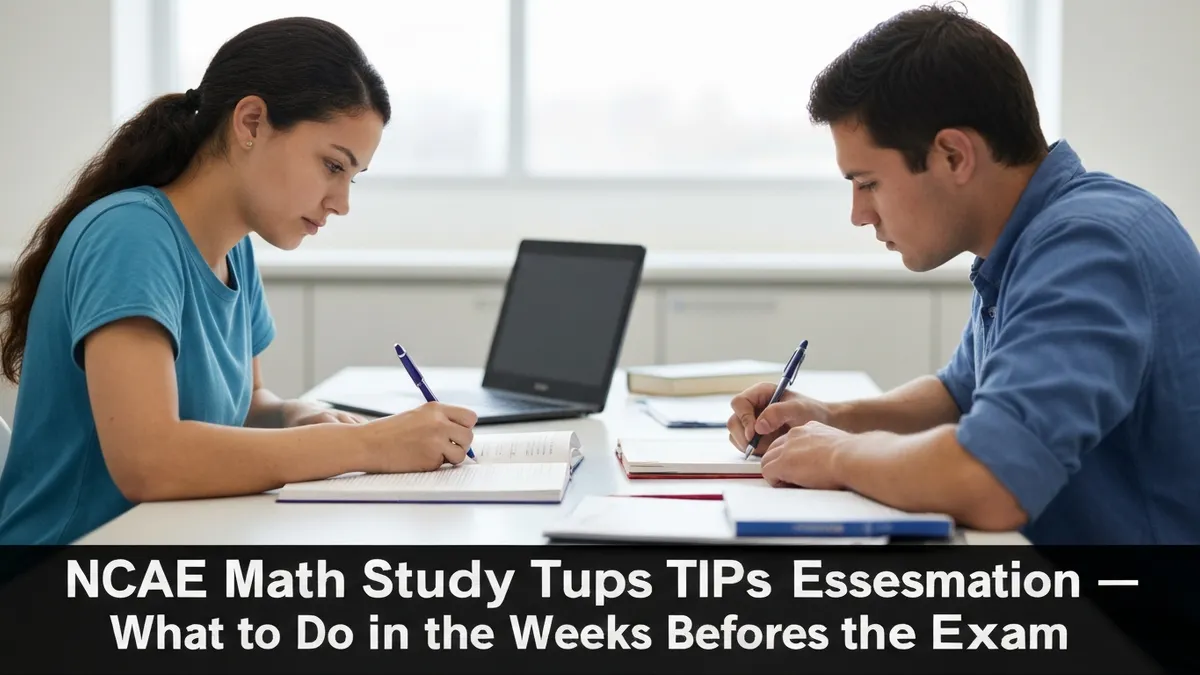
NCAE Math Study Tips — What to Do in the Weeks Before the Exam
- ✓Take a diagnostic NCAE Math practice test first to identify your weakest topics
- ✓Review arithmetic and fractions daily — these are the fastest points to gain
- ✓Memorize all geometry formulas on a flash card and quiz yourself each morning
- ✓Solve at least 10 word problems per day focusing on percentage and ratio questions
- ✓Practice setting up algebra equations from word problems — not just solving them
- ✓Use real NCAE-style practice tests timed at 1 minute per item to build exam speed
- ✓Review your wrong answers after every practice set and identify the exact error made
- ✓Study statistics graphs and tables — interpret them without re-reading the question
- ✓On the final week, do full timed practice sets only — no new topics
- ✓Sleep 8 hours the night before the NCAE — fatigue cuts math performance by up to 20%
How the NCAE Math Score Contributes to Strand Recommendations
The NCAE results are used by the Department of Education (DepEd) to guide Senior High School (SHS) strand selection for every Grade 9 student in the Philippines. The Mathematical Ability subtest directly influences recommendations for the following strands: STEM (Science, Technology, Engineering, and Mathematics), ABM (Accountancy, Business, and Management), and Technical-Vocational-Livelihood (TVL) tracks that require numerical aptitude. For practice covering the career aptitude components, explore the NCAE SHS Track Aptitude Assessment quiz set.
A strong score in Mathematical Ability alone does not guarantee a STEM recommendation — the NCAE also weighs your General Scholastic Aptitude, Scientific Ability, and Occupational Interest Inventory. However, students who score in the upper quartile of the Math subtest are significantly more likely to receive a STEM or ABM recommendation. For a complete exam overview that ties all sections together, read the How to Pass the NCAE Exam in 2026 guide. You can also download official review materials via the NCAE Practice Test Questions and Answers PDF.
- +Validates your knowledge and skills objectively
- +Increases job market competitiveness
- +Provides structured learning goals
- +Networking opportunities with other certified professionals
- −Study materials can be expensive
- −Exam anxiety can affect performance
- −Requires dedicated preparation time
- −Retake fees apply if you don't pass
NCAE Math Questions and Answers
More NCAE Study Resources
About the Author

Registered Nurse & Healthcare Educator
Johns Hopkins University School of NursingDr. Sarah Mitchell is a board-certified registered nurse with over 15 years of clinical and academic experience. She completed her PhD in Nursing Science at Johns Hopkins University and has taught NCLEX preparation and clinical skills courses for nursing students across the United States. Her research focuses on evidence-based exam preparation strategies for healthcare certification candidates.