
Ncae Meaning: What the National Career Assessment Examination Is and Who Takes It
🎓 NCAE means National Career Assessment Examination, DepEd's computer-based test for Grade 9 and 10 learners. See key facts, format, dates and prep tips.
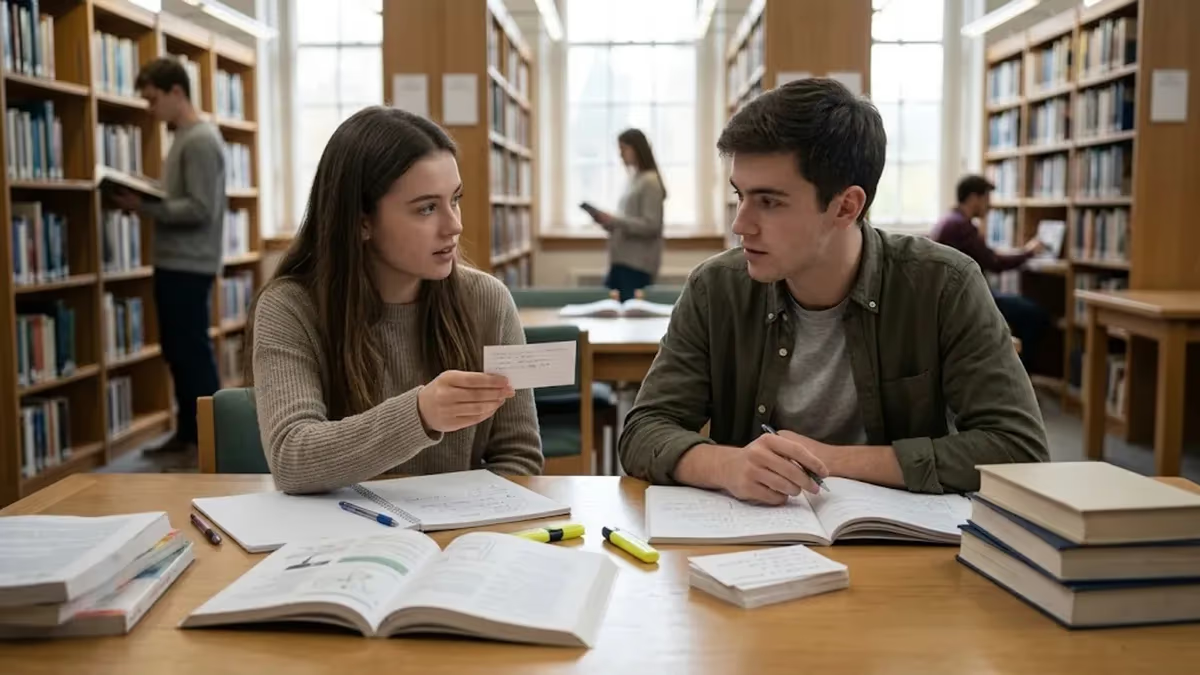
NCAE stands for National Career Assessment Examination, a Philippine Department of Education (DepEd) test that measures Grade 9 and Grade 10 learners' abilities and career interests. The ncae meaning is practical: it is a guidance tool that helps students choose a senior high school track, such as academic, technical-vocational, sports, or arts and design.
Ncae Meaning: Key Facts (Updated October 2026)
| Fact | Details | Source |
|---|---|---|
| Full name | National Career Assessment Examination (NCAE), a career-guidance assessment for school learners | Department of Education (DepEd), Philippines |
| Delivery | Computer-based (CB-NCAE), delivered through the DepEd Learning Management System (LMS) | DepEd Dasmariñas, DM No. 754, s. 2026 |
| Who takes it (SY 2026-2027) | Qualified Grade 9 and Grade 10 learners in public schools and government-recognized private schools | DepEd Bulacan, Division Letter No. 93, s. 2026 |
| Grade 10 Technical Assessment pause | Temporarily suspended September 24 to October 11, 2026 (BEA Advisory No. 022, s. 2026) | DepEd Dasmariñas, DM No. 754, s. 2026 |
| Grade 10 Technical Assessment resumption | Officially resumes October 12 to 30, 2026 | DepEd Dasmariñas, DM No. 754, s. 2026 |
The table shows that the exam is now computer-based, and that changes how students should prepare. Older NCAE versions used paper booklets, but the CB-NCAE runs through the DepEd Learning Management System. Learners who want to rehearse the format can start with an ncae practice test that mirrors the question types, the timing pressure and the on-screen answering. Practicing on a screen first removes the surprise factor, so test day feels routine rather than stressful.
Breaking the acronym apart makes the ncae meaning easier to remember. National signals that DepEd designs one common instrument for the whole country. Career points to the goal of matching learners with future pathways rather than ranking them against classmates. Assessment tells you it measures current skills and interests instead of mastery of a single syllabus. Examination simply notes the formal, scheduled, supervised setting. Together, the four words describe a nationwide, supervised diagnostic that informs counseling decisions.
The exam usually covers two broad areas: scholastic ability and career-related interests. The scholastic part checks skills such as verbal and numerical reasoning, abstract and logical reasoning, and general knowledge in subjects like science, math and language. The interest part asks which kinds of activities a learner enjoys, such as working with tools, people, data or ideas. Counselors combine both pieces to suggest tracks where a student's strengths and personal preferences line up with real school offerings.
For School Year 2026-2027, DepEd extends the CB-NCAE to qualified Grade 9 and Grade 10 learners from public schools and private schools with government recognition. That means a student attending an unrecognized private school may not be scheduled through the same channel. Parents should confirm with the school registrar or guidance office, because schools typically receive the schedule, access instructions and testing arrangements through their division offices rather than through any individual student registration process.
Timing matters this month. According to BEA Advisory No. 022, s. 2026, the Grade 10 Technical Assessment (Pre-Test) was temporarily suspended from September 24 to October 11, 2026. Testing officially resumes from October 12 to 30, 2026, so the window is open right now. Grade 10 students who missed a session during the pause should ask their guidance counselor which rescheduled slot applies to their section before the window closes at the end of October.
A common misunderstanding is that NCAE works like a pass-or-fail entrance test. It is not designed that way. The results are intended to guide placement conversations, so there is no cut score meant to bar anyone from senior high school. Even so, honest effort still pays off: careless answers produce a misleading profile, and a misleading profile can steer a student toward a track that feels wrong two years later. Treat the exam as a mirror, not a gate.
What Are the Key Numbers Behind the Ncae Meaning?

What Does the NCAE Measure in Grade 9 and Grade 10 Learners?
Measures general academic readiness through verbal, numerical and general knowledge items. These questions show how comfortably a learner handles reading, math and science concepts at their grade level, giving counselors a baseline for academic-track suitability and a common national yardstick across participating schools.
Tests how well a learner spots rules in patterns, shapes and sequences without relying on memorized lessons. Strong reasoning supports technical work, programming and problem-solving careers. Short practice sessions make a visible difference by teaching you to find the rule first and verify each option second.
Asks what kinds of activities you enjoy, such as building, helping, organizing, creating or analyzing. There are no right or wrong answers, only honest ones. Counselors translate your pattern of preferences into career families that point toward strands likely to keep you motivated for two full years.
Part of the Grade 10 cycle in School Year 2026-2027, officially resumed October 12 to 30 after a temporary pause. It supports guidance for technical pathways. Content details come from DepEd, so rely on school announcements instead of rumors, old screenshots or unofficial group-chat summaries.
What Is the NCAE Test for Grade 10 Learners in the Philippines?
The NCAE for Grade 10 learners is the same National Career Assessment Examination, delivered to students who are about to choose a senior high school pathway. In the Philippines, DepEd's Bureau of Education Assessment oversees national assessments, and the CB-NCAE is one of them. Grade 10 students take it because their next decision, which track and strand to enter in Grade 11, is exactly the one the results are designed to inform.
For School Year 2026-2027 the Grade 10 session includes a Technical Assessment, labelled a Pre-Test in the official advisory. Whatever the label suggests, treat it seriously. Responses gathered here serve the same career-guidance purpose as the rest of the cycle, so arriving rested, on time and focused is still the sensible approach for every learner. If you are unsure what the Pre-Test label means for your section, ask your guidance counselor directly.
Some families type unusual spellings into search engines, such as encae or incae, when they hear classmates mention the test. Those are simply typing variants of NCAE, and they point to the same DepEd exam. There is no separate ENCAE or INCAE high school test. If a website claims to sell an official INCAE reviewer, treat that claim with caution and verify it against a DepEd memorandum or your school's guidance office before paying anything.
Learners asking what is nca in the context of Grade 10 will find the fuller walkthrough in our Grade 10 reviewer, including subject coverage, sample questions and a four-week study plan. Use it after you finish this overview, because the reviewer assumes you already understand why the exam exists and how counselors use its results when they sit down with families to discuss tracks.
Because the exam is computer-based, logistics differ from the paper era. Each learner needs a working device slot, a stable connection and a login handled by the school. Students typically do not set anything up themselves; teachers or ICT coordinators prepare the room. If your school lacks devices for everyone, expect sessions to be split across days, which is one reason the October 12 to 30 window is long rather than a single date.
Grade 9 learners are part of the same cycle. Under the SY 2026-2027 eligibility rule, both Grade 9 and Grade 10 students in qualified schools can be scheduled. A Grade 9 student therefore gets an early look at personal strengths, giving a full year to explore subjects, clubs and short work exposures before the final track decision. Parents of younger teens should view early results as a conversation starter, not a verdict about the future.
Finally, remember what the exam is not. It is not a college admission test, it does not award a diploma and it does not replace report-card grades. For readers in the United States, the closest comparison is a career interest and aptitude inventory used by school counselors in middle or early high school. The purpose is the same: help a teenager see which pathways fit before committing time, effort and sometimes money to one of them.
Is NCAE the Same as NCAA, GCSE, Versant or an LLN Test?
The two acronyms differ by one letter and nothing else. NCAA is the National Collegiate Athletic Association, the US body behind college sports, so people searching ncaa wrestling championships, ncaa wrestling brackets or ncaa wrestling rankings want tournament coverage, not a Philippine career exam. The same goes for ncaa volleyball bracket, ncaa hockey rankings, ncaa softball scores and ncaa playoffs queries, all of which belong to athletics fans and have nothing to do with DepEd or career guidance.
NCAE, by contrast, ends with E for Examination and is a school-guidance assessment for Grade 9 and Grade 10 learners. It involves no teams, seeds or brackets, and nobody wins a title. If you landed here looking for ncaa wrestling or other college sports results, check an athletics source instead. If you are a student, parent or teacher in the Philippines, you are in the right place and can keep reading for exam facts.
Is the Computer-Based NCAE Better Than the Old Paper Format?
- +Learners see a clear profile of strengths and interests before choosing a track
- +Delivery through the DepEd LMS standardizes the experience across participating schools
- +Results give counselors information beyond report-card grades
- +Practicing on a screen builds comfort for later digital exams
- +It is a guidance tool rather than a pass-or-fail gate, so pressure can stay low
- +A long testing window gives schools flexibility to reschedule sections
- −Schools with few computers may struggle to seat every learner on time
- −An unstable internet connection can interrupt a session and frustrate students
- −Schedule changes, like the September suspension, can confuse families
- −Unofficial reviewers circulate online and may mislead students
- −One test day cannot capture every talent or a changing interest
- −Students unfamiliar with computers may be slower at first
How Do You Prepare for the NCAE Step by Step?
- ✓Ask your guidance counselor for your section's exact test date.
- ✓Confirm that your school is a qualified public or recognized private school.
- ✓Practice 20 to 30 minutes a day for two to four weeks.
- ✓Do at least ten practice sessions on a screen, not on paper.
- ✓Learn to name the rule in a pattern before checking the options.
- ✓Answer interest questions honestly, not to impress anyone.
- ✓Sleep seven to nine hours the night before the exam.
- ✓Eat breakfast and arrive early on test day.
- ✓Raise your hand at once if the computer freezes or logs you out.
- ✓Book a counseling meeting after the exam to discuss tracks.
It is a guidance profile, not a pass-or-fail grade
Once you know that NCAE means National Career Assessment Examination, you can stop preparing like it is an entrance test and start preparing like it is a mirror. Honest answers produce a useful profile, and a useful profile leads to better track advice.
What Is the Meaning of NCAE Results for Choosing a Track?
The meaning of NCAE results is best understood as a profile rather than a single grade. A learner receives information about scholastic strengths and interest areas, and school counselors read these together. For example, a student with strong numerical reasoning and a high interest in working with machines might be steered toward a technical-vocational pathway, while another with strong language skills and an interest in people might consider an academic strand.
Interpretation always happens in context. Counselors compare NCAE information with report-card grades, teacher observations, family circumstances and local opportunities such as nearby schools that offer a given strand. A result that looks mismatched is not an error; it may signal that a student has untested interests. Good counseling treats the gap as a prompt for questions, like whether the learner has had enough exposure to that field to judge it fairly.
Timing is part of preparation too. If you are unsure when your section will sit the exam, check our guide on ncae test date: when is the ncae and how to prepare, which tracks schedules and lays out what to review beforehand. Dates differ by division and sometimes by school, so use the guide for orientation and your guidance office for the final word on your own session.
Parents often ask whether low numbers should worry them. The honest answer is that a lower score in one area only describes performance on that day and on that style of question. Fatigue, nerves, screen unfamiliarity or a slow connection can depress results. Instead of panicking, look at patterns across several areas and then talk with the counselor about whether extra practice, tutoring or exposure activities make sense for your teenager, rather than reacting to one number in isolation.
Students also benefit from writing down their own expectations before seeing results. Jot three careers you imagine, two subjects you enjoy and one you avoid. When the profile arrives, compare it with that note. Agreement builds confidence; disagreement reveals blind spots worth exploring. This simple habit turns a passive report into an active reflection exercise and makes the counseling meeting far more productive for both the learner and the adult across the table.
Keep in mind that senior high school tracks have their own admission realities. Popular schools may limit slots in certain strands, and some technical-vocational programs require specific tools, uniforms or workshop fees. NCAE guidance cannot guarantee a seat. What it can do is help you create a first choice and a realistic second choice, so you are not scrambling when enrollment opens and the preferred strand is already full.
Last, results should never be used to label a teenager permanently. Interests shift between ages fourteen and seventeen, and skills grow fast with practice. Many adults work in fields unrelated to their early test profiles. Use the NCAE as one data point on a long journey, revisit it with a counselor each year, and stay curious about options that did not appear in the first report you received. Growth is normal, and so is changing your mind.

The Grade 10 Technical Assessment was suspended from September 24 to October 11, 2026, then resumed on October 12 to 30, 2026. Schools schedule sections inside official windows, so always confirm your own date, room and login steps with the guidance office before test day.
What Does the NCAE Technical Assessment Mean for Senior High School Tracks?
The Technical Assessment is the part of the Grade 10 cycle that the latest advisory addresses. After a pause from September 24 to October 11, 2026, DepEd confirmed that it officially resumes October 12 to 30, 2026. Because the notice came through BEA Advisory No. 022, s. 2026 and was echoed by division offices, schools are expected to schedule affected sections inside that window and tell families which day applies to each class. Watch your adviser's announcements.
Why does a technical component matter? Technical-vocational-livelihood learners work with tools, trades and practical outputs, so counselors need evidence beyond academic reasoning. A technical assessment helps point toward specializations such as ICT, home economics, industrial arts or agri-fishery. The exact content is set by DepEd and may change from year to year, so rely on current school announcements instead of old reviewers or screenshots circulated in chat groups.
That leads to a warning about unofficial material. Many learners who search what is the nca end up on Google Sites pages and social posts that claim to share the real questions. DepEd does not publish live test items, so such claims are unreliable. The safest approach is practicing skills with clearly labeled practice questions instead of memorizing supposedly leaked answers that may be wrong, outdated or invented.
For Grade 10 students aiming at TVL, a few habits help. Review basic measurement, reading of diagrams and simple computations, since practical work depends on them. Practice following multi-step written instructions precisely, because workshop tasks reward accuracy. Finally, get comfortable with on-screen drag, select and scroll actions. Technical items are often visual, and wasting time on controls is an avoidable handicap during a timed computer session.
Academic-track hopefuls should not skip the technical component either. A learner planning for STEM, humanities or business may discover unexpected strengths in practical reasoning. Likewise, a student aiming for arts and design can find spatial and visual reasoning questions surprisingly relevant. Approaching every part with equal effort gives counselors a more complete picture, and it keeps future options open instead of narrowing them based on one early assumption. Many learners change strands after discovering a skill they never knew they had.
Schools handle makeup sessions differently. If you were absent during the suspension, or if a technical failure interrupted your attempt, tell the guidance counselor immediately and in writing if possible. Include the date, the section and what happened. Quick, polite communication usually gets a learner placed into a later slot within the October window, while silence until the final week risks running out of available computer time and leaves the counselor with no room to help.
Teachers and parents can help in small ways. Confirm that the learner knows the room, time and login procedure; remind them to bring any required ID; and avoid heavy cramming the night before. Sleep and breakfast raise attention more than a late-night study sprint. A calm learner reads each question slowly, which is the biggest single factor in accurate responses on any reasoning-based assessment. Rushing through easy items often costs more points than missing a hard one.
How Should You Prepare for the NCAE Before Test Day?
Start by building a simple routine: twenty to thirty minutes a day beats a weekend marathon. For two to four weeks, rotate between verbal reasoning, numbers, abstract patterns and interest reflection. Short, regular sessions let the brain consolidate patterns, which matters most for abstract and logical reasoning items. Keep a notebook where you log each session, the topic, your confidence and the mistakes you made, so you can see real progress.
Next, practice on a screen. Open a free set of questions on a laptop or school computer, set a timer and answer without pausing. Notice how it feels to scroll, select and review. If you only practice on paper, the first minutes of the real exam will spend attention on interface habits. Ten screen-based sessions are enough to remove that friction for most students, and they cost nothing but time.
For reasoning questions, learn to identify the rule before checking the answer choices. In a number or shape sequence, ask what changes between steps: size, position, rotation, count or color. Write the rule in a few words, then test each option against it. This method beats guessing and works under time pressure. If a question still resists after about a minute, mark it, move on and return with fresh eyes.
For the interest inventory, there is no right answer, so avoid trying to guess what looks impressive. Answer based on what you enjoy doing on a free afternoon, not what a relative wants for you. Honest answers yield a profile that matches the real you. It can help to answer in one sitting, trusting your first reaction, because overthinking tends to produce flattering responses that blur the signal counselors rely on.
Handle test-day basics. Sleep seven to nine hours, eat breakfast, arrive early and bring whatever your school requires, such as a student ID. Silence phones as instructed. If the computer freezes, raise your hand right away instead of waiting. Proctors can resolve many glitches quickly, and reporting a problem promptly protects your answers and your time budget. Staying calm during a hiccup is a skill worth rehearsing, and a deep breath costs only seconds.
Use official information as your anchor. Check DepEd memoranda and your division website for dates, since the schedule changed this season. Guides like ours can supplement that, but they never replace a school announcement. When you hear a rumor in a group chat about new rules, ask the guidance counselor before changing how you prepare or what you bring. One confirmed answer is worth more than ten forwarded messages, and counselors are glad to be asked.
Finally, plan for after the exam. Book a counseling conversation, bring questions about tracks and strands, and visit the senior high schools on your list if you can. Ask about workshop facilities, strand availability and entry requirements. The exam itself lasts only a session or two, but the decisions it supports shape the next two years, so invest at least as much effort in the follow-up as in the preparation.
NCAE Questions and Answers

NCAE (National Career Assessment Examination) Test Prep

NCAE Practice Test on Google Sites: Are Those Reviewers Reliable? (2026 Guide)

NCAE Reviewer for Grade 10 (2026): Subjects, Sample Questions and a 4-Week Study Plan

NCAE Test Date: When Is the NCAE and How to Prepare
NCAE Vocational Aptitude Reviewer 2026 — TVL Track Guide

NCAE Schedule 2026 — When Is the National Career Assessment Examination?
NCAE Social Science Reviewer 2026 — Araling Panlipunan
About the Author

Educational Psychologist & Academic Test Preparation Expert
Columbia University Teachers CollegeDr. Lisa Patel holds a Doctorate in Education from Columbia University Teachers College and has spent 17 years researching standardized test design and academic assessment. She has developed preparation programs for SAT, ACT, GRE, LSAT, UCAT, and numerous professional licensing exams, helping students of all backgrounds achieve their target scores.